Quotulatiousness

November 9, 2026

“[T]he world of the Starship Enterprise serves as warm pablum to comfort the thinking Boomer”

Filed under: Media, Technology, USA — Tags: , , , , , , — Nicholas @ 05:00

“My” Star Trek was the original series … in after-school reruns, because it was off prime time schedules by the time I was paying attention (Generation Jones really didn’t experience the Boomer world except in re-runs). But the TV show and its many, many successors have a cultural weight that the original TV show didn’t in its own time. On Substack, Tom Swift calls out the soothing boomer themes of the original show and contrasts it to later — and in his belief, better — science fiction treatments:

For nearly a half-century, Star Trek has been the thinking man’s vision of what society will one day become. This world is one of peace, prosperity, where scarcity is but a distant memory. Yet upon closer investigation, the world and characters depicted therein seem to violate every law of human nature.

Aliens are barely modified versions of ourselves, yet without many of the negative qualities thereof. One must suspend belief in even the rudiments of biology to believe that a human-alien hybrid could exist. Economics is barely mentioned, and there are occasional references to a guaranteed living. How that has not led to sclerosis of institutions and lack of motivation within the Federation is never explained. Little of the world outside the ship is shown. The number of children depicted is not nearly sufficient to explain the spread of mankind across the galaxy. In short, the world of the Starship Enterprise serves as warm pablum to comfort the thinking Boomer; it provides a future with clear technical advances yet enough familiarity to allow him to sleep at night and forget any transitory qualms in the morning.

Science fiction offers unlimited horizons for the imagination, yet the derivative nature of the Hollywood franchise has greatly limited its potential. However, there are a few notable exceptions, which have for the most part originated from independent works of literature. We shall now investigate three science fiction films which may portray the future far more accurately.

The looming end of secure encryption

Secure encryption is one of those background utilities we all depend on, like plumbing and sewers: it only comes to our attention when something is going wrong. David Clinton says that things are going wrong with encryption standards, thanks to the technical omnicause, artificial intelligence:

Without secure encryption, we’ll all be living dangerously

This topic has a guaranteed boredom score of 12 (where “10” represents catatonic). But its could make a difference to my own life score is 15 (where “10” represents “Yikes!”).

Data encryption is the peg on which the possibility of all modern financial and healthcare-related activity hangs. Without standard encryption algorithms like AES and RSA:

  • The contents of every exchange of information between you and your bank’s website would be visible to anyone on the internet.
  • The passwords you use to authenticate to your digital accounts would be readable by anyone with access to any node between you and your account’s host.
  • The sensitive data stored by any financial, healthcare, or government organization would be visible to anyone with access to their host systems — access made possible by decrypted passwords (see above).

Encrypted data contains all the original information. But its value lies in the assumption that the underlying algorithm is so complex that it would require the use of powerful computers and hundreds of years to crack it.

For the past 50 years, that assumption has held up well. But the theoretical existence of quantum compute resources — which can execute exponentially more compute operations than traditional processors — presents a theoretical threat to existing algorithms.

In other words sometime within the next 10-20 years, quantum compute devices will be powerful enough to brute-force the end of modern encryption. That sounds scary.

But it’s arguably not even the real problem. That, as Tyler Cowan recently wrote in the Free Press, would be the recent explosion of AI-driven discoveries in mathematics. Such events have introduced concerns about the odds encryption security could be compromised in months rather than years.

Frontier AI models are now at least making progress solving longstanding mathematical problems. The pace of discovery seems to be growing and it seems inevitable that someone somewhere will turn a powerful AI model on the algorithms we rely on.

Writing history … or “history”

Filed under: Books, Britain, History — Tags: , , — Nicholas @ 03:00

Historiography is difficult, because the people who write histories are not just fallible human beings who make mistakes, but they have all the particular weaknesses and failings of human beings. They might be pushing an agenda, they might be trying to hide their own biases, they may favour “what should have happened” over “what actually happened” … or they could just be lazy. On Substack Notes, Medieval Realms shares an example from last century:

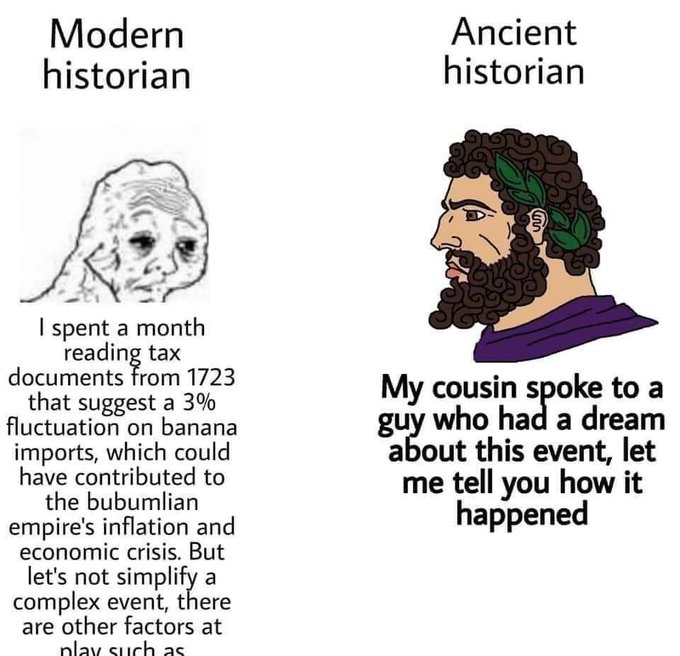
Ancient historians were not limited to mere evidence (not part of Medieval Realms’ original post).

Some of you may have noticed I tend to question popular narratives of medieval battles. I’m not trying to score cheap points, but it is a fact that the evidence often fails to match up. The following is another example.

In November 1294 a series of revolts were raging in Wales. Two battles were supposedly fought, at Denbigh and Builth.

The battle at Builth comes from John Morris, writing circa 1900. He was a grammar school teacher and academic historian, whose best-known work is The Welsh Wars of Edward I. This was the first study to make thorough use of contemporary records held in the Public Record Office.

In his book, Morris wrote:

    John Giffard organised a relieving force of ten knights, twenty troopers and forty light horse, who made five attempts to cut their way through to the castle [at Builth], and were finally successful about November 12.

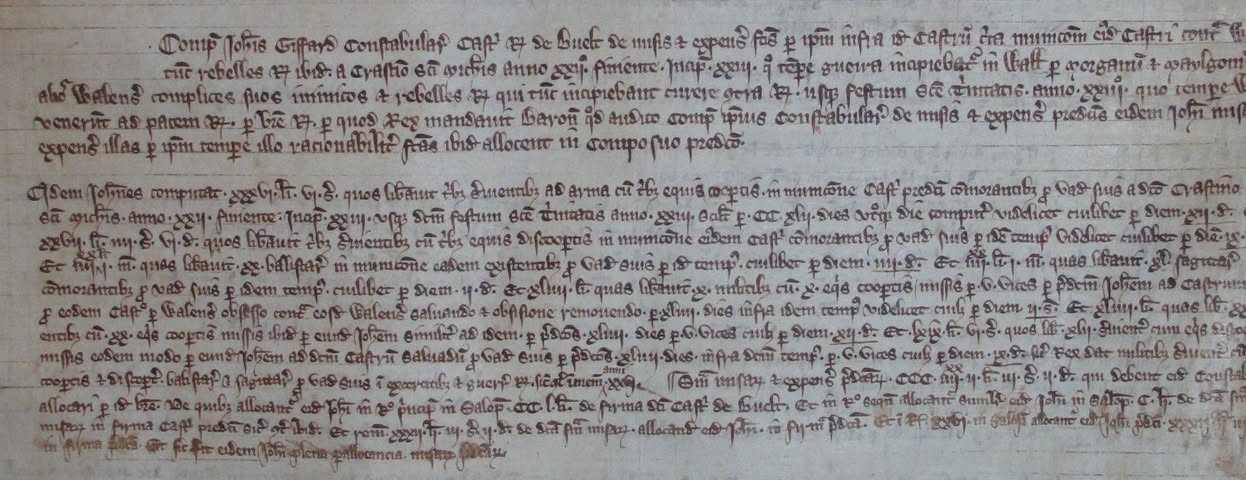
In his footnotes, Morris quoted the attached document. I recently had this translated. The preamble reads:

    Account of John Giffard, constable of the castle of Builth, of the wages and expenses made by him in the custody of the said castle and in the capture of various rebels and thieves in those parts.

This is followed by a set of expenses, totalling £65 10 shillings 8 pence.

There is no mention of Giffard having to cut his way through Welsh siege lines, or anything so dramatic. He was being paid to garrison Builth and deal with “various rebels and thieves”.

Obviously, it is no easy task to extract medieval documents and compare them to modern accounts. But we should make the effort, where possible.

How to Make Reproduction Guns (And How Not To)

Filed under: History, Military, USA, Weapons — Tags: , , , — Nicholas @ 02:00

Forgotten Weapons
Published 10 Jul 2026

Since I continue to get a lot of questions about reproductions, I figured I’d devote today’s video to looking at different elements that go into producing reproduction firearms. Why some work out and some don’t.
(more…)

QotD: Robert E. Lee

Filed under: History, Military, Quotations, USA — Tags: , , , — Nicholas @ 01:00

This isn’t a classroom. And it’s not your Ivy League syllabus. I’m not here to cherry pick history to fit your comfort level. This page isn’t about preserving feelings. It’s about preserving truth.

You’re going to learn about all kinds of Americans here. The brilliant. The broken. The brutal. The redeemed.

And yes, today, that includes Robert E. Lee. One of the finest battlefield commanders to ever walk the face of the earth.

But this post isn’t really about Lee. It’s about what’s coming if you don’t wake up and understand ALL of the American condition, not just the parts you like. And what history refuses to let us forget.

Spare me your pearl clutching cries of “traitor”. You want only the parts of the American experiment that make you feel good? Too bad. Battle it out in the comments.

You don’t get to cherry pick the Republic. You’re going to get all of it: the glory, the grief, the blood, the brilliance.

Because believe it or not, that’s how we heal this ridiculous divide. Not by erasing history. By facing it, whole.

Lee was mythic in his own time, and while still in uniform no less. I can count on one hand the number of military leaders in world history who held that kind of gravity.

His mere presence on the battlefield moved thousands. His men believed he rode with God. And his enemies feared he commanded the wind. Why?

Because Lee was the perfect storm of lethal factors, a man forged in pressure, faith, and brilliance: He possessed a battlefield mind that bent terrain, timing, and psychology to his will.

He spoke softly, but carried the moral weight of a holy man, which made others fight for him as if fighting for something divine. He was the living embodiment of a region’s grief, pride, and wrath.

He never had to scream. His silence made others move. The most dangerous man in any war is the one who didn’t want it, until you gave him no choice. Lee was that man. And that’s why he was so effective.

You want to understand Lee? Then understand the war he fought in. Don’t give me another surface level take about rifled muskets and outdated tactics. That’s not why it was the bloodiest war in our history.

The Civil War was decades in the making. The riots. The compromises. The moral rot no one wanted to confront until it swallowed the whole nation.

It was what happens when generations ignore the pressure, until it explodes. And when it did, men like Lee, Sherman, and Grant emerged. They didn’t crawl out of textbooks. They rose out of chaos, because the times demanded them.

Half of you are begging for civil war now, without the faintest idea what that would mean. You think GWOT was bad? You cry over civilians killed in drone strikes?

That horror would pale next to a war of brother against brother, of neighborhoods torn apart by blood and belief. Because you end up hating someone exactly as much as you once loved them. And how much more do you love your fellow countryman than some stranger in a foreign land?

And here’s what you don’t see: Those archetypes, the Lees, the Shermans, the Grants? They already live among you. Quiet. Unknown. Watching.

You think they’re extinct? They’re not. They’re waiting.
And if the hate keeps boiling, they won’t stay unknown for long.

So yes, on this page, you will hear their names. You will study their victories and their sins. And I won’t soften the blow of reality just to make you feel better.

Because history doesn’t need your approval. It needs your attention.

The lesson? No war is more brutal than the ones we fight with ourselves. And no man is more dangerous than the one who wanted peace … until you gave him no other choice. That’s what the Civil War was. And that’s what you’re playing with now.

So keep screaming in the comments. Just know you’re screaming at the future you’re helping create.

“InfantryDort”, Twitter, 2025-05-18.

Powered by WordPress