
A Defence White Paper is a high level policy document outlining the role of the armed forces. Harold Wilson implemented the 1966 Defence White Paper because he was suspicious of empire and needed defence cuts. It stated the armed forces:
- Would not undertake any major military operations alone. Major operations would always be as a member of a coalition;
- Top priority was supporting NATO; and
- Would not conduct warfighting Operations outside of Europe at all. There were exceptions for a few remaining imperial commitments, all of which wound up by 1970. All other operations outside of Europe would be at less intensity than warfighting and not above the battalion level.
TLDR: The British Empire is over. We are now a NATO contributor and the armed forces only exist to fight in Europe.
Within the next three years the new fleet carrier program was scrapped as part of a general downsizing of the Royal Navy, there was a strategic withdrawal (nothing remaining beyond minimal local garrisons) of British military presence east of Suez, new aircraft programs were cancelled and the RAF was downsized.
[…]
The role of the British Army was home defence and providing a Corps to fight the Warsaw Pact in West Germany (The British Army of the Rhine or “BAOR”). The role of the RAF was home defence and supporting the BAOR. The role of the Royal Navy was keeping NATO’s shipping lanes in the North Atlantic open (to supply the homeland and the BAOR) and operating missile submarines for nuclear deterrence. In 1972 the role of the Royal Marines became deploying a brigade to reinforce northern Norway in the event of war with the Soviet Union.
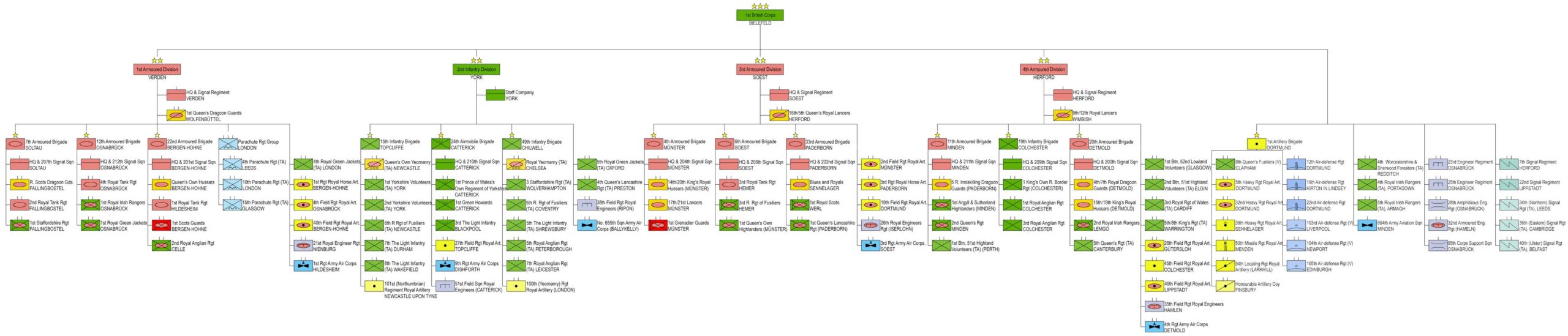
The BAOR always maintained an impressive organisation. Seen here is the 1989 ORBAT of its manoeuvre element.
The Impact of the 1966 White Paper
The 1966 Defence White Paper had two primary flaws. First, it defined the role of the military as confined to Europe when Britain still had global interests and possessions. Second, it remained in place right up to the eve of the Falklands War.
None of the roles for the service branches involved power projection and its incumbent logistic support outside of Europe. This meant over the next 16 years any capability for power projection further than Norway or Germany would not receive funding.
The rule that all major operations would be fought in a coalition meant any capability that supported operational and strategic level command outside the NATO structure would similarly wither on the vine from lack of funding.
This would have been acceptable if Britain only maintained regional interests, but she retained global interests (a large portion of her economy relying on global maritime trade). She also retained some global possessions (such as the Falklands, but also non-European outposts like Hong Kong and Diego Garcia). This meant British military capabilities were geographically smaller than the scope of threats against her core interests.
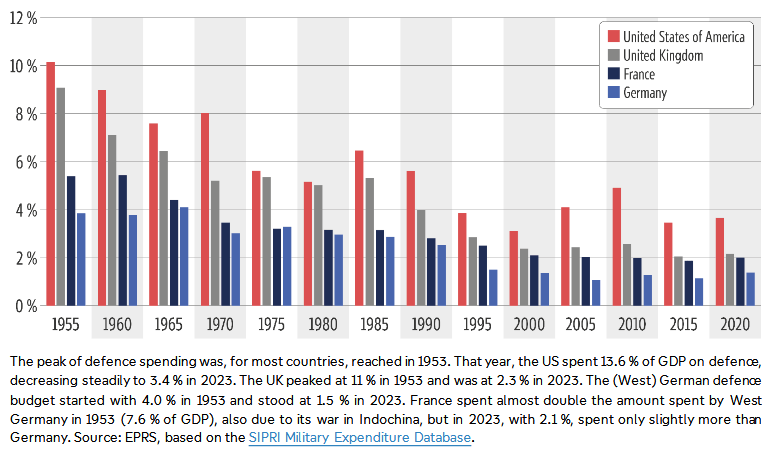
The issue wasn’t simply a lack of defence spending. As you can see from the graph below, British defence spending fell from 7 to about 5% of GDP between 1960 to 1970, but it was then stable around 5% for the 1970s and 1980s. In the decade leading up to the Falklands war by GDP British defence spending was equal to the United States and significantly higher than France and Germany. The issue was were defence spending was allocated, and after 1966 it wasn’t allocated to global power projection.
This mismatch of resources to threats to national interests would not have caused much damage if it was corrected quickly. Since WW2 the UK has generally published a defence white paper every 5-10 years. Prior to WW2 they didn’t have the term, but British national level military strategy was certainly debated and updated at the government level at least every decade. Despite this trend, 1966 White Paper lasted 16 years.
The next white paper was not published until 1981. This would have seen Britain’s carrier and amphibious capability scrapped or sold off in 1982-83. Fortunately implementation had not quite started when Argentina invaded, and it was effectively scrapped in the wake of the Falklands War.
Sixteen years is long enough for a military to retain some institutional memory of global power projection, but little else. Almost all the equipment still in service would have been procured with the European NATO mission in mind and little thought to global commitments. Very senior leadership would vaguely recall doing certain power projection tasks and operations earlier in their career. However, no one junior enough to still be doing hands on work would have experience with those tasks and operations.
This caused no end of problems for the British during the Falklands War. It can be seen in a thousand large through little problems that are well outside the scope of this article.
Operational Art of War, “British Victory in the Falklands War was More Improbable than I Thought”, The Operational Art of War, 2026-07-27.



Powered by WordPress