Quotulatiousness

September 21, 2026

A short check-in on what’s happening in Canada

Filed under: Cancon, Europe, Media, Politics — Tags: , , , , , , — Nicholas @ 04:00

As I’ve mentioned before, even though I’m Canadian I don’t cover a lot of Canadian stories unless it has broader international interest. That said, I do think it’s worth the effort for non-Canadians to occasionally get some insight into what new insanity is going on above the 49th Parallel. The Rewrite has a helpful summary of recent news from the Maple Gulag that may be of interest:

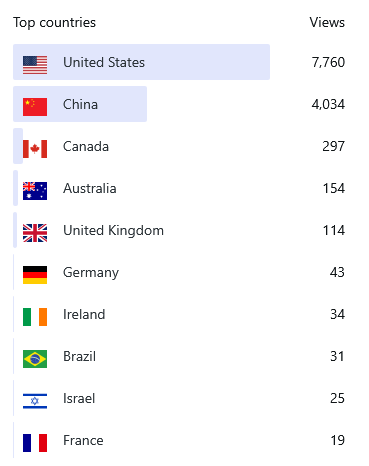
For a Canadian blog, I get a lot more non-Canadian visitors.

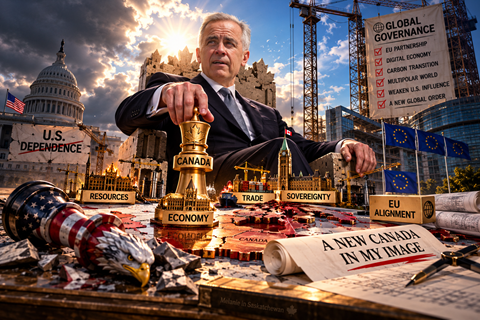
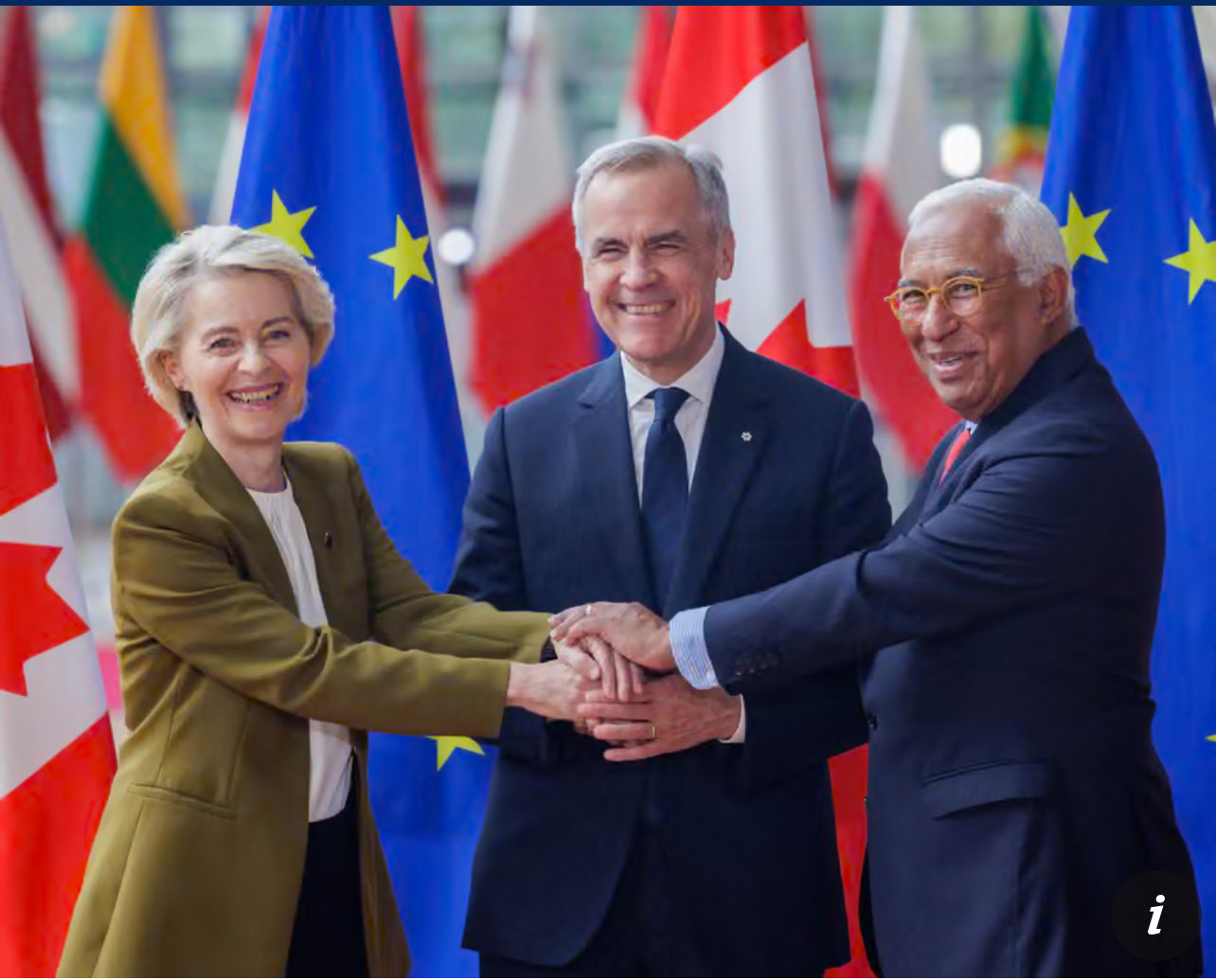
It looks like Canadians are about to cheerfully reconnect with what they were taught for a decade is their unforgivable colonial past. First, the Wall Street Journal (WSJ), primarily citing unnamed sources, reported that Prime Minister Mark Carney was hoping to make Canada an associate member of the European Union. But then CTV News, quoting a senior PMO official, reported Canada wasn’t seeking EU membership “in any capacity.” Paul Wells wrote a column explaining how WSJ had torqued the story and then Carney, who tends to get truthy under pressure, as Brian Lilley pointed out, told reporters he wasn’t seeking anything called membership but something something else something something. A couple days later, EU President Ursula von der Leyen disagreed with that line when she declared in a speech that she wanted to join with Canada at the “highest level possible” and she’d be happy to welcome Canada as an “associate member.” In response, the Financial Times reported other EU leaders were thinking, uh, not so much about the whole thing but good luck Canada and the Daily Mail chimed in with news Brussels was in an uproar. Then, proving it was right all along, WSJ quoted a Canadian official saying “We were the ones who proposed associate membership”, which Carney and his office had denied.

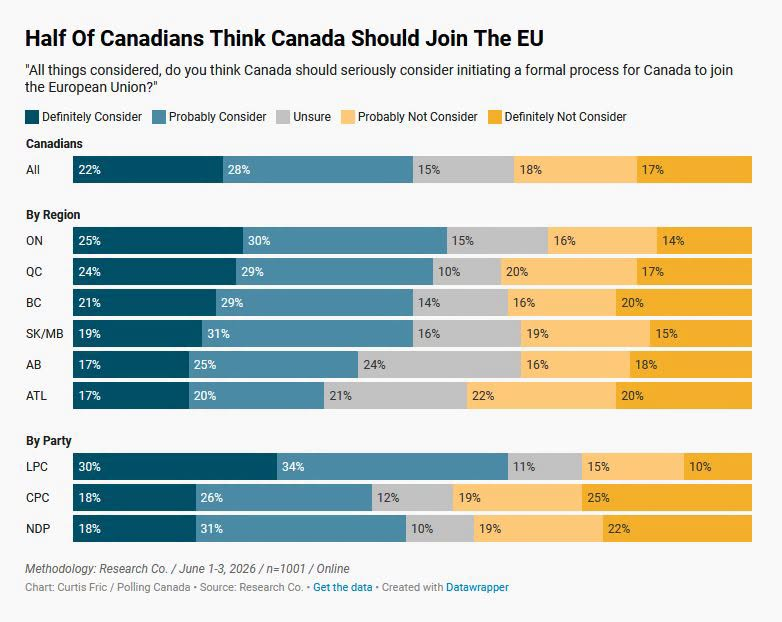
US President Donald Trump said if Canada joins the EU with a hostile intent (the qualifier having been omitted in some Canadian reports), the USA will bring in more EU tariffs. Our PM recaptured headlines with a speech promoting an undefined but aspirational union and flew home to a nation that polls indicate is now wildly enthusiastic about embracing settler culture even while the Daily Telegraph said the whole thing was already unraveling.

The challenge for journalists was to make sense of all this prestidigitation while wondering if maybe they should have taken the time to ask who Carney was hanging out with during his recent vacay in Tuscany. Many were left wondering if PMMC could do this without Parliamentary approval which, as every working journalist should know, he can, partly because they let him. When it comes to treaties, it’s a one-man show. Credit the Toronto Star‘s Althia Raj for noting in regards to Carney’s plan to further privatize major airports that “The Liberal government has no mandate to do this”.

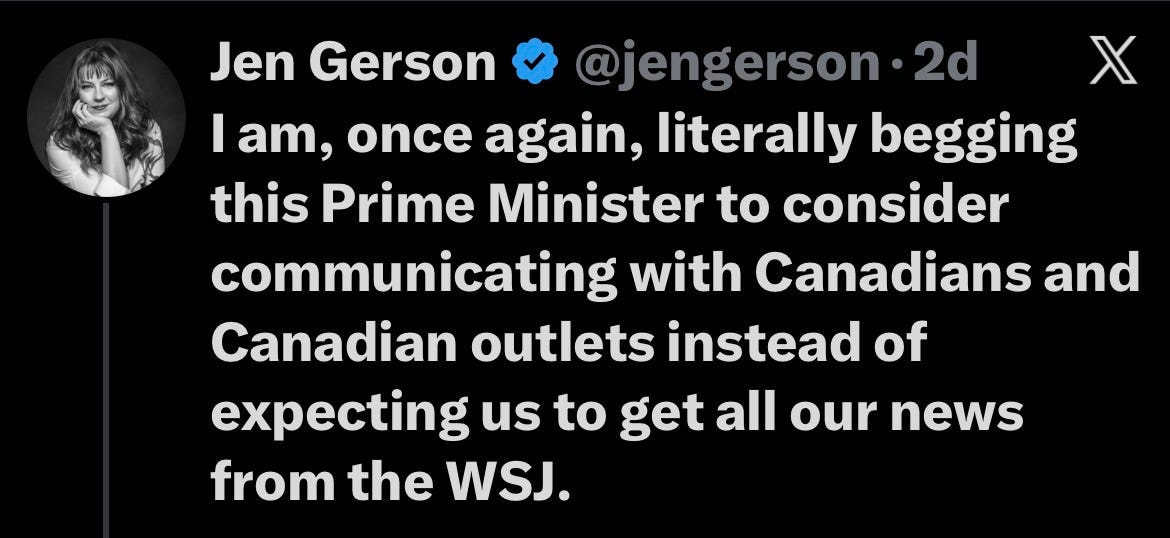
While The Line‘s Jen Gerson and others were taking umbrage with the PMO’s preference for foreign media, John Ivison was getting some decent insider dirt for National Post on how vigorously bureaucrats are resisting the PM’s need for speed — a concept with which they are notoriously unfamiliar.

A further chapeau to Brian Passifiume for the scoop on how, while Carney is urging us to buy Canadian, his government hired an American company to run his Toronto investor match making sessions.

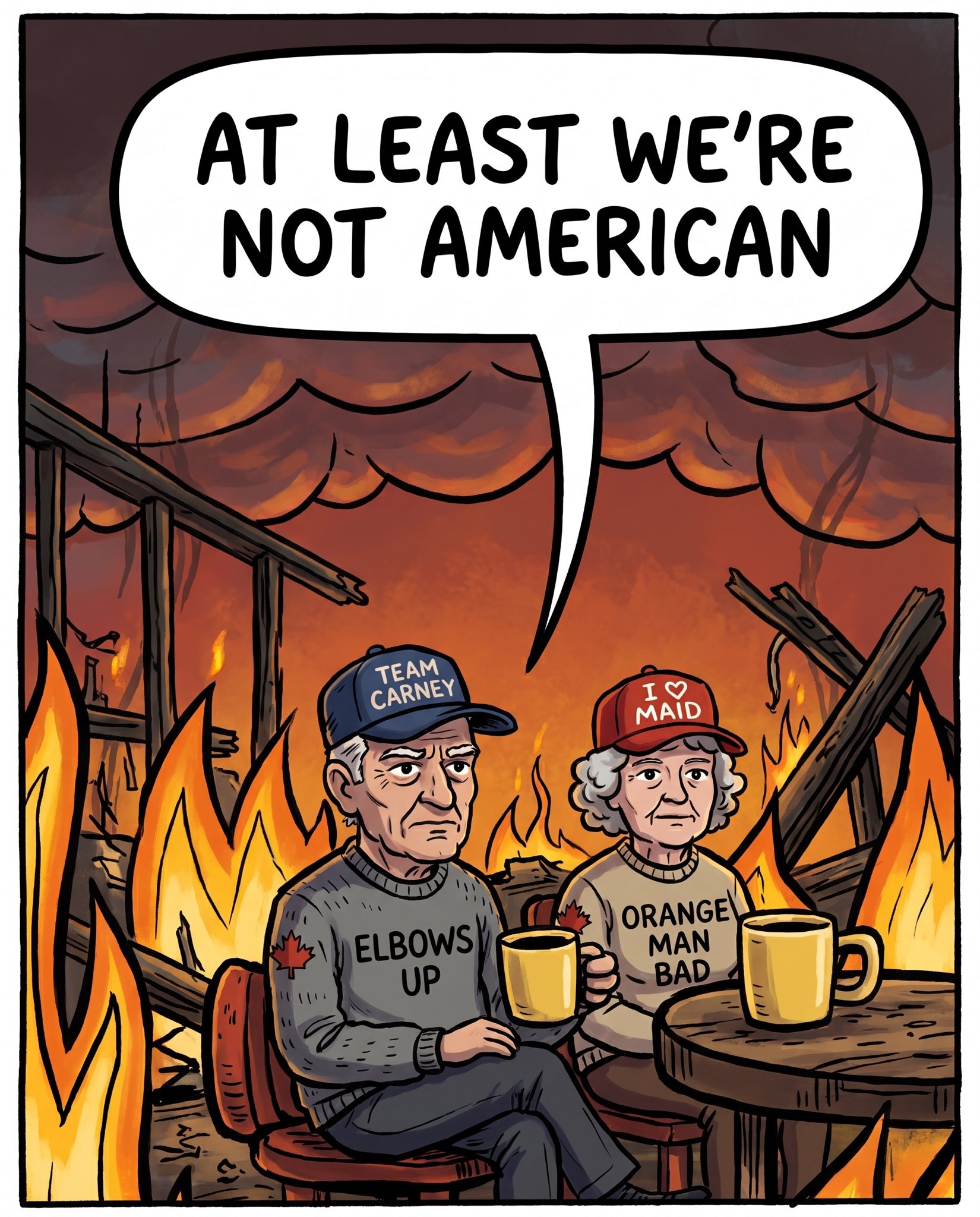
I have frequently pointed out that the mystery of why Germans supported Hitler and the National Socialists in the 1930s comes down largely to the value of non-stop propaganda: ordinary Germans read the newspapers and listened to the radio and the messages they got were increasingly co-ordinated to praise the party and the work of its leader and to demonize enemies of the state. What brought it home to me was just how efficiently Canadian relic media spare no effort to praise our very own Dear Leader and belittle the opposition or private citizens who don’t automatically wave their elbows on demand:

Putting on the neuroscience hat for a minute.

When people are called “traitors” simply for saying Canada should negotiate a workable deal with the United States, something interesting is happening psychologically.

The brain has a fast threat-response pathway and a slower regulatory pathway. The amygdala can detect a perceived threat almost immediately and trigger a stress response.

When people feel they are losing control or fear social judgment, cortisol can rise. Under enough perceived threat, slower prefrontal-cortex functions such as weighing evidence, considering alternatives and regulating emotional reactions can become less dominant.

Now add politics.

If Trump, the United States, Canadian sovereignty and national loyalty become emotionally loaded symbols, a disagreement over tariffs can stop being treated as an economic question. It becomes: “Are you with us or against us?”

That is where tribal thinking can take over.

Calling somebody a traitor because they want negotiations is the fast response. The slower question is: What outcome produces the least economic damage for Canadians? What does retaliation cost us? What can Canada realistically gain through negotiation? What happens to workers, farmers and businesses if there is no deal?

You can oppose a deal after doing that analysis. You can support one. The important part is how you reached the conclusion.

I saw much the same psychological process during COVID. Questions that should have involved evidence, probabilities, costs, benefits and changing information often became tests of political identity and loyalty. Once that happens, people defend the tribe first and examine the evidence second.

The neuroscience doesn’t tell us which political side is automatically correct.

It does tell us why fear, loss of control, social judgment and group identity can push people toward rapid emotional responses, while stepping back and deliberately examining evidence requires more cognitive regulation.

Sometimes the most rational thing you can do is refuse the loyalty test and ask the boring question:

What actually works?

September 20, 2026

There are wedding gifts and there are wedding gifts

Filed under: Media, Politics, Russia, USA — Tags: , , , , — Nicholas @ 03:00

Gift-giving has been a thing since caveman days, they say, but sometimes gifts carry strings along with them that are impossible to ignore, or as The Grim Historian puts it, “never let a mobster pay for your wedding”:

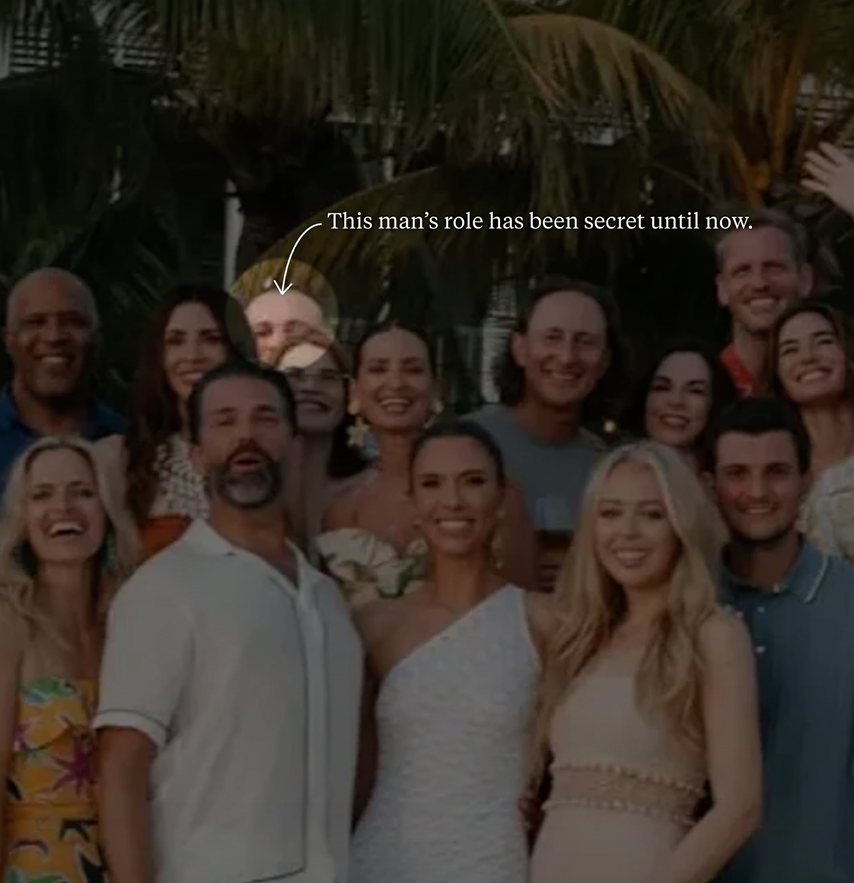
Nothing says “just a wedding gift” like the benefactor whose role stayed secret until ProPublica had to put an arrow over his head.
Photo: Laura Gordon Photography via Instagram; annotation/source: ProPublica.

My Grandma Ella had a rule about gifts, usually delivered while waving a wooden spoon over a white apron so stippled with tomato sauce it could have been entered into evidence.

She would say, “Never accept gifts. That’s how a rich man turns you into a beggar.”

That may sound cynical, but no Italian survives a lifetime of weddings, funerals, Sunday dinners, and relatives saying “forget about it” without learning that generosity has a very long memory.

A gift creates an imbalance. You give me something. Now I am indebted to you. Sure, you may insist it is “just a gift.” But I have seen enough crisp white envelopes exchange hands to know there are gifts, and then there are … gifts.

Say I give you a hundred dollars and tomorrow you hand me a hundred dollars back, congratulations…we have invented banking. Or say you sign up for my breathtakingly grim history newsletter. I have provided you a service in exchange for your 5 ducats, but we are all clear on the bargain.

But suppose I give you something you can’t return. Not tomorrow. Not next year. Now the books stay open. And a man who keeps your books open is not your friend. He owns a piece of you.

Which brings us to Donald Trump Jr.’s wedding and who owns him.

ProPublica reporters Justin Elliott, Brett Murphy, Joshua Kaplan and Alex Mierjeski reported this week that Umar Kremlev — a Russian businessman closely associated with Vladimir Putin — gifted Trump Jr. and Bettina Trump quite the wedding shindig in the Bahamas.

According to records and interviews ProPublica reviewed, Kremlev paid to rent a private island, covered an elaborate fireworks show, and had his team help organize the festivities. There were helicopters, seaplanes, oceanfront villas, and a five-tier funfetti cake flown in from Florida. So not exactly the crystal punch bowl from Aunt Linda.

Fortunately, after ProPublica published its story, the newlyweds fessed up. Yes, Don Jr. and Bettina Trump have a wealthy Russian benefactor (sorry, “friend”) granting party favors. Then they made a statement that would have my Italian grandmother shaking her mano fica.

“Friendship doesn’t require a political motive. Generosity doesn’t automatically come with an agenda. And sometimes a wedding gift is simply a wedding gift.”

Just a gift.

September 15, 2026

A Fall election seems quite likely

One of the advantages of a Westminster-style parliamentary system is that election dates are not fixed, so that the Prime Minister can take advantage of perceived opportunities to win majorities when they arise. It must be very tempting to Mark Carney to call an election as soon as he can, as the Elbozos are still waving their arms and chanting his praises for “standing up to the Bad Orange Man”. His latest notion of trying to add Canada to the European Union as some sort of “associate member” is also popular among people who think that Canada should be more like Europe (the Venn diagram of Elbozos and Europhiles is almost a perfect circle). On X, Jay Currie stares into the abyss of yet another Liberal majority government with a renewed electoral mandate:

The Prime Minister of all the Canadas is prepping for his Davos 2.0 speech to the European Parliament on the 17th when, apparently, he is going to propose that Canada become some sort of associate member of the EU. God help us.

The developed world can be thought of as two camps: the progressives and, for want of a better term the nationalists (could be traditionalists but that is only one strain within the nationalist camp). The supra nationalist institutions, EU, UN etc are progressive to their core.

Progressives see borders as barriers to progress, believe diversity is strength, see international action as the only way to defeat the horror of “climate change”, want international controls on speech, technology and public health.

For progressives individual rights, the rule of law, property are all barriers to the greatest good for the greatest number. Citizenship is an antique concept best left in the 20th century.

Most importantly progressives see the state, rules and regulations, a constantly refreshed “New World Order” and managed decline as both beneficial and inevitable. Arc of History and all.

Nationalists begin with the tiniest unit in society, the individual, and take that unit seriously. What rights does an individual have? If you start there you automatically circumscribe the power of the state. You also set the state’s direction.

Taking individual rights seriously creates a state in which individuals matter, there their voluntary associations beginning with families, matter. “The greater good” is no more than a suggestion when it comes to protecting individual rights.

The Europe of the EU came out of the ashes of a world in which individuals were subjects rather than citizens (with the notable and sporadic exception of post Revolutionary France) and the concept of individual rights was fragile at best.

The progressive intent of the EU was to treat “Europeans” as interchangeable economic units whose value was locked to group identity and which must be prepared to share the burdens imposed for the greater good.

Nationalism was seen as regressive as was patriotism and the insistence that individuals had rights which over rode the “common good”. After all, the horrors of WWI and II were the products of patriotic nationalism.

The progressive European project worked quite well for the first twenty or so years when Marshall plan aid funded the rebuilding of Europe and membership in the EU was relatively restricted. Expansion and mass immigration strained the Community.

Part of the reason the EU worked quite well in the early years was that its goals were relatively modest, a trading bloc with harmonized economic regulation left individual countries to work out their social, legal and rights structures.

As with any progressive institution the modest goals of the early years were gradually replaced with “ambition”. The 1985 Schengen Agreement eliminated hard borders within the EU. The European Convention on Human Rights harmonized the rights of Europeans.

Part of the progressive ambition was the creation of a hitherto unknown entity known as “the European” superficially similar in concept to “the American”. Questions of nationality could be submerged as this new entity stepped into the world.

For the progressive camp the “European” was a giant step forward into a post national future. As indeed it was for a tiny minority of bureaucrats, academics, journalists, financiers and other members of a self appointed cognitive elite.

People who objected to this grand homogenization of the nations of Europe were obviously frightened of the inevitable future because, well, they were not well educated and, entre nous, not too bright.

For the “Europeans” the great cause of the 21st century was laid out in Rio in 1993 when a conference convened by Canadian Maurice Strong sounded the alarm about “global warming” currently rebranded “climate change”.

Now there was a global threat demanding a supra-national response where the “Europeans” could assume a leadership role by…well, by shipping all of their heavy industry offshore and building very expensive windmills and mandating electric cars.

To no one’s very great surprise the Europeans have managed to de-industrialize and regulate themselves to the point of actual poverty. Fortunately, it was all for the global greater good so the Europeans could congratulate themselves.

Not content with climate virtue, the Europeans (though not the regressive nationalist yobs) took it upon themselves to welcome millions of migrants. An act of humanity and also shrewd as the Europeans had given up having children.

Of course, the idea had been trial-ballooned recently to get Carney-friendly headlines ready in advance:

September 9, 2026

The day after counter-tariff Tuesday

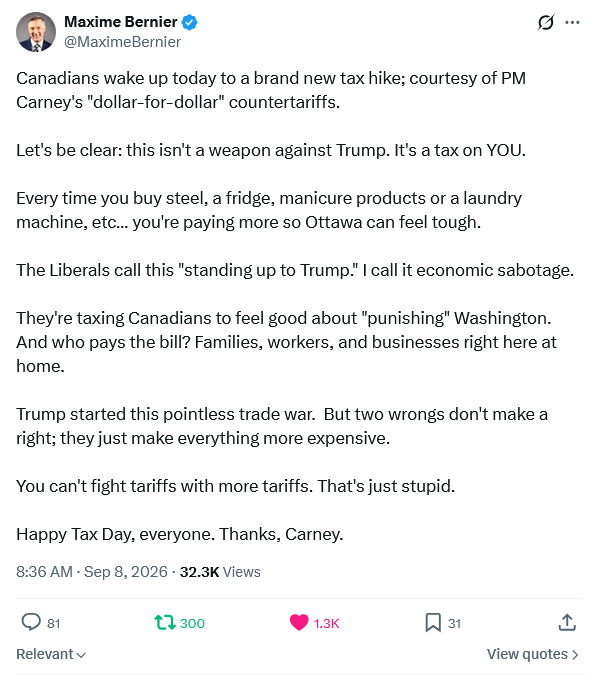
Yesterday, the Canadian counter-tariffs to the latest round of US tariffs kicked in. Maxime Bernier put it this way:

Canadians wake up today to a brand new tax hike; courtesy of PM Carney’s “dollar-for-dollar” countertariffs.

Let’s be clear: this isn’t a weapon against Trump. It’s a tax on YOU.

Every time you buy steel, a fridge, manicure products or a laundry machine, etc. … you’re paying more so Ottawa can feel tough.

The Liberals call this “standing up to Trump”. I call it economic sabotage.

They’re taxing Canadians to feel good about “punishing” Washington. And who pays the bill? Families, workers, and businesses right here at home.

Trump started this pointless trade war. But two wrongs don’t make a right; they just make everything more expensive.

You can’t fight tariffs with more tariffs. That’s just stupid.

Happy Tax Day, everyone. Thanks, Carney.

Carney’s plan all along has been to push Trump into saying and doing things that give Carney and the Liberals even more Boomer support. Pretty much controlling the relic media allows the government to massage the stories so that Dear Leader is never in the wrong and “the Bad Orange Man hates you and wants to destroy you”. Canadian boomers are among the last people in the world to realize that they’ve been systematically gaslighted since Justin Trudeau ran for Liberal leader … and the penny still hasn’t dropped. Enough of them are already psychologically prepared to destroy what’s left of the economy, Thelma & Louise style, if Carney invites them to. And he’s going to.

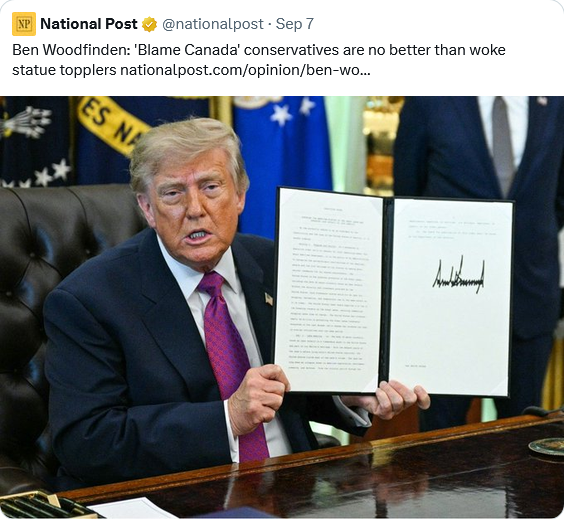
John Carter responds to a Ben Woodfinden article in the National Post, blaming dissident Canadians for not rallying behind Mark Carney to … do exactly the same sort of performative elbozo pantomime that the Boomer Liberals have been doing for over a year?

This misses the mark in a subtle but interesting way. The author invokes the concept of oikophobia against the Canadian online right for joining in (actually initiating) American mockery of Canada, arguing that Canadian rightists are themselves oikophobic for not instead supporting the Carnites.

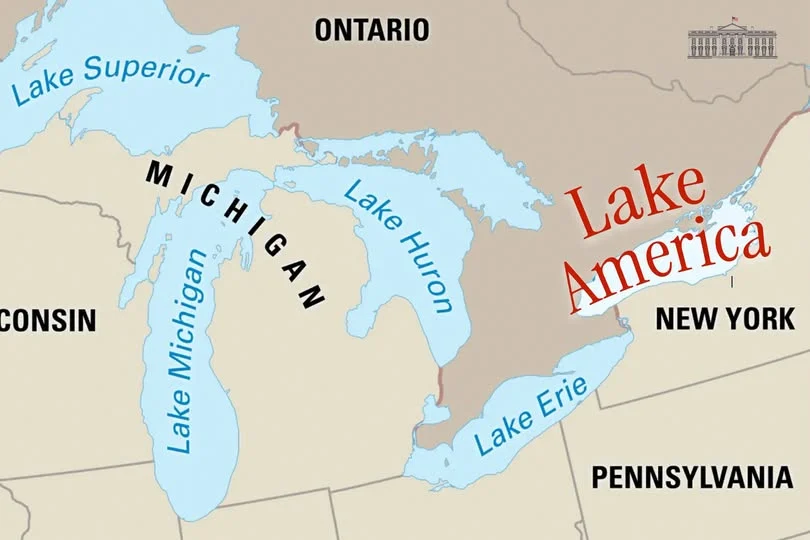
This is incoherent. The Liberal regime is itself oikophobic, loudly so. Oikophobia is explicit Canadian government policy, as the author himself tacitly acknowledges by noting that we pointed out the hypocrisy of Canadian politicians decrying Trump’s lame Lake America stunt after a decade-long orgy of renaming every school, square, and street in the country in the name of a Woke ideology imported straight from America. That’s to say nothing of replacement migration, and racial preference systems that make white Canadians second class citizens. You can’t be oikophobic against the oikophobes.

There are certainly slopulist 51st staters out there, but their influence in the Canadian right is actually marginal, largely confined to a rump of lolcow Alberta separatists. The energy is all in Canadian Loyalism, and that is a different animal entirely.

The reason we’re happy to pile on to the Canadian political elite when the Americans mock them isn’t because we want to be America. It’s because we’re disgusted by the state of the country.

Trump can excoriate the Canadian military for being fat and woke because it is. That isn’t Trump’s fault. That’s because of decades of sabotage and social engineering by the Liberal Party.

Trump can joke about annexation because the Canadian military is weak. Again, that isn’t Trump’s fault. That’s the fault of the Laurentian elite, the very people now insisting that they can turn things around.

If Canada had a serious government, we’d be taken seriously. We don’t, and haven’t since Pearson at least. As a direct result of the deeply unserious clowns running the country into the ground, Canada is poor, defenseless, sclerotic, and despondent. Every time Trump makes fun of us, the very fact that his insults land is a condemnation of the elites that brought our beautiful country to this shameful condition.

Saving Canada requires circulating the elite.

And that’s why we pile on.

And since I try not to overtax my non-Canadian readers (the vast majority of you) with too many separate maple-flavoured posts, here are some sensible suggestions from Matt Gurney about fixing our own problems — which are legion, and mostly self-inflicted — rather than pretending that Trump is the problem:

… there’s a bigger issue at play here than just managing the relationship with America. What the hell do we do as Canadians?

Don’t think about the States at all. Don’t think about Trump. Just think about Canadians in Canada. What should we be doing for ourselves? Even if the trade war does eventually end, our relationship with the United States is going to require generations to fix. Some very fundamental assumptions about Canadian, well, everything, now need to be reconsidered. I’m the guy who wrote the column about our expectations being a problem, and I’m still having a hard time keeping up with this.

But if there is one thing that I could suggest we should prioritize, it’s simply fixing the problems we have in this country. Really. Just … do the right things. Fix the problems. Just like virtue is its own reward, making good decisions is always a good decision. It’s bizarrely not something we’ve been good at lately, though, and it’s probably actually going to get harder for a while. In fact, a patriotic rallying-around-the-flag effect is very likely to make it even harder than it already is to get Canadians to actually admit there are major problems in this country, and then insist that the politicians get serious about fixing them.

I’ve been thinking about writing this column for a couple of weeks. Last month I was in the United States for some family business. I was actually there the day Carney called our negotiators home, and I returned to Canada the next day; I joked with some friends that, much like our negotiating team, I was packing up and leaving the United States to show them we meant business.

But one of the things I did notice on my visit to the United States, which included stops in two major cities, was that those American cities were much cleaner than my hometown of Toronto, and in much better repair.

And the especially bizarre thing was, one of these cities was Detroit.

Yes, that Detroit. Astute Line readers — the smartest and best-read people in the whole wide world — will recall that Detroit has not often been held up as an exemplar of civic governance and urban success.

But the downtown looked good. It was safe, clean, well-patrolled; I’m not exactly a regular visitor, but I do pop in often enough to have noted real improvement in the state of things there, even compared to my last visit, which was only about a year ago.

The other major city I visited, Chicago, has always struck me as the best apples-to-apples comparison my hometown of Toronto has with a U.S. city. Chicago has a lot of visible problems. I’m not trying to gloss those over; one thing I quickly noted was a roughly Toronto-esque number of people wandering the streets in evident mental-health crisis, shouting at nothing. But overall, Chicago had much less visible homelessness and was in a considerably better state of repair and cleanliness than my hometown. It wasn’t subtle. Cleaner streets, in better condition, with fewer people obviously living on them. Toronto did not compare well.

And just when the hell did that happen?

We can’t blame Trump for our laughably protectionist inter-provincial trade barriers. We can’t blame Trump because we’re functionally incapable of building a pipeline to bring Canadian oil and natural gas to Canadian markets. We can’t blame Trump for our ever-less-functional public healthcare systems. We can’t blame Trump for our ever-less-appealing market conditions for foreign investment. We can’t blame Trump for our deteriorating relationship with First Nations groups. These are all things that need to be fixed by Canadians. In Canada. No matter who might be occupying the Oval Office in Washington, DC.

Update: Added missing URL to John Carter’s post on X.

August 29, 2026

On the scenic shores of “Lake America”

Filed under: Cancon, Media, Politics, USA — Tags: , , , , — Nicholas @ 04:00

One thing Trump does better than any other politician is finding ways to send his opponents crazy. It’s not a skill I’d want to have myself, but it’s amazing how Trump can do or say something outrageous … and pretty much every time his opponents take the bait and make themselves even more ridiculous in trying to react to his provocations. Like randomly renaming Lake Ontario by executive order:

I don’t think Carney has Trump Derangement Syndrome, the citizens who vote for him do. Carney knows this, he counted on it to win the election. Elbows up was about preparing Canadians for a breakdown in relations with the U.S. – A breakdown that Carney and the other Laurentian elites who run things in Canada saw as inevitable. To anyone paying close enough attention, Carney is the de facto new leader of the globalists (the WEF mob). He ascended to that position at the moment he became the Canadian prime minister. Trump and the MAGA movement, on the other hand, are the singular force in the world effectively opposing globalism as it has emerged in the post-WWII “rules based order”.

This effectively places Canada at the center of an existential global struggle. However, we are not only at the center, but oppositionally set against the most powerful nation the world has ever seen, locked in a “trade war” with the largest economy in the history of humanity. Pardon my use of acronymic French as I blurt out an unruly “WTF!”

I am sure Carney has read The Art Of The Deal and knows how to win diplomatically with Trump – which is all one needs to read to gain the key insights prerequisite to mutually successful negotiations with the orange one. But Carney is not interested in mutually beneficial trade relations with the U.S. because that would mean tacit support for the American led reset of global political economy (which of course follows from America’s new economic policy, because yes absolutely America is that powerful), or put another way, it would mean Carney supporting the thing which is opposing the thing that he actually supports.

Elbows up Canadians have been manipulated by the most cynical government in the history of Canada. Carney is a smooth operator but a cunning wirepuller. He has essentially pulled the wool over the eyes of a malinformed citizenry who have been fed an endless diet of state-sponsored anti-American, Anti-Trump, and Anti-Poilievre propaganda since at least the final scenes of the Trudeau premiership set the stage for Carney the globalist show closer.

[…]

And at last we come unceremoniously to the supreme troller who has cast his line in the newly anointed Lake America. He is fishing for a major catch of Canadian TDS, and he is bound to fill his nets. Indeed, Trump has signed an executive order officially changing the name of Lake Ontario to Lake America. Canadians are of course triggered and are whining insufferably. I think it is funny, and I like that for once an Indian name is being changed to a European one. Trump is the greatest troller in the history of trolling. However, the move is a serious one, in twenty years the world will be flooded with maps and globes that label the former Lake Ontario as Lake America, in spite of the impotent protestations of butt hurt Canadians. America has vastly more power in this world, if they want our lake known as Lake America it will be so. Canadians who have a hard time accepting this simply have no clue about the dynamics of power.

Carney’s response to Trump’s redesignation of the lake was replete with a self-own only one as invested in a globalist “new world order”, and oblivious to actual domestic concerns could muster. He posted the following to X:

    The name Lake Ontario comes from the Wendat word Ontari’io, which, appropriately, means “the lake is beautiful, the lake is big”.

    The name is more than 400 years old, predating both the Confederation of Canada and the Declaration of Independence of the United States of America.

    We know that America is changing. Their trading relationships, their foreign policies, their national monuments, their hydronyms.

    Canadians also know that naming reality means calling it Lake Ontario – then, now and always.

A hilarious response to this which appeared on X was posted by Miranda Veracruz de la Jolla Cardinal, which I am assuming is a parody account since Miranda was a recurring character in the 1980s sitcom Married With Children. MVdlJC wrote:

    “How dare Trump rename Lake Ontario!”

    “Anyways, here I am at Sankofa Square …”

If that is not the cat’s pajamas then I have no idea what type of a response to Carney’s boundless smugness would adequately compliment a feline’s slumber. Carney says that Canadians know about “naming reality”, yet how many unpronounceable aboriginal terms have been grafted over the real names of Canadian places in the past decade or so.

August 24, 2026

Trade negotiations degrade into full-on trade war

Filed under: Cancon, Economics, Government, Media, Politics, USA — Tags: , , , — Nicholas @ 03:00

As I mentioned the other day, I don’t believe Prime Minister Mark Carney ever intended to reach a trade agreement with the United States, because it was far better for his domestic political situation to have the US — and especially Donald Trump — as a focal point for retired Canadian boomers to trigger a two-minute hate. Every time the name Trump appeared in a state-sponsored newspaper or TV story, Carney’s popularity went up. After a decade of economic stasis and relative decline under Justin Trudeau, Carney’s more staid persona told the boomers that “the adults were back in charge”, yet Carney’s policies have been largely the same as Trudeau’s with a bit less hamming it up for the cameras.

On his Substack, Brian Lilley considers the potential economic damage of the increased tariffs:

“You’re at war when you get attacked, we got attacked.”

That’s what Prime Minister Mark Carney said when he was asked why it sounded like was going to war after his Saturday morning speech.

Carney used references to war multiple times in his speech and during his Q & A with reporters.

“We’re stronger now than when the United States started this trade war. More unified, more determined, more ambitious,” he said in his speech.

Not sure that I believe that to be the case, though we could be if we take the right steps, something I was writing about in my latest column for the Sun.

Previously, I have questioned whether we should consider this a trade war between Canada and the United States. The Americans say they don’t see it that way, they see it a change in trade policy, an attempt to rebalance trade.

My thinking that perhaps the Americans were right was that calling it a trade war put us in the wrong mindset. Canadians were looking for a fight with the Americans, many still are and are happy that Carney walked away from this deal.

Of course, for the devoted “Elbows Up” crowd, no deal was always the best deal. They foolishly believe we can and should walk away from the United States.

After this latest round of tariffs though, I’m fine calling it a trade war.

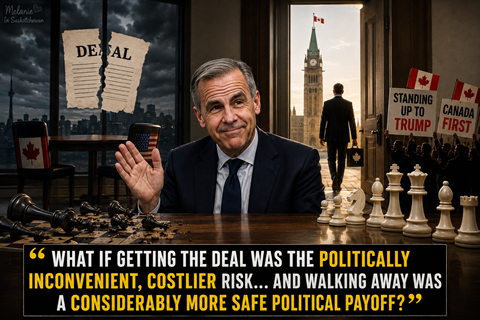
Melanie in Saskatchewan calls it “the most convenient failed trade deal in Canada”:

AI-generated image from Melanie in Saskatchewan

Imagine, if you will, a prime minister first installed and then elected, because Canadians believed he was uniquely equipped to deal with Donald Trump. Our hypothetical prime minister has impeccable credentials, international connections, central banking experience, serious suits, and the reassuring manner of a man who appears to know exactly which fork to use while the dining room burns down around him.

Most importantly, his political identity rests on one enormously useful proposition: Only he can handle Trump.

Now imagine the negotiations aren’t going particularly well. Not outright disastrous, at least not yet. Just difficult. Canada makes concessions. Ottawa drops the Digital Services Tax, removes most retaliatory tariffs, and American alcohol and supply management are on the table.

Still, negotiations continue, but then something changes.

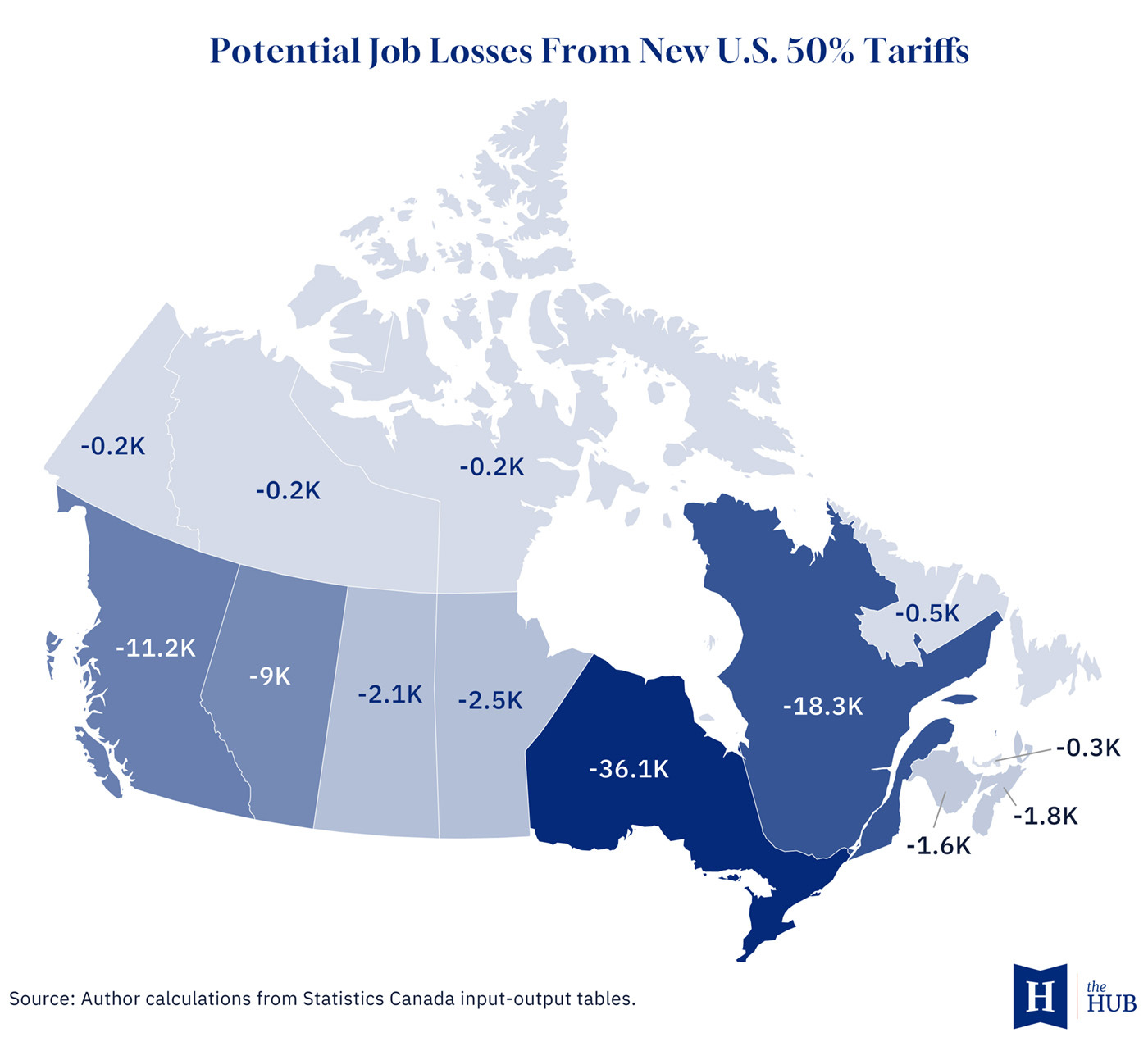
On August 18, Trump postpones the new 50 per cent tariffs for three days after the two sides report “substantial progress”. By August 20, Canada’s trade minister says they’re “very close” to a deal. Reporting suggests the agreement under discussion could halve steel and aluminum tariffs and reduce tariffs on Canadian-built vehicles from 25 to 15 per cent.

And then … poof!

No deal. Do not pass go, consider this farce terminated.

The 50 per cent tariffs take effect. Carney suspends negotiations, the Canadian negotiators come home, and Ottawa announces retaliation. Washington says Canada backed away from commitments while Ottawa resolutely asserts Washington changed the terms at the last minute.

Well, that’s pretty fricking interesting, isn’t it?

So naturally our hypothetical prime minister takes to the airwaves and explains exactly what happened. Except he doesn’t, not with any actual clarity.

He speaks for more than twenty minutes, probably moistly, wandering from storms and changing climates to sovereignty and resilience, then through infrastructure, LNG, nuclear power, housing, defence, diversification and investment. By the time he finishes, we’ve practically navigated the entire federal government, several industries and the weather forecast.

Canada, we learn, is “master in our own home”. Well, isn’t that just terrific! What happened to the bloody trade deal?! Carney says the Americans introduced new terms that were “uneconomic” and “unfair”. They “asked too much and offered too little”. Who is going to draw the short straw and tell Carney those are adjectives and conclusions, and not terms?

Then comes a particularly curious bit. Carney says Washington also sought restrictions affecting Canada’s future trade relationships with other countries.

Other … countries.

But he never actually tells us which countries Washington was talking about, exactly what restrictions were being demanded, or which “certain sectors” he meant when he admitted the Americans wanted Canada to coordinate tariffs against other countries. Stranger still, Carney conceded that Canada could actually see merit in some of it as part of the right deal.

So which countries? Which sectors? And which parts of this supposedly unacceptable assault on Canadian sovereignty did you actually find reasonable? Suddenly the man who just spent twenty minutes talking develops an acute shortage of proper nouns.

August 23, 2026

Trade deal? What trade deal? Best we can do is more tariffs

Filed under: Cancon, Economics, Government, Media, Politics, USA — Tags: , , , , , — Nicholas @ 03:00

My sense has always been that the Carney government didn’t really want to get a deal done with Trump, because it was far more politically useful to keep the eLbOzOs all angry and posturing than to negotiate in good faith. Canada’s premiers, taken as a group, have been a never-ending stream of clown car antics, political gamesmanship, and schoolyard baiting. Yes, Trump is infuriating, inconsistent, obnoxious, and even more performative than Justin Trudeau but he’s the current American president and we needed to send sensible politicians and diplomats to work with him.

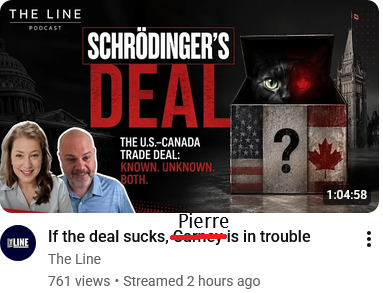
The presstitutes in the Canadian relic media have been eagerly fanning the flames of Trump Derangement Syndrome across the country, so when the latest episode of The Line podcast popped up yesterday, I had to provide a helpful edit to their episode title:

They’re going to do everything they can to deflect blame from their beloved paymaster, Dear Leader, and point accusingly at Pierre Emmanuel Goldstein and his band of anti-Canadian wreckers and looters in the Conservative party.

On the social media site formerly known as Twitter, @jaycurrie discussed this when the news broke of the breakdown in talks:

The last minute collapse of trade negotiations between Canada and the US demonstrates a fecklessness on the Canadian side which is astonishing. The walking resume — in the very good suits — could not get’er done.

Apparently those damn Yankees had unacceptable last minute changes. No shit. You are dealing with serious negotiators who will squeeze hard. It is said of Trump that he regarded signed contracts as the beginning of the negotiation.

Brutal, unscrupulous, nasty. Orange man very, very, bad. But you play the hand you’re dealt. Had Canada sent serious negotiators a year ago rather than posturing and dumbly sticking the official elbows in the air, we’d have a deal.

Or, had we had negotiators who did not take Dudley Doright as a model, we would have signed a “bad deal” and gone right back to the table to get a better deal. I’d love to know what the show stopper American last minute “demands” were.

Trade is a constant series of negotiations. A deal in place would have avoided the BS 50% tariffs and set the stage for the next deal. This collapse just puts us in a deep hole smarter people will have to climb out of.

“That’s my final offer” is a tactic. Is it an offer you like? No. Is it an offer you can live with? Probably. Again, the devil is in the details. But unless the offer required Canada to cede territory (which Eby is already more than willing to do) it was workable.

“A bad deal is worse than no deal at all” when there are 50% tariffs looming as a consequence of “no deal” is a very dumb position to take. Brace for “defense of Canadian Sovereignty” in a matter of minutes.

These trade talks have been bungled from the beginning simply because a combination of the political advantages of TDS and an inflated view of Canada’s relative bargaining strength created a reality free bubble.

The sheer arrogance and vile political opportunism of the Carney Liberals has been on full display for a year. Trump and his people called BS. Carney was euchred. Canada is, frankly, boned.

Maxime Bernier:

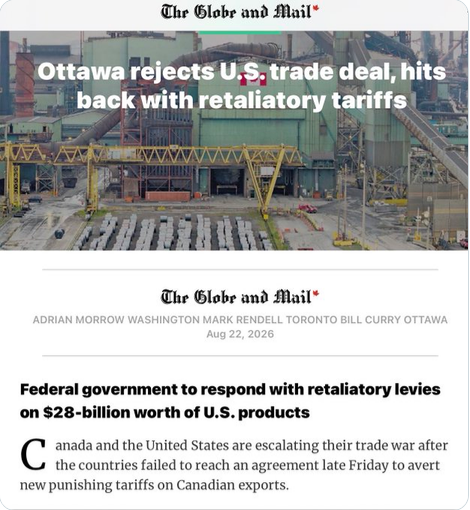
New 50-per-cent levies will hit around $28-billion worth of Canadian goods, which is roughly 5 per cent of Canada’s exports to the United States.

Carney has said it will respond with retaliatory tariffs on $28-billion worth of U.S. products.

Escalation is a very bad idea! Tariff retaliation has just triggered an escalatory trade war we cannot win. The U.S. economy is 10 times larger than ours.

A study released last week by the Canadian American Business Council concluded that the end of USMCA would have a surprisingly small impact on the Canadian economy.

It estimates that, even with high and long-lasting tariffs, Canada’s economy would only be about 1.6 per cent smaller in 2035 than if the USMCA were renewed and respected, and tariffs fell to near zero.

We are further damaging our economy with these “dollar-for-dollar” counter-tariffs.

Retaliatory tariffs are NOT a weapon. They are a tax on Canadians.

Who do you think absorbs that cost?
Canadian consumers, businesses, and workers.

Let’s be brutally honest: the Canadian government is worsening the situation. Canadian families will pay the price at the checkout counter.

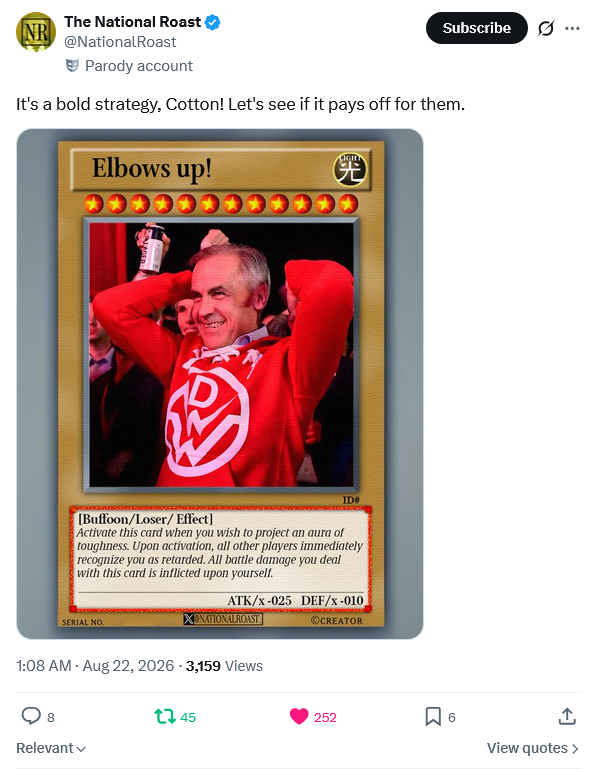
The National Roast gets it:

August 15, 2026

Mark Steyn denies being a “Never Trump”-er

Filed under: Media, Politics, USA — Tags: , , , — Nicholas @ 04:00

From his sickbed, Mark Steyn responds to a criticism from one of his long-time readers that he’s “gradually devolved into NeverTrumpism:

I have no idea where I saw this meme, but it makes me laugh

I begin to understand why, since I emerged from my coma, the docs have recommended eschewing the Internet. Following Wednesday’s Clubland Q&A, Joe Huber comments:

    Unfortunately, SteynOnline (once my favorite place to visit) has gradually devolved into NeverTrumpism, and that’s sad. But it is what it is.

We may have to introduce weekly ceremonial expulsions from The Mark Steyn Club. I’m not “NeverTrump” on immigration, DOGE, MAHA, endless war, etc, and I would still favour him over any likely Democrat candidate or “mainstream” Republican. The first time I met him was over thirty years ago, when his then wife was auditioning for a Broadway musical produced by a friend of mine. The only substantive exchange we had that day was his demand for assurance that the show was a bona fide hit … because the defining characteristic of Trump has always been his utter contempt for what he calls “losers” and his disinclination to allow his brand to be contaminated by association with them.

So it is a mystery to me that he allowed himself to get mixed up with an institution that, by any objective measure, is the biggest “loser” on the planet.

By contrast, my position on this has been exactly the same throughout the time Mr Huber regarded SteynOnline as “my favorite place to visit”. This piece, for example, was published in the print edition of National Review over fifteen sod-bollocking years ago, and its first sentence remains the question that, multiple unwon wars later, the Rah-Rah Right still declines to answer. I recall multiple back-and-forths with the editors over passages they felt were too strong meat, and I would probably write it more bluntly today. But its comparative sobriety should cause Mr Huber to reflect that his charge of “NeverTrumpism” is bollocks, and that my concerns about US inability to use half of the entire planet’s military budget to accomplish any minimal strategic purpose is principled, long-held, and borne out by any random headline. From today:

    Russia Captures Record Share of India’s Oil Market

And so it goes. (Incidentally, just as a minor point: I note the increasing adoption of the term “West Asia” for the zone of conflict. “Middle East” is a designation that reflects the view from Washington; “West Asia” is how it looks from Delhi and Beijing.)

You will see in the latter half of my ancient piece the reference to the US military as “the expeditionary force of the Parliament of Man”. It is safe to say that President Trump — with his declaration that he’ll pick the next Supreme Leader — does not see it like that, but that’s the point: the rhetoric may change, but the self-bollocksing of American warmongering does not.

August 14, 2026

Ontario premier doubles-down on provoking Trump. What could go wrong?

Filed under: Business, Cancon, Economics, Government, Media, Politics, USA — Tags: , , , , , — Nicholas @ 05:00

At some point you have to ask yourself … if Canada was being run by people who wanted to destroy it, what would they have done differently in the trade negotiations with Donald Trump’s government?

Is Doug Ford the dumbest Canadian?

I know, it is a deep bench. But the tubby premier is extraordinary. You have to appreciate talent.

There are, apparently, two schools of Canadian thought on the trade fracas with the US. “Punch the bully in the nose.” and “For God’s sake get a deal already.” As I prefer a Canada with an economy, I pick door number 2.

Our Chief Trade Negotiator Janice Charette, is more combative. If Trump brings in his retaliatory tariffs in a week she’s packing up and going home. That’ll learn him.

The idle threat school of negotiation enjoys wide currency in both Ottawa and Queens Park. Meanwhile, Canadian businesses are looking [longingly] at the low tax, low reg world inside the Trump tariff wall.

I’m having a beer with a buddy who is in “founder’s mode” on a startup and, frankly, he’d be crazy not to be looking at domiciling his business in the States. Sure, have a Canadian sub, but why put your main business in Canada?

And decisions like this are being made all over Canada and, indeed, the world. People might hate Trump and all his works but the business attractions of Red States make Ontario and BC look pathetic.

You would think that after Ford’s Super Bowl ad fiasco he would have the wit to remain silent as his province’s fate is being negotiated. You know, avoid more damage. But no, the tubby premier likes to “talk tough”.

I actually feel a bit sorry for Carney having to deal with the fallout of this idiot’s remarks. Unless, of course, like the Super Bowl ads, Carney actually encouraged these remarks … In which case the competition for dumbest guy in Canada has tightened up.

August 12, 2026

“It might be Carney’s unconditional surrender to Trump, but it’d be worse under Poilievre”

Filed under: Cancon, Economics, Government, Media, Politics, USA — Tags: , , , , — Nicholas @ 05:00

I exaggerate a tad in my choice of headline, but Canada’s bought-and-paid-for relic media will always choose to present a spectacular Carney faceplant as being somehow better than any theoretical action by Poilievre. If Carney’s going to surrender to the Yanks unconditionally, it would obviously be far worse if the Leader of the Opposition had been PM instead. eLbOwS uP, everyone!:

The new Canadian trade flag – The Line

Well, it looks like our prime minister is losing his nerve, eh?

Reports are now leaking fast and furious that Trump’s surprise August 19 tariffs have worked to break our strategic patience. Canada is working to secure some kind of interim deal, and if the leaks are to be believed, we’re going to give the Americans essentially everything they want while they maintain most tariffs on us. It appears to be a shit deal for us, and one that puts us directly in the glide path toward vassal state.

Worse — and, to be frank, I do think this is the worst part of all of this — it’s the exact opposite of what we elected Mark Carney to do. When facing economic and political aggression from a neighbour and once-ally like the United States, surrender vs. resistance is a valid conversation to have. Given our circumstances, one could make a legitimate case for either choice. However, as a people, we did have that conversation, in the spring of 2025. We did make that choice. We chose resistance. We chose sacrifice. That was the premise of the last election, and that was the value proposition Mark Carney made for himself.

Instead, what we’ve actually done in the past year-and-a-half is a counter-productive middle path: yes, we’ve made moves toward strengthening our economy internally, and this is all to the good. But when it comes to measures that require a willingness to stand up to real power, all we’ve offered has been performative resistance in the form of angry social media sputtering and grandiose global speeches, followed in private by concession after concession. This has left us with the worst of both options. We’ve demonstrated that we lack the collective will to sustain real economic sacrifice. And we’ve just annoyed the Americans, which has clearly only increased their desire to make an example of us.

What we absolutely did not vote for was the prediction offered by Ian Bremmer of the Eurasia Group, a political risk analysis firm with long ties to Carney and the Liberals. Last year, Bremmer wrote: “Canadian leaders have a political incentive to put up a bigger fight because Trump’s threats toward Canada’s economy and sovereignty have sharply inflamed nationalist sentiment north of the border in the run-up to the April 28 elections. However, I expect Ottawa will quietly fold shortly after the vote to ensure that ongoing relations with the U.S. remain functional.”

Congratulations, Canada. You got punk’d.

In honesty, I can’t think of a worse strategy for achieving a remotely fair trade deal with the United States than the one Carney chose to follow. If he’d been dealing with George W. Bush, this plan might have worked, but I think that Bush was the last US president who would put up with the juvenile performative “strategy” Canada used. Barack Obama would have easily turned the tables, as the relic media loved (and still love) Obama more than they love maple syrup and oxygen. Even Joe Biden’s handlers could have highlighted just how J.V. Canada was acting. But for some reason, the Liberals decided that constantly pissing in Donald Trump’s cornflakes was a winning strategy. And now we’re looking at a maple-flavoured Appomattox Court House meeting … and Trump has no interest — quite the opposite, in fact — in being as generous to a defeated foe as Ulysses S. Grant was to Robert E. Lee.

July 29, 2026

The changing nature of Canadian patriotism

Filed under: Cancon, History, Media, Politics, USA — Tags: , , , , — Nicholas @ 03:00

On the social media site formerly known as Twitter, Jay Currie contrasts the kind of patriotism most Canadians grew up with against the politicized version hijacked by the Liberals as a tool in their never-ending quest to re-shape Canadians in their preferred image:

Sitting out here on the southern tip of Vancouver Island overlooking the Olympic mountains across the Strait of Juan de Fuca, I am bemused by the Eastern Canadian debate on Canadian patriotism. @BenWoodfinden weighs in as does Auntie Andy @acoyne

The current version of the debate is focused on whether the Conservative Party is “patriotic enough”. In less fraught times that would translate to “love of Canada” but now it comes down to anti-American and, more importantly, anti-Trump enough.

Probably because, after twelve years of Trudeau/Carney there is very little “Canada” left to love. We’re a post-national, genocidal, nearly European entity ruled from an embattled Ottawa beset by Americans, Chinese and our own separatists.

From the Ottawa/Toronto point of view Canada’s singular attribute is our willingness to punch Trump right in the nose. And woe betide the traitors like Smith, Moe and Frechette who are not willing to get behind Captain Canada as he takes his roundhouse swings.

And the Conservative Party is failing on the patriotism front precisely because a significant part of it thinks punching the Yanks in the nose is possibly the dumbest thing they have ever heard. Why the Hell would we do that?

On the Auntie Andy/Woodfinden scale of patriotism this disqualifies the CPC from ever winning a federal election because only Canadian Patriots should be allowed to command the Ottawa ramparts eyes firmly fixed on the perfidious Yanks.

As a thought experiment try to define Canadian patriotism without reference to the US or Donald Trump. I assure you it can be done. The way you do it is begin with the ground you are on. Where is it? What is it? What can you see?

Now, think about your neighbours, the stores you go to, the pub you like, the golf course or soccer field or swimming pool you prefer, the schools you went to, the teams you played on, yes, your favourite NHL team, vacation spot, drive.

Essentially these and hundreds of other details are the ground truths of your Canada and it is that Canada where your patriotism begins. The Canadian flag, the Peace tower, your favourite version of “Oh, Canada” are all abstractions of this ground truth.

People don’t fight for “King and Country”, they fight for their children, their spouse, their parents, their neighbours. That is where the real loyalty lies. It’s acutely local and it accretes across time, across generations.

The Liberal Party project of the last half century has been to replace this hyper-localized patriotism with an synthetic, denatured, atomized Patriotism which defines itself by what it is against, not what it is for. It is a deeply unsatisfying project.

The fact the CPC is wary of this synthetic patriotism is to its credit. Looking at its messaging in the last election at least a part of the CPC understands that Canada is the ground you stand on, not an invention of Ottawa. It’s the right message.

At Without Diminishment, Carl Vallée identifies one of the structural strengths of the left that allow them to concentrate on achieving and maintaining power: unity of vision across all progressive parties.

Exit Trudeau, enter Carney.

It must be admitted that the Liberals have dominated the political landscape for much of the past century, enabling them to weave their own partisan symbols and values into the fabric of Canadian institutions.

The federal state as it exists today is a legacy of Liberal Party rule. Pierre Trudeau’s Charter of Rights and Freedoms fundamentally changed the trajectory of this country, but the ideology underpinning it had begun to take shape even before his time. Whether one considers multiculturalism, mass immigration or the red maple leaf flag, Canada is a country whose institutions naturally lean, if not lurch, to the left.

Therefore, conservatives must swim against the current, almost perpetually. Why is this? I submit that it stems from the fact that Liberals in both English Canada and Quebec are ideologically closely aligned and share a common vision of Canada. The left often looks much the same everywhere. Certainly, its values, methods and codes of communication are identical across the Western world.

In Canada, Liberals will not hesitate to weaponise the state to ensure their values endure. The alignment between Liberals in Quebec and English Canada has been critical to their electoral success.

Conversely, the right are more locally rooted and provincial, and are therefore less inclined to share a broad common vision with their compatriots across the country. This poses a challenge to both the coherence of Canadian conservatism and its electoral arithmetic.

Conservatism in Quebec is not libertarian, and here we envisage using the state to advance nationalist and conservative ends. What we conserve in Quebec is not what our friends in Western Canada or Ontario seek to conserve.

Arrayed against our alliance of local political traditions are the Liberals, who share and promote a single, pan-Canadian narrative. The inability of the right to offer a catch-all vision capable of rallying the anti-Liberal vote partially explains the electoral success of the Liberal Party over the past few decades.

Structurally, the 1982 rupture over the imposition of the Charter has made this phenomenon almost permanent, despite the efforts of prime ministers Brian Mulroney and Stephen Harper to rally coalitions against the Liberals. Neither was able to prevent the Charter from entrenching itself as Canada’s new national narrative, despite the explicit opposition of Francophones, one of the country’s founding peoples.

If there is a fault, it does not lie solely with the pan-Canadian conservative movement, but also with Quebec’s bleus, who failed to invest in the Conservative Party of Canada, the only political party capable of rivalling the Liberals. As a result, the Quebec vote is split between the Conservatives and the Bloc Québécois, whose voters are much less left-wing than the party’s current leadership. In the 2025 federal election, the combined Conservative and Bloc vote in Quebec actually exceeded the Liberal vote.

July 24, 2026

Brian Lilley: “Carney has run out of time”

Filed under: Business, Cancon, Economics, Government, USA — Tags: , , , , — Nicholas @ 03:00

While Prime Minister Mark Carney has been playing to the anti-American crowd at home, President Donald Trump has pretty clearly run out of patience with Canada’s dilly-dallying:

🚨 Trump just dropped a tariff ultimatum on Mark Carney — and Canada’s PM is officially out of time. Instead of cutting a real deal, Carney’s played delay tactics: dodge serious talks and pray Democrats win midterms to weaken Trump.

Foolish strategy. Here’s why it’s blowing up 👇


Trump’s threat: 50% tariffs on $28 BILLION in Canadian exports (hockey sticks to whisky, honey to flowers) unless Canada brings real solutions by Aug. 19.

U.S. Trade Rep Jamieson Greer: This is about forcing real negotiations.

Carney says he’s “intensifying” talks. But sources on BOTH sides say Canada’s offers are just vague “promises to discuss”. No substance.


Insiders call it “ragging the puck” — stalling in hopes a weaker Trump post-midterms gives Canada a sweeter deal.

Meanwhile, manufacturing jobs are bleeding: 17K lost last month alone. Over 50K since Carney became PM.
Ordinary Canadians are paying the price while politicians play games. 😡


Carney’s team hasn’t even used obvious bargaining chips:

* Provincial bans on U.S. booze (keep ’em in place, but not leveraged)
* Preferred access to Canada’s critical minerals
* Fixing cheese import disputes

These could be packaged to get tariffs lifted. Why sit on them?


Reality check on dependency:

🇨🇦 Canadian exports to U.S. = 19.9% of our GDP
🇺🇸 U.S. exports to Canada = just 1.4% of their GDP

Trump’s claim Canada “needs us to survive” is exaggerated — but we’re far more exposed.

Delaying hurts us way more.


Why the foot-dragging?

Carney has little incentive to end the fight. Angry Canadians at Trump = more Liberal votes.

Politics over prosperity. Classic.


Question for Canadians:

Should Carney drop the delay tactics, use our leverage, and get a deal done ASAP? Or keep waiting for U.S. midterms?

What’s your take?

Reply below 👇

Who’s really paying for this? Workers or politicians?

Jen Gerson points out that by being relative pushovers every time it’s clear that Trump really means something, it’s confirming American belief that we’ll always be pushovers:

Parody cover of Mark Carney’s Value(s) seen on the net.

This week’s announcement of 50 per cent tariffs on a raft of goods is more proof that the Liberals’ ironclad strategy of “say tough things in public but then capitulate quietly on issue after issue” isn’t panning out. And I write that knowing full well that the statute being used to implement the tariffs is old, tenuous, and may not hold up. I’m not talking about them, for a moment. I’m talking about us.

Where do we even start with Prime Minister Elbows Up? Dropping the Digital Services Tax and retaliatory tariffs? The apology for the terrible sin of running a Ronald Reagan ad? And now we have the business of the Gordie Howe Bridge: to recap, Canada fronted $6.4 billion to build the span between Windsor and Detroit, which was to be paid back over decades through bridge tolls. At the last minute — and presumably at the behest of the rich MAGA donor who owns the competing bridge — Donald Trump announced the bridge would not open until the U.S. got a better deal. After more quiet negotiations, such a deal was struck.

Initially, Carney claimed that the U.S. would take a split of the operating profits — but only after the debt was paid off, something which was expected to bring real profits down to a very small amount. Effectively, he said the deal would give the Americans chump change.

Subsequent reporting suggested this wasn’t the case at all; that the Americans are to take their cut from operating revenue, which presumably will have the effect of dramatically extending our payback period.

In short, it’s a major concession, made worse by the fact that Carney appears to have lied.

And, frankly, I’m not sure which of these two pills is harder to swallow. Regular press conferences aside, Team Canada has been rather shockingly non-communicative about what the hell is going on with USMCA re-negotiations. I give the government some credit for the need to maintain “strategic silence” in order to pursue “strategic patience”, but if your entire brilliant communications strategy for rallying the Canadian public in the face of unprecedented American economic aggression amounts to “Shush. Just trust us. Carney’s super smart. He’s got this,” well, then, you really can’t lie and be dumb about it.

Carney came to power 18 months ago with an explicit “Elbows Up” promise that is deteriorating into a punch line. I don’t object to choosing not to rise to the bait of every provocation. But when “doing nothing” is accompanied by caving on everything, what you have is no longer “strategic patience.” It looks a lot more like “showing the Americans that we have no appetite for retaliation.” We’ve indicated with crystal clarity that aside from the odd mean speech, and the fact that Canadians are Big Mad, we will extract no material consequence for anything they choose to do. And absent consequence, they will continue to escalate past the point of diminishing returns.

Why?

Because they can.

Because they don’t care.

Because they take delight in their own contempt for our demonstrated weakness.

July 23, 2026

DSA: Trump doesn’t respect political norms. Also DSA: Let’s abolish the current system

Filed under: Economics, Government, Media, Politics, USA — Tags: , , , , , — Nicholas @ 05:00

On Substack, Chris Bray attempts to establish what the nascent Democratic Socialists of America actually stand for — and what they stand against:

Democrats are racing left, sprinting faster and faster toward abject authoritarian idiocy. Democratic socialists are defeating old Democrats in Congress and governing our big cities to death, and the DSA now offers an explicitly post-capitalist future in which everything is “free”, the one thing that resources can’t actually ever be:

    You have no debt. You don’t need health insurance. You don’t pay a mortgage or have a landlord, because comfortable housing is a human right. Your retirement is publicly funded. Food, education, energy, medicine, and transportation aren’t for-profit businesses; they are common goods and utilities.

You get as much food, energy, and everything else as you feel that you need, and labor is no longer imposed on anyone. Should work well.

Meanwhile, after years of dire warnings that Evil Trump doesn’t respect our Constitution, here’s an actual headline today from one of the mindless institutions of the Democratic Party’s narrative-making apparatus:

They also propose the replacement of the Supreme Court, the restructuring of the presidency, and the elimination of the Electoral College, but other than that they’re really mad that Trump doesn’t respect our political norms. Trump is very bad, because he’s tearing down our political system, and also we demand the destruction of our political system.

Why are they moving left, moving left, and then moving left some more? Why doesn’t anything ever hold them in check?

Because there’s no anchor on the right to hold the left anywhere near the center. There’s no force in American politics pulling consistently and effectively in the other direction. They’re unopposed and unanchored, so nothing holds them. Mixing metaphors, it’s like gravity ceased to exist, so the moon is floating away. Political centering is the product of a contest. Bad ideas are punished and rejected through debate. And we increasingly don’t have that. Here’s a Republican congressman bragging about getting his measure passed to make home repairs a federally funded giveaway:

Democrats think the federal government should just give you whatever you need as a government handout, while Republicans think the federal government should, how can I put this, just give you whatever you need as a government handout. Your bathroom faucet broke? Don’t worry, that’s a federal program.

Meanwhile, while Democrats demand the abolition of the Senate, the Supreme Court, the Electoral College, and private property, prominent Republicans are theatrically angry at … Donald Trump.

The danger of election fraud isn’t cheating – it’s citizens believing their votes no longer count

Filed under: Government, Media, Politics, USA — Tags: , , , , — Nicholas @ 03:00

Following up on his post about the need to audit elections, Larry Correia explains why election fraud is an existential threat to the very concept of democratic government:

“Polling Place Vote Here” by Scott Beale is licensed under CC BY-NC-ND 2.0 .

The thousands of comments on my voter fraud post remind me of one very important thing.

The issue isn’t about Trump. It is about the perception of the citizens. But they need to make it about Trump.

It is difficult to dismiss the valid concerns of millions of nervous or angry citizens. It is easy to dismiss one guy as a sore loser and make the whole thing about his ego. Hence any discussion of this topic inevitably devolves into them fixating on Trump and the details surrounding one election and one moment in time, and ignoring everything else in the universe, up to and including fundamental human nature (as in some people cheat).

Voter fraud existed long before Trump was born and will exist long after he dies. The fixation on Trump is merely a smokescreen to obfuscate the issue. He was just louder about it than most politicians who traditionally just sulk off rather than rock the boat.

Everybody made their mind up about that election six years ago. It was a big muddled mess. And no matter what happens now around other elections, they’re gonna try and shift the discussion back to that. They’d rather relitigate 2020 and have those same tired arguments over and over again than focus on the threats today, and those which are looming in the future.

And yes, they really don’t want you to talk about the future. It can only be 2020, forever and ever. Amen. Even though technology is evolving rapidly, we have hostile foreign actors who we know for absolute certain have their intelligence services meddle in other nations’ elections, and this is a cheap and easy ploy … nope. Thinking about the future is bad. Why do you hate those millions of elderly disabled women of color who can’t get IDs?

Don’t let them gas light you that you’re crazy for being suspicious of your fellow man. It is perfectly sane, rational, and logical to suspect that fraudulent behavior is occurring when suspicious things happen and the same parties always seem to benefit.

It becomes even more prudent to be suspicious when instead of tightening the process to make fraud more difficult, they loosen the process to make fraud easier. That sends the opposite message.

There is nothing wrong with you. You look out there and see a world of unaccountable mail in ballots, drop boxes, organized ballot harvesting, bribing homeless schizophrenics to vote, weird questionable crap, and blue cities who take longer to count their results than a 3rd world nation. It would be insane to NOT be suspicious.

And then rather than placate the reasonable people who are worried about this loosening of the controls, they attack everyone who raises concerns as a racist, sexist, conspiracy theorist, dismiss them as insane or stupid, and then turn the subject back to talking about Trump’s personality.

The biggest danger about election fraud isn’t just someone cheating their way to victory. It’s a critical mass of citizens losing faith in their institutions and believing that their votes no longer count, and that being dangerous to the survival of the country. When people truly believe that the fix is in, and their votes don’t matter, bad things tend to occur. That’s what I want to avoid.

It would be logical and reasonable to do everything possible to assure the people that their system is secure, but instead they get berated, gas lit, and told they’re insane. Don’t believe your own eyes. Asking for ID is racist. Taking weeks to count votes is perfectly good and normal. Having late ballots continue to appear is wonderful, and questioning this is makes you a bad person. How dare you wonder if ineligible non-citizens are voting? Sure, we’ve got people registering their pets to vote just to prove a point, and humans lie and cheat in every other endeavor on Earth, but they’d never cheat in an election. How dare you?

And so forth.

Now watch. If this post goes viral like the last one the process will repeat, and the NPC/bot army will do exactly what I described trying to browbeat and shame everyone into compliance. I’m safe to say that here because almost none of them actually even read the posts they’re responding to.

July 20, 2026

Carneynomics in action

Even though the relic media are all singing from the government’s hymn book — because they might lose their generous subsidies if they don’t — a few dispiriting details about the real state of Canada’s economy still slip through:

This is the Carney economy in one picture.

He sold himself as the adult in the room. The banker. The international dealmaker. The man who could handle Trump and restore confidence.

Instead, Canadian manufacturers are preparing their exit.

According to the KPMG survey, 42% of manufacturers have already moved some production to the United States or are considering doing so. Another 36% are cutting investment, 12% have paused spending and 9% have cancelled projects altogether.

Manufacturing jobs are disappearing. Investment is drying up. Factories are moving south.

Businesses respond to incentives, costs and uncertainty. They do not remain in Canada because Mark Carney gives polished speeches about nation-building. They go where taxes, energy prices, regulation, labour costs and access to markets make production worthwhile.

Carney promised competence. What Canadians are getting is stalled trade talks, falling investment, disappearing jobs and another Liberal government that seems incapable of understanding how private-sector wealth is actually created.

A great many Canadians now see Carney as an incompetent ideologue in a good suit, surrounded by the same Liberal machine that helped create this mess.

And what consequences does he face?

Very few.

Carney is rich. His family is secure. His pension, investments and connections are intact. He will never worry about a mortgage payment, a grocery bill, a lost factory job or whether his children can afford a home.

The people who pay for his failures are workers, families, small-business owners and young Canadians whose futures are being shipped across the border.

That is the ugliest part of modern government. The people making the decisions are often insulated from the consequences. They can damage an economy, lose jobs, drive away investment and still retire wealthy, respected and welcomed back into corporate boardrooms.

A résumé is not an economic policy. A banker’s vocabulary cannot hide factories closing and investment leaving.

Canada is not being built. It is being hollowed out, while the people responsible remain comfortable.

This is why I thought the announcement on Friday that a Republican senator is calling for Carney’s assets in the US to be seized and to refuse him a visa … it’s beyond weird that a Canadian Prime Minister would have over 90% of his personal assets invested in the United States rather than in Canada. This gives Trump another handle on Carney, if he chooses to use it.

On her Substack, Melanie in Saskatchewan envisions how this may play out:

AI image from Melanie in Saskatchewan

So let me make a prediction: Any day now, your government will solemnly discover the importance of proper forest management.

There could be a task force, or a federal strategy, a minister standing solemnly in front of some trees. Perhaps an announcement that Ottawa has been “working around the clock” on a comprehensive plan that, by a miraculous coincidence, became urgent only after the American president threatened tariffs and a U.S. senator started talking about sanctions.

Should that happen, Canadians will be entitled to ask a very simple question: What finally changed Ottawa’s mind?

Was it concern for Canadians living through evacuations, destroyed communities and weeks of choking smoke? Was it the economic damage caused by recurring fire seasons? Was it pleas from provinces, northern communities and forestry workers for better prevention, mitigation and emergency capacity?

Or did the urgency arrive only when Washington threatened to slap another charge on Canadian exports and Senators possibly sanctioning Canadian officials like yourself? You personally have A LOT at stake if you are sanctioned since the majority of your wealth investment portfolio is in America.

The timing on this matters a great deal. It matters whenever a government suddenly treats a long-standing domestic problem like a national emergency only after somebody powerful outside the country attaches a financial consequence to it.

Trump has accused Canada of “wilful negligence” in maintaining its forests and says he intends to ask you what Canada plans to do. Your emergency management minister responded that governments have invested billions in fire prevention and forest sustainability since 2020. That defence deserves to be examined very closely and very carefully, because Canadians can reasonably ask what those billions purchased, where they went and why so many communities remain frighteningly vulnerable. To say it plainly … Canadians simply do not see any value for the dollars spent.

You announced spending of $317 million to lease 10 water bombers and heavy helicopters for rapid deployment to provinces because the wait time for them to be built is too long. So, here’s a fun little arithmetic exercise for Ottawa: water bombers are built right here in Canada — jobs, sovereignty, the whole patriotic package you’ve been selling — yet the federal shopping list remains stubbornly empty.

With $317 million, you could buy three heavy scoopers and have pocket change left for spotter planes or a helicopter, or — and this is where it gets embarrassing — you could roll out 45 to 55 single-engine Fire Boss aircraft, scattering an actual national fleet across every province that needs one. But apparently the government prefers its firefighting budgets theoretical. It is here that I will remind you, Fort Mac, Jasper and Lytton should have already provoked this response to act years ago.

The United States is hardly in a position to lecture anyone without hypocrisy. It is enduring its own brutal wildfire season, and fires do not stop at customs booths to declare their country of origin. Climate, drought, lightning, forestry practices and emergency capacity all play a role. There is plenty of responsibility, contradiction and political theatre to go around here. America has somehow managed to turn airborne smoke into an international trade dispute, because apparently even oxygen now requires a customs declaration. But that doesn’t absolve Ottawa. Again … Fort Mac. Jasper. Lytton. The warnings were already there. The time to act was then, but Ottawa chose navel gazing instead. In my books, that means today’s consequences lie with the governing Liberals.

Older Posts »

Powered by WordPress