Quotulatiousness

February 13, 2026

To be accepted as a true European, you must performatively hate Trump

Filed under: Europe, Media, Politics, USA — Tags: , , , , , — Nicholas @ 05:00

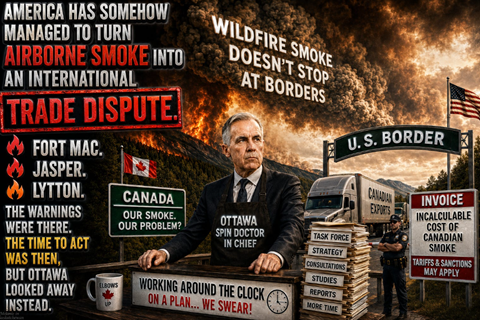
In Spiked, Frank Furedi explains why European elites and the poseurs who aspire to be counted among the elites must now ostentatiously and performatively hate US President Donald Trump (even more than they hated George Bush, if possible). Comment on dit “eLbOwS uP”?

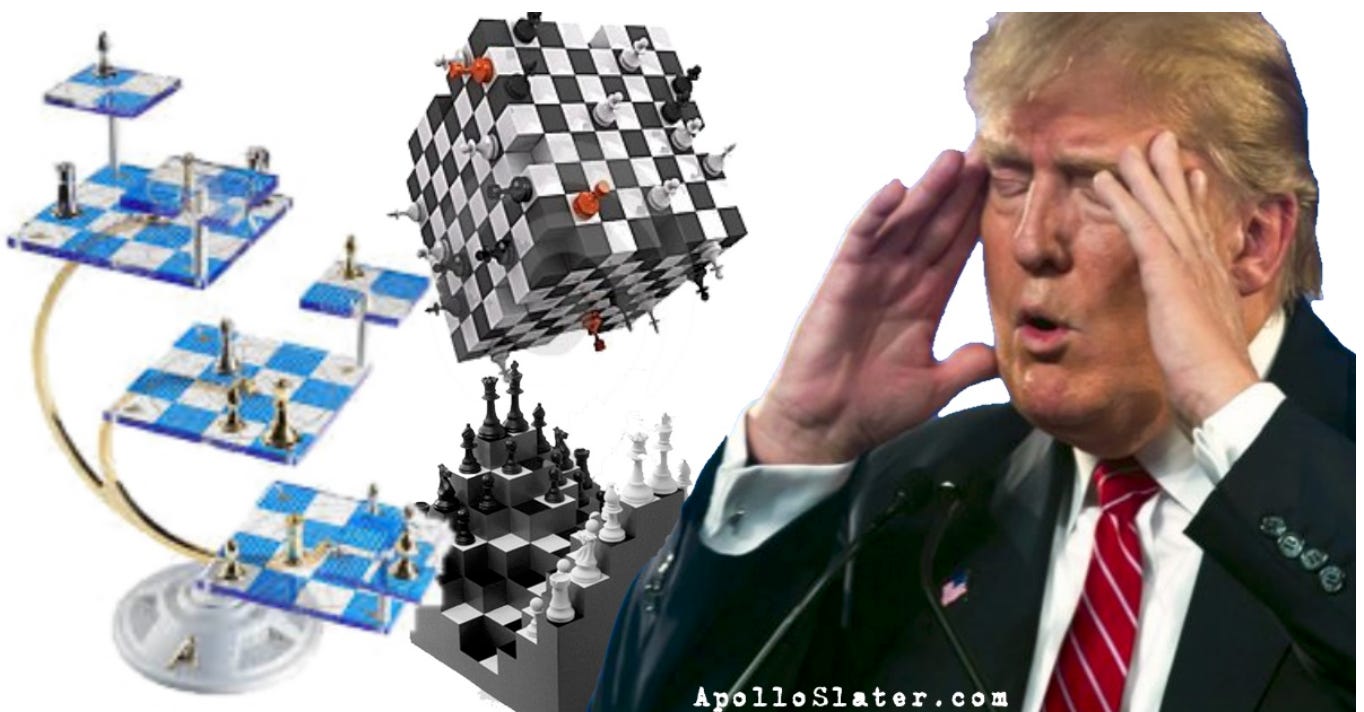
AI-generated image from AndrewSullivan.substack.com

In recent months, anti-Americanism has emerged yet again as a respectable prejudice in Europe. It is widely promoted through the mainstream media and enthusiastically endorsed by the continent’s cultural elites. There are now even numerous campaigns to boycott American goods – most respondents to a survey in France said they would support a boycott of US brands like Tesla, McDonald’s and Coca-Cola. As a piece in Euractiv put it, anti-Americanism is “in vogue across Europe”.

This has become all too clear at the Winter Olympics, currently being held in northern Italy. At the opening ceremony for Milano Cortina 2026, Team USA and vice-president JD Vance were booed by a crowd of over 65,000 people. Someone I know who attended the event told me that the booing was spontaneous and quickly became widespread. According to the European Union’s foreign-policy chief, Kaja Kallas, those booing were displaying “European pride“. It seems that for the Brussels elites, anti-Americanism bolsters Europe’s self-esteem.

The explicit target of this resurgent anti-American animus is, of course, US president Donald Trump. But it’s implicitly aimed at all those who voted for him, too. In a piece on boycotting American goods in the normally sober Financial Times, published last March, the author gave the game away. While saying it is “wrong to conflate Americans and their president”, he argued that “it’s [also] wrong to disentangle them entirely … Trump reflects half of America. He reflects a society where a democratic majority is prepared to tolerate mass shootings and a warped political system”.

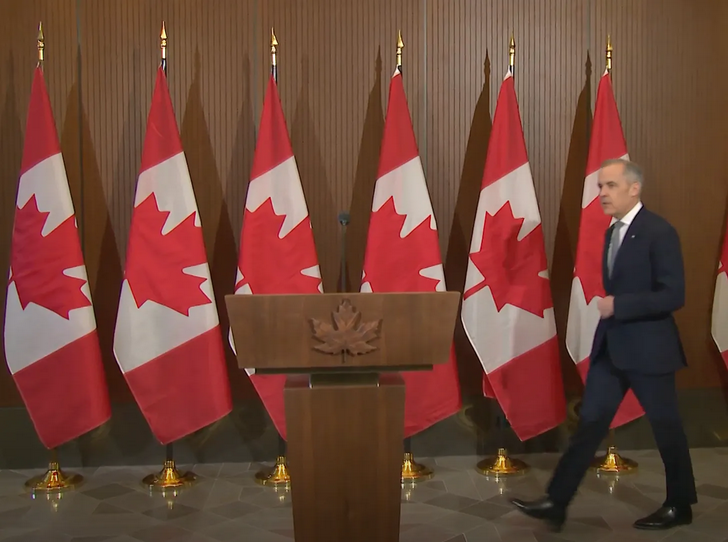
Certain politicians are being boosted by this wave of anti-Americanism. Canadian prime minister Mark Carney, in particular, has been turned into the unexpected hero of the European political establishment. His defiance of Washington has turned him into the posterboy for this new brand of anti-Americanism. “Europe has a lot to learn from Mark Carney”, was the verdict of the New Statesman. The Guardian echoed this sentiment: “Europe must heed Mark Carney – and embrace a painful emancipation from the US”.

Expressing anger against America appears to be the one emotion that binds the European political establishment. As one Financial Times commentator explained earlier this month, “Trump is Europe’s best enemy yet”. He has apparently provided Europe with the “common foe” it needs. It appears that anti-Americanism is now the glue holding together otherwise disoriented and divided European elites.

The reason usually given for this turn against the US is Trump’s behaviour towards Europe, specifically his threats to annex Greenland, impose tariffs and downgrade America’s NATO commitments. No doubt these policies have played an important role in putting Europe’s ruling classes on the defensive. However, they are not the leading cause of this wave of anti-Americanism. Rather, they have merely brought to the surface pre-existing prejudices deeply entrenched within Western Europe’s elite culture.

In his fascinating study, Anti-Americanism in Europe (2004), Russell Berman linked the growth of anti-Americanism during the 1990s and 2000s to the project of European unification. Berman claimed that, in the absence of an actual pan-European identity, anti-Americanism “proved to be a useful ideology for the definition of a new European identity”. He noted that the main way Europe defines itself as European is precisely by underscoring its difference from the United States.

February 12, 2026

Pro-tip – be suspicious “of any reporting on NATO from Europeans, especially from Brussels”

Filed under: Britain, Cancon, Europe, Media, Military, Politics, USA — Tags: , , , , , — Nicholas @ 05:00

CDR Salamander reacts with some exasperation to how European mainstream media are choosing to report pretty much anything involving the US/NATO relationship:

I’ve about reached my limit on lazy, high-emotion/low-reason, or performative reporting from Europe on the NATO/U.S. relationship. If the EuroLeft/EU-uber-alles crowd was really concerned about keeping the relationship between the U.S. and European NATO as good as possible, they would be making an effort to bridge and salve over some of the tough-love comments coming out of DC.

However, that is not what they are doing. No, they are seeing a gap, and are trying to pound a wedge into it. They see a spark, and look to throw a litre of petrol on it.

I guess what galls me the most is that their actions are, in operation, producing exactly the opposite condition they will tell you they are concerned about.

These are not dumb people. They, or the ones they work for, know what they are doing. At best, they are farming rage clicks. At worst, they are moving towards a desire the core of the EU nomenklatura has been driving for over decades — get the U.S. out of Europe.

They have found allies in part of the U.S. right-of-center coalition … and they will leverage that as well.

The below is just another example. A ham-fisted one, but one nonetheless.

Let’s dive in.

I don’t like to call out people by name … wait … yes I do.

Anyway, this isn’t personal; this is professional. No, wait. This reporting is so bad that, as a former proud NATO staff officer, I cannot let this stand. It is kind of personal. Plus this makes a larger point.

It isn’t petty either. As mentioned above, very serious people who are not our friends or our NATO allies’ friends — most of whom are citizens of NATO nations — are trying to seize the moment to push a multi-generational effort to wedge conflict between the U.S. and the Europeans in NATO.

Yes, there are some who are unknowingly doing their bidding, but make no mistake — bad reporting is allowed for a variety of reasons and should be called out when it happens.

First the larger point, then the details.

The reaction in Europe to the clear and direct peer counseling of our European allies by the U.S. over the last year has just demonstrated the fact that many of the people who put themselves forward as “experts” simply do not have either the knowledge or inclination to be anything of the sort.

For ideological, political, or standard issue look-at-me’ism, reporting about the state of the alliance and the American place in it drifts from farcical to the edge of a PSYOPS project by the usual suspects of the EuroLeft who have been trying to prove their anti-American bonafides since they first flirted with the cute socialist girl at the anti-NATO march in college.

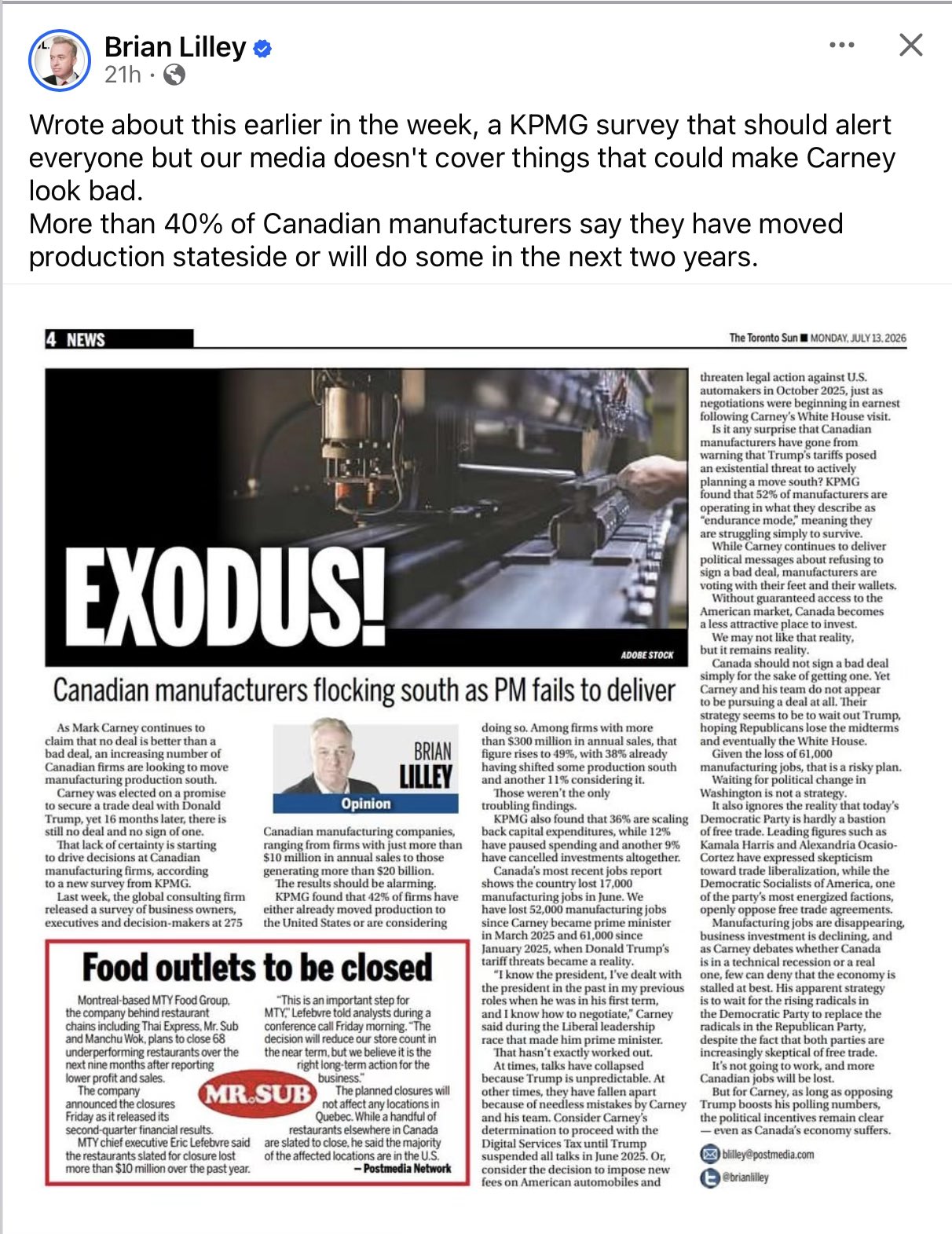
In related news, Chris Bray discusses Canada’s “Muscular New Anti-Trump Strategy™”, showing that it’s not just EU-based media to be suspicious of:

Recall the recent discussion here of the “Carney Doctrine”, after Canadian Prime Minister Mark Carney threw down the gauntlet at Donald Trump’s feet. Orange Man Bad, so Canada is going to become a rising power and lead a new international coalition to challenge the cruel American hegemon and stuff. The deeply silly opinion pages of the deeply silly New York Times celebrated Carney’s deeply silly speech, and declared the potential emergence of “an economic and defense alliance that rivals American power.” Back when all of this happened, I discussed the obvious condition of the Canadian armed forces, and advanced a sophisticated argument that LOL.

Reality keeps making the same joke. At the Federalist this week, I wrote about the recent notifications in the Federal Register about a series of arms deals that will allow Canada to make large purchases of American weapons. So as Carney spoke about challenging American military power on the world stage, he knew that his plan for doing that was to get the weapons from America. It’s an I want to punch you in the face, but first I need you to teach me how to throw a punch maneuver.

And then, this morning, Politico dropped this bomb, by which I mean that Politico has been eating a lot of Taco Bell and dropped into a stall in the gender-neutral office bathroom:

Muscular! Canada’s been puttin’ in work at the world order gym.

Note subhed: This is a story about “the new international order”. America is being shoved into the global background, now, as Canada flexes its haaaard new muscles. The story is illustrated with a ship, so obviously a huge announcement about naval powe— nope.

February 10, 2026

Trump’s bullying gets NATO members to get serious about defence

Filed under: Europe, Government, Military, USA — Tags: , , , — Nicholas @ 05:00

Living in a country that’s starting to feel a bit like little Melos facing the might of Athens in its prime, I can assure you that, for all of his other questionable moves, Trump has succeeded in forcing the NATO allies to address their freeloading on defence where every president before him had come up empty:

There are downsides to insulting and threatening friends and acting like a Mafia don slapping around his goons. You risk turning them against you, for one thing. But if those friends have been freeloading off you for years, well, there are some upsides, too. We’re seeing that as President Donald Trump’s rough treatment of our European allies has driven them to huffily make steps to actually defend themselves rather than continue to rely on the American defense umbrella.

There’s No Incentive Like a Kick in the Rear

For years, Trump has pointed out that the prosperous nations of Western Europe have long free-loaded off of American military might to maintain their security—especially against Russia’s threat from the East. He claims that, during his first term, he told NATO leaders if they didn’t meet the alliance target of 2 percent of GDP on military spending per member, they’d be on their own. According to him:

    One of the presidents of a big country stood up, said, “Well, sir, if we don’t pay and we’re attacked by Russia, will you protect us?” I said, “You didn’t pay. You’re delinquent?” He said, “Yes, let’s say that happened.”

    “No, I would not protect you. In fact, I would encourage them to do whatever the hell they want. You got to pay. You got to pay your bills.”

Those were rough words for supposed allies. They didn’t stand alone. Since then, Trump has also threatened to acquire Greenland over the protests of Europeans, Denmark (which governs the island territory), and Greenlanders themselves. That’s on top of his trade war antics which imperil the commerce that most effectively binds people together in peaceful relations. Such bullying has an impact.

“European governments and corporations are racing to reduce their exposure to U.S. technology, military hardware and energy resources as transatlantic relations sour,” Politico‘s Nicholas Vinocur and Zoya Sheftalovich wrote last week. “At a weekend retreat in Zagreb, Croatia, conservative European leaders including [German Chancellor Friedrich] Merz said it was time for the bloc to beef up its homegrown mutual-defense clause, which binds EU countries to an agreement to defend any EU country that comes under attack.”

“Military spending across the European Union is ramping up in what observers have noted is a significant and ‘extraordinary’ pivot from the comparatively placid postwar decades,” Northeastern University’s Tanner Stening observed last summer. “As part of the ReArm Europe plan, EU member states hope to mobilize up to 800 billion euros. In June, NATO leaders agreed to increase defense spending up to 5% of each country’s gross domestic product by 2035.”

Commenting on the Trump administration, eugyppius clearly understands something that a lot of Trump’s critics (and many fans) don’t seem to comprehend:

AI-generated image from AndrewSullivan.substack.com

An unstudied impression: Donald Trump is like a shark, in that he must always swim forward or risk suffocation. He, his administration and the media ecosystem that has grown up around Trump’s political persona depends upon action and controversy. In fallow news cycles, Trump steadily loses the initiative and two things happen: First, the media establishment and the leftist activist machine begin gathering their own critical momentum. Second, the vast MAGA-adjacent social media sphere must turn to other controversies to keep the clicks and the ad revenue flowing. Both of these work against the forty-seventh president and his purposes.

Since Trump’s initial barrage of executive orders has subsided, the media cycle has therefore lurched from one moment of hysteria and excitement to the next. Each new controversy totally eclipses the last. Hardly anybody remembers or talks about Nicolás Maduro any longer; the twin Minneapolis ICE shootings and associated protests, too, have faded. What were hailed as pivotal events which would finally discredit Trump’s programme this time look, in retrospect, like passing trivialities – not necessarily because they didn’t matter, but because sustained attention in this crazy messaging environment is impossible.

And on Trump’s pimp-handed dealings with the NATO allies:

Trump and NATO: Much of Trump’s MAGA base remains firmly isolationist and demands that the United States abandon the NATO alliance. Trump himself knows this and he has periodically questioned the utility of NATO. Formally, however, Trump’s administration stands behind the alliance, as anyone can see from reading the 2026 National Defense Strategy and the 2025 National Security Strategy. Yes, Trump wants European countries to increase defence spending. Yes, he still hopes to complete a strategic pivot away from Europe towards China. And yes, in the longer term, he probably nurtures ambitions of reducing the importance of NATO in favour of separate bilateral agreements with various European states. Such arrangements would also provide a lever for present and future administrations to disrupt the various policies and initiatives of the European Union, which Trump clearly despises and which at least as presently constructed amounts to a suicide pact for all of us on the Continent. These populist pressures and future ambitions, together with a general distrust and legitimate scorn for Eurocrat elites, seem to be why NATO periodically fades from Trump’s favour, although never for very long. All of this is to say that I really don’t think Trump’s January bluster was a mere Art-of-the-Deal negotiating tactic, but a reflection of real tensions and contradictions within Trumpism.

Trump and Europe: Here again, we see two competing tendencies. Generally, the Trump administration has followed a sly strategy of pursuing ties with the more or less aligned and presently ascendant populist-right movements of Europe. The Trump administration has also defended our rights to free speech, particularly on social media; relentlessly attacked our insane energy transition; and criticised our elites for their failure (or refusal) to stop mass migration. The purpose of these efforts is to isolate the Eurotards by fertilising the hostile populism that is growing ominously just beneath their double chins. If you are wondering why Trump bothers with this, I refer you to my previous paragraph: Sympathetic governments in key European states, joined to the United States, would be a means of sidelining the European Union and remaking Atlanticism in Trump’s image.

Exactly how to help the populist right into power is a much harder nut to crack. Expressing overt support for parties like Alternative für Deutschland can hurt more than it helps, and the Americans don’t have more direct means of influencing domestic politics over here. At the very least, this a long-term project requiring tactics and strategies we have yet to explore, and probably some institutions we have yet to create.

Update, 11 February: Welcome, Instapundit readers! Have a look around at some of my other posts you may find of interest. I send out a daily summary of posts here through my Substackhttps://substack.com/@nicholasrusson that you can subscribe to if you’d like to be informed of new posts in the future.

February 9, 2026

Jamil Jivani on his trip to Washington DC

Filed under: Cancon, Economics, Government, Media, Politics, USA — Tags: , , , , , — Nicholas @ 05:00

If you depend on the CBC, the Toronto Star or other legacy Canadian media, if you heard anything at all about Bowmanville-Oshawa North MP Jamil Jivani’s visit to key American leaders in Washington DC, you probably got the story framed as Liberals tut-tutting and disapproving of Jivani, his initiative to make the trip, and how he should leave everything to the government. If nothing else, it further proved that Prime Minister Carney doesn’t actually want better relations with the US, as his entire campaign was based on opposition to Trump and its success in riling up Canadian boomers with the moronic eLbOwS uP nonsense.

In the National Post Jivani discusses the trip and what he’s learned from it:

Image from Melanie in Saskatchewan

It was a whirlwind of a trip, full of excellent conversations. I had meetings with the White House and State Department, including conversations with President Donald Trump, Vice-President JD Vance, and Secretary of State Marco Rubio. Senators from Montana, Ohio, and Wisconsin, as well as the United States Trade Representative, each sat down with me to share their priorities. Businesses and industries employing thousands of Canadians shared their insights with me on where Canada-U.S. trade fits into their vision for economic growth.

Doors were open for dialogue about how Canada and the U.S. can work together at a time when pessimism gets most of the media attention. Certainly, my 15-year friendship with the vice-president played a key role in opening those doors. But what I found across the board was optimism about how we can move trade negotiations forward. I was particularly happy to hear key insights on how we can make progress on specific sectoral priorities, and the importance of strategic diplomacy. I offered my perspective on why CUSMA is so important to communities like mine in Bowmanville—Oshawa North, and I expressed my hope that CUSMA will continue to ensure Canada and the U.S. both benefit from a special economic and security relationship.

There is only so much I can share without first having the chance to speak with Prime Minister Mark Carney and Minister Dominic LeBlanc. Out of respect for their unique responsibilities in negotiating trade with the United States, it’s important that I debrief them before saying too much publicly and see how we can work together moving forward as Conservatives and Liberals.

However, I do want to point out a key observation related to the need for strategic diplomacy. Mexico — the third partner in our trilateral trade agreement with the U.S. — is further ahead in its engagement with the U.S. than Canada is. On Jan. 28, 2026, Mexico and the U.S. announced formal talks on CUSMA reforms. A week later, Mexico and the U.S. announced a joint action plan for critical minerals. Neither of these announcements included Canada.

Observers of this news would be right to worry that the current Canadian government may be making similar mistakes as were made under Prime Minister Justin Trudeau during the 2017 CUSMA negotiations. At that time, Mexico advanced its negotiations with the U.S. while Canada was largely left out of the process. It was only at the last minute, when a bilateral agreement between Mexico and the US was a real possibility, that Canada was included and our unique trilateral arrangement continued.

It would be a mistake to relive 2017 all over again, if for no other reason than Canadian workers and businesses deserve to have full representation in a process that has such a significant impact on our economy. The workers at the GM plant in Oshawa deserve to know that their government did everything possible to protect their jobs and encourage investment in their industry. All Canadians deserve to know that their elected officials are making the best effort possible to advance our national interests.

Full disclosure: Jamil Jivani is my Member of Parliament, and I fully support his decision to go and I hope that it actually does help make for improved trade relations between Canada and the United States. Bitterness and uncertainty only benefit the Liberal Party and Mark Carney, not ordinary Canadians. Attacking and criticizing Donald Trump plays well in our deranged and sycophantic media, but it makes Trump less willing to deal fairly with Canada on trade or other issues of critical importance to both nations.

February 7, 2026

Liberal horror at a Conservative MP going to Washington to talk trade

Jamil Jivani, Conservative Member of Parliament for the riding of Bowmanville-Oshawa North, is being called all sorts of names by Liberals and their creatures in the mainstream media for his temerity in actually going to Washington DC to try to encourage trade talks between Canada and the United States:

Image from Melanie in Saskatchewan

Mark Carney, I want to speak to you directly for a moment, because this whole episode has your fingerprints all over it.

You have spent months telling Canadians we live in a more dangerous and divided world. You have warned us that this is not a transition but a rupture. You have explained, repeatedly, that Canada must adapt, that middle powers must act differently, that old assumptions no longer apply. It is very serious language. Big language. The kind you deliver slowly, as if the room should be taking notes.

So imagine my surprise when a Conservative MP behaved exactly the way your speeches suggest Canada must behave, and Ottawa promptly short-circuited.

Jamil Jivani went to Washington to try to open a door you and your government have been telling Canadians does not exist. He used a personal relationship with JD Vance, not for applause, not for theatrics, but for the radical act of actually talking to someone who matters. And suddenly, Mark, this was not adaptive diplomacy. It was alarming. Inappropriate. A problem.

This is the part where your credibility starts to wobble.

Because let’s be honest. When people asked you about engaging Donald Trump directly, your response boiled down to “Who cares?” Either because it bored you or because you preferred not to acknowledge that door at all. So when a Conservative tries anyway, the issue is not that the door was touched. It is that someone proved it was never locked in the first place.

Jivani did not freelance. He did not sneak off. He offered this connection to your government first. Openly. Calmly. And it was dismissed. Brushed aside. Not interested. And when he went anyway, your side did not react with curiosity or even grudging respect. It reacted with outrage.

The kind of outrage you see when someone fixes a problem you have been holding meetings about for weeks without ever intending to solve it. Like an office that has spent months discussing a flickering lightbulb, only to panic when someone quietly screws in a new one and sits back down before the chair can call the meeting to order.

And then, almost on cue, came the shiny object.

I am not accusing you of anything, Mark. I am simply asking whether it is coincidence that the outrage over Jivani going to Washington was followed almost immediately by a dramatic announcement about dropping the EV mandate. Was that timing accidental, or was it a convenient way to make Canadians look over there while a Conservative threatened to come back with something measurable. I am not saying it was a distraction. I am just saying the choreography was impressive.

Now, let’s talk about cooperation, because you and your allies invoke that word constantly.

When generalized liberals complain that Conservatives will not “play ball”, what they seem to mean is that Conservatives are not being obedient. Cooperation, in practice, appears to mean standing aside politely while you govern unchallenged. It does not mean Conservatives doing something useful that might work. Especially not if it works where you did not.

And this is where your rhetoric corners you.

January 31, 2026

A new homily from Saint Hillary

Filed under: Media, Politics, USA — Tags: , , , , , — Nicholas @ 04:00

Chris Bray fondly remembers how the late Michael Kelly pin-pointed the moral character of Hillary Clinton very early in the first Bill Clinton term, where he named her “Saint Hillary”. She’s back in her bully pulpit again:

It’s a moral lecture on the true meaning of Christianity from Hilly Rodham Clinton, from Saint Hillary. All credit to Michael Kelly: Mrs. Clinton is still struggling with words. This is as dull a performance of narrative ineptitude as a human thing could possibly manage without actually turning into Tom Nichols:

    That compassion is weak and cruelty is strong has become an article of MAGA faith. Trump and his allies believe that the more inhumane the treatment, the more likely it is to spread fear. That’s the goal of surging heavily armed federal forces into blue states such as Minnesota and Maine — street theater of the most dangerous kind. Other recent presidents, including Joe Biden, Barack Obama, George W. Bush, and Bill Clinton, managed to deport millions of undocumented immigrants without turning American cities into battlegrounds or making a show of keeping children in cages.

    “The cruelty is the point,” as The Atlantic‘s Adam Serwer memorably put it during Trump’s first term. The savagery is a feature, not a bug. By contrast, as Serwer noted recently in these pages, the people of Minnesota have responded with an approach you could call “‘neighborism’ — a commitment to protecting the people around you, no matter who they are or where they came from”. To my ears, that’s as Christian a value as it gets.

First you notice the complete failure to land the facts, like the one about the way Barack Obama deported lots of people, but he didn’t make a show of keeping children in cages. The Obama administration built the cages, and this isn’t obscure. Similarly, and obviously, all those other presidents didn’t turn American cities into battlegrounds because no one fought against deportation during their terms. Nor have the Trump administration’s ICE operations turned “American cities” into battlegrounds. Dallas isn’t. Miami isn’t. The cities that are battlegrounds are cities where organized left-wing activism has manufactured a series of battles. Does Hillary Clinton notice that some cities are battlegrounds, but many cities are not? She most assuredly does not. It doesn’t help her to notice that, so her mind omits it. More box wine, and then more typing.

But since we’re talking about an argument made by Hillary Clinton, never mind about mere facts. Start with the fact that these are back-to-back paragraphs. First paragraph, assurance that previous administrations “managed to deport millions of undocumented immigrants”. Next paragraph, depiction of resistance to deportation as “a commitment to protecting the people around you, no matter who they are or where they came from”. How does one square a depiction of Clinton-era mass deportations as reasonable behavior with the placement of organized resistance to deportation under the umbrella of “neighborism”, real Christianity, and more specifically how does Hillary Clinton explain how she squares those opposing things? Short answer: She doesn’t even notice she’s done this. She doesn’t know there’s anything to square. She’s making word-sounds. She has no idea what any of it means.

Several decades ago, Michael Kelly told us that Hillary Clinton didn’t hear herself at all. And I still miss Michael Kelly. Hillary speaks, but she doesn’t listen. She half-absorbs events and the lives of other people, and coughs out a kind of instinctive Reader’s Digest annotated version, but mangles all the details as efficiently as bad AI. I could go on about this at great length, showing paragraph by paragraph how she misrepresents and misunderstands everything she discusses. Her discussions of toxic empathy and the ordo amoris show with great plainness that she doesn’t have the foggiest idea what the most basic outline of the discussion might be. But “the message of the preacher” persists, rising out of the least appropriate messenger you could ever ask for an essay on moral decency.

You have to give her credit. It can’t be easy to play a vampire for four straight decades.

Only one comment, Mr. Bray: she’s not playing.

Update, 2 February: Welcome, Instapundit readers! Have a look around at some of my other posts you may find of interest. I send out a daily summary of posts here through my Substackhttps://substack.com/@nicholasrusson that you can subscribe to if you’d like to be informed of new posts in the future.

January 26, 2026

The 2026 US National Defence Strategy

Filed under: Cancon, Government, Military, USA — Tags: , , , , , , — Nicholas @ 04:00

Noah looks at the recently released American National Defence Strategy and identifies areas of interest (or concern) for Canada (edited for typos):

The 2026 National Defense Strategy is out, and with it we get a few references to Canada. While our mention is little, and when there is it is fairly mundane, there is a message. You either step up or get stepped over. [NR: This has always been true, but administrations in the past have been more coy about it than President Trump … who is the opposite of coy. On the other hand, the Canadian government has been quite blatant about giving mere lip service to shared US-Canadian defence interests and slacking off completely on any serious work to keep the Canadian Armed Forces in a state to be able to do what the government pretends to want.]

This policy was shadowdropped in the middle of the night, so I decided to quickly rush to get just about anything out about it. This isn’t a full analysis, but more a quick rundown with some personal thoughts for those who want the quick go of whats happening.

To start, here are the direct mentions of Canada:

    We will engage in good faith with our neighbors, from Canada to our partners in Central and South America, but we will ensure that they respect and do their part to defend our shared interests. And where they do not, we will stand ready to take focused decisive action that concretely advances U.S. interests.

The policy continues:

    Canada also has a vital role to play in helping defend North America against other threats, including by strengthening defenses against a missile, and undersea threats. In addition, U.S. partners throughout the Western Hemisphere can do far more to help combat illegal migration as well as to degrade narco-terrorists and prevent U.S. adversaries from controlling or otherwise exercising undue influence over key terrain, especially Greenland, the Gulf of America, and the Panama Canal.

The strategy itself is fairly domestic in focus, with repeated mention of the Western Hemisphere and borders as the key areas for which the United States should focus. It takes a backseat approach to the Indo-Pacific, favoring a collaborative approach to Chinese containment that focuses on “peace through strength”, instead of what the NDS refers to as “confrontation”.

In this regard, it is funny that despite criticisms today from President Trump regarding Canada’s trade deal with China, as well as criticism over an apparent lack of Canadian support for Golden Dome, the NDS further states that “President Trump seeks a stable peace, fair trade, and respectful relations with China.” [NR: I think Noah is being a bit naive here … Trump wants to deal with China as a normal trading partner, but China’s actions in so many ways show that China doesn’t want to reciprocate.]

The strategy further states that “Our goal in doing so is not to dominate China; nor is it to strangle or humiliate them. Rather, our goal is simple: To prevent anyone, including China, from being able to dominate us or our allies.”

On today’s Golden Dome comments, I wanna take note that Canada has been discussing participation fairly openly and trying to figure out in what ways we can align even without full participation. There is no indication the current government is against Golden Dome.

The RCAF has its own IAMD study underway in Canadian Shield. It is already fairly well aligned to what the Americans are doing. People will focus on space-based interceptors and such, but Golden Dome is far more extensive than that. There’s much we align on without joining.

Canada is also undertaking its own extensive modernization of both NORAD and space-related assets, both of which will significantly contribute to Continental Defence in a variety of different ways. That includes OTHR and F-35, yes, but is so much more extensive.

From autonomous vehicles in the Arctic to ground- and space-based optical capabilities, AEW&C aircraft, new satellite constellations for both communication and surveillance, domestic launch investments, and even establishing a VLF communication capability.

There is so much going on that can and will contribute to collective Continental Defence. Much more than I believe anyone truly knows about, even myself. We need to highlight and promote these investments if we want mentalities to change and people to recognize the effort.

King Donald the First

Filed under: Government, History, Media, Politics, USA — Tags: , , , , — Nicholas @ 03:00

His most rabid fans liked to call him the God-Emperor, but Andrew Sullivan sees him much more as a modern King George III:

King George III in his Coronation robes.
Oil painting by Allan Ramsay (1713-1784) circa 1761-1762. From the Royal Collection (RCIN 405307) via Wikimedia Commons.

It is where lies and truth are entirely interchangeable; where the rule of law has already been replaced by the rule of one man; where the Congress has abdicated its core responsibilities and become a Greek chorus; where national policy is merely the sum of the whims and delusions of one man; and where every constitutional check on arbitrary power, especially the Supreme Court, is AWOL. In that abyss, even an attempt to explain events through the usual rubric of covering a liberal democracy is absurd. Because that rubric is irrelevant.

And so the wheels spin.

The only honest way to describe what is in front of our noses is that we now live in an elected monarchy with a manic king whose mental faculties are slipping fast. After 250 years, we appear to have elected the modern equivalent of King George III, and are busy dismantling the constitution Americans built to constrain him.

The situation is not irrecoverable — the forms of democracy remain even if they are functionally dead. We have centuries of democratic practice to fall back on. But every moment the logic of the abyss holds, the possibility of returning to democracy attenuates. Tyranny corrupts everything and everyone — fast. David Brooks returns to the ancients today to understand where we are:

    As the disease of tyranny progresses, citizens may eventually lose the habits of democracy — the art of persuasion and compromise, interpersonal trust, an intolerance for corruption, the spirit of freedom, the ethic of moderation. “It is easier to crush men’s spirits and their enthusiasm than to revive them,” Tacitus wrote. “Indeed, there comes over us an attachment to the very enforced inactivity, and the idleness hated at first is finally loved.”

Forty percent of the country still backs the tyrant. Forty percent watch this and cheer.

Let us briefly review what they are cheering. For the first time since the Second World War, the president of the United States declared last week that we no longer support the notion of national sovereignty or collective security, and reserve the right to invade and occupy other sovereign countries — even close allies — to extract their resources. Quite a Rubicon. His chief adviser declared international law a dead letter:

    [W]e live in a world, in the real world … that is governed by strength, that is governed by force, that is governed by power. These are the iron laws of the world since the beginning of time.

To put it bluntly, this was the argument of King George III. It was the justification for the British Empire, and, more hideously, for the Nazi and Soviet occupations of Europe. It’s a rejection of the principle that literally created the United States.

And yet this mad king threw this founding principle away because he believes a) we deserve Greenland as reparations for World War II, b) because Russia and China would invade otherwise, c) because rare earths are there — even though they are buried under a mile of ice — and d) because he didn’t win the Nobel Prize. Insane.

This staggering concession to evil — which cannot be withdrawn — robs us of any case against Russia’s invasion of Ukraine or China’s threat to Taiwan. It legitimizes war by major powers for conquest everywhere. It endangers the entire system of collective security that has kept the peace for nearly 80 years. Why? And for what? Because the king was on a high.

That’s where we are.

January 22, 2026

Carney in Davos … “the mismatch between message and messenger is … very special”

I make it a point not to listen to politicans’ speeches, as I need to keep my blood pressure within safe ranges for health reasons. A lot of Canadian commentators have been gushing with praise for Prime Minister Mark Carney’s bloviations at the WEF gabathon in Davos, because of course they have. Brave Mr. Carney standing up to the Bad Orange Man and getting ovations from the kind of people he’s most comfortable dealing with. How very nice for him. But as Chris Bray explains, it didn’t play quite as well with the rest of the non-Davos-attending world:

Mark Carney gave a speech in Davos, that fortress of democratic pluralism where hotel rooms inside the security zone cost thousands of dollars a night and no one with an expense account has to be lonely because the massive security forces don’t try to interfere with all the sex trafficking, which is very democratic. Anyway, the speech was stunning and brave, and everybody clapped a lot.

Someone put the word “flexes” next to the word “Canada”, apparently not intending to cause laughter, but yes: Mark Carney flexed and warned and puffed himself up like a man who’d just eaten the wrong part of the fugu.

You should watch it. Don’t try to eat or drink during the speech, because you’ll choke, and push any breakable household goods away from the reach of what will soon be your flailing arms, but you should watch him perform this extraordinary set of stranded symbols. The mismatch between message and messenger is … very special.

I was physically paralyzed as an effect of hearing this sentence from this face for a full ten seconds, and then I spasmed. It’s like watching Erich Honecker stand up to the East German regime. “We cannot tolerate misogyny, warns Jack the Ripper.”

Carney hinted broadly that the rules are breaking down in international relationships …

… which for the first time in a long time are being reshaped by mere power, a rare thing on the global stage, because there’s meanness and bullying and a rejection of friendly norms and restraint from … someone very bad, not that he was naming names, and so Canada is turning to new partners, extending the hand of friendship to nations and leaders that still care about rules and values and democracy.

The central banker who was selected as his country’s head of government before he’d ever stood for election to any office anywhere ever, the prime minister of a country where the government had just been rebuked by its courts for faking a national security emergency so it could suspend the rule of law and crush dissent, gave a real tubthumper about democracy and the rule of law.

The total absence of connection between “things being said” and “things being done” sets a record, here.

January 21, 2026

“It is a deal so bad that only Keir Starmer could have negotiated it”

In Spiked, Fraser Myers says that British Prime Minister Keir Starmer fully deserves to be humiliated over his give-it-all-away negotiations for the Chagos Islands, which includes the strategic naval base at Diego Garcia:

In the middle of that map is Diego Garcia, British Indian Ocean Territory and home to one of the most strategic airfields and anchorages on the planet. […] The red circle is 2,000 nautical miles from the island. The purple circle is 1,150 nautical miles, roughly the distance from London to Malta, that represents the distance from Diego Garcia. That circle is also the distance from Diego Garcia to the island of Mauritius.
Caption and image from CDR Salamander.

With the assistance of the brightest and best of the UK Foreign Office, the Labour government agreed to an arrangement that would hand over territory containing an Anglo-American military base to an unfriendly country, condemn its former inhabitants to permanent exile, and pay tens of billions of pounds for the pleasure.

I’m talking, of course, about Chagos (officially, the British Indian Ocean Territory), which has briefly caught the attention of the world’s most powerful man. This morning, amid a flurry of Truth Social posts about his designs on Greenland, US president Donald Trump’s gaze briefly alighted on this small, tropical archipelago on the other side of the planet. And he did not hold back in his criticism of Britain’s plans: “Shockingly, our ‘brilliant’ NATO Ally, the United Kingdom, is currently planning to give away the Island of Diego Garcia [the largest of the Chagos Islands], the site of a vital US Military Base, to Mauritius, and to do so FOR NO REASON WHATSOEVER”, he wrote. “The UK giving away extremely important land is an act of GREAT STUPIDITY”.

Trump’s reaction has widely been described as a major about-turn. But, in truth, his team has veered all over the place on the Chagos question. In October 2024, when Starmer initially agreed to hand over the islands, Marco Rubio, then still a US senator for Florida, reportedly warned that this would allow “Communist China” to spy on the US Navy, given Mauritius’s alliance with China. Yet in February 2025, when Starmer visited the Oval Office, the US president said he was “inclined to go along with” the UK’s proposals. And by May, when the deal was signed between the British and Mauritian governments, Rubio, by now US secretary of state, welcomed it. He claimed that Trump himself had “expressed his support for this monumental achievement”, hailing the deal that would cede sovereignty to Mauritius, while Diego Garcia would be leased to Britain for the next 99 years.

Of course, Trump’s motivation for bashing Starmer’s deal now has little to do with the Chagos Islands themselves. The real prize for the US president is in a different hemisphere entirely, as he freely admits. In a bizarre non-sequitur, the US president’s Truth Social post goes on to say that the Chagos deal is “another in a very long line of reasons why Greenland has to be acquired” by the US. This smackdown over Chagos, this attempt to humiliate Starmer and Britain on the global stage, is clearly part of Trump’s broader pressure campaign against the European powers, in his bid to seize Greenland for the US.

Nevertheless, it really should not have taken Trump’s intervention to put the brakes on the dreadful Chagos deal. Whichever way you spin it, this arrangement has never been in Britain’s national interest, nor the interests of the Chagossians who call the islands their home. It poses a risk to Western security interests, handing sovereignty over a territory, where almost 400 UK and US troops and 2,000 contractors are based, to a country that’s allied to China. The cost of leasing back Diego Garcia from Mauritius is also eye-watering. Although the Labour government tried to present the cost as just £3.4 billion, the true figure is believed to be 10 times as much, at around £34.7 billion.

So what on Earth possessed Starmer to sign up to such a risible deal? What leverage was a tiny island like Mauritius able to gain over Britain?

January 20, 2026

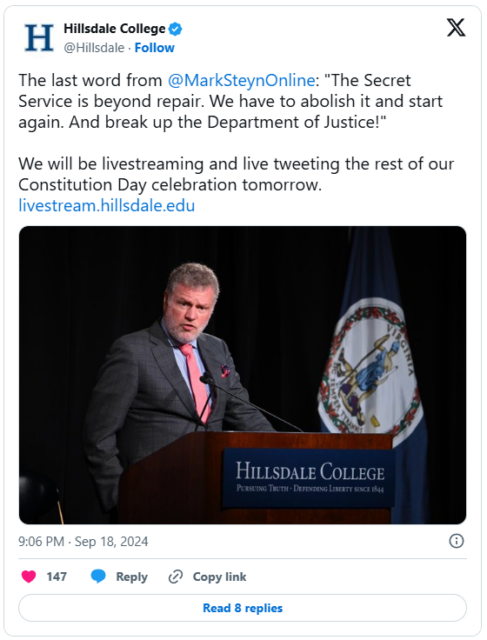
Mark Steyn on demographics, Trump, and Greenland

Filed under: Europe, History, Media, Military, Politics, USA — Tags: , , , , , — Nicholas @ 04:00

Mark Steyn was warning about demography in the west twenty years ago, and at the time he was dismissed as a crank. Now, not only have the demographic forecasts matched what he predicted, they’re actually worse:

As noted yesterday, twenty years ago this month — January 2006 — The Wall Street Journal and The New Criterion published the first draft of what would become the thesis of my bestselling book, America Alone.

The Journal headline sums it up:

The sub-head makes plain what’s at stake:

    The real reason the West is in danger of extinction.

And the lead paragraph spells it out:

    Most people reading this have strong stomachs, so let me lay it out as baldly as I can: Much of what we loosely call the Western world will not survive this century, and much of it will effectively disappear within our lifetimes, including many if not most Western European countries.

Two decades ago that scenario was dismissed as “alarmist” by the bleepwits of The Economist. Today it is assumed by elites of all stripes, from the authors of the new US National Security Strategy

    Trump warns Europe faces “civilizational erasure” in explosive new document

… to peer-reviewed papers positing that all Western European nations other than Portugal and micro-states such as Andorra will become majority Muslim

… to the Deputy Leader of Britain’s supposedly “populist” party reacting to news that native Anglo-Celts will become a minority in the UK by 2063 — and in England rather sooner than that:

    I’ll be long gone by then.

So, in the twenty years since my Wall Street Journal essay, the ruling class has gone from “alarmism” to “yeah, it’s happening, but maybe not until 2100” to “okay, it’s a fait accompli, but what’s the big deal?” As to Richard Tice being long gone, which is devoutly to be wished, 2026 to 2063 is thirty-seven years — or Whitney Houston to now.

This is why nobody cares about the pleas of the “expert” class to save the “rules-based international order”, which is a long-winded way of saying “1950”. Trump, for one, is moving on:

The obsession with Greenland, so bewildering to US “allies”, derives from America’s need for an Israeli-style “Iron Dome”, which, as the mighty builder of Trump Tower, the President has upgraded to a “Golden Dome”. Why would he seek such a thing? Because in this scenario America’s Israel …and Western Europe is Gaza, the West Bank, Lebanon, Syria and Iran.

Twenty years ago, my eventual book-length argument was summarised in the Toronto Globe and Mail by the eminent “political scientist” William Christian as “quite possibly the most crass and vulgar book about the West’s relationship with the Islamic world I have ever encountered“. Professor Christian has evidently led a sheltered life: he was born in the Queen Charlotte Islands, which are now officially known as “Haida Gwaii”, a bollocks name invented in hopes of appeasing “the Haida nation”; it turns out that these days nowhere is really that sheltered, don’t you find?

But just because something is “crass and vulgar” doesn’t mean it’s not correct. It’s certainly straightforward. The western world is going out of business because it’s given up having babies. The mid-twentieth-century welfare state, with its hitherto unknown concepts such as spending the first third of your life in “education” and the last third in “retirement”, was carelessly premised on mid-twentieth-century fertility rates, and, as they collapsed, the west turned to “migrants” to be the children they couldn’t be bothered having themselves. The condition of your maternity ward may be “crass and vulgar”, but it’s not a speculative prediction.

eugyppius discusses the European response to President Trump’s public statements about Greenland:

Eager to make an epic display of retardation demonstrate resolve and independence in the face of these sudden American ambitions on Danish territory, a variety of European countries announced they would send soldiers to Greenland in a display of “military solidarity” with Denmark. Germany sent a grand total of 13 or 15 soldiers (reports vary) to defend the icy island against the Americans. They departed on a matte grey A400M Atlas military transport with plenty of press on hand for photographs. You could almost hear Wagner’s “Ride of the Valkyries” between the lines of the press coverage.

Alas, the Eurotards also did not want to possibly in some hypothetical world perhaps overstep by maybe potentially creating conditions for anything that might conceivably be interpreted by the Americans as a show of force on Greenland itself, so the Luftwaffe A400M landed politely in Denmark, thousands of kilometers away from the disputed territory. From there, all the soldiers boarded a completely non-threatening commercial airline to Nuuk, Greenland’s capital. While this was happening, German Defence Minister Boris Pistorius desperately assured the press that it was a purely routine and preplanned mission.

The next thing to happen, while our soldiers were sitting in Greenland for no reason, was that all these efforts to make a statement while not really making a statement to avoid annoying the Americans backfired, in that the Americans got annoyed anyway. U.S. President Donald Trump announced on Truth Social that all participants in this publicity junket would be slapped with punitive 10% tariffs, to be increased by 1 June 2026 to 25% tariffs, “until such time as a Deal is reached for the Complete and Total purchase of Greenland.”

Hours after Trump posted this note, the Greenland weather soured and our soldiers cancelled an “exploratory tour” they had planned for Sunday afternoon and returned to the Nuuk airport to fly home a few hours ahead of schedule. This lent the impression that Trump’s wall-of-text Truth Social post had scared them into a retreat from Greenland, inspiring hours of social media mockery. In the end we did succeed in making a statement, if not precisely the one we had intended.

Update, 21 January: Welcome, Instapundit readers! Have a look around at some of my other posts you may find of interest. I send out a daily summary of posts here through my Substackhttps://substack.com/@nicholasrusson that you can subscribe to if you’d like to be informed of new posts in the future.

January 19, 2026

Regulating the clankers

At the Foundation for Economic Education, Kevin T. Frazier and Antoine Langrée consider how artificial intelligence can be regulated by state and federal bodies:

Yes, I’m still 12

President Donald Trump’s executive order on artificial intelligence invites analysis of a question so complex that it rarely gets asked: “What exactly do states have the authority to regulate?”

The current, somewhat trite answer is, “The residuary powers reserved under the Tenth Amendment”. Omitting the legalese, that means that states can do whatever the federal government cannot.

States have the power to look out for the health, safety, and welfare of their residents. Thus, for instance, they have the power to address local concerns through zoning laws, professional certifications via licensing regimes, and ensure public safety through law enforcement. These authorities make up what’s often referred to as a state’s “police powers”.

While this generic reading of state power is not necessarily wrong, it’s imprecise. As the AI Litigation Task Force created by Trump’s EO starts its work, a more specific answer is warranted.

The task force is charged with challenging “unconstitutional, preempted, or otherwise unlawful State AI laws that harm innovation”. Reading between these lines, its mission is to contest state laws that interfere with the Administration’s vision for a national AI policy framework. This isn’t an unlimited charge, though. Federal courts reviewing state laws will only strike them down if they fail to align with the Constitution’s allocation of authority or otherwise prove unlawful.

Many stakeholders in AI debates liberally interpret the authorities afforded to states. Based on concerns of existential risk to humanity and the idea that states must protect the health of their citizens, state legislators have proposed and enacted laws that impose significant obligations on the development of AI. Some assume they must have this right, since protecting the lives of their residents is a core priority and unquestioned authority of state governments. After all, since the founding, states have been able to enforce quarantines out of a concern for public health — aren’t aggressive AI laws just extensions of such public health measures, but tailored to the threat of modern threats?

It’s not that simple. States’ police powers are reasonably broad, but not unlimited. States must respect both an upper bound — the purview of enumerated powers reserved for federal authority — and a lower bound—the rights retained by the states’ citizens. These constraints have been tested in litigation throughout our Constitution’s history, notably when state law conflicts with the federal government’s exclusive authority over interstate commerce and when states unduly limit the freedoms of their residents.

These notions are relatively blurry and highly contextual. As national regulatory policy evolves, so too does the extent of preemption. The Lochner era, for example, was a paradigm shift for state police power: as courts expansively interpreted the individual liberty to contract, states’ police power over health, labor protections, and market regulation shrank significantly — only to be restored later. Likewise, individual liberties and valid justifications for their abridgment have evolved to fit developments in civil rights law — from Brown v. Board to Dobbs and Lawrence.

Despite these significant changes in context, the constitutionality of states’ exercise of their police powers follows a bounded framework. This can be observed in the jurisprudence on public health measures — a prime example of police powers. Quarantine orders, from nineteenth-century epidemics to Covid-19, have a direct link to protecting local communities — one of the most important elements of state police powers. They respect the upper and lower bounds of police powers. First, they are geographically specific: they only affect local residents or people coming into local communities. Second, they directly reduce the risk to state residents: quarantines are known solutions to real threats to the health and safety of local communities. They infringe the individual liberties only insofar as is necessary to protect state residents’ vital interests.

January 18, 2026

QotD: Having zero agency

Filed under: Media, Politics, Quotations, USA — Tags: , , , — Nicholas @ 01:00

I am not sure I remember too much from my high school philosophy class, other than the lesson that I probably would not be actively pursuing a career in philosophy. But I remember one discussion about displaying one’s rebellious nature by doing the exact opposite of whatever an unfavored person said. The teacher made the point that if you always did the exact opposite of what person X says, then you are just as much ruled by X as any of X’s most cultish followers. In such a case you have completely abdicated your agency to X.

I took the lesson from that, which I still try to follow to this day, that you have to process people’s actions and ideas one by one. Certainly this is not to say that there is no room for trust and reputation. If I have found myself agreeing with someone historically and they have been proved right on certain topics time and again, I am going to give their next statement a lot of credence — but I am still going to mentally challenge it to some extent. And for individuals, this sort of reputational trust can vary by topic. If my wife gives me a read on a person, I am going to assume she is correct; if she opines on navigation issues when we are walking around an unfamiliar city, I am going to treat that with a lot more skepticism.

Most will have guessed where I am going with this — the opposition to Trump has reached this point of zero agency. Smart people I know will mock everything Trump says, even if it is something they would normally agree with or at least entertain. People who are extraordinarily skeptical of all medication suddenly think that concerns about Tylenol during pregnancy are totally absurd. The whole Tylenol story is actually pretty interesting — a Harvard dean’s imprimatur seems to tick the credentialism box that was so prominent in COVID, but a look at the quality of the research and the money involved tends to make one very skeptical. And of course a lot of what RFK says makes me skeptical. The whole story is a really interesting, including appeals-to-authority issues we had during COVID, only with the parties reversed. But no one really looks because if Trump said it, it must be mocked.

Coyote, “On Having Zero Agency”, Coyote Blog, 2025-10-02.

January 17, 2026

How would Greenlanders cope with a sudden case of American citizenship?

Filed under: Americas, Europe, Media, Military, Politics, USA — Tags: , , , — Nicholas @ 04:00

Only a minority of Canadians would welcome Donald Trump’s offer to become the 51st state, and Canadians have a long history of coping with the overflow of American politics across the border. Greenland is suddenly a target for involuntary statehood if Trump gets his way, yet few seemed to be concerned how the actual people in Greenland feel about this proposed change of legal status:

Satellite view of Greenland, Iceland, and parts of Northern Canada.
NASA/Ames Research Center, 17 May, 2005.

According to President Donald Trump, taking possession of Greenland is a national security necessity. It’s so critical, he claims, that he’s willing to take the chilly island the “easy way” or the “hard way”. Denmark, which governs Greenland, isn’t eager to surrender the territory. Even more important, the residents of Greenland, most of whom don’t especially want to be Danish, have even less interest in becoming American. The leader of a country founded on high-minded sentiments about the “consent of the governed” should consider taking that into account.

[…]

“56% of Greenlanders answer that they would vote yes to Greenlandic independence if a referendum were held today, 28% would vote no, and 17% do not know what they would vote for,” The Verian Group announced a year ago about a survey it conducted in Greenland.

With regard to Trump’s long-voiced desire to acquire Greenland for the United States, Verian’s Camilla Kann Fjeldsøe added, “the results show that 85% of Greenlanders do not want to leave the Realm and become part of the United States, while 6% want to leave the Danish Realm and become part of the United States, whereas the remaining 9% are undecided”.

Greenland’s 57,000 people don’t want to be Danish, but they really don’t want to be American. If forced to choose between remaining an appendage of one country or joining another, they’ll likely take the devil they know over the one they don’t.

What About the Consent of the Governed?

That’s a problem for Trump’s imperial ambitions — annexing Greenland would have to happen over the objections of the people who live there. The U.S. could get away with that sort of thing when it didn’t even pretend to give a damn about what the Sioux and the Cheyenne wanted, and when it bought the Louisiana Territory and Alaska from autocratic regimes. It’s not as if Napoleon Bonaparte or Czar Alexander II were going to offer their subjects a say in the matter anyway. But Denmark is a relatively inoffensive liberal democracy that holds regular elections. Greenlanders are accustomed to picking their own political leaders and having input into their fate. If asked, they’ll almost certainly reject the offer.

So, is Trump really going to opt for doing it “the hard way” and just grab the island?

When the United States decided its own fate 250 years ago, the Declaration of Independence set out grievances with the British crown, as well as some basic principles for the new nation. Among them:

    We hold these truths to be self-evident, that all men are created equal, that they are endowed by their Creator with certain unalienable Rights, that among these are Life, Liberty and the pursuit of Happiness.–That to secure these rights, Governments are instituted among Men, deriving their just powers from the consent of the governed.

Most Americans no longer consented to be governed by King George III or the British Parliament and so set up a new country with a government of its own. What excuse would we have for foisting American governance and laws on Greenlanders if — as seems likely — they reject political affiliation with the U.S.?

In his Weekly Dish, Andrew Sullivan — who has never in his life been a fan of Donald Trump — warns that “Greenland is a Red Line” and crossing that line will destroy the American constitution (Warning – contains Andrew Sullivan):

(more…)

January 15, 2026

“The logic employed to support an invasion of Greenland is purely onanistic”

Filed under: Europe, Media, Military, Politics, USA — Tags: , , , , , — Nicholas @ 04:00

Last week, I reposted part of CDR Salamander’s view of President Trump’s desire to take Greenland from Danish control. I still don’t really understand his motivation, so Kiran Pfitzner‘s take that Trump’s “perverse interest in Greenland” can only be explained as rising from a belief “that conquest, that being a conqueror, is a pleasant fantasy to indulge in”:

“InfantryDort” is not worth responding to, but the tweet is a useful frame for our discussion.

Aside from morality and legality, invading Greenland is, strategically speaking, utterly pointless. Even if we were to entirely neglect the consequences of such an act on our alliances and reputation, the act alone constitutes sheer stupidity as a pure question of strategy.

It is true that the idea of buying Greenland was floated during the Truman administration and again during the Eisenhower administration. However, a number of factors differentiate that endeavor:

  1. The offer was made secretly, so as to prevent any political or diplomatic complications over the question.
  2. The significance of Greenland was peculiar to the time — a nuclear attack on the US would have had to have come over the Arctic by Soviet bombers — technology has since starkly reduced its importance.
  3. Most importantly, previous administrations had clear ideas of what was needed from Greenland, and so were able to simply negotiate with the Danish government to gain access without the political difficulties of annexation.

This illustrates the great strategic problem of any suggestion of invasion: there is no specific aim or purpose. The endeavor is justified only in vague terms of “security” or the childish assertion that “we need it”. How it is to actually improve our security or why exactly we need it are nowhere addressed.

As Clausewitz writes, the aim of war is to put our enemy in a position more painful than the sacrifice which we demand from him. What exactly is it we want from Greenland? What have they denied us that we should seek to gain by force?

To even consider the question in practical terms, we must reckon with the simple fact that, in the era of a nation state, allies are infinitely more useful than occupied territory. Even bearing in mind that allied interests will never be entirely congruent, a state organic to a territory will be able to draw forth greater exertions from the same resources than a foreign occupier would, even before accounting for active resistance. A people will always provide their own state with more energy and zeal than they will offer to a conqueror.1 There is less “friction”.

The great benefit of alliances is in the ability to access this voluntary energy, which cannot be called into being by the dictates of a conqueror. Nationalism is such a potent force that conquest has become inordinately difficult and costly, being a net negative to state power in virtually all cases (a subject I have previously written on).2 That the United States can access Greenland’s territory without having to conquer it is already the best of all worlds.


  1. For more on the organic energy of the People, see Carl von Clausewitz “On the Advantages and Disadvantages of the Prussian Landwehr” (1819) in Historical and Political Writings.
  2. See also: Posen, Barry R. “Nationalism, the Mass Army, and Military Power”. International Security 18, no. 2 (1993): 80–124.
« Newer PostsOlder Posts »

Powered by WordPress