Quotulatiousness

January 10, 2026

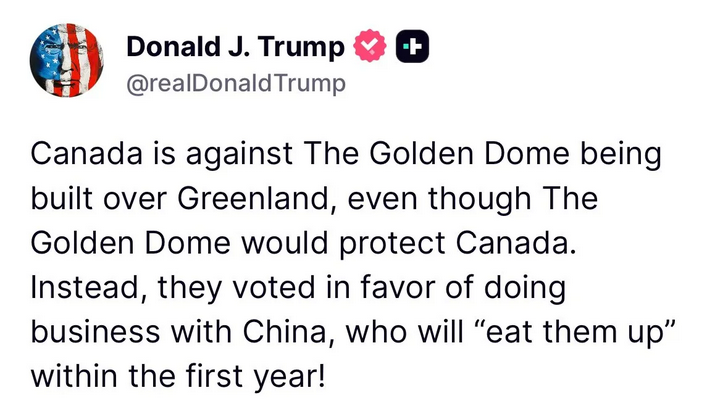
Why Greenland of all places?

Filed under: Europe, Media, Military, Politics, USA — Tags: , , , , — Nicholas @ 03:00

President Trump’s renewed interest in Greenland seems inexplicable to most of us, unless it’s part of his notorious 51st state plan to further encircle Canada (forget I said that, the Liberals might use it to scare the boomers again…). A few days back, CDR Salamander discussed the “unfortunate Greenland kerfuffle” on his Substack:

It would be an understatement to say that I am not all that pleased with where we are in January 2026 with the Greenland question. This would not have been the productive path I would have recommended because, in the end, this is a very serious issue.

Sure, in the first few months of 2025, the meme-ish nature of it all was fun and funny … but only to a point.

In 2026, Denmark is not going to sell or otherwise transfer Greenland to the USA like they did with the now-U.S. Virgin Islands a bit more than a century ago.

However, before we go further, if you have a knee-jerk reaction to support or oppose anything or any topic because DJT is involved, please repress that feeling until at least the end of the post. It isn’t productive, enlightening, or good for your health — so give it a rest for a bit until we are done, then you can carry on as before.

Next, let’s do as we should in most things: let’s go to the chartroom.

Object Zero’s crayon work on the Arctic Institute’s map is superb to illustrate that point.

The Europeans have whipped themselves into an almost comical lather over it all. Having lived with their NATSEC nomenklatura for years, I’m not shocked. They tend to be very narrowly read, get their ideas about the USA from NYT, WaPo, the usual suspects in East Coast Universitlandia, and their nomenklatura is worm-ridden with the same people who opposed Cold War NATO efforts to counter the Soviet Union’s militarism and supported every anti-USA trend of the fiscal quarter, etc. It is always 1968 or 1983 with these people.

Unhelpful to trans-Atlantic cooperation has been an almost gleeful approach to triggering these people who never thought DJT would come back to power, and from 2020-24 acted like it. The vengeful and bitter are fighting with the frag-pattern hitting everyone else.

Behind that triggering and, at least from this side of the pond, trolling, is a very serious security concern in the high north that Greenland is, literally, right in the middle of.

At The Conservative Woman, Jonathon Riley wonders if Greenland is worth more than the NATO alliance:

Satellite view of Greenland, Iceland, and parts of Northern Canada.
NASA/Ames Research Center, 17 May, 2005.

Greenland is the world’s largest island, (just) contiguous with Canada, and geographically part of North America. It was colonised by Denmark in the tenth century but the Norse settlements, which farmed sheep and cattle, died out during the mini-ice age of the medieval period, not long before the rediscovery of America by Columbus.

The majority of the population is now Inuit with only about 10 per cent being Nordic. Following a 1979 referendum, Denmark granted Greenland home rule and in 2008, self-government increased further. Denmark retains control of citizenship, security, finance and foreign affairs. Greenland joined the EU with Denmark but has since left. As a self-governing part of Denmark, it remains a member of Nato.

Greenland sits astride an area of great strategic importance. First, the Arctic ice is retreating as the result of an entirely natural process of cyclical warming – nothing to do with so-called man-made “climate change”. This will end when the world enters the next ice age, which is long overdue.

As the Arctic ice retreats, ships can sail through the north-east and north-west passages, sought for so long by explorers. This means not only that transit times can be reduced but also that the Russian “shadow fleet” of unregistered oil tankers engaged in moving sanctioned oil can more easily dodge interception, as is happening to Venezuelan oil tankers.

Second, Greenland probably has reserves of oil, coal and gas concealed beneath the ice cap, but exploration has been slow and difficult, for obvious reasons. Estimates put Greenland fourth in terms of likely reserves in the Arctic region.

Third, in Greenland’s territorial waters in the Arctic Ocean there are huge reserves of fish, shrimp, whales and seals – valuable food resources especially for China and Japan.

Finally, there is the matter of fresh water, an increasingly scarce commodity in many parts of the world. The Greenland ice sheet holds about 10 per cent of the world’s fresh water.

It is therefore easy to see why both the Russians and the Americans see Greenland as a valuable asset. Donald Trump made aggressive noises about “acquiring” Greenland during his first presidential term and has now made further remarks, perhaps emboldened by his successes in Iran and Venezuela.

Special envoy Jeff Landry has been appointed to examine how the US could acquire Greenland. The means so far mentioned have included diplomacy, a territorial purchase – the US has done this before in its history, for example Louisiana and Alaska – or a lease agreement.

The problem here is that the Greenlanders and the Danes are having none of it. Danish Prime Minister Lars Lokke Rasmussen told the BBC: “As long as we have a kingdom consisting of Denmark, the Faroe Islands and Greenland, we cannot accept actions that undermine our territorial integrity”. Rasmussen is on solid legal ground, as the UN Charter specifically states that frontiers must not be changed by force.

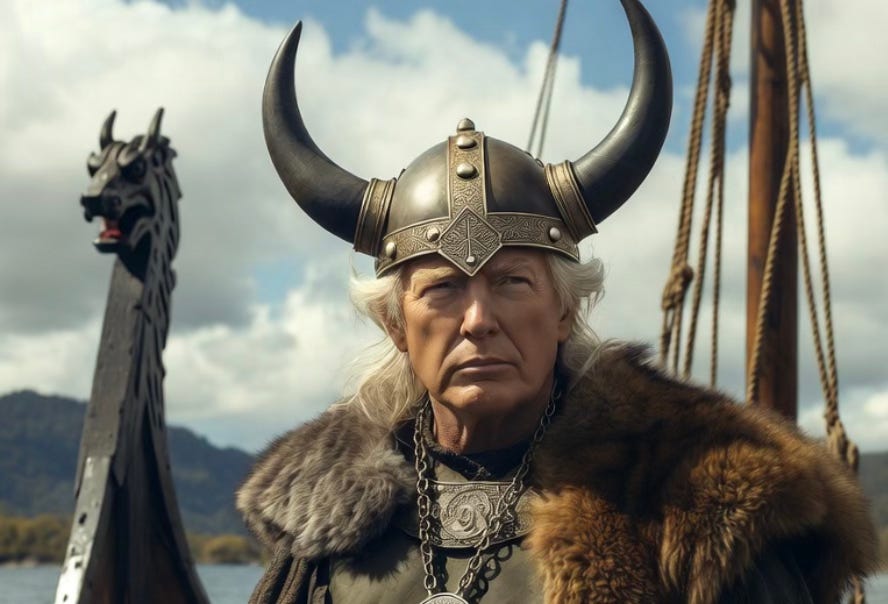
In his weekly post, Andrew Sullivan says that Trump is conducting a “Viking foreign policy” (trigger warning: contains Andrew Sullivan):

(more…)

January 9, 2026

Instead of “regime change” … “regime decapitation”

Filed under: Americas, Government, Military, Politics, USA — Tags: , , — Nicholas @ 04:00

At Postcards from Barsoom, John Carter considers the startling return of military competence and the ongoing echoes of the decapitating attack on Venezuela:

Photo from Postcards from Barsoom

In the age of simulations and simulacra, every action is also a symbol. Within the hyperreality of discourse the semiotic content of a public event is primary to its physical, political, or economic import. This is true of war as much as anything else; war in this age takes place first and foremost in the psychic realm, at the level of meaning, of hermeneusis. Warfare is psychological, not only in the sense of bolstering morale or breaking the will of the enemy to fight, but in the more fundamental sense of affecting the minds of those caught up in its spectacle by inserting new ideas that change the way that they think. This is most effective, as any magician or hypnotist or marketing executive will tell you, when those effects are left implicit, that they might operate directly upon the collective subconscious, in the shadow realm of instinct and intuition from which all political impulse springs.

With that in mind we might ask, in the spirit of an augur inquiring after the flight of a dove at daybreak, a circling hawk at high noon, or the cold gaze of a crow in the gloaming, what is the meaning of the Caracas raid? We do not need to assume that the meaning we look for in this action is intentional, though we should not rule this out, either; what matters is how the act will manifest symbolically, how it will be interpreted in the minds of onlookers, which it will do regardless of intention.

The superficial import of the action is clear enough. America has seized control of Venezuela’s vast oil reserves, the largest in the world, and at a stroke applies crippling pressure to the economies of China, Iran, and Cuba (who were Venezuela’s best grey-market customers), as well as to the economies of its adversary Russia and its wayward sibling Canada (both of which depend for their prosperity upon high oil prices). Both China and Russia have been deprived of a key New World ally, and thus the Monroe Doctrine is reasserted, and foreign powers pushed out of Washington’s sphere of influence. A hostile communist government has been decapitated, opening the way for the millions of Venezuelans displaced by Bolivarian tyranny, refugees whose presence has destabilized Venezuela’s neighbours for many years now, to return home.

To be sure, there is still great uncertainty. Hugo Chavez’ tomb may have been destroyed, but his Bolivarian regime is still largely intact, his apparatchicks remain in control of Venezuela’s state apparatus and military, and his terrorist colectivos still control the streets of Caracas.

Trump’s declaration that America now owns Venezuela’s oil feels a bit premature. Can one really claim control, without boots on the ground? I confess that it is not at all clear to me exactly how this is all supposed to work. Perhaps it is meant to function through pure intimidation: whoever ends up assuming power in Venezuela, they will know that if they don’t do as they’re told, they might be next, and perhaps will not be given the grace of an arrest and a show trial but simply executed without warning by drone; meanwhile, America offers itself as the sole legitimate customer for Venezuela’s sole marketable product, while providing its oil industry engineers to rebuild (and assume control of) infrastructure fallen into disrepair following Chavez’ nationalization and subsequent decades of neglect and mismanagement. Trump holds out one hand in an offer of assistance and mutual benefit, while holding back his other curled in a mailed fist, a threat made plausible by the fact that he just punched them hard in the mouth.

Still, all of this is nothing more than realpolitik, the hard edges of power in the material world.

The real meaning, the symbolic importance, lies deeper. It is not measured in dollars or barrels of oil. It is a message.

So what is that message?

And some of the recipients of that message should be paying especially close attention:

Mass third world invasion is a choice. Economic sabotage in the name of preventing the weather from changing is a choice. Ruining the lives of young men with DEI is a choice. Blackwashing our history and mythology is a choice. Predatory taxation is a choice. Overregulation is a choice. Brainwashing the young to hate themselves is a choice. Yasslighting the young women into choosing girlbossery over family is a choice. Sacrificing the lives of the young to the fears of the old during the COVID lockdowns was a choice.

Allowing the incompetent to run things in the name of ‘social justice’ is a choice, and the contrast between the litany of inept fumbles that has resulted in and the smooth professionalism on display in the Caracasian raid has thrown the consequences of that choice – and the consequences of its alternative – into sharp relief.

And all we have to do to reverse the decline is decapitate the beast, put the right men in charge, and everything will follow naturally from there. Nature will begin to heal, as surely as Yellowstone’s ecology repaired itself once wolves were returned to their rightful place at the predatory apex.

That is why leaders across the Western world are squealing so loudly.

Canadian liberals, for example, are not actually worried that a Delta Force team will rappel down from an MH-47G Chinook Special Operations Helicopter to blackbag Prime Minister Mark Carney from 24 Sussex Drive, Ottawa, Ontario, K1M 1M4, and not only because the inadequate security of the traditional prime minister’s domicile has motivated Carney to instead take up residence at Rideau Cottage, 1 Sussex Drive, where he is usually home by 9 pm with his wife Diana. The concern is much more general: that the beleaguered Canadian people, along with those of the rest of the rotting West, will look at the remarkable results obtained by regime decapitation in the United States, and start getting ideas.

Want to fix the United Kingdom, and make Great Britain again? Sweep the traitors of the Labour Party out of Parliament, remove that pusillanimous android Two-Tier Queer from power, put Nigel Farage and 300 Reform MPs in their place, and watch as they invoke the doctrine of parliamentary supremacy to cast off three decades of Blairite Fabianism in a Great Repeal Act that frees the British state to remigrate the foreign invaders, rebuild the country’s industry, and revive the British military.

Want to fix Europe? Cast down the old women in Brussels – they have no popular legitimacy in any case – and remove their creatures, like Macron or Merz, who keep their peoples yoked to the suicidal EUrocracy. Raise up nationalists in their place – Le Pen, the AfD – and watch as Europe’s natural creative genius and martial spirit reasserts itself. No more Net Zero incapacitating industry, no more European Court of Human Rights preventing invaders from being remigrated, no more Digital Services Act censoring the Internet, no more micromanagerial bureaucratic overregulation strangling the economy.

Mark Carney’s play-acting on the international stage

There is no way that Canada can make itself economically independent of the United States, no matter how much wishcasting power is exerted to persuade anti-American boomers who habitually vote Liberal. Our entire economy is oriented to serve the vast market to our south, and we’ve been freeloading on our own military because the Americans have been willing to take up the slack and — until recently — not castigate our leaders for their fecklessness. It was bad under Justin Trudeau, but it’s actually gotten worse under Mark Carney’s leadership. Trudeau was performative and loved to play to the world media, but Carney seems to actually believe that he can reverse the entire direction of the Canadian economy by jetting around the world and bad-talking Donald Trump. The Canadian economy has been stalled for ten years now, and if Trump finally loses patience with our idiotic elites, it’ll go into free-fall.

On the social media site formerly known as Twitter, James E. Thorne points out just how few cards Carney actually has in his hand:

Mark Carney’s and Canada’s Dangerous Refusal to Face Reality.

Mark Carney and most Canadians are behaving as if Canada is an independent pole in a multipolar order, when the world he actually inhabits is a hierarchy being brutally clarified by Washington. Trump’s revamped National Security Strategy and the “Trump Corollary” — asserted through the seizure of Nicolás Maduro and open threats toward Cuba and Colombia, make plain that the United States now treats the Western Hemisphere as an American security estate, not a debating society among equals.

In that framework, Canada is not a co-author of the rules. It is a dependency inside the U.S. sphere, structurally lashed to American markets, finance and supply chains. AND after decades without a serious sovereign industrial or energy strategy, Canada is at best a weak Middle Power, that has for decades squandered its competitive advantage through proformative politics and virtue signalling.

In this era, the Western Hemisphere is now a “secure production platform” for American industry and technology, defined not by territorial control but by ownership, access and compliance. The Trump doctrine logic is clear and blunt yet internally coherent: if the Western Hemispheres natural resources and supply chains are secured, the economic and geopolitical dividends will follow.

Carney’s answer to the Trump Doctrine, however, remains the same “City-of-London” orthodoxy that produced him: more proformative political grandstanding, more process, more declarations, more meetings, and more boondoggles.

The Greenland consulate, rhetorical red lines over annexation, the flying around the world, and ritual protests against U.S. action in Venezuela all presume that we still live in the post WWII rules based order. We do not! Will live in the era of the Trump Doctrine, and no we can’t wait it out. And in this era, Greenland will not be allowed to be under the influence of Russia or China.

Thucydides warned that “the strong do what they can and the weak suffer what they must”. Carney’s tragedy is that he quotes the rules-based order while presiding over a country whose economic structure is colonial and whose security ultimately depends on the very power he is theatrically chastising. Posturing without power is not prudence. It is provocation without a plan. And yes it’s dangerous.

The irony is that Carney understands all of this perfectly well, which only sharpens the question: what, exactly, is he doing by posturing as a rules-based equal in a hierarchy where he knows Canada lacks the hard power to back his stance?

January 8, 2026

“Kidnapping the head of a sovereign state with whom you are not at war is also nuts”

Filed under: Americas, Government, Law, Media, Politics, USA — Tags: , , , , — Nicholas @ 03:00

On the social media site formerly known as Twitter, David Knight Legg responds to an Andrew Coyne post on the legality of the US operation to capture Nicolás Maduro in Venezuela:

Image from CDR Salamander

    Andrew Coyne @acoyne
    Kidnapping the head of a sovereign state with whom you are not at war is also nuts, Jason. The two go together.

Andrew @acoyne this isn’t accurate.

– Maduro was definitively not the elected President of Vanzuela. He was rejected as such by 50 nations incl the EU in 2024. He was a known narco-terrorist and cartel leader that used state capture and the army to run and enforce his drug and sanctions evasion empire.

– Biden put a $25million bounty on his head Jan 2025 for crimes against humanity and the USA cocaine trade, because destroying his nation for a decade, he fraudulently took power in 2024 and committed atrocities against his opponents after losing in a landslide so he could keep using state capture to run Venezuela — with the aid of terror groups and China Russia and Iran who protected him there and at the UN in exchange for oil, gold and a western hemisphere base of operations.

He was taken by the US to face trial just like Noriega in 1990 (on almost identical charges).

It may not suit your politics but bringing him to justice any other way had proven implausible. This is all well known.

Venezuelans around the world are celebrating wildly after two decades of socialist ruin and the worst humanitarian crisis in the western hemisphere creating 8 million refugees.

Honest question: what would you have done instead?

– status quo? let him stay in power with the help of Russia, Iran and China while actively torturing and murdering his opposition?

– more legal proceduralism at a UN Security Council where Russia and China protect him?

– bureaucratic inertia: letting people die and regional security deteriorate under the protection of another strongly worded reminder to abide by international law and stop the narco terrorism and atrocities?

There aren’t easy answers. It’s going to take a lot of work for Venezuela to come back from a deeply embedded Baathist-style state capture, but this is a critical first step for that nation.

If this is actually about Trump instead of the outcome, would you feel the same way if Biden instead of Trump had executed the same strategy to follow his bounty on Maduro?

The demise of Maduro is such an obviously good thing in so many ways it baffles me to see the debate revert to (often inaccurate) readings of legal minutiae with the underlying idea that it was better for him to be left in place …

A few days back, Daniel McCarthy suggested that the Venezuela operation reveals useful information on the “Don-roe Doctrine”:

A small detachment of Canadian “semi-professional leftist protesters” swapped out their Palestinian flags for this photo op.

President Trump is a wager of “un-war”, which confounds his critics and some of his supporters alike. The capture of Venezuelan leader Nicolás Maduro over the weekend is a case in point. The usual semi-professional leftist protesters are hitting the streets of Europe and a few American cities to decry America’s latest war – but what kind of war lasts just two-and-a-half hours?

US troops didn’t invade en masse. A handful of special forces were dropped in, they killed el presidente‘s guards, nabbed their man and got out. Whatever one thinks about the justice of the whole thing, calling it a “war” is ridiculous. If that’s what this was, then Jimmy Carter waged a war with Iran in 1979 when he launched a doomed military mission to rescue US hostages. And the US must have been at war with Pakistan in 2011 when special forces raided Abbottabad and killed Osama bin Laden.

Critics of US foreign policy have long mocked the tendency of neoconservative hawks to frame every foreign tension as a replay of 1939. Such mockery is well deserved. Yet many of the same people who perceive the idiocy of treating every dictator as a new Adolf Hitler treat every US intervention, however small or brief, as a new Iraq War. Whatever else the Venezuelan operation might be, it isn’t that.

In fact, what Trump did in Venezuela isn’t even really “regime change”: the socialist regime that began under Hugo Chávez is still in power, only with a more pliable successor to Maduro now in charge. Former vice-president and now acting leader Delcy Rodríguez, despite initial remarks condemning the US action (and who would expect her to say anything different?), appears to be willing to de-escalate and cooperate with Washington. Trump’s own record, such as his intervention last summer in the Iran-Israel war, suggests he will want to de-escalate as well. He’s now made his point.

That doesn’t mean the situation isn’t perilous, of course. This may not be a war. There’s no ongoing fighting and Venezuela has continuity of government, albeit not the same president as a week ago. But even if Rodríguez and Trump both want a thaw in US-Venezuela relations, there are a multitude of scenarios that could lead to disaster. Hardliners or malcontents within the Venezuelan regime could stage a coup against Rodríguez. Or a popular revolt, with perfect justice on its side, could lead to bloody confrontations between the government and people. Trump seems to be inclined to minimise those risks by not pushing for speedy democratisation and liberalisation, but there may be some in his administration with less patience and more idealism.

January 5, 2026

International law is more like International “law”

On the social media site formerly known as Twitter, Konstantin Kisin points out that calling it “International Law” gives it a semi-mythic quality that it absolutely does not deserve:

All the bleating about “international law” shows just how completely deluded some of our elites have become.

International law was a pleasant fiction that lasted for a few decades. It was never real and now the world has reverted to its default setting: Great Power politics.

This is why, as a strong Ukraine supporter, I have never talked about international law or called Putin’s attack an “illegal invasion”.

Laws are based on submission to an overarching authority backed by force. There is no such international authority and even if you view the UN as one, it does not have the ability to use force against those who violate “international law” other than against small countries with weak militaries.

When the US attacked Iraq, the UN did nothing.
When Russia invaded Ukraine, the UN did nothing.
If China invades Taiwan tomorrow, the UN will do nothing.

If you cannot enforce a law, it’s not a law.

I do not support Ukraine because naughty Vlad broke the rules. I support Ukraine because it’s not in OUR interest in the West to have Russia marauding its way through friendly countries on the borders of Europe. It’s in our interest for us to be as strong as possible and for our adversaries to be as weak as possible.

President Trump is a realist and a pragmatist. He sees through the fictions other “leaders” cling to.

A good leader advances the national interests of his country. If more Western leaders did this, our civilisation would be in a much better place.

I commented on another post that,

For a lot of people (Canadian Liberals and American Democrats in particular), the invocation “international law” has a mesmerizing effect on their ability to reason [insert usual disclaimer that if they could foresee the results of their enlightened beliefs, they wouldn’t be progressives]. They seem to have a quasi-religious belief in the UN as if it were some kind of God-given supergovernment that is always right and must always be obeyed. “World opinion” might as well be the hand of God to them, so any time the legacy media can portray the US (and Trump in particular) as going against “world opinion” they want to get out the sackcloth and ashes … or sack a city and turn it into ashes, whichever comes first.

vittorio analyzes the default position of most progressives on the social media site formerly known as Twitter:

most political issues nowadays can be explained by understanding that american leftists dont have positions, they have oppositions.

their entire belief system is defined by negation of whatever the right supports. this is why portland chants “free maduro” while actual venezuelans celebrate in the streets. they’re not pro-venezuelan or pro democracies, or pro tyrant, or pro maduro, they’re simply anti-american-right.

they’ve outsourced their worldview to institutional narratives for so long that genuine self-reflection would require questioning everything. for them it’s much easier to just oppose. the beliefs arent coherent because they were never meant to be coherent. they only need to signal tribal membership, and leftist membership is gained by opposing the right.

trump does X? the left screams and cries because they wanted Y

trump does Y? the left screams and cries and riots because even if they said they wanted Y, what they meant is that X was the way to go

trump cures cancer? they’ll argue that the cancer cells are alive have a right of free determination

trump saves lives? they’ll protest because somehow those lives didn’t matter and should have been ended

no coherent word model. no logic. pure opposition

at some point you just have to stop engaging with it as if it’s a real political position. it’s not. it’s aesthetic opposition wearing the costume of ideology

As Severian at Founding Questions often remarks, progressives’ core belief is The Great Inversion: “whatever is, is wrong”.

Bingo Bobbins makes the case that “International law is fake and gay”:

Was this operation necessary? Was Maduro really a “narcoterrorist”? I admit that I haven’t really been following all the drama with Venezuela recently, but my intuition is that Maduro was probably accepting bribes to look the other way with regards to drug trafficking, rather than being directly involved. And sure, he was a socialist dictator but there’s plenty of those around. The US doesn’t go and topple dictators unless there is a perceived US interest in doing so.

What Maduro was actually doing was cozying up to China. In fact, he had just finished a meeting with some Chinese ambassadors hours before Delta Force snatched him up by the scruff. This was actually a warning to China not to mess around in our hemisphere. The Trump administration is re-establishing the Monroe Doctrine, or, as he recently called in a press conference, “The Donroe Doctrine“. As far as I can see, this is completely in keeping with my preferred Vitalist Foreign Policy.

You can agree or disagree with this show of force, but please don’t whine to me about “International Law”. International Law is fake and gay. I certainly don’t care that the Trump administration “targeted a political leader”. This is the complaint being leveled by many leftists in regard to the operation. Really, this is just because leftists are anti-American third-worldists, and they are filled with butthurt because “their guy” lost. But, let’s examine this “rule” of not being allowed to target a countries rulers, because it’s particularly ridiculous.

If you have a problem with a specific country, who do you really have a problem with? You have a problem with that country’s leaders, since they are the ones making the decisions. Why wouldn’t you target the leaders? The only reason is that all the leaders from all the countries got together and agreed that they wouldn’t target each other. They would rather resolve their differences by throwing cannon fodder at each other, while keeping themselves off the table. And sure, I understand why that is great for them, but not why it would be great for me (or you).

Of course, the CIA has been ignoring this “international law” for decades, but they’ve been doing it in a very effeminate way, skulking about the world, funding Color Revolutions and clandestinely arming insurgent groups in order to subvert existing regimes. The Donroe Doctrine is much better. Imagine if the Trump administration had tried to handle Maduro the way the Obama administration tried to handle Assad. Fund a decades long civil war, accidentally establish a caliphate, fight a war against said caliphate, facilitate the deaths of tens of thousands of Christians, all to have an even worse dictator eventually rise to power.

Update, 6 January: Welcome, Instapundit readers! Please do have a look around at some of my other posts you may find of interest. I send out a daily summary of posts here through my Substackhttps://substack.com/@nicholasrusson that you can subscribe to if you’d like to be informed of new posts in the future.

January 4, 2026

Venezuela in the news

Filed under: Americas, Government, Law, Military, Politics, USA — Tags: , , , , , — Nicholas @ 05:00

Tim Worstall explains that despite the usual suspects’ claims that “it’s all about the oil!”, it actually isn’t very much about the oil at all:

Trump taking — kidnapping, arresting, to taste — Maduro and his wife simply isn’t about the oil business. Please note, this also isn’t about whether it’s a good idea or not although I’ll admit to thinking that it’s way damn cool — getting in and out of hostile territory without, so far as we know right now, a single American casualty at all? Damn cool in that military sense.

This is about the shrieking we’re getting from the usual suspects — this is all about the oil! See! Ms. Raisin is one I’ve seen online already, there are those quoting that Counterpunch article with the idiot Michael Hudson and so on.

My point is solely and only about access to that oil.

So, travel back 10 to 15 years.

Venezuela’s Orinoco Belt oil is very “heavy”. Technically it is about viscosity but think about it as “thick”. It’s more like treacle than it is like a free flowing liquid. There are also issues with sulphur but leave that alone here. It is, in the technical parlance, “cheap shit”. So bad that it has to be mixed with much lighter (and usually “sweeter”, which means less sulphur) crude oil from different oil fields so you can pump it through a pipeline or get it into a tanker.

Venezuela used to have — still could have — fields of that light and sweet oil but they ran those fields — during and after Chavez — so badly that production fell over. So, they used to actually import US crude oil to then mix with that heavy crude so they could export. They also price petrol — gasoline — so low that they cannot possibly run refineries to make their own gasoline. So, they would import the US crude, mix it, export the blend to the US and then buy back the gasoline from those US Gulf Coast refineries. This was ridiculous, of course, but you know socialists with prices and economies.

It also meant that those US Gulf Coast refineries were adapted to use that Venezuela mix. You can change the mix a refinery uses but it’s potentially costly. The more the mix changes the more the cost rises. But the important thing to note is that the only refineries within cheap shipping distance that could use the Venezuela crude efficiently were those US Gulf Coast ones. Sure, they’d be pissed if they lost access to their supplies but they could be altered to work with other crude mixes. The reliance was much more of Venezuela upon the refineries than the refineries upon Venezuela — at least, the cost of adaptation to a change was lower for the refineries.

OK, so that was the old situation.

Over this past decade and a bit the US — under both Trump and Biden — has been saying, well, you know, we don’t think much of the Venezuelan Government. We also know the only money they get is from crude oil sales, so, if we refused to take that for those Gulf Coast refineries then we could screw with Maduro. Which is what happened — sanctions on Venezuelan oil exports which, most obviously, apply to people shipping into the US and so obeying US law.

Other people who do not, or don’t have to, obey US law haven’t, wholly, been abiding by those sanctions. OK. Maybe that’s all a good idea and maybe it isn’t — not my point here at all.

We should also note that the oil fields in Venezuela actually owned/managed by Chevron, a US company, have still been allowed to ship to the US and elsewhere under US law.

One more little fact. The US is now — as a result of fracking — a net oil exporter. This is also something done under Trump I, the lifting of the ban on crude oil exports. It can still be true that maybe buying in some Venezuelan oil — or Mexican, Canadian, whatever — meets either geographic or blend desires. We’d like some really heavy sludge, for example, or maybe Canadian oil works for Wyoming (not real examples, just ideas). But in terms of total oil production and usage the US produces more than it uses now. So any decision to import is about those marginal issues of location and blend, not urgent necessity for simple crude oil. Fracking works, d’ye see?

Shaded relief map of Venezuela, 1993 (via Wikimedia Commons)

On the other hand another bunch of the usual suspects are screaming about this as a violation of international law. ESR comments on the social media site formerly known as Twitter:

Since there’s a lot of screaming about the legality of black-bagging Nicolas Maduro going on, let’s talk about the game theory of international law.

Before I do that, though, I’m going to acknowledge that the Trump administration’s legal posture doesn’t even implicate international law significantly. Their theory is that Maduro stole an election, is not the legitimate head of state of Venezuela, and is a criminal drug-cartel leader; universal jurisdiction applies.

This is why a photograph of Maduro restrained by a soldier wearing a DEA patch was released.

I’m not here to state a position on whether that legal posture is valid; I want to instead outline a game theory of the “rules-based international order”, which people are complaining has been violated because the US black-bagged a head of state.

There are two different ways to establish a framework of governing law. Most people only understand one of them, which is the imposition of law by a ruler or coalition with force dominance. I’ll call this “unitary law”.

The other mechanism is mostly only understood by a handful of libertarians; it is law as a violence-minimizing equilibrium among a number of roughly equal agents playing an iterated Prisoner’s Dilemma game. In such settings, cooperation evolves naturally and doesn’t have to be handed down by a single ruler or coalition. I’ll call this “IPD law”.

“International law” is enforced by an uneasy combination of both mechanisms. This is more difficult to see than it should be because there’s also a lot of air and bullshit around “international law”, bullshit consisting mostly of wordcels trying to cast magic spells on people with guns.

The air and bullshit is why it’s common to say that international law is a mirage, or a fraud that only serves the interests of the strongest powers. This isn’t true: what is true is that if an international norm is not sustained by being a stable strategy in an IPD game, only force majeure by a dominant power or coalition can uphold it.

Here’s an example of a moral good that was established by unitary law of nations: the general abolition of chattel slavery, which happened because a dominant coalition of Western nations said “Fuck your sovereignty, we’re no longer tolerating this anywhere our militaries can reach.”

Here’s an example of a moral good that was accomplished by IPD law of nations: generally humane treatment of prisoners of war in armed conflicts. This didn’t develop because great powers unilaterally said “stop doing that”, it happened because even a great power at war with a minor one is exposed to effective tit-for-tat retaliation if it abuses POWs.

If you want to understand “international law”, you need to be able to disentangle three different things that claim to be international law: unitary law imposed by great powers, IPD law enforced by the threat of pain-inducing defections in an international tit-for-tat game, and wordcel bullshit.

The thing to bear in mind is just because there’s a lot of wordcel bullshit going around in “international law” doesn’t mean there isn’t a reality underneath.

British Prime Minister Keir Starmer rushes to distance himself from Trump’s action, for fear that someone might possibly mistake him for a vertebrate:

Leave it to the Babylon Bee to find the appropriate framing for a news story:

Update, 6 January: Welcome, Instapundit readers! Please do have a look around at some of my other posts you may find of interest. I send out a daily summary of posts here through my Substackhttps://substack.com/@nicholasrusson that you can subscribe to if you’d like to be informed of new posts in the future.

December 30, 2025

Tariffs are an economic burden, even when you claim they’re paid by foreigners

Filed under: Business, Economics, Government, USA — Tags: , , , , — Nicholas @ 04:00

At the Foundation for Economic Education, David Hebert responds to a recent pro-tariff puff piece from financial columnist, Matthew Lynn:

As Lynn acknowledges, “the tariffs are a tax”. Because they are a tax, they are going to be paid by someone in some form. You can’t have money flowing into the Treasury without someone paying that extra money in some way. Broadly speaking, we can divide the potential payors of American-imposed tariffs into three camps: American consumers, American importers, and foreigners.

One of the oft-cited effects of a tariff is to reduce the amount of imports coming into America. This makes sense and is in fact one of the numerous goals administration officials have pointed to. Insofar as American consumers and importers end up paying the tariff, they will buy less of the now-more-expensive foreign products. We’re already seeing this happen in the US, which Lynn alludes to throughout his article.

If foreigners pay the tariff, they’ll sell less of the now-tariffed goods to the US. This will, as President Trump and others have correctly identified, hurt their bottom line. To offset at least some of this, these countries will try to sell more of their products to their domestic consumers or consumers in countries other than the US. This is exactly what we have seen and what we are seeing, as other countries around the world are securing new trade deals with one another and deliberately excluding the United States from said deals.

So, Lynn is correct to point out that foreign corporations have incurred costs because of the Trump tariffs. However, despite his repeated implication to the contrary, this is not money that goes to the US Treasury. Volkswagen, for example, has raised the price of its 2026 models by up to 6.5 percent, largely due to tariffs, and has indicated that this is just the beginning. That’s more money coming out of American consumers’ pockets. At these higher prices, American consumers are purchasing fewer Volkswagens than last year. Volkswagen’s losses from the tariffs include an almost 30 percent decline in profits from auto sales. Importantly, sales that do not happen count toward the reduced profit that Volkswagen reported but generate no tariff revenue for the Treasury to collect. That Lynn, a financial commentator, does not understand this distinction is deeply troubling.

Who Really Pays the Tariff?

Lynn’s central argument rests on a fundamental confusion between what economists refer to as the “legal incidence” and the “economic incidence” of a tax. Legally, because tariffs are a tax on imports, it is the US importers who must write the check to Customs and Border Protection. But this says nothing about who actually pays the tariff.

For example, when landlords’ property taxes go up, who pays? The landlord will obviously write the check to the county assessor, but unless Lynn thinks that landlords are running charities, that cost gets passed on to tenants in the form of higher rent, less frequent maintenance, or fewer included benefits (utilities or access to designated parking, for example). The legal incidence falls on the landlord, but the economic incidence falls disproportionately on renters, i.e., young Americans already besieged by high housing costs.

Tariffs work the same way. US Customs and Border Protection bills the American importer directly, which is the legal incidence of the tariff. But the economic burden gets distributed among American consumers, American importers, and foreign exporters, depending on the particulars of the individual markets.

Lynn cites the Harvard Pricing Lab finding an approximately 20 percent “pass-through rate,” meaning that American consumers are only paying about one-fifth of the tariff costs. He treats this as a permanent feature of the tariff regime and as proof that foreigners are footing the bill. But the question isn’t who writes the check today, it’s who bears the cost over time. And here, the evidence directly contradicts Lynn’s fables.

As we have seen, pass-through rates are not static, but evolve over time as markets adjust. And every piece of evidence suggests that the pass-through rate has been and is continuing to rise rapidly. Goldman Sachs and the Council on Foreign Relations tracked the evolution over just this administration. Their findings are stunning: In June, US businesses absorbed about 64 percent of the tariff costs, American consumers about 22 percent, and foreign exporters about 14 percent in the form of reduced profits. Just four months later, American businesses absorbed just 27 percent, while American consumers absorbed 55 percent and exporters absorbed 18 percent. Projections for 2026 continue the trend with consumers absorbing 67 percent, exporters 25 percent, and importers just 8 percent.

The logic behind this is simple and has been echoed by President Trump and Scott Bessent themselves. In the initial months following Liberation Day, American importers could not quickly shift to alternative suppliers, giving them little leverage to demand price cuts from existing foreign vendors. Many American importers also believed (or hoped?) that the tariffs were simply a negotiating tool that would be bargained away. Having built up inventories before April, they were able to avoid raising consumer prices, with the belief that the “temporary pains would be worth the long term gains.”

That’s no longer the case. As the BLS notes in its latest import price index report, the price of imports has barely changed. This matters because US importers, not foreign sellers, are legally required to write the tariff check. American buyers pay the foreign company’s price, then pay the tariff on top of it. If foreigners were truly absorbing the tariffs, they’d have to lower their prices to compensate, and we would see a decrease in the import price index. We haven’t. The index is flat, which is evidence that the burden of the tariff is, as economists warned, being paid disproportionately by Americans in one form or another. As the Council on Foreign Relations analysis points out, by October, importers have “had time to seek alternative suppliers, giving them a bit more negotiating leverage.” More importantly, the “trade deals” that the administration has inked have made it clear that substantially higher tariffs are here to stay. All of this gives importers and retailers good reason to continue passing more of the costs along to consumers.

We are already seeing evidence of this happening. The Federal Reserve Bank of Boston’s survey of small and medium-sized businesses, for example, confirms this dynamic. Firms expecting tariffs to persist for a year or longer plan to pass through three times more of their cost increases to consumers than firms expecting short-lived tariffs. As of August, over 45 percent of affected businesses expected their costs to be impacted for longer than a year.

But how does all of this compare to the pass-through rate felt during the 2018–2019 tariffs? The Harvard Pricing Lab — the same data that Lynn cites — actually undermines his entire argument. After just six months, the 2025 tariff pass-through rate is indeed around 20 percent. But if we compare this to the 2018 tariffs, the difference is night and day. After Trump’s first-term tariffs, the pass-through rate stayed under 5 percent after a full year. This isn’t evidence that these tariffs are working. It’s evidence that these tariffs are hitting consumers harder and faster than the previous round.

December 29, 2025

Will 2026 finally be the year Canada abandons food cartels?

For reasons unknown, Canadian politicians both left and right have been willing to sacrifice almost anything in trade negotiations except the cosy protectionist scheme we call “supply management”, which enriches a tiny number of farmers in Ontario and Quebec by keeping grocery prices significantly higher than the free market price. On his Substack, The Food Professor predicts that Prime Minister Carney will be forced to give up this market-rigging, anti-consumer scheme in the coming year:

Image from Agri-Food Analytics Lab, Dalhousie University

As we enter 2026, several forces are converging to reshape Canada’s food economy. Consumer empowerment — amplified by social media — continues to accelerate, while geopolitics, particularly tensions with our southern neighbour, are becoming increasingly disruptive. Together, these dynamics will push food policy issues that once lived in technical silos into the public spotlight.

At the top of that list sits CUSMA and supply management. Prime Minister Carney has signaled firmness on market access, backed by legislation that shields supply management from parliamentary debate. That protection, however, is unlikely to endure. Even if the United States has little genuine interest in exporting more dairy to Canada — and even if Canadian consumers show limited appetite for it — President Trump now understands, far better than during his first term, that supply management is a potent political wedge. The system protects roughly 9,400 dairy farmers who exert disproportionate influence over agricultural policy, while compensation payments continue to flow without any meaningful reduction in production or market share. For a growing number of Canadians, this arrangement increasingly resembles a closed loop rather than a public good. The irony is that global demand for dairy is rising and Canadian milk should be part of that growth story. Instead, the system prioritizes insulation over ambition — a missed opportunity at a time when competitiveness should matter most.

January 1 also marks the formal implementation of new front-of-package nutrition labels. Although these symbols have been appearing on shelves for some time, many consumers either overlook them or misunderstand their purpose. Their real impact has been largely invisible to the public: they have already reshaped how food companies formulate products, invest in research, and redesign portfolios. Whether the labels meaningfully change consumer behaviour remains debatable, but their influence on product development is no longer.

[…]

Finally, 2026 coincides with the United Nations’ International Year of Rangelands and Pastoralists — a timely moment to reset the debate around meat consumption and livestock production. Rangelands underpin global meat systems by converting grasslands — often unsuitable for crops — into high-quality protein. In a world where demand for animal protein continues to grow, portraying livestock as inherently incompatible with sustainability ignores nutritional, economic, and ecological realities. Well-managed grazing supports rural livelihoods, strengthens export economies, and can enhance biodiversity and soil health rather than undermine them. If policymakers are serious about food security, climate resilience, and affordability, 2026 should mark a shift away from apologizing for meat production and toward recognizing livestock as a strategic pillar of resilient food systems — not a sector to be regulated out of existence

December 28, 2025

It may seem petty to deny entry to EUrocrats, but it’s all they will understand

At first, I thought it was just another bout of Trump being deliberately petty over trivial stuff, but on reflection, it’s actually a neat way to bring home the message to the EU bureaucrats personally that they will be held responsible for their actions:

RE: Free Speech & Denying Visas to Euro Autocrats

The very most Orwellian mind game happening in the world today is the way authoritarian globalists are attempting to redefine the concept of “free speech”.

In America, “free speech” has long meant that we are free to say or write virtually anything without fear of government intervention or suppression. It is this ability to express whatever we want that makes it “free”.

The authoritarian globalists, however, have stood this on its head. They have decided that in order for their citizens to be “free”, they must be free of ever hearing or reading any speech that might offend someone or sow doubt as to government policies. To these fascists, “free speech” means GOVERNMENT MODERATED speech which somehow — through its moderation — sets people “free” from ever hearing conflicting views. As I said — straight out of Orwell.

Europe is, of course, the hotbed of this fascist redefinition of what free speech means, but we in America have only narrowly escaped this plague by electing Trump. Remember, Biden and his team were reliant on institutionally stamping out so-called “disinformation” as a means of control over the populace. We must be ever vigilant here in the USA that such thuggish government criminality never again be allowed to prosper.

I think it is very important that every citizen of the USA and the world understand the depths of depravity these people will sink to in order to control ordinary people. This is about mind control, and nothing else.

Ultimately, the value of true free speech is that it embraces the idea that we all have agency over ourselves; that we are free individuals who can and should hear conflicting views, and decide for ourselves what is true and just, and what is untrue and unjust. This is sovereignty over the self, and unfortunately Europe has never let go of the concept of serfdom, so self-sovereignty is a threat that must be stamped out.

The Trump Administration has been prescient, bold and effective in denying visas to the Eurotrash autocrats who would see free speech reduced to whatever speech unelected bureaucrats deem acceptable. I cannot commend Trump enough for the thoughtfulness and importance of that action.

In a world where almost all humans are linked by essentially the same communications platform, only one world leader is truly standing for free speech: Donald Trump. And I thank him for it. We all should — even the TDS sufferers.

For a relevant example, Dries Van Langenhove:

Update, 29 December: Welcome, Instapundit readers! Please do have a look around at some of my other posts you may find of interest. I send out a daily summary of posts here through my Substackhttps://substack.com/@nicholasrusson that you can subscribe to if you’d like to be informed of new posts in the future.

December 16, 2025

If your military embraces “Net Zero”, you’ve actually got a civil service in uniform, not a military

Filed under: Britain, Environment, Government, Military, Russia — Tags: , , , , , — Nicholas @ 05:00

In The Critic, Maurice Cousins points out the painful truth (painful that is to policians and career bureaucrats) that no serious military can prepare and carry out their prime duties if they also tout their allegiance to “Net Zero” bullshit:

Two developments explain the shift in tone. The first is the protracted US–Russia peace talks conducted largely over Europe’s head. The second is the publication of Donald Trump’s National Security Strategy, which makes explicit that Europeans must now assume far greater responsibility for their own defence. None of this should surprise anyone who has been paying attention. The Trump administration has been saying the same thing, bluntly and repeatedly, since its inauguration.

Speaking at the NATO Defence Ministers’ meeting in February 2025, the US War Secretary, Pete Hegseth, put it plainly: “To endure for the future, our partners must do far more for Europe’s defence. We must make NATO great again. It begins with defence spending, but must also include reviving the transatlantic defence industrial base, prioritising readiness and lethality, and establishing real deterrence.”

After nearly eighty years of relying on American power to underwrite their security, European leaders are being forced to relearn the fundamentals of hard power and grand strategy. It is difficult to overstate how profound a challenge this represents for both Europe and the UK. It demands a rethink across policy areas that, for decades, have been treated as marginal to national security.

Since the 1990s, Britain’s political and intellectual elite has operated within a fundamentally different paradigm. The “end of history” has become a cliché, but it is worth recalling just how deeply it shaped elite thinking. In the aftermath of the Soviet Union’s collapse, Anthony Giddens — one of the intellectual architects of New Labour — argued in The Third Way that the West no longer faced “clear-cut enemies”. Cosmopolitanism, he claimed, would be both the “cause and condition” of the disappearance of large-scale war between nation-states. The “strong state”, once defined by preparedness for war, “must mean something different today”. They believed that post-material and post-traditional values, including ecological modernisation, human rights and sexual freedom, would come to dominate politics.

For realists, this utopian worldview was always naïve. In her final book, Statecraft (2003), Margaret Thatcher warned that the post-Cold War world was far more likely to vindicate Samuel Huntington’s “clash of civilisations” than Francis Fukuyama’s progressive vision of an “end of history”, in which liberal democracy emerged as the inevitable global victor.

Clearly, the liberal internationalist illusion should finally have been shattered by Russia’s annexation of Crimea in 2014. Alas, it was not. Instead of prompting a fundamental strategic reset, Britain’s governing class doubled down on the same post-material, cosmopolitan assumptions that had shaped the 1990s and 2000s. In 2015, Europe and the UK embraced the Paris Climate Agreement. In 2019 — a year after the attempted murder of Sergei Skripal on British soil with a chemical weapon — ministers enshrined Net Zero in law and banned fracking. Each decision reflected the same belief: that geopolitics could remain subordinate to “climate leadership”, and that the material foundations of security could continue to be dismantled.

That worldview is now colliding with reality.

The US National Security Strategy contains a series of blunt truths about Europe’s condition. British commentary has focused on its remarks about culture, migration and defence spending. But one critical area has been largely overlooked: energy and industry.

The document begins from a hard material premise: that dominance in dense and reliable sources of energy — oil, gas, coal and nuclear — is essential to the ability of the United States, and its allies, to project power. From that foundation it draws a sharper conclusion, rejecting what it describes as the “disastrous ‘climate change’ and ‘Net Zero’ ideologies” that have hollowed out Europe’s industrial base while subsidising its adversaries. The result, it argues, is a defence problem that runs far deeper than military budgets. Alongside cultural weaknesses, myopic energy policy and de-industrialisation — exemplified by Germany’s recent offshoring of its chemical industry to China — are identified as anti-civilisational forces that directly erode Western hard power.

This makes Carns’s most important observation all the more sobering. While armies, navies and air forces respond to crises, he said, it is “societies, industries and economies [that] win wars”. He is unequivocally right.

On his Substack, Niccolo Soldo discusses the contents of the Trump administration’s new National Security Strategy:

Egyptian President Gamel Nassar had some choice lines to describe US foreign policy too:

    The genius of you Americans is that you never make clear-cut stupid moves, only complicated stupid moves which make the rest of us wonder at the possibility that we might be missing something.

    With the Soviet Union, you know where you stand today and where you will stand tomorrow. With the United States, you never know where you will stand tomorrow—and sometimes not even today.

    America is like a beautiful woman who changes her mind every night. You can love her, you can fear her, but you can never be sure what she will do in the morning.

And then there is this recent classic from Russia’s chief diplomat, Sergey Lavrov:

    The USA is agreement non-capable.

The point of sharing these quotes is to highlight the obvious fact that US foreign policy has long been unpredictable. This wouldn’t be too much of an issue if it were a middling power. When a superpower routinely upends the table, it makes life very, very difficult for those countries that have become “states of interest” for the Americans. Creating and pursuing foreign policy strategies require a lot of time and effort, meaning that they are very rarely predicated on short-term trends. When the predictability of foreign actors is removed from the strategic equation, the foundation of any plan becomes very weak.

Earlier this month, the White House issued its 2025 National Security Strategy vision in a 33 page .pdf document available for all to see and read here. This is an action that the US Executive Branch is mandated to do, ever since the Goldwater-Nichols Act of 1986. The point of this exercise is to articulate the vision of the President of the United States of America regarding foreign policy, so as to effectively communicate said vision to Congress and the American people. It does not mean that it is an official foreign policy strategy, since this area of governance is the responsibility of both the executive and legislative branches of the US Government.

Because this is the Trump Administration, and because of the fever pitch that has coloured both of his terms in office, a lot of attention is being given to this iteration of this mandatory document. This document is intentionally high-level (meaning that it purposely doesn’t drill down into specifics), keeping within the tradition of previous administrations. However, attention is warranted this time, because the vision outlined by President Trump per this document indicates a significant break in both the USA’s approach to and philosophical arguments regarding how and why it conducts its foreign policy. Despite the obvious Trumpist (think: transactional) touches interspersed throughout this document, what it does represent is a stated desire to break with certain idealist practices of recent administrations in favour of a more realist approach and worldview, one that stresses respect (if we accept the document at face value) for national sovereignty, and an admission that US global hegemony is simply not possible.

So what we are left with is a document that outlines a new vision for US foreign policy, one that has determined that taking on both Russia and China simultaneously is the wrong approach to securing American national interests. This makes it very worthy of closer inspection and analysis (something that I have been thinking about deeply since it was first made available to the public a fortnight ago). Before we begin to dive into it, I am asking you all to temporarily suspend your cynicism and take the strategy outline at face value for the sake of this analysis. I will once again repeat that this is not official policy, and there is a very strong chance that it will never be adopted as that.

December 9, 2025

The age of Trump – “America has ‘walked away’ from its allies”

Filed under: Cancon, Government, Military, USA — Tags: , , , , , — Nicholas @ 05:00

In The Line, Matt Gurney talks about last month’s annual Halifax International Security Forum, where the biggest change from previous events was the official absence of US government representation:

Late last month, attending the Halifax International Security Forum, I was having the damndest feeling. Can you have déja vu for something that you only experienced via fiction? Because it was kind of like that.

The fiction in question was a novel by an Australian, published during the Second Iraq War. Anti-American sentiment was running rampant all over the world. The premise of the novel is out there in the realm of sci-fi — America disappears. Specifically, Americans disappear — some mysterious wave of energy scours most of North America clean of life. Virtually all of the U.S. is wiped out; most of Canada and Mexico, too. Somewhat to the surprise of the anti-Americans, this does not result in an improvement in life on Planet Earth.

Standing around at the forum, eating the delicious snacks and drinking the good coffee and chatting with friends old and new, that was what I kept thinking about. Where are the Americans? And what the hell are we going to do without them?

And, in case you’re wondering what’s up with that headline, here’s another question — what will we do if they one day try and come back?

The forum is an annual gathering of senior military officers, defence and intelligence officials from across the free world, and representatives from the media, think tanks, large companies and civil society organizations whose work relates to defence and security issues or in some way seeks to promote and preserve a healthy democratic world. Funded by NATO, the Canadian government and private-sector sponsors, the event is a major part of Canada’s “soft power” offering to our allies — we host the big party and show everybody a good time. The actual schedule is split between on-the-record panel talks or presentations, off-the-record sessions, and informal time for mingling and schmoozing. I am grateful to have been invited to participate again this year.

Especially this year. I’ve been going to the forum for years, and the event always had a strongly American flavour.

Not anymore! Yankee went home.

Like, literally. He was ordered to go home, or stay there. Secretary of Defense Pete Hegseth ordered the Pentagon to avoid a series of high-profile annual defence summits. That includes Halifax, and others in places like Munich and Singapore, and even inside the United States itself. The reason, according to the Pentagon’s press apparatus, was that, and I swear to God this is the actual quote, such events promote “the evil of globalism, disdain for our great country and hatred for the president of the United States”.

Oh. Well, then.

That’s what made the forum so fascinating this year. As I told my colleague Jen Gerson while I was in Halifax, the entire event felt a little bit like the first Thanksgiving after a divorce. It’s great to see everyone, but there’re some notable absences, is the thing.

December 3, 2025

Like him or loathe him, Trump’s response to the DC shootings was “spot on”

In The Conservative Woman, Richard North makes the case that US President Donald Trump is the only western political leader who can stop the migration crisis:

Like him or loathe him, question his inconsistencies and his many other flaws, but in my view Donald Trump’s response to the shooting of two members of the West Virginia National Guard in Washington DC by an Afghan migrant was spot on.

There was none of the pussyfooting “my thoughts are with …” etc. Without equivocation, he immediately branded the shooting “an act of evil, an act of hatred and an act of terror”, adding: “It was a crime against our entire nation”.

Shortly thereafter, Secretary of State Marco Rubio posted a tweet declaring: “President Trump’s State Department has paused visa issuance for ALL individuals travelling on Afghan passports. The United States has no higher priority than protecting our nation and our people.”

Attached was an official tweet from the Department of State making it clear that the ban was of immediate effect, with the Department “taking all necessary steps to protect US national security and public safety”.

This added to the ban in June when Trump imposed restrictions on citizens from 12 countries, including Afghanistan, but that ban did not revoke visas previously issued, and holders of Special Immigrant Visas (SIV) were exempt.

Now Trump has gone further. In a Thanksgiving message posted on X, he offered a salutation which, in Trumpian style, didn’t mince words. It started with: “A very Happy Thanksgiving salutation to all of our Great American Citizens and Patriots who have been so nice in allowing our country to be divided, disrupted, carved up, murdered, beaten, mugged, and laughed at, along with certain other foolish countries throughout the world, for being ‘politically correct’, and just plain STUPID, when it comes to immigration …”

That was only the start of a very long and quite extraordinary tweet which, if nothing else, can be criticised for a complete absence of paragraphs and sentences which rivalled in length those in a Dickens novel.

With his opening out of the way, Trump asserted that the official United States foreign population stands at 53million, most of whom, he averred, “are on welfare, from failed nations, or from prisons, mental institutions, gangs, or drug cartels”.

“They and their children,” Trump continued, “are supported through massive payments from patriotic American citizens who, because of their beautiful hearts, do not want to openly complain or cause trouble in any way, shape or form”.

Warming to his theme, he declared: “They put up with what has happened to our country, but it’s eating them alive to do so! A migrant earning $30,000 [£27,000] with a green card will get roughly $50,000 [£38,000] in yearly benefits for their family. The real migrant population is much higher.”

Pressing his point, he stated what none of Starmer’s motley crew will admit.

“This refugee burden is the leading cause of social dysfunction in America, something that did not exist after World War II (failed schools, high crime, urban decay, overcrowded hospitals, housing shortages, and large deficits, etc)”, the Donald wrote.

In a passage which might have got him arrested had he posted in the UK, with refreshing candour, the President gave the example of “hundreds of thousands of refugees from Somalia” who were “completely taking over the once great State of Minnesota”.

Somali gangs, he said, “are roving the streets looking for ‘prey’ as our wonderful people stay locked in their apartments and houses hoping against hope that they will be left alone”.

No matter which country they end up in, Somalis tend to be bad news. There are multiple reports stretching back to 2007 of a plague of criminal gangs among the 32,000 Somalis who have settled in Minnesota.

Recently the Minnesota gangs have been associated with a series of massive welfare fraud schemes, the proceeds of which may have been funnelled to the Somalia-based terror group al-Shabab.

The largest fraud scandal involving Somalis was the “Feeding Our Future” scheme. Prosecutors racked up 56 criminal convictions in what they alleged was a plot to steal $300million (£270million) from a federally funded programme meant to feed children during the covid event.

November 27, 2025

Carney – “Who cares?”

Filed under: Business, Cancon, Economics, Government, Media, Politics, USA — Tags: , , — Nicholas @ 03:00

On the social media site formerly known as Twitter, Melanie in Saskatchewan reacts to Prime Minister Mark Carney’s shrugging-off the economic concerns of ordinary Canadians with a casual “Who cares?”

Dear @MarkJCarney

“Who cares?”

That’s what you actually said when asked when you last bothered talking to Trump about the tariffs that are currently body-slamming Canadian jobs.

“Who cares? … It’s a detail.”

Really Mark? Let’s meet some of those “details”, Prime Minister.

The single mom juggling three gig jobs because the factory that used to pay her mortgage “paused investment” and then paused her entire livelihood: she’s just a detail.

The Windsor autoworker whose night shift got cancelled forever while you were busy perfecting your thoughtful squint for the cameras: tiny detail.

The steelworker in Hamilton burning through EI while the mill runs skeleton crews and you call the carnage a “temporary adjustment”: just a little detail.

The small-shop owner deciding which of her three employees to fire this month because 25% tariffs turned her cross-border contracts into suicide notes: who cares, right? Detail.

The rail worker staring at empty tracks where trains full of Canadian auto parts and steel used to roll: super minor detail.

The Saskatchewan electrician watching Nutrien build its next billion-dollar terminal in Washington State instead of BC because at least the Americans aren’t at war with their own economy: I guess that’s barely worth mentioning.

The welders and millwrights being told the next big plants are going up in Ohio and Texas, not Ontario or Alberta, because Canada’s too busy arguing about jurisdiction to actually fight for work: pfft, details.

The family parked on gurneys in an ER hallway at 3 a.m. because we never trained enough doctors and now the ones we have are bolting: honestly, who has time for that detail?

All those kids with degrees doing DoorDash because private-sector job growth is wheezing and every company is frozen waiting for the next Trump tweet or Trudeau shrug: whatever, details.

You flew around the world taking heroic photos, sold us “Team Canada”, bragged you were the adult who could handle Trump, and the second a reporter asks when you last actually picked up the damn phone to fight for Canadian jobs, you smirk and say “Who cares?”

Message received, loud and clear.

Those people I mentioned above? They care.

Every single one of them cares when the shift vanishes, the mortgage renews, the mill goes quiet, the doctor quits, the plant gets built south of the border, and their kids ask why Mom’s crying at the kitchen table again.

But you don’t care.

And the worst part? You didn’t even bother to lie about it.

You lied to every single Canadian to get elected, yet you don’t care.

Well Mark … we sure as hell do care.

And you WILL care.

When your greasy grifting ass is voted to the curb and we undo all the harm you’ve caused Canadians to fatten your coffers. You cant stand living in Canada and can’t wait to move back to the UK … remember?

We sure will.

Just watch us.

Sincerely,
One of the millions of Canadians tired of being your rounding error.

Melanie in Saskatchewan

Also published on her Substack.

Apparently even the most detached of politicians can occasionally be persuaded to acknowledge an unforced error:

November 26, 2025

The RCAF needs either F-35s or Gripens … not both

Filed under: Cancon, Europe, Government, Military, USA, Weapons — Tags: , , , , , , — Nicholas @ 05:00

Although the Trump provocations are a unique situation for the Royal Canadian Air Force to find itself dealing with, the long-delayed decision on what the replacement for our current CF-18 fleet can’t be realistically put off for much longer. The government has committed to paying for the first 16 aircraft of an 88-plane order, but many pundits are crying out for the government to cancel the remaining portion of the order and instead purchase different aircraft … the leading contender being the Swedish Gripen. This might be the worst of all worlds for the RCAF, in needing to support two different airframes with zero parts compatibility. This two-fleet “solution” would make life much more difficult for RCAF training and logistics, but it’d be a performative eLbOwS uP to Trump, so there’s a strong chance it’ll happen despite military and economic reality. Bryan Moir makes the argument for the Gripen on his Substack:

Mark Carney loves the big phrases. “Build Canada strong.” “Rewire the economy.” “Generational investments.”

It’s good branding. But slogans don’t build nations — decisions do. And right now, one decision matters more than the rest:

Will Canada assemble the Saab Gripen fighter on Canadian soil — or will we lock ourselves into permanent military dependence through the F-35?

Let’s start with the truth no one in Ottawa wants to say out loud.

The F-35 is a 56% aircraft in a 100% environment.

The F-35 fleet’s mission-capable rate sits at 55–56%. That means a country buying 16 aircraft can expect maybe eight airborne on a good day. Eight jets to defend the Northwest Passage, the Arctic archipelago, and a coastline longer than Russia’s.

This isn’t speculation; it’s physics, logistics, and accounting.

Meanwhile, the United States fields 54 F-35s at Eielson AFB in Alaska — backed by billions in supporting infrastructure: software hubs, spares depots, rapid part cycling, and multiple layers of maintenance and training.

They can sustain the F-35 in the Arctic.

Canada cannot.

And pretending that we can — or worse, pretending that it doesn’t matter — is not national defence. It’s denial.

Gripen was designed for the world Canada actually lives in.

Gripen’s core design features are the ones Canada pretends the F-35 also has:

  • Cold-weather resilience
  • Short runway and road-base operations
  • Minimal crew requirements
  • Quick turnarounds
  • Low maintenance footprint
  • Sovereign sustainment

Gripen isn’t just compatible with Canada.

It was built for countries whose geography forces them to be independent.

November 19, 2025

US Democrats issue clarion call to the military: “You must refuse illegal orders”

Filed under: Government, Law, Military, USA — Tags: , , , , — Nicholas @ 05:00

Well, thank goodness that someone remembers Nuremberg! Apparently President Trump has been issuing illegal orders to the US Army, Navy, and Air Force, and these brave legislators are putting their careers — and even their lives — on the line to defend democracy. I’m unaware of what these specific orders may be, but as Chris Bray points out, he’s the Bad Orange Man so pretty much anything he orders must be illegal:

Note what they don’t say. They say that the American military is being “pitted against” their own countrymen, and they say to servicemembers that “you can refuse illegal orders …”

… they don’t say, even once, even in a pretty clear hint, precisely what illegal orders Trump has issued. He’s being vaguely bad, so you don’t have to obey him. The serious version would look like this: On [date here], the President of the United States ordered [unit name] to enter [place name] for the purpose of [specific action], and that order violated [explicit citation of US Code]. They mushmouth around a set of feelings-signals about Mean Orange Something, but they never quite manage to spit it out. What’s the illegal order anyone is supposed to disobey, and what makes it illegal? News reports suggest that they mean to refer to the boat strikes, but click on that link if you want to see more vagueness and weak hinting.

This is exactly what the Catholic bishops just did in their own stupid virtue performance, the precise mark of an absence of seriousness in a coven of drama queens, as they declared that they’re very concerned about questions that have arisen regarding certain situations involving immigrants. More mush from the wimps. Donald Trump is very bad, because mumble mumble mumble. Be precise and clear, or be silent.

This is an age of unseriousness, and here’s another heaping plate of it. Soldiers, you don’t have to obey the orders of your military superiors if you feel that they, that they, uh, oh hey look at the time anyway I have to go. It’s passive-aggressive bad girlfriendspeak as politics. I guess if you feel like you have to obey, that’s fine. No, it’s fine! I’m not mad! Let’s just go to dinner!

We want to speak directly to members of the military, but we don’t actually have anything to say. Just, you know, disobey the president. Small thought, not a big deal.

High school drama club president Elissa Slotkin has been banging on this drum in an especially insistent way, as she holds town hall meetings with veterans who mumble their own vague slogans about Trump bein’ against the Constitution real hard and stuff.

But all of their descriptions are stupid. Sending a few hundred National Guard troops to a city of hundreds of thousands of people with narrow orders about protecting federal facilities and personnel or patrolling to deter violence isn’t military conquest of the population or the militarization of all law enforcement. The hyperbole renders the argument insane. Related, the veterans in Slotkin’s video talk about the “systematic removal” of military leaders, and the “purge of the generals”. The US military has over 800 flag officers; the Trump administration has removed about 15. There’s a desperate stupidity to all of this panic-mongering that just renders it deeply tiring.

Actual servicemembers will be familiar with the rhetorical style of the shithouse lawyer, the idiot in the barracks who tells you that akshully they can’t order you to do that, it’s totally illegal.

You should just tell your drill sergeant that you refuse! He can’t even do nothin’ about it! He’ll just back right down!

« Newer PostsOlder Posts »

Powered by WordPress