Quotulatiousness

June 22, 2026

Two-tier Keir resigns as UK Prime Minister

Filed under: Britain, Government, Media, Politics — Tags: , , — Nicholas @ 11:30

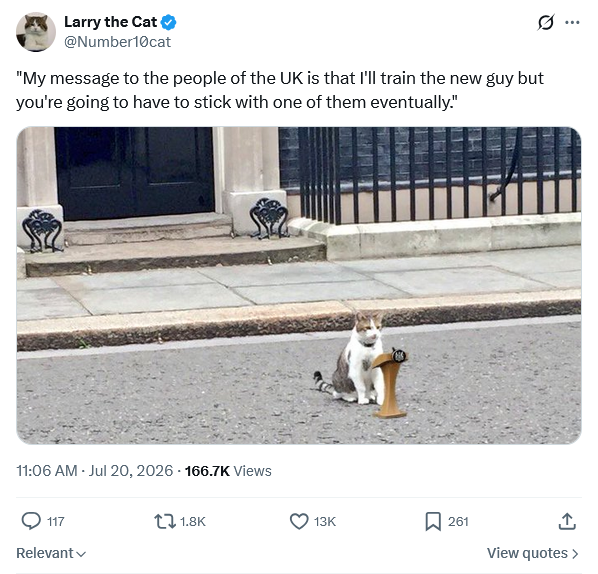
History will not be kind to Sir Keir Starmer’s time in office, both for his actions and his failures-to-act. The Labour Party will now select the next person to live at Number 10 Downing Street, as they still hold a majority in the House of Commons and are not required to go back to the people for a new mandate, regardless of who is their party leader.

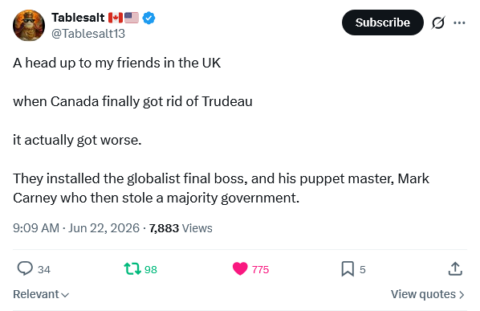
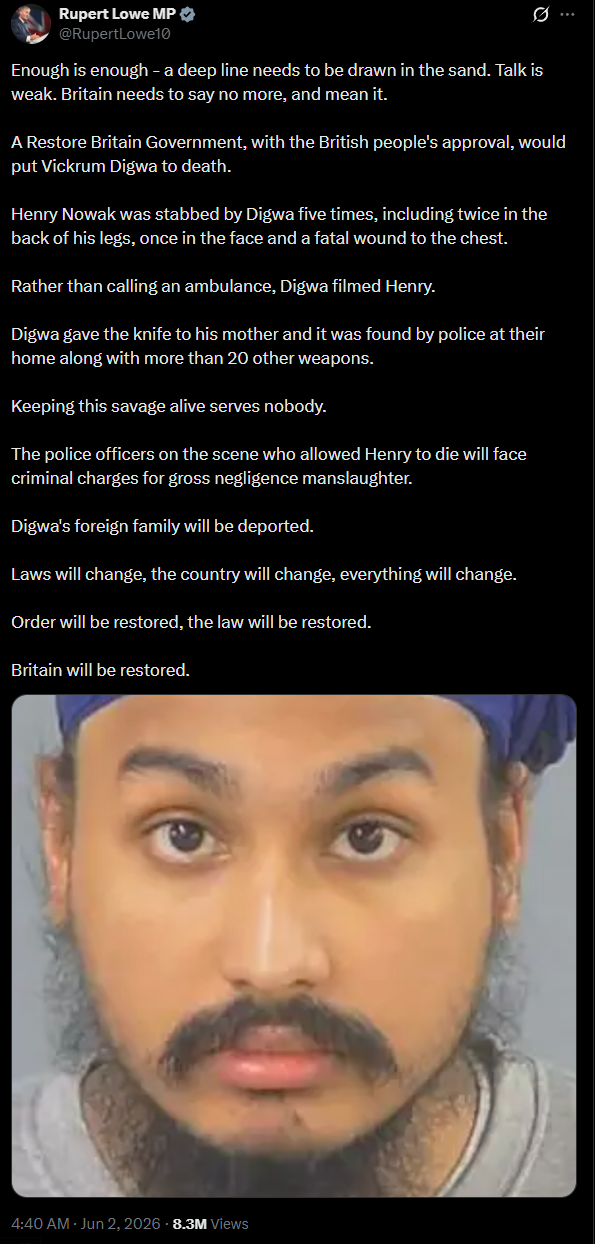
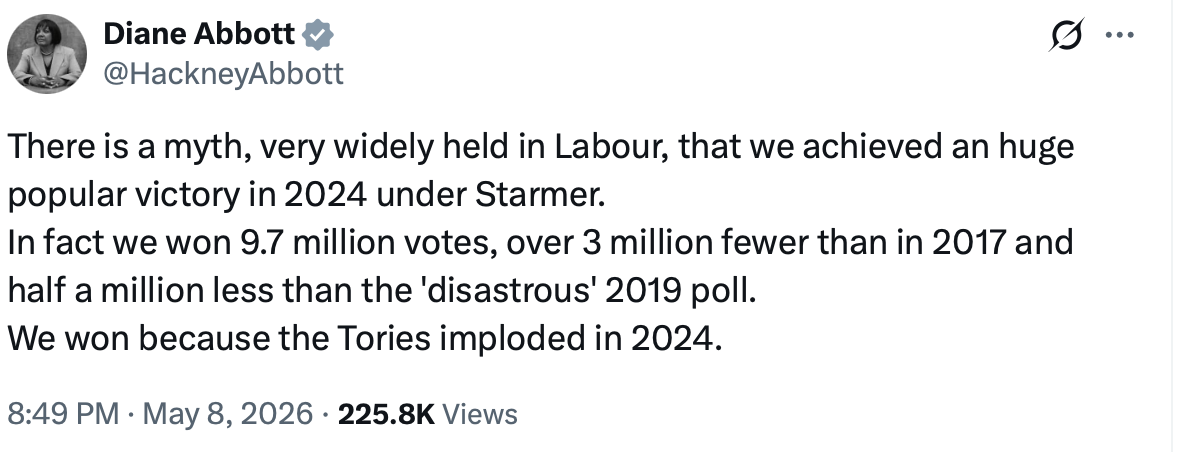
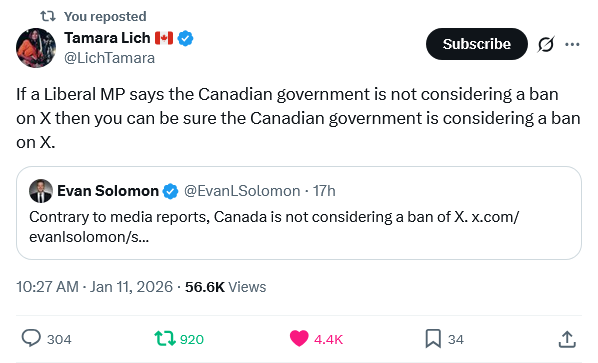
Rupert Lowe, the leader of Restore Britain, greeted the news on the social media site formerly known as Twitter:

I reposted this on my other social media accounts, saying “Sadly, this is completely true. We belatedly ditched the clown prince of progressivism … only to install Mark Carney, who believes all the same progressive shibboleths that Trudeau did, but he’s far more capable of implementing them by hook or by crook.”

Starmer resigns — he has been a truly disgraceful Prime Minister.

I do not believe him to be a good man or a patriot.

He has deliberately and rapidly accelerated the destruction of our Britain, of our home.

History will not remember him kindly, nor should it.

I sat in Parliament, looking him in the eye, listening to him attempting to justify his decision to block a national inquiry into the mass rape of young British girls.

I will never forgive him. For that, and so much else.

What comes next, I do not know.

Whatever that is, Restore Britain will be ready to offer the British people a democratic route out — a better way, the only way.

But Starmer is gone.

And that is a good thing.

Enjoy it.

Former Manchester mayor and recently elected Member of Parliament for Makerfield Andy Burnham is the most likely successor to Starmer.

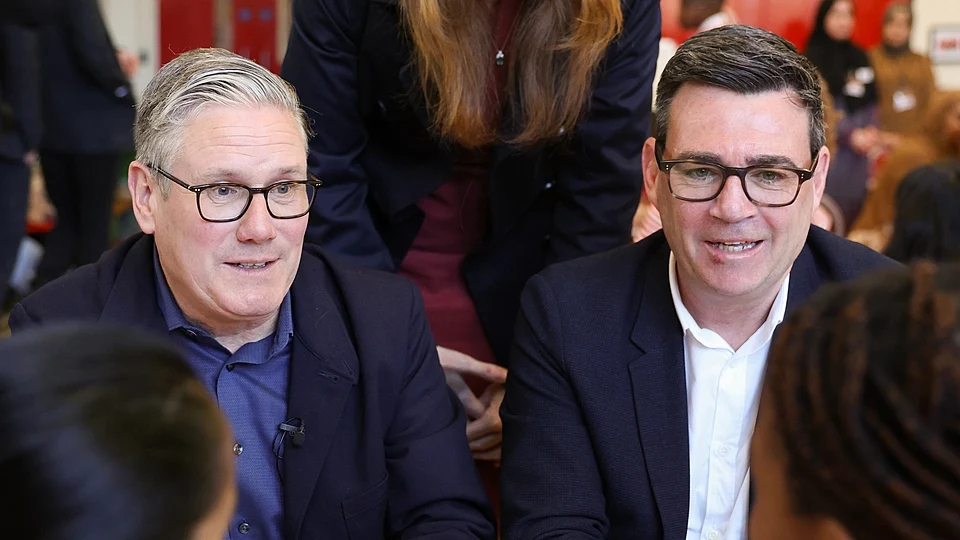
Then-Prime Minister Sir Keir Starmer visiting Holy Trinity Church of England Primary School in Manchester on 13 April 2026 with Andy Burnham, Mayor of Greater Manchester.
Picture by Lauren Hurley / No 10 Downing Street via Wikimedia Commons.

June 11, 2026

“Thoughts and prayers” in a Two-Tier Keir accent

Filed under: Britain, Government, Media, Politics — Tags: , , , — Nicholas @ 04:00

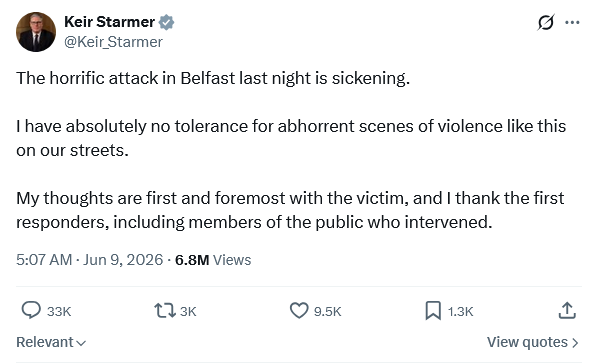
Sir Keir Starmer posted to X in response to the attempted beheading of a Belfast man a few days ago:

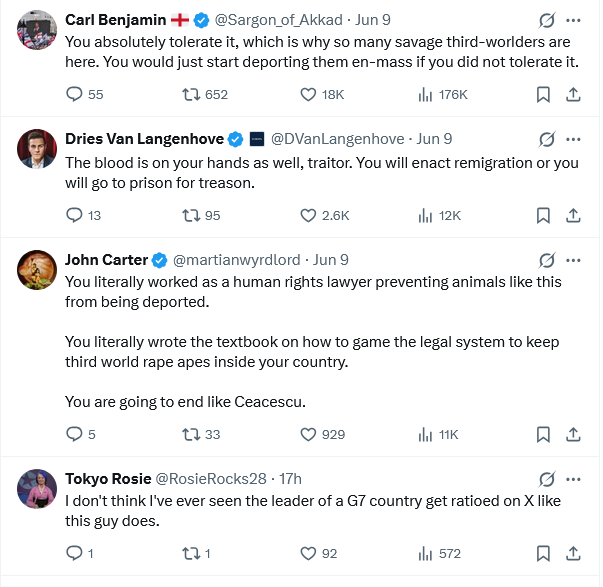
It drew some angry responses like this:

And a longer response from Jim Chimirie:

.@Keir_Starmer, your statement says you have absolutely no tolerance for abhorrent scenes of violence like this on our streets.

With respect, tolerance is not the issue. Nobody tolerates a near beheading on a residential street in Belfast. The question your statement carefully avoids is prevention. And prevention requires honesty about a pattern your government has consistently refused to name.

A man in his thirties, a Somali national, pinned a man to the ground on a residential street and stabbed him repeatedly in the face and neck. Members of the public intervened with a hurling stick. A woman required hospital treatment for the stress of witnessing it. This happened in Northern Ireland, a place that has known more than its share of violence, and even there residents said they had never seen anything like it.

Your government has presided over record small boat crossings. It has failed to proscribe the IRGC despite repeated promises. It has blocked the grooming gang inquiry for a year before being forced to concede it. It has spent £10 billion on asylum accommodation contracts. It has actively resisted measures that would have reduced the number of unvetted individuals entering and remaining in this country.

The victims of these attacks are not statistics. They are British people, going about their lives on their own streets, who were failed before the attack happened. Failed at the border. Failed by a system that prioritises the rights of those who arrive illegally over the safety of those who were already here.

Your thoughts are with the victim. So are ours. The difference is that thoughts are not policy. Thoughts do not secure borders. Thoughts do not remove individuals with no right to be here. Thoughts do not protect the next victim, whose name we do not yet know, on a street we cannot yet identify, from an attack that has not yet happened.

How many more before the thoughts become action?

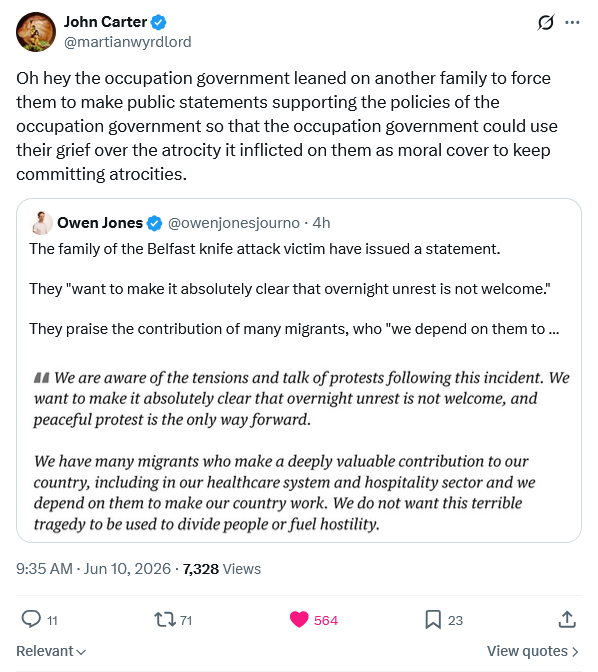
The family of the victim talked to the media and it in no way seems to have been pre-scripted by the government and was clearly uncoerced and of their free will and is in no way any kind of hostage statement:

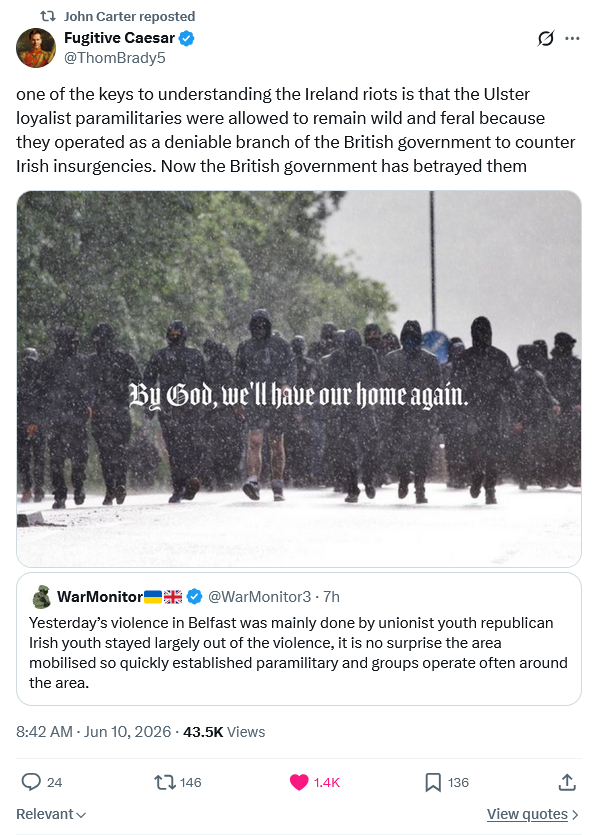
Northern Ireland has seen a lot over the last few decades, but I doubt anybody expected to see the two opposing sides of “The Troubles” joining forces:

Between them, the Ulster Protestant paramilitaries and the IRA operatives have a lot of hard-won skills at avoiding the authorities and committing direct violence. At The Bugscuffle Gazette, Ian notes that he predicted this earlier:

In June of last year I penned an essay titled “Popular Misconceptions” in which I opined that if the “good men and true” of an area get “fed up with lawlessness” they tend to take matters into their own hands.

We are now seeing this play out in real time in Northern Ireland.

For those of you not paying attention to the news, a refugee from the Sudan attempted to saw off the head of an Irish man in Belfast on Monday, 08 JUN 26. He was on a public street when he did so, and several locals rushed to stop his assault. His victim has lost an eye from the attack, and is in critical care at a local hospital.

If you read my previous essay, I postulated that when the vigilance committees show up, a lot of collateral damage come with them — so nobody should be shocked to understand that a whole bunch of immigrant homes and businesses are currently on fire in Northern Ireland.

I will now expound upon that previous essay. I will even go so far as to issue a warning that the people who should heed said warning are going to ignore:

If the “good men and true” get the perception that the government and officialdom are not only facilitating what has them all riled up, but just might be a source of what has them all riled up … well, history has shown that the “good men and true” have very little problem with expanding the “extra-judicial punishments” to include Minions of the Law and Government.

And for those folks who pish-tosh any sort of threat from the British “subjects” — this is Northern-bloody-Ireland. The time and area where the locals refined the “Vehicle-Borne Improved Explosive Device” to the point a popular cocktail was named after the practice.

This is the area where there are more SLRs, Sterlings, and Browning Hi-Powers buried around that little island than any three countries in Africa.

Hell, the Irish made the AR-18 famous.

I speak to the government and officials of Northern Ireland, Ireland, and the United Kingdom: Listen to me — you won’t, but listen to me … You’d better — at the very least — pay some sort of lip service towards a credible perception that you give a tinker’s damn about what has the people all lathered up, and make the people believe that you’re doing something about it.

If you don’t — and you won’t — don’t come whinging to me when your dance card abruptly becomes filled with such exhilarating numbers as: the Hemp Fandango, the Beatdown Boogie, and the Arson Waltz.

You have failed the people. You have failed them utterly, completely, and totally. They’re about to rectify that situation. You might want to get ahead of that power curve before you find yourself watching folks get loaded onto cattle cars alongside you.

John Ringo on X:

One more post on the subject of the Irish getting their dander up.

The Irish Troubles (a continuous low level insurgency) lasted from the 1960s to 1998. But they were the continuation of “Troubles” stretching back to the 1800s.

1998, that’s a bit over 25 years ago.

Both sides in the Troubles, the Catholics and the Protestants, are one generation away from a civil war that lasted for TWO GENERATIONS.

The Gen Z men of today were raised on the stories of the heroism and patriotism of their fathers and grandfathers and THEY HAVE HAD NO SIMILAR OUTLET.

The IRA did not invent the vehicle borne IED. The Vietnamese used it before them.

They just invented a cocktail from their name as well as a drinking song.

“Former” IRA weapons dealers are still some of the top illegal weapons dealers in the world.

1/10th of “British” SAS come from Ulster. A significant fraction of the British infantry as well.

Many of them served in GWOT so they have a recent master’s class in insurgency.

And now Keir Bloody Starmer and the Irish Government have given BOTH SIDES a reason to start again, but this time UNITED.

We may be about to get a glimpse of what a civil war in the US looks like up against a massive surveillance state.

Take notes.

Update, 12 June: Welcome, Instapundit readers! Have a look around at some of my other posts you may find of interest. I send out a daily summary of posts here through my Substack – https://substack.com/@nicholasrusson that you can subscribe to if you’d like to be informed of new posts in the future.

June 4, 2026

The murder of Henry Nowak and the failure of British policing

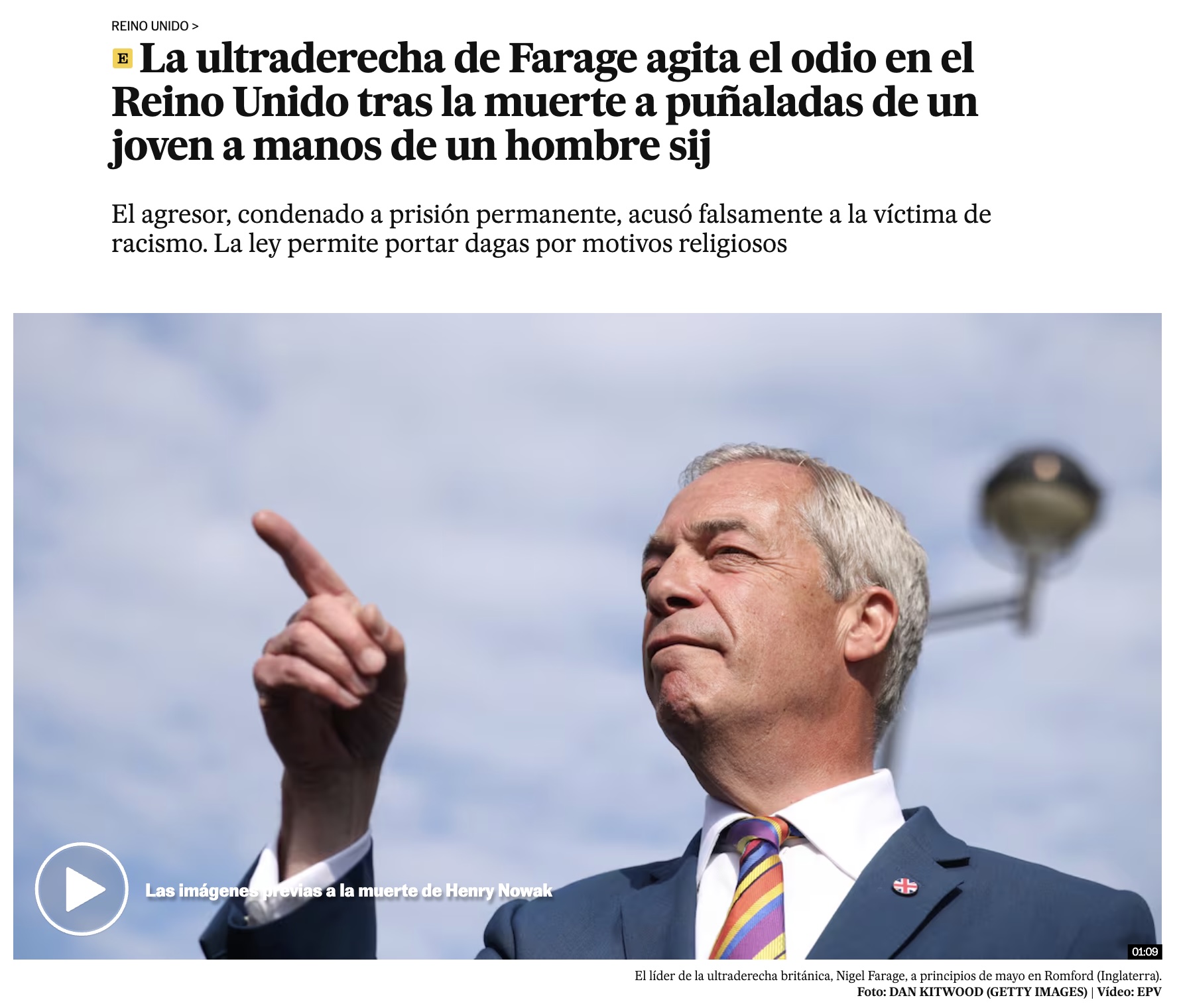
Andrew Doyle notes that the very first mention of Henry Nowak’s murder in Spain’s El País (approximately Spain’s equivalent of the Toronto Star, The Guardian, or the New York Times) frames the story as “evil extremely extreme extreme-right-wing Führers pounce”:

While the country is still reeling from the horrific murder of eighteen-year-old student Henry Nowak, an astonishing article has appeared in El País, Spain’s largest national newspaper. Rather than focus on the failures of the police officers, or the institutional bias within the force, the headline steers its readers away from the case and towards the outlet’s own obsessions. The headline translates as “Farage’s far right stirs up hatred in the UK after a young man is stabbed to death by a Sikh man”.

As Alejo Schapire (an Argentine journalist based in France) has pointed out, this is the first and only article produced by El País on the subject of the Nowak killing. Instead of an image of the victim, the newspaper has opted for a photograph of Nigel Farage. The Guardian was similarly histrionic and detached from reality in its coverage: “As ethnonationalist far right drives racist agenda, Reform UK leader felt need to weigh in on murder of Henry Nowak”.

It is one thing to take issue with those who seek to weaponise human tragedies for their own political gain, and quite another to dismiss legitimate criticism of a failed system. Reform UK is by no means a “far right” party, but of course the term has been so promiscuously misused in the press that at this point it might be best to dispense with it altogether. But of course, this is not really about Farage or his response to the murder at all. It is a cynical means of deflecting from the fate of Nowak and what it reveals about the state of policing in the UK.

So what exactly did Farage say to have the Guardian fulminate about his “racist agenda” and for El País to make him the focus of the story rather than the victim? During a live broadcast, Farage praised the Nowak family for their “extraordinarily dignified” response following the conviction of their son’s killer, and went on to say: “I suggest the rest of us respond to this with pure cold rage”.

And why not indeed? Let’s not forget the shocking details of what happened in this case. Nowak was stabbed multiple times by Vickrum Digwa using a Sikh ceremonial dagger. His mother hid the murder weapon, and his brother called 999 claiming that Nowak had been racially abusive. When police arrived, Digwa repeated this lie. And when Nowak repeatedly told the officers he had been stabbed, one replied “I don’t think you have, mate” and handcuffed him as he lay dying.

At Always the Horizon, Copernican shares his thoughts on the political response to the murder:

Riots have been growing over the last few years in the UK when incidents like this occur. Nigel Farage addressed the incident in a youtube video here. Referring it as a “moment to take a long hard look at ourselves and the country that we’ve become”. He proceeds to say, “All the values and standards of living in a free country, where everyone is judged equally before the law, have been trashed and thrown away”. Nigel Farage demands that “the police complaints operation, the IOPC, needs to get to the bottom of this and produce a report very very quickly.” He also states that the sentencing is unacceptable, as the sentencing of the Sikh was less severe than the minimum recommended for a sustained, aggressive, murderous assault.

Nigel knows how to fix this: file some more reports. Maybe even reprimand a judge for being too lenient. That will surely bring back the murdered man, make whole his family, and un-rape and un-murder the children that have been attacked over the years by numerous violent psychos imported from the third world by domestic traitors. What a British solution: file another report about it.

Keir Starmer took another position. He condemned Nigel Farage for “Whipping up” division against the wishes of Nowak’s family. He believes “Nigel Farage’s Reaction” is the “wrong reaction”. We wouldn’t want division at a time like this. What we really need to do is respect the wishes of the cucked cowards whose son was killed and who took no flesh or blood from the offending Sikh as recompense. Who were cowed by government processes and report filing. Those are the people whose feelings we should be worried about. We would hate for the Sikh community to feel threatened.

To be honest, I agree with Keir Starmer. Nigel Farage’s reaction is the wrong reaction


Rupert Lowe, an MP of the “far-right” British Reform party [correction: Lowe is the leader of the Restore Britain party], is getting closer to the correct reaction when it comes to this murderous Sikh, his community, and the managerial bureaucracy that brought them here and protected them.

That said, I think Rupert Lowe is also heavily couching his language for fear of public backlash, or getting arrested for “inflaming racial tensions”.

Update, 5 June: Welcome, Instapundit readers! Have a look around at some of my other posts you may find of interest. I send out a daily summary of posts here through my Substack – https://substack.com/@nicholasrusson that you can subscribe to if you’d like to be informed of new posts in the future.

May 9, 2026

Starmer thinks local elections’ message is for Labour to move faster on their progressive agenda

Filed under: Britain, Media, Politics — Tags: , , , , , — Nicholas @ 04:00

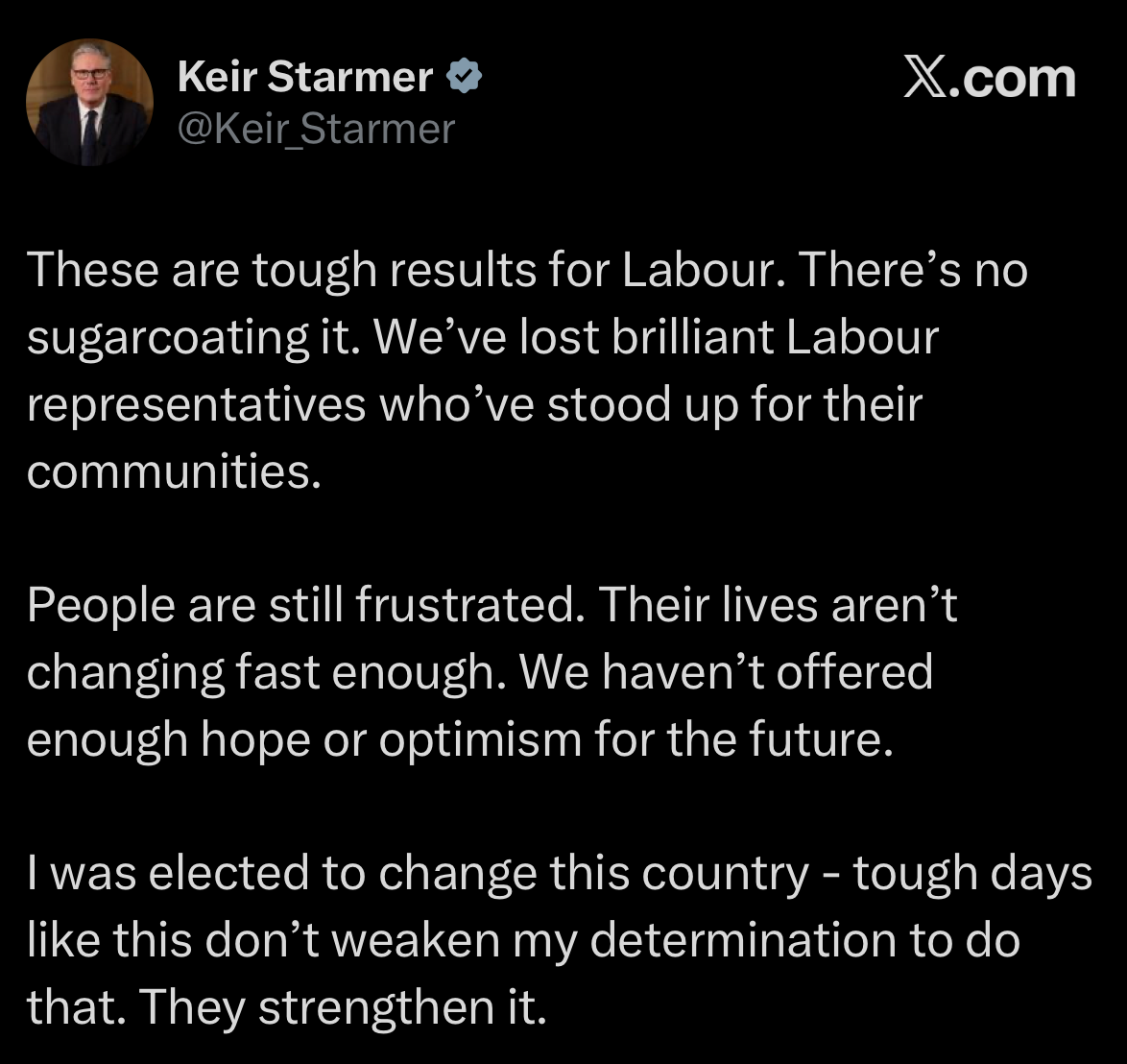
British Prime Minister Sir Keir Starmer — who many commentators have for months been describing as a “dead man walking” — somehow manages to find an interpretation for the Labour Party’s disastrous local election results, and thinks voters just sent a message that he needs to move faster and more vigorously to implement their vision. That’s certainly a take.

Nigel Farage is certainly enjoying the outcome:

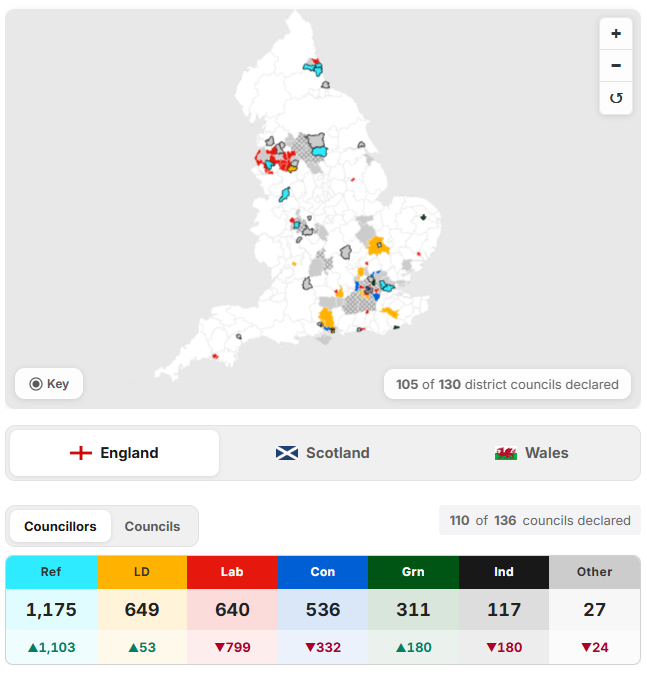
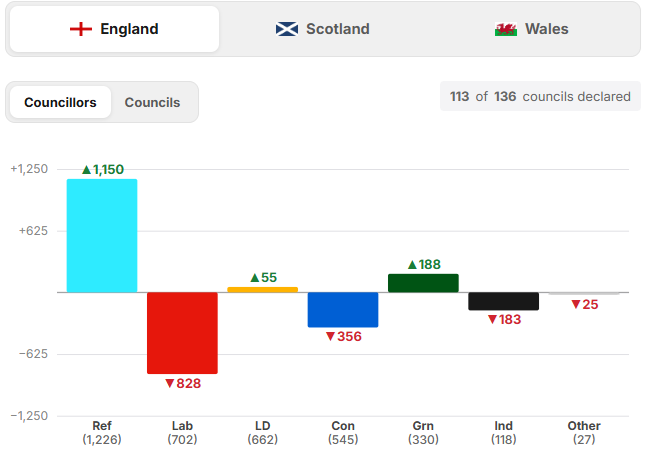
Partial council election results in England, 8 May 2026.
Graphic from the Daily Mail

Hurrah for the Tealshirts! Nigel Farage emerged from Havering Town Hall looking smug even by his standards. For years, he has been written off, denied the respect — and peerage — he feels he deserves, forced to scrape by on gifts from well-wishers, and now he was showing them all, wreaking havoc on both Labour and Conservatives.

Nothing could hold the party back, not the endless terrible comments from Reform candidates who for some reason believe Farage agrees with them, not even a huge bribery scandal involving the party leader in Wales. Today Havering, tomorrow Westminster!

Elsewhere, people were gloomier. James Cleverly explained to the BBC that winning elections isn’t the goal of politics. The Conservatives aren’t interested in here today, gone tomorrow popularity, it turns out. They just want to govern well. Which leaves a couple of questions about the last decade and a half.

David Lammy told anyone who would listen that you don’t change pilot mid-flight. Better, he didn’t add, to wait until the plane has hit the ground.

The real show of the morning was the confrontation on the BBC between Cleverly’s colleague Vicky Atkins and their former fellow Tory, Robert Jenrick. Atkins and Jenrick have a long friendship going back to the time when he was the anti-Farage candidate in Newark in 2014, through the time he was an anti-Brexit MP supporting David Cameron, his days in Theresa May’s government, his early backing of Boris Johnson, his years in the Cabinet, all the way to his realisation this year that he’d never believed any of the things he’d been telling the voters.

“Robert and I haven’t actually spoken to each other since I supported his leadership campaign,” Atkins announced, and the rest of us fastened our seatbelts for a bumpy ride. “I’m surprised that he’s so quick to can all of the work that he did when he was in government.”

Next to her, Jenrick looked like a man who has arrived at a school parents evening to discover that his ex-wife got there first and has been filling people in on the reason she cut the crotches out of all his suits. But Atkins was just getting started. “Nobody should believe the snake oil salesmen,” she said. Jenrick had accused the Tories of messing things up. “Rob was part of the team that made those mistakes.”

Jenrick made another bid to get the conversation back on track. “The question is about honesty and trustworthiness,” he said. You could have used Atkins’ expression at that moment to freeze lava.

At the time of this Daily Mail report from James Tapfield and David Wilcock, the demands from Labour MPs for Starmer to resign hadn’t quite reached the “red alert” level yet:

Partial council election results in England, 8 May 2026.
Graphic from the Daily Mail

Keir Starmer is desperately fighting to subdue a Labour revolt tonight after a local elections bloodbath saw the party routed on English councils, and destroyed in Wales and Scotland.

Loyalist ministers and MPs have been deployed in a frantic bid to prop up the PM, after a series of backbenchers broke cover to demand his resignation.

So far no Cabinet ministers have publicly joined the mutiny – a moment that many believe would be the final nail in Sir Keir’s coffin.

Rachel Reeves and David Lammy were among those backing Sir Keir – but there has been an ominous lack of vocal support from Wes Streeting, Yvette Cooper, Ed Miliband and Shabana Mahmood. London Mayor Sadiq Khan released a statement saying the results in the capital were ‘bitterly disappointing’ and the threat to the party is ‘existential’ – without mentioning the PM.

The civil war reignited this evening after Labour’s Welsh leader, Baroness Morgan, humiliatingly lost her own seat as the party’s tally of the 96 Senedd members was slashed to just nine. In a jibe at the PM, she said the Government nationally must ‘change course’.

Until yesterday Labour held nearly half the seats at the Welsh Parliament, and has never failed to top an election in the country – regarded as its birthplace.

Scottish Labour leader Anas Sarwar has also conceded defeat at Holyrood, saying they had ‘lost the argument’ and pointing the finger at Sir Keir.

Meanwhile, the Greens have dealt a hammer blow by taking the mayoralty in deep-red bastion Hackney, as well as Lewisham – signposting more misery to come in London. The Labour leader in Camden – Sir Keir’s own council – has been defeated by Zack Polanski’s candidate.

Even some Labour stalwarts are reading the tea leaves correctly:

March 11, 2026

Britain’s reputation in the Near East just cratered

Filed under: Britain, Middle East, Military, USA — Tags: , , , , , — Nicholas @ 03:00

On Substack Notes, Earl explains why the inexplicable delay in getting a Royal Navy warship out to protect Gulf allies from Iranian missiles is having serious negative impact on Britain’s longstanding relations with the targeted nations:

A MASTERCLASS IN MILITARY INCOMPETENCE

The Starmer administration’s handling of the Iranian crisis is being whispered about in the corridors of Whitehall as a historic “cock up” of the highest order. Despite receiving a formal request from the Americans on 11 February — a full 17 days before the offensive actually commenced — the British government appears to have spent that critical window in a state of paralyzed indecision. The U.S. request was not an invitation for Britain to join the initial “decapitation strikes”, but rather a plea for the Royal Navy to help shield vulnerable Gulf allies from the inevitable Iranian retaliation. Instead of stepping up to protect the 240,000 British citizens living in Dubai and Abu Dhabi, the Ministry of Defence oversaw a period of baffling inaction that has left regional partners feeling utterly betrayed.

The diplomatic fallout has been described by insiders as nothing short of catastrophic, with Middle Eastern allies expressing “undiluted fury” at the lack of British support. A former minister with deep ties to Amman reports that Jordan is “fking furious”, while leaders in Kuwait and the Emirates are openly questioning whose side Britain is actually on. The Cypriots are reportedly “incandescent” after learning that military assets were actually withdrawn from their vicinity just as the threat level spiked. Only this week did it emerge that HMS Dragon would finally deploy — nearly three weeks after the initial American SOS — a timeline that military experts say is far too little and far too late to restore trust.

Strategic failures have been compounded by what veteran commanders call a total lack of foresight regarding naval positioning. The only available Astute-class submarine was permitted to continue its journey toward Australia, despite having passed through the Gulf just weeks ago when it could have been held as a vital contingency. Security officials now warn that the Trump administration is viewing the UK’s “free riding” with growing contempt. There is a palpable fear in the MOD that the Americans, tired of London’s dithering, will simply cut Britain out of the loop entirely and strike a direct deal with Mauritius to secure the long-term use of Diego Garcia for future operations.

Inside the government, the situation is being described as “incoherent” and “unconscionable”. By allowing the United States to utilize British bases like RAF Fairford for strikes while simultaneously refusing to participate in the missions themselves, Starmer has managed to achieve the worst of both worlds. Critics say they have invited the risk of being targeted by Tehran without the benefit of having any say in the coalition’s strategic direction. One former defence chief has branded this policy “reprehensible”, arguing that Britain has effectively surrendered its seat at the table in exchange for a front-row seat to its own strategic irrelevance.

The sobering reality in Whitehall is a growing sense that the UK no longer has the capacity to shape events in the Middle East. A former Downing Street adviser noted that the “intensity of Labour’s feelings” on the conflict is now matched only by their lack of influence. Allies have stopped listening because they no longer believe Britain can — or will — deliver on its security promises. As the Trump administration continues its high-tempo campaign to dismantle the IRGC, the United Kingdom finds itself sidelined, watched with suspicion by its friends and emboldened by its enemies, all due to a fortnight of inexcusable hesitation.

On March 9th, The Guardian reported that HMS Dragon will sail “in the next couple of days”, heading to Cyprus to take over duties from French, Greek and Spanish ships in providing missile defence to the British air base at Akrotiri. YouTube channel Navy Lookout posted footage of HMS Dragon leaving Portsmouth here.

CDR Salamander looks back at the naval “special relationship” that appears more and more to be just a fading memory:

We need to stop pretending we have a Royal Navy we knew in our youth or even that of two decades ago. No, we have something altogether different. Something shrunken. Something weaker. Something that is, in the end, really sad. A symptom of a nation who has lost an enthusiasm for herself or even an understanding of her national interest and led by a ruling class that seems uninterested in stewardship.

The state of the Royal Navy — a condition that took decades of neglect to manifest into its form today and will take decades to repair if there is ever the will to do so — has become, as navies can often do, a symbol of the state of the nation it serves.

There is a lesson here, not just for the United States, but all nations who consider themselves a naval power.

If you fail over and over to properly fund, develop, train, and support your navy, you can coast for quite awhile on the inertia of the hard work and investment of prior generations, but eventually that exhausts itself, and you are left with the husk of your own creation.

Yes, I’m looking at you, DC.

February 10, 2026

Heightening tensions in the Indian Ocean

Filed under: Britain, China, Government, Military, USA — Tags: , , , , — Nicholas @ 04:00

On Substack, Fergus Mason updates us on what’s happening around the UK/US military base on Diego Garcia in the Chagos Islands in the Indian Ocean:

Diego Garcia

One of the great mysteries of Keir Starmer’s government is why he’s so determined to give the Chagos Islands to Mauritius, which is 1,200 miles away and has never owned them. Even now, as he desperately fights for his political survival, Starmer is pushing ahead with plans to give away the strategic archipelago then pay tens of billions of pounds to lease back one of the islands. It’s an odd thing to be so focused on — but whether his compulsion to surrender the islands is driven by corruption or naivete, it’s sending out signals of weakness. And those signals are being noticed.

The Maldives Makes A Grab

Last Thursday the Republic of Maldives announced that it had rejected the UN International Tribunal for the Law of the Sea’s ruling on its maritime boundaries, and sent an armed boat to carry out a “special surveillance operation” in the northern part of the Chagos island’s Exclusive Economic Zone (EEZ). The Chagos EEZ is claimed by Mauritius, but of course actually belongs to Britain until Starmer’s surrender deal is approved by Parliament. However, the Maldivian government has now decided to make its own claim on the area — and it’s very publicly doing something about it. The “coast guard vessel” CGS Dharumavantha — a former Turkish Navy fast attack craft — is now operating in the area, along with drones from the Maldives National Defence Force Air Corps.

Of course, the Maldives has no real claim to the Chagos islands or any part of their waters. The country — a tiny group of islands southwest of Sri Lanka, with a land area of just 115 square miles — was a British crown colony from 1796 to 1953, and a British protectorate until 1965. Like Mauritius, it has never owned the Chagos Islands. However, it’s just 300 miles away from them, much closer than Mauritius. It appears that its leader, President Mohamed Muizzi, has decided that if the key British territory is up for grabs the Maldives should be the ones to grab it. It’s true the Maldives doesn’t have much of a navy, but then Mauritius doesn’t have much of a navy either and is a lot further away. If the Maldives can seize control over part of the extremely valuable Chagos Marine Protected Area (MPA), and even possibly some of the northern islands, there isn’t a lot Mauritius can do about it.

Why would the Maldives be so keen to seize part of the Chagos EEZ? That one’s simple. Under British protection, the Chagos MPA (which is the largest marine nature reserve in the entire world) has been officially off limits to commercial fishing since 2010 but, in practice, has barely been fished at all since 1968. This makes it a unique and potentially lucrative resource in the Indian Ocean region, which has seen its ecosystems devastated by destructive fishing methods. The wealth of the MPA is the main reason Mauritius wants the Chagos islands. Its own coastal waters have been blighted by overfishing, including the destruction of coral reefs by explosives and bleach injection, and now it wants to plunder the MPA. The Maldives is also busily engaged in destroying its own fish stocks (fishing is the country’s largest industry and employs half the population) and is desperate for new waters to pillage. They don’t just want access for their own boats, either. Like Mauritius, the Maldives under Muizzi’s rule is an increasingly close ally of China.

The Scourge Of The Seas

China has the world’s largest fishing fleet, and it’s not even close. Over 44% of all commercial fishing is carried out by Chinese boats — and they’re notorious for flouting international law. Chinese boats regularly change their names and disable their satellite tracking systems to conceal their identity, then fish illegally in other countries’ waters. They violate quotas, catch protected species and strip whole swathes of ocean clean of any life much larger than plankton with massive, indiscriminate drift nets. Chinese fishing boats have also been implicated in people trafficking, drug smuggling and acting as spying and covert action platforms for the Chinese navy.

If either Mauritius or the Maldives gain control of the Chagos MPA it’s a certainty they will immediately give Chinese boats access, and this priceless nature reserve will rapidly be trawled and drift-netted into a barren, lifeless wasteland. From China’s point of view, of course, it doesn’t matter which of their lackeys takes over the Chagos islands as long as one of them does, so don’t expect them to step in to help Mauritius. They don’t care who they get the fishing rights from.

January 21, 2026

“It is a deal so bad that only Keir Starmer could have negotiated it”

In Spiked, Fraser Myers says that British Prime Minister Keir Starmer fully deserves to be humiliated over his give-it-all-away negotiations for the Chagos Islands, which includes the strategic naval base at Diego Garcia:

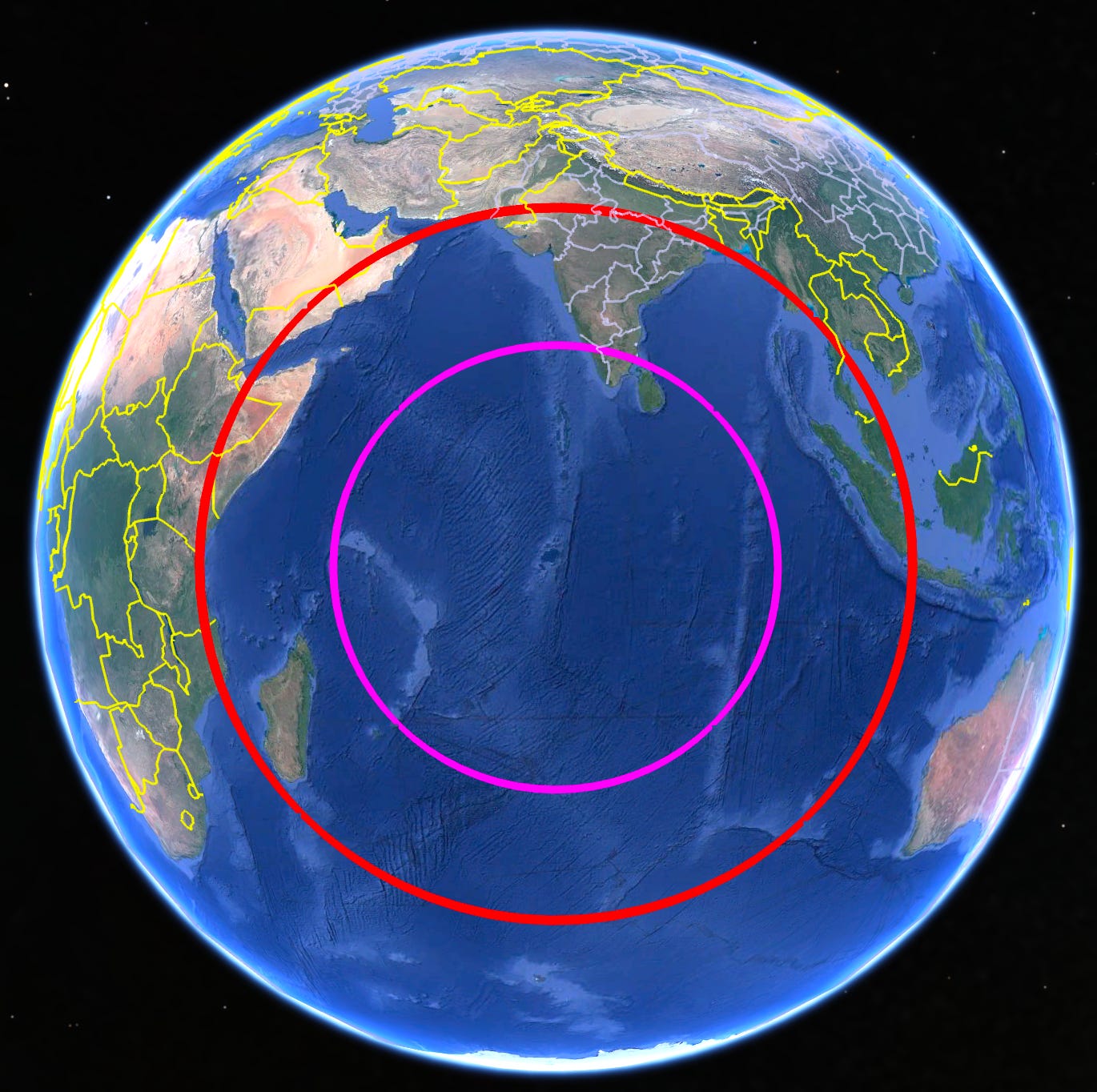
In the middle of that map is Diego Garcia, British Indian Ocean Territory and home to one of the most strategic airfields and anchorages on the planet. […] The red circle is 2,000 nautical miles from the island. The purple circle is 1,150 nautical miles, roughly the distance from London to Malta, that represents the distance from Diego Garcia. That circle is also the distance from Diego Garcia to the island of Mauritius.
Caption and image from CDR Salamander.

With the assistance of the brightest and best of the UK Foreign Office, the Labour government agreed to an arrangement that would hand over territory containing an Anglo-American military base to an unfriendly country, condemn its former inhabitants to permanent exile, and pay tens of billions of pounds for the pleasure.

I’m talking, of course, about Chagos (officially, the British Indian Ocean Territory), which has briefly caught the attention of the world’s most powerful man. This morning, amid a flurry of Truth Social posts about his designs on Greenland, US president Donald Trump’s gaze briefly alighted on this small, tropical archipelago on the other side of the planet. And he did not hold back in his criticism of Britain’s plans: “Shockingly, our ‘brilliant’ NATO Ally, the United Kingdom, is currently planning to give away the Island of Diego Garcia [the largest of the Chagos Islands], the site of a vital US Military Base, to Mauritius, and to do so FOR NO REASON WHATSOEVER”, he wrote. “The UK giving away extremely important land is an act of GREAT STUPIDITY”.

Trump’s reaction has widely been described as a major about-turn. But, in truth, his team has veered all over the place on the Chagos question. In October 2024, when Starmer initially agreed to hand over the islands, Marco Rubio, then still a US senator for Florida, reportedly warned that this would allow “Communist China” to spy on the US Navy, given Mauritius’s alliance with China. Yet in February 2025, when Starmer visited the Oval Office, the US president said he was “inclined to go along with” the UK’s proposals. And by May, when the deal was signed between the British and Mauritian governments, Rubio, by now US secretary of state, welcomed it. He claimed that Trump himself had “expressed his support for this monumental achievement”, hailing the deal that would cede sovereignty to Mauritius, while Diego Garcia would be leased to Britain for the next 99 years.

Of course, Trump’s motivation for bashing Starmer’s deal now has little to do with the Chagos Islands themselves. The real prize for the US president is in a different hemisphere entirely, as he freely admits. In a bizarre non-sequitur, the US president’s Truth Social post goes on to say that the Chagos deal is “another in a very long line of reasons why Greenland has to be acquired” by the US. This smackdown over Chagos, this attempt to humiliate Starmer and Britain on the global stage, is clearly part of Trump’s broader pressure campaign against the European powers, in his bid to seize Greenland for the US.

Nevertheless, it really should not have taken Trump’s intervention to put the brakes on the dreadful Chagos deal. Whichever way you spin it, this arrangement has never been in Britain’s national interest, nor the interests of the Chagossians who call the islands their home. It poses a risk to Western security interests, handing sovereignty over a territory, where almost 400 UK and US troops and 2,000 contractors are based, to a country that’s allied to China. The cost of leasing back Diego Garcia from Mauritius is also eye-watering. Although the Labour government tried to present the cost as just £3.4 billion, the true figure is believed to be 10 times as much, at around £34.7 billion.

So what on Earth possessed Starmer to sign up to such a risible deal? What leverage was a tiny island like Mauritius able to gain over Britain?

January 16, 2026

Rapidly declining democracy in the home of the “Mother of Parliaments”

As I’ve mentioned before, it sometimes seems that Australia, Britain, and Canada are in a three-way race to de-democratize themselves as fast as they possibly can. Here’s the free-to-cheapskates portion of Ed West‘s essay on the return of liberal authoritarianism:

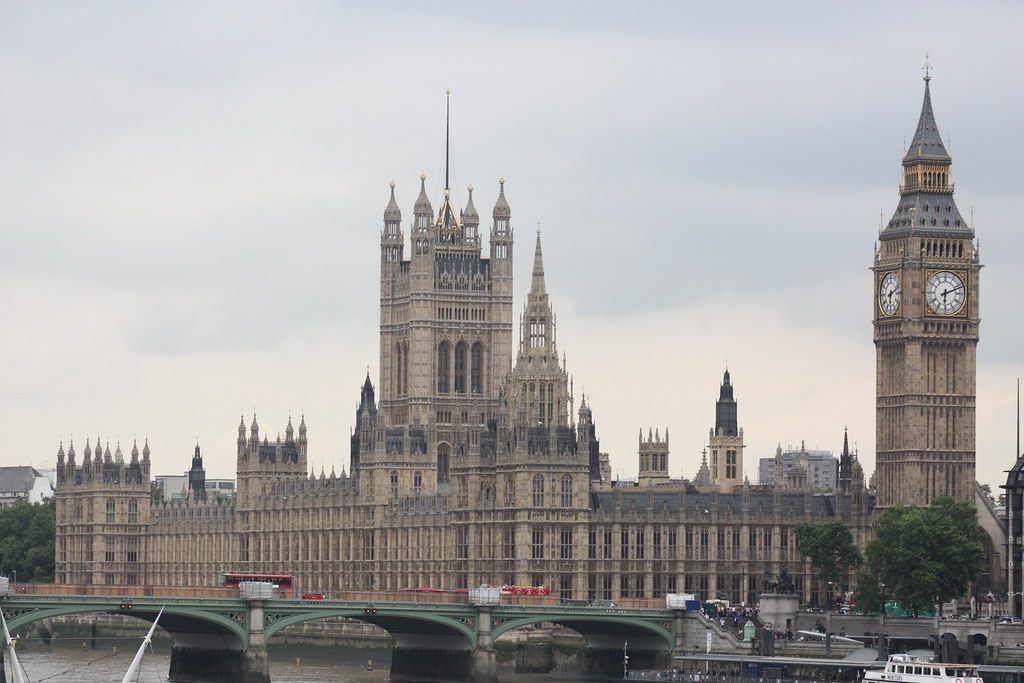
“Palace of Westminster” by michaelhenley is licensed under CC BY-NC-SA 2.0

It’s around this time of year that various NGOs give their assessment on the state of democracy and freedom of the world. The Fraser Institute’s Human Freedom Index was published earlier in December and Freedom House’s next report will arrive in February. It was at the start of last year that Romania was downgraded to a “hybrid democracy” by another body, the Economist Intelligence Unit (EIU), while France is now merely a flawed democracy. Sacré bleu!

What about our own beloved island, the mother of Parliaments? It will be interesting to see where Britain features in this year’s reports, and whether recent developments will impact on our rating.

Just recently, for instance, the British government postponed four mayoral elections until 2028, elections they are certain to lose. The Electoral Commission warned that it risked undermining “the legitimacy of local decision making and damaging public confidence”, while the chairwoman of the Labour Party even refused to rule out delaying the next General Election, leading Nigel Farage to accuse her of having “total contempt for democracy”.

Keir Starmer has also taken effective control of the House of Lords and will almost entirely eliminate opposition among peers by 2027, which he is able to do to the second chamber thanks to Tony Blair’s constitutional reforms. While the government extends the franchise to children, and even plans to place voting booths in schools, a clear violation of rules about politicising the education system, they’re also keen to restrict who can stand in elections.

As the i reported, Emily Darlington, Labour MP for Milton Keynes Central, “is seeking to make the Electoral Commission recommend enhanced DBS checks for candidates and then publish whether or not parties have agreed to the vetting. The aim is to ensure political parties justify whether their candidates are fit for office and name and shame those who refuse to participate.”

This is troubling when one considers that DBS (Disclosure and Barring Service) checks include not just criminal history but “non-crime hate incidents“, which may even appear on the records of people who haven’t been contacted by police. These highly-political charges are far more likely to be directed at those with Right-wing opinions.

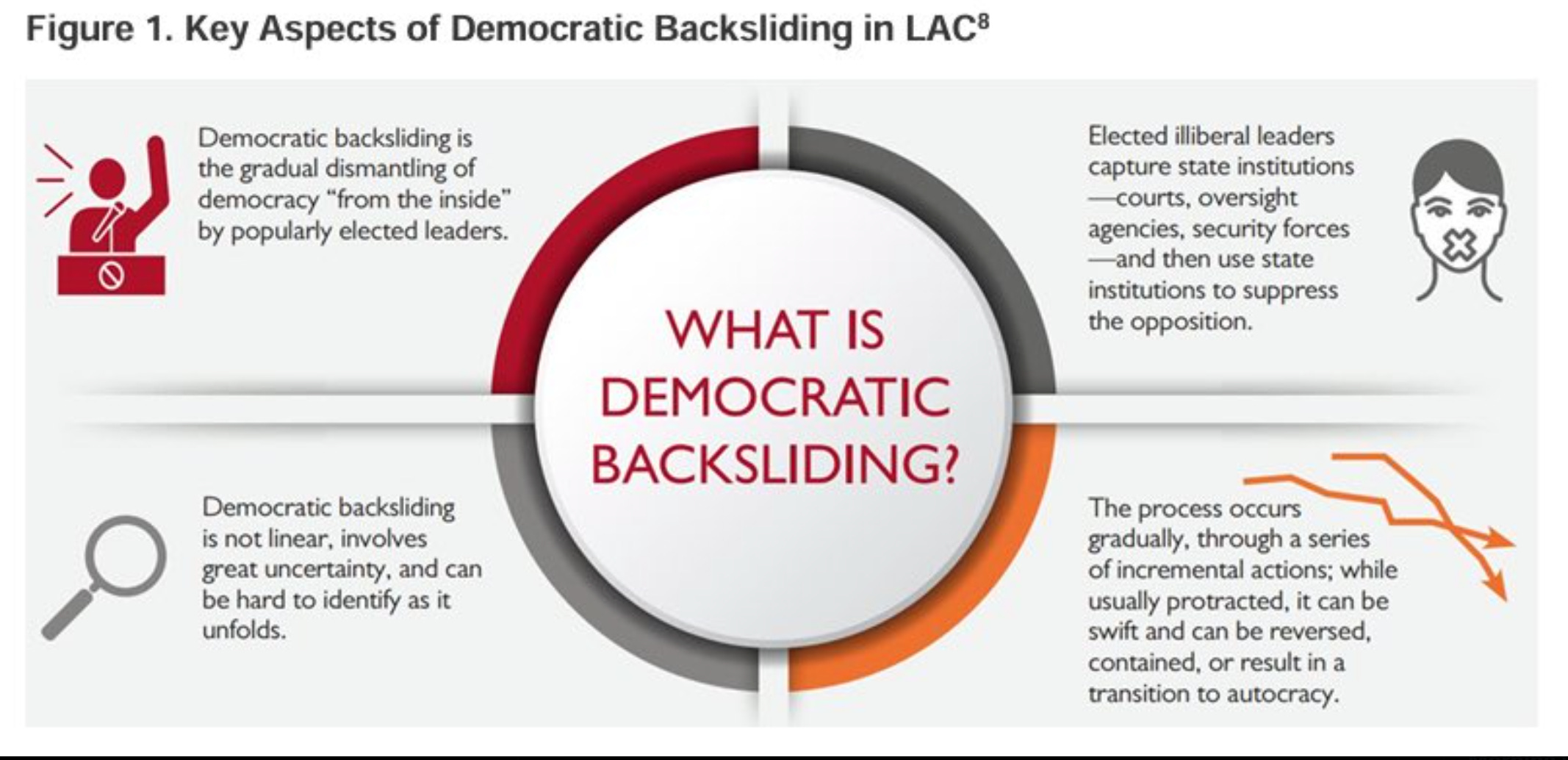
When western European countries do things like this, I try to gauge whether this is normal by asking the question: what if Hungary did this? In most of these cases, I imagine the assessment would be that it was an assault on liberalism and democratic norms. In which case, what if Britain is undergoing the sort of “democratic backsliding” usually levelled at central European countries with conservative governments? What if Keir Starmer is actually one of these illiberal “strongmen” we read about, just not a very effective one.

There are a number of accepted symptoms of democratic backsliding, among the most commonly listed being rejection of democratic rules, a disregard for constitutional norms, attempts to use legal mechanism to sidestep democracy, which is described as “stealth authoritarianism”, denial of opponents’ legitimacy, and the tendency to characterise them as outsiders or a threat to national security; on top of this, one might consider a willingness to curtail civil liberties, restricting the power of the media, and violating freedom of speech and association. Finally, and worst of all, is the toleration or encouragement of violence against opponents.

Credit: the National Opinion Research Center at the University of Chicago

By these broad definitions, Britain arguably meets many of these criteria (but not, most importantly, the last). There is certainly censorship, which has increased with the Online Safety Act, designed to combat “hate” as well as “misinformation”. Misinformation, of course, is everywhere, but its existence certainly provides a convenient excuse for governments to clamp down on the sort of information they dislike. The Government has also pondered banning Twitter, and while I feel that the widespread disgust at the Grok “deepfake” feature is reasonable, such a ban would completely cripple opposition, returning control of the discourse to the old media.

As for the British state’s definition of “hate”, there is a widespread belief that people motivated by hostility to mass immigration are extreme and dangerous, so the full force of the law must be used to stop them gaining support among a public who are totally guileless when it comes to absorbing information. This belief has grown more entrenched with the rise of populism, and makes western European governments increasingly sceptical of democracy itself.

It’s obvious that many people are concerned about the prospect of Nigel Farage becoming prime minister, and as the election date comes closer, and if he’s still in a position to win, the tone will become more shrill. Starmer admitted to this terror when he said, tellingly, that “If there is a Conservative government I can sleep at night. If there was a right-wing government in the United Kingdom, that would be a different proposition.”

Update, 17 January: Welcome, Instapundit readers! Have a look around at some of my other posts you may find of interest. I send out a daily summary of posts here through my Substack – https://substack.com/@nicholasrusson that you can subscribe to if you’d like to be informed of new posts in the future.

January 14, 2026

The Chagos Islands and the military base on Diego Garcia

The British government is engaged on a fantastic quest to subordinate the Chagos Islanders to a new foreign colonial government a thousand miles away who have never had any connection other than an earlier colonial convenience relationship. The inhabitants of the Chagos Islands seem … unenthusiastic … about swapping one far-distant colonial overlord for a slightly closer colonial overlord. In the “outside the paywall” section of this post, Nigel Biggar explains why he’s fighting against this transfer in the House of Lords:

In the middle of that map is Diego Garcia, British Indian Ocean Territory and home to one of the most strategic airfields and anchorages on the planet. […] The red circle is 2,000 nautical miles from the island. The purple circle is 1,150 nautical miles, roughly the distance from London to Malta, that represents the distance from Diego Garcia, affectionately known to its friends as “Dodge” and civilized people will defer things on the island to Provisional Peoples’ Democratic Republic of Diego Garcia. That circle is also the distance from Diego Garcia to the island of Mauritius.
Caption and image from CDR Salamander.

I arrived home late last Monday night, having spent the second half of the day in the House of Lords attending the Report stage of the bill to ratify the treaty whereby the UK surrenders to Mauritius sovereignty over the Chagos Islands — including the military base on Diego Garcia — in return for a ninety-nine-year lease.

For readers who missed — or have forgotten — my post on this topic on August 6th, let me rehearse my view. Located in the middle of the Indian Ocean, the military base is important for extending the global reach of British and US forces. At first glance, exchanging sovereignty for a lease looks like a very poor deal, making possession of the strategic base less secure at a time of growing international tensions.

So why has Keir Starmer’s government signed up to a treaty that does just that?

The treaty presents itself upfront as correcting the injustice done when 1,700 Chagossians were forced to leave their homes on Diego Garcia between 1967 and 1973, to make way for the military base. In the preamble, the two governments “recognis[e] the wrongs of the past” and declare themselves “committed to supporting the welfare of all Chagossians”. Yet the process that produced the treaty does not bear this out. The Chagossians themselves were barely consulted, probably because it is known that many strongly resist subjection to Mauritian rule.

Diego Garcia

Moreover, the treaty binds the Mauritian government to do little for them. Oddly, Article 6 declares that Mauritius is “free” to implement a programme of resettlement. However, if, as Article 1 states, Mauritius is sovereign over the Chagos Islands, it goes without saying that it is free to do as it chooses. It does not need stating. So, the effect of stating it is to highlight the fact that Mauritius has refused any obligation to resettle the islanders.

Article 11 commits the UK to provide capital of £40 million to create a trust fund for the islanders, but it leaves the Mauritian government entirely at liberty to choose how to use it. Yet, when it received £650,000 (equivalent to £7.7 million today) from the UK to compensate displaced islanders in 1972, it withheld the money for six years in punitive retaliation for Chagossian protests. And, again, nine years after it was given £40 million in 2016, to improve Chagossian welfare, it has only disbursed £1.3 million under restrictive conditions.

The treaty’s main concern lies elsewhere. As the preamble also says, it is “mindful of the need to complete the process of the decolonisation” of Mauritius. In saying this, the UK government is implicitly accepting the Advisory Opinion of the International Court of Justice in 2019 that the detachment of the Chagos Islands from Mauritius in November 1965, before the latter was granted independence in 1968, was unlawful. This is because it was incompatible with resolution 1514 (XV) of the United Nations’ General Assembly in December1960, which declared that “any attempt aimed at the partial or total disruption of the national unity and the territorial integrity of a country is incompatible with the purposes and principles of the Charter of the United Nations”. Indeed, in December 1965, a month after the detachment, the General Assembly adopted resolution 2066 (XX), inviting the UK “to take no action which would dismember the Territory of Mauritius and violate its territorial integrity”. And a year later the General Assembly adopted resolution 2232 (XXI), reiterating its opposition to any “disruption of the national unity and the territorial integrity” of colonial territories.

None of these resolutions makes good sense. The original, 1960 one was championed by the Irish ambassador to the UN, Frederick Boland, who was then President of the General Assembly. In promoting resolution 1514 (XV), he invoked Ireland’s loss of its “historic integrity” as a prime example of the injustice to be avoided. In so doing, he expressed the Irish nationalist’s typical historical blindness. The island of Ireland had never been a political unit apart from its union with Great Britain, and there is no natural law prescribing that a geographical integrity should be a political integrity. On the contrary, there can be very good reasons for dividing it. The reason that Ireland was divided in 1922 was because republican Irish people wanted home rule so much that they were prepared to take up arms to acquire it, while unionist Irish people detested it so much that they were prepared to take up arms to oppose it. Ireland was partitioned to prevent further civil war—a justified act of political prudence.

The 1965 and 1966 resolutions are no more sensible. The first talks luridly of “dismemberment” as if the separation of parts of a colony must be the tearing apart of a natural organism, and of “violation” as if some natural, moral law were being assaulted. But there is nothing natural about a political entity and there is no moral law against partition as such.

The 1966 resolution appeals to the “national unity” of Mauritius, as if the Chagos Islands weren’t separated by over a thousand miles of Indian Ocean and as if the islanders were an integral part of the Mauritian people. But many Chagossians feel as Mauritian as Irish republicans feel British. The only connection between Mauritius and the Chagos Islands is an accident of colonial, administrative convenience. Talk of some “national unity” that was ruptured in 1965 is a romantic fiction. Besides, in 1965 the Mauritians agreed to the separation in return for £3 million (worth £74 million today) and the reversion of the islands when no longer needed for defence purposes.

Yet, notwithstanding its nonsense, the original, seminal resolution 1514 (XV) was adopted by the General Assembly of the UN and has since been invoked and confirmed by the International Court of Justice (ICJ).

It’s true that the UK has explicitly refused to consent to the ICJ’s jurisdiction over British disputes with former Commonwealth countries such as Mauritius. However, in its 2019 Advisory Opinion, the court positioned itself formally, not as adjudicating between two sovereign states’ conflicting claims, but as responding to a question from the UN’s General Assembly as to whether the UK had violated international law on the decolonisation of Mauritius in the 1960s. Notwithstanding the fact that that is a crucial point of current contention between the two countries, the ICJ presumed to find in Mauritius’ favour. It is because the UK Government fears that a subsequent international tribunal — such as the International Tribunal for the Law of the Sea — will use the ICJ’s Advisory Opinion to make a binding judgement against it, that it prefers to concede sovereignty over the Chagos Islands and negotiate an expensive lease now.

But there is more to the Government’s motivation than fear. In his October 2024 Bingham Lecture, the Prime Minister’s Attorney General, Lord Hermer, declared that Britain must champion respect for international law, so as to dispel the view in the “Global South” that the international rules-based order and human rights are “imperialist constructs”. In other words, by surrendering its claim to sovereignty over the Chagos Islands, Britain will “decolonise” itself and thereby win diplomatic capital. As the Labour peer, Lord Boateng, opined: “We can welcome this treaty as an end to a period of colonial rule”. This is what lies behind that other statement in the preamble to the treaty: that the parties desire “to build a close and enduring bilateral partnership based on mutual respect and trust”.

January 12, 2026

Is Keir Starmer malevolent or stupid? Or both?

On his Substack, Tim Worstall wonders just how damn stupid Two Tier Keir actually is:

I fear our answer has to be very, very, stupid indeed. Unless he’s simply malevolent which makes things oh so much better, right?

Now, I confess to a fundamental disagreement with the very premise here. For the argument about why we should make child porn legal, see here. Making it more difficult to generate, let alone illegal, strikes me as the wrong decision. But then I’m sufficiently wise in years to realise that I might not be able to persuade some people of either that or of the many other things I am correct about. So, let us leave that aside.

There’s also the point that Grok is hardly the only image generation tool out there these days. Further, the one thing we know about computing is that this year’s leading, bleeding, edge is the free phone app of 5 years in the future. Shrieking that this must be banned just isn’t going to cut it as anyone trying that is simply a Cnut demanding the tide doesn’t flow in.1 On that larger issue of image generation in general we’re just going to end up changing the societal rules. A picture is no longer proof of anything. After all, it wasn’t up until about 1850 — those painters would just do any old thing, the truth be damned — and it won’t be after about 2028. Well, there we are then but …

But OK, let us leave all of that to one side and start from where British politics currently is. Grok generated AI kiddie porn is Bad, M’Kay, and must stop:

    Technology Secretary Liz Kendall says she would back regulator Ofcom if it blocks UK access to Elon Musk’s social media site X for failing to comply with online safety laws.

    Ofcom says it is urgently deciding what to do about X’s artificial intelligence (AI) chatbot Grok, which digitally undressed people without their consent when tagged beneath images posted on the platform. X has now limited the use of this image function to those who pay a monthly fee.

    But Downing Street said the change was “insulting” to victims of sexual violence.

“Downing St” is the equivalent of the American “the White House said” … so yes, that is Keir Starmer, the Prime Minister there.

We’ve also an article from Liz Kendall today:

    That Grok continues to allow this kind of content to be created by those willing to pay for it is an insult to victims. No business model should be built on the exploitation and abuse of women and children.

    The Online Safety Act was designed precisely for situations like this, where platforms fail to take their responsibilities seriously and allow harmful content to proliferate. The British public rightly expects robust action. This is a matter of urgency that demands an urgent response.

    I’ve also been clear that the Online Safety Act includes the power to apply to the courts to block services from being accessed in the United Kingdom if they refuse to comply with UK law.

We can see the threat there. If Elon Musk doesn’t do something about this then we’ll block X/Twitter from the UK.


  1. Why yes, I do know the correct story of Canute and the tides.

A Canadian and Australian connection showed up as well:

While I don’t depend on the social media site formerly known as Twitter for my news, I have found it a very useful additional source since Elon Musk took over the site. I’m clearly not the only one to feel this way:

As they used to say, however, “never believe anything until it’s been denied by the Kremlin”:

November 8, 2025

Think Before You Post | How the UK fell to a sinister new form of censorship

spiked
Published 27 Oct 2025

“Think before you post.” Those were the words screamed out by government social-media accounts, threatening to lock up people for “hate speech”, as riots swept the United Kingdom in the summer of 2024. To those who hadn’t been paying attention, it offered a stark insight into a supposedly liberal, democratic nation that had come to police speech as much as, sometimes even more so, than actual violence. Inciting racial hatred, inciting religious hatred, “grossly offensive” online communications – over the past 60 years or so, Britain has written one new speech crime after another into its statute books. And it has led to a situation in which at least 30 people a day are now arrested in England and Wales for social-media posts. This is a documentary about some of those speech criminals. What we found out was even more chilling than the headlines would have you believe. Featuring: Maxie Allen, Rosalind Levine, Toby Young, Allison Pearson, Luke Gittos and Jamie Michael.

October 9, 2025

Britain is only a few steps further than Canada in the war on free speech

In The Line, Peter Menzies looks at the worsening situation for freedom of speech and freedom of expression in Britain, noting that what’s happening over in Blighty is our immediate future with current Liberal bills before Parliament to give government bureaucrats more power to silence us:

Everyone may know, for instance, that Kimmel got suspended by ABC for a week following statements made in the wake of the assassination of Charlie Kirk. But not a lot of people consuming Canadian media know that in the U.K., comedians weren’t just getting one-week suspensions. Nope. Last month they were getting arrested.

Right-wing icon Katie Hopkins, best known for her Batshit Bonkers Britain clips and Silly Cow tour, hadn’t been charged at the time of writing, but was arrested and, as they say in Blighty, “interviewed under caution”. Previously, Graham Linehan was arrested upon his return from the United States by five armed police officers at Heathrow Airport. At issue were posts he had made on X in April.

“If a trans-identified male is in a female-only space,” one Linehan post declared, “he is committing a violent, abusive act. Make a scene, call the cops and if all else fails, punch him in the balls.”

Currently on bail, Linehan returns to court on Oct. 29. The charges are harassment, criminal damage and suspicion of inciting hatred.

The merits of the cases can be debated, but my point today is that when it comes to digital policy and policing you, and the internet, Canadians and their media should be paying a lot more attention to the U.K.

Because it is there that the true illiberalism of modern Western so-called liberalism is most menacingly embraced. Even prior to the U.K.’s Online Safety Act coming into effect, pre-existing British legislation had been used to, for instance, convict six retired police officers for making comments “deemed to be offensive” within their private WhatsApp chat group. Following the Southport mass stabbing murders of little girls, at least two women with no prior history with police were given prison sentences — one for 15 months for a Facebook post calling for a mosque to be blown up, another 31 months for a tweet calling for hotels full of migrants to be burned. While their comments were certainly worthy of vigorous condemnation, the intervention of the state into private, closed conversations and the involvement of police, courts and the penal system has taken matters in the U.K. to a level inconsistent with liberal traditions.

Now that the Online Safety Act has supplemented those laws, hundreds of people have been arrested and dozens so far convicted for social media posts. The government calls the act a “new set of laws that protect children and adults online” in much the same way Justin Trudeau explained Canada’s own Online Harms Act. It’s all about “safety”.

Online Harms may have died when Parliament was prorogued last winter, but a successor is anticipated and, given Prime Minister Mark Carney’s obvious Anglophilia, it’s easy to speculate — fear is a better word — that he is taking inspiration from the Brits. After all, up until a few months ago, he was one of them.

Fighting back in the U.K. is, among others, Lord Toby Young, the Conservative peer, associate editor of The Spectator and founder of the Free Speech Union, which now has a Canadian branch featuring, among others, journalist Jonathan Kay. Young has protested that criminalizing disinformation hands governments the power to determine truth. Nevertheless, while Prime Minister Sir Keir Starmer has muttered that maybe the police have more important things to do, he shows — despite the meteoric rise in the polls of Nigel Farage’s Reform Party — no inclination to order a digital retreat.

In fact, Starmer just doubled down with the introduction of legislation imposing mandatory digital IDs. A petition opposing it and the potential to enable mass surveillance and state control has already gathered close to three million signatures.

There’s a good chance the Canadian Free Speech Union will be similarly engaged in the years ahead. The Trudeau government’s instincts when it came to digital legislation were not as extreme as Britain’s. And there are very real differences in the legal structure of free-speech rights in Canada and the U.K. — we have the Charter, and the British don’t. So our laws would be enacted and enforced differently here than they can be the the U.K.

October 6, 2025

“[Starmer’s] love of football feels like something an alien would simulate, trying to blend in with our ways”

Filed under: Britain, Media, Politics — Tags: , , , , , , — Nicholas @ 05:00

Britain’s current prime minister, Sir Keir Starmer, is not having even the echo of a political honeymoon despite the utter collapse of the Conservatives in the last general election. Andrew Sullivan, who knew Starmer in school, thinks that Starmer’s plight is a useful illustration of what might have happened in the last US federal election if Kamala Harris had won:

The other day I sat, slack-jawed, reading Kamala Harris’ book — which was not easy to do with my eyeballs permanently rolled into the back of my head. (On one issue that killed her campaign, trans policy, she still hasn’t got the slightest clue what she’s talking about.) At one point, I even tried to imagine what America would be like today if this woke lawyer had actually won last year.

Then it occurred to me that we already kind of know. We actually have a pretty good test case of exactly that: a center-left lawyer-politician coming to power last year after a massive immigration wave had discredited and ousted the previous incumbent. Enter Keir Starmer, my high school frenemy, and now prime minister.

But unlike Harris, Starmer has at least shown signs of understanding his problem: he kicked the far-left Corbynites out of the party, called out anti-semitism, and in his big speech to his party’s annual conference this week, spoke proudly of flying the Union Jack, saying “we placed too much faith in globalization”. In office, he backed Israel’s war against Hamas strongly for a year-and-a-half, followed the science by banning puberty blockers and sex changes for kids, tightened immigration rules a bit, and pursued deregulation of the private sector, especially housing.

So how is he doing?

In one recent poll, his approval rating is 18 percent, with 61 percent disapproving. His government, just a year old, is polling around 19 percent. And in his first year in office, the new anti-immigration Reform Party has doubled its support from 15 to around 31 percent. The Tories — who gave Brits a massive wave of non-white, non-European immigration after Brexit — are at a historic low of 15 percent. Boris may have done what no leftist could: destroy the most successful political party in the West.

This, to put it mildly, is an earthquake. A party barely a year old is almost more popular than the Tories and Labour combined. On paper, Starmer still has four years to right the ship. But in reality, a prime minister who is loathed by four out of five Brits is like Wile E Coyote five feet off the cliff edge. To get a flavor of the general public’s view of Keir, check out this hilarious profile. Money quote:

    Then there is the voice — a cornucopia for sketch writers. We could fill pages with descriptions of the thing — an expiring corncrake, a Dalek suffering stasis of the lower bowel, a fart in a coffin, etc. His love of football feels like something an alien would simulate, trying to blend in with our ways — “I follow the game like any other carbon-based life form”.

The fart in a coffin did his best this week — and survived. Critically, he acknowledged the centrality of mass immigration to the national discourse, the way it has undermined a sense of common culture, undercut wages, begun to replace Christianity with Islam, required ever higher levels of censorship, killed Jews, and turned the cities my grandparents knew into something they wouldn’t even recognize as British.

No vote was ever taken on this policy of making London 40 percent foreign-born, a place where English is now often not heard at all — and even where it is, is almost always in a foreign accent. But the minute anyone ever proffered the slightest objection to mass migration (around a million migrants a year for the past four years), the charge of “hate” and “racism” was instantaneous and deafening.

Elite right and left were as one, defying the public for decade after decade. The hangover, especially after Boris’ brutal betrayal, is now here. (For a single glimpse, think of yesterday when a British citizen named Jihad attacked a synagogue, with two dead, and a flash mob of Hamas supporters swarmed Downing Street.)

Update, 7 October: Welcome, Instapundit readers! Please do have a look around at some of my other posts you may find of interest. I send out a daily summary of posts here through my Substack – https://substack.com/@nicholasrusson that you can subscribe to if you’d like to be informed of new posts in the future.

October 4, 2025

What did poor Liverpool do to deserve “the worst speech in modern British political history”?

In The Conservative Woman, Sean Walsh wonders why his home city of Liverpool was chosen to be the site of a modern political crime-against-humanity in the form of a Two-Tier Keir speech to the Labour faithful:

LIVERPOOL happens to be my city of birth, and my family is generational CIA (Catholic, Irish, Alcoholic). I get back there when I can, usually for funerals family reunions. I can confirm that if you don’t mention Thatcher, the Sun, any Manchester band, the Wirral, or ask a native to pronounce the word “chicken”, you will be made to feel more than welcome as a visitor there. Scousers are rightly celebrated for a quick, if chippy, wit and unique sense of humour. Not least by ourselves.

Hopefully that last quality will help the city survive this week’s invasion by activist lawyers, Islington familiars, boilerplate career MPs, lanyard fetishists, lobbyists, and the process algorithm who was slush-funded to the Labour leadership.

For years Liverpool dodged hosting the Labour conference and was probably resentful at the snub. Now its rejuvenated docklands are the go-to venue for this annual festival of enforced fun/confected joyfulness. It’s probably resentful at that as well.

I’m not sure British politics has seen a speech as bad as the one the Prime Minister gave to this year’s wake gathering. And before you mention Enoch Powell and “rivers of blood”, that speech was “bad” only in the minds of those who never read it or were unable or unwilling to appreciate the deep truths Powell was advancing behind the veil of metaphor.

The Prime Minister was vindictive and politically maladroit in equal measure. Powell, a genuine member of the British working class, was a trained classicist who thought, spoke and wrote in the languages and metaphors of the ancient world. Powell’s lack of condescension and unwillingness to dumb down created room for bad faith and mischievous interpretation.

Starmer, who thinks and speaks the language of the petty bureaucrat, has no such defence. Where Powell made his predictions in poetry (which have proven correct, let’s not forget), Starmer rams home his malevolence in bullet points and crass soundbites.

I make this unhappy comparison partly to draw attention to the decades-long decline in the culture of political speechcraft, which TCW recently wrote about, and to affirm that even by the standards of today Starmer was awful.

We expect our political speeches to be unlovely now. Starmer’s went beyond that and managed to be offensive and yet boring all at once. As I said, the Prime Minister is an algorithm, and there are three things you can say about algorithms: they lack memory, have no sense of humour, and are unaware that they are, well, an algorithm.

On his Substack, Christopher Gage offers “A forward-thinking manifesto to deliver change for stakeholders”. That’s just the sort of bafflegab progressive thinkers think the general public wants to hear, apparently:

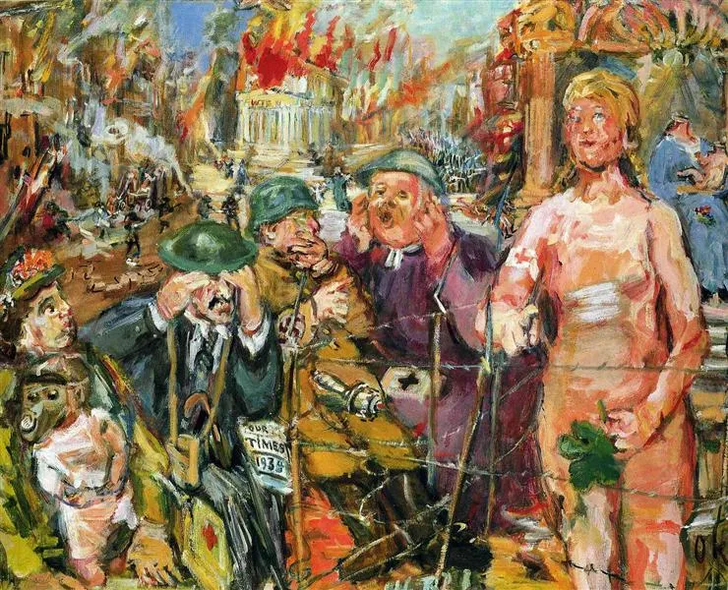
Alice in Wonderland by Oskar Kokoschka (1942)

This year’s Labour Party conference kicked off in the idiosyncratic style befitting its more excitable, green-haired cohort: confusion, contradiction, and faux contrition.

On Sunday, Sir Keir Starmer, our accidental prime minister, condemned Reform’s plan to deport migrants as “racist and immoral”. By Tuesday, it was Labour policy.

Politicians will say anything to keep suckling on the erect nipples of eternal power. And Labour politicians, despite their holier-than-thou affectations, are no different. They’ve seen the polls. Reform has led with room to spare in the last one hundred.

Labour has changed its spots. Starmer’s new Home Secretary, the combative and admirable Shabana Mahmood, is one foot on planet earth, at least.

At the conference, Mahmood warned the Guardian-reading element that they “won’t like the things I do”. She duly unveiled plans to ensure migrants “earn the right” to stay here: speak English, pay their way, and don’t expect their family to follow.

These once radioactive proposals are now common sense — two-thirds support immigration restrictions, whilst one-half wants not only the door welded shut but for many recent arrivals to be ushered politely through it. If Labour wants to win another election, they’d better listen to Wetherspoon Man over Performative Male.


As the week spluttered on, Starmer opted in to opting out to opting in to opting out. But Labour is listening. Nigel Farage, the Wetherspoon Man high priest, must feel his pockets lightened this week. Just glance at the swathes of Labour members waving the Union Jack, faces stretched incredulously like those masks from The Purge.

One impression emerges from this blancmange of bodily fluids: Farage has won the argument. Labour loves Britain, mate. Britain, big tits, Stella Artois, and XL Bullies.

Starmer even took it to Boris Johnson, onetime prime minister and two-time shagger of the year. The epithet “Boriswave” leapt from Starmer’s tongue with pace-sticked regularity. According to the prime minister, letting in four million people in two years — the Boriswave in Twitter slang — is an affliction so terrible that to reverse it would be, erm, even worse.

To be fair, such logic is not so much witless as it is anti-sense. And anti-sense has defined the Labour Party since I was spermatozoa.

One thing is clear. The Labour party, which presides over the sputtering, worn-out appendage known as Great Britain, needs some dire advice.

Here are a few proposals, the wholesale adoption of which would solve every problem befalling broken Britain.

October 3, 2025

Adding digital ID to the pocket moloch … what could possibly go wrong?

Filed under: Britain, Bureaucracy, Government, Liberty, Technology — Tags: , , , , — Nicholas @ 03:00

On Substack, Andrew Doyle explains why it’s a terrible idea to trust the government — any government — in forcing digital ID on everyone:

An illustration of Jeremy Bentham’s Panopticon prison.
Drawing by Willey Reveley, 1791.

During a trip to Russia in 1785, the philosopher Jeremy Bentham sketched an outline for a new prison design. The cells were arranged around the circular perimeter and, at the centre, he placed his “panopticon”: a watchtower which afforded a view of any of the cells at all times. The prisoners might not always be being observed, but they could never be sure that they weren’t.

Bentham’s design was never directly used, but the idea took hold as a symbol of state overreach and control, most famously in Michel Foucault’s Discipline and Punish (1975). Foucault was alert to the political ramifications of such a concept, and how surveillance might become an internalised experience. With Keir Starmer now pledging to introduce a digital ID system as a mandatory condition for the right to work, are we seeing the first step towards the realisation of Bentham’s vision?

I suppose we are already there. I have seen friends switch off their phones before discussing politically sensitive issues, genuinely convinced that digital eavesdropping is the norm. Many people are mistrustful of the “Alexa” voice assistant, which they are persuaded is recording their every word. While this all seems terribly conspiratorial, I’m sure most of us remember those reports a few years ago about the Pegasus spyware which had been covertly installed on the phones of journalists and government figures, turning the devices into pocket spies.

[…]

Few will be surprised to hear that public trust in political institutions has plummeted. The increasingly authoritarian tendencies of successive governments, our two-tier policing system, public manipulation as embodied in the “nudge unit”, and the corrupt prioritisation of the interests of the political class over the people they serve – perhaps best demonstrated by parliament’s flagrant efforts to overturn the Brexit vote – have all contributed to this climate of mistrust. The bizarre overreach of police during the lockdowns – in which dog walkers were publicly shamed with drone footage, and shopping trolleys were probed for “non-essential items” – has hardly helped matters.

To many of us, it is baffling that anyone at all would support the prospect of the government keeping track of our movements and holding our private details in a database. Starmer claims that the scheme will curb illegal immigration, but we are talking about criminals who already work outside the system and will doubtless continue to do so. Besides, identity cards have been a reality on the continent for years, and have done precisely nothing to resolve the problem. Employers in the UK are already legally obliged to insist on proof of immigration status from workers.

Labour’s digital ID scheme seems more about control than anything else. The possibility of fraud is also a major concern. It’s not as though the government has an unblemished track record of preventing data breaches. We all recall the massive leak of official MOD data regarding Afghans who had worked with the British government during the UK’s military campaigns. And who could forget the senior civil servant who, in 2008, left top-secret documents concerning al-Qaeda and Iraq’s security forces on a train from London Waterloo? Are we really to suppose that the creation of an all-encompassing centralised database will not leave the public open to risk from hackers and hostile foreign powers?

Tim Worstall adds that “they c’n fuck off ‘n’ all”:

So we’ve that wet dream of Tony Blair raising its ugly head again. There should be a national ID system. Actually, it’s not just Blair, T — the bureaucracy has been right pissed at the erasure of the wartime system since the 50s when it was abolished.

For there are two ways of looking at, thinking about, the whole governance thing. One is — the Blair, bureaucrats’, version — that the population are cattle, kine, to be managed. For the benefit of the bureaucracy of course — or at very least to be forced into doing what the bureaucracy thinks they — we — should be doing.

Then there’s that stout Englishman, the Anglo Saxon, version, which is that government are just the slaves we communally hire to make sure the bins get emptied. Well, OK, maybe raise a bit of tax for a Royal Navy to sink the Frenchies. But even then, not too much of that — the Civil War was, after all, triggered by Ship Money. Did the people who would not be slaughtered by the first wave of invading Frenchies — because they had the silly excuse of living 25 miles inland — have to pay the tax to run the Royal Navy to keep the Frenchies at bay or not? The King said yes — the King was right — and not for the first nor last time in British political history the guy who was right had his head cut off for being so.

Digital ID, so which version should we have? That one beloved of Froggie-type bureaucrats who view La Profonde as kine to be corralled? Or the Anglo Saxon version where we just devolve the scut work to a few slaves?

[…]

The reason this never will be proposed is that it doesn’t fit the reasons why our rulers wish to have an ID system. They’re insistent that we be their kine rather than they our. So, the Hell w’ ’em.

But it could be done. Government simply publishes an interface — an API — which says that proof of identity needs to be presented in this format. We’re done as far as whose kine is whose.

Update 4 October: From Samizdata, another illustration of just how toxic Two Tier Keir has become to British voters:

The Guardian reports:

    “Reverse Midas touch”: Starmer plan prompts collapse in support for digital IDs

    Public support for digital IDs has collapsed after Keir Starmer announced plans for their introduction, in what has been described as a symptom of the prime minister’s “reverse Midas touch”.

    Net support for digital ID cards fell from 35% in the early summer to -14% at the weekend after Starmer’s announcement, according to polling by More in Common.

    The findings suggest that the proposal has suffered considerably from its association with an unpopular government. In June, 53% of voters surveyed said they were in favour of digital ID cards for all Britons, while 19% were opposed.

Older Posts »

Powered by WordPress