Quotulatiousness

April 24, 2026

Britain’s Green Party … not your weird cousin’s old Green Party

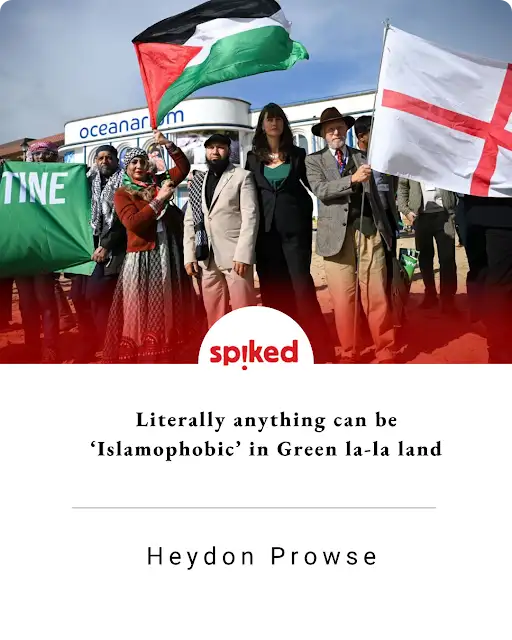
The Green Party have been more of a punchline than a party for decades in British politics, but the Green Party of today shares only a name with its earlier incarnations (the old UK party is now split into three separate Green Parties for England and Wales, Scotland, and Northern Ireland). Now, it’s become a significant threat to the Labour Party thanks to its unlikely fusion of socialist and green policies with strong support from Britain’s growing Muslim community:

The Green Party is a growing force in British politics. In February, they gained the Parliamentary constituency of Gorton and Denton in a by-election — a supposedly “safe” seat for the Labour Party. Local elections in May see them set to make big gains — perhaps sweeping to power in several town halls in London, perhaps including Camden, where Sir Keir Starmer is one of the local MPs. Opinion polls often show them roughly level with Labour and the Conservatives.

This is quite a change from previous decades when they were indulged as eccentrics on the political fringe. The Green Party (or the Ecology Party, as it was earlier named) were the sandal-wearing, muesli-munching environmentalists who wanted to go back to nature. They opposed economic growth — but their supporters tended to be affluent enough that they could afford to do so. Its leader was the aristocrat Sir Jonathon Porritt.

They were the breed George Orwell was thinking of when he wrote: “One sometimes gets the impression that the mere words ‘Socialism’ and ‘Communism’ draw towards them with magnetic force every fruit-juice drinker, nudist, sandal-wearer, sex-maniac, Quaker, ‘Nature Cure’ quack, pacifist, and feminist in England”.

Great fun. But there was a darker side to the quackery then and now. A totalitarian mentality which, as Orwell also vividly described, proves horrific when it prevails.

Increasingly, the Green Party has shifted its focus away from the environment. In the few towns and cities where it has gained power locally, such as in Bristol and Brighton, it has proved ineffective at practical work in this respect. Typical behaviour would be to pass a motion declaring a “climate emergency” but then perform lamentably when it comes to recycling or tree planting or any of the relevant matters they have the power to deal with.

There was always a distortion in its supposed concern for sustainability in that it was really an excuse to denounce capitalism. The Property and Environment Research Center, a US think tank which champions free-market environmentalism, has shown a more enlightened approach. Their work has included a comparison of privately-owned and state-owned forests. Another applies property rights to marine assets. But the role of property rights as a means of good stewardship of our planet is dismissed by the Green Party out of hand.

In any case, much of the campaigning by the Green Party now is on non-green issues. Its leadership talks a lot about foreign policy and a broader economic pitch focusing on class war rhetoric and an extreme programme of state control. Taxing the rich is always seen as the panacea, despite the reality that many entrepreneurs are already fleeing the United Kingdom due to its hostile fiscal environment.

Its Manifesto for the last election two years ago proposed a Wealth Tax, a pensions tax, and a big increase in Capital Gains Tax. A £90 billion carbon tax would have closed down much of British industry, which was probably the idea.

April 17, 2026

The Chronicles of Riddick: a Treatise on Political Machinery

Filed under: Media, Religion — Tags: , , — Nicholas @ 02:00

Feral Historian
Published 28 Nov 2025

The Chronicles of Riddick probably isn’t on anyone’s “top 10 science fiction” list, but it’s a remarkably astute study of how ideologies lead to systems, and how those systems co-opt people within them.

And of course it has a great cast that seems to have had fun with their roles.

00:00 Intro
01:04 Perception of Enemies
03:12 The Underverse
04:59 Plotting and Scheming
07:47 Superposition
08:20 Institutional Inertia
(more…)

April 7, 2026

“The Eight Hundred Years of Oppression”

Filed under: Britain, History, Politics, Religion — Tags: , , , , — Nicholas @ 04:00

On Substack, Upper Canadian Cavalier examines “The Irish Question”:

Every confidence scheme requires three things. A mark who is sympathetic. A grievance real enough to be credible. And an operator whose entire livelihood depends on ensuring the grievance is never actually resolved. Resolution ends the game. The operator does not want justice. He wants the next fundraising dinner.

Irish nationalism, in its mature institutional form, is one of the longest-running confidence schemes in the history of democratic politics. This is not to say the underlying grievances were invented. English rule in Ireland produced genuine catastrophes, and anyone who tells you otherwise has not read much history. The point is not that the wounds were fake. The point is that a very specific class of people discovered, sometime in the nineteenth century, that a bleeding wound is worth considerably more than a healed one, and they have been salting it professionally ever since.

The operators of this scheme are not a conspiracy in any tidy sense. They do not meet in a room. They are, rather, an ecosystem: the Sinn Féin political class, the Irish-American fundraising establishment, the Gaelic cultural bureaucracy with its language boards and arts councils and grant committees, and undergirding all of it for most of its history, the Catholic Church, which managed the remarkable trick of positioning itself as the spiritual soul of Irish resistance while simultaneously running the country’s schools, hospitals, orphanages, and laundries with the administrative efficiency of a medium-sized colonial power. They share no common mailing list. They share something considerably more durable: a common interest in a people who define themselves entirely by what was done to them, because such a people will always need someone to explain what it means.

That someone, naturally, has a salary. Sometimes several.

Part One: The Invoice That Never Clears

The foundational text of Irish identity is not a poem or a legal document or a philosophical treatise. It is an invoice. The Eight Hundred Years of Oppression, presented at every available occasion, never stamped paid, accruing interest at a rate that defies actuarial calculation. It is invoked at pub tables and university seminars and Boston fundraisers and Sinn Féin press conferences with the solemn regularity of a liturgical response, which is appropriate, since it has become one.

Eight hundred years. Let us sit with that number for a moment, because it deserves scrutiny rather than reverence.

The Poles were partitioned entirely out of existence for a hundred and twenty-three years, absorbed simultaneously by three empires, had their language banned, their nobility liquidated, their clergy persecuted, and their country removed from the map of Europe with a finality that the Irish situation never approached. They rebuilt it. They were then invaded again from both sides at once within living memory, occupied by The Nazis and Soviets losing somewhere between five and six million citizens in six years. They do not, as a general rule, organize their entire national identity around the experience. They built things instead.

The Armenians experienced something so total it required the coinage of an entirely new word to describe it. The Acadians were physically deported. The Welsh had their language suppressed for centuries by a state apparatus that regarded Welsh-speaking children as candidates for corrective intervention, which is considerably more systematic than anything the Penal Laws produced. The Greeks spent nearly four centuries under actual Ottoman administration, not the notional suzerainty that characterized much of the Anglo-Irish relationship, and emerged and got on with being Greeks.

None of them made Eight Hundred Years into a brand.

What distinguishes the Irish accounting of oppression is not the severity of the oppression, which was real but not historically singular, but the extraordinary care with which it has been packaged, maintained, and exported. The Famine, which ended in the 1850s, is still discussed in certain Irish-American circles as a recent bereavement requiring ongoing condolences and, more usefully, ongoing donations. The emotional statute of limitations has never been permitted to run. Each generation receives the invoice freshly printed, as though the debt were personally owed to them and personally owed by someone who can still be made to feel bad about it.

April 5, 2026

“Easter remains one of the major annual high holy days of confectionery derangement”

Filed under: Africa, Books, Food, Media, Religion — Tags: , , , — Nicholas @ 05:00

At The Freeman, Nicole James remembers her early chocolate obsessions:

Roald Dahl’s chocolate river was the economic policy of my childhood. Dripping with glossy abundance, and available to any enterprising glutton with a low sense of self-preservation. I never looked at Augustus Gloop and thought, “There goes a cautionary tale about excess”. I thought, “There goes a boy with initiative”. I wanted the river. I wanted the factory. I wanted an Oompa Loompa or two, ideally unionized and living in a tasteful outbuilding, making me truffles on demand. I wanted a world in which everything was edible and slightly mad. While everyone else was apparently learning moral lessons, I was busy fantasizing about a life in which I could plunge both arms into a molten tributary of cacao and come up glistening, like some sort of deranged dessert otter.

Easter seemed to offer the nearest thing to this ideal. It was the one annual moment when adults, in a dramatic collapse of judgment, agreed that children should be handed industrial quantities of wrapped chocolate and told to go hard. Easter had tiny eggs hidden in pot plants and larger ones with enough packaging to survive atmospheric re-entry. It was capitalism in a bunny suit.

Then adulthood arrived, lugging excellent literary references. Along came Like Water for Chocolate, with its sexy sorrow and culinary melodrama, and suddenly chocolate was not just a childhood frenzy but a vehicle for yearning and seduction. It could communicate things one would never dream of saying aloud at a suburban dinner party. Chocolate had range.

And this is why the present state of it feels so personally offensive because what is happening to chocolate is a slow-motion mugging. Cocoa is being shaved out. Bars are shrinking. Prices are soaring. Palm oil and vegetable fats are barging into flavor. Chocolate flavor. Not real chocolate, but a cheap mockery of the original deity.

And yet Easter remains one of the major annual high holy days of confectionery derangement. According to Cargill, in the United States, people are expected to plough through around 73 million pounds of chocolate over the Easter season. Around 90 million chocolate bunnies are produced, with — fun fact — 78% being devoured from the ears first.

Easter spending in the US has in recent years hovered around the $23 billion mark, with candy doing much of the heavy lifting. Chocolate, marshmallow Peeps, baskets, flowers, brunches, the whole pastel circus. Christianity may supply the headline act, but the event itself has clearly been workshopped by a mall.

But beneath the cellophane gaiety lies an increasingly grubby truth. Cocoa prices have surged, largely because harvests in West Africa have been hammered. Ghana and Côte d’Ivoire, which together produce the bulk of the world’s cocoa, have been clobbered by poor weather, crop disease, supply chain fragility, deforestation, and the sort of labor abuses that make any cheerful Easter ad feel criminal. The global appetite for chocolate remains immense, but the cacao tree itself is having a nervous collapse.

Update, 19 April: To the surprise of many who’ve latched on to the “woe, woe, mankind bad” chorus, there are now reports of a bumper crop of cocoa and the market prices are dropping:

It all seemed to kick off in March 2024 with the BBC’s chief climate headbanger Justin Rowlatt noting that “climate change” was one of the reasons for chocolate Easter eggs getting more expensive. Experts are said to have claimed that “human-induced” climate change had made extreme heat “10 times more likely” in the main cocoa bean-growing areas of West Africa. The story has had excellent fearmongering legs with a couple of years of bad weather-related harvests sending the world price of cocoa soaring. As late as October last year, the New York Times was stating that higher cocoa prices pushed up by climate change had led to companies changing their chocolate confectionary concoctions. Alas, sadly missing in recent chocolate climate claptrap is that an improved recent harvest (no weather-adjusting humans thought to be involved) has led to a massive 75% slump in global cocoa prices from the peak reached in January last year.

Like coral, polar bears and Arctic ice, any narrative-disturbing news is ignored. The media barkers promoting the Net Zero fantasy simply move onto the next promising climate porn project that can be ramped up to Armageddon level. The Great Choccy Catastrophe is a classic of its kind, but it is just the latest in a long and increasingly tedious line of crying wolf climate tantrums.

[…]

They get a lot of weather in the tropics, particularly in countries like Ivory Coast which accounts for up to 45% of world cocoa bean production. Dry periods alternate with wetter conditions, and there is some short-term variability in decadal temperatures. But according to World Bank climate figures, the average temperature since 1900 has risen just 1°C, while rainfall totals have remained remarkably stable. The average annual total since 1900 is around 1,354 mm. This is nearly identical to the 1,283 mm recorded in 2023, and similar to the 1,239 mm that fell in the supposedly drought conditions in 2024. Neighbouring Ghana is the world’s second largest cocoa producer and its 125 year precipitation average is 1,236 mm. This is a little higher than the 2024 ‘drought’ total of 1,181 mm, and a tad lower than the 1,278 mm in 2023.

The tropics have provided good pickings for climate and Net Zero agitators. Temperatures and rainfall can vary widely over individual years and decades. For instance, Ghana had record low rainfall in 1983 of 851 mm compared with a record high of 1,775 mm in 1968. As we have repeatedly seen over the last few years, any departure from the norm becomes the basis for a politicised junk science prediction that the climate is in crisis.

April 3, 2026

Hot Cross Buns – Mother Goose Would Love These

Filed under: Food, Religion — Tags: , , , — Nicholas @ 02:00

Food Wishes
Published 12 Apr 2017

Pretty much all I know about hot cross buns, I learned from the nursery rhyme, but thanks to a recipe I found on Anson Mills, I was still able to make a fairly decent batch. Including real crosses, not to be confused with dinner rolls on which an icing cross has been piped.

In addition to its eye-catching appearance, the dough-based “cross” provides an interesting textual contrast, as it gets sort of chewy, and crispy edged.

Like I said in the video, any sweet dough will work with this easy technique, especially rich, and fragrant examples, like our Italian Easter Bread dough. Times may vary, but regardless of the dough, simply wait for the dough to double in size, and proceed.

If you want to get all your buns the same size, weigh your dough in grams before dividing, and then divide by 16. Then, weight each of your dough balls to that exact amount, and boom, your tray of buns will look like the ones you saw on that magazine cover. Or, just eyeball it and take your chances. Either way, I really hope you give this a try soon. Enjoy!

April 1, 2026

The fall of Rome and the rise of Islam

Filed under: Books, Economics, Europe, History, Religion — Tags: , , , , — Nicholas @ 03:00

Gustavo Jalife points out that a work from nearly a century ago identified the rise of Islam as being far more disruptive to western civilization than the fall of the western Roman Empire (and the surge of Islamic power destroyed the Persian Empire and nearly toppled Constantinople as well):

Expansion of the Caliphate: Mohammed, 622-632 (red), Rashidun Caliphate, 632-661 (orange), and the Umayyad Caliphate, 661-750 (yellow).
Wikimedia Commons.

In Mohammed and Charlemagne – posthumously published in 1937 – renowned historian Henri Pirenne (1862-1935) advanced a thesis at once simple and much contested: that the true rupture between Late Antiquity and the beginning of the Middle Ages was not the fall of Rome in the fifth century, as traditionally held, but the expansion of Islam in the seventh. The Germanic kingdoms, he argued, had preserved much of the Roman economic and cultural architecture. Trade across the Mediterranean continued; cities, though diminished, remained nodes in a wider network sustained by the circulation of goods and by administration. For the Romans, the mare nostrum was a highway rather than a barrier.

If a good article starts after it ends, one might say that a civilisation reveals itself most clearly not in its proclamations, but in the modification of its habits – when what was once assumed becomes contested. In such subtle alterations, Pirenne discerned the end of the ancient world.

With the Islamic expansion the greater part of the Mediterranean’s southern and eastern shores fell under Muslim control, from the Levant and Egypt to North Africa and the Iberian Peninsula. The sea was no longer a unified Roman basin, but a divided one. Authority and function shifted: the Mediterranean ceased to operate as a shared commercial zone. Long-distance trade dwindled, the flow of goods between East and West was disrupted and with it the urban and monetary life that depended upon it. Only then did Western Europe withdraw inward, shrinking into the medieval world as it is recognised today.

The argument has been debated, qualified, and revised. Yet its inner core endures: civilisations are sustained not merely by armies or laws, but by the invisible fibres of exchange – commercial, intellectual and cultural – that bind their parts together. Sever those threads and, without even the cut of a sword, a whole order may vanish into a rumour.

To draw a parallel with present-day Europe is to tread on disputed ground. The language of “invasion” is often employed with more heat than light; yet to deny that significant demographic and cultural changes are under way would be equally unhelpful. The question, then, is whether Pirenne’s model can illuminate what many believe is a tragedy without reducing it to a farce.

The spread of Islam in the seventh and eighth centuries was a series of military conquests. The Arab fleets that took North Africa and Spain, the armies that crossed into Gaul, and the long struggle for control of the Mediterranean were enterprises of war and empire. Contemporary migration into Europe, by contrast, occurs largely through civilian movement, legal and illegal. However, both historical processes demonstrate that massive migratory movements, whatever their specific nature, do not merely add numbers to a population; they introduce new networks, new loyalties, new values and new norms that eventually fracture the existing state of affairs.

Before the eighth century, the Mediterranean economy continues to function, vibrant and connected. After the eighth century, that system is shattered. The sea is closed. Trade disappears. Europe faces an empire whose only wealth is the land, where the movement of goods is reduced to a bare minimum. Far from advancing, society regresses.

Pirenne’s thesis gains thrust and edge in presenting the Islamic expansion as embodying a fundamental alteration in coexistence.

March 7, 2026

The massive blind spot in gender studies programs

Filed under: Education, Media, Middle East, Politics, Religion, USA — Tags: , , , , , — Nicholas @ 05:00

On the social media site formerly known as Twitter, stepfanie tyler recounts her own experience in university with gender studies:

Some feminists romanticize mandatory hair coverings, social exclusion and lack of rights for women in Islamic countries. Because reasons.

When I was in “Women’s and Gender Studies” in college, we spent a lot of time talking about “systems”, “the patriarchy” and all these hidden structures supposedly shaping women’s lives in the West

I entertained a lot of those ideas back then and I was trying my best to understand the frameworks they were teaching

But the one place I never gave them an inch on was women in the Middle East

Every time someone would say “that’s just their culture” something in me short-circuited. No matter how hard I tried, I just couldn’t reconcile it

We were told American women were oppressed because of wage gaps or subtle social expectations, but when the conversation turned to women who could be punished by the state for showing their hair, suddenly we were supposed to become culturally sensitive (some of these lunatics even romanticized it!)

My professors used to get irritated with me when that topic came up bc they knew I wasn’t going to play along and my pushback would cause a rift in their narrative

They didn’t like it when I pointed out the hypocrisy of calling Western women oppressed while treating literal legal restrictions on women’s bodies as a cultural difference

One of my professors even had a running joke she’d use to preface discussions on Islam—she’d do this smug smirk and say something to the effect of “we all know Stepfanie’s take on Islam” as if I was the ridiculous one

Looking back, I wish I had the language and wit to verbally obliterate her but I was 22 and simply did not have the intellectual capacity yet. I didn’t know the first thing about geopolitics, I just knew in my bones how fucking stupid it sounded to be bitching about making 20 cents less than men when women in the Middle East were being stoned to death for showing their hair

Even back then, before my politics changed, that contradiction never sat right with me. And it’s one of the many reasons I despise so-called feminists so much today

February 19, 2026

QotD: The Donation of Constantine

Filed under: Europe, History, Italy, Quotations, Religion — Tags: , , , , , — Nicholas @ 01:00

Y’all know I love the 15th century. Not “the Renaissance”, although “the Renaissance” — insofar as that’s a useful concept of historical analysis, which is not very — was in full swing in Italy by 1400, and soon enough north of the Alps, too. The professional periodization and terminology can be confusing here — the “Northern Renaissance” can refer to different things, sometimes a hundred or more years apart, depending on whether you’re talking about visual arts or poetry or what have you. So I prefer to confine the term “Renaissance” to Italy. Unless I’m talking specifically and exclusively about Italy, I’ll refer to the period as “the 15th century”.

I love it because it’s clearly a watershed moment in human thought. I don’t mean the rediscovery of the classical past; I mean the shift between a more cyclical orientation towards life, versus an orientation around linear time. Time as the regular procession of the seasons, vs. time as a stream or river.

Some examples will help. The 15th century saw not just the creation of archives-based history, but the techniques in various fields that make archival work possible. For instance, the Donation of Constantine was definitively proved to be a forgery in the 15th century, on the basis of philological evidence. Before that point, the people using the Donation – both ways — wouldn’t have cared too much if they knew it was a fake. Not because they were opportunists (although they were), but because “factual accuracy”, to use one of my favorite of the Media’s many Freudian slips, just didn’t matter much back then.

When they said “the Donation of Constantine” they meant “hallowed by tradition”, and if you’d proved to them that the Donation was fake, they’d just keep on keepin’ on — ok, then, “hallowed by tradition” it is, everyone update your style books accordingly.

Severian, “The Ghosts (II)”, Founding Questions, 2022-05-18.

February 15, 2026

How to Make The Economy Look Better Than It Is – Death of Democracy 03 – Q3 1933

Filed under: Economics, Germany, History, Religion — Tags: , , , , , , — Nicholas @ 04:00

World War Two
Published 14 Feb 2026

Death of Democracy returns to Nazi Germany in Q3 1933. See Hitler enforce one‑party rule, sign the Reichskonkordat, tighten propaganda and press control, and expand work programs that feed rearmament. From July to September, follow the legal and cultural Gleichschaltung that normalizes terror and reshapes Europe’s future in this episode.
(more…)

February 11, 2026

QotD: Delusional takes – “There are no white people in the Bible”

Filed under: History, Italy, Middle East, Quotations, Religion — Tags: , , , , , — Nicholas @ 01:00

[Responding to an image posted here.]

Oh boy, I get to post more Damned Facts that will offend people who richly deserve to be offended.

There were lots of white people in the Bible. And you don’t need to get into any definitional questions about the genetics of ancient Judea, either.

Greeks and Romans were white — that is, pale-skinned Caucasians. We know this from art, from sequenced genomes, and from contemporary descriptions of what they looked like. Herodotus described the Pontic Greeks as being blonde and blue-eyed.

Here’s the really Damned Fact: brownness in Mediterranean European populations was a late development. Post-Classical. Caused by …

… the Islamic invasions, post 722 CE. Resulted in Europeans of the Mediterranean coast becoming admixed (to put it very, very diplomatically) with Arabs and Africans. That’s why there’s a really noticeable gradient in Italy between lighter-skinned Northerners and darker-skinned Southerners; it’s all about how long various regions were under Islamic domination.

The question that usually comes up is, was Jesus himself “white”?

It’s possible. We can’t go by the artistic evidence, because Byzantine art deliberately confused Jesus with stylized depictions of the Emperor in his glory (there’s a really famous example of this in the Hagia Sophia in Constantinople). And those Greek emperors may well have been depicted as a bit blonder and more blue-eyed than they actually were, because that was considered beautiful. Dashboard Jesus is a late polyp of this tradition.

But until we find actual genetic material we’re not going to know. Imperial-run Palestine was a swirling cauldron of different ethnic groups, and the genetic boundaries didn’t necessarily match up neatly with the religious ones. Knowing that his parents were part of the Jewish people doesn’t necessarily help much.

The two most likely cases are that Jesus looked like a current-day city Arab, or he looked like a Philistine — that is, Greek with some local admixture; a lot of coastal Lebanese still look like that today. But full-bore pasty-skinned Euro can’t be ruled out.

ESR, The social media site formerly known as Twitter, 2025-11-10.

February 4, 2026

QotD: The impact of quasi-official monotheism on the Roman Empire

Filed under: Europe, History, Quotations, Religion — Tags: , , , , , — Nicholas @ 01:00

This trend towards calcification [into the relatively rigid categorizations of honestiores and humiliores (“respectable” and “humble” people, but in practice, “wealthy” and “commoners”)] had been matched by the loss of Rome’s (admittedly opportunistic and unevenly applied) religious tolerance. This is often attributed to Christianity itself, but is perhaps better understood in light of the increasing demands of emperors during and after the Crisis of the Third Century to insist on unity through uniformity. The first empire-wide systemic persecution of Christians, the Decian Persecution (250 AD) was exactly this – an effort to have all Romans everywhere sacrifice for the safety of the emperor as an act of unity to strengthen his reign which rather backfired because it seems not to have occurred to Decius that Christians (of whom, by 250, there were many) would be unable to participate. Diocletian likewise launched the Great Persecution in 303 as part of a program to stress unity in worship and try to bind the fractured Roman Empire together, particularly by emphasizing the cults of Jupiter and Hercules. From that perspective, Christians were a threat to the enforced, homogeneous unity Diocletian wanted to foster and thus had to be brought back or removed, though of course in the event Christianity’s roots were by 303 far too deep for it to be uprooted.

That is part of the context where we should understand Constantine (r. 306-337). Constantine is famous for declaring the toleration of Christianity in the empire and being the first emperor to convert to Christianity (only on on his death-bed). What is less well known is that, having selected Christianity as his favored religion, Constantine – seeking unity again – promptly set out to unify his new favored religion, by force if necessary. A schism had arose as a consequence of Diocletian’s persecution and – now that Christianity was in the good graces of the emperor – both sides sought Constantine’s aid in suppressing the other in what became known as the Donatism controversy, as the side which was eventually branded heretical supported a Christian bishop named Donatus. Constantine, after failing to get the two groups to agree settled on persecuting one of them (the Donatists) out of existence (which didn’t work either).

It is in that context that later Christian emperors’ efforts to unify the empire behind Christianity (leading to the Edict of Thessalonica in 380) ought to be understood – as the culmination of, by that point, more than a century of on-again, off-again efforts by emperors to try to strengthen the empire by enforcing religious unity. By the end of the fourth century, the Christian empire was persecuting pagans and Jews, not even a full century after it had been persecuting Christians.

These efforts to violently enforce unity through homogeneity had the exact opposite effect. Efforts to persecute Arian Christians (who rejected the Nicene Creed) created further divisions in the empire; they also made it even more difficult to incorporate the newly arriving Germanic peoples, who had mostly converted to the “wrong” (Arian) Christianity. Meanwhile, in the fifth century, the church in the East splintered further, leading to the “Nestorian” (the term is contested) churches of Syria and the Coptic Church in Egypt on the “outs” with the official (Eastern) Roman Church and thus also facing persecution after the Council of Ephesus in 431. The resentment created by the policy of persecution in the East seems to have played a fairly significant role in limiting the amount of local popular resistance faced by the Muslim armies of the Rashidun Caliphate during the conquests of Syria, the Levant and Egypt in the 630s, since in many cases Christian communities viewed as “heretical” by Constantinople could actually expect potentially better treatment under Muslim rule. Needless to say, this both made the Muslim conquests of those regions easier but also go some distance to explaining why Roman/Byzantine reconquest was such a non-starter. Efforts to enforce unity in the empire had, perhaps paradoxically, made it more fragile rather than more resilient.

Bret Devereaux, “Collections: The Queen’s Latin or Who Were the Romans, Part V: Saving and Losing and Empire”, A Collection of Unmitigated Pedantry, 2021-07-30.

February 1, 2026

The Agora of Athens | A Historical Tour

Scenic Routes to the Past
Published 3 Oct 2025

The Agora was the political and economic heart of ancient Athens. This tour explores its long history and evocative ruins.

Chapters
0:00 Introduction
0:47 Bouleuterion
1:44 Tholos
2:22 Monument of the Eponymous Heroes
2:56 Temple of Hephaestus
5:28 The Hellenistic Agora
6:16 Stoa of Attalos
6:57 Augustus and the Agora
8:06 Odeon of Agrippa
9:26 Herulian Wall
10:56 Overview

QotD: Don’t bother accusing progressives of hypocrisy … that’s a “category error”

Filed under: Media, Politics, Quotations, Religion, USA — Tags: , , , , , — Nicholas @ 01:00

We have to start, I think, by rejecting the Donatist heresy. As usual I’m framing this discussion in Catholic terms because it’s easier to mesh up the discussion with Escriva that way, but you don’t have to be a theologian to see that Clown World has given itself entirely over to a version of Donatism:

    Donatists argued that Christian clergy must be faultless for their ministry to be effective and their prayers and sacraments to be valid.

Donatists Democrats are the real racists, amirite? In Clown World, hypocrisy is a category error:

    Hypocrisy is the practice of engaging in the same behavior or activity for which one criticizes another or the practice of claiming to have moral standards or beliefs to which one’s own behavior does not conform. In moral psychology, it is the failure to follow one’s own expressed moral rules and principles. According to British political philosopher David Runciman, “Other kinds of hypocritical deception include claims to knowledge that one lacks, claims to a consistency that one cannot sustain, claims to a loyalty that one does not possess, claims to an identity that one does not hold”. American political journalist Michael Gerson says that political hypocrisy is “the conscious use of a mask to fool the public and gain political benefit”.

The underlying assumption here is that there exists a standard outside of oneself. What SJW believes that? If you want a learned citation for it, get our main man Marcus Aurelius back up in here: Of each particular thing ask, what is it in itself? What is its nature?1

SJWs are nihilists. Hypocrisy requires an external standard, and they don’t have one. All they have is their self — which they hate, and long to extinguish, along with everything else that reminds them of their hated, hateful self. Their every thought, word, and deed aims only at that — extinction — whether they recognize it or not.

In practice, then, SJW “hypocrisy” is a tool, a tactic — a really valuable one. They want to kick down some pillar of ambient civilization. And they’ve got all the time in the world to do it, because while they’re just getting on with it, their putative “opponents” are shrieking about hypocrisy! Often with some blather about “Chesterton’s Fence” or similar for good measure.

That’s Donatism, PoMo version. “If you’re going to tear down the fence, first you must explain how it got there, and what it was supposed to do, and then what you’ll be replacing it with.” No. Category error. They don’t care. They have never cared. The fence isn’t the point. Neither is the fence’s replacement, or whatever might be behind the fence, or anything else. They’ve never given any of that a second’s thought, because destruction is the point.

It’s the only point. Always. They have no other.

Thus we must reject Donatism. It doesn’t matter how flawed your “priest” is. The work is bigger than the man. The work transcends the man.

Severian, “The Way, Chapter 2: Guidance”, Founding Questions, 2022-05-01.


  1. A PoMo in joke. That’s not Aurelius, it’s Hannibal Lecter. But it’s an accurate paraphrase of Aurelius. Can you believe there was once a time when a bestselling thriller could make an allusion to Marcus Aurelius a small but important plot point? That time was 1988, for the record.

January 30, 2026

QotD: Slavery in the Islamic world

Filed under: Africa, Books, History, Middle East, Quotations, Religion — Tags: , , , , — Nicholas @ 01:00

As one recent study of the 19th century slave Fezzeh Khanom puts it, “The history of slavery in Iran has yet to be written”. A general history of slavery in the wider Islamic world had yet to be written, too — until Justin Marozzi took up the task.

The widespread neglect of the history of slavery in North Africa and the Middle East, which Captives and Companions seeks to redress, partly reflects a culture of American exceptionalism; slavery in other parts of the Americas (it was abolished in Brazil only in 1888) also receives little attention.

Partly, too, it reflects a tradition of denial in the Islamic world itself. Marozzi recalls a professor at Bilkent University in Turkey admonishing a younger historian not to dig too deep: “Our ancestors treated their slaves very well; don’t waste your time”.

In the West, meanwhile, Islamic slavery is an unfashionable — and often suspect — subject: one is reminded of West Germany in the 1980s, when any overemphasis on Soviet crimes against humanity could appear as an attempt to whitewash or relativise the Holocaust. Marozzi is careful not to dwell too much on comparisons between Islamic and Atlantic slavery, except as regards the scholarly attention which they have received. Still, many readers will pick up his book hungry for such comparisons. So here they are.

In both Islamic and Atlantic slavery there was a marked racial — anti-black — component. Slavery was sustained by similar religious and philosophical justifications: the biblical “curse of Ham”, for example, and the idea that geography and climate made sub-Saharan Africans naturally suited for servitude. “Chattel slavery”, Marozzi emphasises, existed in the Islamic world too. Both involved horrific violence and displacement. Both were complex and sophisticated enterprises, often with serious money at stake.

People have always been hesitant to draw any comparisons between Islamic and Atlantic slavery, albeit often for entirely opposite reasons to historians today. Whereas the Jewish-American writer Mordecai Manuel Noah was a vocal supporter of the enslavement of Africans in America, he was also bitterly opposed to the enslavement of Americans in North Africa — and therefore a strong supporter of America’s involvement in the Barbary wars.

Gladstone, meanwhile, thought that Turks killing and enslaving Europeans was far worse than “negro slavery”, which had at least involved “a race of higher capacities ruling over a race of lower capacities”. However dubious his family connections, Gladstone was born after Britain had abolished the slave trade.

The lack of attention given to Islamic slavery is all the more dismaying when one considers just how much longer it survived.

Most of slavery’s 20th century holdouts were in the Islamic world. Iran abolished slavery in 1928; Yemen and Saudi Arabia in 1962; Turkey — which we like to consider more “Western” than the others — in 1964. Mauritania half-heartedly abolished slavery in 1981. Slavery was still a feature of elite life in Zanzibar as late as 1970. When 64-year-old President Karume took an underage Asian concubine, he justified it by declaring that “in colonial times the Arabs took African concubines … now the shoe is on the other foot”.

The Royal Harem in Morocco, meanwhile, was only dissolved on the death of Hassan II in 1999. In the Islamic world, human beings were bought and sold, and forced to do demeaning and painstaking labour, within living memory; some people languish there still.

The key difference between Atlantic and Islamic slavery concerned status. Slaves in the Islamic world could rise to high places: 35 of the 37 Abbasid caliphs were born to enslaved concubine mothers; the slave eunuch Abu al Misk Kafur was regent over Egypt from 946 to 968. Slave dynasties, most notably the Mamluks, were amongst the most powerful in the Islamic world.

The polyglot governor of Hong Kong, Sir John Bowring, when he inveighed against “slavery in the Mohamedan states”, had no choice but to acknowledge that a slave in the East could attain the “highest social elevation” — a far cry from the black slaves of the West Indies. Some slaves, too, were amongst the worthies of Islam, such as the first Muslim martyr, Sumayya bint Khabat.

Slavery occupied a complex place in Islamic law. The Quran, on the one hand, permits men to have sex with female slaves. But on the other, the emancipation of slaves is smiled upon as one of the noblest things a Muslim can do. The Abyssinian slave Bilal ibn Rabah was freed by Abu Bakr and became the first caller to prayer; another freed slave, Zayd ibn Haritha, was briefly the Prophet’s adopted son.

The Quran also expressly forbids Muslims from enslaving fellow Muslims. Nonetheless, as Marozzi shows, this prohibition has not always been strictly observed. The Mahdi (of General Gordon fame) claimed to represent pure, Islamic orthodoxy, but he had no qualms about enslaving Muslim Turks.

Likewise, it mattered little that the Prophet Muhammad had explicitly forbidden castration of male slaves. For over a millennium his tomb in Medina was guarded by a corps of eunuchs. This, too, was an institution which survived into living memory: in 2022 a Saudi newspaper reported that there remained one living eunuch guardian.

Samuel Rubinstein, “The dirty secret of the Muslim world”, The Critic, 2025-10-17.

January 19, 2026

British Islamists scare Islamic governments more than the British government

Filed under: Britain, Education, Government, Religion — Tags: , , , , , — Nicholas @ 04:00

In Spiked, Rakib Ehsan discusses the recent efforts by the governments of some Gulf states to limit potential radicalization of their own people by reducing support for students attending British universities:

Flag of the United Arab Emirates (UAE)

In yet another blow to Britain’s reputation on the global stage, the United Arab Emirates (UAE) has curbed state funding for its citizens seeking to enrol at UK universities, over concerns they will be radicalised by Islamists.

As reported in the Telegraph last week, the Gulf state has taken this drastic step because of the influence in the UK of the Muslim Brotherhood – a transnational Sunni Islamist organisation, which is a designated terror group in the UAE. It is also banned in Egypt, Saudi Arabia and Jordan. The UAE has long offered Emirati students generous grants – including rent and living allowances – for studying “priority” subjects at British universities. These scholarships have now ended because, according to a source quoted in the Telegraph, “the UAE doesn’t want its kids to be radicalised on campus”.

This is not the first time that the UK has been embarrassed for being a soft touch on Islamism by a Muslim country. In January last year, the UAE placed eight UK-based organisations on its local terror list on the grounds of their alleged connections to the Muslim Brotherhood. Most of these entities, which range from property firms to video-production outlets, are registered in London. Then, in April, the head of the Muslim World League, Saudi Arabia’s Sheikh Mohammad bin Abdulkarim al-Issa, warned that the UK should treat poor integration as a national-security issue. He said that young British Muslims had grown disillusioned because of conflicts in the Middle East, advising the UK that “a political situation outside should not interfere with integration inside”.

The UAE’s latest decision should hardly come as a surprise. Indeed, for some time, British universities have embraced the very extremism that Muslim-majority countries have long sought to root out.

Older Posts »

Powered by WordPress