Quotulatiousness

April 26, 2026

Rightists think leftists are stupid and leftists think rightists are evil

Filed under: History, Media, Politics — Tags: , , , , — Nicholas @ 05:00

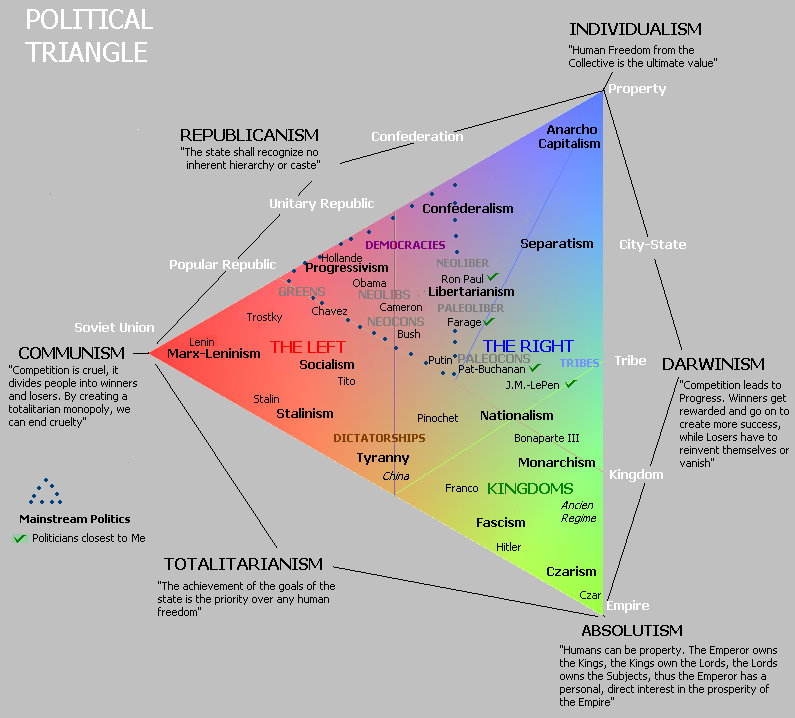
Lorenzo Warby discusses political categories and explains why they aren’t the same as moral categories:

A lot of people who class themselves as being on the Left clearly feel that there is some automatic moral kudos from being on the Left. As a direct implication of this sense of moral kudos, they also clearly think that there is some moral deficiency from being on the Right.

Yes, there are difficulties in defining Left and Right. Nevertheless, even without that difficulty, any such claim of moral kudos is ridiculous. The Left includes Lenin, Stalin, Mao, Kim il-Sung, Pol Pot, Mengistu … Indeed, by far the most important historical impact of Left politics on world history is precisely the actions of this succession of mass-murdering tyrants and their regimes.

If you think that somehow the Left does not include said mass-murdering tyrants, you are simply wrong. It is very revealing that there are clearly many folk on the Left who somehow edit out this history. They are not looking at the Left as it is in history, but as some set of noble aspirations that morally ennoble themselves.

Folk not of the Left absolutely associate the Left with those mass-murdering tyrants. Moreover, if you edit out that history, you are editing out how the political tradition you identify with can go horribly wrong. That is not a reassuring pattern. On the contrary, it is a deeply worrying pattern.

Of course, if you are happy to be associated with some or all of those mass-murdering tyrants, that is even more of a worry.

Clearly, Left is not a moral category. It is a political category, not a moral one.

The same point applies, of course, about the Right. After all, the Right includes Hitler.

Thus, neither Left nor Right are moral categories. They are political categories, and political categories that people can get very tribal about. But they are not moral categories.

This point applies to other political categories: Socialist, for example. Hitler was a socialist. He called himself a socialist, he did socialist things, intended to do more socialist things after the war. In his writings, he argued in socialist ways.

The aforementioned mass-murdering tyrants were all socialists. They were implementing socialism on the way to communism, except for Hitler, who was using socialism as a tool to forge an Aryan super race worthy and able to dominate others. So, Socialist is not a moral category.

If you stop regarding broad political categories as also being moral categories, a lot of silly arguments go away. Such as, for example, whether Hitler was a socialist. Or, whether Hitler was of the Right. Yes, Hitler was a both a socialist and of the Right—which points to how diverse a range of political traditions Right applies to.

Even when there are grounds to attaching moral valence to political categories, that is something to be done carefully and sparingly, otherwise it can seriously get in the way of understanding.

Thus, using Fascist as a boo! word but Communist as a neutral, or even hurrah! word, is ridiculous. It is even more so when Fascist is used to obscure Nazis being National Socialists.

April 24, 2026

The Mailbox Test

Filed under: Law, Liberty, Politics, USA — Tags: , , — Nicholas @ 03:00

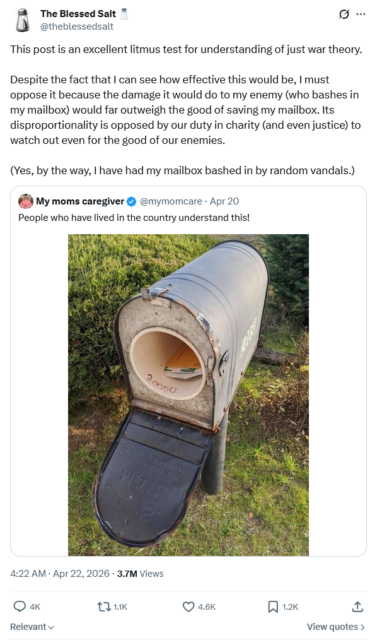
On the social media site formerly known as Twitter, Devon Eriksen responds to a thread about the ethics of setting up a trap that will only be effective if someone attempts to destroy it:

The Mailbox Test, like the breakfast test, is an excellent way to tell who you can allow to wield power in your society.

Goes like this:

    If someone is hurt trying to destroy someone else’s stuff in order to take pleasure from their pain, do you sympathize with …

    The aggressor because he got hurt?

    Or with the guy who owns the stuff, because he wasn’t the aggressor?

You can have people in your society who fail the Mailbox Test. That’s okay … they can work at hospices, or shelters for orphaned kittens, or something.

But you cannot allow them to vote, or otherwise wield political power. Because if you do, they will open the gates of the city to the enemy.

I am personally tired of everyone pretending that people who enjoy ruining things for random strangers are just kewt smol beans who are only aggressive because of all the complex socioeconomic factors and lack of resources.

They knew someone would be hurt by what they did. They knew that someone had done literally nothing harmful to them. And those two ideas, in combination made them feel pleasure. And they went and did it.

That is the sign of a rotten soul.

Defending ourselves and our property is not just a right, it’s a moral obligation. Otherwise, we just kick the can down the road for someone else to deal with, someone who may not be able to defend herself.

I don’t care if a vandal breaks his arms trying to destroy my stuff. Because I value my stuff more than a vandal’s arms. And the fact that he tried to destroy somebody else’s stuff shows that he, too, values his arms less than the opportunity to hurt somebody.

We cannot allow such people inside the city, and we cannot give the keys to those who would open the gates for them.

Another response to the original post from Kit Sun Cheah:

Sure, this adheres to a strict interpretation of Just War Theory.

However … we’re talking about a mailbox.

A mailbox is not a weapon. It does not serve any military purpose. Its existence is entirely inoffensive.

That is why it is an easy target.

A reinforced mailbox is purely defensive. Do not meddle with it and it will leave you alone. Strike it, and Newton’s Third Law kicks in.

Poke it and nothing will happen to you. Try to smash it and you risk smashing your own arm. It does not amplify an incoming force, it merely resists and returns it. Thus it is inherently proportionate.

No law or theory of war requires that you advertise your capabilities. Concealment may feel wrong to a certain type of personality, but openness is not always a social good.

Yes, you can fortify the mailbox in a blatantly obvious fashion. Some ne’er do well will notice it, then decide to pick another easier mark.

You have deterred an attack on your own property by redirecting attention to someone else’s.

Now suppose the mailbox were covertly fortified. A vandal strikes it and is injured. He passes along word to his friends, and their friends. Then they will start to wonder: are all the mailboxes reinforced?

They can’t tell, so they must assume every mailbox is fortified.

Thus, covert reinforcement does more to deter aggression than overt reinforcement. And ultimately, we want to see an end to mailbox destruction.

This post is not about just war theory or mailboxes.

Update, 25 April: Welcome, Instapundit readers! Have a look around at some of my other posts you may find of interest. I send out a daily summary of posts here through my Substackhttps://substack.com/@nicholasrusson that you can subscribe to if you’d like to be informed of new posts in the future.

March 26, 2026

From conservative, traditionalist Wilhelmine Germany to the unbridled excess of the Weimar Republic

Filed under: Germany, History, Media — Tags: , , , , , — Nicholas @ 05:00

Celina discusses the wrenching social changes Germany went through as the First World War ended, the Kaiser abdicated, and the Versailles terms were imposed on a still-young nation that didn’t think it had been defeated on the battlefield (it had been, decisively, but the truth was not revealed or understood on the home front):

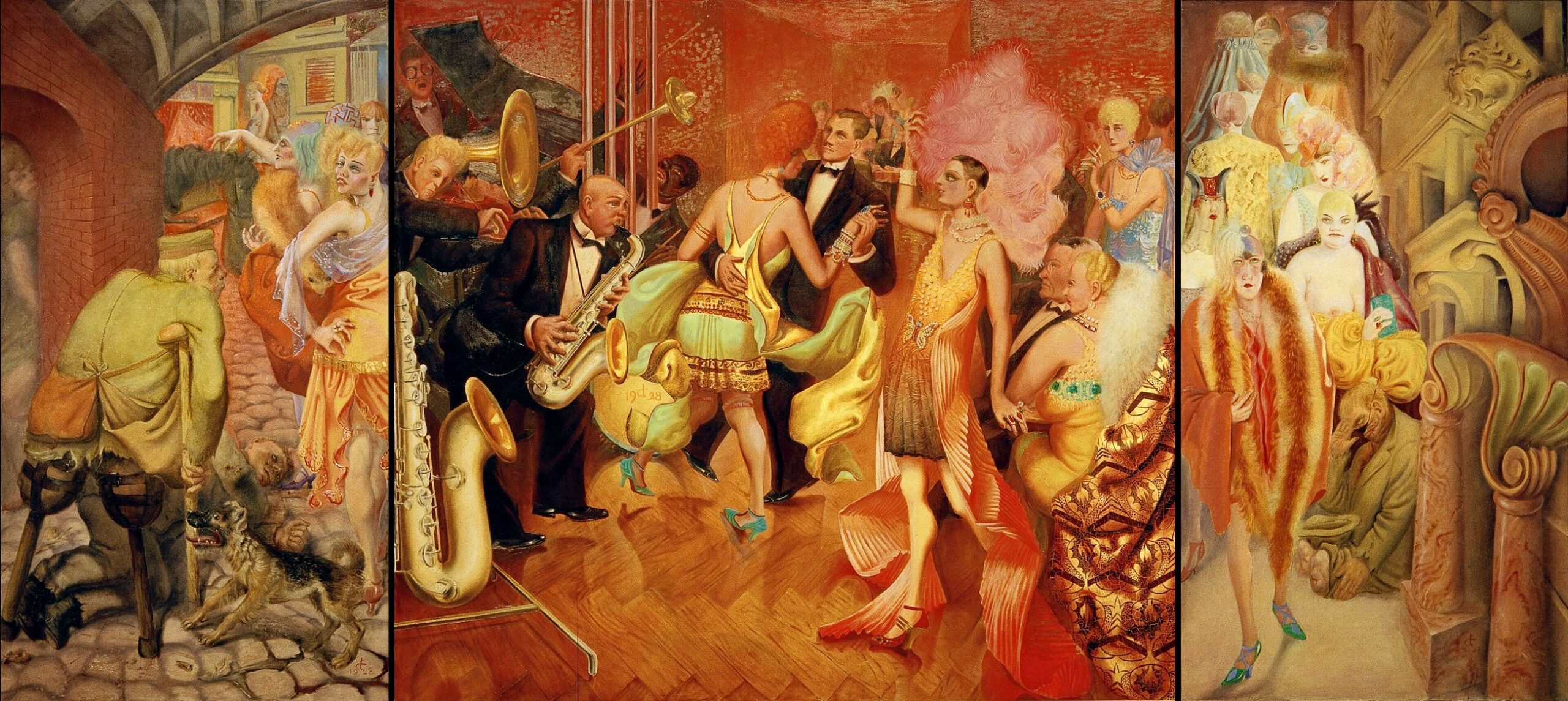
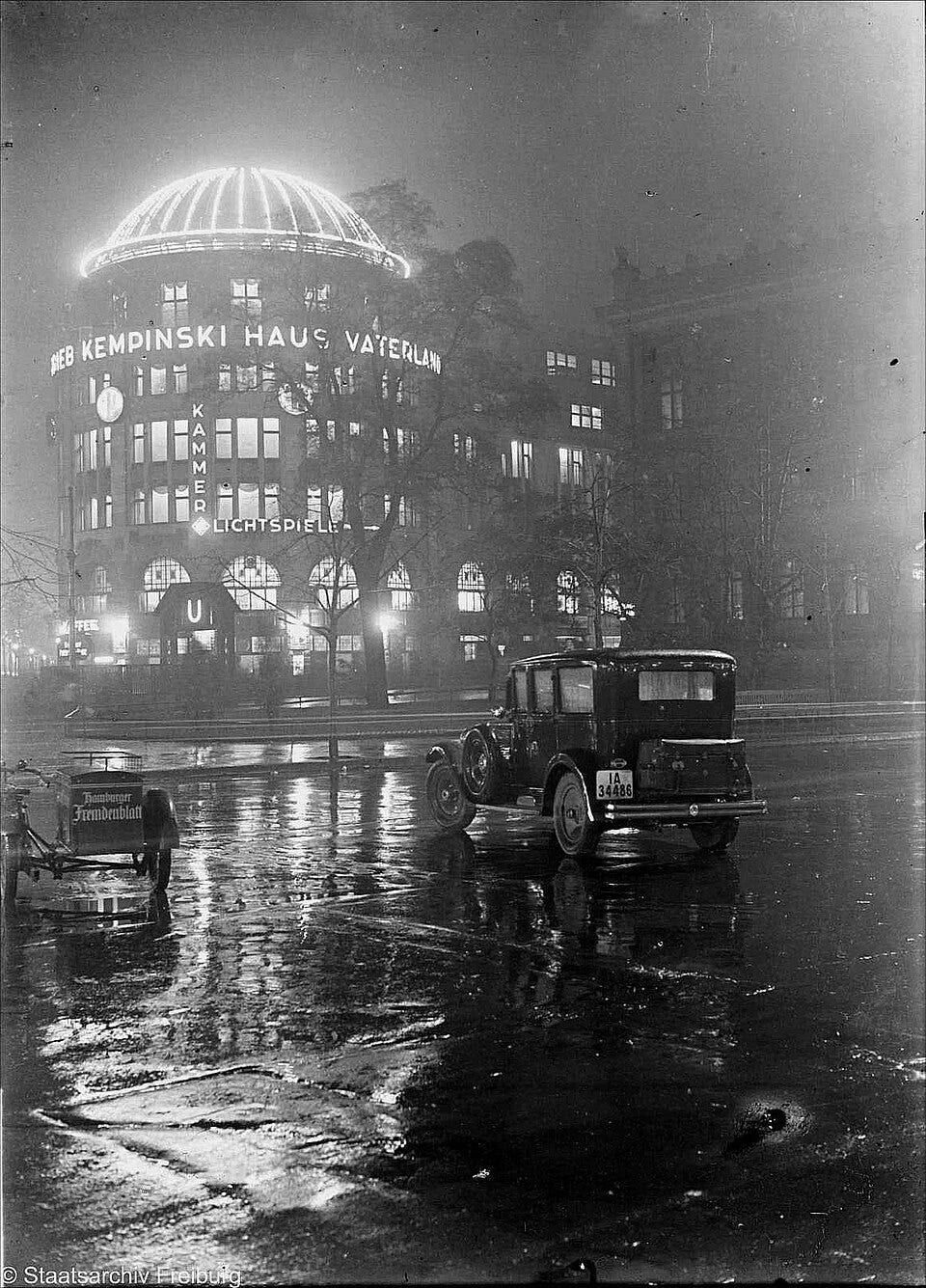
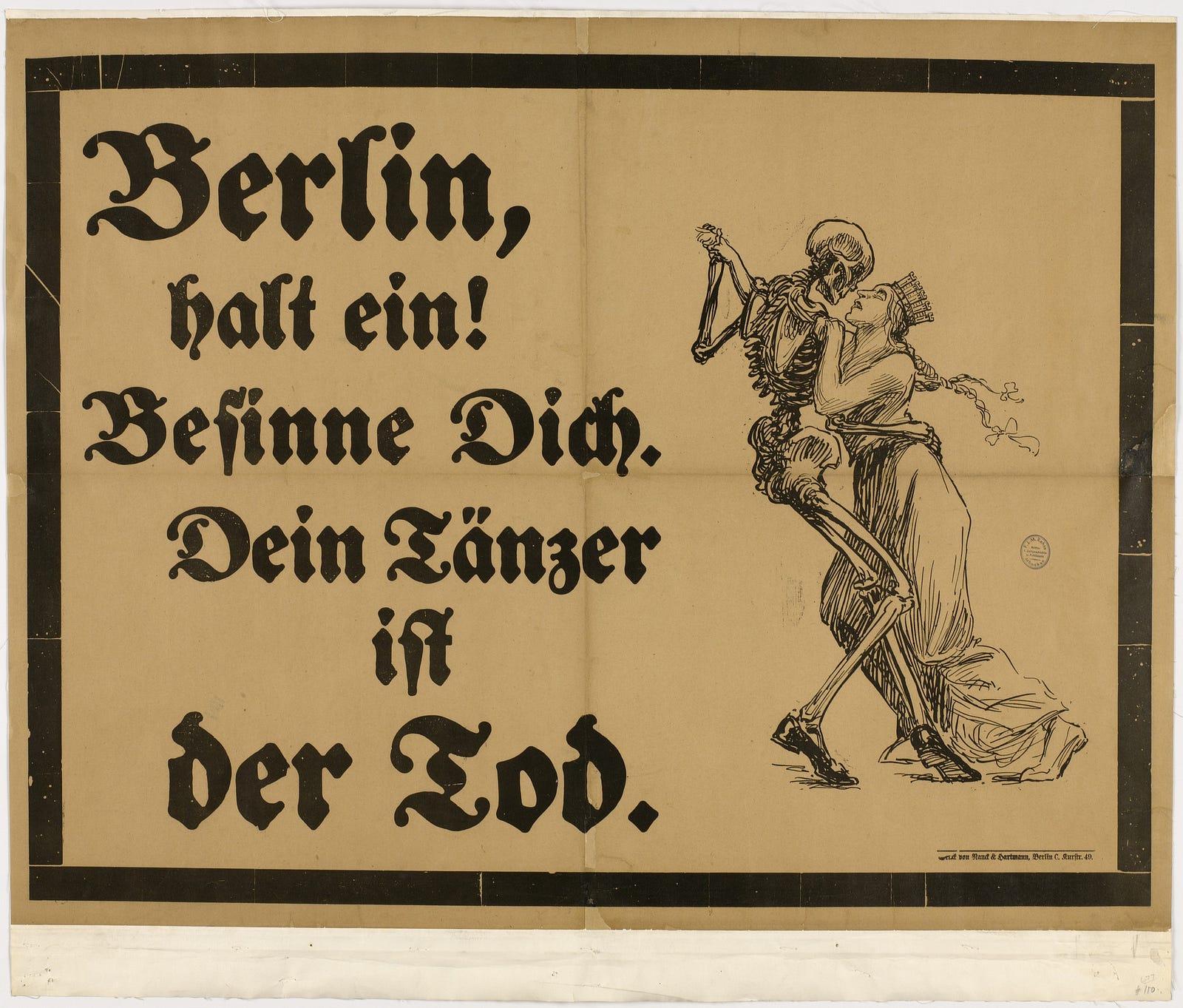
To understand the death of a civilisation, one must first walk through its ruins. The scene is Berlin, sometime in the mid-1920s, beneath the blinding, electric glare of neon and the suffocating, narcotic haze of the Berliner Luft, an atmosphere that locals gleefully described as an amphetamine-like air that made hearts race, pupils dilate, and morals evaporate until dawn.1 In the shadowed, labyrinthine alleys of a shattered empire, the streets of the capital have been entirely surrendered to a bacchanalia of unprecedented depravity. Prostitutes in various stages of undress crowd the cobblestones. They are openly aggressive, their ranks swollen by pregnant mothers, desperate war widows, and adolescents, all selling their flesh for the price of a meal.2 On every street corner, hawkers peddle cocaine, morphine, and opium to passersby, while newsstands prominently display nudist magazines dedicated exclusively to the exhibition of children.3

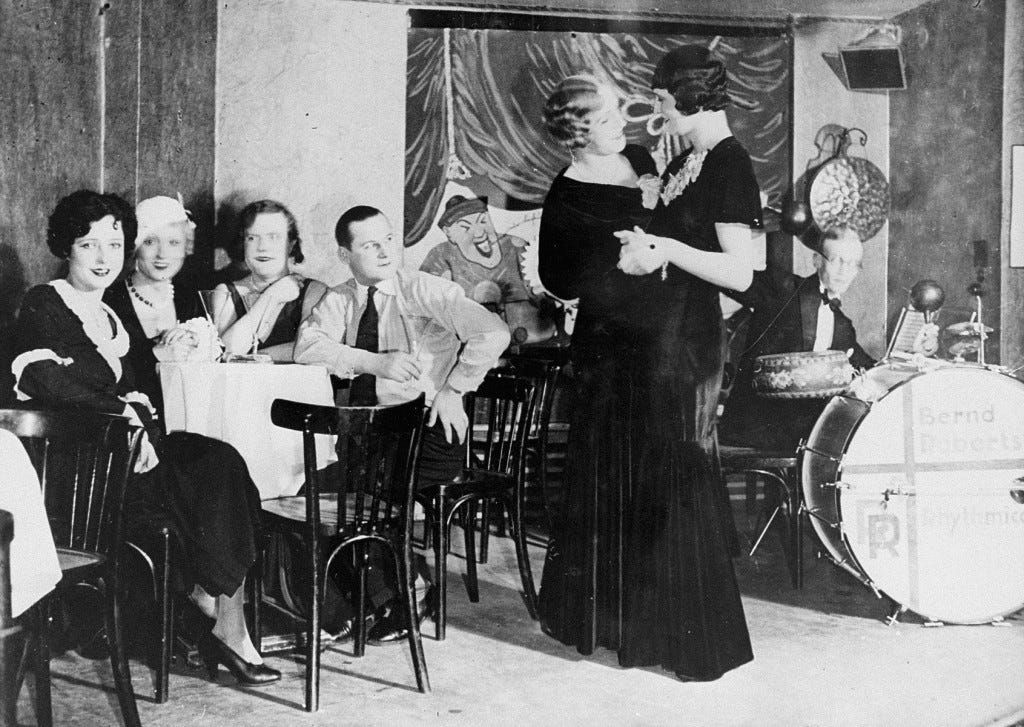
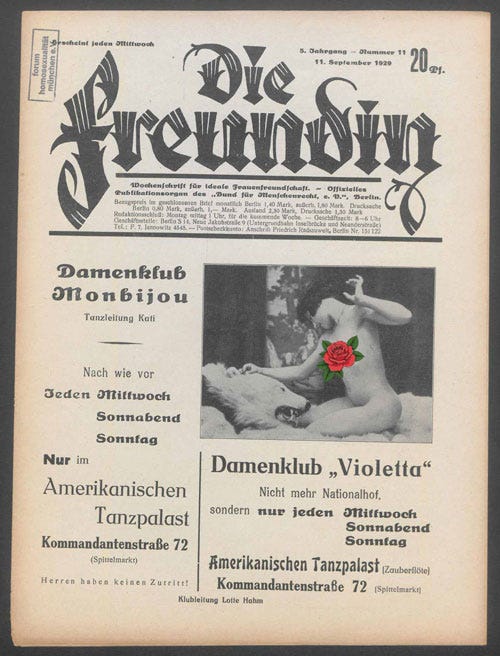
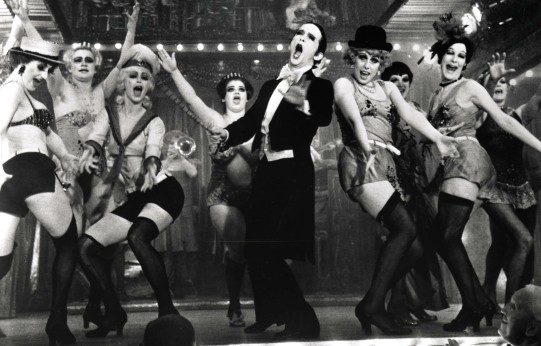
Push past the heavy, smoke-stained velvet curtains of the subterranean cabarets, and the full, suffocating scope of the abyss reveals itself. Here, glittering shows parade acres of sweaty, perfumed flesh to the applause of an audience intoxicated by a potent mixture of ecstasy, terror, and moral decay. Cross-dressing men perform grotesque pantomimes of traditional womanhood, while tuxedo-clad women mock the remnants of patriarchal authority, puffing cigars and sneering at the ghosts of their fathers.

Cabaret

For the modern, liberal apologists of the era, this explosion of libertinism is often retroactively celebrated as a vibrant, avant-garde renaissance, a brief, shining moment of progressive emancipation before the darkness of fascism fell. It is romanticised in our modern cinema and theatre as a glorious rebellion against the stuffy confines of tradition. But to the ordinary, rooted citizens of the German nation, the truth was far darker and far more evident.

The normalisation of perversion was not an expression of human flourishing, it was an aggressive, deliberate assault on the family, faith, nation, and the natural order itself. It was the deliberate dismantling of the moral architecture that had sustained European civilisation for a millennium. This was not liberation. This was civilisational suicide and the German people knew it.

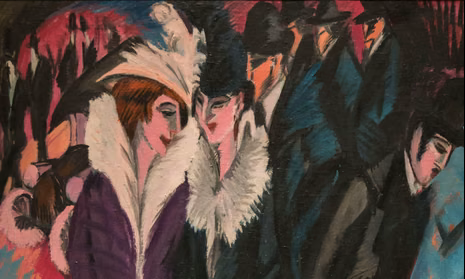
Left: Valeska Gert, Dance in Orange, Munich (1918). Right: Olga Desmond performing the ‘Sword Dance’ (1908). Photo by Otto Skowranek.

The Shattered Fatherland: Versailles and the Death of Order

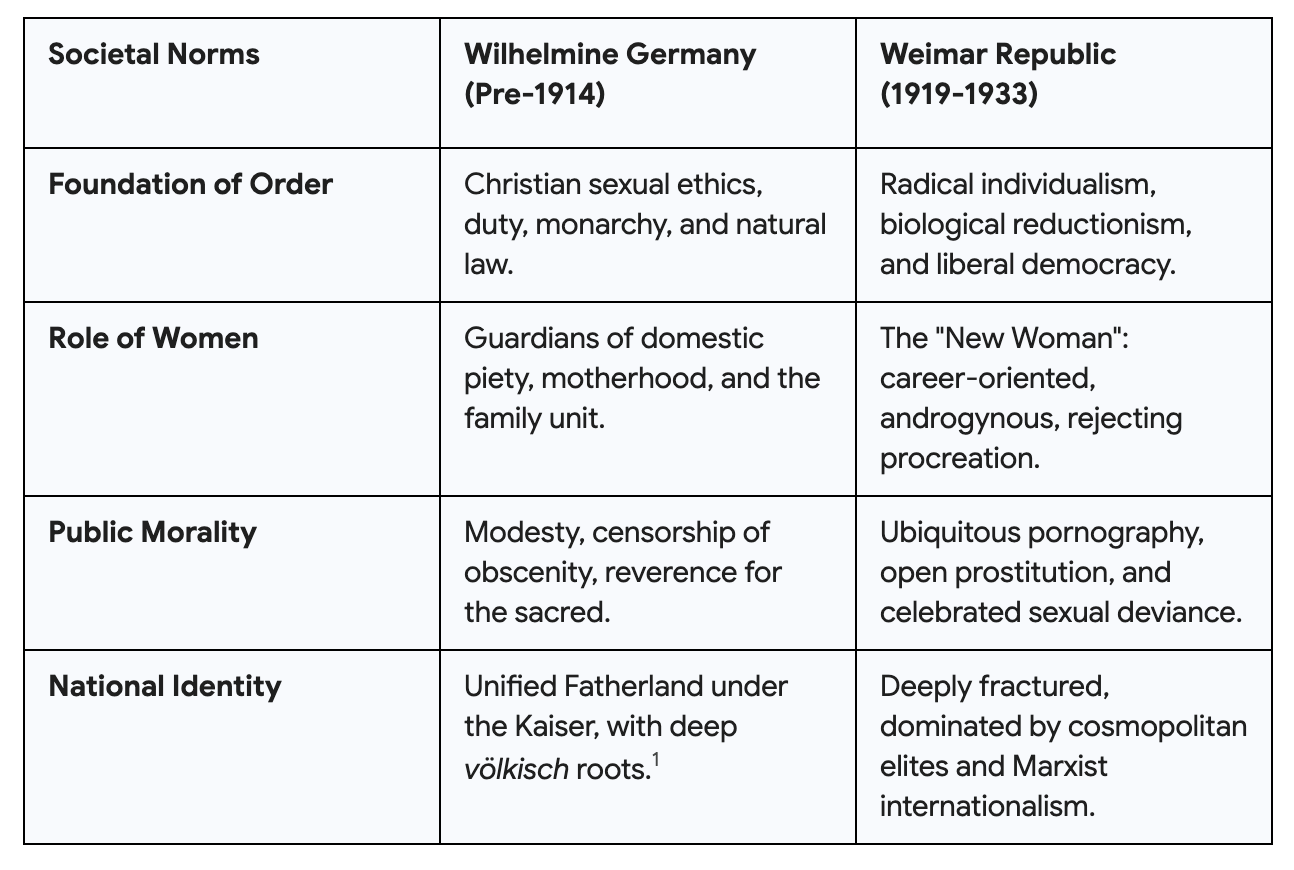
The tragedy of the Weimar Republic cannot be understood without first grasping the significant psychological and spiritual trauma that birthed it. Before 1914, Wilhelmine Germany was a society defined by structure, piety, and an organic connection to history. It was a nation grounded in Christian sexual ethics, where the family was revered as the inviolable bedrock of the state, and where duty, honour, and natural law governed public life.4 Men were expected to be providers and protectors; women were the venerated guardians of the hearth and the moral educators of the next generation.5

The cataclysm of the First World War shattered this world completely. The defeat of the German Empire brought not only physical devastation, millions of young men fed to the meat grinder of the trenches, but an unprecedented spiritual crisis. The humiliating terms of the Treaty of Versailles, specifically the “War Guilt Clause” and the crippling imposition of 130 billion marks in war reparations, stripped the nation of its dignity and its sovereignty.6 The collapse of the monarchy left a gaping void where the Fatherland had once stood, and the pervasive Dolchstoßlegende, the widely held belief that the military was stabbed in the back by domestic traitors, socialists, and cultural subversives festered in the national consciousness.7


  1. https://www.salon.com/2000/11/22/weimar/
  2. Ibid
  3. Ibid
  4. https://verso.uidaho.edu/view/pdfCoverPage?instCode=01ALLIANCE_UID&filePid=13308274540001851&download=true
  5. Ibid
  6. https://theoldshelter.com/weimar-republic-and-the-rise-of-anti-semitism/
  7. https://verso.uidaho.edu/view/pdfCoverPage?instCode=01ALLIANCE_UID&filePid=13308274540001851&download=true

March 10, 2026

QotD: The slave trade

Filed under: Africa, Britain, History, India, Politics, Quotations — Tags: , , — Nicholas @ 01:00

    Brett Pike @ClassicLearner
    The Ottoman slave trade, the trans Saharan slave trade, the trans Indian slave trade, lasted for thousands of years and enslaved millions of people … Yet school children are led to believe that slavery was a uniquely European activity.

    Now why do you think that is?

The Arabs, Turks, and Indians collectively enslaved three times as many people as Europeans, their slave trades lasted three times as long, and the only reason they ended was that Europeans — in particular the British — used military power to force them to stop.

Yet we get the exclusive blame for slavery.

Why?

Simple.

We’re the only ones who felt bad about slavery.

Even at the height of the slave trade it was morally controversial. It never sat right with us. We’re genuinely ashamed of it.

No one else feels bad about it. At all.

And they know this. They know that the European soul is profoundly empathetic in a way that their own petty, clannish chauvinism is not. And in that universalizing empathic conscience they smell weakness, and in weakness, opportunity.

They remind us endlessly of the role we played in continuing slavery, knowing full well that we will be either too courteous, or too distracted by guilt, to point to the much larger role that they played.

By pressing on that sore nerve they sustain a moral assault on our conscience that they then exploit for financial benefits: welfare parasitism, preferment in admissions and hiring, open borders.

The slave societies have found a way to take their revenge for the end slavery, enslaving us with our own conscience.

And they don’t feel the slightest twinge of guilt about that, either.

John Carter, The social media site formerly known as Twitter, 2025-12-08.

February 17, 2026

The three core false claims of wokeness

Lorenzo Warby analyzes the three claims that underpin the intellectual structure of all the sub-categories derived from Critical Theory:

Universities across Anglo-America, and across the West more broadly, have become increasingly dominated by a Critical Theory magisterium: a teaching authority that claims ultimate or trumping moral authority. This magisterium is based on Critical Theory and its derivatives — Critical Race Theory, Critical Pedagogy, Queer Theory, Post-Colonial Theory, Settler-Colonial Theory, and so on: which constitutes the Critical Social Justice matrix.

This magisterium has come to increasingly dominate academe for a range of reasons. It generates intolerant zealots, so benefits from the dynamics of an intolerant minority.

It offers a powerful shared status game — affirm beliefs X, Y, Z and that makes you A Good Person. This status game spreads a supporting censorious intolerance, for if affirming beliefs X, Y, Z and makes you A Good Person, then denying X, Y, or Z makes you A Bad Person.

This justifies shaming and shunning anyone who denies X, Y, Z, because they are Bad People and its shows your commitment to what makes someone A Good Person. It shows commitment to the shared status game. This status game generates moralised cognitive assets, and you protect the value of those assets by participating in — or at least going along with — the shaming and the shunning.

The status game generates moral projects that the central administrations of universities can use to expand their authority, range of action, and so resources. An opportunity they have enthusiastically embraced. An opportunity that corporate, non-profit and government bureaucracies have also enthusiastically embraced.

The emotions this status game attaches to those moralised cognitive assets — care, compassion, concern for the marginalised, if you affirm those beliefs, the opposite if you deny them — also plays into fears about threatening emotions (and safety through norm conformity) which are much stronger among men than women. Women are thus systematically more hostile to freedom of speech than men.

It is an exaggeration to claim that “wokery” is just the consequence of feminisation of institutions and occupations. It is, however, true that what works for — what is emotionally resonant in — increasingly feminised institutions and occupations has been selected for.

Source: data taken from this paper.

But the Critical Theory magisterium has expanded across academe — and beyond — due to the nature of its three foundational claims:

  • A blank slate view of human nature.
  • A view of social dynamics as dominated by conflict.
  • An activist relationship with information: that the trumping purpose is not to describe the world, but to change it.

The blank slate view of human nature — not merely that we are not born without inborn ideas, but that everything that forms us is social — means that any level of social transformation that can be conceived is attainable. Provided enough social power can be assembled—to move human action, speech and thought in the correct direction—the socially-transformative society free of oppression and alienation can be created.

The grander the conceived purpose, the more energising and motivating it is. But also the more it rhetorically trumps anyone who is willing to “settle” for less than complete human liberation. This then feeds back into energising and motivating, as it provides an endless sense of being moral trumps.

A recurring version of such blank slate claims is that our “true” nature has been obscured or repressed by oppressive forces. This might be the alienation via private property (Marx) or by patriarchy, or white supremacy, or heteronormativity or whatever.

The most dramatic statement of the “repressed true nature” claim is also the earliest, in the first sentence of Jean-Jacques Rousseau‘s The Social Contract (1762):

    Man is born free and everywhere he is in chains. (l’homme est né libre, et partout il est dans les fers.)

The view that oppressive forces are blocking our true nature goes naturally with the claim that social dynamics are dominated by conflict. This dominated-by-conflict claim was classically stated by Marx and Engels as the first sentence of the first chapter of The Communist Manifesto:

    The history of all hitherto existing society is the history of class struggles.

If conflict dominates social dynamics, then the prosecution of such conflict so as to achieve human liberation becomes the ultimate moral good. Coordinating the fighters for human liberation becomes a moral urgency. To prosecute that struggle becomes the most important thing one can do.

Both of these claims naturally lead to, and gain strength from the claim, that the morally trumping thing to do with information is to prosecute the struggle for human liberation. Marx famously said:

    The philosophers have only interpreted the world, in various ways; the point is to change it. Theses on Feuerbach, Thesis Eleven, 1845.

Max Horkheimer, in his seminal essay Traditional and Critical Theory (1937) tells us that:

    Critical thinking, on the contrary, is motivated today by the effort really to transcend the tension and to abolish the opposition between the individual’s purposefulness, spontaneity, and rationality, and those work-process relationships on which society is built. Critical thought has a concept of man as in conflict with himself until this opposition is removed. If activity governed by reason is proper to man, then existent social practice, which forms the individual’s life down to its least details, is inhuman, and this inhumanity affects everything that goes on in the society.

Critical Theory is activist Theory, aimed at human liberation from the unwanted constraints of existing society and epitomises the activist relationship with information. All scholarship is trumped by this aim and so the most authoritative scholarship is that which is most committed to this aim.

Source. Notice the delusional claim of the first listed article. The intrusion of such updated Lysenkoism into contemporary science and medicine is even more rampant with matters Trans.

February 11, 2026

The rise and fall of the “Western” on TV and in movies

Filed under: History, Media, USA — Tags: , , , , , — Nicholas @ 03:00

Ted Gioia reconsiders his childhood loathing of the TV western (because of massive over-exposure to the genre):

I hated cowboys when I was a youngster. Not real cowboys — I never met a single gunslinger, cowpoke, or desperado in in my urban neighborhood. My loathing was reserved for cowboys on TV.

And they were everywhere.

At one point, eight of the top ten shows on the flickering tube were westerns. And it got worse from there — Hollywood kept churning out more and more cowboy movies and TV series. I tried to avoid them, as did many of my buddies, but it was like dodging bullets in Dodge. There was nowhere to hide.

That’s because our parents loved these simple stories of frontier justice. They couldn’t get enough of them. And when they weren’t watching them on TV, they dragged us off to movie theaters to see The Magnificent Seven (128 minutes), The Alamo (138 minutes) or How the West Was Won (an excruciating 164 minutes).

In 1959, Warner Bros posed some of their TV cowboy stars in a single photo (Source)

[…]

Many aspects of these films still put me off. I struggle with the clichés and tired formulas. But I’ve gradually acquired an affection for the genre — or maybe an affection for the audiences of an earlier day who could put such trust and faith in a sheriff or US marshal or gunslinger for hire.

Do any of us have that kind of faith in any authority figure nowadays? I doubt it. But I wish we could. And that’s impressed powerfully on my mind when I see Gary Cooper take on outlaws in the deserted western street of High Noon. Or James Stewart confront the dangerous Liberty Valance. Or John Wayne battle with a gang of desperadoes in Rio Bravo.

So forget all the shootouts and cattle drives and fancy roping. The real foundation of the western genre was moral authority. And Hollywood never let you forget it — that’s why heroes wore white hats and villains dressed in black.

The audience didn’t even have to think about it.

[…]

Because that’s exactly what happened to the western. Just consider the unsettling film The Good, the Bad and the Ugly — which came out around the time the western genre died. Despite the movie’s title, it’s hard to identify any character in this film as good — instead they merely differ in their degrees of badness and ugliness.

And the same is true of The Wild Bunch or Once Upon a Time in the West and so many other films from that era. There are no heroes on display here, only various pathways into nihilism.

So long John Wayne. Hello Friedrich Nietzsche.

But this made perfect sense. The entire US of A was traumatized by the Vietnam War, and then Watergate — along with assassinations, riots, sex, drugs, and rock & roll. The moral sureness of the Eisenhower years, along with the complacent righteousness of so much of the public started to erode. At first it happened slowly, and then rapidly.

The classic western could not survive this.

February 5, 2026

The Mote in God’s Eye: A No-Win Scenario

Filed under: Books, Media, Space — Tags: , , , , , — Nicholas @ 02:00

Feral Historian
Published 26 Sept 2025

For whatever reason books by [Larry] Niven and [Jerry] Pournelle always end up being a lot harder to cover than I expect. It’s not that the core ideas are buried in dense convoluted storytelling or unusually compelling characters (often quite the opposite) but rather I think that the core ideas are always a little uncomfortable to face head-on. And Mote is great example.

Niven and Pournelle create a scenario not only of the cyclical rise and fall of a civilization, but one that through a combination of biological and cultural factors points to the impossibility of long-term coexistence between Humanity and the Moties.

00:00 Intro
01:26 Aristocracy and Contact
04:11 The Moties
08:48 Crazy Eddie
10:18 The Middle Path?
12:53 The Gripping Hand
(more…)

February 2, 2026

QotD: Moral relativism

Filed under: Asia, Quotations, USA — Tags: , , , , , — Nicholas @ 01:00

In Jakarta, aside from flags at half-staff, we have seen no signs of mourning for the victims: while employees and dependents of the American embassy spent their holiday loading trucks and putting together medicine kits, the city’s inhabitants went ahead with New Year’s parties; nightclubs and shopping centers are full; and regular television programming continues. At least 120,000 of their fellow countrymen are dead, and Indonesians hardly talk about it, much less engage in massive charitable efforts. The exceptionally wealthy businessmen of the capital — and the country boasts several billionaires — haven’t made large donations to the cause of Sumatran relief; a few scattered NGOs have done a bit, but there are no well-organized drives to raise funds and supplies. We have seen nothing akin to what happened in the USA following the 9/11 atrocity, or the hurricanes in Florida of this past year.

The Sri Lankan’s words echo in my mind every day, “Why do we want to bother with this? We all know you Americans will do everything”. With the exception of handful of Western countries, most of the world would appear inhabited by the sort of Eloi-type creatures depicted in that old sci-fi flick based on H.G. Wells’ The Time Machine, passively watching as flood waters or Morlocks drag their fellows away.

Begging the pardon of the cultural relativists, but might we not be allowed to raise — ever so gently, of course — the possibility that these differing reactions to human suffering, show Western civilization as the best we have on the planet? Maybe, just maybe Western civilization is morally superior.

The Diplomad, “Death in Nasty Places: Who Cares?”, The Diplomad, January 10, 2005.

January 26, 2026

QotD: Twitter isn’t life … it’s far more important than that

Filed under: Media, Politics, Quotations, USA — Tags: , , , , , — Nicholas @ 01:00

[Progressives] did it in two stages. First, they convinced us that process and outcome are the same thing … and when the chips are down, process is better than outcome. Everyone knows the old saying “Those who can’t do, teach”. It was originally coined to make fun of this tendency, but look how that worked out. At the conceptual level, the Left wins because they make moral arguments, but at the practical level, how do they win?

Because they talk. Constantly. They never, ever shut up. Most Leftists in my life — and in yours too, I guarantee — never do anything. We all know that the Left take zero interest in their communities. They don’t donate to charity. Let’s say one of those late April blizzards hits and their driveway is snowed in. While everyone else is breaking out the shovels one last time, the Leftist’s natural impulse is to jump on Twitter and start petitioning Congress for some giant, trillion-dollar snow removal bill. It has to have set-asides for Diversity quotas, of course, and isn’t the word “removal” triggering? And so forth, until the snow melts. Hey, problem solved!

I’m kidding, but I’m not joking. Leftists are process people par excellence. Even Stalin won that way, 99% of the time — even though he could have had the entire Politburo shot with a snap of his fingers, he got his way by grinding them down, meeting after meeting after endless meeting. Yes, eventually someone has to actually do something, but that someone isn’t going to be them; it’ll be some toady somewhere, who is only working as hard as he has to in order to get promoted up the totem pole, so that he’s the one in meeting after endless meeting, forever discussing, never doing.

This reaches its apotheosis (apocolocyntosis!) in Twitter, and do you see what I mean? For the Left, tweeting about something is exactly the same as, if not better than, actually doing anything about it. Look around: we’re about to get into WWIII because of this. And speaking of missiles flying, we’ve all remarked on the Left’s signature “fire and forget” policy approach. To them, words are magic — healthcare, for instance, is now Affordable. How can it not be? It says “Affordable Care Act“, right there in the title! Don’t start in with your facts and figures, please — it’s Affordable, damn it! What part of “Affordable Care Act” don’t you understand?

He who talks the loudest and longest, therefore, is the purest.

Combine that with the second step for maximum effect: Emotional incontinence. Just as talking is the same as (better than!) doing, so emotion equals competence. She who feeeeeeels the strongest about an issue wins. This, too, has been obvious for a long time, so much so that Jonah Goldberg, of all people, had a good bit on it back when he was still somewhat convincingly playing a conservative. He joked about how stupid it was to be preoccupied with caring in practical life. Who would you rather have cut that tumor out, your best buddy — who really, really, really cares — or a brain surgeon? Even an utterly dispassionate one, to whom you are nothing more than a slab of meat?

Again, and always: see Twitter. Maximum talk, maximum hysteria, always. I’m belaboring this because in our tabloid-culture society, the identification is complete: The all-talk hysteric is the brahmin; screaming about how much you care just IS morality. Never mind that your caring affects nothing in the best case scenario; worst case it ends up killing people (e.g. the Blue Checkmarks tweeting us into WWIII).

Severian, “Intro to The Way“, Founding Questions, 2022-04-17.

January 2, 2026

“The report is a wonderful, almost pristine, example of pure Expertism, the perfect blend of scientism and bright red euphemism”

Filed under: Cancon, Health, Media — Tags: , , — Nicholas @ 05:00

Despite our decade-long vacation from economic development, common sense, and growth, there appears to be one key area where Canada is a world-beater: inventing euphemisms for physician-induced death:

“See that guy over there, Mugsy?”

“Yeah, boss.”

“He needs to be provisioned.”

“You got it, boss.”

I have a small collection of euphemisms for killings, curious deaths and murder. Most of them are comedic, like Wodehouse’s “handing in his dinner pail”. You know the serious ones: expedited, eliminated, liquidated, liberated (from Real Genius), handled, disappeared, etc.

So you can imagine how thrilled I was to discover a new one, invented by Canadian doctors: provisioned.

You are provisioned when a doctor slips you the needle or some pills, on purpose, to send you instantly to your Particular Judgment. (The doctors will get theirs at later dates, and boy wouldn’t you like to be, as they say, a fly on the cloud for those.)

Doctors — white-coated physician killers, we can call them Rxecutioners — are increasingly enjoying collecting paychecks to kill Canadians.

According to the official “Sixth Annual Report on Medical Assistance in Dying in Canada“, 16,499 ex-Canadians were produced, or rather provisioned, in 2024. Some 22,535 applied, but 4,017 of them cheated their Rxecutioner by dying early. Can you picture the dejected look on the killer-doctor’s face, his needle poised, poisoned and dripping, only to find his customer left without him? Sad.

These numbers were up from 2023, but the rate of growth of killings (provisionings) has slowed; it was 6.9% from 2023 to 2024. If that deceleration stays about the same, Rxecutioners will put some 17,500 under in 2025. And slightly more than that in 2026.

“The vast majority (95.6%),” of those slaughtered, “identified as Caucasian (White)”. Rxecutioner provisionings are the one area where Canadian rulers allow Whites to excel. Incidentally, what’s with “identified”? Maybe Canadian rulers will let people identify as different races.

But never mind all that. The report is a wonderful, almost pristine, example of pure Expertism, the perfect blend of scientism and bright red euphemism. All should read it.

November 19, 2025

Julia: A Feminist Retelling of 1984?

Filed under: Books, Britain, Media, Politics — Tags: , , , , — Nicholas @ 02:00

Feral Historian
Published 11 Jul 2025

Julia, a 2023 novel by Sandra Newman, does more than just retell Orwell’s 1984 through Julia’s eyes. That perspective switch presents an Oceania that is both more mundane and more familiar. It’s certainly a companion piece more than a stand-alone work, but it does have something to offer both in how it examines Orwell and a few times, how it contradicts him.

00:00 Intro
02:18 a Different Perspective
09:30 Caught in a Trap
12:45 Backstory
15:40 Departures
20:18 Endings and Beginnings
(more…)

October 17, 2025

Civilizational collapse is … female

On her Substack, Janice Fiamengo addresses the unpalatable contention that female power leads to civilizational disaster:

Liberty Leading the People by Eugene Delacroix

Multiple surveys (see, for example, with thanks to James Nuzzo, here, here, here, here, here and here) suggest that when women hold power, they pursue typically feminine preferences and policies. Female-led institutions become more oriented to social justice than objective truth. Feelings matter above facts, context above law, and victimhood above expertise.

Protecting and promoting the allegedly vulnerable — through censorship, shaming, coercion, or lawbreaking/lawfare — becomes a greater priority than excellence or impartiality. Truth-tellers find themselves cancelled, Nobel prize winners reduced to tears, laws and policies applied unequally, white men accused and vilified, criminals cossetted, mental illnesses affirmed, and destructive policies embraced. No one who has paid attention over the past 20 years can be surprised by the findings.

Moreover, our ability to discuss this feminine revolution in values is hampered by the very logic of the revolution, as I will show. Both women and men, deeply disinclined to “harm” women, fail to confront the problem adequately.

Two discussions of the subject — an essay by two social psychologists at Quillette and, more recently, a conference speech by a feisty conservative woman — draw a line under the seeming inevitability of the west’s collapse. Even faced with that alarming prospect, most pundits cannot bear to imagine an alternative to the female-led assault on our core institutions.


Cheering on Women’s Empowerment

A 2022 article in Quillette, “Sex and the Academy“, provides a stark illustration of my thesis. The subtitle rules out the very conclusion the data supports, with the authors emphasizing that “The inclusion of women in higher education is a great achievement for Western liberal societies. How is this changing academic culture?”

The “great achievement”, as it turns out, will almost certainly be a lethal one.

The article was written by two academics, Cory Clark and Bo Winegard, both PhDs in social psychology. Winegard, a male scholar, had an unfortunate run-in with academic orthodoxy that led to his loss of employment; Clark, a female scholar, has a secure academic position. Both authors express enthusiasm for the takeover of academia by women even as they point out its damaging consequences. Neither one advocates any form of resistance, no matter how mild, to feminine academia’s assault on truth.

Summarizing the results of many surveys, Clark and Winegard demonstrate that while a majority of men favor free speech and the advancement of knowledge over emotional comfort, a majority of women prefer conformity, safety, and the protection of victim groups’ feelings. Not all women are indifferent to the traditional underpinnings of western civilization (and not all men support those underpinnings), but the general trends are clear.

Women are significantly more likely than men to support the cancellation of controversial speakers or the suppression of controversial research.

Women also tend to favor the existence of snitch lines to report people who cause offence. Women are more supportive than men of diversity quotas that exclude white men from consideration for prizes, positions, and promotions. (It would be interesting to know how many white women support diversity quotas that exclude white women from consideration for prizes, positions, and promotions.)

[…]

Asserting that both sides are pursuing worthy goals, the authors downplay the shock value of the findings, which show that women are, overall, less interested in truth and accuracy than men are. Imagine assessing such a finding as anything but catastrophic. Imagine calling the disregard for truth moral.

In place of truth, women value a utopian ideology that they perceive — usually without any consistency or adherence to fact, but nonetheless granted by Clark and Winegard — as “morally desirable”. But morally desirable for whom, and to what end? The use of the phrase, a misnomer, demonstrates how thoroughly the authors themselves are in thrall to the corrosive feminine culture they examine.

There is nothing moral (or generally desirable) about the suppression of truth-seeking research when it conflicts — or is perceived to conflict — with an allegedly emancipatory social goal. There is nothing morally desirable or indeed “protective” about shouting down an academic speaker because of the alleged harm of the speech. Naturally, social justice proponents would be outraged if their speeches were shouted down or their research blocked and censored.

I saw a link to this Helen Andrews article which seems to go well with Janice Fiamengo’s article linked above describing the “Great Feminization”:

… Cancel culture is simply what women do whenever there are enough of them in a given organization or field. That is the Great Feminization thesis, which the same author later elaborated upon at book length: Everything you think of as “wokeness” is simply an epiphenomenon of demographic feminization.

The explanatory power of this simple thesis was incredible. It really did unlock the secrets of the era we are living in. Wokeness is not a new ideology, an outgrowth of Marxism, or a result of post-Obama disillusionment. It is simply feminine patterns of behavior applied to institutions where women were few in number until recently. How did I not see it before?

[…]

The substance fits, too. Everything you think of as wokeness involves prioritizing the feminine over the masculine: empathy over rationality, safety over risk, cohesion over competition. Other writers who have proposed their own versions of the Great Feminization thesis, such as Noah Carl or Bo Winegard and Cory Clark, who looked at feminization’s effects on academia, offer survey data showing sex differences in political values. One survey, for example, found that 71 percent of men said protecting free speech was more important than preserving a cohesive society, and 59 percent of women said the opposite.

The most relevant differences are not about individuals but about groups. In my experience, individuals are unique and you come across outliers who defy stereotypes every day, but groups of men and women display consistent differences. Which makes sense, if you think about it statistically. A random woman might be taller than a random man, but a group of ten random women is very unlikely to have an average height greater than that of a group of ten men. The larger the group of people, the more likely it is to conform to statistical averages.

Female group dynamics favor consensus and cooperation. Men order each other around, but women can only suggest and persuade. Any criticism or negative sentiment, if it absolutely must be expressed, needs to be buried in layers of compliments. The outcome of a discussion is less important than the fact that a discussion was held and everyone participated in it. The most important sex difference in group dynamics is attitude to conflict. In short, men wage conflict openly while women covertly undermine or ostracize their enemies.

Bari Weiss, in her letter of resignation from The New York Times, described how colleagues referred to her in internal Slack messages as a racist, a Nazi, and a bigot and—this is the most feminine part—”colleagues perceived to be friendly with me were badgered by coworkers.” Weiss once asked a colleague at the Times opinion desk to get coffee with her. This journalist, a biracial woman who wrote frequently about race, refused to meet. This was a failure to meet the standards of basic professionalism, obviously. It was also very feminine.

Men tend to be better at compartmentalizing than women, and wokeness was in many ways a society-wide failure to compartmentalize. Traditionally, an individual doctor might have opinions on the political issues of the day but he would regard it as his professional duty to keep those opinions out of the examination room. Now that medicine has become more feminized, doctors wear pins and lanyards expressing views on controversial issues from gay rights to Gaza. They even bring the credibility of their profession to bear on political fads, as when doctors said Black Lives Matter protests could continue in violation of Covid lockdowns because racism was a public health emergency.

[…]

The Great Feminization is truly unprecedented. Other civilizations have given women the vote, granted them property rights, or let them inherit the thrones of empires. No civilization in human history has ever experimented with letting women control so many vital institutions of our society, from political parties to universities to our largest businesses. Even where women do not hold the top spots, women set the tone in these organizations, such that a male CEO must operate within the limits set by his human resources VP. We assume that these institutions will continue to function under these completely novel circumstances. But what are our grounds for that assumption?

The problem is not that women are less talented than men or even that female modes of interaction are inferior in any objective sense. The problem is that female modes of interaction are not well suited to accomplishing the goals of many major institutions. You can have an academia that is majority female, but it will be (as majority-female departments in today’s universities already are) oriented toward other goals than open debate and the unfettered pursuit of truth. And if your academia doesn’t pursue truth, what good is it? If your journalists aren’t prickly individualists who don’t mind alienating people, what good are they? If a business loses its swashbuckling spirit and becomes a feminized, inward-focused bureaucracy, will it not stagnate?

If the Great Feminization poses a threat to civilization, the question becomes whether there is anything we can do about it. The answer depends on why you think it occurred in the first place. There are many people who think the Great Feminization is a naturally occurring phenomenon. Women were finally given a chance to compete with men, and it turned out they were just better. That is why there are so many women in our newsrooms, running our political parties, and managing our corporations.

On the social media site formerly known as Twitter, John Carter comments on Helen Andrews’ article:

One thing Helen misses in this otherwise excellent analysis is the role played by prestige. Cancel culture was enabled by the unique circumstance of women weaponizing the prestige of freshly feminized legacy institutions. So long as those institutions retained their prestige, what the people who ran them said really mattered.

Unfortunately for the ladies (but luckily for civilization), this is self-limiting, because prestige is fundamentally an emergent property of masculine competence hierarchies. We see this demonstrated whenever a profession becomes coded as women’s work: its prestige immediately crashes. Feminists have complained about this for years, though of course they misunderstand the mechanism (prestige is a component of male sexual attractiveness, but not of female, and this is biologically hard-wired).

This prestige collapse is now affecting essentially every coopted, feminized institution — universities, news media, publishing houses, movie studios, large corporations, various government agencies, hospitals, courts, churches, all of them wield far less cultural power than they did even a few years ago. The only people who really care what these legacy institutions say are the women who took them over. To everyone else, the angry sounds they make are nothing more than background noise.

This is probably the main reason for the vibe shift. Once the prestige of feminized institutions declined below a certain threshold, their ability to enforce social consensus began to evaporate.

It’s also probably no accident that the Trump administration seems to care a lot more about what the anons of the Online Right say than it does about the opinion of the universities or the news media. All the intelligent young men got pushed out of the institutions, and those ionized particles of free male energy then began to self-assemble online into an ad hoc competence hierarchy where prestige is measured by clout rather than professional degrees, job titles, or institutional affiliations. The anon swarm is entirely informal, meaning that its outcomes are not amenable to antidiscrimination legislation or to procedural manipulation; you can screw with the algo all you want but you can’t actually force people to care what women say just because they’re women (thereby placing women into the position of openly trading in thirst, which gets them attention but certainly doesn’t mean that anyone has to pretend to take them seriously).

All that’s happened so far is that people’s attention has been redirected away from crazy woke females and towards the influencers of the online right. The fever has broken but society is a long way from recovered. The institutions are still under the control of crazy woke females, and this is extremely bad, especially because they are – for biological reasons related to childlessness — only going to get crazier as time goes on. Fortunately no one really cares what they say anymore, so as they throw tantrums as the institutions are reclaimed over the next decade or so, their protests won’t register as anything but irrelevant toddler noise.

October 4, 2025

The “nation of shopkeepers” is now the nation of problematic “Centrist Dads”

Filed under: Books, Britain, Germany, History, Military, WW2 — Tags: , , — Nicholas @ 03:00

Dr. Robert Lyman on the common misunderstanding of the nature of war and even their own imperial history among British voters:

I’ve been involved with the practice and study of war for the past 44-years. I have five degrees in history and the study and practice of war, and I have written 19 books on the subject and have contributed to the writing of 10 more, with 3 more of my own in train. The net result of this, observing international events and Britain’s response to them over recent times, is to conclude that Britain – and Britons – have a problem about war. The problem is that at a very fundamental or essential level we simply don’t understand it. I see eyebrows rising everywhere at this assertion, protests arising in the usual places to suggest that if we don’t understand war, how on earth did we create an empire? Worrying swathes of academia and our impressionable young – I know, I’ve taught them – believe that Britain is and has been a nation of rapacious warlords that conquered a major part of the world by the use of violence and disrespect for others. We don’t have time to refute that silly nonsense here, apart from observing that the primary nature of the British Empire wasn’t one that was secured or maintained by violence.

But, to the subject at hand. A product of long decades readying, studying, teaching and writing about war has led me to the conclusion that as a nation, both politically and culturally, we are too squeamish about the practice of war to be any good at either preventing it, or preparing for it. Put simply, our problem is that we are just too nice. Centrist Dads spend their entire lives seeking compromise, and worrying when a middle way cannot be found. It is only when, deep into a war we hoped wouldn’t wash up against our shores, that we come to the shocking realisation that people are trying to destroy us and as a result we find ourselves forced into the process of trying to master the business of organizing violence on a massive scale, and unleashing it as effectively as we can against our enemies. We always seem to be playing catch up, because we haven’t prepared adequately in the first place for the inevitability of war in a fractious world.

[…] Kit Kowol’s superb (and recent) Blue Jerusalem describes in embarrassing detail the ignorance evinced by politicians and military thinkers in the 1930s who hoped to avoid the sharp end of war by buying only bombers, or ships, or of relying on persuading the enemy population to coerce their leaders into ending a war they had themselves started. Perhaps if we dropped leaflets on Herr Hitler he would see the error of his ways, and end all this silliness? Very few people in Britain on the eve of the Second World War could bring themselves to comprehend the extent of the fascist animus either for democracy in general, or the Jews in particular, both seen by the Nazis as preventing the creation of a Grosse Deutschland and allowing Germany to regain her status as primus inter pares in continental Europe. It was only as Belsen was liberated nearly six-years later that the penny seemed to drop in the befuddled British mind that these people were bad, really bad, after all. It is one of the accepted reasons for the Allied failure to destroy the railways feeding Auschwitz: decision-makers in London or New York never truly comprehended the scale of the slaughter then underway across Occupied Europe.

This is where are again. Evidence for the worryingly widespread intellectual softness that dominated political thinking through the 1930s, which I would describe as a Centrist Dad problem, is everywhere. At an event last year with General Lord Dannatt where he gave what I considered to be a pretty straight forward talk on the security threats facing the UK, and what we should do about them, I overheard a comfortable middle class couple at the end complaining that he was being “too pessimistic”. They couldn’t see any cause for alarm. I was almost too shocked to reply. These are the sort of people who cannot quite understand why Hamas and Israel don’t just kiss and make up. It must therefore be Israel’s fault that there is no two-state solution in the Middle East. I read this sort of commentary every day in the broad sheets. It is particularly well expressed by the weekly output of two well-known podcast blatherers, archetypical Centrist Dads, one a retired politician – you know the two I mean – who consistently demonstrate that they have a fragile grasp on the animus that is generated in the hearts of those who despise us, no real understanding of the security steps we need to take to prevent it, nor of the kind of war required to eliminate such threats.

The starting point of these blatherers is what the journalist Jake Wallis Simon and the security commentator Andrew Fox describe as the “Wykehamist proposition”, which is that we should treat all people, hostile or otherwise, on the basis of our own benign ideological predilections. Accordingly, if we want to prevent someone attempting to kill us, regardless of the enemy’s motives, all we need to do is to sit round a table together, assume we all want the same positive outcomes from our conversation, and proceed amicably to resolve our differences. The sad reality is that this is not how the world works, nor is it how humans behave. If they have been to taught from childhood to despise you and everything about you, to the extent that they want to kill you – as Hamas and its ilk see Jews – no amount of so-called Wykehamism is going to persuade them to do otherwise. I suggest that the opposite approach is required. We need to treat threats to ourselves and our friends seriously, both in political and in military terms, and prepare accordingly. As General Lord Dannatt and I suggest in our book, stern, decisive military active to prevent Herr Hitler from remilitarising the Rhineland may well have prevented the entire Second World War from breaking out at all. To understand how to deal with war and threats of war, we need a political class that understands the scale of the threat we face and is prepared to undertake decisive action to nip hostility in the bud when it might occur. If we can resolve our differences amicably then of course we must always do so. But where an enemy does not want to play this game we must be determined to use force – and if necessary extreme violence – to protect our interests, and our people. This might involve dropping leaflets over the Ruhr but it might also entail dropping incendiaries on Berlin. In other words, to defend ourselves as a country, we must have the capability and the willingness to exercise the full-throated management of violence. We must also accept that it is the legitimate function of other democracies – like Israel – to do the same.

September 21, 2025

QotD: Herbert Hoover, an epitaph

Filed under: History, Quotations, USA — Tags: , , , , , , — Nicholas @ 01:00

Hoover was a man who did everything wrong. He was the quintessential High Modernist. He was arrogant, he was authoritarian, he didn’t listen to anyone, he put no effort into pleasing people or making his ideas more palatable. He never solicited stakeholders’ opinions. He lied like a rug, constantly and egregiously. He lived his life like a caricature of exactly the sort of person who should fail at philanthropy and become a horror story to warn future generations.

But he won anyway. He started from a measly few million dollars and beat out Rockefellers and Carnegies to become the most successful philanthropist in early 20th century history. Whyte’s estimate of 100 million lives saved seems much too high; there were only 100 million people in Europe total during the relevant period. But even during his own time, people universally credited him with saving millions. And he did it again and again and again. I didn’t even have space to talk about the time he saved the Southern United States from a giant flood, or half a dozen other impressive accomplishments. Maybe the rules are wrong. Maybe all of this stuff about how authoritarian approaches never work, and you need to let the people you are helping lead the way, is all just modern prejudices, and putting a brilliant and very rich engineer in charge of a hypercentralized organization is just as good as any other way of doing things.

But even this I find less interesting than his psychology. He combined a personal callousness with a love for all humanity. When he was inspecting mines in Australia, he fired the worst-performing X% of workers. One worker begged him to reconsider – he had a family to support. Hoover raised $300 for the man’s family – a lot of money at the time! Probably more than Hoover made in a month! – but fired him anyway. In 1932, when the Bonus Army marched on Washington, Hoover was adamant that he would not give these men – poor, starving veterans – a single cent more than they were entitled to by their existing benefits. But he also instructed his staff to go around to their encampments and give them food and supplies in secret.

Sometimes his stubborness calls to mind the fictional Inspector Javert, who refuses to bend the law for any reason. In this model, Hoover sympathizes with everybody, but his honor forbids him to bend the rules in favor of underperforming employees or protesters who want more than their contracts entitle them to. But this picture of a hyper-honorable Hoover crashes into his constant willingness to lie, cheat, and bend the rules in his own favor. Sometimes his lies are for the greater good, like when he tells Britain that Germany is preparing to feed Belgium. Other times they seem entirely selfish, like his various Chinese mining scams. The best that can be said about Hoover is that if he decides a principle is involved, he sticks to it.

And this is actually really good! Again and again through the book, Hoover feels like the only person with a moral compass. When it is in everyone’s strategic interest to let Belgium starve, Hoover is the only one who is able to keep fixated on the potential human toll. When it is in everyone’s interest to let the USSR starve, only Hoover – despite his fanatical anti-communism – is able to stick to the frame where the Russians are human beings and politics is beside the point. When Americans are starving during the Great Depression …

… okay, Hoover totally dropped the ball on that one. In fact, one of his Democratic opponents wrote something about how maybe if unemployed American workers pretended to be Belgians, they could get Hoover’s sympathy. I don’t have a great explanation for this. But Hoover’s weak and inconsistent sympathies are often enough to let him outdo everyone else. Or at least, he is uncorrelated with everyone else and succeeds when they fail. Again and again Hoover is accused of treating people like numbers on a piece of paper. But if this is true, it seems to be linked to the reverse talent – the ability to remember that numbers on a piece of paper represent people, even when other people would rather forget.

I’m equally confused about Hoover’s politics, although it’s not really his fault. The whole era confuses me. The Progressives, Hoover’s own faction, seem clearly related to modern progressives. But they also give me more of a technophile, rationalist feel than their modern counterparts. Am I imagining things? If not, where did this go?

And how did Hoover so deftly merge authoritarian centralizing technocratic engineer side with his small-government individual-freedom pro-capitalism side? Maybe it wasn’t that deft? Maybe he started his life as a centralizing technocrat, then made a 180 after becoming a small-government individualist helped him dunk on FDR more effectively? But it didn’t feel that way. It felt like all of it was coming from some central set of core beliefs throughout his life.

[…]

I get the impression that Kenneth Whyte is a bit of a revisionist historian, too sympathetic to his subject to tell his story the way everyone else does. But at least in Whyte’s telling, the Hoover presidency was a great missed opportunity, or at least a fulcrum of history. If a few key economic events had been a few months off in one direction or the other, FDR might have been a footnote to history, and a four-term President Hoover might have left an indelible mark on America. Instead of a New Deal, we might have gotten a optimistic small-government technocratic meritocracy that was able to merge the best aspects of a dying frontier America with the best aspects of the industrial age.

In one of the most poignant passages in the book, Commerce Secretary Hoover fires back at his socialist critics. He points out that of the top dozen US officials – the President, VP, and ten Cabinet Secretaries – eight, including himself, had begun as manual laborers and worked their way up. That was the America Hoover was working to defend. He lost, and now we have this shitshow. But it’s hard to begrudge him the attempt.

Scott Alexander, “Book Review: Hoover”, Slate Star Codex, 2020-03-17.

August 14, 2025

“Just war” theory and nuclear weapons practice

Filed under: History, Japan, Military, USA, Weapons, WW2 — Tags: , , , — Nicholas @ 03:00

On Substack, Nigel Biggar discusses the postwar argument about whether the use of nuclear weapons against Japan was justified or not:

Atomic cloud over Hiroshima, taken from “Enola Gay” flying over Matsuyama, Shikoku, 6 August, 1945.
US Army Air Force photo via Wikimedia Commons.

For pacifists, Christian or otherwise, the answer is clear: since any deliberate killing is wrong, the dropping of atomic bombs on Hiroshima and Nagasaki on 6 and 9 August 1945 was wrong about two hundred thousand times over.

But that clear answer generates further questions whose answers aren’t so obvious. If killing is always wrong, then the United States should never have gone to war against Imperial Japan and therefore its ally, Hitler’s Germany. What, then, would have stopped the triumph of brutally racist Japanese imperialism in Asia and massively murderous Nazism in Europe? The noble witness of innocent non-violence?

Unfortunately, the historical evidence is that the kind of people who ran the slave-labour camps in Burma, and the likes of Dachau in Germany and Auschwitz in Poland, were not at all shamed by the face of vulnerable innocence; on the contrary, it excited their lust for domination and they fed upon it.

On the other hand, those who think that war can sometimes be justified, might judge that the mass killing of civilians by the atomic bombs was, simply by its massive extent, indiscriminate and therefore unjust. But there are two problems here. The first is that the vast majority of people, certainly in the UK and the USA, regard the war against Hitler and his allies as morally justified, notwithstanding the fact that that cost between 60 and 80 million deaths, well over half of them civilian.

Image credit – Wikipedia

And the second problem is that the ethical tradition of “just war” thinking doesn’t say that we may not kill civilians, even on a massive scale; it only says that we may not kill them intentionally. If a military objective can’t be achieved except by risking the possible or probable deaths of civilians, then it may still be attempted, provided that the objective is sufficiently important, militarily, and that all reasonable measures are taken to avoid or minimise the side-effect of civilian casualties. The reason for this permissiveness is that in most circumstances just war would be impossible to prosecute otherwise.

So, for the “just war” proponent, if the intention in dropping the atomic bombs on Japan was to destroy vital military or military-related targets, and if there was no more discriminate way of achieving that end, then the bombing was morally justified. It was deeply, deeply tragic—but nevertheless just.

Older Posts »

Powered by WordPress