Quotulatiousness

July 21, 2026

Frederick the Great’s 1741 book, The Anti-Machiavel

Filed under: Books, Germany, History, Italy — Tags: , , , , , , — Nicholas @ 04:00

At SteynOnline, Tal Bachman continues his look at all things Machiavelli, including Prussian king Frederick the Great’s polemic against the author of The Prince:

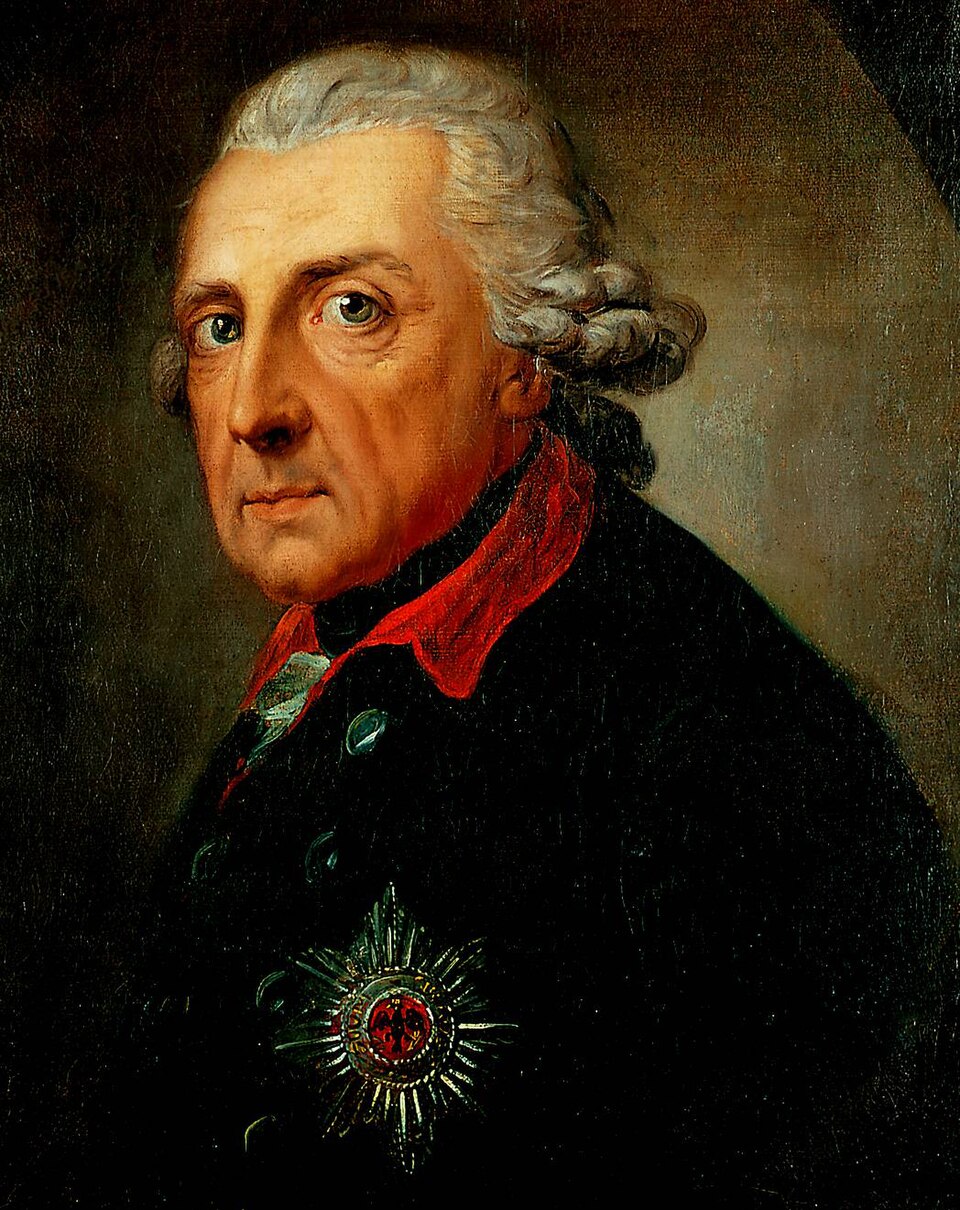
Frederick the Great, 1781
Oil portrait by Anton Graff (1736-1813) in the Sanssouci Palace collection via Wikimedia Commons.

Maybe Machiavelli’s teachings have no relevance in any remotely civilized political system. Maybe they’re far worse than irrelevant: maybe they’re all entirely evil (as they appear), and in addition, would prove the ruin of both the people and their ruler.

This was, as it happens, the view espoused by one important ruler: the Prussian king Frederick the Great. In his 1741 book, The Anti-Machiavel, he claims Machiavelli’s book is “one of the most dangerous that ever appeared in the world”, in that the political crimes it encourages would impose “a lasting misery upon whole nations”. Truly great rulers, says Frederick, aren’t the avaricious, amoral, self-serving, shape-shifting demons that Machiavelli describes. Rather, they are those “whose business it is to administer justice, and to set examples of justice to their subjects; and who, by their magnanimity, mercy, and goodness, ought to be the living images of Deity”. Thus, Frederick sees his rebuttal as “a defense of humanity against a monster who would destroy it”; it is “an antidote to poison”.

Frederick ruled Prussia for nearly 50 years. Most historians rate him a success. On the face of things, he seems like the kind of critic who knows what he’s talking about.

But Machiavelli would say, not so fast. What did Frederick do almost immediately after assuming power? Without any provocation, he launched a war to seize the large, prosperous, populous province of Silesia (now in southwestern Poland) from the Habsburg Monarchy. And he did so on a convoluted, centuries-old dynastic claim which sounded as unconvincing to his contemporaries as it does to us now. In the three Silesian wars which followed (the third turning into the Seven Years War), well over a million soldiers died fighting. Millions more wound up maimed, psychologically scarred, or otherwise ruined. Of course, millions of non-combatants also suffered: wives lost husbands, mothers and fathers lost sons, children lost fathers and uncles and brothers. Those non-combatants also suffered displacement, terror, deprivation, and injury. Over two decades, Frederick’s wars — particularly the Seven Years War — convulsed Europe. Frederick gained 30% more territory and 50% more citizens, but the cost was losing 10% of the Prussian population to combat or disease (the modern equivalent of 35 million Americans, 6 million English, or 3 million Australians). The point is: if his actions are anything to go by, Frederick didn’t oppose Machiavellian power moves as much as he professed, if at all. Machiavelli might even argue that in taking pains to proclaim his opposition to Machiavelli even as his wars of acquisition injured and killed millions, he was doing exactly what Machiavelli had advised: seeming to be good even as he was doing whatever the hell he wanted, for his own purposes. Most people will buy the act anyway, says Machiavelli, so why not?

This brings me back to Machiavelli’s claims about how rulers do in fact act, and how they must act to avoid ruin. And that in turn brings me back to the original wording of The Prince, and what real-world credibility Machiavelli might have as a political commentator.

As it happens, Machiavelli was no armchair quarterback. Even if he hadn’t spent nearly fifteen years at the highest levels of Florentine government (which he did), he might well have qualified as a political expert just by virtue of growing up in the tumultuous time and place he did. Between the jockeying Italian states, the myriad (and ever-changing) foreign alliances and enemies and designs, the political influence of the papacy, and Florence’s own internal politics, Machiavelli’s home city furnished more than enough lessons in how the political world could, and often did, operate.

July 15, 2026

The Prince – “The only people who haven’t read it are the ones who keep losing”

Filed under: Books, History, Italy, Politics — Tags: , , , , , — Nicholas @ 05:00

I didn’t intend to turn this into Machiavelli week, but after the discussion of correctly translating “virtù for modern audiences, here’s Krzysztof Szczawinski with more about that famous/infamous book:

Niccolò Machiavelli wrote The Prince in 1513 as a practical manual for power. For five centuries, polite society has pretended to be shocked by it. Meanwhile, every successful political operator — on every side — has been quietly following it. The only people who haven’t read it are the ones who keep losing.

1. Machiavelli’s central insight is not that the ends justify the means. That is the misquote that lets comfortable people dismiss him. His actual insight is simpler and more disturbing: power has its own logic, independent of morality, and those who refuse to understand that logic will be defeated by those who do. The Prince is not a villain’s manual. It is a description of reality that makes virtuous people uncomfortable – because reality doesn’t care about their virtue.

2. The current progressive system applies Machiavelli more fluently than any of its opponents. His first rule: the appearance of virtue matters more than virtue itself. The DEI statement while systematically excluding dissent. The democracy rhetoric while suppressing opposition. The compassion branding while destroying careers. This is Machiavelli’s prince – not good, but performing goodness to maintain legitimacy. The performance is the power.

3. His second rule, which the current system also applies perfectly: cruelty, when necessary, should be delivered swiftly, completely, and early. Cancellation is Machiavellian – total, swift, exemplary. The point isn’t the individual being cancelled. The point is the ten thousand people watching who quietly adjust their behavior. One public destruction purchases a million private silences. Machiavelli would have recognized the mechanism immediately. He invented the theory.

4. Communism applied the fear side of Machiavelli with full conviction – Stalin made the explicit choice Machiavelli described: better to be feared than loved. The show trial is pure Machiavellian theater – a public demonstration of power functioning as a warning to everyone who isn’t on trial. But communism made his fatal mistake: it destroyed the people’s goodwill so completely that it generated not just fear but hatred. And Machiavelli is unambiguous – you can rule through fear, you cannot survive through hatred.

5. His most important democratic insight — the one nobody quotes — is that the prince who builds his power on the people is more secure than one who builds it on elites. Elites are few, demanding, and treacherous. The people are many, ask only not to be oppressed, and are a more stable foundation. The political movement that actually connects with ordinary people against the credentialed elite is applying Machiavelli more correctly than the elite relying on institutional capture alone.

6. What should we do? Stop bringing virtue to a knife fight. The chronic error of the opposition is the naive prince Machiavelli explicitly warns against – the leader who assumes truth wins automatically, who believes that being right is a strategy. It is not a strategy. It is a precondition. Being right gives you something worth fighting for. Machiavelli tells you how to fight: build your own power base, never rely entirely on others, control your narrative before your enemies do, and treat fortune as something to be seized, not waited for. Fortune favors the bold. Not the righteous. The bold.

7. Machiavelli is taught in universities as cynical amoralism – the thing decent people reject. This framing is itself Machiavellian – it keeps the manual out of the hands of the people who most need it. The current establishment didn’t reject Machiavelli. It institutionalized him, rebranded him in the language of social justice, and uses him daily. The opposition reads Augustine and loses. The system reads Machiavelli and wins. Until the side that is actually right decides that understanding power is not a betrayal of principle but a precondition for defending it – the result will be the same. Virtue without strategy is just a dignified way of losing.

Update, 16 July: Welcome, Instapundit readers! Have a look around at some of my other posts you may find of interest. I send out a daily summary of posts here through my Substackhttps://substack.com/@nicholasrusson that you can subscribe to if you’d like to be informed of new posts in the future.

July 14, 2026

Translating “virtù” in Machiavelli’s The Prince

Filed under: Books, Government, History, Italy, Politics — Tags: , , , , — Nicholas @ 04:00

At SteynOnline, Tal Bachman ponders the use of the Italian word “virtù” and how best to translate it into English without losing the essence of what Machiavelli was trying to communicate:

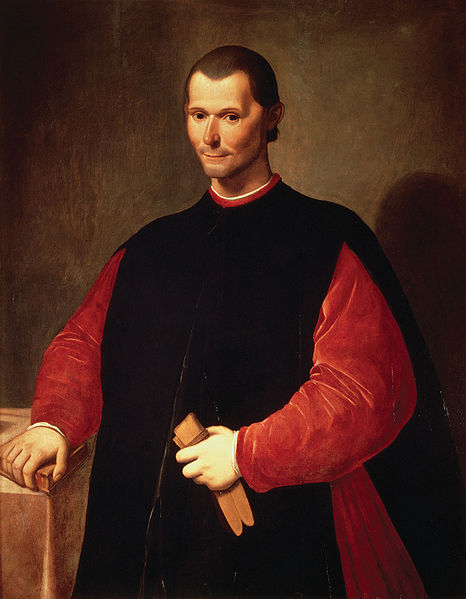
Portrait of Niccolò Machiavelli by Santi di Tito (1536-1603)
Via Wikimedia Commons.

I’d read Machiavelli’s The Prince many times. Pondered its fiendish teachings as I watched political events. Wondered how true, or at least universal, the suggestions really were. I’d even started translating the text myself a few months earlier, just for fun. Machiavelli’s Italian wasn’t all that different from Spanish, so I could get quite a bit of it. With a bit of study, I got the rest. Now, here I was, standing in the very room he’d written the book in, touching the very desk he might have used.

It was in that moment I remembered a letter Machiavelli had written once, to a friend, about writing in that very room:

    When evening has come, I return to my house and go into my study. At the door I take off my clothes of the day, covered with mud and mire, and I put on my regal and courtly garments; and decently reclothed, I enter the ancient courts of ancient men, where, received by them lovingly, I feed on the food that alone is mine, and that I was born for. There, I am not ashamed to speak with them and to ask them the reason for their actions; and they in their humanity reply to me. And for the space of four hours I feel no boredom, I forget every pain, I do not fear poverty, death does not frighten me. I deliver myself entirely to them … I have composed a little work (The Prince), where I delve as deeply as I can into reflections on this subject.

The book itself opens with a quick description of the different types of states, and then concludes the first paragraph with an important sentence. New dominions, says Machiavelli, are acquired o con le armi di altri o con le proprie, o per fortuna o per virtù — that is, they’re acquired “either with the arms of others or with one’s own, either by fortune or by” — drum roll — “virtù“. That’s the word in Italian. The question is how to best translate virtù into English.

You might say, “virtue”. And you wouldn’t entirely be wrong: of course the Italian virtù and the English virtue are cognates. The problem is that in the Tuscan Italian of 1513, virtù carried important connotations which no longer exist in contemporary Italian, and don’t exist in English. “Virtue” these days, in either language, refers to an ethical attribute; it describes something good or moral. But in Renaissance Italian, it still retained an older meaning — one unaligned with anything specifically ethical. That older meaning merely described a certain kind of manly excellence, skill, power, prowess, or virtuosity: the Latin root of virtù is vir, meaning man; virility, like virtuosity, traces back to the same root. (The only remaining echo of this meaning in English or Italian, that I know of, lies in the idiom “by virtue of” — which attributes some authoritative force to something: “The agreement remained binding by virtue of state law”, or “Dan became captain by virtue of his experience”.)

To make matters even more challenging for the conscientious translator, Machiavelli pushes this older meaning to its extreme end throughout The Prince. In fact, his use — or as some might have it, his abuse — of the word virtù drives the main theme of the book.

In brief, what Machiavelli argues is that the political realm has its own rules — its own sort of morality, if it can even be called that. This morality is entirely unlike Christian morality, Aristotelian morality, or commonsense folk morality. Thus, the meaning of “virtue” and “vice” in the political realm differs from the meaning in other contexts. Failure to understand this and act accordingly will bring ruin to any aspiring ruler.

So, according to Machiavelli, a “virtuous” ruler isn’t necessarily a good man. In fact, he can’t be a good man by any normal definition; if he were, he’d inevitably fail as a ruler. After listing off some admirable moral qualities, Machiavelli says this:

    It is not necessary, then, for a prince to have in fact all of the qualities written above, but it is indeed necessary to seem to have them … when these qualities are possessed and always observed, they are harmful; but when they seem to be possessed, they are useful. So it is useful to seem compassionate, faithful, kind, honest, religious … a prince cannot observe all of those things for which men are believed good, since to maintain his state he is often required to act against faith, against charity, against kindness, and against religion.

A virtuous ruler, in other words, is simply a political virtuoso: a ruler who knows what it takes to acquire and use power effectively, and has the guts to do it.

[…]

As you read through The Prince, you can almost hear Machiavelli saying, hey — I didn’t create this world. I’m just explaining how it actually works. If that’s anyone’s fault, it’s God’s — except there’s no reason to believe God even exists. And so, the aspiring ruler can and must do whatever it takes to succeed, without fear of divine disapproval.

This is Machiavelli’s conception of, or redefinition of, virtù. It is the main theme of the book. Yet as Harvey Mansfield notes in his book Machiavelli’s Virtue, often “Machiavelli’s translators have difficulty in rendering virtù“. Indeed they do, and where they don’t get it right, the reader has no chance to grasp just how radical or disturbing Machiavelli’s morality-inverting argument is. Where they do get it right, we get the chance to engage with one of history’s subtlest and most challenging political thinkers. This raises the question of whether there’s some specific set of principles which ought to guide the translation of great books, and if so, what they might be.

June 19, 2026

QotD: The Prince is a … satire?

Filed under: Books, Education, Government, History, Italy, Quotations — Tags: , , , — Nicholas @ 01:00

When I was a lad, I was told that Machiavelli’s The Prince is a satire. I don’t believe it, personally — I know a few things about Renaissance Italy, and I think he meant every word — but I learned something important from the people who insist it’s a satire: They’re wishcasting.

Let me back up. The occasion where I first heard the “it’s a satire” thesis was an “advanced placement” History class back in high school. They probably don’t have those anymore as part of the regular curriculum — dat be rayciss — so in case you’ve never endured one, it’s a bunch of mega-nerds who only care about pleasing Teacher trying to do History. For our unit on “The Renaissance”, we had to read both The Prince and More’s Utopia, and do our term paper on one or the other.

Naturally I picked The Prince, and since you all know the kind of kids who were in that kind of class, naturally everyone else picked Utopia. I might’ve been the only kid who ever did his paper on Machiavelli; certainly the teacher acted like she’d never seen one before. We didn’t have the phrase “trigger warning” back then, but that’s what it amounted to — Teacher hastened to inform everyone in the class that The Prince was really a satire, and so of course I was just kidding too, ha ha, because otherwise we were in the presence of very, very, very bad thought …

“Yes, kidding, ha ha ha,” I muttered, because while I obviously wasn’t the quickest on the uptake back then — I should’ve just done the stupid paper on goddamn Utopia like the rest of the sheep — even I could figure out that I was gonna get sent to the school counselor if I didn’t get with the program …

… and that’s when I learned the aforementioned lesson. Kidding? You think Machiavelli’s kidding? Didn’t we just do this whole unit on the Renaissance? Your main man Thomas More was burning people at the stake, for fuck’s sake! And as for the Italians, they were straight whacking people out in church, with the active connivance of the fucking Pope himself. Satire, fuhgetaboudit, that’s Godfather shit, Machiavelli’s as serious as cancer. You just don’t want to believe that people are actually the way they so obviously are, so you’ll tell yourselves he’s kidding … and Teacher will back you up on it, because she doesn’t want to believe it either.

(Meanwhile, I’ll get an A for my excellent “satire”, in exchange for which I will never ever bring it up again or I’ll fail the rest of the semester).

Severian, “End States and Inverted Incentives”, Founding Questions, 2022-06-22.

December 19, 2024

QotD: Replacing the outdated “left” and “right” with more accurate terms

Filed under: Books, History, Politics, Quotations — Tags: , , , , — Nicholas @ 01:00

Keeping the simple spectrum approach of “Left” and “Right”, I’d divide the world into the fundamentally incompatible camps of “Theory” people and “Reality” people. We all know all about the Theory People, so just one quick example: J.B.S. Haldane. Indisputably a great scientist, and not just a great scientist, a great evolutionary biologist. If there’s anyone on this earth who should’ve been convinced, right down to the very marrow of his bones, that human beings are NOT blank slates, it was J.B.S. Haldane. And yet, he was a Marxist — and not just a Marxist, a really loopy one, even by the standards of the early 20th century.

It was guys like Haldane who caused Stove to write a great essay about “The Ishmael Effect”. He said something like (from memory) it’s a striking fact about powerful minds, that even though they know better than everyone else some fact about the physical world — the conservation of energy, say — their powerful minds cause them to get caught up in all the fascinating implications of their pet theory, such that they fail to see their pet theory requires energy not to be conserved. Thus (said Stove), a guy like Kant: After telling us that no human mind can access the Thing-in-Itself, he gives us four hundred pages of extremely detailed information about the Thing-in-Itself. Or Karl Marx, who was able to soar so far above his own economic class situation as to tell us, with oracular certainty, that no one is able to transcend the cognitive limits of his economic class situation. I don’t think it’s much of an exaggeration to say that “the Ishmael Effect” pretty much IS 19th century philosophy … and thanks to entropy, 20th century politics, and now 21st century culture.

Such are the Theory People who, however many raw IQ points they have, will really see five lights if The Party tells them to, because The Party controls the Theory and the Theory is never wrong, facts be damned. Call them Rubashovs if you like (and are feeling literary), but let’s move on to the Reality People. If Rubashov is the ultimate Theory Person — marching willingly off to his destiny in the dreaded Lubyanka, because The Party requires it and The Party is never wrong — so the ultimate Reality Person is Niccolo Machiavelli.

Much hooey has been written about The Prince, that it’s ACK-shully a biting satire (you could call the Rubashovs’ junior varsity the ACK-shully kids), but Ol’ Nick meant every fucking word. Politics was a contact sport in his day — he picked the wrong side of a political dispute, and got the strappado for it. He knew exactly what he was talking about, and had the disjointed shoulders to prove it.

Machiavelli is often called a cynic, but just as everything in Clown World always turns out faker and gayer than the most jaded can imagine, so even the hardest-bitten cynic can’t touch Ol’ Nick. The Prince is beautifully written, but it’s one of the toughest reads you’ll ever have, because surely he can’t mean what he just wrote … he just can’t. But he does, and it’s true — that for example a man will more quickly get over the murder of his father than the loss of his patrimony. And you know it’s true, if only in the darkest watches of the night when you toss and turn in the coldest of cold sweats. There aren’t more than a handful of sentences in The Prince that won’t give you insomnia, if you really start thinking them through …

But just as (one hopes) even Rubashov would balk at shooting his children on The Party’s orders, so even Machiavelli marvels at the truth that no one is thoroughly, consciously evil, even when it’s in his obvious best interest to be. A man will always convince himself he’s doing good, even when he’s obviously, objectively doing the most heinous evil, and that — Nick implies — is the way to manage a tyrant. Even when doing X is the obviously advantageous thing to do, and doing Y is obviously disadvantageous, you can convince someone to do Y by changing the moral frame.

There’s obviously a spectrum here, which like all human behavior bends in on itself at the extremes. One imagines Rubashov, for instance, going through an “if only Comrade Stalin knew!” type thought process if The Party ordered him to shoot his infant children. Yes, The Party is never wrong … but even though Comrade Stalin IS The Party, The Party is, finally, the historical manifestation of a metaphysical necessity, and therefore, in the light of the Highest Truth, Comrade Stalin — though never wrong!! — is perhaps misinformed in this case … Just as Francesco Sforza or whomever balks at murdering those infants in their cribs, though it’s clearly the very best course of action, politically.

Rubashov vs. Machiavelli. That’s the best I can do.

Severian, “Mail / Grab Bag”, Rotten Chestnuts, 2021-09-10.

August 12, 2024

Lions, foxes and wolves

N.S. Lyons tries to explain how Britain has gotten into its current social and political plight by recalling the works of Niccolò Machiavelli:

Portrait of Niccolò Machiavelli by Santi di Tito (1536-1603)
Via Wikimedia Commons.

The riots that have recently wracked the streets of the UK reflect decades of pent up public frustration with the country’s governing elite, especially their total refusal to control mass immigration despite vote after vote demanding they do exactly that. The pot has now boiled over. But the ongoing back-and-forth of ethnic violence also represents a signal that the British elite’s whole broader strategy of governing – one based in the fundamental personality of the ruling class itself – may be beginning to break down. And that carries some significant implications.

To understand why, however, we need to take a brief detour back about five centuries to Niccolò Machiavelli. He identified two archetypical psychological profiles of people who become leaders: the cunning but weak fox, who can outmaneuver his opponents but is “defenseless against wolves”; and the strong and brave lion, who likes to fight and who can scare off wolves but who is “defenseless against traps”. Machiavelli argued that a true statesman must embody both personalities, or risk destruction.

A distant student of Machiavelli, fellow Italian political theorist Vilfredo Pareto, would later expand the metaphor further. Observing history, he noted that the rise and fall of states and civilizations could be matched to a cyclical pattern in the collective personality of their ruling classes.

Nations are founded by lions, who are a society’s natural warrior class – its jocks, so to speak. They establish and expand a kingdom’s borders at the point of a sword, pacifying external enemies. Like Sparta’s Lycurgus or Rome’s Augustus, their firm hand often also puts an end to internal strife and establishes (or re-establishes) the rule of law. Their authority can be dictatorial, but it is relatively honest and straightforward in nature. They value directness and the clarity of combat. They are comfortable with the use of raw force, and open about their willingness to use it, whether against criminals or their own enemies. They have a firm sense of the distinction between enemies and friends in general – of who is part of the family and who is a prowling wolf to be guarded against. The security and stability they establish is what allows the nation to grow into prosperity.

Security and prosperity produce a proliferation of foxes. Foxes are unsuited to and deeply uncomfortable with the employment of force; they prefer intellectual and rhetorical combat, because they’re nerds. They seek to overcome obstacles through clever persuasion or the manipulation of people, information, narratives, and formal processes. If they have to use physical force they will, but prefer to disguise its nature and are prone to use it ineptly. The brainy and cosmopolitan foxes have talents the lions don’t, however: they are good at managing complexity and scale, navigating the nuances of diplomatic alliances, or extracting profits from an extensive empire.

As long as peace prevails, civilizations come increasingly to morally prize the indirect and diplomatic methods of foxes and to avoid and indeed abhor the strength and violence of lions. And as states grow larger and more complex, establishing new layers of bureaucracy, law, and procedure, this quickly favors the byzantine organizing and scheming of foxes. In comparison lions are inarticulate and unprepared for the traps of more underhanded mammals. So eventually a wholesale replacement of the elite occurs: the lions who founded the nation are pushed out of its leadership, marginalized and excluded by a class of foxes who see them as brutish relics of a barbaric age.

But a curious thing then happens, Pareto observed: the instability of societies overly dominated by foxes begins to increase relentlessly. The foxes, reluctant to properly distinguish and identify real threats, or to openly employ force even when necessary, find themselves defenseless against wolves both internal and external. When faced with escalating challenges, the foxes tend to resort to doubling down on their preferred strategy of misdirection, manipulation, and attempting to bury or buy off threats rather than confront them directly. This does nothing to solve problems that require the firm use of force, or the threat of it, such as keeping packs of wolves on the other side of the borders. Eventually, when things get bad enough, foxes may desperately lash out with violence, but do so indecisively, ham-fistedly, or in entirely the wrong direction. The wolves, for their part, can instinctively smell weakness and just keep coming.

Like the rest of the West, Britain has been ruled for decades now by an effete managerial elite whose system of technocratic control is absolutely characteristic of foxes. There could be no better example of this than how the government has attempted to manage immigration and the ethnic tensions it has brought to unhappily multi-cultural Britain. It has sought to control public perception of the problem, and indeed has strived mightily to pretend the entire problem simply doesn’t exist.

It has done so, in classic foxlike fashion, through careful control of media and online information, engaging in an effort to downplay inconvenient facts, obscure the identity of terrorists and violent criminals, memory-hole potentially divisive events, and censor counter-narratives. Those who have continued to speak out on the issue are smeared with reputation-destroying labels like “racist”, “xenophobic”, or “far right” in order to deflect others from listening to them. This reflects foxes’ consistent instinct to turn first and foremost to information warfare and narrative manipulation over direct confrontation. Hence the ruling elite’s immediate reaction to the latest riots: blaming them on “misinformation” and “unregulated social media” – the implication being that nothing at all would be amiss if the information common people had access to could just be better suppressed.

March 12, 2024

QotD: Isaiah Berlin on Niccolò Machiavelli

When asked about Machiavelli’s reputation, people use terms like “amoral”, “cynical”, “unethical”, or “unprincipled”. But this is incorrect. Machiavelli did believe in moral virtues, just not Christian or Humanistic ones.

What did he actually believe?

In 1953, the British philosopher Isaiah Berlin delivered a lecture titled “The Originality of Machiavelli”.

Berlin began by posing a simple question: Why has Machiavelli unsettled so many people over the years?

Machiavelli believed that the Italy of his day was both materially and morally weak. He saw vice, corruption, weakness, and, as Berlin says, “lives unworthy of human beings”. It’s worth noting here that around the time that Machiavelli died in 1527, the Age of Exploration was just kicking off, and adventurers from Italy and elsewhere in Europe were in the process of transforming the world. Even the shrewdest individuals aren’t always the best judges of their own time.

So what did Machiavelli want? He wanted a strong and glorious society. Something akin to Athens at its height, or Sparta, or the kingdoms of David and Solomon. But really, Machiavelli’s ideal was the Roman Republic.

To build a good state, a well-governed state, men require “inner moral strength, magnanimity, vigour, vitality, generosity, loyalty, above all public spirit, civic sense, dedication to security, power, glory”.

According to Machiavelli, these are the Roman virtues.

In contrast, the ideals of Christianity are “charity, mercy, sacrifice, love of God, forgiveness of enemies, contempt for the goods of this world, faith in the hereafter”.

Machiavelli wrote that one must choose between Roman and Christian virtues. If you choose Christianity, you are selecting a moral framework that is not favorable to building and preserving a strong state.

Machiavelli does not say that humility, compassion, and kindness are bad or unimportant. He actually agrees that they are, in fact, good and righteous virtues. He simply says that if you adhere to them, then you will be overrun by more unscrupulous men.

In some instances, Machiavelli would say, rulers may have to commit war crimes in order to ensure the survival of their state. As one Machiavelli translator has put it: “Men cannot afford justice in any sense that transcends their own preservation”.

From Berlin’s lecture:

    If you object to the political methods recommended because they seem to you morally detestable … Machiavelli has no answer, no argument … But you must not make yourself responsible for the lives of others or expect good fortune; you must expect to be ignored or destroyed.

In a famous passage, Machiavelli writes that Christianity has made men “weak”, easy prey to “wicked men”, since they “think more about enduring their injuries than about avenging them”. He compares Christianity (or Humanism) unfavorably with Paganism, which made men more “ferocious”.

“One can save one’s soul,” writes Berlin, “or one can found or maintain or service a great and glorious state; but not always both at once.”

Again, Machiavelli’s tone is descriptive. He is not making claims about how things should be, but rather how things are. Although it is clear what his preference is.

He writes that Christian virtues are “praiseworthy”. And that it is right to praise them. But he says they are dead ends when it comes to statecraft.

Machiavelli wrote:

    Any man who under all conditions insists on making it his business to be good, will surely be destroyed among so many who are not good. Hence a prince … must acquire the power to be not good, and understand when to use it and when not to use it, in accord with necessity.

To create a strong state, one cannot hold delusions about human nature:

    Everything that occurs in the world, in every epoch, has something that corresponds to it in the ancient times. The reason is that these things were done by men, who have and have always had the same passions.

Rob Henderson, “The Machiavellian Maze”, Rob Henderson’s Newsletter, 2023-12-09.

December 12, 2023

On Machiavelli

Filed under: Books, History, Italy — Tags: , , , , — Nicholas @ 04:00

Rob Henderson dips into the works of Niccolo Macchiavelli, not so you don’t have to, but perhaps in hopes you’ll do so as well:

Portrait of Niccolò Machiavelli by Santi di Tito (1536-1603)
Via Wikimedia Commons.

This is an overview of Niccolò Machiavelli — his backstory, his personal views, a summary of Machiavellian thought, and an explanation for why his ideas have been so despised throughout history.

Throughout his books, Machiavelli seems to take delight in demonstrating — much to his reader’s discomfort — the distance between our lofty intentions and the actual consequences of our deeds.

Writing in the sixteenth century, Machiavelli anticipated Nietzsche’s conception of master and slave morality by some three hundred years.

In Ch. 15 of The Prince he wrote:

    Since it is my intent to write something useful to whoever understands it, it has appeared to me more fitting to go directly to the effectual truth of things than to the imagination of it … many have imagined republics and principalities that have never been seen or known to exist in truth … he who lets go of what is done for what should be done learns his ruin rather than his preservation.

This passage is often viewed as the essence of Machiavellianism. He had no intentions of disguising unpleasant realities. He wanted to describe the world as it is, and not as people wish it to be.

[…]

Machiavelli rejected the dominant utopian ideas of his day, including Platonic or Augustinian cities of God and the concept of Christian universalism (or its modern variant of Humanism).

Machiavelli warns rulers to be on guard against those who do not see men as they are, and see them through spectacles colored by their hopes and wishes, their loves and hatreds, in terms of an idealized image that they want men to be, and not as they are.

Some pieces of advice Machiavelli offers to rulers:

  • Employ brutality or kindness, as the case requires. Brutality is usually more effective, but kindness, in some situations, bears more fruit
  • It’s better to be feared than loved. Love is fickle, but fear is predictable. The worst is to be hated. Hatred will lead your subjects to destroy you
  • It’s a good idea to keep your people in a state of poverty and always prepared for war. This helps to reduce both ambition and boredom — two qualities that can undermine obedience
  • Fierce competition in a society is desirable, for it generates energy and ambition
  • Religion must be promoted regardless of how truthful it is, because it supplies social solidarity
  • When you confer benefits to the people, make sure to do so yourself. But let minions do the dirty work of inflicting punishments because then they, not you, will be blamed, and you can then gain the people’s favor by cutting off your minions’ heads
  • Men prefer vengeance and security to liberty
  • If you have to commit a crime, don’t advertise it beforehand. Otherwise your enemies may destroy you before you destroy them
  • Punishment should be delivered in a swift and brutal manner, while rewards should be dispersed in small amounts over time
  • Be wary of powerful advisors and servants — victorious generals should be purged after they have served their purpose, otherwise they may attempt to usurp you
  • You can be violent and use your power to command obedience, but if you break your own laws you will undermine societal stability
  • Men should either be caressed or annihilated; appeasement and neutralism always lead to ruin. Your adversaries can recover from minor injuries and setbacks to seek revenge. But if you crush them totally, you neutralize any threat.
  • Rulers must live in the constant expectation of war
  • Success inspires more devotion than friendliness and affability
  • Men will lie to you unless you compel them to be truthful by creating circumstances in which deception will not pay

This list could continue but I’ll stop here.

July 30, 2023

QotD: Thomas Hobbes and Leviathan

… I’m not trying to cast Thomas Hobbes, of all people, as some kind of proto-Libertarian. The point is, for Hobbes, physical security was the overriding, indeed obsessive, concern. Indeed, Hobbes went so far as to make his peace with Oliver Cromwell, for two reasons: First, his own physical safety was threatened in his Parisian exile (a religious thing, irrelevant). Second, and most importantly, Cromwell was the Leviathan. The Civil Wars didn’t turn out quite like Hobbes thought they would, but regardless, Cromwell’s was the actually existing government. It really did have the power, and when you boil it down, whether the actually existing ruler is a Prince or a Leviathan or something else, might makes right.

One last point before we close: As we’ve noted here probably ad nauseam, modern English is far less Latinate than the idiom of Hobbes’s day. Hobbes translated Leviathan into Latin himself, and while I’m not going to cite it (not least because I myself don’t read Latin), it’s crucial to note that, for the speakers of Hobbes’s brand of English, “right” is a direction – the opposite of left.

I’m oversimplifying for clarity, because it’s crucial that we get this – when the Barons at Runnymede, Thomas Hobbes, hell, even Thomas Jefferson talked about “rights”, they might’ve used the English word, but they were thinking in Latin. They meant ius – as in, ius gentium (the right of peoples, “international law”), ius civile (“civil law”, originally the laws of the City of Rome itself), etc. Thus, if Hobbes had said “might makes right” – which he actually did say, or damn close, Leviathan, passim – he would’ve meant something like “might makes ius“. Might legitimates, in other words – the actually existing power is legitimate, because it exists.

We Postmoderns, who speak only English, get confused by the many contradictory senses of “right”. The phrase “might makes right” horrifies us (at least, when a Republican is president) because we take it to mean “might makes correct” – that any action of the government at all is legally, ethically, morally ok, simply because the government did it. Even Machiavelli, who truly did believe that might makes ius, would laugh at this – or, I should say, especially Machiavelli, as he explicitly urges his Prince, who by definition has ius, to horribly immoral, unethical, “illegal” (in the “law of nations” sense) behavior.

So let’s clarify: Might legitimates. That doesn’t roll off the tongue like the other phrase, but it avoids a lot of confusion.

Severian, “Hobbes (II)”, Founding Questions, 2020-12-11.

July 15, 2023

QotD: Historical figures didn’t think of themselves as doing evil

Filed under: History, Quotations — Tags: , , , , — Nicholas @ 01:00

Back in my professing days, I used to try to “bring history alive”, as it were, by “humanizing” historical figures. Let’s stipulate that Adolf Hitler was evil, I’d tell my students. Still, he obviously didn’t think of himself that way. Like all of us, he thought well of himself. In his own mind, he was a good person doing good things (or, at worst, doing bad things for good ends). We won’t learn anything meaningful about Hitler’s policies, I told them, unless we try to understand how he saw himself, as an historical actor.

If I thought it would help, I’d quote Machiavelli at them, to the effect that it’s impossible for a person to be thoroughly, consistently evil, even when it’s obviously to his best advantage. If I thought they were capable of grasping it, I’d follow by observing that this quote is just Machiavelli restating – in his inimitable style – the thoroughly conventional, utterly uncontroversial, indeed banal, opinion that people like to think well of themselves, and balk at doing things which make them bad people in their own eyes.

By that point, I’d have lost all but the sharpest undergrads, so I’d spell out the lesson Machiavelli intended us to take from his observation: While no one wants to think of himself as doing evil, when it comes to something that’s obviously advantageous, pretty much any rationalization will do.

Severian, “Acid”, Founding Questions, 2020-12-17.

November 19, 2019

Overly Sarcastic Podcast: Blue Talks Machiavelli!

Filed under: Books, Europe, History, Italy — Tags: , , , , — Nicholas @ 06:00

Overly Sarcastic Productions
Published 23 Apr 2016

Damn, YouTube, back at it again with the Podcast.

From the man who brings you outdated memes and crude photoshops comes the second episode of the Overly Sarcastic Podcast. Today, Blue talks through Machiavelli’s two most famous works, and how they work together more than you might initially think.

This episode has slightly different visuals because the blue orb from last time charges by the minute. Comment below if you have a preference for visuals in future OSPodcasts and let us know if you have any topics you’d like Blue to discuss.

November 10, 2019

History-Makers: Machiavelli

Overly Sarcastic Productions
Published 8 Nov 2019

If I could have a conversation with any person in History, it’s Machiavelli. Easy. And I wouldn’t even have to do anything, I’d just say “So, tell me about Rome” and watch the fireworks. In the meantime, I’ll settle for playing Assassin’s Creed Brotherhood and liberating Roma with my boy Niccolò.

The best Prince is one who donates to TEAM TREES: https://teamtrees.org

PATREON: https://www.Patreon.com/OSP

DISCORD: https://discord.gg/sS5K4R3

MERCH LINKS: https://www.redbubble.com/people/OSPY…

OUR WEBSITE: https://www.OverlySarcasticProductions.com
Find us on Twitter https://www.Twitter.com/OSPYouTube
Find us on Reddit https://www.Reddit.com/r/OSP/

March 31, 2018

If anybody could be described as Machiavellian, it’d surely be Machiavelli, right?

Filed under: Books, Europe, History, Italy — Tags: , , , , — Nicholas @ 03:00

At the Foundation for Economic Education, Paul Meany tries to rescue the reputation of Niccolò Machiavelli:

Portrait of Niccolò Machiavelli by Santi di Tito (1536-1603)
Via Wikimedia Commons.

If you have ever studied Shakespeare, you might have heard your teacher use the word “Machiavellian” to describe amoral characters such as Iago from Othello or Edmund from King Lear. “Machiavellian” denotes a person or action that disregards morality and is wholly self-serving. The origin of the word derives from the famous Florentine politician and writer Niccoló Machiavelli.

[…]

Published posthumously, The Prince left Machiavelli with an infamous reputation as an amoral, atheistic, and cynical writer. In 1559, the Catholic Church put Machiavelli’s works on the Index of Prohibited Books. In the play The Jew of Malta by Christopher Marlowe, written in 1589, Machiavelli appears in the prologue, boldly exclaiming, “I count religion but a childish toy, and hold there is no sin but ignorance.”

Machiavelli came to be associated with an Elizabethan term, “Old Nick,” used to denote the devil. There is a subject of modern psychology, known as the “dark triad,” which focuses on three malevolent personality traits: narcissism, psychopathy, and Machiavellianism.

However, this deeply negative image of Machiavelli did not always exist. In the 17th and 18th centuries, a more positive view of Machiavelli emerged, with authors such as the Republican James Harrington referring to Machiavelli as “the prince of politicians.” During the Italian Renaissance, humanist Giovanni Battista Busini fondly described Machiavelli as “a most extraordinary lover of liberty.”

This praise might seem confusing; after all, the word “Machiavellian” denotes someone who is cunning and unscrupulous. How could a man so devious and pragmatic be called a lover of liberty? The answer lies with Machiavelli’s other book, known as Discourses on Livy, which presents a very different image of his political beliefs.

[…]

The stark differences between Machiavelli’s Discourses on Livy and The Prince come from the nature of the aims of each book. The Prince aims to refine the conduct of a single prince, while Discourses on Livy offers guidance for the entire citizen body. The Prince was written to address a unique political opportunity that quickly evaporated, whereas Discourses on Livy was written to articulate the principles required by republics that sought longevity, liberty, and prosperity.

To this day, there still remains a huge debate over the intricacies and contradictions that characterize Machiavelli’s writings. Machiavelli was an extremely nuanced and original thinker whose reputation should not exclusively be that of an evil schemer. He argued for a republic whose liberty is safeguarded by the common person, in which free, unhindered debate provides the best course of action, and where compromises between opposing groups create harmony. Discourses on Livy reveals another side of Machiavelli, a man committed to the ideals of freedom through the means of representative government.

January 17, 2014

Have you read these books or have you lied about having read them?

Filed under: Books, Media — Tags: , , , , — Nicholas @ 09:16

Ben Domenech discusses the books that “everyone must read”, but very few have actually done more than turn the pages a bit, or perhaps scanned the Wikipedia entry for:

The truth is, there are lots of books no one really expects you to read or finish. War and Peace? The Canterbury Tales? The History of the Decline and Fall of the Roman Empire? Announcing that you’ve finished those books might surprise a lot of people and make them think you’re abnormal or anti-social, unless you’re an English or History major who took their reading very, very seriously. Perhaps the shift to ebook format will diminish this reading by osmosis – and book sales, too – since people can afford to be honest about their preference for 50 Shades over The Red and the Black since their booklists are hidden in their Kindles and iPads.

So here’s my attempt to drill this down to a more realistic list: books that are culturally ubiquitous, reading deemed essential, writing everyone has heard of… that you’d be mildly embarrassed to admit you’ve never read.

10. Atlas Shrugged, Ayn Rand: The libertarian moment has prompted a slew of people to lie about reading Ayn Rand, or to deploy the term “Randian” as a synonym for, say, competitive bidding in Medicare reform without even bothering to understand how nonsensical that is.

9. On the Origin of Species, Charles Darwin: Many pro-evolutionists online display no understanding that the pro-evolution scientific community rejects the bulk of Darwin’s initial findings about evolution.

8. Les Miserables, Victor Hugo and A Tale of Two Cities, Charles Dickens: Virtually every bit of literature about the French Revolution could be tied here, though ignorance of it might inspire fun future headlines, such as “De Blasio Brandishes Knitting Needles, Calls For ‘The People’s Guillotine’ To Be Erected In Times Square.”

7. 1984, George Orwell: A great example of a book people think they have read because they have seen a television ad. On Youtube.

6. Democracy in America, Alexis De Tocqueville: Politicians are the worst about this, quoting and misquoting the writings of the Tocqueville without ever bothering to actually read this essential work. But politicians do this a lot – with The Federalist Papers and The Constitution, too.

5. The Wealth of Nations, Adam Smith: Smith’s invisible hand is all that many people seem to know about his work, but his contributions were more sophisticated than that, rejecting a simplistic view of self-interest and greed as the motivating factors in a healthy economy.

4. Moby Dick, Herman Melville: If you haven’t managed this one yet, consider that William F. Buckley, Jr. did not actually read this until he was 50, remarking then to friends: “To think I might have died without having read it.”

3. The Art of War, Sun Tzu: Misunderstood and misapplied by people who’ve never bothered to read it, Sun Tzu’s advice is as much a guide to war as it is to avoiding combat via deception and guile, and to only fight battles one is certain of winning.

2. The Prince, Niccolo Machiavelli: Viewed by people who don’t understand the context as a guide to mendacious political gamesmanship and the use of hypocrisy and cruelty as political tools, Machiavelli’s work is likely a brilliant work of sarcastic trolling which contradicts everything else he wrote in life – which is one reason it was dedicated, sarcastically, to the Medicis who exiled and tortured him.

1. Ulysses, James Joyce: I own this book but have never read it.

Yeah, there are a few books I’m ashamed to admit I’ve never read or, in the wonderful phrase used on the Bujold mailing list, “bounced off”. I’ve read lots of Rand’s non-fiction, but have only ever finished We, the Living in her fiction works. I have read Nineteen Eighty-Four, and own copies of most of the others, but haven’t finished most of them (and haven’t even begun with the Darwin, Dickens, Hugo, or Melville titles).

February 26, 2013

Why did Machiavelli write The Prince?

Filed under: Books, History, Italy, Media — Tags: , , , — Nicholas @ 10:45

In History Today, Alexander Lee discusses the situation in Florence leading up to the time when Niccolò Machiavelli wrote his (in)famous work:

In 1512, however, everything fell apart. After a series of military defeats, Soderini was forced from office. With the help of Pope Julius II, Giuliano di Lorenzo de’ Medici was installed as the de facto ruler of Florence. The Republic collapsed.

Immediately, Giuliano purged the government and instituted a city-wide witch-hunt. As a prominent republican, Machiavelli was summarily dismissed from his positions in late 1512, and in 1513, a warrant was issued for his arrest. Accused of plotting against the Medici, he was tortured using a cruel technique known as the ‘strappado’ — which left his shoulders dislocated, and his whole body in excruciating pain — before being released and exiled to his country estate.

It was at this point that Machiavelli penned The Prince. Broken, depressed, and penniless, he saw it as his best chance of getting into the Medici’s good books, and of recouping his losses. Dedicating the book first to Giuliano di Lorenzo de’ Medici — the very man who had destroyed his life — and, after Giuliano’s death, to his nephew, Lorenzo, Machiavelli set out to provide not just a guide to princely government, but a positive justification of all of the terrible things to which he had fallen victim. Much like a fallen Politburo members at a Soviet show trial, Machiavelli defended his persecution in the hope of securing favour. Only later did he feel safe enough to express his republican sympathies more openly.

Powered by WordPress