
I used to live with a guy who was smack in the middle of the bell curve, IQ wise. He always seemed just half a step slow to one group of friends … and just a bit quicker on the uptake to another. Fantastic guy, he’d give you the shirt off his back, but he was also an object lesson in what the biology folks call “assortative pairing”. It wasn’t a big deal, but if the quicker-on-the-uptake group knew Jeremy was coming along, you had to be sure to spell out that one extra step that everyone else just took for granted. I imagine the just-under-the IQ-hump group had the opposite issue. It was fascinating, sociologically speaking.
Hitler didn’t have that problem. It’s a mug’s game, trying to tie “measured IQ” to anything, much less to try to retroactively guess any given historical figure’s IQ. But it’s a useful-ish concept, so let’s call that “processor speed”. My buddy Jeremy was right at the apex of the bell curve re: processor speed. Hitler was clearly on the right hand side of that particular curve. Probably a fair ways out there, if the truth be known — no genius, Hitler, but pretty sharp nonetheless.
Unfortunately, that degree of smart makes one especially vulnerable to a certain kind of stupidity — let’s call it “the stupidity of misplaced self-esteem”. Snowflake stupid, maybe, for short. I’m sure we’ve all had the experience of being the smartest guy in the room. I mean clearly, unquestionably the sharpest knife in that particular drawer. If you have too many experiences like that, you start thinking you’re the sharpest knife in every drawer; the smartest guy in any possible room. Which means you veer out of your lane on the regular.
It’s endemic in academia, so I’m particularly sensitive to that kind of stupidity. Most profs actually are fairly bright, processor speed-wise. […] If he’d used those brains to, say, open up a mechanic shop or something, he’d fall victim to Big Man Syndrome — every babymomma’s cousin’s sister’s former roommate would start coming around, expecting him to pimp her ride for free. Since academia produces nothing useful, the homies can’t freeride on you).
Throw in the fact that you control the grade book, and it’s really, really easy to convince yourself you’re the smartest guy in any room. With no one to hold you in check, and in the absence of reality testing — which the entire ivory tower ecosystem is designed to avoid — it’s sometimes a real battle not to let your freak flag fly. Indeed you frequently come to wonder why you bother …
… and that’s the kind of stupid Hitler was. Snowflake stupidity is, obviously, situational. There were lots of legit very smart guys in the Nazi party. I doubt Hitler was ever the processor-speed smartest guy in any room, but he was up there, and in the early days he knew it — both ways. Moreover, he had charisma. What the PUAs study like crazy to learn, he just naturally knew how to do. Even the people who were constitutionally immune to his charm could see how and why so many others fell for it.
That’s the most dangerous combo. He was smart enough to be right in there in most rooms … but he could dominate any room with his charisma. Which leads to another special kind of stupidity, what you might call “messianic stupidity”. Things just kind of work out for that kind of guy; have you noticed? I’m sure everyone has known someone like that — probably not to Hitler’s degree, but I’m sure there’s someone in your life that just seems to catch every possible break, all the time, and when something does start going south for him, he can just turn on those baby blues and it all kinda just … goes away.
That kind of person — and I had a buddy like this; I saw it at close range — “knows better”. In the sense that if you gave him a situation on paper, and had him dope it out Heuer-style, he’d come up with the “correct” choice. Nothing wrong with his decision making process in a vacuum, and of course he was smarter than the average bear, too. If you went to Ross with a problem and pitched it as something that might hypothetically happen to some guy, he’d give you solid to excellent advice.
If, however, you went to him with one of your problems, in a situation involving mutual acquaintances, his advice would be terrible. For instance, he was one of those guys who don’t look like anything special, but every girl in the room starts drooling when he walks in. So you ask him “Hey, what should I do about Jane?” and though he’ll try his best to help, it really just doesn’t compute. Because while whatever he advises would work out great for him — of course it would — for you it’ll be a big mess, even if you do your very best Ross impersonation, because you don’t have that thing he has, the one the Germans call je ne sais quoi.
Hitler did. His successes were due, in large part, to doing zany, completely off-the-wall shit, the kind no rational planner would ever even bother planning against. Which can work out spectacularly well — Joan of Arc had the same gift. Lenin did, too. Combine that with the devil’s own luck (at least initially) and you get the mystique of the messianic leader. He does zany stuff, and it just kinda works out … until it doesn’t.
Combine that with ideological stupidity and you’re bound to have tears before bedtime. The Nazis had absolutely no idea what they were going to do with Grossdeutschland. Not the first clue. There’s a wonderful book on this, by Mark Mazower, called Hitler’s Empire. To say “they had no clue” is actually an understatement. His thesis, which I agree with, is that Hitler — being a 19th century guy — thought of the conquered territories in terms of Germany’s lost colonies in Africa. Really. A kind of Bismarckian Weltpolitik, except in France instead of Tanzania.
That’s just dumb. It’s not processor-speed dumb; it’s a lifetime of mental habit dumb, combined with ideological enstupidation. Add to this Adam Tooze’s The Wages of Destruction, which is buried in my to-read pile somewhere, but you can find good reviews on it with a little googling. Is that IQ-dumb? No. Is it really fucking stupid? Oh yeah.
Severian, “Friday Mailbag”, Founding Questions, 2022-08-12.
October 24, 2026
QotD: Was Hitler stupid?
October 20, 2026
QotD: What is “hate speech”?
The answer is yes. There is nothing else for them to suppress. Repressive positions are difficult to defend for those who wish to keep their liberal credentials intact. They usually do so by quoting bits of pernicious nonsense from the kind of speech they would ban to illustrate how worthless and abhorrent it is. But pointing to the abhorrent nature of despised speech is insufficient because no speech is legislated against unless it’s abhorrent to some. Nobody outlaws Mary Poppins, not even the Human Rights Commissions (though this could be famous last words).
If suppressing opinion breaches axioms of liberalism, can it be justified by utility? Canadian defenders of hate-speech laws rarely offer any examples, other than the dubious benefit of distinguishing ourselves from Americans (one Human Rights-type called free speech an American concept in a recent court case) but one suggestion is that such laws would have stopped a Hitler. The problem is, the Weimar Republic had such laws. It used them freely against the Nazis. Far from stopping Hitler, they only made his day when he became Chancellor. They enabled Hitler to confront Social Democratic Party chairman Otto Wels, who stood up in the Reichstag to protest Nazi suspension of civil liberties, with a quotation from the poet Friedrich Schiller: “‘Late you come, but still you come'”, Hitler pointed at the hapless deputy. “You should have recognized the value of criticism during the years we were in opposition [when] our press was forbidden, our meetings were forbidden, and we were forbidden to speak for years on end.”
The Nazis would have been just as repressive without this excuse, but being able to offer it made Hitler’s task easier. Like Canadian supporters of hate-speech legislation, supporters of the Weimar Republic thought that their groups and causes would occupy all seats of authority and set all social and legal agendas forever. Shades of the Canadian Civil Liberties Association or the Canadian Jewish Congress! They couldn’t envisage the guns of their own laws being turned around to point at them one day. Eradicating hateful ideas through free discourse is liberal; trying to eradicate them through legislation is illiberal. “There is always a chance that he who sets himself up as his brother’s keeper”, wrote Eric Hoffer, “will end up by being his jail keeper”.
Another thing: “Banned in Boston” sells tickets. As Victor Hugo put it: “The writer doubles and trebles the power of his writing when a ruler imposes silence on the people”. I’d think twice before banning neo-Nazis for this reason alone.
George Jonas, “Regulating speech that is not against any law”, CanWest Publications, 2008-04-02.
October 9, 2026
Conrad Black on Tucker Carlson
On his (new-ish) Substack, Conrad Black discusses Tucker Carlson’s media career before he unceremoniously left Fox News and what he has been doing since then:
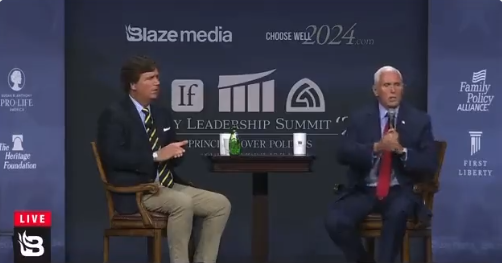
Tucker Carlson talking to Mike Pence, July 2023.
This became a dangerous cycle because the more Tucker forayed into the fringe, the harder he struck a vein of malformed but popular sentiment. Meanwhile, censorship of his relatively tame views only handed him a bigger megaphone and more incentive to go further. His sensible opposition to the Iraq and Afghanistan disasters, and his wariness of another quagmire emerging in Ukraine, curdled into progressively more unhinged forms of isolationism. His legitimate concerns about demographic trends and failed immigration policy curdled into belief in a coordinated conspiracy to erase white people from Europe and North America. Reasonable criticism of Israel and the American role in the Middle East curdled into the quasi-antisemitic trope of AIPAC as the hidden hand controlling U.S. foreign policy. His well-earned distrust of government curdled into various conspiracies involving some mix of extra-terrestrials, the CIA, and the Jews.
The pattern has become so predictable that if there was an effort to block him from praising Brussels sprouts as his favourite vegetable, at least three of his next five interview guests would spend two hours apiece insisting the maligned little cabbage is the victim of a coordinated smear campaign bankrolled by Big Salad. The attempted prohibition becomes the proof.
As a free-speech and free-market advocate, I think Tucker is entitled to say what he wants, and I congratulate him on his commercial success, even while finding many of his views idiotic. What troubles me is not so much the outlandish claims, but the skill atrophy — the phenomenon whereby any skill sharpened by adversarial pressure dulls without resistance. In boxing, the term “ring rust” is sometimes used to describe the way a boxer who stops facing strong opponents loses their timing, power, and urgency, until nothing’s left but a shell of their former selves. Looking back over his podcast guest list, with the exception of this Rees-Mogg segment, Ted Cruz last year, and perhaps a handful of others, it has been a long procession of hundreds of people brought on to confirm his own worldview back to him, in their own words. And the ring rust has set in.
I first noticed it at an event in Edmonton in January 2024, where I sat on a panel with Tucker and Jordan Peterson. I found myself in the awkward position of feeling the need to defend then-Finance Minister Chrystia Freeland in front of a packed arena of anti-Liberal partisans (with whom I would have considered myself somewhat of a kindred spirit). I was booed by parts of the audience for pointing out the fact that while Freeland, whom I know slightly and like personally, was politically hopeless, she was not, as Tucker had claimed, a fascist. The typically leftist habit of reducing every political opponent to a Hitler or Mussolini analog is lazy and obnoxious — not adjectives I would have used to describe the old Tucker. His justification was that he had recently seen a video of reporter David Menzies being detained by the RCMP after a collision with an officer while trying to get his microphone close enough to pick up Freeland’s response (or lack thereof). It was an outrageous overreaction by the officer, but there was no suggestion that Freeland had ordered the arrest. Ironically, Menzies’ question that Freeland was trying to dodge had been about why the Liberal government had gone soft on Iran’s terrorist regime — a question one might well put to Tucker.
The signs of atrophy continued to show up and in ways that, as a former admirer of Tucker’s, became progressively more alarming. At the memorial following the tragic murder of Charlie Kirk, Tucker gave an odd speech in which he claimed that the assassination was reminiscent of his “favourite story”, in which Jesus Christ was killed for telling the truth by a group of shadowy figures “in a lamp-lit room” in Jerusalem, “sitting around eating hummus”. When asked about it a few days later, Tucker employed a variation of the Jon Stewart technique of backing away from his own words to avoid serious scrutiny. With his characteristic forced laugh, he denied any implication that he had echoed the nascent conspiracy theory that Israel had murdered Charlie Kirk. His defense: hummus is a traditional Arab (rather than Jewish) food.
The evident decline grew even more pronounced in his May 2026 New York Times sit-down, when Lulu Garcia-Navarro asked why he had suggested that Donald Trump might be the Antichrist. Tucker insisted he had never said that, wasn’t even sure what the Antichrist was and insisted “those words never left my lips” — then, after he was shown a clip from his own show of the words leaving his lips, he apologized that his remarks from the clip implied “a precision I haven’t arrived at”. In other words, the jury is still out about whether Trump is the Antichrist, and he regretted jumping the gun on the verdict.
Which brings us to the latest instalment. After roughly 200 interviews, each amounting to hours-long sessions of Tucker and his guests regurgitating the same pablum into each other’s mouths, the transformation into a shell of his former self appears to be complete. In this conversation, moments after declaring that killing the innocent is “never justified under any circumstances”, he pivoted almost in the same breath into a full-throated defence of Hitler — history’s single greatest killer of innocents. He argued the invasion of Poland was understandable given that 15% of the country had been German before the Treaty of Versailles. While absurd, at least it is consistent with his position on Russia’s invasion of Ukraine. But even if, for argument’s sake, that justified Poland, Hitler didn’t stop there. What justified the invasions of Belgium and France? After all, France was faithfully adhering to the Tuckerite foreign policy of reluctant rearmament, appeasement, and assuming an entirely defensive posture (behind the Maginot Line). Stretching the flimsy logic further one could argue (feebly) that France had it coming too, since 6% of France (Alsace-Lorraine) was also German before Versailles. But there’s still no justification for the invasions of Denmark, Norway, the Netherlands, Yugoslavia, Greece, or the Soviet Union — with whom Hitler had a signed non-aggression pact. None of those countries were ever German, let alone Libya, Tunisia, and Egypt.
What’s clear is that Hitler used his early invasions to test whether anyone would stop him — and the feedback he got was a green light for more. History keeps teaching the same lesson: appeasement is just expansionism outsourced to your enemies.
Small wonder Tucker hasn’t learned this lesson from history, given that he called Darryl Cooper — a man with zero historical credentials — “the best and most honest popular historian in the United States.” Cooper spent two hours on Tucker’s show in September 2024, arguing Churchill, not Hitler, was the “chief villain” of the war, and that the deaths of millions in Nazi camps owed more to German logistical incompetence than deliberate extermination.
August 22, 2026
August 9, 2026
How To Launch the Apocalypse – Death of Democracy 27 – Q3 1939
World War Two and Spartacus Olsson
Published 8 Aug 2026This is Step 27 in the Death of Democracy: LAUNCH A WORLD WAR — the moment when the collapse of democracy, diplomacy, and collective security culminated in an attack that would engulf the world.
In July and August 1939, Adolf Hitler turned the destruction of German democracy into the instrument for launching a European war.
While Nazi Germany armed Danzig, mobilized reservists, prepared its U-boats, introduced civilian rationing, and manufactured stories of Polish aggression, Britain, France, Poland, the United States, and the Soviet Union made a final series of increasingly desperate attempts to prevent catastrophe.
At the center of the crisis was the failed effort to construct an Anglo-French-Soviet alliance against Nazi aggression. Negotiations foundered on delay, mutual suspicion, the Baltic states, and the Soviet demand for military passage through Poland. Stalin then chose an agreement with Hitler: the Molotov–Ribbentrop Pact and its secret protocol divided Eastern Europe into German and Soviet spheres of influence and prepared the way for the destruction of Poland.
Inside Germany, there was little repetition of the supposed national enthusiasm of August 1914. Nazi leaders and Wehrmacht commanders ranged from confidence and opportunism to anxiety and fatalism, while many ordinary Germans feared that Hitler had finally pushed Europe beyond the point of no return. Yet propaganda, repression, and six years of dictatorship had stripped the population of any effective means of preventing the war.
The next episode will conclude the series with an epilogue examining what the destruction of the Weimar Republic teaches us about defending democracy today.
August 2, 2026
How to Make Aggression Sound Like Defense – Death of Democracy 26 – Q2 1939
World War Two
Published 1 Aug 2026By the spring of 1939, Hitler’s Germany is no longer merely threatening war, it is preparing to launch one while insisting that every act of aggression is really self-defense.
In this episode of “Death of Democracy”, we look at Germany in the second quarter of 1939: the launch of the battleship Tirpitz, the secret planning for Fall Weiss — the invasion of Poland — Hitler’s 50th-birthday military spectacle, the renunciation of the German-Polish Non-Aggression Pact and the Anglo-German Naval Agreement, the Pact of Steel with Mussolini’s Italy, and the diplomatic moves designed to isolate Poland before the coming attack.
But behind the military display, Nazi Germany’s economy is still on a knife’s edge. Rearmament, shortages, debt, plunder, and autarky have pushed the regime toward a brutal logic: conquest is no longer just ideology; it has become the regime’s chosen answer to the crisis it created.
Meanwhile, persecution inside the Reich continues to escalate. Jewish tenants are stripped of protection, the refugee ship St. Louis leaves Hamburg in a desperate search for sanctuary, and Ravensbrück opens as a concentration camp for women. As Germany exports terror into annexed Austria and Bohemia-Moravia, Britain and France finally begin to wake from appeasement — but dangerously late.
This is how aggression is made to sound like defense.
Never Forget.
July 26, 2026
How to Provoke a War – Death of Democracy 25 – Q1 1939
World War Two
Published 25 Jul 2026By March 1939, appeasement has failed.
Hitler’s Germany has moved from threats and persecution inside the Reich to the destruction of Czechoslovakia, the seizure of Memel, and renewed pressure on Poland. No shots have yet been fired between the great powers — but Europe is now locked on a course toward war.
In this episode of Death of Democracy, Spartacus Olsson reports from Berlin at the end of Q1 1939: the “Israel” and “Sara” decree, Schacht’s dismissal, Göring’s Central Office for Jewish Emigration, Hitler’s genocidal Reichstag threat, the launch of Bismarck, the coerced occupation of Prague, the Memel ultimatum, and Britain’s guarantee to Poland.
This is the moment when the Munich illusion collapses. Hitler is no longer pretending to unite Germans. He is dismantling states.
July 12, 2026
How WW2 Really Started: Appeasement! – Death of Democracy 23 – Q3 1938
World War Two and Spartacus Olsson
Published 11 Jul 2026On September 30, 1938, Neville Chamberlain returned from Munich promising “peace for our time”. Adolf Hitler returned to Berlin with the Sudetenland.
In this episode of “Death of Democracy”, Spartacus Olsson reports from Berlin as Nazi Germany escalates on two fronts: terror against Jewish citizens at home, and diplomatic blackmail against Czechoslovakia abroad.
While the Evian Conference fails to open the world’s doors to Jewish refugees, the Nazi regime tightens the trap with identity cards, forced names, professional bans, the opening of Mauthausen, and Eichmann’s machinery of forced emigration in Vienna.
At the same time, Hitler manufactures the Sudeten Crisis, threatens war, breaks Czechoslovakia’s defenses through the Munich Agreement, and convinces much of Europe that surrendering another country’s territory is the price of peace.
This is Germany in Q3 1938: the lie that Hitler would not start another war — and the world’s decision to believe him.
June 29, 2026
Stupid Super Heavies: Germany’s Biggest Tanks
The Tank Museum
Published 27 Feb 2026By late 1943 Germany was losing the war …
They needed tanks, and lots of them, if they were going to wrestle back the initiative. Instead, they became obsessed with wonder weapons they hoped could change their fate
From the logistical paralysis of King Tiger, growing ever bigger and more unwieldy with the Maus, ultimately reaching the madness of the thousand tonne Ratte.
Like Augustus Gloop, German tank development in the Second World War greedily ate up more and more resources.
While an absolute boon for historians working at The Tank Museum, it made no logical sense … What were they thinking?
This is the bewildering story of the “Super Heavies”
00:00 | Introduction
00:48 | The Panther Problem
02:27 | Bigger is Better
05:42 | Pushing the Limits
09:19 | Gigantic Fantasies
12:03 | Losing the War (and the Plot)
(more…)
June 26, 2026
Magda Goebbels: The Nazi Mother Who Murdered Her Children
World War Two
Published 25 Jun 2026Magda Goebbels was one of the most infamous women in Hitler’s inner circle. Known as the wife of Nazi Propaganda Minister Joseph Goebbels and often treated as an unofficial “First Lady” of the Third Reich, she helped project an image of family, elegance, and loyalty while standing beside one of history’s most murderous regimes. But her story ends in one of the darkest acts of the Second World War.
As Berlin collapsed in 1945, Magda Goebbels took her six children into Hitler’s Führerbunker. Offered chances to escape, she refused. One day after Hitler’s suicide, she helped murder her own children with cyanide, claiming that a world without National Socialism was not worth living in.
In this episode of our new format, Baddies and Battleaxes, Anna Deinhard returns to tell the story of Magda Goebbels: socialite, Nazi fanatic, mother, accomplice, and child murderer. Her life reveals how women in the Third Reich were not always passive bystanders. Some, like Magda, actively embraced Nazi ideology, helped legitimize the regime, and chose loyalty to Hitler over humanity itself.
This is the story of the Nazi “First Lady” who followed fascism all the way into the bunker.
Who should Anna cover next in Baddies and Battleaxes? Tell us which heroines and villainesses of WW2 you want to see in a future episode.
June 21, 2026
How To Make War Inevitable – Death of Democracy 20 – Q4 1937
World War Two and Spartacus Olsson
Published 20 Jun 2026By late 1937, Nazi Germany’s rearmament economy had trapped itself. Autarky was failing. Hjalmar Schacht was pushed aside. Göring’s Four-Year Plan dominated economic policy. And at the secret Hossbach meeting of November 5, Hitler turned economic impossibility into an argument for territorial conquest.
This episode covers Q4 1937: the Hossbach Memorandum, Schacht’s resignation, the Anti-Comintern alignment, Lord Halifax’s visit, Himmler’s police-state consolidation, the December “Preventive Crime Fighting” decree, and the antisemitic propaganda exhibition Der Ewige Jude.
The argument is not that war was metaphysically inevitable. It is that the Nazi regime built an ideological, economic, and police-state machine that made war look increasingly necessary to its own leadership. This is a historical analysis of Nazi dictatorship, antisemitic propaganda, and war planning. It condemns Nazism and uses extremist material only for educational and documentary context.
Chapters:
0:00 Q4 1937 Intro
0:53 The world at the end of 1937
1:36 Germany’s quarter of acceleration
3:30 Himmler Tightens Police Power
6:26 Der Ewige Jude and dehumanization
8:30 Hossbach: autarky fails
11:16 Halifax and diplomatic confidence
13:03 Mood inside Germany
15:09 Mein Kampf has become policy
17:16 Conclusion: the politics of beasts
May 31, 2026
How the Nazis Got Rich Preparing Germany for War – Death of Democracy 17 – Q1 1937
World War Two
Published 30 May 2026By March 1937, Nazi Germany had renewed dictatorship, buried Versailles, and turned rearmament into a corruption machine.
Berlin, March 31, 1937. Adolf Hitler’s regime appears stronger than ever. The Enabling Act is extended for another four years, the civil service is bound more tightly to Hitler personally, and Germany formally rescinds its signature from the war-guilt clause of the Versailles Treaty.
But behind the speeches about honor, work, and national revival, another transformation is underway.
In the first quarter of 1937, Nazi Germany moves deeper into an economy built around rearmament, Party patronage, racial exclusion, corporate privilege, and theft. The new German Corporation Law weakens ordinary shareholder control and strengthens management boards. Industrial giants profit from military preparation. Jewish property becomes a field of extortion and enrichment. Hitler himself grows wealthy through book royalties, image rights, hidden payments, and political slush funds.At the same time, the regime tightens control over public life. Civil servants are required to serve the Nazi state without reservation. Journalists, professors, doctors, artists, and Jewish Germans are pushed out of public and professional life. Concentration camp roundups expand beyond political opponents. And on Palm Sunday, Pope Pius XI’s Mit brennender Sorge is read from Catholic pulpits across Germany, openly challenging Nazi ideology.
This episode looks at Germany in the first quarter of 1937: a moment when dictatorship no longer needs to look revolutionary. It looks administrative, profitable, respectable — and permanent. This is the story of how power, profit, propaganda, and fear helped turn a modern state into a robber regime preparing for war.
0:00 Berlin, March 31, 1937
0:47 A World in Crisis
01:10 Germany Extends the Legal Shell of Dictatorship
01:23 Civil Servants Bound to Hitler
01:51 Hitler Rejects the Versailles War-Guilt Clause
02:21 The Enabling Act Is Renewed
02:48 Göring in Rome, Reassurances in Warsaw
03:44 The New Corporation Law
04:00 The Catholic Church Challenges Nazi Ideology
05:08 Police Roundups and Expanding Concentration Camps
05:46 Press, Education, Medicine, and Culture Under Control
08:20 The Nazi Economy: Private Profit, State Power
09:41 Aryanization and Organized Theft
10:20 Rearmament, Industry, and Oligarch Profits
12:21 How Hitler Personally Got Rich
14:55 The Party Mood: Confidence at the Top
15:22 German Public Sentiment and Victor Klemperer
16:20 Analysis: How Results Become Consent
17:06 Conclusion: The Quiet Theft of Democracy
18:27 Never Forget / Support TimeGhost
May 24, 2026
How to Indoctrinate a Generation – Death of Democracy 16 – Q4 1936
World War Two and Spartacus Olsson
Published 23 May 2026How did Nazi Germany seize control of its youth by the end of 1936? In this episode, Spartacus traces the Hitler Youth Law, the Four-Year Plan, Winterhilfswerk, the Anti-Comintern Pact, Goebbels’ attack on criticism, and the tightening exclusion of German Jews.
Berlin, December 31, 1936. The Nazi regime did not need another single dramatic coup. It connected the household, the factory, the school, the street collection, the newspaper, and the foreign threat into one system of mobilization.
This episode covers how the Law on the Hitler Youth declared all German youth organized within the Hitler Youth; how the Four-Year Plan redirected recovery toward rearmament and autarky; how charity became mandated patriotic ritual through Winterhilfswerk; how anti-Bolshevik propaganda linked Spain, Japan, Italy, and Germany; and how Jewish Germans were pushed further into isolation through administrative humiliation and police control.
This is an educational historical documentary condemning Nazism, antisemitism, dictatorship, racial exclusion, and political indoctrination.
May 17, 2026
Why Didn’t Germans Resist Hitler? – Death of Democracy
World War Two and Spartacus Olsson
Published 16 May 2026Why didn’t Germans resist Hitler? Were they all Nazis, or were they terrorized into silence by the Gestapo?
The truth is more unsettling. The Nazi regime ruled through a combination of targeted terror, social atomization, propaganda, popular support, opportunism, and broad accommodation. This episode examines why mass resistance never emerged — and why millions of ordinary Germans accepted, enabled, or benefited from the Third Reich.
00:00 Why didn’t Germans resist Hitler?
00:33 The myth of the all-powerful Gestapo
01:36 Targeted terror and selective repression
02:39 The Nazi seizure of power
03:09 Gleichschaltung and the destruction of civil society
03:38 Inner emigration and private conformity
04:16 Why early Nazi successes mattered
04:33 Unemployment, rearmament, and national pride
05:39 Versailles, trauma, and German victimhood
06:22 Identity, propaganda, and belonging
07:25 Volksgemeinschaft and the “Hitler Myth”
08:54 Kristallnacht and the failure of collective action
10:40 What the numbers suggest
11:47 Postwar surveys and lingering Nazi support
13:31 Terror, consent, and accommodation
15:07 Did this absolve ordinary Germans?
16:16 Democracy, responsibility, and Never Forget
May 10, 2026
How to Make Nazi Germany Look Normal – Death of Democracy 15 – Q4 1936
World War Two and Spartacus Olsson
Published 9 May 2026How did Hitler use the 1936 Berlin Olympics to make Nazi Germany look peaceful — while preparing the country for war?
Berlin, September 30, 1936. Under the Olympic flame, Nazi Germany staged one of the most successful propaganda spectacles of the twentieth century. Foreign visitors saw order, ceremony, technology, pageantry, and athletic triumph. But behind the facade, the regime hid antisemitic persecution, rounded up Sinti and Roma, intensified police repression, intervened in the Spanish Civil War, and moved toward a massive new war economy.
In this episode, Spartacus Olsson looks back at the third quarter of 1936: the Berlin Olympics, Jesse Owens’ victories, Hitler’s secret war memorandum, the Four-Year Plan, Nazi propaganda, Germany’s growing involvement in Spain, and the dictatorship’s attempt to sell peace to the world while preparing for conquest.
The Olympics gave Hitler international validation. The Four-Year Plan revealed what he truly intended.
In this episode:
– How Nazi Germany sanitized Berlin before the Olympic Games
– How the regime temporarily hid antisemitic violence from foreign visitors
– How Sinti and Roma were forced out of sight before the Games
– How Jesse Owens challenged Nazi racial mythology on the track
– How Hitler moved Germany toward a war economy
– How the Four-Year Plan tied German recovery to rearmament
– How Germany’s intervention in Spain marked a new stage of escalation
– How propaganda, spectacle, and controlled media helped normalize dictatorshipThis is not just a story about the 1936 Olympics. It is a story about how authoritarian regimes use spectacle, national pride, media control, and international complacency to hide what they are becoming.
Never Forget.


