Quotulatiousness

September 23, 2026

Friedrich Merz’s rapidly fading political future

Filed under: Germany, Media, Politics — Tags: , , , — Nicholas @ 05:00

On Substack, eugyppius discusses the electoral chasm at Chancellor Friedrich Merz’s feet after terrible showings in recent state elections for his party and the continued rise of the extremely extreme extreme-right Alternative für Deutschland (AfD):
“German flag” by fdecomite is licensed under CC BY 2.0 .

Within months of becoming Chancellor, Friedrich Merz promised an “Autumn of reforms”, which never materialised because the political will to fix Germany’s economic and fiscal problems does not exist within his coalition. Having failed to fix anything and driven support for the once-mighty CDU to historic lows, Merz has instead been served an Autumn of Reckoning. It is unclear whether he will survive it.

The state elections in Sachsen-Anhalt, Mecklenburg-Vorpommern and Berlin that for months have inspired fear and trembling within the German political establishment have come and gone. Each of them has realised our rulers’ worst fears in different ways.

1) In Sachsen-Anhalt, the CDU underperformed polls by more than 20%, while Alternative für Deutschland achieved the highest vote share any party has ever won in that state. The AfD are already in talks with the Bündnis Sahra Wagenknecht, and everyone expects an AfD government under Ulrich Siegmund to take power in the coming months.

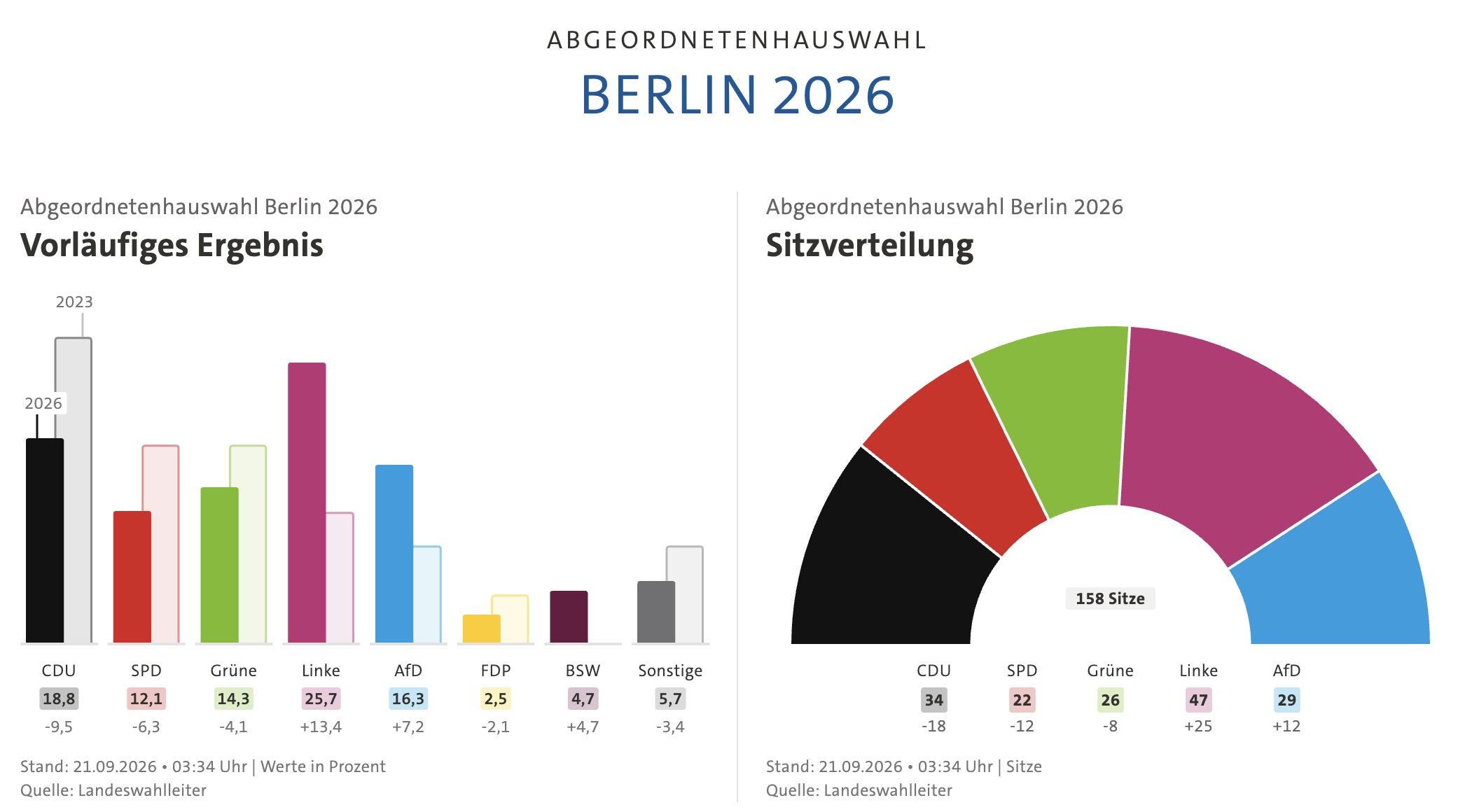
2) In Berlin, the CDU managed to squander the clear polling dominance it enjoyed throughout 2025 to finish in second place with just 18.8% of the vote – nearly seven points behind Die Linke. That is what a series of extremely stupid and unnecessary local scandals alongside association with the most unpopular Chancellor in the history of the Federal Republic can do to a party.

Zohran Mamdani’s advisers and campaign strategists assisted Die Linke in their left-populist Berlin campaign, which enjoyed particularly strong appeal among young voters. Assuming some late-breaking turbulence caused by the corruption and indiscipline that are typical of Die Linke do not derail things, they will form a government with the Greens and the Social Democrats.

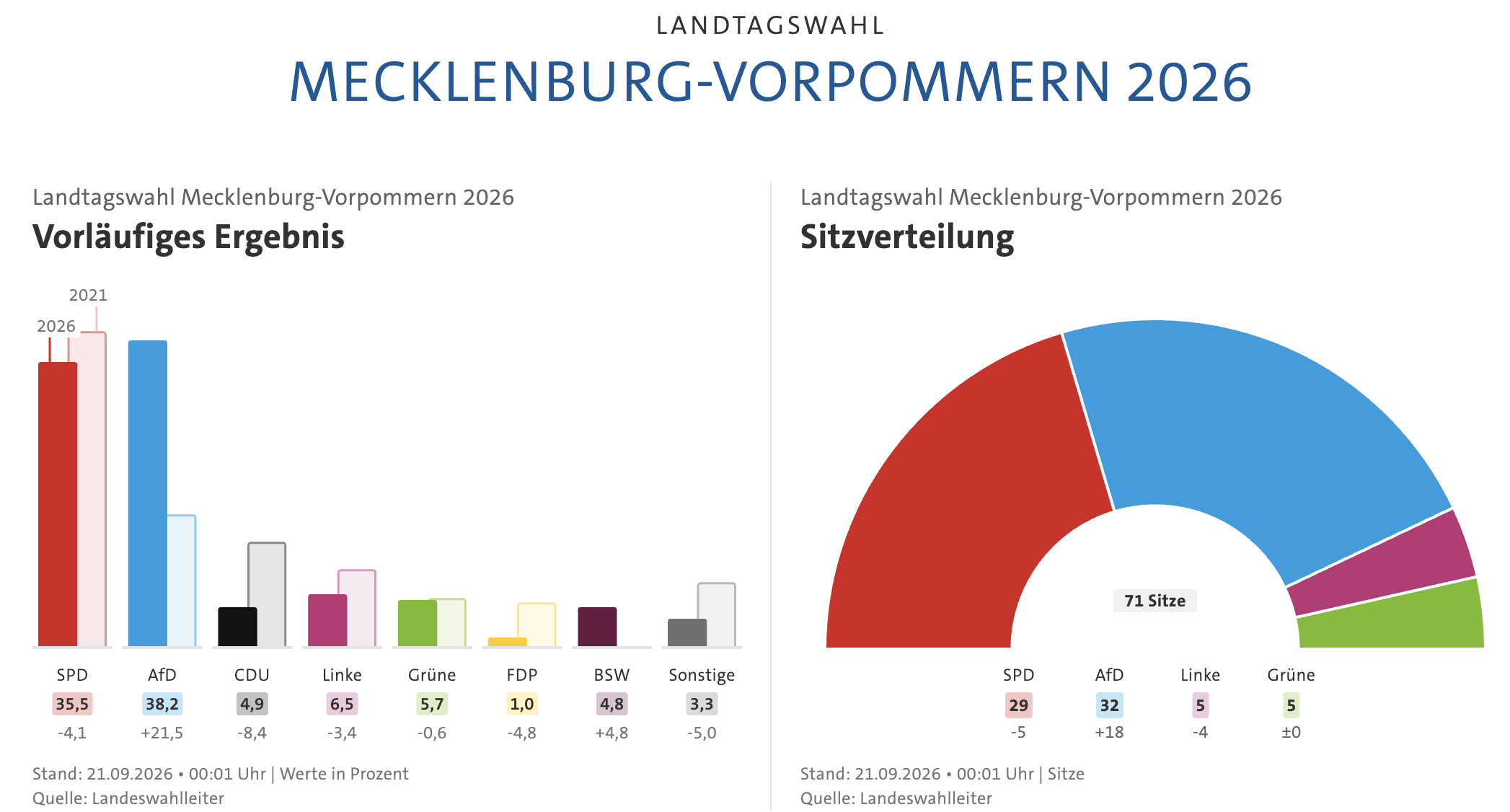
3) In Mecklenburg-Vorpommern, the CDU managed to underperform every last poll, logging their worst electoral result in all of history. With just 4.9% of the vote, they failed for the first time ever to scrape across the 5% hurdle for representation in the Landtag – an outcome I have predicted for weeks. Whereas in Sachsen-Anhalt voters overcame the firewall by making the AfD too powerful to wall off, in Mecklenburg-Vorpommern they abolished it entirely by kicking the party that invented and maintains the firewall straight out of parliament.

Alternative für Deutschland won the largest vote share, but the result will be another coalition of Social Democrats, Greens and Die Linke under the long-serving Minister President Manuela Schwesig. Schwesig enjoys especially strong popularity among women and pensioners, and she will be helped into power by a smattering of leftist students and climate-obsessed urbanites. The AfD will stand alone in opposition to the tepid foolishness of the coming legislature, and the citizens of Mecklenburg-Vorpommern will develop new ways of thinking about the Evil Fascist Nazi Hitler party, which probably cannot be all that evil or fascist or Nazi or Hitler, given that there is no longer any alternative to the left here in the northeast.
September 12, 2026

Berlin after 1918 … the decadence the Nazis fought

Filed under: Germany, Health, History — Tags: , , , , , , , , — Nicholas @ 05:00

The period after the First World War in Weimar Germany was a huge break with the Wilhelmine past, especially in Berlin and some other large cities. Hitler wasn’t wrong about the moral decadence of the 1920s and the reaction helped build his movement. At The Grim Historian, Carlyn Beccia illustrates what life was like in Berlin for those who fully indulged in the excesses of the new liberalized society that so outraged Hitler and his supporters:

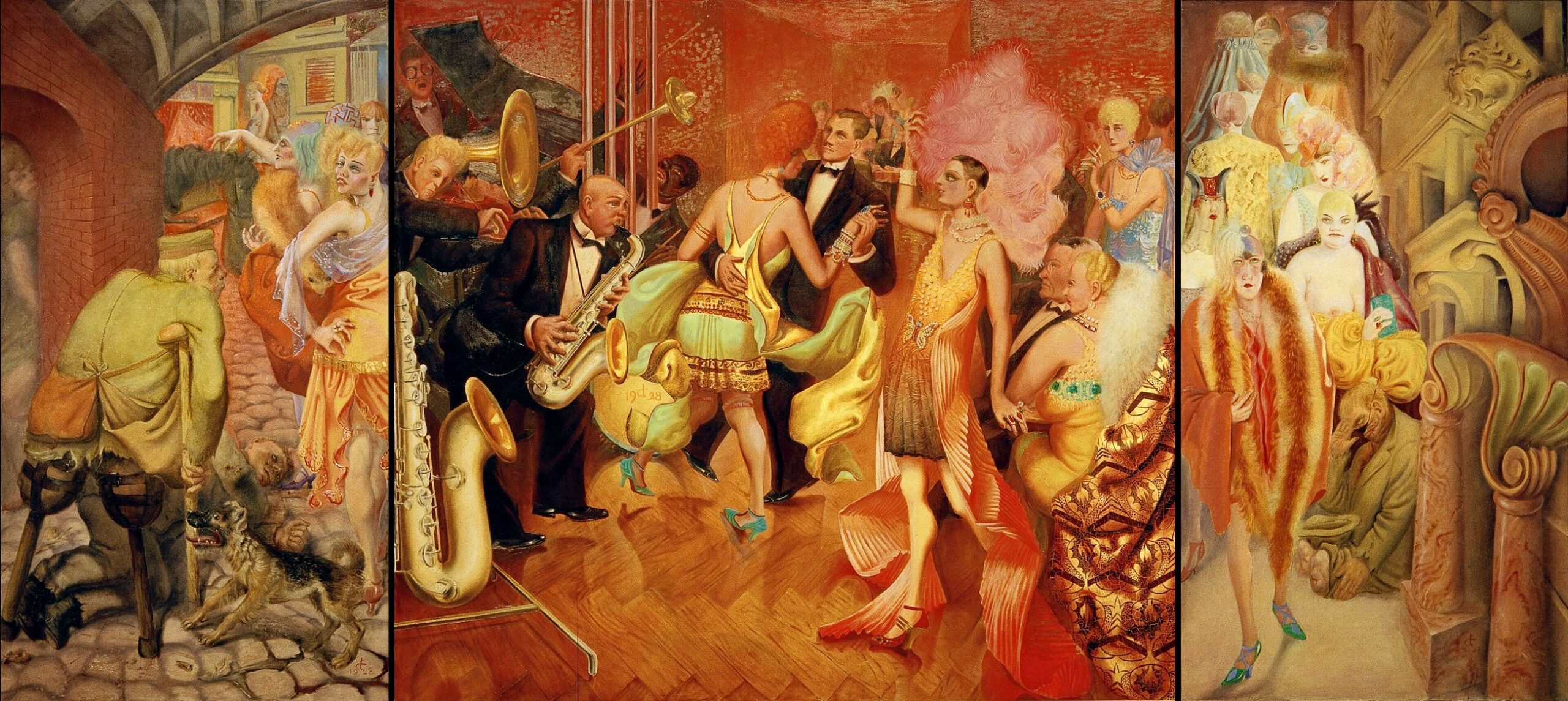
Metropolis by Otto Dix, 1927–1928,
Kunstmuseum Stuttgart

It’s 1929, and Berlin is having the kind of night respectable people will later insist never happened.

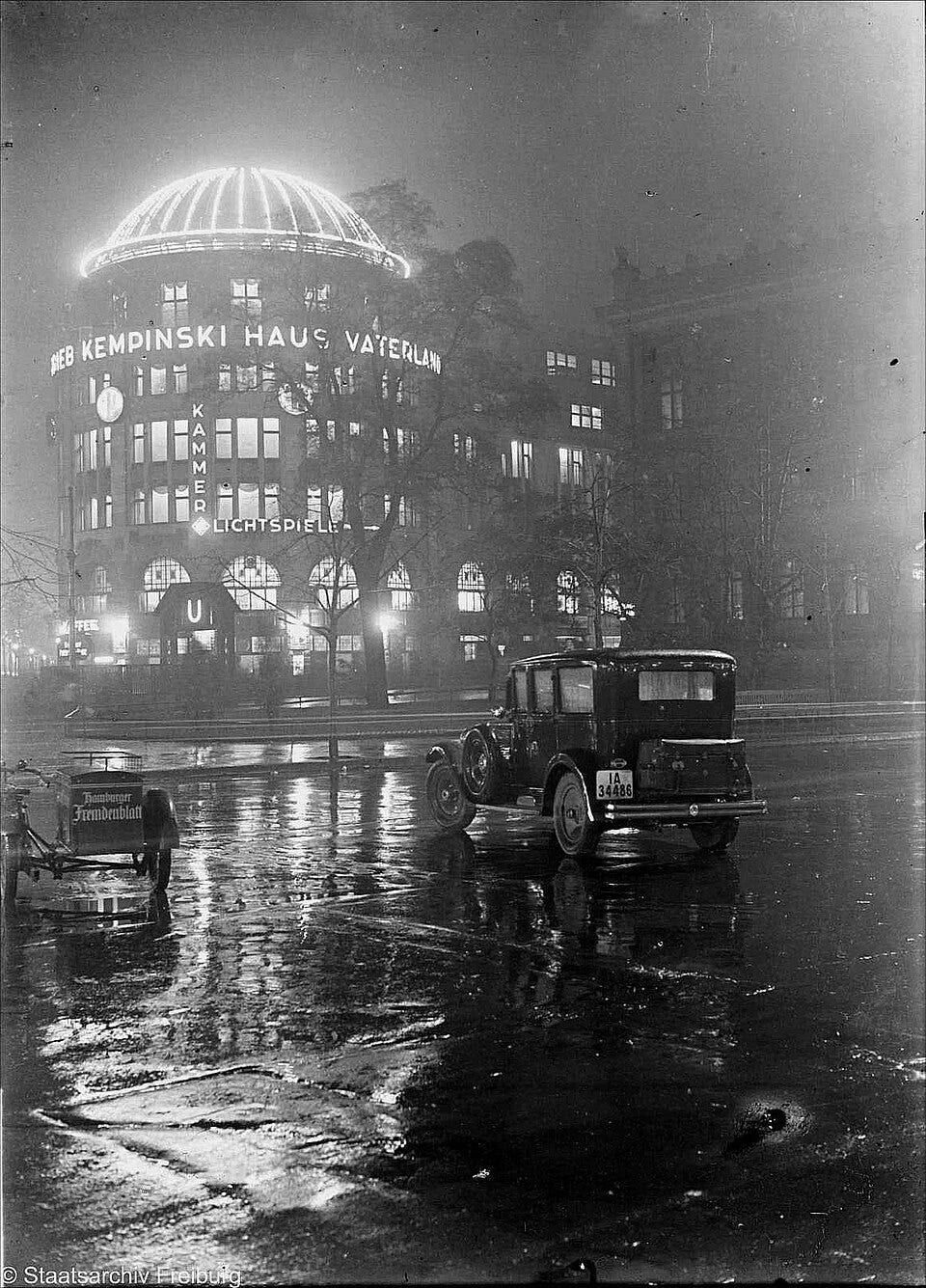
Neon bleeds across wet pavement. A taxi hisses past, throwing gutter water onto a woman whose dress has misplaced most of its back. Somewhere below street level, a trumpet murders a respectable German melody while a girl in a tuxedo leans in to kiss another girl.

Berlin, 1929: Haus Vaterland, where Berliners could drink, dance, dine around the world, and enjoy an hourly fake thunderstorm over the Rhine because subtlety had apparently taken the night off. The pleasure palace could accommodate as many as 8,000 people.
CC BY 4.0

She goes in. Another comes out laughing. The door swings.

They call these women the Neue Frau — “new woman”. Hair bobbed to the jawline as though she took a knife to the nineteenth century. Hemline at the knee, one stocking laddered at the ankle.

The new woman works behind a counter at a department store. When the doorman holds out his hand, she pays him with her own wages from her own bank account. Today, we would call these progressive women “girlbosses” while silently hating ourselves for not having a less cringy word.

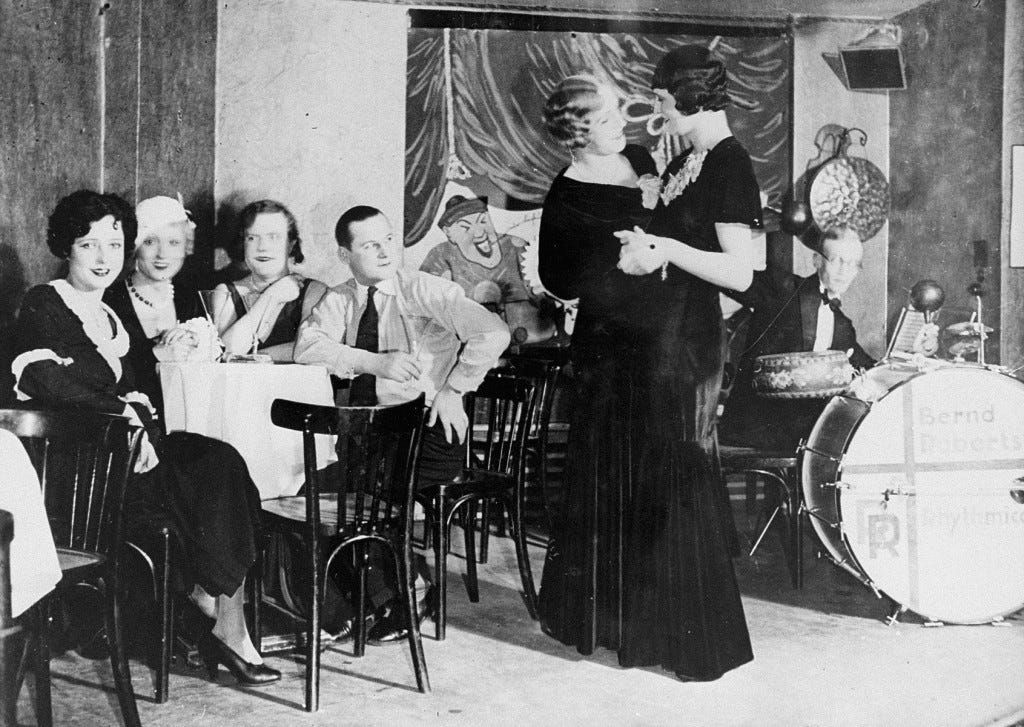
Berlin, 1929: Two women dance at the Eldorado, where lipstick, tuxedos, and heterosexual expectations were all optional. Four years later, the Nazis shut it down.
Bildarchiv Preussischer Kulturbesitz, via United States Holocaust Memorial Museum, Holocaust Encyclopedia

Other young women belonged to a more slippery category Berliners called the Halbseidenen — the “half-silks”. Half-silk was fabric woven partly from real silk and partly from cheaper thread. The fabric was glossy enough to pass at a distance, suspect once you got close.

The nickname landed on women who were equally difficult to classify — shopgirls, dancers, sexually independent working women, occasional prostitutes, girls dressed just a little better than their wages should have allowed.

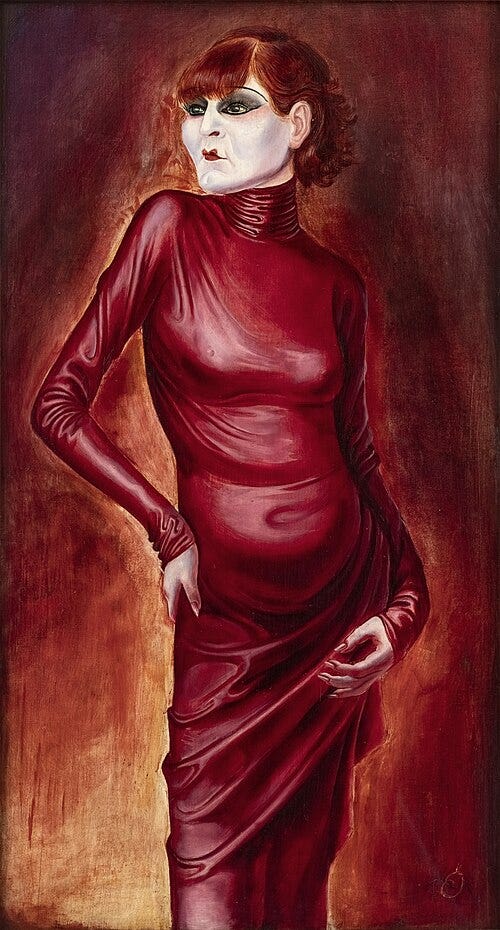
These women do not dance politely. Anita Berber, Berlin’s cocaine-addicted queen of nude dance, had made Dances of Vice, Horror and Ecstasy infamous. Grosz and Otto Dix paint Lustmord — sex murder — as a genre, and sell it.

Otto Dix –  Portrait of the Dancer Anita Berber, 1925
Public Domain

Inside the club, smoke curls from red-stained lips like a genie escaping its lamp. Champagne sweats in silver buckets and sloshes in chipped glasses. A folded banknote, a razor’s quick flash, two white lines cut across a mirror while dancers stamp and spin inches away.

Women arrive as men, men arrive as women, and bankers disappear into back rooms with people their bankers’ wives would not have invited to luncheon.

This particular den of iniquity has competition. Weimar Berlin supports somewhere between 65 and 80 gay bars and another fifty lesbian ones.

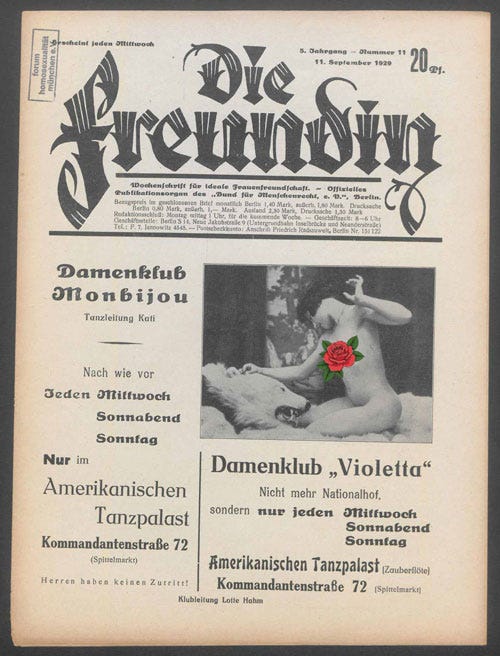
And the sexual revolution does not stop at closing time. It is sitting on the newsstands. By the end of the decade, more than twenty publications cater to gay, lesbian and gender-nonconforming readers — romance serials, political essays, personal ads, and club listings. A lonely girl in Leipzig can get Die Freundin without ever setting foot in a dancehall.

Berlin, 1929: Die Freundin, Germany’s lesbian weekly, advertises two women’s clubs at the Amerikanischer Tanzpalast. The fine print reads: “Men are not admitted.” I added the flowers. Weimar Berlin did not. | Forum Queeres Archiv München.

Across town, Magnus Hirschfeld has spent years trying to drag sex out of whispers and into science. The physicians in his Institute for Sexual Science would soon help pioneer some of the first gender-affirming surgeries. The institute also offers birth control and counseling, and works with Berlin police on “transvestite passes” — documents that let trans people walk the city without being arrested for their clothes.

Berlin has somehow managed to give gender nonconformity paperwork.

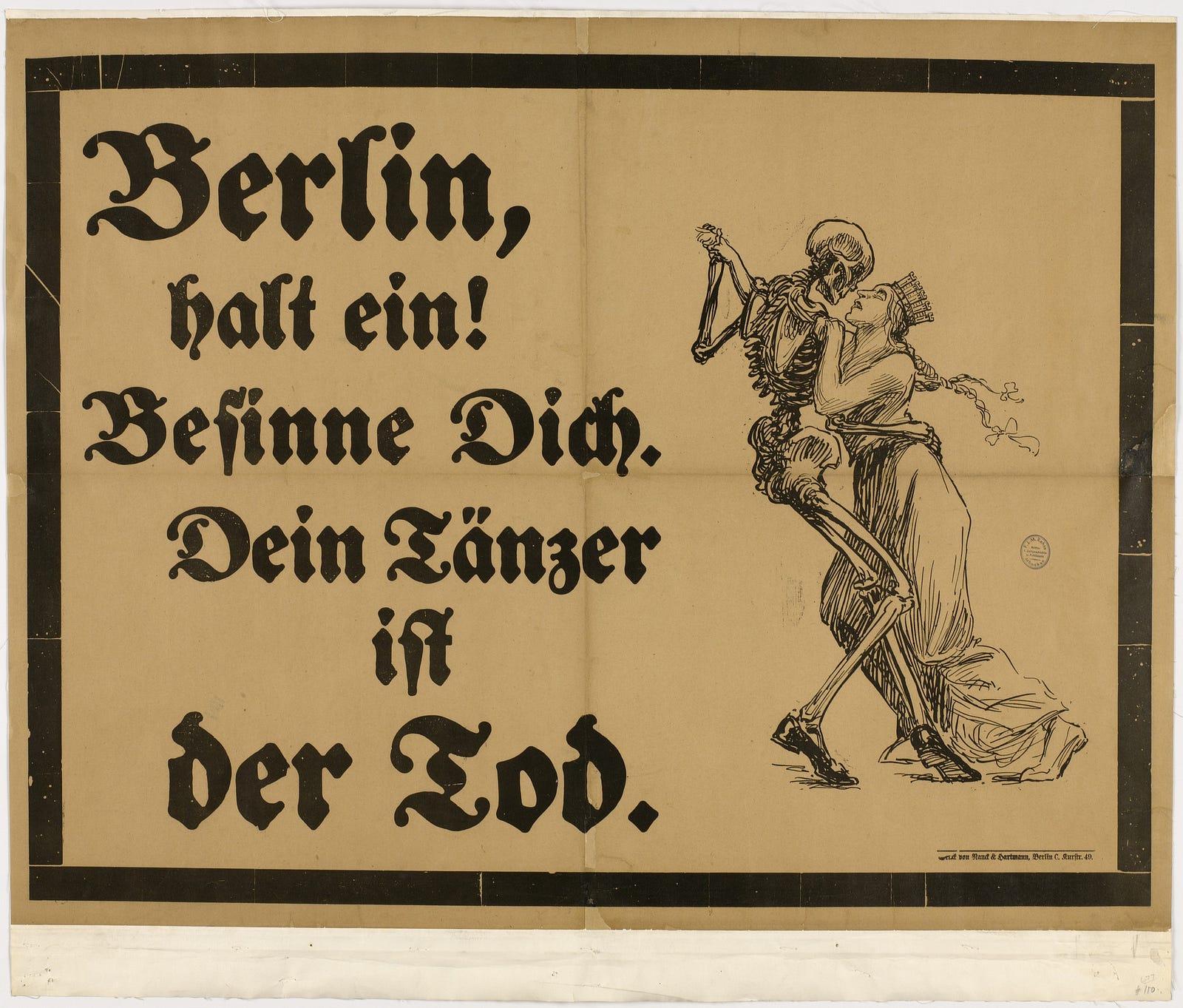
Not everybody finds this charming. Berlin has been hearing the opposite sermon since the republic was born. Ten years earlier, in the political convulsions after World War I, a poster showed a crowned Berlin locked in a waltz with a skeleton, “Berlin, halt ein! Besinne dich. Dein Tänzer ist der Tod” — Berlin, stop. Come to your senses. Your dance partner is Death.

The poster was not about lesbians in tuxedos. It came from the political chaos of 1919. But the accusation is already there.

Berlin is losing itself. It must return to the past and what once made it great.

Of course, by the late 1920s, the people making that nostalgic argument have begun pointing at sex. In 1927, Wilhelm Frick warns that homosexuality will lead to the “disintegration of the German people”. Large numbers of Germans describe Weimar’s new sexual visibility as decadent, immoral, and evidence of national degeneration. Right-leaning religious organizations and parties preach family, restraint, and traditional German culture.

Looking back on the inflation era, Austrian writer Stefan Zweig remembered the city transforming into “the Babel of the world”, with gay bars multiplying like mushrooms and transvestite balls so extravagant he thought ancient Rome had been outdone.

Berlin read the room. Berlin went on dancing, spending, and fucking.

Berlin, 1919: Ten years before Fritz stands outside our nightclub, Berlin is already being warned about its dance partner. “Stop! Come to your senses! Your dancer is Death.” | Van Santen, Berlin, Stop! 1919.
Lithograph. Library of Congress Prints and Photographs Division. Public Domain

Berlin’s own tourist bureau was advertising Jeder einmal in Berlin! — everyone should visit Berlin at least once. In 1929, nearly 1.7 million guests did.

But not everyone enjoyed watching Berlin turn its private vice into a tourist attraction.

Because while people inside experienced liberation, and the moral right experienced decadence and national decline, young men experienced something else.

Exclusion.

May 10, 2026

How to Make Nazi Germany Look Normal – Death of Democracy 15 – Q4 1936

Filed under: Germany, History, Sports — Tags: , , , , , , — Nicholas @ 04:00

World War Two and Spartacus Olsson
Published 9 May 2026

How did Hitler use the 1936 Berlin Olympics to make Nazi Germany look peaceful — while preparing the country for war?

Berlin, September 30, 1936. Under the Olympic flame, Nazi Germany staged one of the most successful propaganda spectacles of the twentieth century. Foreign visitors saw order, ceremony, technology, pageantry, and athletic triumph. But behind the facade, the regime hid antisemitic persecution, rounded up Sinti and Roma, intensified police repression, intervened in the Spanish Civil War, and moved toward a massive new war economy.

In this episode, Spartacus Olsson looks back at the third quarter of 1936: the Berlin Olympics, Jesse Owens’ victories, Hitler’s secret war memorandum, the Four-Year Plan, Nazi propaganda, Germany’s growing involvement in Spain, and the dictatorship’s attempt to sell peace to the world while preparing for conquest.

The Olympics gave Hitler international validation. The Four-Year Plan revealed what he truly intended.

In this episode:
– How Nazi Germany sanitized Berlin before the Olympic Games
– How the regime temporarily hid antisemitic violence from foreign visitors
– How Sinti and Roma were forced out of sight before the Games
– How Jesse Owens challenged Nazi racial mythology on the track
– How Hitler moved Germany toward a war economy
– How the Four-Year Plan tied German recovery to rearmament
– How Germany’s intervention in Spain marked a new stage of escalation
– How propaganda, spectacle, and controlled media helped normalize dictatorship

This is not just a story about the 1936 Olympics. It is a story about how authoritarian regimes use spectacle, national pride, media control, and international complacency to hide what they are becoming.

Never Forget.

January 21, 2026

QotD: White elephant airports

Filed under: Australia, Cancon, Germany, Government, History, Humour, Quotations — Tags: , , , , , — Nicholas @ 01:00

Few things capture modern planning like a multibillion-dollar airport no one’s entirely sure will have any planes. Enter Western Sydney International Airport (WSI), Australia’s shiny $5 billion gamble at Badgerys Creek. It’s a development so hyped it already has merch, an anticipated metro line, and a better skincare routine than most of us, despite rumors it may spend its first year servicing only freight and the occasional confused ibis.

If history teaches us anything, it’s that airports, like wrinkle creams which cost the GDP of a small country but couldn’t iron out a bedsheet, can be wildly overpromised and underdelivered. Western Sydney’s runway might yet join the vainglorious global herd of White Elephant Airports: majestic, expensive, and standing alone in a field wondering where everyone went.

Let’s take a safari.

Mirabel: Montreal’s Monument to Inconvenience

Built in 1975, Mirabel International was meant to replace Montreal’s Dorval Airport and usher in a new aviation era. Instead, it became the architectural embodiment of “We should’ve checked the map”. Located more than 50 kilometers from the city, it was so unpopular that passengers would rather fling themselves onto dogsleds than make the commute.

Eventually, Mirabel stopped pretending to be an airport and transitioned into its second act: a car-racing track and film set. Somewhere in Quebec there’s probably still a baggage carousel being used as a wedding dance floor.

Ciudad Real: A Billion-Euro Garage Sale

Spain saw Mirabel and said, “Hold my sangria”. Ciudad Real International Airport opened in 2009 with a €1.1 billion price tag, dreams of high-speed rail links, and the confidence of a Bachelor contestant in week one. Within three years, it had no flights, no buyers, and no shame.

It was eventually auctioned for €10,000, less than a parking space in Bondi or a bottle of champagne at a Sydney rooftop bar. One imagines the bidding process was just two blokes shrugging in a room and someone whispering, “Ten grand and a paella voucher?”

Berlin Brandenburg: German Efficiency, But Make It Chaos

If you’ve ever wanted to see what happens when a nation famous for precision tries on farce, just pay a visit to Berlin Brandenburg Airport. Construction began in 2006, with an opening scheduled for 2011. By 2015, it was such a national embarrassment that Berliners stopped making jokes about British plumbing to recover emotionally.

In 2020, it finally launched amid the global COVID pandemic, after delays caused by faulty fire systems, suspicious cables, and the ghost of every German engineer pacing in dismay.

Nicole James, “Australia’s New Albino Elephant Sanctuary (Now with Parking)”, The Freeman, 2025-10-16.

October 6, 2025

Fire and Fury – Bomber Command 1943 – The Ruhr, Hamburg, Berlin and Disaster

HardThrasher
Published 4 Oct 2025

The Bomber War continues — In this second part of our deep dive into RAF Bomber Command, we explore the WW2 strategic bombing campaign that raged from the Spring of 1943 to the Spring of 1944.

This episode covers the Battle of the Ruhr, the Hamburg Firestorm, the raid on the V1 and V2 rocket research site at Peenemünde, and the disastrous attacks on Berlin and Nuremberg. We’ll look at how these missions affected the course of World War II, the Nazi war economy, and the future of the Royal Air Force itself.

00:00:00 – Introduction
00:00:23 – Quotation
00:00:57 – The Battle of the Ruhr and Context of the War
00:04:59 – Planning for Operation Gomorrah
00:06:29 – Window
00:07:42 – Gomorrah
00:10:00 – Firestorm
00:14:53 – An Old “Friend” Returns
00:16:00 – Germany Goes On The Defensive
00:18:59 – Assessing the Damage
00:19:54 – Killing the V1 & V2s at Peenemünde
00:22:51 – The Battle of Berlin
00:27:53 – Reality Check for Bomber Command
00:29:50 – Disaster over Nuremberg
00:31:23 – Summing Up
00:32:05 – Survivor’s Club

References –
xvi The Wages of Destruction, Tooze, Penguin, 2006 (from the 2007 reprint) p. 590 and on
xvii The Wages of Destruction, Tooze, Penguin, 2006 (from the 2007 reprint) p. 597
xviii Stalin’s War, McMeekin, Penguin, 2022 p.470 and on
ixx Ibid p.327
xx The Bombing War, Overy, Penguin, 2012, p.332
xxi The Bombing War, Overy, Penguin, 2012, p323
xxii Ibid p.334
xxiii The Bomber Command War Diaries, Middlebrook and Everitt, Penguin, 1990 (orig 1985) p.413
xxiv Ibid p.440
xxv Speer: Hitler’s Architect, Kitchen, Penguin, 2020 p.185
xxvi The Rise and Fall of the German Air Force, Arm & Armour Press, 1983, p.236
xxvii The Bomber War, Overy, Penguin, 2020, p.336
xxviii The Rise and Fall of the German Airforce, Arms and Armour Press, 1983, p.235
ixxx Flak, Westerman, University of Kansas Press, 2001 p.202 and on
xxx The Pathfinders, Iredale, Penguin, 2021, p.213
xxxi Bomber War, Hastings, Pan Military, 1977, p. 371 (2020 reprint)
xxxii Bomber Command’s War Against Germany, Frankland, Pen & Sword, 2020 (see also original AIR 41/57, 1951) p.89
xxxiii AIR 16/487 – Despatches on War Operations Feb 1942 – May 1945
xxxiv Bomber Command’s War Against Germany, Frankland, Pen & Sword, 2020 (see also original AIR 41/57, 1951) p.197
xxxv Bomber Command, Hastings, Pan, 2021 (orig. 1979) Pan, p.373
xxxvi Bomber Command, Hastings, Pan, 2021 (orig. 1979) Pan, p.376

Get Your Merch Here – https://hardthrasher-shop.fourthwall….
Email me – lordhardthrasher@gmail.com

September 8, 2025

June 17, 1953: The Day East Germany Erupted – W2W 43

Filed under: Germany, History, Russia — Tags: , , , , , — Nicholas @ 04:00

TimeGhost History
Published 7 Sept 2025

Breadlines, quotas, and Stasi fear collide with propaganda promises as East Germany erupts. In June 1953, strikes on Stalinallee ignite a nationwide uprising — Soviet tanks roll into Berlin, thousands are arrested, and the GDR tightens control. How did the regime survive this shock?
(more…)

August 8, 2025

Germany’s Darkest Night Yet? – Rise of Hitler 21 – September 1931

Filed under: France, Germany, History — Tags: , , , , , , — Nicholas @ 04:00

World War Two
Published 7 Aug, 2025

September 1931: Berlin descends into chaos as Nazis unleash a violent pogrom on Jewish New Year — while the police stand by. The scandal of the Kurfürstendamm riot rocks Germany, but the month’s headlines don’t stop there: Hitler’s niece is found dead under mysterious circumstances, France’s leaders visit Berlin to a frosty reception, and Japanese troops invade Manchuria. Extremists surge at the polls as democracy teeters — can the Republic survive?
(more…)

May 9, 2025

Nazi vs. Nazi – The Rebellion Within – Rise of Hitler 16, April 1931

Filed under: Germany, History — Tags: , , , , — Nicholas @ 04:00

World War Two
Published 8 May 2025

April 1931 plunges Hitler’s Nazis into crisis as SA leader Walter Stennes leads a dramatic internal revolt, challenging Hitler’s oath to legality. Meanwhile the Nazis loose their only ministerial post and President Hindenburg’s emergency decree intensifies clashes with communists, leading to mass arrests during banned protests.
(more…)

May 8, 2025

Aftermath

Filed under: Books, Europe, Germany, History — Tags: , , , , , — Nicholas @ 09:19

I’ve read a few books on what happened in Europe after the surrender of Nazi Germany in May of 1945, but there is always more to learn about a continent-wide struggle to recover from a disaster of the magnitude of World War Two:

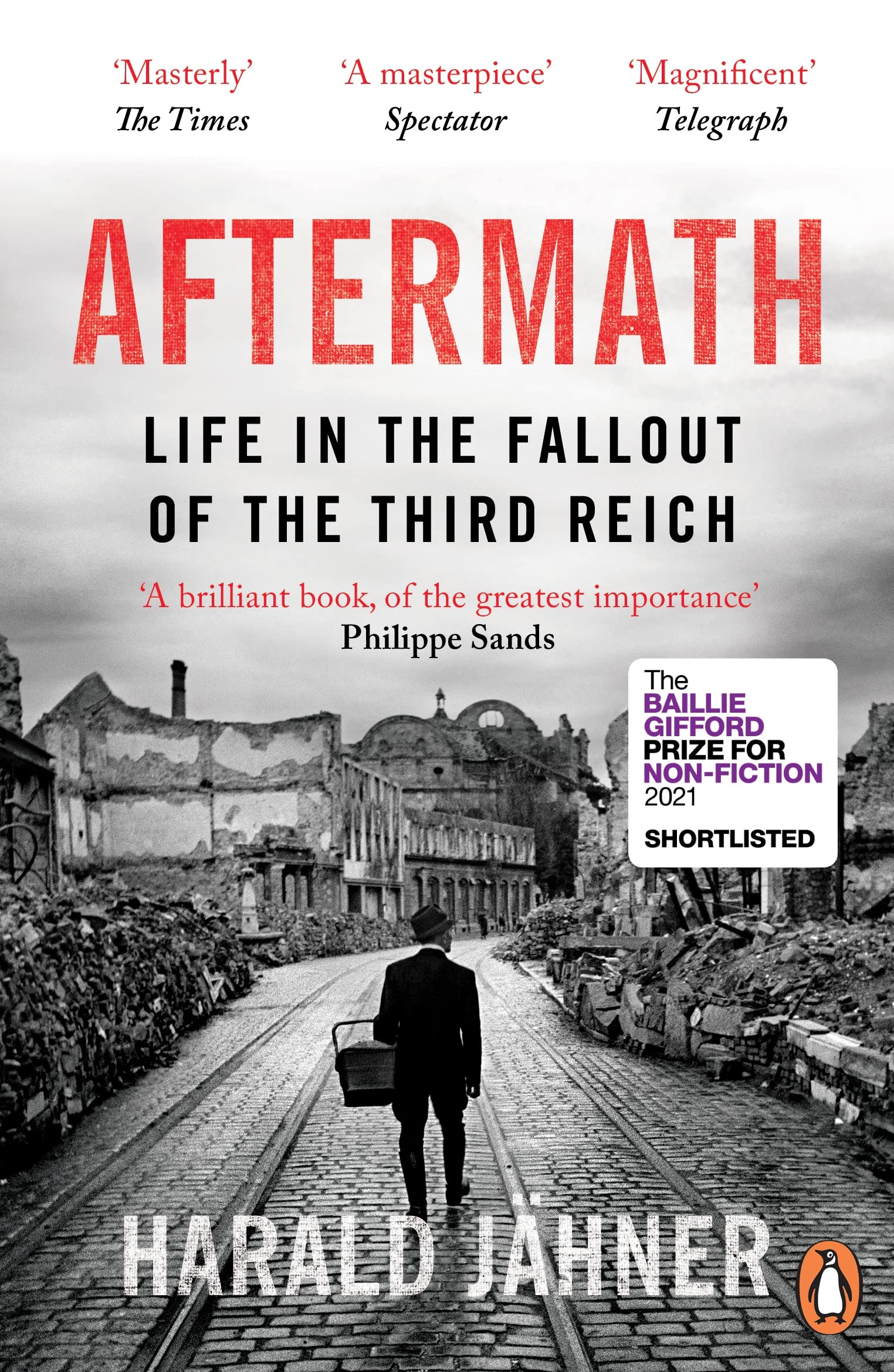
On a train journey earlier this year between Cologne and Berlin, I began to read Harald Jähner’s Aftermath, a fascinating account of the years when Germany emerged from the destruction and shame of the Third Reich.

The war ended 80 years ago today, and in the defeated nation the scenes were primeval and apocalyptic. In Berlin, journalist Ruth Andreas-Friedrich, along with a doctor, actor and musical conductor, discovered a white ox wandering through the streets and, after finding a Russian soldier to shoot it, found themselves suddenly surrounded by a ravenous mob. She recalled: “Suddenly, as if the underworld had been spying on them, a noisy crowd gathered around the dead ox. They crept from a hundred basements. Women, men, children. Were they lured by the smell of blood? Within minutes they were scrambling for meat.” The bourgeois of Middle Europe reduced to an animal state.

Germany was a pile of rubble; the ruins in the Reich‘s capital amounted to 55 million cubic metres, enough for a wall 30 metres wide and 5 metres high stretching all the way to Cologne. In West Berlin, for the next 22 years, up to 800 lorries a day unloaded so much rubble on the former Factory of Armaments Technology that it became known as Teufelsberg, or Devil’s Mountain. The last “rubble brigade” in Dresden only finished work in 1977.

Although Nazi party members were made to clear rubble as a punishment, the Germans hardly needed encouragement; on 23 April, the war not yet over, the municipal building of Mannheim had already declared WE ARE REBUILDING.

The communal process of clearing away seemed to serve a psychological function for a hungry, defeated people, and was encouraged by the new authorities — all the “heroic cinematic rhetoric” employed by the UFA film company of the Nazi regime now used to get the country clearing up. There was even a cinema genre called Trümmerfilm, rubble films, one — And The Heavens Above Us — ending with the Lord’s Prayer being recited among the ruins of Germany.

German POWs, “dispirited, disciplined and dutiful to the point of submissiveness”, made life easy for occupying soldiers while their former victims were far more troublesome. (Russian POWs in France caused such anarchy that they called in a Soviet liaison officer who selected ten at random and shot them, bringing the mob under control.) This led to a bizarre alliance between Allied and German law enforcement working hand-in-hand from the early days of the occupation, with joint raids and weapons searches on displaced persons from Poland and the Soviet Union, which the Poles and Russians “of course saw as an intolerable provocation”.

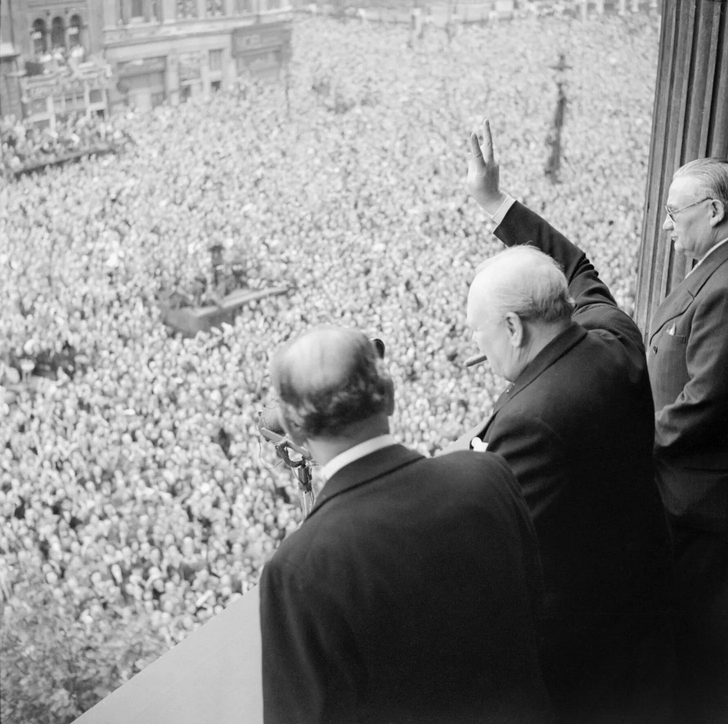
London cheered on May 8, 1945. In Berlin they searched for food and cleared rubble

In a strange irony, there was now a large-scale migration of Jews from Poland to Germany, fleeing fresh persecution despite the horror they had endured. Even here in a camp system under Allied control, there were anti-Semitic attacks from other survivors, so that Jews were eventually separated altogether following the conclusions of the Harrison Report. The Americans, in a likely first in European history, now made Jews an explicitly privileged group, with superior camp conditions.

The Polish Jews set up their own camp in the Munich district of Bogenhausen where locals were confused and disorientated by the new arrivals. These eastern Jews actually looked like the alien caricatures Nazi propaganda had bombarded them with, dressed in oriental clothes from the shtetl, totally unlike the assimilated German Jews they had grown up with. One local complained that “the Jews from the old days were really, how can I put it, very intelligent, polite and unusually friendly and elegant people. And of course the ones who turned up after the war included all sorts.” The Jews “from the old days” were “the good Jews”, he lamented.

Holocaust guilt was in the distant future for most, and newly re-established newspapers weren’t remotely shy about publishing anti-Semitic content. One printed a resident’s complaint about Polish Jews that “these were not people who had been persecuted” but “the sputum, the yeast and the scum of elements who were never deported but, to avoid regular work, came here from the eastern states, in many cases completely illegally, and are now spreading themselves raggedly about the place.”

May 2, 2025

Monkey Rockets, beavers with Parachutes, and the Fall of Empires – 1948 Newscast – W2W 26

Filed under: Europe, History, USA — Tags: , , , , , , , , — Nicholas @ 04:00

TimeGhost History
Published 1 May 2025

In 1948, the Cold War intensifies as Stalin blockades Berlin, triggering a dramatic US-led Airlift to save West Berlin. Meanwhile, the British Empire continues to crumble as Burma, Ceylon, and Palestine gain independence — with Israel’s declaration igniting immediate war. America launches the Marshall Plan, the Soviets tighten their grip in Eastern Europe, and televised anticommunist hearings captivate the US public. The year ends with humanity pushing new frontiers — from launching monkeys into space to relocating beavers by parachute — showing just how rapidly the world is changing.
(more…)

April 24, 2025

Berlin Airlift: From Bombs to Candy – W2W 23 – 1948 Q3

TimeGhost History
Published 23 Apr 2025

In 1948, Stalin blockades West Berlin, isolating over two million people without food, fuel, or supplies. Refusing to surrender the city, Western powers launch the Berlin Airlift, history’s largest aerial supply mission, to deliver food, coal, and even candy. As tensions soar, planes defy Soviet threats around the clock — can the Allies really sustain a city from the sky?
(more…)

April 19, 2025

Downfall: The Battle of Berlin 1945

Filed under: Germany, History, Military, Russia, WW2 — Tags: , , , , , , — Nicholas @ 02:00

Real Time History
Published 6 Dec 2024

April 1945. After nearly six years of war, the Red Army stands massed on the banks of the Oder River in eastern Germany. The Nazi capital and Hitler’s bunker are just 60km away, but the Nazi Party and the Wehrmacht are preparing to fight to the bitter end in the final struggle of WW2 in Europe – the Battle for Berlin.
(more…)

March 27, 2025

Uncovered: The CIA’s Secret War That Shook Stalin! – W2W 16 – 1947 Q3

Filed under: China, Europe, History, Italy, Russia, USA — Tags: , , , , , — Nicholas @ 04:00

TimeGhost History
Published 26 Mar 2025

In 1947, the Cold War intensifies as the Truman and Zhdanov Doctrines divide the world into opposing camps. The CIA is born to counter communist threats, while Stalin’s Cominform tightens its grip across Eastern Europe. From Berlin’s streets crawling with double agents, to covert American election meddling in Italy, espionage becomes the frontline of this global showdown. Welcome to a new age of spies, secret doctrines, and ruthless intelligence wars.
(more…)

February 25, 2025

German election results

Filed under: Germany, Government, Media, Politics — Tags: , , , , , — Nicholas @ 03:00

Germany voted on Sunday (on paper, and the votes all got counted in less than 24 hours) and the most likely result will be a coalition between the centre-right CDU and the social democratic SPD, excluding the second-largest party, the extremely extreme extreme right-wing AfD:

The federal elections in Germany are over, and the preliminary count is in. The CDU/CSU have narrowly avoided the Kenyapocalypse, as the Bündnis Sahra Wagenknecht failed to meet the 5% hurdle for representation in the Bundestag by a mere 13,435 votes. In consequence, the Social Democrats and the Union parties together will command a thin but workable parliamentary majority of 328 seats. In all likelihood, we will have a black-red government under CDU Chancellor Friedrich Merz – a not-so-grand coalition of the kind we grew used to under Angela Merkel.

Here is a district-by-district map of the election results, with each district coloured according to the winning party. Black is CDU/CSU, blue is AfD, red is SPD and green is Green:

My district is the one all the way due south of Munich on the Austrian border. The CSU got 41.9% of the party vote here – one of their best showings in all of Bavaria.

The Losers

The preliminary results of each party compared to the last elections in 2021 reveal last night’s losers clearly enough:

This vote was as poignant a rejection of Olaf Scholz’s parodically bad traffic light coalition as anyone could imagine. Everybody has improved at the expense of red-green-yellow, but it is interesting to observe who has done the worst.

The Greens dominated the traffic light, and voters have dealt them the lightest punishment of all. Imagine how crazy you have to be ever to enter a government with this toxic party: They get their way on all major political issues and you get punished for it. Even so, the Greens did much worse than I thought they would. Almost everybody beyond their hardcore devotees has abandoned them, and Green Chancellor Candidate Robert Habeck (who also lost his direct mandate in Flensburg-Schleswig) has announced he will never again seek a leading role in the party. We have finally rid ourselves of his Majesty the Sun Chancellor, the champion of speech crime charges, and that alone is worth a stiff celebratory scotch.

The FDP lost far harder than the Greens. Last night was their worst showing of all time – worse even than the last time they were chased out of the Bundestag in 2013. Party chief Christian Lindner will resign and withdraw from politics, and he should. The FDP stood idly by and waved through ruinous Green policies like the building heating ordinances, all the time pleading that things would be even worse if the FDP weren’t in government. After the constitutional court in Karlsruhe killed the budgetary schemes of the traffic light, the FDP could have left the coalition, but they subjected all of us to another year of Scholzian incompetence and insanity. If there is any justice in the world the FDP will become a minor West German party that nobody thinks about anymore.

The next biggest loser of the night was the Social Democrats, who likewise booked their worst electoral result in history, and also achieved the worst-ever electoral collapse of a chancellor party in the 80-year history of the Federal Republic. Olaf Scholz has said he will not participate in any future government or coalition negotiations, and party co-chair Lars Klingbeil spoke last night of a “caesura” in the history of the SPD, promising substantial changes in party leadership. The first such change happened almost immediately, with the resignation of SPD faction leader Rolf Mützenich. Klingbeil will replace him. Many expect that Klingbeil’s co-chair, Saskia Esken, will also be forced out before long, although she is clinging to her job for the moment.

Looking from the US, CDR Salamander notes the very high turnout for a federal election with approval:

Sunday, Germany held national elections for the parliament, the Bundestag. Congrats to the German people and their ~83% turnout, the greatest I believe, since unification.

The previous government led by SPD and hobbled the the Greens was unstable at best, and was not doing great things for the German people. That would be why the SPD’s results were the worst since 1887.

    Defense Minister Boris Pistorius has clear words for the performance of his SPD. “This is a devastating, catastrophic result,” he said. “There is no way to sugarcoat it.” He congratulated the Union on its election victory. “I hope that — especially in view of Friedrich Merz’s speech in Munich yesterday — they will now strike the right tone and understand that it is about keeping the democrats together and not playing them off against each other.” An AfD at 20 percent cannot leave the Social Democrats in particular at rest.

Nuff said.

The above numbers were from Sunday night and are not final, but we can safely assume that they are roughly where the final count will be.

You need 316 seats to control, and you need 5% to enter government. That last bit puts FDP and BSW out of the picture. I’ll chat a bit about that at the bottom of the post, but let’s focus on the big boys.

First things first, Germany voted for right-wing governance. CDU/CSU (Union), and AfD got 49.2% of the vote. However, no one will form a government with them, so the Germans will not be getting what they voted for.

[…]

AfD broke into the former West Germany. Both Kaiserslautern and Gelsenkirchen voted for AfD. I also find it interesting that in addition to the West Germany/East Germany divide, the East Berlin/West Berlin divide is still there.

History is sticky.

I lived with Germans for four years, yet I don’t fully grasp German politics. Still, some political constants hold true everywhere.

Again, the Germans voted for a right-wing government. With Union having to partner with SPD, that will pull the center of the government to the left, further away of the center of the electorate … again.

Were I a German, I would want a few things, in this order:

  1. Cheaper energy — lower monthly bills and prices across the board. It will also make German manufacturing more competitive. Yes, the only way to do that is to restart the nuclear power plants. With the Greens gone, no reason not to.
  2. Stop migration. Expel illegal migrants. If someone has vacationed in the nation they claimed to seek asylum from, deport them. Etc.
  3. Be a player in ending the war in Ukraine, if it can be ended. If Russia refuses to be reasonable at the table, then fully back the Ukrainian fight. As this is aligned with the general direction of the USA and other allies, it makes sense.
  4. Redouble spending on national defense. 2% will not do. 2.5% is the floor, and must be reached faster.

All the four above will be more difficult with SPD in government. Remember my long-held position that applies everywhere, not just in Germany:

    When the center-right and center-left refuse to address the legitimate concerns of the people, especially in issues of migration and culture, then the people will look elsewhere for their concerns to be met.

If AfD were brought into government, they would be forced to moderate and to be held accountable for the action of government. With AfD in opposition — with a bone in their teeth — they will most likely, if they do not implode due to their well-known “personnel challenges”, they will increase their popularity with voters.

February 21, 2025

Berlin ’45: City of Spies

Filed under: Britain, France, Germany, History, Russia — Tags: , , , , — Nicholas @ 04:00

World War Two
Published 20 Feb 2025

In 1945, Berlin is a city in ruins — but for the world’s spies, it’s a goldmine. As the Soviets, Americans, British, and French carve up the capital, they scramble to seize Nazi secrets, recruit informants, and outmaneuver each other in an intelligence war that will define the Cold War. From stolen blueprints to fabricated reports, Berlin becomes the world’s first battleground of espionage.
(more…)

Older Posts »

Powered by WordPress