
What gave socialism a shot was that the hypertrophic nationalism of the first half of the twentieth century plunged the world into not just one but two world wars. Without these catastrophes, it is inconceivable that so many devotees of Marx would have come to power in the seventy years after 1917. The world wars made the case for socialism in multiple ways. First, they seemed to confirm the destructive tendencies of “imperialism, the highest form of capitalism”, in Vladimir Lenin’s words. Second, they greatly expanded the role of the state, which became the principal purchaser of goods and services in most combatant countries, creating precisely the kind of state-controlled economy that socialist theory claimed would perform better than free markets. Third, the wars acted as a great leveler, imposing very high marginal rates of taxation, wage controls, and price controls in ways that tended to reduce wealth and income disparities. Fourth, in 1917 the German government financed the Bolshevik coup in Russia that brought Lenin to power.
The tragedy was that those who promised utopia generally delivered hell on earth. According to the estimates in the Black Book of Communism, the “grand total of victims of Communism was between 85 and 100 million” for the twentieth century as a whole. The lowest estimate for the total number of Soviet citizens who lost their lives as a direct result of Stalin’s policies was more than 20 million, a quarter of them in the years after World War II. Mao alone, as Frank Dikötter has shown, accounted for tens of millions: two million between 1949 and 1951, another three million by the end of the 1950s, a staggering 45 million in the man-made famine known as the Great Leap Forward, yet more in the mayhem of the Cultural Revolution. Even the less bloodthirsty regimes of Eastern Europe killed and imprisoned their citizens on a shocking scale. In the Soviet Union, 2.75 million people were in the Gulag at Stalin’s death. The numbers were greatly reduced thereafter, but until the very end of the Soviet system its inhabitants lived in the knowledge that there was nothing but their own guile to protect them from an arbitrary and corrupt state. Other communist regimes around the world, including the very durable dictatorships in North Korea and Cuba, were strikingly similar in the miseries they inflicted on their own citizens.
The various socialist regimes could not even justify their murderous behavior by providing those they spared with higher living standards than their counterparts living under capitalism. On the contrary, they were economically disastrous. The collectivization of agriculture invariably reduced farming productivity. A substantial proportion of the victims of communism lost their lives because of the famines that resulted from collectivization in the Soviet Union and China. North Korea had a similarly disastrous experience. Central planning was a miserable failure for reasons long ago identified by Ludwig von Mises, Friedrich Hayek, and Janos Kornai, amongst others. Indeed, the economic performance of strictly socialist countries got worse over time because of rigidities and perverse incentives institutionalized by planning.
Moreover, the evidence is clear that, as countries moved away from socialist policies of state ownership and toward a greater reliance on market forces, they did better economically. The most striking example — but one of many — is that of China, which achieved a true great leap forward in economic output after beginning to dismantle restrictions on private initiative in 1978. After the collapse of “real existing socialism” in Central and Eastern Europe in 1989 and the dissolution of the Soviet Union in 1991, there was widespread recognition (the “Washington consensus”) that all countries would benefit from reducing state ownership of the economy through privatization and from lowering marginal tax rates. […] the highest marginal personal income tax rate was reduced in nearly all Organisation for Economic Co-operation and Development (OECD) countries between the mid-1970s and mid-2000s.
Niall Ferguson, “Capitalism, Socialism and Nationalism: Lessons from History”, 2020-02.
October 5, 2026
August 26, 2026
The Korean War Week 114 – Stalin’s Secret Plan – August 25, 1952
The Korean War by Indy Neidell
Published 25 Aug 2026Heavy rains prevent action in the field in Korea this week, so the big story worldwide is talks in Moscow between Josef Stalin and Chinese Foreign Minister Zhou Enlai. They talk about Five Year Defense Plans, artillery production, Soviet aid for the Chinese, and exactly how they see the war in Korea and what they think of the American forces.
00:00 Intro
01:09 Bunker Hill
01:51 South Korean Prisoners of War
02:44 Chinese Soviet Talks
05:06 Five Year Defense Plan
07:26 Artillery Production
11:23 Stalin and the USA …
12:52 Eisenhower and the War
16:05 Summary
16:18 Conclusion
18:29 Sign Up
August 24, 2026
“Communism is an ideology designed to liquidate nations”
I nearly skipped this post by Celina, as it started off appearing to be pretty much of interest only to Australians, but that was just the opening sections:
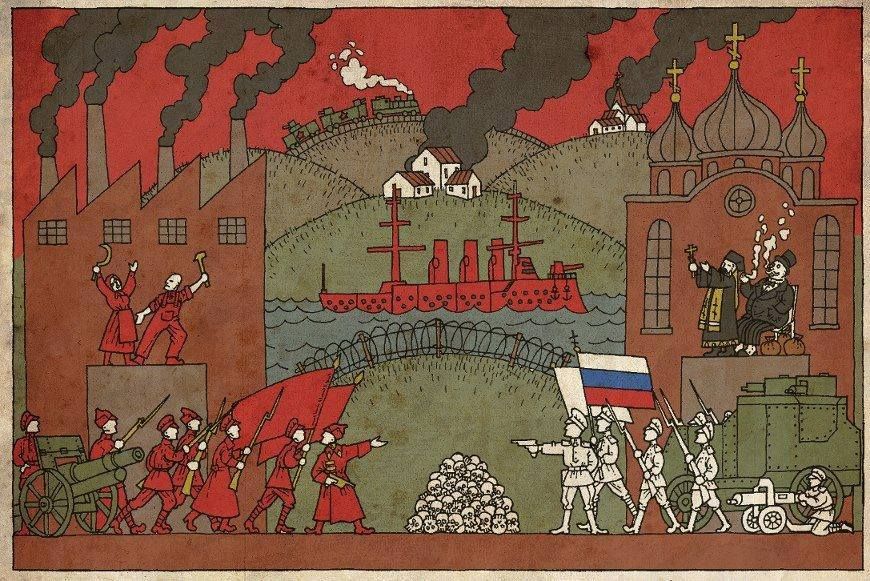
The Bolsheviks were the first governing power of the modern era to write the suppression of “national enmity” into a systematic criminal code. The RSFSR Criminal Code of 1922 penalised agitation and propaganda arousing national enmity or dissension, its successor, the 1926 Code, carried the provision forward as Article 59-7, under the chapter dealing with especially dangerous crimes against the order of administration, punishing “propaganda or agitation directed towards arousing national or religious enmity or discord”, with sharply escalated penalties, up to and including death, where the offence occurred in wartime or amid mass disturbances. From the earliest years of the Soviet state, in other words, speech about nationality was not a civil-society problem to be argued out, but a category of state crime sometimes punishable by death.
To understand why, it is necessary to understand something about communism that conservatives and libertarians have largely obscured. If you ask the average conservative what communism is, he will most likely start discussing government ownership, five-year plans, bread queues etc.
Communism, from this point of view, is essentially capitalism with the economic settings reversed. The government “does and owns everything“. This is why so much conservative analysis eventually degenerates into horseshoe theory: fascists liked government intervention and communists liked government intervention, therefore fascism and communism were basically versions of the same thing.
But that completely misses the ideological conflict which defined twentieth-century Europe. Communism was not just some economic theory about who should own what. It was an internationalist theory about who you are.
Communism is an ideology designed to liquidate nations. Literally.
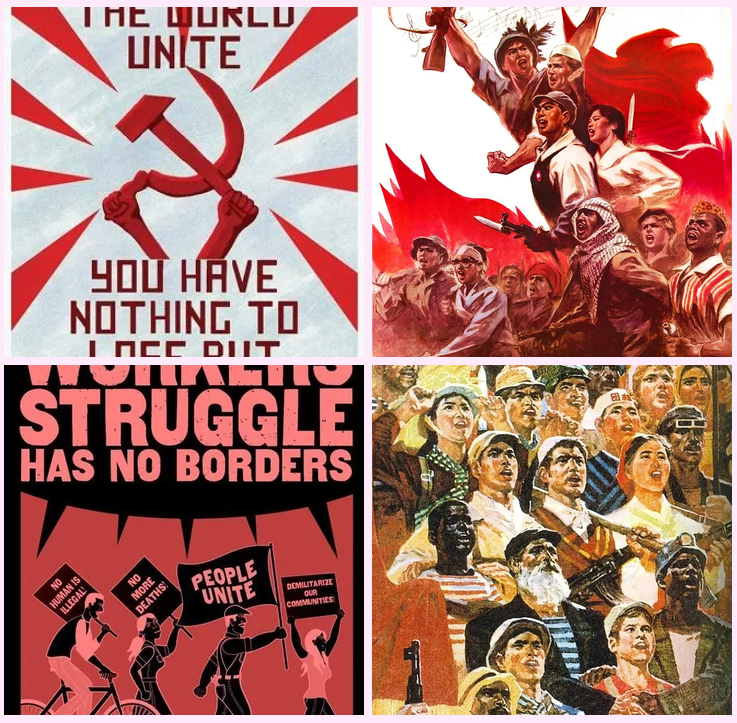
Marxism insisted that the fundamental political division of mankind was class. The worker was not ultimately supposed to understand himself principally as English, German, Italian, French or Russian. He belonged to the proletariat. His historical interests were shared with workers beyond the borders of his own country, while his supposed national solidarity with his own bourgeoisie concealed the class relationship upon which capitalism depended. Hence the language that runs through the entire communist tradition: Workers of the world, unite; The proletariat has no fatherland; No war but class war. You’re not Italian, you’re not German, you’re the proletariat, and all you have to lose is your chains.
The political logic here is blatantly obvious. Nationality competes with class consciousness, patriotism competes with proletarian internationalism. The nation tells a German worker that he shares something profound with another German who happens to own a factory. Marxism tells him that this solidarity is false and his real political brother is the French, Russian or Italian worker standing on the other side of the border.
That is why the nation became one of the great obstacles confronting revolutionary socialism. The theory said workers possessed common international class interests. Yet, history repeatedly demonstrated that workers continued to behave like members of nations.
In 1914, the workers of Europe did not unite against their governments and refuse the coming war. They rallied overwhelmingly to their respective countries. Socialist parties fractured along national lines. Men who Marxists expected to understand themselves as an international proletariat marched into battle as Germans, Frenchmen, Russians, Austrians and Britons. And the same problem returned after the Bolshevik Revolution.
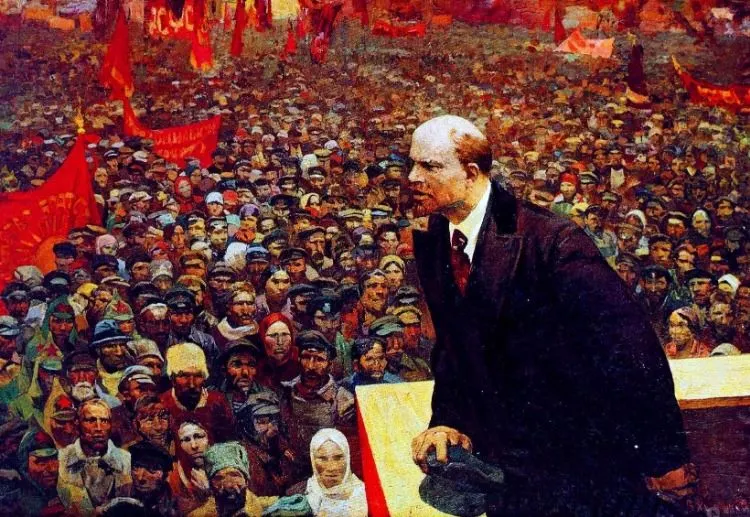
That is why the great twentieth-century conflict between communism and nationalism was not accidental. It was ideological. Communism was internationalist not in the banal sense that communists in different countries cooperated with one another, but in its conception of history itself. The nation was something history would ultimately transcend. Lenin said this openly: socialism aimed not simply to bring nations closer together, but eventually to “merge them“. Elsewhere he described the centralised state as a historical step towards the future “socialist unity of the whole world“.
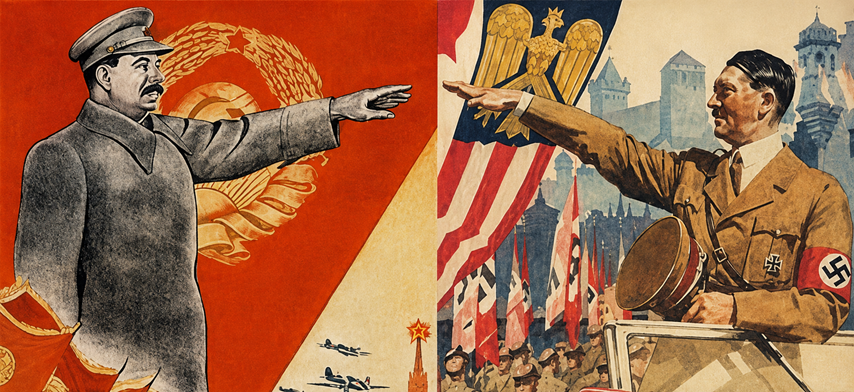
Stalin, grasping this principle, forged civic nationalism as the indispensable stepping-stone toward that communist universalism. Inside the borders of the revolutionary state the old nationalities were to be liquidated into a single Soviet identity: you are not Ukrainian, you are not Russian, you are not Jewish, you are not Georgian, you are a Soviet patriot, loyal only to the revolution. That state, once purged of national loyalties, would then project its universalist ideology outward, seeking global hegemony by liquidating, in turn, every nation that still dared to resist it.
Update, 25 August: Welcome, Instapundit readers! Have a look around at some of my other posts you may find of interest. I send out a daily summary of posts here through my Substack – https://substack.com/@nicholasrusson that you can subscribe to if you’d like to be informed of new posts in the future.
August 20, 2026
QotD: George Bernard Shaw’s role as Stalin’s useful idiot
Shaw toured Ukraine during the height of the Holodomor, when Soviet grain requisitions had stripped peasants of every scrap of food. Conservative estimates put the death toll at 3.5 million Ukrainians. Shaw saw the empty villages, the skeletal survivors, the mass graves. Then he signed a public letter praising Stalin’s “remarkable progress” and told Western journalists that reports of famine were capitalist propaganda.
Why would an intelligent man become Stalin’s useful idiot? Shaw believed in central planning with religious fervor. He thought brilliant intellectuals like himself could design society better than millions of individuals making their own choices. When confronted with central planning’s inevitable result (mass death), he chose to lie rather than admit his ideology killed people. Shaw preferred beautiful theory to ugly facts.
Shaw deliberately used his celebrity status to give Stalin cover while Ukrainian children died of starvation. He returned to Britain and spent years defending Soviet policies, even as refugee testimonies and photographic evidence exposed the genocide. The man who wrote about moral awakening in Pygmalion had abandoned his own moral compass entirely.
Free market economists warned that socialist calculation was impossible, that without prices and property rights, economies would collapse into chaos and death. Shaw dismissed these warnings as bourgeois nonsense while standing ankle-deep in their vindication.
Handre, The social media site formerly known as Twitter, 2026-05-13.
Update, 21 August: Welcome, Instapundit readers! Have a look around at some of my other posts you may find of interest. I send out a daily summary of posts here through my Substack – https://substack.com/@nicholasrusson that you can subscribe to if you’d like to be informed of new posts in the future.
May 3, 2026
QotD: Communism, nationalism and literature
According to Orwell, “As early as 1934 or 1935 it was considered eccentric in literary circles not to be more or less ‘left’, and in another year or two there had grown up a left-wing orthodoxy that made a certain set of opinions absolutely de rigueur on certain subjects”. In other words, many writers became communists, which meant they constantly had to decide whether to toe the line or shut up, depending on the circumstances: “Every time Stalin swaps partners”, Orwell wrote, “‘Marxism’ has to be hammered into a new shape … Every Communist is in fact liable at any moment to have to alter his most fundamental convictions, or leave the party. The unquestionable dogma of Monday may become the damnable heresy of Tuesday, and so on.”
Orwell also explained how communism replaced the patriotic and religious feelings that members of the English intelligentsia believed they had transcended: “All the loyalties and superstitions that the intellect had seemingly banished could come rushing back under the thinnest of disguises. Patriotism, religion, empire, military glory — all in one word, Russia. Father, king, leader, hero, savior — all in one word, Stalin”. Is it any wonder that Orwell, witnessing these endless intellectual and moral contortions, the shameless propaganda, and the constant stream of wartime lies and distortions, was drawn to a writer who didn’t regurgitate any orthodoxies or toe any lines? Miller gave his readers “no sermons, merely the subjective truth”.
Matt Johnson, “George Orwell, Henry Miller, and the ‘Dirty-Handkerchief Side of Life'”, Quillette, 2020-10-05.
April 3, 2026
QotD: The Great Purge
Stalin ordered Nikolai Yezhov, who later was head of the NKVD during the purges, to interrogate the two as part of a larger conspiracy involving Trotsky loyalists. Yezhov appealed to their devotion to the Soviet Union. They were, of course, subjected to physical and psychological pressure. Yezhov told Kamenev he had evidence against his son, which could result in his execution. Inevitably, they agreed to participate in what would be the first of many show trials against Stalin’s enemies.
The bargain Zinoviev and Kamenev struck with the Politburo was that they would testify against their comrades in exchange for their lives and their family’s lives. Stalin himself agreed to the deal in person, on behalf of the Politburo. They were tried with fourteen other defendants in the House of the Unions, which still stands today. All sixteen were found guilty of plotting to kill Stalin and other Soviet officials. They were promptly executed in the basement of Lubyanka Prison.
This would be the pattern throughout the Great Purge. Political enemies would be turned against one another through a combination of terror, torture and the promise of forgiveness if they cooperated. The real purpose of forcing friends to denounce friends and family members to denounce other family members was to create an atmosphere in which no one could trust anyone. As Montesquieu noted, the motor that powers every despotic regime is a general fear of the ruler.
The Z Man, “What Comes Next”, The Z Blog, 2020-08-03.
September 30, 2025
How Tyrants Rise — and How to Stop Them – W2W 46
TimeGhost History
Published 28 Sept 2025Tyrants don’t just appear overnight — they rise through propaganda, fear, and control. In this episode of War 2 War, we explore how authoritarian leaders consolidated power in the 20th century, from the ruins of World War Two to the opening battles of the Cold War. How do tyrants gain control, how can you recognize the warning signs, and what can societies do to resist them? Drawing on lessons from Hitler, Stalin, and beyond, we break down the patterns of dictatorship and what history can teach us about confronting them.
(more…)
August 24, 2025
Much of our prosperity is based on trust, and we’re rapidly losing it
Ted Gioia foresees a precipitous fall in trust coming at us very soon, and I’m afraid he might be being too optimistic:
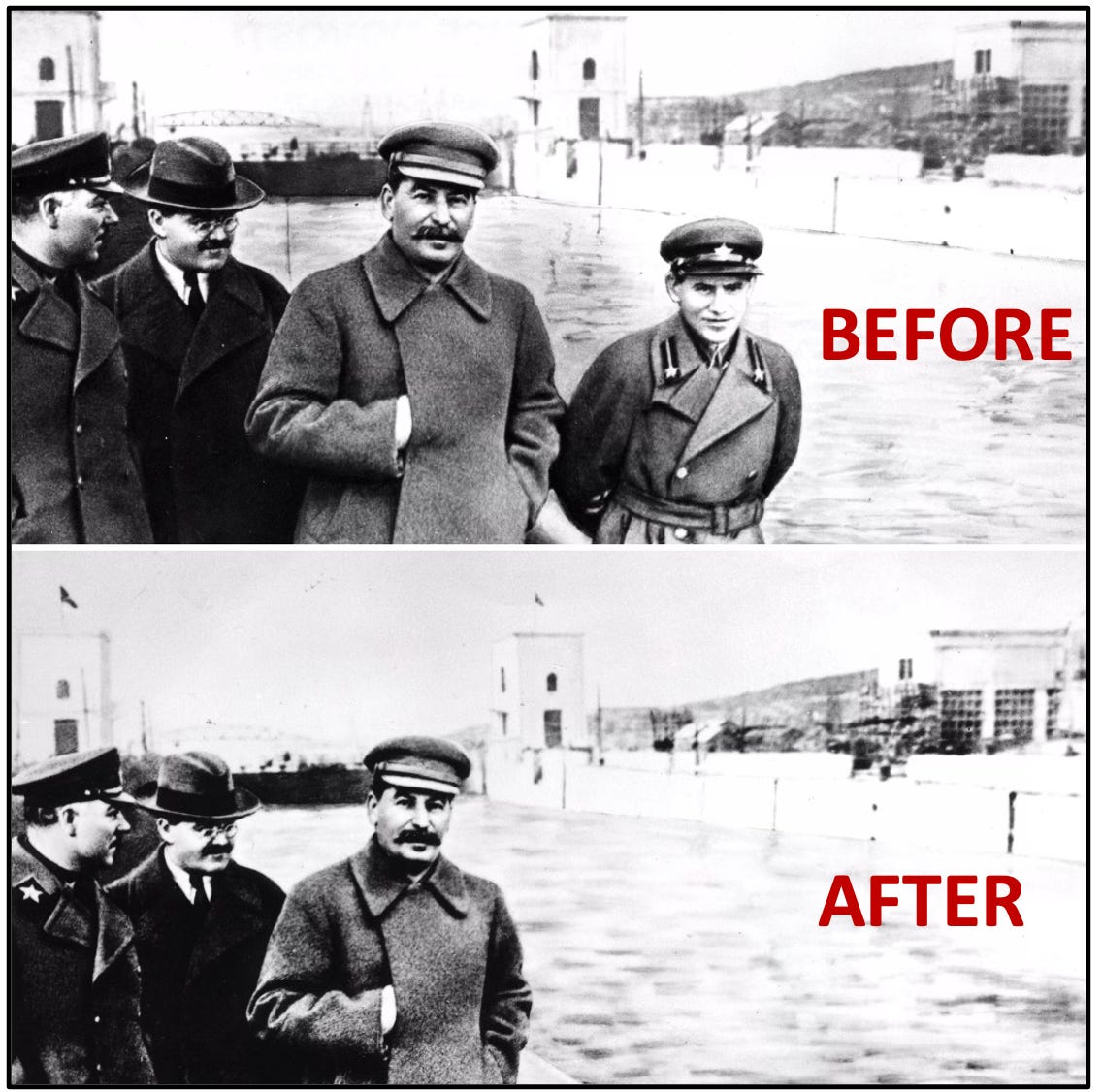
During the great purges of the 1930s, Stalin ordered the execution of a million people, including some of his closest associates. But it wasn’t enough to kill these victims — they also had to disappear from photographs.
In a famous case, Nikolai Yezhov got removed from his position next to Stalin in a photo taken by the Moscow Canal. This erasure alarmed many party elites because Yezhov, head of the secret police, had been one of the most feared men in the Soviet Union.
And now he got totally deleted.
Well, not totally. In those days of print media, original photos survived, and a paper trail made it difficult to erase history.
So this photo was later used to mock Stalin, and the pretensions of dictators. They can try to change reality, but that’s not possible.
Or is it? Maybe dictators now get the last laugh. Because in the last few months, reality has been defeated — totally, completely, unquestionably.
It is now possible to alter reality and every kind of historical record — and perhaps irrevocably. The technology for creating fake audio, video, and text has improved enormously in just the last few months. We will soon reach — or may have already reached — a tipping point where it’s impossible to tell the difference between truth and deception.
- Can I tell the difference between a fake AI video and a real video? A few months ago, I would have said yes. But now I’m not so sure.
- Can I tell the difference between fake AI music and human music? I still think I can discern a difference in complex genres, but this is a lot harder than it was just a few months ago.
- Can I tell the difference between a fake AI book and a real book by a human author? I’m fairly confident I can do this for a book on a subject I know well, but if I’m operating outside my core expertise, I might fail.
At the current rate of technological advance, all reliable ways of validating truth will soon be gone. My best guess is that we have another 12 months to enjoy some degree of confidence in our shared sense of reality.
But what happens when it’s gone?
Back in 2023, I asserted that trust is the most scarce thing in society. But that was before all these tech deceptions came online. Trust will soon get even more scarce — or perhaps disappear completely from the public sphere.
This is not a small matter.
Most discussions of this issue focus on the technology. I believe that’s a mistake. The real turmoil will take place in social cohesion and individual psychology. They will both fracture in a world where our shared benchmarks of truth and actuality disappear.
We will be — already are — in desperate need of Robert Heinlein’s Fair Witnesses:
A Fair Witness is an individual trained to observe events and report exactly what is seen and heard, making no extrapolations or assumptions. While wearing the Fair Witness uniform of a white robe, they are presumed to be observing and opining in their professional capacity. Works that refer to the Fair Witness emphasize the profession’s impartiality, integrity, objectivity, and reliability.
An example from the book [Stranger in a Strange Land] illustrates the role of Fair Witness when Anne is asked what color a house is. She answers, “It’s white on this side.” The character Jubal then explains, “You see? It doesn’t occur to Anne to infer that the other side is white, too. All the King’s horses couldn’t force her to commit herself … unless she went there and looked – and even then she wouldn’t assume that it stayed white after she left.”
August 17, 2025
August 11, 2025
Stalin’s Death: The Day the USSR Changed Forever! – W2W 39
TimeGhost History
Published 10 Aug 2025March 1953: Stalin’s sudden death triggers a whirlwind of conspiracies, paranoia, and a deadly battle for control inside the Kremlin. As Beria, Khrushchev, and the Soviet elite scramble for power, the fate of the world’s largest superpower hangs in the balance. Was Stalin murdered by his inner circle, or did his own regime consume him? Discover the truth behind the downfall, the rise of Khrushchev, and the birth of the KGB in the Cold War’s most dramatic turning point.
(more…)
August 1, 2025
When Stalin and Hitler Teamed Up – Prussia 1931 – Rise of Hitler 20, August 1931
World War Two
Published 31 Jul 2025August 1931: Prussia becomes the battleground as a bizarre alliance of Nazis, Communists (under Stalin’s orders), right-wing elites, and President Hindenburg tries to topple Germany’s last major democracy. With foreign meddling, political violence, and backroom deals, the fate of the Weimar Republic hangs by a thread. Against all odds, the democratic coalition prevails — at least for now. But with chaos spreading and the world watching, can democracy survive the next assault?
(more…)
June 16, 2025
The Machine of Terror: How the Soviet Secret Police Ruled – W2W 32
TimeGhost History
Published 15 Jun 2025From Tsarist Russia to Stalin and the Cold War, the Soviet secret police evolved through endless name changes — but their mission never wavered: repress, control, and terrify. Discover how these agencies — from the Okhrana to the Cheka, GPU, OGPU, NKVD, and eventually the KGB, shaped Soviet life with ruthless efficiency. Torture, purges, and mass surveillance weren’t just tactics; they were the system.
(more…)
June 10, 2025
How Moscow Got the Atomic Bomb – W2W 31
TimeGhost History
Published 8 Jun 2025In 1949, the Soviet Union detonates its first atomic bomb — years ahead of Western expectations. This episode dives into how the USSR mobilized former Nazi scientists, forced Soviet physicists into secret cities, and relied on intelligence from spies like Klaus Fuchs. While Stalin pushes for rapid progress, Beria enforces brutal discipline, and Soviet scientists race to meet an impossible deadline. The nuclear balance of power is about to shift — forever.
(more…)
April 28, 2025
Stalin and Tito fight over the Balkans: Greek Civil War part 2 – W2W 24 – 1948 Q4
TimeGhost History
Published 27 Apr 20251948 plunges Greece deeper into civil war as foreign aid fuels brutality on both sides. The Nationalist government launches ruthless crackdowns, establishing notorious prison camps, while the Communist Democratic Army desperately seeks aid from Yugoslavia and Stalin’s Soviet Union. But when Stalin rejects the rebellion, Yugoslavia’s Tito steps in — until a stunning feud erupts, leaving Greek communists stranded. Will this power struggle decide Greece’s fate?
(more…)
March 23, 2025
Rigged Votes and Terror: Stalin’s Takeover Tactics! – W2W 014 – 1947 Q2
TimeGhost History
Published 21 Mar 2025By 1947, Stalin’s Soviet Union has begun to firmly grip Eastern Europe, reshaping nations through rigged elections, terror tactics, and propaganda. From Poland to Bulgaria, countries are forced into Moscow’s orbit, crushing opposition and extinguishing democratic freedoms. As Truman declares a doctrine to contain communism, the stage is set for decades of Cold War confrontation.
(more…)


