World War Two
Published 19 Sep 2026The Panzerkampfwagen IV began life as a short-barreled infantry-support tank. By the middle of World War II, it had become Germany’s principal medium gun tank, carrying thicker armor and a long-barreled 7.5 cm gun capable of confronting the Soviet T-34 and KV-1.
It was the only German tank to remain in continuous production throughout the war. From Poland and France to North Africa, Kursk, Operation Bagration, and the ruins of Berlin, the Panzer IV survived through constant adaptation. Its weight grew from roughly 17.5 to 25 metric tons, while its role changed from specialized support vehicle to the dependable workhorse of the Panzerwaffe.
But every upgrade imposed a cost. Greater weight strained a chassis already approaching its practical limits, while increasingly powerful Allied tanks and anti-tank weapons steadily overtook its protection. Even after the Panther entered service, production problems and mechanical failures ensured that Germany could never dispense with the older Panzer IV.
In this episode of our Nazi Rearmament series, we trace the Panzer IV from its secret origins under the restrictions of the Treaty of Versailles through its wartime evolution and postwar service with the Syrian Army. It is the story of a remarkably adaptable weapons system, the industrial limitations of Nazi Germany, and the murderous war of aggression that this tank was built to serve.
Check out our episode about Panzer III: • The Backbone of the Nazi Panzer War – Panz…
September 20, 2026
September 13, 2026
August 22, 2026
January 4, 2026
September 14, 2025
August 24, 2025
August 17, 2025
August 10, 2025
June 29, 2025
January 21, 2025
October 2, 2024
QotD: Alternative history Operation Barbarossa
Trying to predict specific events is of course a mug’s game, but the trend lines are easy to spot. The danger is the nearly irresistible temptation to retcon psychological events into political decisions.
Knowing full well how dumb it is to bring up World War II on the Internet, consider that a pretty reasonable case can be constructed for Operation Barbarossa. Having purged all their competent, experienced officers, the Red Army had just gotten their clocks cleaned by the Finns in the Winter War. Yeah, the Soviets “won” in the end, but with that disparity of forces, there’s pretty much no possible “win” that doesn’t look like a loss … and the Soviets, to put it mildly, were nowhere near that best-case scenario. Moreover, even if you took the show trials for exactly that — kangaroo courts — their very existence showed there was a deep rift at the very top of the Soviet leadership. Anyone, not just Hitler, could be forgiven for thinking that the Soviet Union would collapse under one big sledgehammer blow.1
It works the other way, too. If we accept the “Suvorov Thesis”, that Hitler only attacked Stalin because Stalin was gearing up to attack Hitler, then we can easily construct a similar case from The Boss’s perspective: The Wehrmacht can’t play defense. The one time they came up against anything approaching a real opponent with technological parity (the Battle of Britain), it was at best a bloody draw, more than likely a stinging defeat. And the Hitler regime was reeling, internally. No show trials for der Führer, but Rudolf Hess, who was at least the number three man in the Reich and at the time Hitler’s heir apparent, had just defected to the British. Anyone, not just Stalin, could be forgiven for thinking that the Third Reich would collapse under one big sledgehammer blow.
See what I mean? Both of those cases are quite plausible, and fit with most known historical facts … and yet, they’re retcons. “Rationalizations” might even be a better word, because the thing is, even though those arguments are “logical”, and might indeed have been convincing to important people at the time, that’s not why Hitler did what he did, or why Stalin would’ve done what he would’ve done under the Suvorov Thesis. No, the truth is simpler, and much more horrifying: They would’ve done it anyway, because that’s who they were.
That’s what the Castle Wolfenstein people got right about the Nazis. Same deal with that Amazon show (which was interesting for a season) The Man in the High Castle. In the real world, there’s no possible way the Nazis could’ve invaded the USA, no matter how it turned out on the Eastern Front …
… but in the real world they would’ve tried nonetheless, somehow, because that’s just who they were. Everything Stalin, Khrushchev, et al did during the Cold War here in the real world, Hitler, Heydrich, and the gang would’ve done in the Castle Wolfenstein world where the Battles of Stalingrad and Kursk went the other way.2 They couldn’t have done any different, without being different people, and while it’s fun to speculate on questions like “who would’ve been the Nazi Gorbachev, who self-destructed the Reich by attempting however you say ‘perestroika‘ in German”, it’s not really germane.
Severian, “The Man in the High Chair”, Rotten Chestnuts, 2021-07-05.
1. And Soviet losses were stupendous, utterly mind-boggling, in the first few months of Barbarossa. Tanks and planes destroyed in their tens of thousands, prisoners captured in millions. Even as it became clear that OKW had underestimated Red Army strength by orders of magnitude, it was still almost inconceivable that they had anything left to fight with. Just one more push …
2. This is actually the world of a fun novel, Robert Harris’s Fatherland.
August 15, 2024
Yet another revisionist history of World War II
In the latest anonymous review at Astral Codex Ten, the book to be considered is How the War Was Won by Phillips Payson O’Brien:
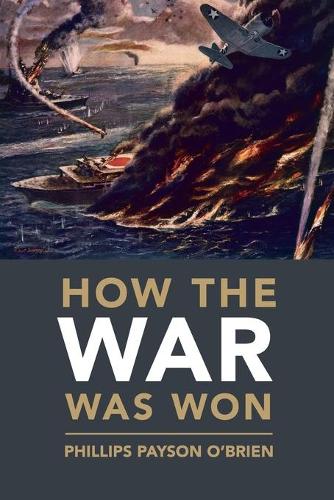
To a first approximation, there are a million books about World War II. Why should you care about How the War Was Won (hereinafter “HtWWW”) by Phillips Payson O’Brien?
- It provides a new, transformative view of the conflict by focusing on production of key goods and what affected that production instead of the ups and downs of battles at the front.
- That particular lens used can (and should) be applied outside of just World War II, and you can get a feel for how that might be done by reading HtWWW.
- I have lectured about World War II and read many, many books about it. I have never texted friends more excerpts of a book than this one.
I have some criticisms of HtWWW, but if the criticisms dissuade you from reading the book, I will have failed. These complaints are like tut-tutting Einstein’s penmanship.
The Wikipedia-Level Story of World War II (and O’Brien’s Counterargument)
To understand why O’Brien’s argument is so novel, you need to know the modern-day conventional understanding of the story of World War II. Here is my summary of the conventional narrative of World War II:
- Germany conquered Poland and France. It tried to bomb the UK into submission/maybe enable an invasion. That effort failed when Germany was defeated in the Battle of Britain, thanks largely to the plucky efforts of British airmen (memorably summarized by Winston Churchill: “Never in the field of human conflict was so much owed by so many to so few”.)
- Stymied in the West, Germany invaded the Soviet Union, won a bunch of crushing victories, but then got turned back at the gates of Moscow. The Soviets moved all of their factories east of the Ural Mountains and produced a vast tide of T-34 tanks that overpowered the Germans.
- The Germans suffered a catastrophic defeat at Stalingrad and a bloody strategic defeat at Kursk, after which the Soviets relentlessly pounded Germany to defeat.
- The US and the UK sent a lot of material help and eventually fought the Germans too, most notably in the D-Day invasion and the Battle of the Bulge. However, most of the fighting was done by the Soviets.
- It is very difficult to say how important the aerial bombing campaigns of the Western Allies were in defeating Germany. The Germans moved much of their production underground, insulating them from truly disastrous effects.
- The U.S. mostly fought alone against Japan, which won a series of impressive early victories (e.g., Pearl Harbor, the conquest of Singapore) until the decisive Battle of Midway, after which the vastly larger US industrial base outproduced Japan into oblivion.
- The US bombed the Japanese into submission by destroying Japanese cities, ultimately by dropping atom bombs on Hiroshima and Nagasaki.
By examining where the Axis focused their productive capacities and how the Allies disrupted those capacities, O’Brien challenges virtually every part of that narrative:
- The Battle of Britain was not a close-run thing. The fact that British fighter planes were flying over their own territory meant their attrition rate of pilots and aircraft were far lower than the Germans’.
- American and British bombing mattered far more to the war’s outcome than the battles of the Eastern Front, which consumed a much smaller portion of German expenditures.
- American and British airpower made German battlefield victories on the Western Front virtually impossible and dramatically limited the force Germany could bring to bear in the East.
- Japan (really, Japan plus the giant empire it conquered at the beginning of the war) was an industrial behemoth to rival the Soviet Union. However, the destruction of the Japanese merchant fleet by American air and sea forces wrecked Japan’s economy.
- The firebombing of Japanese cities and the atomic bombings of Hiroshima and Nagasaki had an ambiguous strategic effect. American air power played a much more important role in severing Japan from the natural resources it had conquered in the early part of the war.
June 23, 2023
From Operation Barbarossa in 1941 to the disinformation and cover-up over the origins of the Wuhan Coronavirus
Chris Bray outlines the utterly amazing situation between the Soviet Union and Nazi Germany on the eve of Hitler launching Operation Barbarossa — where Stalin refused to believe that Hitler would attack Russia despite overwhelming evidence from many sources — to the parallel situation over Covid:
Several sources quite specifically reported to the Soviet government that the Germans would invade around dawn on June 22. Their reports can be found in the Soviet archives in a “folder of dubious and misleading reports”. Then, shortly before dawn on June 22, Germany invaded the Soviet Union. Military leaders on the border called in reports of the invasion, and the people they talked to in Moscow declined to believe them. Soviet border troops held their fire, seeing Germans while being ordered to understand that no true invasion could possibly be underway. Stalin knew better, and contradicting Josef Stalin was known to be a fatal mistake. Achieving an entirely avoidable surprise, the Germans destroyed much of the Soviet air force on the ground, parked wingtip-to-wingtip for the convenience of the invader’s bombers.
[…]
An invasion that could have been met with brutal severity from the first moment instead achieved considerable initial success against a supine nation because the Soviet leader, and the chain of subordinates beneath him who were forced to adopt his conception of facts and truth, assumed that things they didn’t wish to believe constituted disinformation. Millions of lives were wasted for that illusion. A society that categorizes inconvenient truths in this way is committing a form of suicide, hiding from hard facts that demand acknowledgment.
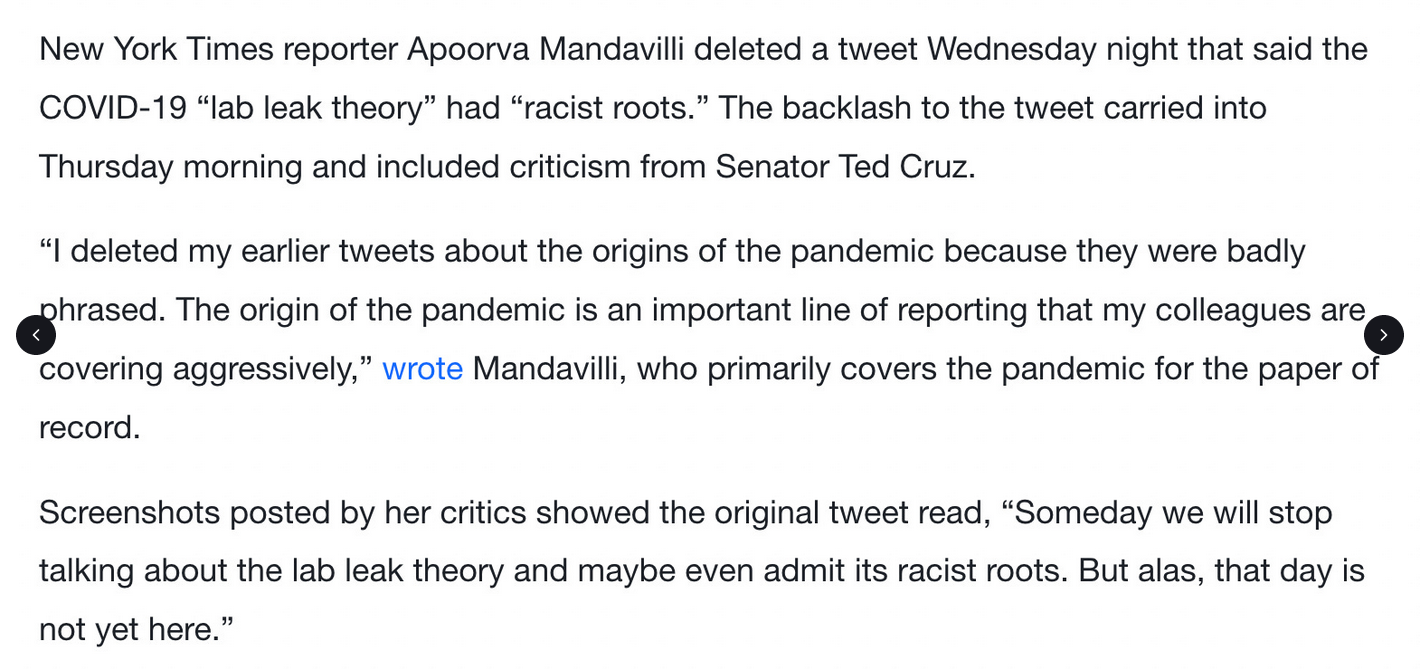
Now: In 2021, the lab leak theory was a disgusting lie with “racist roots”.
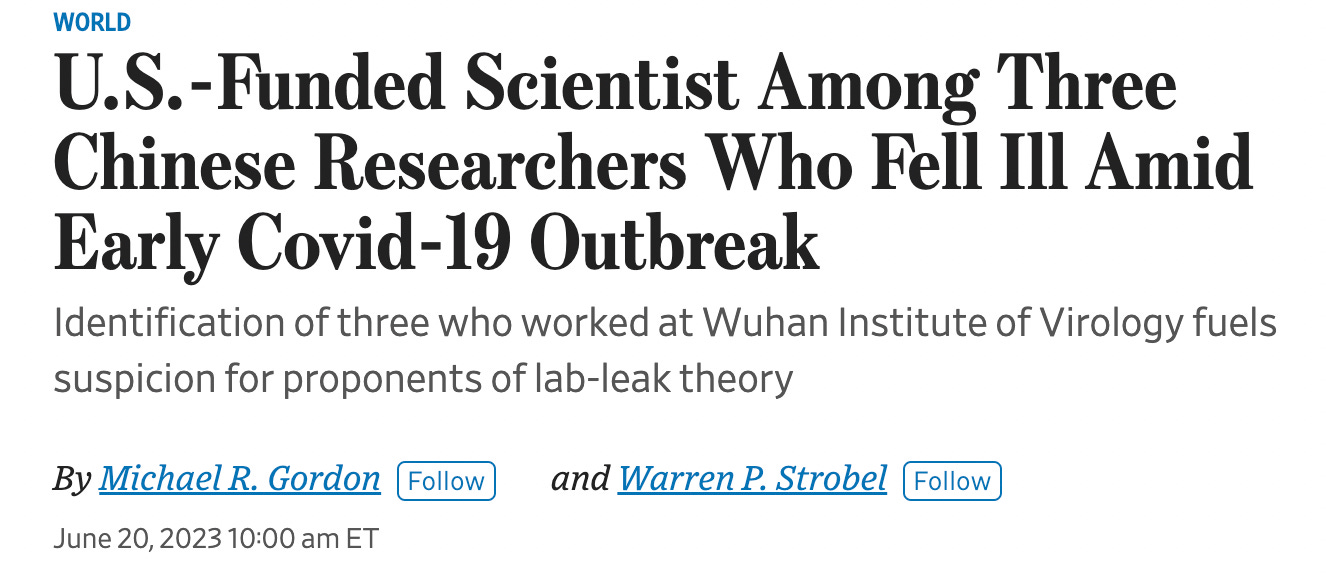
In June of 2023, the, uh, first people who got sick with Covid turn out to have been, uh, scientists at the lab in Wuhan. BUT THEY PROBABLY HAD SOME BAT SOUP AT THE WET MARKET, IS WHY, or something.
Stupid conspiracy theorists, you people are such MORONS, do you actually bel— okay, that one’s true too.
We’ve somehow developed an industry of professional information barriers, dimwitted parasitical human garbage whose sole function in life is to prevent understanding by pasting “disinformation” stickers on things that you’re not supposed to know.