Quotulatiousness

June 30, 2026

A World Cup “first” – no new stadiums built just for WC matches

Filed under: Cancon, Soccer, USA — Tags: , , , , — Nicholas @ 03:00

The 2026 World Cup broke new ground in several different ways, not least of which was that none of the venues for matches were built just for the tournament:

The 2026 World Cup is one for the books, a tournament of firsts. The first to be hosted by three different countries—United States, Mexico, and Canada. The first to feature 48 teams. The first time a single country, Mexico, has hosted the World Cup three times. The first time one stadium, the Azteca, opens a World Cup for the third time. The first time the final will stage a halftime show. And the first time since USA 1994 that no stadiums were built exclusively for the occasion. And while many stories are worth covering with the World Cup, let’s talk about stadiums.

World Cups, like many major competitions, face backlash for their heavy government funding, because once the fans leave, the citizens are stuck footing the bill. For most of these international tournaments, the model is first to build stadiums for the sole purpose of hosting, and then to figure out what to do with them afterward—that’s where most of the funding goes. South Africa built Cape Town Stadium from scratch in 2010, and it barely survives today as a rugby and concert venue, rebranded DHL Stadium. Brazil, the 2014 host, spent more than $3 billion on 12 stadiums, with its priciest venue, the Mané Garrincha in Brasília, a city with no major club, ending up as a parking lot for buses. While 2026 seems to have broken the pattern, at least for now, 2030 and 2034 already have preparations underway and are, in fact, building stadiums. But this time, not one venue was built for the occasion. Every stadium already existed: NFL stadiums in the United States, soccer grounds in Mexico, multi-use venues in Canada. It almost seems like the responsible version.

Almost, because even when you don’t build a stadium, hosting still sends a bill. Take Monterrey, where the stadium is privately owned and was renovated by FEMSA. Public money went elsewhere. Governor Samuel García’s administration poured billions of pesos into the city’s metro — 25 billion pesos — for three new lines to carry fans from the airport to the stadium, but it won’t be finished until 2027, a year after the fans have gone home. And in the weeks before kickoff, the government raised walls along the avenues tourists would travel, in order to hide the poor neighborhoods. Regios called them the walls of shame. It is the whole logic of the tournament in miniature: cover what you would rather the world not see. This isn’t new; hiding the poor before the international crowds arrive is an old Olympic habit.

Most of the stadiums today carry a corporate name, and because of that, most assume that the money behind them was private, too, but it wasn’t. Most US venues for the World Cup are publicly owned, all three Mexican stadiums are private, and both Canadian venues are public. Of the 30 stadiums that normally host NFL teams, only three were built entirely with private money. The rest took public subsidies, even as the name on the façade says otherwise. This wasn’t always the model.

Through much of the last century, private money built and ran arenas, and public funding for them was almost unthinkable. The shift is fairly recent. As historian Frank Andre Guridy tells it in his book The Stadium, grounds that once carried the names of places and local stories became corporate billboards. This modern wave is usually traced to 1985, when Sacramento developer Gregg Lukenbill sold the naming rights to the Kings’ new home to the Atlantic Richfield Company, and ARCO Arena was born. Naming rights themselves go back further, to Rich Stadium in Buffalo in 1973, but it was only after ARCO that the practice became the rule. Today, nearly every arena in the country answers to a sponsor.

June 15, 2026

European World Cup tourists in the US

Filed under: Europe, Media, Soccer, USA — Tags: , , — Nicholas @ 03:00

On the social media site formerly known as Twitter, Larry Correia notes that Europeans’ reactions to visiting the United States changes once they get out of the big cities:

The posts from World Cup Europeans seeing actual America has been great. The shock and awe is hilarious.

I think it’s because their perspective has been based on TV shows (overwhelmingly set in LA or NYC, which get everything wrong about the rest of the nation because the writers are usually provincial liberal dorks who despise the rest of the country) and when they do come here as tourists it is to the same handful of tourist places. Which are always artificial, weird, and crowded.

It turns out that when you get away from our big stupid blue cities, and all the societal decay that comes from liberals not being able to govern worth a shit, America is actually really awesome.

I’ve been to 45 US states. I’ve enjoyed all of them. Even the blue ones, once I’m away from the parts that are entirely paved where lawless crazy people are allowed to shit in the streets and threaten everyone. It’s just a collapse of leadership, and democrats being inept, not giving a fuck as long as they’re still getting paid, or actively rooting for society’s destruction because they’re deluded morons who think they’re going to build a socialist utopia from the ashes.

America has managed to isolate that retarded shit tier philosophy mostly to our big blue city liberal enclaves, where lawless dumb shit can rule, while the rest of us live relatively normal lives, and our politics are primarily based on keeping those assholes away from our stuff as much as possible.

But the cool Europeans have been trapped on a continent where that philosophy rules EVERYWHERE. They’ve got nowhere to escape from their mediocre control freaks. Their shocking discovery that normal sane people can still just do things, and make things, and build, and have fun, and be safe, and raise their kids, is what’s making this whole thing fun.

I don’t follow soccer, futbol, whatever. But I am cheering on some Europeans right now. 😀

Update: Fixed broken link.

June 12, 2026

The mystical powers of climate change, is there anything it can’t do?

Filed under: Environment, Media, Soccer — Tags: , , , — Nicholas @ 04:00

In Canada, all problems are now blamed on US President Donald Trump. It’s a fantastic get-out-of-trouble move for politicans like Prime Minister Mark Carney, Ontario Premier Doug Ford, and even mayors of towns and cities across the Demented Dominion. But even the malign powers of the Bad Orange Man seem puny in comparison to the amazing powers of — gasp! — CLIMATE CHANGE:

Every now and then I suspect there is a game played by bored elites to see which of them can get away with the most asinine “climate change” claim. There have been some doozies: lack of UFOs, “climate change” anxiety, increased sugar consumption, engineering short people. On and on and on ad infinitum.

Today we meet what could be the winner in the contest. Experts are claiming World Cup matches could be slower. Now instead of ninety-plus minutes running around ending in zero-zero ties and dramatic shootouts, we’ll get ninety-plus minutes of somewhat slower running around ending in zero-zero ties and dramatic shootouts. Because “climate change”.

Seems to me, though, that if we really wanted to save time, we could have all matches begin at the shootouts. The whole tournament could be over in a day. Take that, “climate change”!

Here’s the claim, appropriately announced on a PR site, a site whose specialty is juicing dull and dubious headlines: “Climate Central finds climate change has increased the likelihood of heat that could slow players for 97 of the 104 matches, threatening game speed and fan safety.”

What will happen to the other 7 matches they don’t say. Probably they will end in shootouts.

Details:

    Previous research shows temperatures above 82.4°F can reduce sprint frequency, total distance covered, and recovery time, impacting not only player performance and safety, but also match tempo, tactics, and overall style of play.

Previous researchers discovered — and stay with me, here — that when it’s hot outside people outside in the heat act like people act when it’s hot out.

Where would we be without previous researchers?

[…]

As you have surmised, we don’t have to believe any of this: the scenarios are all silly, proving that the stunning new research is purely performative, a way to signal the vices and predilections of the researchers. As proof, we oblige the PR site which asks us to quote this:

    As global temperatures continue to rise, driven by the burning of fossil fuels, the 2026 World Cup could become another example of how climate change can disrupt sports and traditions people cherish, forcing a reevaluation of how the game is played.

This is all ridiculous, and only saved by the charge of falsity by adding that “could.” Meaning might, which also means might not.

They also provide this quote they ask us to re-quote:

    Alex Jacobs, professional player formerly with the Jamaican Premier League:
    Heat is not new. But extreme heat — made more likely by heat-trapping pollution driving climate change — might just be a difference maker in this summer’s edition of the biggest sporting event on the planet.

Way these quotes work is that either the PR firm, or the organization employing the PR firm, write them for victims, who are sought out and asked to sign on. The people allowing their names to be used are, of course, fully responsible for the words used, and even often believe them. But there’s no mistaking that stilted prose of the manufactured quote. Nobody talks like this. This prose is not conclusive, but whenever you see it, it’s a darn good reason to dismiss the claims made.

Of course, using a highly visible public event to advance the climate change agenda is nothing new, they’ve literally been doing it for decades now. Media outlets have always had a bias toward the most dramatic outcome, if only for marketing purposes — “if it bleeds, it leads” — but even the more skeptical outlets have drifted in the climate hysteria direction over time:

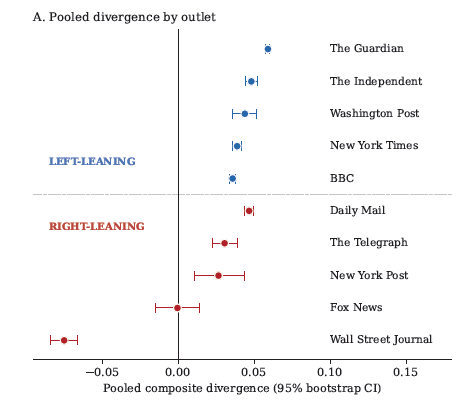
We have complained many times that the public is presented with a picture of climate science systematically biased towards alarmism. And it’s not just our anecdotal impression. We have data, in the form of a new study from the US National Bureau of Economic Research saying the government delegates who write the IPCC Summary for Policy Makers (SPM) overstate the science in the underlying report, and then the media further overstates what’s in the SPM. The study authors used multiple AI systems to extract key scientific statements in every IPCC Assessment Report since 1990, track how they were summarized and what the accompanying media coverage said. Using a statistical model they measured the way the statements get changed or twisted at each stage. There were some surprising results and some unsurprising. Unsurprisingly the data showed the UK Guardian has by far the most climate coverage of all major media outlets and is also the most biased. Another unsurprising result is that the overall media bias regarding the severity of climate change has been consistent over time. A surprising result (to many, but not to us) is that the only major media outlet exhibiting precisely zero bias was Fox News. Otherwise most right-leaning outlets adopted the left-leaning outlets’ alarmist bias as of 2007, again unsurprising to us. And there’s much more.

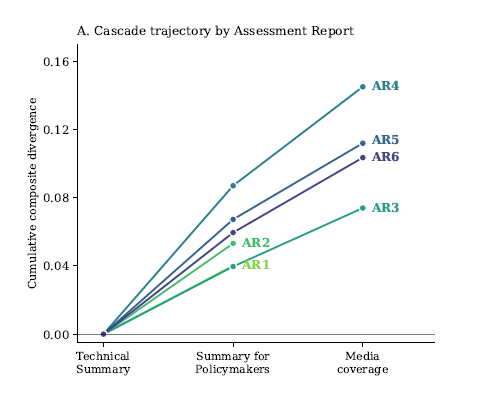
The authors identified three forms of bias: severity, in which a summary picks the upper end of a range of claims, uncertainty, in which a summary downplays caveats and qualifiers, and scenario in which worst-case scenarios get foregrounded. They used a numerical scale from -2 to +2 that captured bias in either direction: a positive number indicated that the summary was biased towards alarmism and a negative number indicated a bias in the opposite direction. Then they averaged the bias measures together and measured them at two stages in the game of telephone. The “TS-to-SPM” stage compared statements in the author-written Technical Summary to how they were worded in the government-written Summary for Policymakers. The “SPM-to-media” stage looked at how statements in the SPM were then reported in the press. The authors examined the TS-to-SPM stage for every IPCC Assessment Report from 1990 to 2023. They only looked at the SPM-to-media stage from the 2001 Third Assessment Report (AR3) because that’s as far back as their media library went.

[…]

That’s right, folks. Even the right-leaning outlets have also gone in for alarmist bias, at least since 2007. Indeed, the media’s bias converged in size and direction over time, as shown in this chart:

For the AR3 in 2001, right-leaning outlets on average understated the climate findings while left-leaning outlets overstated them. But thereafter both sides shared the alarmist bias. Which reflects the success of alarmist activists in the post-An Inconvenient Truth era (2006) driving skeptical voices out of the media. That campaign didn’t eliminate bias, it only replaced one form by another, with the result that the overall media landscape became entirely one-sided.

The uniformity of the bias can also be seen in this chart:

The right-leaning outlets in red are about as bad as the lefties in blue, except for Fox News which is the only outlet with no measurable bias and the Wall Street Journal which had an overall negative (anti-alarmist) bias.

January 27, 2026

QotD: “Two world wars and one World Cup!”

Filed under: Britain, Germany, History, Military, Quotations, Soccer — Tags: , , , — Nicholas @ 01:00

As a child of postwar England, I found that there was no love lost for the Germans. So I set out to find that lost love. I don’t remember how many times I encountered unthinking hostility towards them, but it was often enough to make me think there must be something to be said for them.

“Don’t let’s be beastly to the Germans,” Noël Coward had jeered in 1943. “It was just those nasty Nazis who persuaded them to fight.” It hadn’t been true then, of course, and the wartime generation still hadn’t quite forgiven the Germans, not only for their crimes against humanity, but for bouncing back faster than the British in the 1950s.

Erhard’s “economic miracle” had rubbed salt in the wounds of a nation that had sacrificed its status as a great power in order to save Europe. And now that same Europe had cold-shouldered the British, excluding us not once but twice from their new “economic community”. In the 1960s and 70s it was often the British, not the Germans, who felt despised and rejected. After 1966, Germanophobic football fans would chant “Two world wars and one World Cup”, but that was mere bravado. Everyone knew that the boot was now firmly on the other foot — and in many British eyes, it was a jackboot.

Daniel Johnson, “How I discovered Germany”, The Critic, 2020-08-02.

August 9, 2025

Alert the non-crime hate incident police: soccer star proclaims pride in being English!

Filed under: Britain, Media, Politics, Soccer — Tags: , , , — Nicholas @ 03:00

In Spiked, Obadiah Mbatang discusses a recent disturbing incident of a member of the Lionesses (England’s female national soccer team) saying something completely unacceptable to the great and the good:

So the Lionesses were victorious in the UEFA Women’s Euros, holding the title they won in 2022. England forward Chloe Kelly, who scored the decisive penalty in the final against Spain, declared after the match: “I am so proud to be English”.

To hear a sports star make such a simple and patriotic statement was, for most of us, a pleasant breath of fresh air. Just as refreshing has been the muted response to her declaration of national pride. In the week or so since, there have been no online campaigns denouncing Kelly’s views as “problematic”. This raises the question: is it just the Lionesses who are allowed to be patriotic?

Compare the response to Kelly’s post-match comment with the recent treatment of Courtney Wright, a 12-year-old schoolgirl from the West Midlands. A few weeks ago, she wore a Union Jack dress inspired by the Spice Girls to her school’s “Culture Day”, in which pupils were encouraged to “proudly represent their heritage”. Courtney, who had also prepared a speech celebrating Shakespeare and fish and chips, was put into isolation by her school and then sent home. Essentially, she was told it was unacceptable to express pride in being British.

What followed next gave us a fascinating, if depressing, insight into the online left. Aaron Bastani, co-founder of Novara Media, came out in defence of Courtney. “A white British person being proud of their country and its accomplishments does not make them racist”, Bastani said on X. “Either all groups get to celebrate identity and culture, or none.” Yet for striking a fair-minded and consistent approach, he was attacked by his largely left-wing audience.

One notable assault came from Eleanora Folan, who runs the hugely popular “Stats for Lefties” X account. Folan said celebrating British culture “literally does” make someone racist because “the concept of white ‘identity’ is inherently exclusionary and racist”, adding that “all of Britain’s ‘accomplishments’ were built on racism and imperialism”.

Now, I suspect Eleanora and many on the left would never say that Nigerians should view their heritage as “evil” because of the Biafran War and the anti-Igbo pogroms of the 1960s and 1970s. Does anyone on the left talk about King Ghezo’s determined efforts in the 19th century to maintain slavery, even as the British tried to stamp it out in his West African kingdom? Would they say that British people of Arab descent should be ashamed because of Arab slavery of Africans, which still persists to some extent today? Should British people of Rwandan Hutu descent be ashamed because of the Rwandan genocide? Of course not.

Admittedly, there is no shortage of right-wing whataboutery that uses the histories of other countries to avoid discussing the darker aspects of Britain’s past. But that is not what is going on here. Courtney’s treatment by her school, and those online leftists blasting her as racist, reveals that self-loathing oikophobia remains one of the dominant prejudices of the left.

October 8, 2024

QotD: The competitive instinct

Filed under: Gaming, Quotations, Soccer, Sports, USA — Tags: , , , , , , — Nicholas @ 01:00

I once saw an interview with basketball player Charles Barkley, in which he discussed his retirement. Barkley was a Hall of Fame player, and like most of those guys, he hung on a few seasons too long. Even having lost a step or three, Sir Charles was still a decent player, but that’s all he was — a decent player, but getting paid like a superstar and with a superstar’s reputation. A few seasons after retiring, he admitted as much. He said something like (from memory) “I’d guard a guy and think, ‘this is going to be easy, this guy is terrible’. And then he’d beat me, and I’d realize I just got beat by some guy who’s terrible, and then I knew it was time to hang it up.”

One thing chicks of both sexes and all however-many-we’re-up-to genders don’t realize these days is how competitive men — actual biological males — are hardwired to be. Things like World of Warcraft and fantasy football only exist because the genius who invented those figured out a way to tap into that heretofore-unexpressed male competitiveness. And indeed, it’s the guy who’d never even dream of putting on shoulder pads who’s the most insanely competitive guy in a fantasy football league or (I’m certain) a whatever-they’re-called in World of Warcraft. Even the uber-dorks in the Math Club and the Speech and Debate Society went after each other like Mickey Ward and Arturo Gatti. It’s just how guys are … or, at least, how guys used to be.

[…]

When it comes right down to it, that’s why men of a certain age simply don’t get “women’s sports”. Few will be as crustily chauvinistic as yer ‘umble narrator, and come right out and say it, but here goes: Women’s “sports” are just a shoddy knockoff of the real thing, because women just aren’t wired that way. That’s not to say that there aren’t competitive women, or athletic women — obviously there are, some very athletic and very competitive — but the female of the species just isn’t wired to put in the work the way males are. When faced with the prospect of three straight hours in the batting cage, swinging at curve after curve until your blisters have blisters and your shoulders feel like they’re falling out of their sockets, most women will quite sensibly ask “why bother?” Competition-for-competition’s-sake, even when it’s only against yourself in those long, long, looooong hours in the cage, just doesn’t motivate them the way it does us.

Which is why a person’s reaction to Simone Biles, or the USA Women’s soccer team, or the WNBA, or what have you is an almost perfect predictor of their age, not just their “gender”. I judge sports as sports. I don’t care about soccer, but if I did, I’d care about it as soccer — meaning, I’d want to see the best possible players, playing at the highest possible level. Women’s Olympic teams — that is to say, all star teams, the very best players — routinely get smoked by teams of 15 year old boys. Sir Charles is pushing sixty, but he could dominate the WNBA right now, in street clothes. Obviously this doesn’t apply to Pee Wee or rec leagues, but if you’re going to take a paycheck for doing it, then I want to see exactly what I paid for.

In estrogen-drenched, synchronized-ovulation Clown World, it’s all about appearances. Sure, she let her team down and wussed out (while still talking up how great she is), but can’t you see that it gave her the sadz? Sure, Megan Rapinoe et al keep getting smoked by 14 year old boys, then choking in international competition, but can’t you see her out there, with her pink hair and her tats and her Strong, Confident Empowerment? The “competition”, such as it is, is an excuse for the display. Michael Jordan ought to give baseball another shot. We know he can cry. These days, that’d get him a first-class ticket to Cooperstown.

Severian, “On Competition”, Rotten Chestnuts, 2021-08-02.

June 22, 2024

“We can learn a lot about our betters from looking at each exception to their rules”

Filed under: Britain, Media, Politics, Soccer — Tags: , , , , , , , — Nicholas @ 03:00

Julie Burchill isn’t a soccer fan, but she points out that the “exceptions” to the usual “rules” that the kakistocrats allow during international soccer tournaments tell us a lot about them:

Patriotism is not the only “bad” thing we’re suddenly “allowed” to do in the weeks when the national team plays on the world stage. The BBC in particular reminds men that they can disregard the finger-wagging for a few brief weeks. In EastEnders, male characters cringingly ask their mates to “get the beers in for the game”. Alcohol would generally be condemned as a public-health menace by Auntie, but during “The Game”, one more “cheeky” tipple apparently won’t hurt you.

We can learn a lot about our betters from looking at each exception to their rules. Don’t be racist – except against Jews. Believe all women about sexual assault – unless they’re Israeli. Oh, and be careful not to “culturally appropriate” the slightest thing from any other nationality, even to the point of never wearing a sombrero in a Mexican restaurant – but it’s fine to be a cross-dressing man culturally appropriating my sex. Meanwhile, if you’re a woman, be a good little Transmaid and stand by smiling, even if you call yourself a feminist.

Like most other places in the West in these dog days of civilisation, England feels like a nation devoid of hope and pride. Even so, being allowed to take pride in some overpaid ball-kickers, but not in the fact that this country contributed massively to ending slavery – lest we be called out as White Saviours – is a somewhat surreal situation to find ourselves in, after all those centuries of blood, sweat and struggle.

Flying the flag for the duration of the Euros is like being a eunuch who’s permitted to have his nuts back for a couple of weeks – for old times’ sake – and wear them as earrings. But those who indulge must be sure to tear their St George’s down sharpish once the festivities are over, lest they be fingered as a fascist for liking their own flag more than others. Remember, the only flag that can be flown constantly now is the Pride flag. This must be saluted respectfully wherever it pops up – failure to do so may identify you as an unworthy citizen of Soft Play Pit Nation.

May 14, 2024

QotD: Sporting songs

Filed under: Britain, Humour, Quotations, Soccer, Sports — Tags: — Nicholas @ 01:00

[A]ll the great football songs are by Americans — Rodgers and Hammerstein (“You’ll Never Walk Alone”) and Livingston and Evans, whose “Que Sera, Sera” has a British lyric of endearing directness:

    Mi-illwall, Millwall
    Millwa-all, Millwall, Millwall
    Millwa-all, Millwall, Millwall
    Mi-illwall, Millwall.

    (Repeat until knife fight)

Mark Steyn, “Hyperpower”, Daily Telegraph, 2002-06-22.

May 10, 2024

QotD: The artificially induced public interest in women’s football

Filed under: Europe, Media, Politics, Quotations, Soccer, USA — Tags: , , , — Nicholas @ 01:00

Sometimes I think (or is it feel?) that we are living in a propaganda state, not like that of North Korea, of course, in which the source of a univocal doctrine is clear and unmistakable, but one in which we are constantly under bombardment by an opinion-forming class that wants to make us believe, or be enthusiastic about, something to which we were previously indifferent or even hostile. There is no identifiable single source of the propaganda, and yet there seems also to be coordination: for how else to explain its sudden ubiquity? It is more Kafka than Orwell.

For example, quite recently there has been a concerted attempt to persuade the European public that women’s football (soccer) is interesting and exciting. The newspapers and online publications suddenly carry stories about it, with pictures, reports, profiles, and the like, whereas, shortly before, most people were only vaguely aware that women even played football.

No one can object to their doing so, of course, but the fact remains that they are not very good at it, at least not by comparison with men. They may be good — but with for women always appended. It is not the fault of women that they are not very good at football, any more than it is the fault of fish that they are illiterate, but the fact that everyone pretends not to notice it and dares not say it, at least in public, is surely a little sinister. A man of seventy may still play a good game of tennis, but it is always for his age: one wouldn’t expect him to win Wimbledon, nor would one expect excited, breathless reports on an over-seventies’ tennis tournament. The sudden interest in women’s football thus has a bogus feel about it, like the simulated enthusiasm of a crowd for the dictator in a communist state.

Theodore Dalrymple, “Propaganda & uglification”, New English Review, 2023-12-21.

April 25, 2023

The Grauniad now thinks sailing ships are racist

Filed under: Britain, History, Media, Soccer — Tags: , , , — Nicholas @ 03:00

Henry Getley on the Guardian‘s ongoing crusade to expiate their historical links to the slave trade which now expands to denouncing the badges of the city’s two professional football teams:

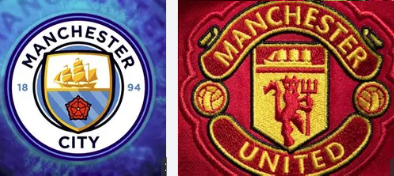
But the latest chapter in this bizarre campaign is really scraping the barrel … targeting the city’s football club badges. Feature writer Simon Hattenstone has homed in on the logos of Manchester City and Manchester United, which both include an illustration of a sailing ship. And he has reached what he clearly sees as a “Gotcha!” conclusion – sailing ships were used to carry cotton, which was produced in the southern United States using slave labour. Therefore, displaying sailing ships is shameful. Both clubs must immediately delete the offending vessels from their badges.

I hold no brief for either Man City or Man United (quite the contrary). But I find it absurd and offensive that the clubs should be thus gratuitously assailed in an attempt to shore up the Guardian‘s increasingly crazed crusade.

For the record, the sailing ships are taken from the coat of arms of the Borough of Manchester. They were granted in 1842, 35 years after Britain’s 1807 abolition of the slave trade, and are there simply to symbolise the city’s trade with the rest of the world. In fact, no large ships were seen in Manchester until the opening of the 35-mile-long Manchester Ship Canal in 1894.

Hattenstone’s argument is that the city was still using slave-produced US cotton up to the outbreak of the American Civil War in 1861, so the symbolic use of the vessels must be denounced. Talk about clutching at straws! I wonder if he knows that in 1862 Manchester mill workers supported US President Abraham Lincoln’s call for an embargo on Confederate cotton, even though it meant destitution and starvation for them and their families. He could have read about this selfless gesture in a Guardian article ten years ago.

I’ll tell you what, Mr Hattenstone, if we’re talking about links to slavery, how about demanding that the Guardian abandons its main headline typeface, which is shamefully called “Guardian Egyptian”? After all, slavery was practised in Egypt from ancient times right until the late 19th century. Yes, it’s a ridiculous link to make, but no more ridiculous than calling for the removal of ships from football badges. Sorry, Mr Hattenstone, you may be a self-proclaimed City fan, but this is an own goal.

April 24, 2023

QotD: The Baader-Meinhof phenomenon

Filed under: Britain, Media, Quotations, Soccer — Tags: , , — Nicholas @ 01:00

You may not have heard of the Baader-Meinhof phenomenon, but once I’ve explained it you will start noticing it everywhere.

A little joke for psychologists there.

In 1994, someone left a comment on the website of the St. Paul Pioneer Press (Minnesota) saying that he had heard two references to the Red Army Faction, AKA the Baader-Meinhof gang — a 1970s German terrorist organisation — in the space of 24 hours, having never previously been aware of them. This somehow provided a new name for a cognitive bias. Don’t let anyone tell you that posting online comments on regional newspaper websites is a waste of time.

Otherwise known as frequency bias, the Baader-Meinhof phenomenon is a combination of selective attention bias (paying more attention to some things than to others) and confirmation bias (looking for things that you agree with or which serve your purposes in some way).

Arnold Zwicky added another aspect when he wrote about the significance of things happening recently, describing the “recency illusion” as …

    … the belief that things YOU have noticed only recently are in fact recent.

The classic example is people’s tendency to notice a certain type of car once they own one themselves, especially when they bought it recently.

Of course it is possible that the thing you’ve just started noticing is truly becoming more frequent. I have noticed more shirts, flags and other merchandise related to Arsenal FC recently. This may be because the team is doing very well this season and I am more conscious of them as a result. Or it may be that Arsenal fans are less coy about showing their support after years of under-performing. What is less likely is that there are significantly more Arsenal fans than there were before.

Christopher Snowden, “Sudden deaths and the Baader-Meinhof phenomenon”, The Snowden Substack, 2023-01-21.

October 15, 2021

Alphonso Davies is “CONCACAF’s best player — which is to say, the continent’s best player”

Filed under: Americas, Cancon, Soccer — Tags: , — Nicholas @ 05:00

I had been a follower of the Canadian national soccer teams back when I was coaching my son and his friends in U-4 through U-16 house league soccer, but while the women’s team is among the world’s best, the men’s team has always lagged a long way behind. In Thursday’s NP Platformed newsletter, Colby Cosh shows that there’s a very big spark of hope in the person of Alphonso Davies of Edmonton:

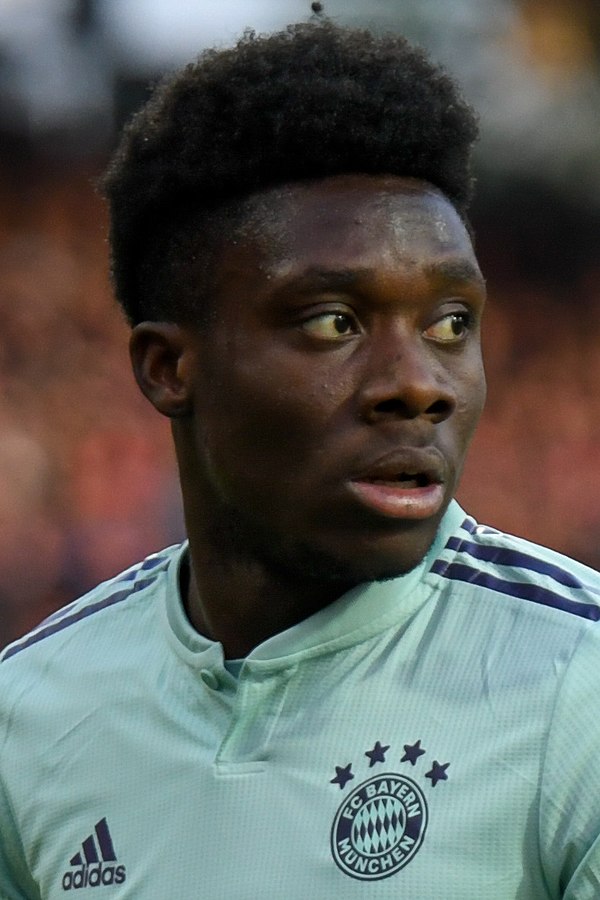
Alphonso Davies playing for FC Bayern Munich, 28 April, 2019.
Photo by Granada via Wikimedia Commons.

Reaching the [2022 FIFA World Cup] tournament involves finishing in the top four in an eight-country “octagonal” round-robin tournament that include the best sides from our continental soccer federation, CONCACAF. Last night, Canada faced a critical home match in Toronto against a traditional close rival, Panama, who stood just ahead of us in the octagonal table after a shock 1-0 home win against the United States.

This game wasn’t a very big deal even in dedicated sports media, but if you were paying close attention, you knew this was a crucial match for our World Cup hopes, which have quietly begun to build in the last year or two. Panama has a strong side, strong enough to have qualified for the 2018 World Cup finals ahead of us. But some awesome young Canadian talent is coming into full flower, and our country now possesses, by common consensus, CONCACAF’s best player — which is to say, the continent’s best player.

If anyone doubted the credentials of 20-year-old Edmontonian Alphonso Davies before last night, they have been silenced, if not entombed. Canada fell behind one-nil to Panama early in the match, then equalized shortly before half-time. Panama was lucky, at that point, to stand even, and their players knew it.

That’s when Davies, who had already filled a highlight reel with unstoppable dribbles in the first 45 minutes, put Canada ahead with the most astonishing goal ever scored by any man wearing the national colours. [Twitter link] Let us emphasize: you don’t need to be a soccer fan to appreciate this one. Phonzie’s pursuit and robbery of Panama’s Harold Cummings, who had a 35- or 45-metre head start to a harmless ball on the touchline, resembles nothing so much as the targeting and evisceration of an antelope by a cheetah. Davies then humiliated a second defender and wrong-footed Panama keeper Luis Mejia, who certainly would have made a better effort if his soul hadn’t already departed his body.

The match ended 4-1 in Canada’s favour, with Panama visibly discouraged at the failure of brutal rugby tactics facilitated by a typically inept CONCACAF referee. Davies plays his professional football at Euro-giant club Bayern Munich, and his galactico ability is no secret across the pond. Over here, he has already won (half of) a Lou Marsh Trophy as Canadian sportsman of the year. But one doubts, talking to people who don’t follow soccer, that he has the appropriate degree of fame in Canada yet. He is probably not as famous as Penny Oleksiak, or Bianca Andreescu, or whomever’s the seventh defenceman on the Montreal Canadians depth chart.

Two years ago, the possibility that Davies might one day help drag Canada to a World Cup final or two was a foggy hypothetical for the future. Last night he took a giant step, or several hundred of them, toward doing exactly that. Canada still has to follow through in the remaining half of the octagonal, but the outlook is now good. (Many Canadian national sides might have wilted against Panama after falling behind and being presented with rapacious unpenalized violence, but our manager John Herdman has achieved a deserved new level of respect in the past year, too.)

June 15, 2019

13-0

Filed under: Soccer, USA — Tags: , , — Nicholas @ 05:00

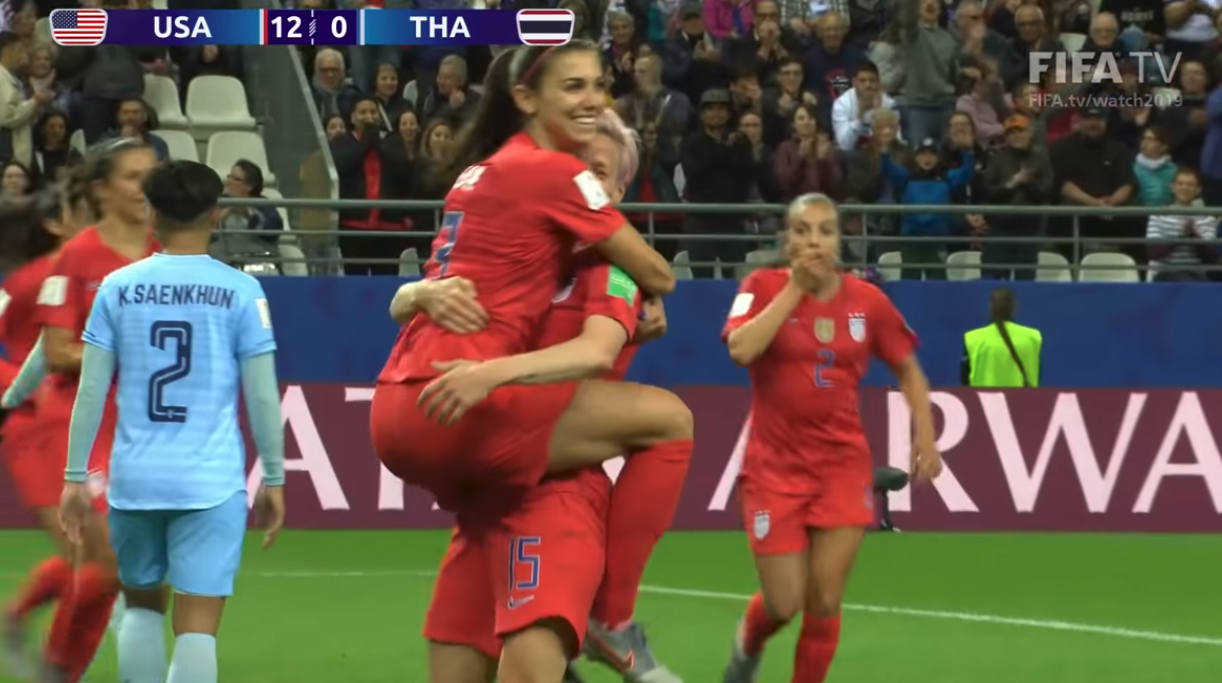
The US Women’s national soccer team eviscerated Thailand by an unheard-of 13-0 score in the group stage of the FIFA Women’s World Cup. It was not a great day for sportsmanship, as the American women celebrated every goal as if they’d just broken a 0-0 tie in injury time of the final:

A screen capture from the highlight video at YouTube. Amusingly, if you try to watch this clip on the official FIFA Women’s World Cup site, you get an error saying “This video contains content from FIFA, who has blocked it from display on this website”

At American Thinker, Jonathan Keiler recounts the reaction to the game and the counter-reaction that followed:

On Tuesday the U.S. Women’s National (soccer) Team (WNT) obliterated a hapless Thailand squad in a 13-0 rout. That’s about 91-0 in football terms, but in a sense even worse, given soccer’s relative dearth of scoring. It would not be worth noting, except that many present and former WNT players recently sued the U.S. Soccer Federation claiming disparate treatment and pay, and to the general championing of all things female in a supposed age of “toxic masculinity.”

The game and the result might cause a reasonable observer to question popular progressive views on these issues, not because the U.S. women won, but how they did it.

[…]

This lack of competitive edge to the women’s game affects it at all levels, from youth leagues to international soccer. It’s not the individual players’ fault, but it’s a fact. I coached soccer for years (boys and girls.) On the women/girls side, routs like what happened on Tuesday are relatively commonplace in many leagues, up to and including high school — and obviously even after. And while this happens on the boys/men’s side too, it is less common and exaggerated.

So even leaving aside the issue of whether the men’s game is better in terms of speed/skill/aggression, the fact is generally the men’s game is more interesting and competitive more often. That puts additional fannies in seats, people watching on TV, and generates greater income, which is reflected in pay. Non-soccer aficionados may pooh-pooh the game’s rhythms and low scoring generally, but the fact is, first round games in the Men’s World Cup are far more interesting and exciting than the female version. So the WNT did themselves no favor in their legal case by making a major shortcoming of the women’s game painfully obvious.

They also did themselves no favors winning over international fans (and a lot of on-the-fence Americans) by their graceless destruction of the Thailand ladies. It’s not just that the WNT ran up the score, it’s that as they did so they acted as if they were heroes doing the impossible, rather than seasoned pros essentially carving up an amateur squad. They screamed, danced, ran around crazily, slid on the ground and the like, after every one of those thirteen goals. They didn’t act like children — they acted worse than children.

July 18, 2018

A great World Cup?

Filed under: Media, Politics, Russia, Soccer — Tags: , , — Nicholas @ 08:38

At Spiked, Mick Hume looks back at what we were told to expect from the hosting nation of the 2018 World Cup:

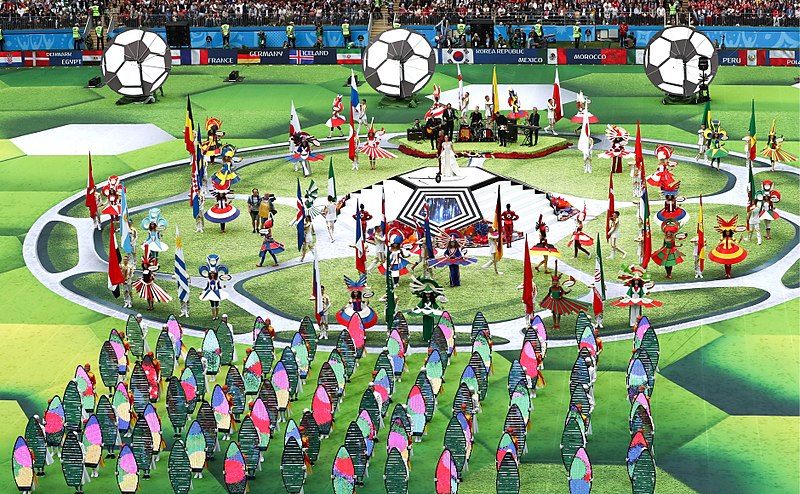
FIFA 2018 World Cup opening ceremony
Via Wikimedia Commons

Everybody agrees that the 2018 World Cup has been a roaring success. Yet remember how recently we were being warned that it would be the equivalent of a humanitarian disaster?

Before a ball was kicked we were assured that English and other international fans would all be beaten up, if not eaten alive, by armies of ‘neo-Nazi’ Russian hooligans, and that President Vladimir Putin would cynically exploit the World Cup ‘like Hitler did the 1936 Olympics’, as a tool in his plot for global domination and world war.

British government ministers and officials boycotted the tournament after the poisoning of Sergei and Yulia Skripal (the expense-account restaurants of Moscow might have missed their presence, but it’s unlikely anybody else did). And England squad member Danny Rose reportedly told his family ‘don’t come to Russia’, because of ‘fears that they would be racially abused’.

Questions were asked about why there were relatively few England fans at the team’s opening games in Russia. In the face of such sustained scaremongering, it might rather seem a wonder that anyone braved the journey.

Yet once the actual football kicked off, what happened? None of the above. Instead the World Cup immediately became a glorious, thrilling spectacle, capturing the imagination of fans worldwide amid a rolling party atmosphere across Russia.

This follows the similar reality gaps between political scaremongering and sporting success around other recent World Cups and Olympic games, notably London 2012. It should surely be a reminder to us all to ignore the agenda-driving doom-mongers in future and remember that, in the end, the game’s the thing. There is no chance of keeping politics out of sport, but we might at least try to keep sport out of politics and reject attempts to use our great sporting occasions as political footballs. (Rider: the idea of staging the next World Cup in Qatar still seems bonkers, but…)

January 11, 2017

“The money paid to footballers is ‘grotesque’, said Corbyn today, in his best irate vicar voice”

Filed under: Britain, Politics, Soccer — Tags: , , — Nicholas @ 04:00

British Labour Party leader Jeremy Corbyn just proposed a salary cap for professional football (that’s “soccer” to us benighted colonials on the other side of the pond) in the UK:

Is there nothing Jeremy Corbyn can’t screw up? This week his advisers whispered to the press that their leader was about to do a Donald, be more populist, try to connect with the man and woman in the street who might think of him as a bit stiff and aloof and stuck in the Seventies. And how does he kick off this project? By slagging off footballers, the most idolised sportspeople in Britain, cheered by vast swathes of the very people Labour no longer reaches but wishes it could. The money paid to footballers is ‘grotesque’, said Corbyn today, in his best irate vicar voice. Cue media coverage of Corbyn’s moaning mug next to Wayne Rooney (£250k a week, loved by millions). What next in Corbyn’s populist makeover? A call to wind down Coronation St? Close pubs on Sundays? A Twitterspat with Ant and Dec or Sheridan Smith or some other national treasure?

[…]

Labour leftists have never understood this basic fact: ordinary people don’t hate rich people. In fact they admire many of them. They don’t wince when they see a footballer and his WAG posing by the pool in Hello! — they think, ‘That looks like a nice life. Good on them.’ Corbyn bemoaned footballers’ pay as part of his proposal to enact a law preventing people from earning above a certain amount of money. Yes, a maximum wage. ‘I would like there to be some kind of high earnings cap,’ he said. It’s the worst idea a British political leader has had in years, and it reveals pretty much everything that is wrong with the left today.

First there’s the sheer authoritarianism of it. It will never come to pass, of course, because Corbyn’s footballer-bashing and bodged populism and general inability to connect with anyone outside of Momentum and the left Twittersphere means Labour won’t be darkening the door of Downing St for yonks. But that Corbyn is even flirting with the notion of putting a legal lid on what people can earn is pretty extraordinary. It would basically be a stricture against getting rich, a restriction on ambition, a state-enforced standard of living: you could be comfortable and middle-class, but not loaded. There’s a stinging moralism, too. Labourites complain about those on the right who look down on the ‘undeserving poor’, but what we have here is not all that different: a sneering at the undeserving rich, a prissy concern with the bank balances and lifestyles of those who’ve made a bomb.

Older Posts »

Powered by WordPress