Quotulatiousness

June 16, 2026

Piketty’s bid for another fifteen minutes

Filed under: Economics, France, Media, Politics — Tags: , , , , — Nicholas @ 05:00

I’m not an economist, so my personal opinion on Thomas Piketty’s work is based purely on the reports of others … you could say I’m not a fan. In the National Post, J.D. Tuccille discusses Piketty’s latest push to impoverish the rich nations for the noble cause of “global justice”:

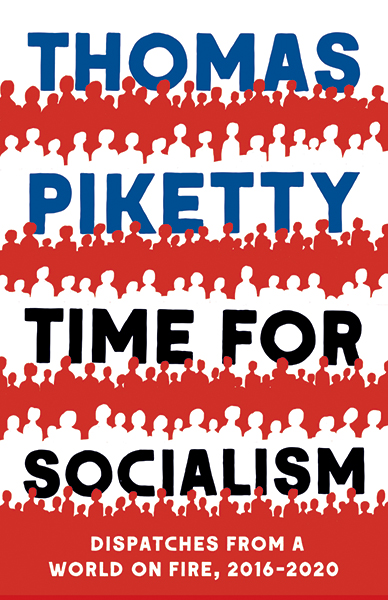
Piketty’s 2021 paean to socialism and central panning.

Celebrity economist Thomas Piketty won fame with a claim that, in market economies, capital accumulates in the hands of the already wealthy, leading to increased inequality. The message found a receptive audience among people eager to believe economic success isn’t earned. Canada’s Prime Minister Mark Carney cited Piketty in his own 2021 book-length argument that economic activity should be managed by people like Carney.

And now Piketty is back seeking new fans with a scheme for top-down central planning of the world’s economy. He is the co-director of the new Global Justice Report from the World Inequality Lab.

Introducing the project, Piketty posted on X, “The world today is characterized by large-scale inequalities. And a climate crisis is looming over us. We urgently need a new vision for global progress in the 21st Century. One that grounds human development and equality in planetary habitability.”

Piketty shoehorns an impressive number of buzz phrases into a few lines. He includes concerns about equality and inequality, climate change and progress that should send thrills through college campuses. But Piketty has a talent for tapping into the moment. In this case, at a time when Freedom House’s annual report finds that “Global freedom declined for the 20th consecutive year in 2025,” the economist and his colleagues propose authoritarian policies for shaping the entire planet to their liking.

In his post, Piketty asks, “What would it take to achieve high prosperity and equality while remaining within planetary boundaries?” He answers that “energy transition” (meaning moving away from power sources that produce carbon) is necessary, as well as “labour hour reductions, growth caps in rich countries, less material consumption, and changes in food habits.”

The report itself asserts, “The compression of global inequality is not only compatible with deep decarbonization; it is a necessary condition for shared prosperity on a finite planet.”

To fight climate change and battle inequality, Piketty and company want “full income convergence across countries by 2100.” This requires, in part, limiting growth to “around 0-0.5% in today’s richest regions (North America/Oceania, Europe).” They argue that near-zero growth in rich countries “does not mean that their living standards stagnate” because people will benefit from flattened incomes.

On his Substack, Tim Worstall says that the latest Piketty emission disproves the “we need a global wealth tax” case of fellow French economist Gabriel Zucman:

So Tommy Piketty has released his big report self-pleasuring over how a few Frogs are going to run the global economy forever. The Guardian, of course, thinks there’s merit in it:

    One of the report’s key aims is to bring every country to today’s rich-country level of €5,000 per person per month in purchasing-power terms. The figure for sub-Saharan Africa is €290. The report proposes a new global fiscal and monetary architecture: taxes on the very rich would build the public realm, while a Keynesian “clearing union” and new international currency would ease the external constraints that limit poorer countries’ state spending.

Super, eh?

But the plan doesn’t just try to get the poor up to our standard of living — an excellent goal in and of itself, obviously. It also insists that we don’t increase our standard of living. For a century. Which is, you know, going to be a little more difficult.

So, how is this to be achieved? Well, this is Piketty — Frogs, eh? — so it’s going to be truly swingeing taxation of anyone who puts their head up above the parapet. The global 1% in fact.

And, well, this isn’t wholly true but it’s a useful rule of thumb, the top 1% globally is about the top 10% of the UK. -Ish, you know? Somewhere just above £50k a year for an individual in the UK. £150k for a two adult w/children household perhaps. That’s the level at which the 90% income tax swinges into action.

Oh, and, lovely wealth taxes on top too.

The effect of this is to kill economic growth. That’s what it’s designed to do too. You’ve enough, you rich bourgeois bastard, you, so that’s all you’re going to get and we’re going to use punitive taxation to make sure that’s true.

Well, OK, it’s a plan, right?

June 13, 2026

Hating on Elon Musk, the world’s first trillionaire

Filed under: Business, Economics, Media, Politics, USA — Tags: , , , , — Nicholas @ 04:00

It shouldn’t be surprising that so many people are doing what they can to raise resentment against the very rich in general, and Elon Musk in particular. Stoking resentment of the better off has always been a viable short-term political play, and it’s not every day we see wealth of this scale:

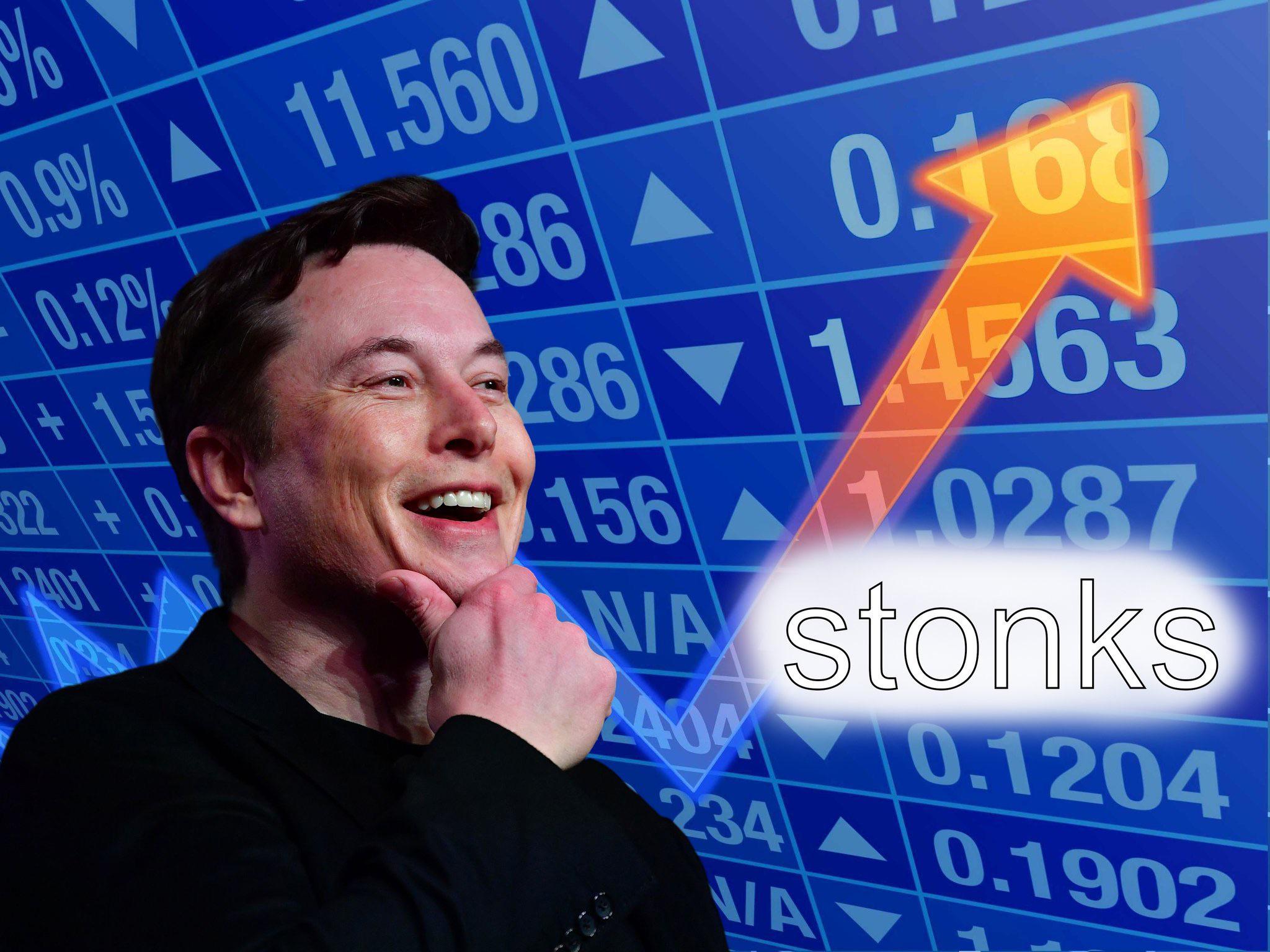
Reddit meme

For all these dumbasses claiming if they had Elon’s money they’d end world hunger, cause world peace, educate everyone, or whatever, blah blah blah … No you wouldn’t. You’re full of shit and everyone knows it, because that’s not how the world works.

Throwing money at a problem doesn’t fix it. The entire history of government demonstrates that. Saying vapid nonsense just makes weak, unimaginative people with a childlike grasp on reality feel better about themselves for caring harder, while accomplishing nothing.

Meanwhile, the guy you hate revolutionized EVs and self driving cars, brought affordable reliable internet to every corner of the Earth, and is making the dream of colonizing space real. And the process of doing all that has given hundreds of thousands of people jobs.

While you posture about how you’d give everybody an imaginary unicorn, he’s done stuff that’s actually changed the world for the better.

And you don’t get it. You can’t get it. Because you’re just too fucking small.

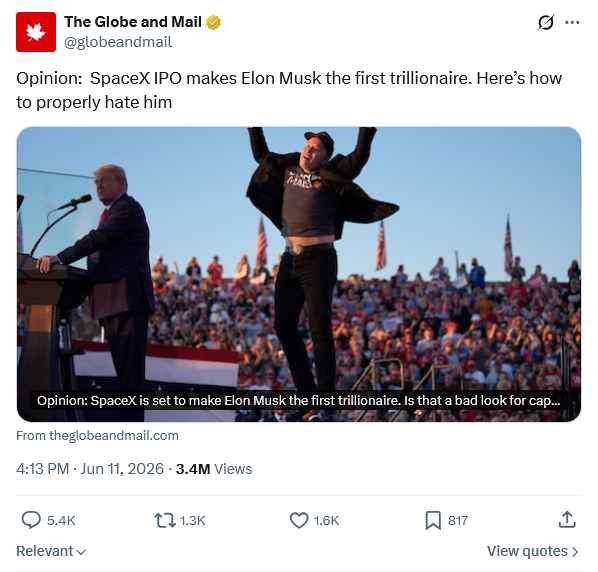
And even the Globe and Mail, which used to consider itself the most respectable and influential newspaper in Canada goes for the “hate the rich” market:

But some people just can’t help themselves and ginning up the hate and envy is all they can do:

For the left, it’s important that you do more than view billionaires with skepticism. You have to actually hate them. You have to blame them for every ill that befalls you, and you must actively resent their wealth.

One way that the left accomplishes this is by framing their gains as somehow your losses.

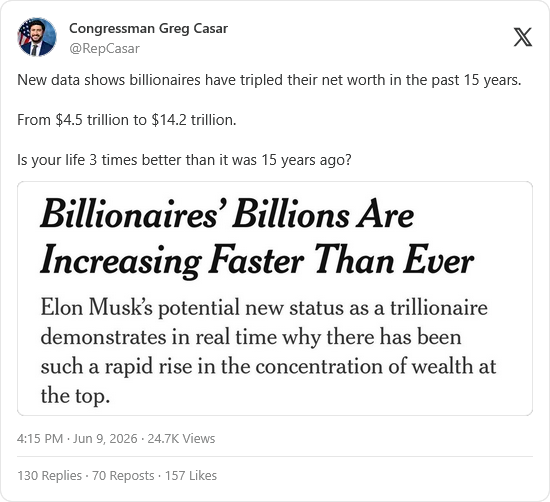
Congressman Greg Cesar (D-TX) decided to try that on X Tuesday with this banger.

Now, it’s interesting that he talks about their wealth being three times what it was 15 years ago, but doesn’t account for what the rest of us are dealing with. Instead, he engages in an apples-and-oranges comparison.

For starters, the increase in net worth for billionaires has nothing at all to do with whether your life is three times better than it was back then. There are too many variables. Someone who was unemployed and homeless and got a job, built a life back up, and then started a successful business is a lot more than three times better off, right?

Plus, it doesn’t account for differences in the cost of living or anything else.

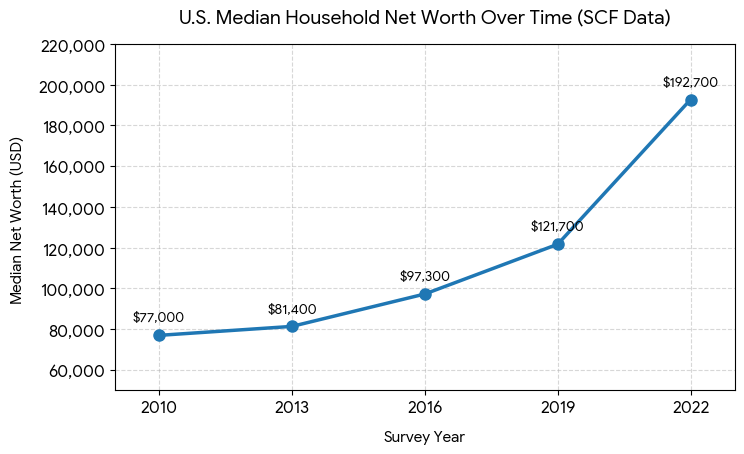
Instead, a better metric is whether the median household net worth in America has increased a similar amount. So, I went to Google, then got its AI to generate a graph for me showing what’s happened over that timeframe.

While that’s not three times, it is 2.5 times the median net worth 15 years ago, and since this caps at 2022, it may well have increased even more.

In other words, the net worth of ordinary Americans seems to be mostly keeping up with that of the billionaires.

Cesar’s question, though, is disengenuous because the cost of living has gone up about 53 percent over that timeframe. So while net worth has increased, so has the cost of living. Not enough to completely drain away the gains in net worth, but enough that people aren’t living three times better than they were.

But that’s the point, isn’t it?

It’s not enough that, on average, Americans are much richer than they were 15 years ago, and by about the same amount as the billionaires, because that won’t foster the necessary resentment the left needs to push through their policies. You have to resent their wealth, and that’s less likely if you realize you’ve gained as much as they have by percentages. You have to feel like their wealth has been taken from yours, otherwise you’re less likely to look at wealth redistribution as a good thing.

And wealth redistribution is what it’s always about.

May 20, 2026

QotD: “Gilded Age” Robber Barons didn’t have access to what even working-class Americans have now

Filed under: Business, Economics, History, Quotations, USA — Tags: , , , , , , , — Nicholas @ 01:00

Where Marx really went wrong was — and I know this sounds flip, but I’m as serious as cancer — being born in 1818. He lived his entire miserable life in a world where “labor” really was a physical thing. The richest robber baron of the Gilded Age lived a far different life, materially, than the poorest serf-in-all-but-name working in his factories …

… but the robber baron knew he needed the serfs. Their relationship was purely dialectical. Without his factory hands, no robber baron. And in a strange but very real way, the higher up the food chain your Gilded Age robber baron went, the more he was dependent on his serfs for his lifestyle. J.P. Morgan is usually credited as being the first guy to become a Robber Baron purely through finance. Carnegie, Rockefeller, all those guys had most of their wealth in financial instruments, of course, but those financial instruments rested on control of a physical product — Carnegie Steel, Standard Oil.

I’m probably being unfair to Jay Cooke, the Michael Milken of his day, but since more people have heard of J.P. Morgan let’s roll with it. Even though Morgan’s wealth was entirely on paper — he was nothing but a securities trader — his lifestyle utterly depended on a battalion of servants. In a very real way, you yourself, right now, live much better than J.P. Morgan did in his heyday. And not just because you have aspirin, antibiotics, and air conditioning, three taken-for-granted things ol’ J.P. would’ve given half his kingdom for. But because you have more time. If you’re hungry, you can open the fridge or the microwave and have all the food you need in a matter of minutes.

J.P. couldn’t. J.P. had to deploy an army of servants every time he wanted a snack, and those servants were constrained by things like “availability of ice” and “when is the fishmonger at his stall”. You’re hungry at 2am, you jump in your car and get some Taco Bell. It takes ten minutes. J.P.’s hungry at 2am and it’s tough titty, J.P., your ass is going hungry. Because even though you’re the richest man in the world and have legions of manservants at your beck and call, Taco Bell just isn’t there. Even if someone had had the brilliant idea to create a Gilded Age Taco Bell, it still would’ve taken hours:

Wake up the manservant. Wake up the groom and stableboy. Hell, wake up the horse, then saddle the horse, ride to the drive thru window … which in this case means “the house of the guy who runs Gilded Age Taco Bell”. At which point he has to fire up the oven, start pounding the tortillas, send his own legion of valets and stableboys and whatnot out to get the refried beans …

And that’s the other thing, J.P. — you’d best not pull that shit too often, because those people know where you live. Not only do they know where you live, they live with you. Literally under the same roof. You want to sleep easy? You’d best not beat the servants too often, buddy.

There’s only so much “class consciousness” one can develop in that world. Oh yeah, J.P. thought of himself as one of the Masters of the Universe, there’s no denying that. But J.P. lived in what was still a brutally physical world, in a way we PoMo people really can’t grasp. If you can’t imagine what it would take to get some Gilded Age Taco Bell, maybe geography will do the trick. Ever seen Gangs of New York? Even if you haven’t, you’ve probably heard the name “Five Points”. The worst slum in America in the 19th century, and 19th century American slums were world class …

That was right down the street from Wall Street. Literally. I am not in any way joking, and if I’m exaggerating a little for effect when I say “J.P. could’ve hit Five Points with a five iron from his swanky digs on Central Park West”, I promise you I’m not exaggerating much. You can look it up for yourself. The main reason the Union rushed troops straight from the Gettysburg battlefield, and no-shit shelled parts of the city with gunboats, during the Draft Riots was because Five Points (et al) was right fucking there, and they might’ve gotten it into their heads to lynch a few Masters of the Universe. Rich man’s war, poor man’s fight, right? Let’s see how you like it, you bankster bastards …

The PoMo “information economy” removes all that. The other day I joked about colleges like Bennington and Goucher. I cracked some jokes, yeah, but I wasn’t really joking. Those places aren’t for us. Wall Street is still a physical location, but it might as well be on the dark side of the moon for all any of us have access to it. J.P. couldn’t beat the servants too hard, or too often. The modern equivalent of J.P. isn’t even aware that he has servants. He just clicks on a website, and stuff appears at his door. Like magic. Hell, it IS magic for all he knows, and he surely doesn’t care, because all that shit is his by right. He went to Bennington, after all. He has achieved full class consciousness.

All of which suggests, of course, that while Marx was wrong about the end state — the State will not, in fact, wither away — he might well have been right about the solution to the “contradictions of capitalism”, if you follow me. And if that makes me some kind of godless pinko Commie subversive, well … I’ve been called worse by better.

Anybody got the lyrics to La Marseillaise in English?

Severian, “On Losing the Cold War”, Founding Questions, 2022-07-02.

Update, 21 May: Welcome, Instapundit readers! Have a look around at some of my other posts you may find of interest. I send out a daily summary of posts here through my Substackhttps://substack.com/@nicholasrusson that you can subscribe to if you’d like to be informed of new posts in the future.

May 11, 2026

“We’ve entered the pre-violence rhetorical phase of the classic communist cycle”

Filed under: China, History, Politics, Russia, USA — Tags: , , , , , — Nicholas @ 04:00

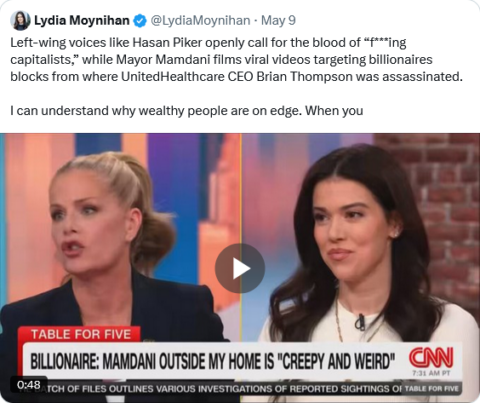
You have to have noticed that progressives all seem to have recently decide en masse that we need to liquidate eliminate expropriate the billionaire class. It’s been done in the past, and modern progressives seem to be unable to spot the pattern, even as they work hard to bring it back to life by constantly scapegoating the wealthy (machine translated from Brivael Le Pogam’s original French post):

Lydia is putting her finger on something that no one wants to name clearly: we’ve entered the pre-violence rhetorical phase of the classic communist cycle.

The script is documented, archived, and it repeats itself identically for a century. Before every mass massacre carried out in the name of Marxism, there are always 5 to 15 years of public designation of a category of people as “the enemy to be taken down”. Not a debate on public policies. Not a critique of inequalities. A methodical dehumanization of an entire class.

In the USSR in the 1920s, it was the kulaks. Lenin wrote as early as 1918 that it was necessary to “exterminate the kulaks as a class”, an expression repeated word for word by Stalin ten years later. Result: 4 million peasants deported, several million dead in the Holodomor.

In Maoist China, it was the landlords and “class enemies”. Mao orchestrates public “struggle sessions” where neighbors, children, former employees are forced to denounce, humiliate, and beat. Tally from the land reform alone: 1 to 2 million executions, not counting what follows.

In Cambodia, it was the “new people”: city dwellers, intellectuals, people wearing glasses. Khmer Rouge propaganda designated them for years as parasites before massacring them. 1.7 million dead in 4 years.

Now look at what’s happening in the United States in 2026.

Hasan Piker, who reaches millions of young men on Twitch, speaks openly of the “blood of f***ing capitalists”. Not in 1968 in a Trotskyist cell, in 2026 on the platform most watched by 18-25 year olds.

Zohran Mamdani, elected mayor of New York, films viral videos in front of billionaires’ buildings, exactly where Brian Thompson, CEO of UnitedHealthcare, was assassinated last year by Luigi Mangione. The latter was turned into a pop icon by a part of the American left in less than 48 hours. T-shirts, fan art, romanticization of the murderer.

This isn’t “political passion”. It’s phase 1 of the protocol. The public designation of a category of humans as legitimately hateable, followed by the valorization of those who take action.

The “normal” reaction of a healthy democracy should be the immediate social and professional isolation of these voices. What’s happening: they top podcast charts, they’re elected officials, and they get favorable media coverage.

History doesn’t stutter. It copy-pastes. And the first victims are always surprised to discover, too late, that the speech they found “a bit excessive but oh well” was actually the clear warning that a pit was being dug for them.

Lydia is right to say it. And she’ll be even more right in five years when we reread these tweets.

And more:

And if you’re reading this thinking, “This doesn’t concern me, I’m not a billionaire”, stop for two seconds and really think about it.

Because that’s exactly what the Russian peasants told themselves in 1918 when people started talking about the “bourgeois”. They applauded, or they looked the other way. It wasn’t their problem. They weren’t rich.

Ten years later, they were called kulaks. And “kulak“, in Stalinist practice, meant any peasant who owned one more cow than his neighbor, who had dared to hire a seasonal worker, who had a slightly better-kept barn. 4 million deported. Several million dead.

That’s exactly what the small Chinese shopkeepers told themselves in 1949, when Mao went after the “great landowners”. Not their problem. They just ran a little store. Five years later, they too were classified as “class enemies”, stripped of everything, publicly humiliated, sometimes beaten to death by their own neighbors.

That’s exactly what the Cambodian schoolteachers told themselves in 1970, when the Khmer Rouge talked about “urban exploiters”. Not their problem. They barely earned enough to live on. In 1975, knowing how to read was enough to sign your death warrant.

The communist mechanism NEVER stops at the ultra-rich. Never. It’s a historical law as solid as gravity.

Why? Because fundamentally, the communist doesn’t hate wealth. He hates individual emancipation. He hates the very idea that a man can build something that belongs to him, decide his own life, refuse the collective. Private property isn’t an economic detail to him — it’s the metaphysical enemy. Because someone who owns something is someone who can say no.

So if you have an apartment you spent 15 years paying off, you’re concerned. If you have a small business, a shop, a sole proprietorship, you’re concerned. If you have a savings plan, a bank book, stocks, you’re concerned. If you have a family home in the provinces, you’re concerned. If you work hard to pass something on to your kids, you’re at the top of the next lists.

Billionaires are just the first course. Always. Because there are few of them and they’re easy to point out. They’re the appetizers for the machine. The main course, historically, is you.

And meanwhile, a lot of people read threads like this, nod their heads, and don’t share. Don’t comment. Don’t take a stand. Out of fear of being labeled “right-wing”, “reactionary”, “too political on LinkedIn”. Out of comfort. Out of social cowardice.

Know that this silence has a precise historical cost. Every time a society has tipped into this madness, it did so because the reasonable majority stayed silent too long, thinking it would all blow over on its own.

It never blows over on its own.

May 5, 2026

Seattle’s Mayor to wealthy residents: “Bye!”

Filed under: Government, Media, Politics, USA — Tags: , , , , — Nicholas @ 05:00

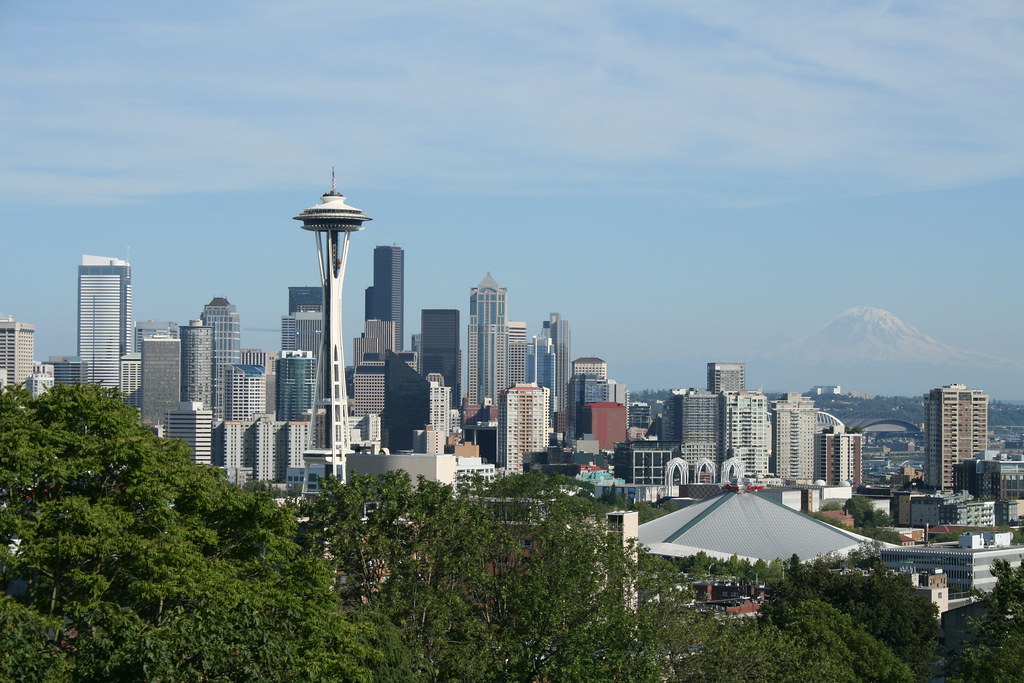
I’ve heard many people praise Seattle as a great place to live with lots of amenities and a fantastic setting. Like a lot of places with those kinds of attractions, it also has a political scene that leans strongly to the left, as Mayor Katie Wilson recently highlighted:

“Seattle Skyline” by Atomic Taco is licensed under CC BY-SA 2.0 .

Seattle’s socialist Mayor Katie Wilson has a message for prosperous people leaving Washington over the state’s soaring tax burden. “Bye!” she says with a laugh, to cheers from a largely progressive audience. Entrepreneurs and investors will certainly take that comment into account as they consider where to live and do business. We can be sure of that fact because recent research further supports the commonsense idea that people often leave high-tax states in search of lower tax bills.

Goodbye, Wealthy People!

Wilson’s comments came during an April 16 discussion about “The New Progressives” as part of Seattle University’s Conversations series. Wilson and King County Executive Girmay Zahilay fielded a series of questions by host Joni Balter and graduate student Ari Winter.

Asked about major companies leaving or threatening to leave over Seattle’s and Washington’s escalating tax burden, Zahilay acknowledged that “everything is a tradeoff” and “of course I think taxes can make companies make decisions about staying or leaving”. You wouldn’t necessarily want to live under his policies, but he sounds like he understands that his decisions may drive people out and impose costs on the community.

Wilson, a self-described “socialist“, was presented with a follow-up question by Winter. She was asked, “do you still think progressive taxes are an easy and promising solution?”

Wilson responded that it was “very, very exciting to see the billionaire tax pass the legislature” and described her history of advocating for higher taxes. She then cut to the heart of her response.

“I think the claims that millionaires are going to leave our state are, like, super overblown. And if, you know, the ones that leave, like, bye!” she said with a wave and a snicker. The audience at the university event joined in with whoops and applause.

Wilson may want to practice her goodbyes. Fisher Investments moved from Washington to Texas to escape a new capital gains tax. Starbucks is building a corporate hub in Tennessee and moving jobs there, largely over tax concerns. Billionaire Jeff Bezos fled the state for Florida, also motivated by taxes.

“Jeff Bezos sold about $15 billion in stocks before the new law took effect, potentially saving over $1 billion in taxes”, the Washington Policy Center’s Chris Corry noted. “Moving his primary residency to Florida would ensure that any future stock sales would not be subject to the excise tax.”

Tech giant Microsoft criticized Washington’s tax environment and threatened to move jobs elsewhere.

April 2, 2026

The persistent wish to “seize the means of production”

Filed under: Economics, Liberty, Politics — Tags: , , , — Nicholas @ 03:00

On the social media site formerly known as Twitter, The Rational Animal explains why the din of progressives demanding that “the rich” be dispossessed of their property always leads to the worst kind of results:

This perfectly captures the parasite’s delusion: that wealth is static loot to be seized and redistributed.

Here’s what actually happens when you “repossess all their stuff”:

The producers will rebuild. They’ll create new wealth because that’s what they do. They identify opportunities, solve problems, innovate, build businesses, and generate value. Their wealth came from their minds, not magic.

The looters will consume what they stole at light speed and wind up with nothing. Because they never learned to produce. They only know how to take.

Look at every socialist revolution in history: seize the factories, the farms, the businesses. Within years, everything collapses. The factories stop producing. The farms stop yielding. The wealth evaporates. Venezuela. Cuba. Soviet Union. Zimbabwe. The pattern is identical.

Why? Because wealth isn’t stuff sitting in a vault. Wealth is the ongoing process of human intelligence applied to production. Confiscate a factory and you get the building. You don’t get the knowledge, vision, and competence that made it productive.

The “rich” you want to loot aren’t dragons hoarding gold. They’re producers creating value. Rob them and you rob everyone, including yourself.

You’ll be left with ruins and still blame capitalism.

Update: Fixed missing URL.

March 24, 2026

QotD: Citizens of a polis

Filed under: Europe, Greece, History, Quotations — Tags: , , , , — Nicholas @ 01:00

A polis is most importantly made up of the citizens, the politai (singular polites (πολίτης), plural politai (πολῖται)); indeed, Aristotle says this too in his Politics (Arist. Pol. 1274b): “for the state [polis] is an assembly of citizens [politai].” Now we are used to the idea that most people in a country are citizens of it, but the idea of the politai is much narrower. In its fundamental meaning a polites is a person engaged in the running of the polis; it is an idea defined by political participation. The politai were adult, citizen men; women, children, the enslaved and free non-citizens were all excluded from this group. A bit of demographic math might suggest that a modest polis with 2000 inhabitants might thus have just 300-400 politai.

Not everyone born in a polis was a member of the politai. Women could be of citizen status (and thus able to bear citizen children in poleis where that was required), but they could not be citizens at all. Being the male child of citizen parents was generally the core requirement of citizenship and in a democratic polis that was generally enough, but oligarchic poleis typically imposed wealth qualifications for political participation so not everyone born to citizens might themselves be a polites if they ended up too poor to meet the requirements. The terms astos and aste (ἀστός and ἀστή), “townsman” and “townswoman” respectively, might be used to make this distinction between the politai and people who were “merely” natives of the polis but barred for whatever reason from political participation. These distinctions become a lot more meaningful when you realize the point Aristotle is making defining the polis this way: if the polis is a community of politai then the residents of a polis (the physical space) who are not citizens are not members of the polis (not merely, we might imagine, non-participatory members).

Now the politai themselves also existed in subdivisions. We’ve mentioned division into demes or neighborhoods; while notionally geographic, demes could become hereditary (and indeed did become so in Athens). In Sparta and some poleis on Crete, citizens were divided into mess groups (syssitia or andreia). But by far the most common and important such division was into “tribes” or phylai (φυλαί, sing. φυλή), inherited kinship groups that often formed the largest subdivision of the politai of a polis, with even very small poleis having attested divisions into phylai in some cases (e.g. Delos as noted by M.H. Hansen in “Civic Subdivisions” in the Inventory). The politai might also be subdivided by other groupings like phratria (brotherhoods) and indeed a polis might have multiple such groupings, either neatly nested (as in Athens’ demes sorted into thirty trittyes sorted into ten phylai to make up the citizen body) or they might confusingly cross-cut each other.

There’s another key distinction between the politai – or at least men who might be politai – which isn’t a legal distinction but nevertheless matters for understanding how the Greeks imagined civic governance: the distinction between the few (hoi oligoi) and the many (hoi polloi). The few were the economic elite of the politai – the wealthy landowners – and the dominant group in oligarchies. A few terms might signify this group: “the few” (οἱ ὀλίγοι – hoi oligoi) or “the best” (οἱ ἄριστοι – hoi aristoi), or “the rich” (οἱ πλούσιοι – hoi plousioi) and can also be part of the meaning of the appellation “beautiful and good” (καλὸς κἀγαθός = καλὸς καὶ ἀγαθός – kalos kagathos) which translates more idiomatically to something like “gentleman” with an implication of both good conduct (especially in war) and high status. At its broadest reach, the few might consist of those politai with enough wealth to serve as hoplites, though it seems in most cases this group is understood much more narrowly and might be defined by heredity in addition to wealth in some cases.

In contrast to the few were, of course, the many. Once again a few terms might signify this group: “the many” (οἱ πολλοί – hoi polloi or οἱ πλῆθος – hoi plethos) or “the poor” (οἱ ἀποροῖ – hoi aporoi) or the people (δῆμος – demos), the last of which gives us the word democracy – rule by the demos. At its narrowest extent, these are all of the people too poor to serve as hoplites but who would otherwise be politai; in fact in a democracy they are politai, but in closed oligarchies they may not be. More broadly the concept of the demos can encompass all of the politai, both wealthy and poor, especially in a democratic context. Nevertheless the Greeks often understand these two groups as oppositional and non-overlapping: the politai composed of “the few”, with money and high status lineages and “the many”, without that, but with far greater raw numbers.

As we’ll see, it is that distinction – between “the few” and “the many” which the Greeks used to define the different forms of polis government, what they called a politeia (πολιτεία), which we might translate as “constitution” with the caveat that these are not written constitutions. And that’s where we’ll go next: now that we have our subdivisions, we’ll discuss next week the different ways they are organized and governed.

Bret Devereaux, “Collections: How to Polis, 101: Component Parts”, A Collection of Unmitigated Pedantry, 2023-03-10.

March 18, 2026

Virginia sees California’s tax schemes and says “hold my beer”

Filed under: Bureaucracy, Business, Government, USA — Tags: , , , , — Nicholas @ 03:00

In The Freeman, Erik W. Matson pleads with the Virginian government not to “California our Commonwealth”, as the new governor keeps cribbing tax policies from Gavin Newsom’s playbook:

The state seal of Virginia. I am told that the motto Sic semper tyrannis does not actually stand for “Thus always to taxpayers”, all appearances to the contrary.

In 1966, fresh off four busy years of touring, the Beatles returned to the UK to discover they were on the brink of bankruptcy. Their earnings had placed them in the top tax bracket, putting them at the mercy of the Labour government’s 95% supertax. George Harrison, in response to this tyranny, penned the lyrics to what became the first track on their next album Revolver: “Taxman”.

    Let me tell you how it will be
    There’s one for you, nineteen for me
    ‘Cause I’m the taxman

Harrison’s words resonate across the pond today, especially for those living and working in the state of California. Consider the recent case of Sam Darnold, quarterback of the Seattle Seahawks. Darnold earned $178,000 for winning Super Bowl LX in February 2026, which was played in Santa Clara — and promptly found himself owing California $249,000, thanks to the state’s so-called “jock tax“. For almost three decades, the state has had the highest top marginal income tax rate in the US. Capital gains in California are treated — and taxed — as ordinary income, pushing many into higher tax brackets. At the state and local level, California features a garden variety of invasive taxes and surcharges to fund everything from tourism to mental health support initiatives. Add to this the recently proposed 2026 Billionaire Tax Act, which would impose a one-time 5% tax on the worldwide net worth of California residents worth more than $1 billion. The act would also amend the state constitution to remove the cap on taxes on intangible property (and likely cost the state $25 billion!).

California’s predatory tax regime, sadly, seems increasingly familiar to those of us living in the Commonwealth of Virginia. Thanks to the initiatives of the new governor Abigail Spanberger, Virginia is barreling down a trail of “California-ization.” In some sense, as Adam Johnston has recently discussed, our California-ization has been underway for over a decade, largely due to the influx of legal and illegal immigrants to the deep-blue suburbs in Northern Virginia. But it has entered a new and more aggressive phase under Spanberger, a former member of Congress’s Blue Dog Coalition who, two months in, is governing like anything but. Spanberger and her administration are openly attempting to gerrymander the Commonwealth’s congressional map in an effort to wipe out the state’s Republicans. They have also proposed an expansive set of truly California-esque taxes, subsidies, and regulations antithetical to liberty, prosperity, and “affordability.”

In January, City Journal‘s Judge Glock catalogued some of Spanberger’s initial ideas for governance, including her desire to subsidize housing for state employees and low-income residents and regulate the Commonwealth towards carbon neutrality. Unsurprisingly, the bulk of her ideas would, as Glock says, “drive up expenses for one group of consumers in order to benefit another group deemed more deserving”. If Spanberger’s officially announced agenda from November 2025 is any indication, the “more deserving” include smokers (taking a tactic straight from California’s playbook), solar farms, and scofflaw tenants (compare California’s 2019 Tenant Protection Act!).

Since the convening of the General Assembly, Virginia Democrats’ wildest dreams have metastasized into a concrete body of legislative proposals that promise at once to limit Virginians’ freedoms and nickel-and-dime us into oblivion. House Bill 978, for example, introduces new taxes on:

    recreation, fitness, or sports facilities; nonmedical personal services or counseling; dry cleaning and laundry services; companion animal care; residential home repair or maintenance, landscaping, or cleaning services when paid for directly by a resident or homeowner; vehicle and engine repair; repairs or alterations to tangible personal property; storage of tangible personal property; delivery or shipping services; travel, event, and aesthetic planning services; and digital services.

Building on the architecture of the widely unpopular vehicle tax (which, despite what Spanberger proposed during her campaign, is likely here to stay), House Bill 557 proposes local personal property taxes on electric-powered lawn equipment — including mowers, trimmers, blowers, and chainsaws — used to maintain “commercial, public, or private gardens, lawns, trees, shrubs, or other plants”. These suggested taxes on electric-powered equipment complement a proposal in House Bill 881 encouraging the regulation and even outright banning of gas-powered leaf blowers — again following the lead of California.

February 23, 2026

“Public intellectuals”

Filed under: Media, USA — Tags: , — Nicholas @ 04:00

Ted Gioia charts the rise of what we now struggle to avoid … the “public intellectual”:

“Orator at Speakers’ Corner, London, with crowd, 1974” by GeorgeLouis is licensed under CC BY-SA 3.0 .

I see this term “public intellectual” everywhere nowadays — and it has a nice ring about it. It summons up images of speakers standing on soapboxes proclaiming the truth to passers-by.

That’s actually happened in places like London’s Hyde Park and 125th Street in Harlem. It sounds so very fair and democratic. Not every intellectual teaches at Harvard and Yale. Sometimes they really do exist out in the wild. We ought to nurture and support them.

Not long ago, these same people were often called “working class intellectuals”. I had two uncles who could be described that way — they lacked prestigious degrees and institutional affiliations. They grew up poor, but were smart and well-read and could speak articulately on almost any subject.

A few colleges specialized in educating these working class intellectuals. Consider the case of City College of New York, where the finest minds of the proletariat got book learning on the cheap. (You can find a list of CCNY alums and profs here — it includes an impressive number of Nobel laureates and Pulitzer Prize winners.)

But those days are long gone. Working-class intellectuals have vanished in recent years. Instead we have witnessed the rise of millionaire — or billionaire — intellectuals.

There have always been super-rich people, but in the past they kept a low profile. In my youth, the wealthiest person in the world was Howard Hughes, and he stayed in hiding for the last two decades of his life — you couldn’t even find a current photograph of the man.

He was doing us a favor. Hughes was rumored to have abandoned all the niceties of personal hygiene.

    During the last fifteen years of his life, Hughes was described as a tall gaunt skeleton of a man with long, unwashed matted hair, a scraggly beard, and fingernails and toenails of such length that curled in upon themselves. He dressed only in a pair of dirty undershorts or went nude.

Believe it or not, Martin Scorsese cast Leonardo DiCaprio to play Hughes in the biopic. You gotta love Hollywood.

Hughes briefly emerged from seclusion on just one occasion. On January 7, 1972, he made a brief phone call from the Bahamas to seven journalists assembled in a room in a Hollywood hotel. This was necessary because a scamming author had published a fake autobiography attributed to Hughes, and the world’s richest man wanted to denounce it as a fraud.

He spoke on the phone for a few minutes, then signed off. That was the last time the media had any contact with Howard Hughes.

After Hughes’s death, the richest person in the world was Daniel Ludwig. You have probably never heard his name. But that’s no surprise — Ludwig was even more reclusive than Hughes. He lived for 95 years, and only gave one interview during that time.

Fast forward to today. Elon Musk is now the wealthiest person in the world — and he’s making proclamations every day. He even bought his own social media platform, and posts his opinions constantly. He’s the reverse of Howard Hughes. You can’t escape him. And unless he flies off to Mars, you never will.

It’s not just Musk. There are dozens of billionaires who aspire to public intellectual status. Bill Gates serves up book reviews. Peter Thiel gives a lecture series. Tom Steyer makes speeches and offers himself as a candidate for President.

We have come a long, long way from the working class intellectuals and soapbox pundits of yore. Everything now is pay-to-play.

How did this happen? When did the status of public intellectual become something you can buy, like merchandise on the shelf at a Rodeo Drive boutique?

“The aim always being to shoot the kulaks and who cares about the reasoning?”

Filed under: Economics, Media, Politics — Tags: , , — Nicholas @ 03:00

It’s funny how the latest crisis always seems to have the same recommendations from the great and the good of the land – give us more money and more power. Pollution? More money and more power, please. Global poverty? More money and more power, please. Climate change? More money and more power, please. So it’s not really surprising that when the great and the good decide that global wealth inequality is a huge and growing problem, well, we all know what they’re going to recommend, don’t we?

As we all know, because we’re all told it so often, global wealth inequality is rising. Therefore something must be done! Punitive taxation and the bureaucrats get to spend everything, obviously.

The one little problem with this is that the aim, intention, is always punitive taxation and the bureaucrats get to spend everything and damn the actual evidence used to support the proposal. It’s all sub-Marxoid ever increasing concentrations of summat and therefore the kulaks need to be shot. The aim always being to shoot the kulaks and who cares about the reasoning?

30 years back — and yes, I am old enough to recall this — it was all about how income was becoming more unequal in its distribution. Therefore punitive taxes, the bureaucrats get to allocate everything and hey, look, we can shoot the kulaks! This all rather fell apart when it was pointed out that the actual effect of global neoliberalism was that income inequality was declining. For which we can thank the work of Branko Milanovic. Who did prove that income inequality was declining under global neoliberalism.

Thus, to my mind, the move to squeeing about wealth inequality. For we need that reason to shoot the kulaks and damn the intellectual perversions required to find it.

And, well, Branko and his numbers again, eh?

    New paper on the capitalization of the world with @BrankoMilan just out!

    Capital income remains very unequally distributed worldwide, but inequality has slightly declined.

Oh. Global neoliberalism is reducing the inequality of capital income, is it? Why yes yes it is:

    Global capital income inequality has declined in the 21st century, with the Gini coefficient falling from 97% to 94%. Over the same period, the share of the world population with annual capital income above $100 increased from 12% to 27%. This implies more than a doubling of the number of individuals earning positive income from interest, dividends, rents, and privately-funded pensions.

That’s alarmingly high, yes. We’d all like it to be lower too. I certainly would. I’d like us all to be living in that bourgeois American upper middle class in fact. $100k a year family incomes, $500k (later in life, obviously) in the 401(k) and all that. You know, bring it on.

We even have a mapped out plan about how we get from here to there. It’s in the SRES, which is the foundation of all that IPCC work about climate change. If we have globalised neoliberalism for the rest of this century then we’ll all be approaching that — in current $ — American upper middle class income. If we power that by going fracking, developing out solar and so on then climate change won’t be a problem either. If we power it by not going fracking and turn back to the use of coal then Bangladesh gets it. But the base idea that all will rise up into those bourgeois pleasures of three squares, a warm crib and choices in life really is in there. And, yes, it’s globalised neoliberalism that will take us there.

So, while it is alarmingly high, that inequality, we’re already solving it as we did income inequality — global neoliberalism. Pity no one gets to shoot the kulaks but there we are, reality doesn’t always accord with desires.

February 17, 2026

The ludicrous idea of an “unrealized gains tax”

Filed under: Bureaucracy, Business, Government, Media, Politics, USA — Tags: , , — Nicholas @ 03:00

Governments everywhere are always on the lookout for more ways to raise revenue, so any suggestion of an untapped resource they can tax will get their attention. Apparently the current hot idea is an unrealized gains tax, which @wokeandwoofing satirized thusly:

Also on the social media site formerly known as Twitter, @Yogi frames the proposed new tax for Gen Z readers:

Unrealized gains tax for Gen-Z:

You buy a Pokémon card for $50.

Someone offers you $500 for it. You say no. You love that card. You’re keeping it.

The government says: “Cool, but that card is worth $500 now. You owe us $100 in taxes.”
You: “… I didn’t sell it.”

Government: “Don’t care. Pay up.”

You don’t have $100 lying around. So you’re forced to sell the card you love just to pay a tax on money you never received.

Next month? That card drops back to $50.

Your card is gone. Your money is gone. And the government shrugs.

That’s a wealth tax on unrealized gains. They don’t pay you back the tax …

Now picture this.

Your mom calls you crying. She has to sell the house she raised you in. Not because she can’t afford it. She’s lived there 30 years. It’s paid off.

But some website says it’s worth more now and the government says she owes $15,000 she doesn’t have.

So she sells your childhood home. The kitchen where she made you breakfast. The doorframe where she marked your height every birthday.

Gone.

To pay a tax on money that was never real.

Now picture the opposite.

Your dad put everything into his small business. For 20 years he built it from nothing. One year the business is “valued” at $2 million on paper. He owes a massive tax bill. He empties his savings. Sells his truck. Borrows money. Pays it.

Next year the market crashes. His business is worth $200,000.

He lost everything to pay a tax on a number that doesn’t exist anymore.

Does the government give him his money back?
No.

Does the government give him his truck back?
No.

Does the government care?
No.

They sold this idea as “taxing billionaires”. But billionaires have armies of lawyers, offshore accounts, and trusts. They’ll be fine.

You know who won’t be fine? Your mom. Your dad. Your neighbor with a small business. The farmer down the road who’s had the same land for four generations and now has to sell it because dirt got expensive.

You’re not taxing wealth. You’re taxing people for owning things.

It’s like getting a parking ticket for a car you might drive somewhere someday.

They want you to own nothing and be happy. To fund the fraud, waste and abuse of the welfare state they created.

There is enough money. More tax isn’t needed. It’s all a lie. But you’ve been gaslit into believing this is a rich vs poor debate.

I hope you understand what’s at stake.

February 15, 2026

QotD: The love of long-distance train travel

Filed under: Food, History, Quotations, Railways — Tags: , , — Nicholas @ 01:00

Why is it that I love, or used to love, trains so much? I thought about this often when I was effectively banned, by the virus, from my normal daily journey between Oxford and London, 63 miles each way. Even now, in bare modern trains systematically stripped of character and romance, there can be a glorious seclusion in a long-distance train that does not stop too much. The soft and distant landscape rolls by, and at any time I can look up and see a familiar hill, church, or stretch of woodland. I can name much of what I see, and have walked over a great deal of it, purposely seeking to know the land better. If I am traveling from the North of England to London, I always try to change at York, to the hourly nonstop train to the capital. The feeling of peace and irresponsibility that spreads through me as the train heaves itself out of the station is a special joy. For two hours nobody can bother me. For two hours I will not be disturbed. For two hours I will be enclosed in a warm and comfortable space, again passing through familiar towns and fields along the route so wonderfully described by Philip Larkin in “The Whitsun Weddings“, until the brakes tighten and I am in prosaic London. And it seems to me that everyone else on that train will be similarly calmed and soothed.

Of course, the accursed cell phone and the even more accursed smartphone have penetrated the seclusion. And alas, there are no more dining cars, a delight now almost completely abolished by spiteful managements, and available mainly on ridiculous super-luxury trains such as the pastiche Orient Express. Yet no restaurant meal I have ever had, including the pressed duck at the old Tour D’Argent in Paris (before it became a museum where you could eat the exhibits), has surpassed the breakfasts, lunches, teas, and dinners I have eaten in trains.

I think of the wonderful bacon and eggs, accompanied by soda bread, on the cross-border Belfast-to-Dublin flyer in Ireland; the vast plates of pork and dumplings accompanied by Pilsener beer on the somnolent Zapadny Express from Nuremberg to Prague; the fresh pancakes and maple syrup at breakfast on the California Limited, with antelopes fleeing from the train somewhere between Dodge City and Albuquerque; the first sip of tea from the samovar, served in a glass in an ornate silver holder, on the Red Star night sleeper from Moscow to Leningrad; the first glass of wine on a sunny September evening as the Rome Express, an hour out of Paris, clattered southward past the faintly minatory cathedral tower at Sens. Then there were the toasted teacakes near Grantham on the southbound Flying Scotsman, and the superb galley-cooked steak on the upper deck of the Chicago-bound Capitol Limited, as it climbed westward through the evening into the forests beyond Harper’s Ferry and up the Potomac valley.

Peter Hitchens, “Why I Love Trains”, First Things, 2020-07-16.

January 22, 2026

California considering a new way to kill the golden goose

Filed under: Economics, Government, Politics, USA — Tags: , , , , — Nicholas @ 03:00

When I first heard about California’s proposed “Billionaire Tax” I thought it was a joke — nobody could be that economically illiterate. But I was wrong and the state really does seem to want to make their state economy a new case study in economics courses of the future. J.D. Tuccille explains why the tax, if implemented, is likely to impact a lot more folks who don’t rank as plutocrats:

California’s potential adoption of a one-time 5 percent “billionaire tax” on the net worth of high-value individuals is already sending wealthy residents fleeing for the exits. By one estimate, at least a trillion dollars has moved beyond the reach of state officials. But a new analysis says the tax may be even more onerous than advertised. Californians may need to get used to the sight of moving vans leaving the state.

Give Us 5 Percent of Everything You Own

Sponsored by a chapter of the Service Employees International Union, the proposed billionaire tax is set to appear as an initiative on the California ballot in November. According to the summary approved by state Attorney General Rob Bonta, the measure “imposes one-time tax of up to 5% on taxpayers and trusts with covered assets valued over $1 billion; covered assets include businesses, securities, art, collectibles, and intellectual property, but exclude real property and some pensions and retirement accounts”. If passed, the tax would apply to people resident in California as of January 1, 2026 — a retroactive element bound to be challenged in court.

[…]

Five Percent Understates the Pain

“The 2026 Billionaire Tax Act, a California ballot initiative, would ostensibly impose a one-time tax of 5 percent on the net worth of the state’s billionaires,” notes Jared Walczak for the Tax Foundation. “Due, however, to aggressive design choices and possible drafting errors, the actual rate on taxpayers’ net worth could be dramatically higher. One particularly momentous policy choice has the potential to strip the founders of some of the world’s largest companies of their controlling interests and force them to sell off a significant portion of their shares.”

According to Walczak, there are many ways in which the initiative creates situations under which “tax liability would be vastly more than 5 percent of net worth”. He focuses on six of them: valuations based on voting interests; assessment rules that can overvalue privately held businesses; excessive underpayment penalties that encourage overvaluing privately held businesses; anti-avoidance rules that tax more than the amount of transfers; provisions on spousal assets and debt to relatives that would tax nonresidents’ assets; and deferrals that would tax wealth that no longer exists.

As an example, Walczak points to the initiative’s means for valuing voting shares that aren’t publicly traded. DoorDash founder Tony Xu owns 2.6 percent of the company but controls 57.6 percent of voting rights. The initiative specifies, “the percentage of the business entity owned by the taxpayer shall be presumed to be not less than the taxpayer’s percentage of the overall voting or other direct control rights.”

That means Xu could be taxed on his voting rights rather than his economic stake in the company. That turns a $2.41 billion ownership interest into a $4.17 billion tax liability. It could force the conversion of voting shares to common stock for sale (subject to capital gains tax), and loss of control of the company.

The other provisions examined by Walczak also impose potential tax liabilities far beyond the 5 percent claimed by the initiative’s sponsors.

Charles Fain Lehman explains that the proposed tax will end up making everyone in California worse off:

… If you pick up all of Google’s employees and put them in Texas — where some of California’s billionaires might look to relocate — then one might assume they would be just as productive.

That would be a reason for non-Californians to be relatively sanguine about the wealth tax’s effects. Yes, it will be bad for California fiscally. But the titans of technology and entertainment can just set up shop in a red state and continue their work unabated.

But what if cities themselves have some additive effect? What if there’s something special about Los Angeles or San Francisco per se? What if the specific concentration of human capital in a specific place yields more than the output you’d expect if you put that same capital in a different place?

Source: Bhalothia et al, fig. 6.

As it turns out, that’s exactly what happens. Take recent research from economists at UC San Diego and Northwestern University. They use data on over 500 million LinkedIn users across 220,000 cities worldwide to ask how moving from one city to another affects an employee’s wages (a measure of their productivity). Because they observe the same people moving multiple times, they can disentangle the effects on wages of moving to a given city from the qualities of the people moving between cities.

The results are remarkable. The authors estimate that 93 percent of global wage variation is attributable to city effects, rather than to the qualities of workers themselves. That effect shrinks when you’re talking about movement within the developed world — someone moving from Bangalore to San Francisco gets a bigger wage bump than someone moving from Omaha to San Francisco, for example. But even looking at movers within their own developed country, cities explain something like 30 to 50 percent of the variance in wages.

In other words: it’s not just that people with better skills move to otherwise more desirable cities. Cities themselves make people worth more — meaning that they also increase total productivity and output, and therefore make the economy stronger.

How can it be that where you work is so important for how much you produce? The basic answer is what economists call agglomeration effects, the gains that come when firms cluster together. Agglomeration effects come, in general, from lowered barriers to exchange — of material goods, but also of ideas. Lots of start-up founders move to San Francisco because that’s where they can meet other start-up founders, and be on “the cutting edge” of what’s happening in their field. That’s only possible in a specific physical place.

Even if you put all the start-up founders in the same new part of Texas, moreover, they would still be worse off. Agglomeration economies come also from local culture and supportive industry infrastructure. Los Angeles as a city is built to support entertainers; San Francisco is built to support programmers. If you move those industries to Miami or Austin, neither city will be able to offer the same amenities — which is why both have struggled in their efforts to replace their Californian counterparts.

In other words: if California’s major industries leave California, they can’t be rebuilt somewhere else. Dismantle Silicon Valley, and you can’t just put it back together in Miami. We’ll still have technology companies, sure. But all else equal, they will be less productive than they would have been if they had stayed put. And we’ll all pay the price.

January 7, 2026

More anti-anti-boomer discussion from Scott Alexander

Filed under: Economics, History, Media, Politics, USA — Tags: , , , , , , — Nicholas @ 03:00

I linked to Scott’s original article last month and thanks to the interest it generated (and perhaps my clickbait-y headline) it got linked at Instapundit thanks to Sarah Hoyt. Scott got a lot of feedback on his post and shares some of that here:

“… Millennials and Generation Z have more money (adjusted for inflation ie cost-of-living, and compared at the same age) than their Boomer parents, to about the same degree that the Boomers exceeded their own parents. This is good and how it should be. The Boomers have successfully passed on a better life to their children”

First, I wish I’d been more careful to differentiate the following claims:

  1. Boomers had it much easier than later generations.
  2. The political system unfairly prioritizes Boomers over other generations.
  3. Boomers are uniquely bad on some axis like narcissism, selfishness, short-termism, or willingness to defect on the social contract.

Anti-Boomerism conflates all three of these positions, and in arguing against it, I tried to argue against all three of these positions — I think with varying degrees of success. But these are separate claims that could stand or fall separately, and I think a true argument against anti-Boomerists would demand they declare explicitly which ones they support — rather than letting them switch among them as convenient — then arguing against whichever ones they say are key to their position.

Second, I wish I’d highlighted how much of this discussion centers around disagreements over which policies are natural/unmarked vs. unnatural/marked.

Nobody is passing laws that literally say “confiscate wealth from Generation A and give it to Generation B”. We’re mostly discussing tax policy, where Tax Policy 1 is more favorable to old people, and Tax Policy 2 is more favorable to young people. If you’re young, you might feel like Tax Policy 1 is a declaration of intergenerational warfare where the old are enriching themselves at young people’s expense. But if you’re old, you might feel like reversing Tax Policy 1 and switching to Tax Policy 2 would be intergenerational warfare confiscating your stuff. But in fact, they’re just two different tax policies and it’s not obvious which one a fair society with no “intergenerational warfare” would have, even assuming there was such a thing. We’ll see this most clearly in the section on housing, but I’ll try to highlight it whenever it comes up.

I’m in a fighty frame of mind here and probably defend the Boomers (and myself) in these responses more than I would in an ideal world.

[…]

1: Top Comments I Especially Want To Highlight

Sokow writes:

Many Europeans chimed in to say this, including people whose opinions I trust.

I find this pretty interesting. We all know stories of American opinions infecting Europeans, like how they’re obsessed about anti-black racism, but rarely worry about anti-Roma racism which is much more prevalent there. I’d never heard anyone argue the opposite — that the European discourse is infecting Americans with ideas that don’t apply to our context — but it makes sense that this should happen. I might write a post on this.

Kevin Munger (Never Met A Science) writes:

    Hating Boomers (and talking about hating Boomers) is uninteresting and I agree morally dubious.

    But it is *emphatically* false that “Boomers were a perfectly normal American generation”. They have served far more terms in Congress than any generation before or since (and we currently have the oldest average age of elected officials in a legislative body IN THE WORLD other than apparently Cambodia), they have dominated the presidency (look up the birthdate of every major party candidate since the 2000 presidential election…), they controlled the commanding heights of major companies, cultural institutions (especially academica).

    They are a historically *unique* generation, for three intersecting reasons: 1. They are a uniquely large generation 2. they came of age as the country and its institutions were maturing 3. they are sticking around because of increased longevity. These are analytical facts, and they produce what I call “Boomer Ballast” — a concentration of our societies resources in one, older generation that increases the tension we are experiencing from technological innovation. Our demography is pulling us towards the past, the internet is pulling us into the future, and this I think is the major source of the anti-Boomer frustration.

    On the specifics of social security and why we might think Boomers have played things to their advantage (not bc they’re specifically evil but bc they have the political power to do so) — the key thing is that they have prevented forward-thinking politicians from fixing the inevitable hole in social security that comes from our demographic pyramid. It would have been relatively painless to increase the rate or incidence of the social security payroll tax at any point in the past 25 years, the looming demographic cliff was obvious and the increased burden could’ve been shared more equally. Instead, they prevented reforms and all of the fiscal pain from demographic shifts will be borne by younger generations.

I agree this is a strong argument, and part of why I think it’s helpful to separate the three points I mentioned at the beginning.

RH writes:

    We [Boomers] did [vote for ourselves to pay higher taxes and get fewer benefits]. My lifetime SS benefits will be 20-25 percent less than they would have been under previous law, and I voted for that. My SS tax rate went up itself, and has been well over 15% since the changes took effect, and the cap on earned income subject to that went up a lot. And I voted to accept all that because it was projected to be sufficient.

    Then the immigrant haters decided we needed fewer workers in the country, or at least fewer paying SS taxes, so they slowed legal immigration and pushed illegals into the underground economy, so they don’t pay taxes to support social security. And social security is going to get whacked again, plus the evils the SS system was intended to alleviate — people too old to work and too poor to live — will return.

I think this says something profound about politics. The problem is less that there’s some group of people who don’t believe in fairness, but that fairness is very hard to calculate.

Suppose RH is right (I haven’t checked), and that Social Security would be sustainable with lots of immigration. Then whether Boomers are paying “their fair share” or not depends on whether immigration is good or bad (a hard question!), and on whether we think of high vs. low immigration as the natural unmarked state of the universe (such that immigration opponents must “own” closed borders and compensate the losers), and on what kind of compensation the losers from closed borders deserve.

Someone else commented by saying we could solve all of these problems without inconveniencing either the Boomers or the young by just increasing taxes on a few ultra-rich people. The ultra-rich could reasonably say they didn’t create this problem and it’s unfair to tax them for it. But so could the Boomers and the young! So whose “fair share” is it?

QotD: Refuting “Limitarianism”

Filed under: Books, Economics, Media, Politics, Quotations — Tags: , , , , — Nicholas @ 01:00

The visible edge of economic populism — the slogans, the soundbites — often conceals an intellectual iceberg beneath: ideas inherited from defunct economists, or sometimes living ones. One such idea with deep roots is limitarianism: the belief that there should be a cap on personal wealth.

Thomas Piketty defines it as “the idea that we should set a maximum on how much resources one individual can appropriate”. Its most articulate modern advocate is Ingrid Robeyns, whose recent book, Limitarianism: The Case Against Extreme Wealth, calls for a global wealth cap, which she suggests could be set around $10 million per person.

But limitarianism rests on an old intellectual error. An error common not only on the Left but even among some classical liberals too: the mistaken division between “production” and “distribution”. The assumption is that production happens through economic forces and that distribution is purely political, so policymakers can reshape who gets what without damaging how much is created.

This assumption leads to the view of the economy as a fixed pie. If one person has a large slice, others must go hungry. As Percy Shelley put it in Queen Mab (1813), “The rich have become rich by the toil of the poor … they increase in wealth by the misery of the workers”. While that may describe life under socialism, it misunderstands how wealth is generated in a capitalist system.

In capitalism, you can grow rich by making the pie bigger: creating products, companies, jobs and innovations that benefit not only yourself, but millions of others. This insight was first observed by French sociologist Gabriel Tarde, and later expanded by economists like Ludwig von Mises and Friedrich Hayek. Tarde noted how luxuries eventually become necessities. His example was forks and spoons, once the preserve of the wealthy, now found in every home.

For our generation, consider childbirth. Queen Anne had 17 pregnancies, yet none of her children survived to adulthood. Today, even the poorest families in developed countries can expect their children to live. This transformation wasn’t delivered by committees or redistribution. It was driven by the freedom of innovators to experiment, often starting with products only the wealthy could afford.

As Hayek wrote in The Constitution of Liberty:

    What today may seem extravagance or even waste, because it is enjoyed by the few and undreamed of by the masses, is payment for the experimentation with a style of living that will eventually be available to many.

Mani Basharzad, “What Zohran Mamdani Doesn’t Understand about Wealth”, Foundation for Economic Education, 2025-09-30.

Older Posts »

Powered by WordPress