
In the Coolidge Review, Burton W. Folsom, Jr. outlines the way President Teddy Roosevelt and his Progressives tried to rein in the wealthy industrialists who had helped create the Gilded Age:
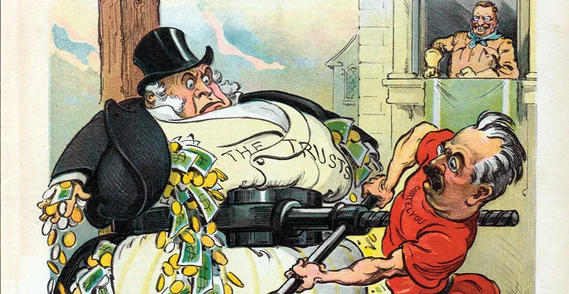
Theodore Roosevelt looks on with glee as his commerce secretary puts the screws to trusts.
(Puck magazine, Alamy Stock Photo, via The Coolidge Review)
The early twentieth century marked the height of the progressive movement, which sought to check the power of free markets and business. To understand what progressives did in the early 1900s, we need to understand what happened in the late 1800s, the period often called the Gilded Age.
After the Civil War, the United States experienced spectacular economic growth. The industries leading the way included railroads, oil, and steel. This expansion made the United States a global economic power. The profits of those businesses enriched the wealthiest — and the average American. That’s in part because bigger, more efficient businesses can offer cheaper prices. Between 1870 and 1880, for example, railroad freight prices fell by half. By 1890, they had fallen by half again. And by 1900, they had been cut nearly in half once more.
Similar advances occurred in many other industries. In the Gilded Age the United States saw perhaps the greatest burst of invention and economic development any country has ever experienced.
[…]
Progressives relied on three tools to restrain business.
The first was the Sherman Antitrust Act. Passed in 1890, this law was used sparingly for a decade. Government enforcement proved difficult in part because the act’s language was vague: the Sherman Act outlawed any contract or “combination” in “restraint of trade or commerce”. In 1895 the U.S. Supreme Court interpreted the law narrowly. In a case involving a sugar-refining business, the Court held that the Sherman Act did not apply to manufacturing. Theodore Roosevelt later wrote in his autobiography that the ruling produced “governmental impotence”.
But soon after entering the White House in 1901, Roosevelt seized on the Sherman Act to engage in “trust busting”. He directed the Justice Department to dissolve the Northern Securities Company, a railroad holding company that Hill had created. This time, the Supreme Court upheld the government’s intervention. Referring to the 1895 ruling, Roosevelt crowed, “This decision I caused to be annulled by the court that had rendered it”, giving the federal government the power “to deal effectively with the trusts”. Roosevelt’s Justice Department soon targeted Standard Oil, which was eventually broken into thirty-four separate companies.
The second tool progressives used against business was the Interstate Commerce Commission. Although railroad rates had declined dramatically for decades, progressives objected to the way those rates were structured. Railroads tended to give the largest discounts to customers that transported the most goods. The railroads still profited from these volume discounts, and smaller customers still paid much lower rates than they had earlier. But progressives argued that it was unjust for smaller shippers to pay higher rates than larger businesses.
In his 1905 annual message to Congress, President Roosevelt demanded legislation to put “a complete stop to rebates in every shape and form”. The 1906 Hepburn Act accomplished that goal. The law was expanded to give the Interstate Commerce Commission the power to inspect railroads’ financial records, eliminate targeted rebates, and set “just and reasonable” rates. In other words, the federal government now had significant pricing power over railroads, America’s largest business sector.
The progressives’ third tool was the federal income tax. In 1909 Congress approved the resolution for a constitutional amendment to establish an income tax. The Sixteenth Amendment took effect in 1913, after three-quarters of the states had ratified it. That was the year Coolidge was elected president of the Massachusetts State Senate.
From the beginning, the tax system was progressive, imposing higher rates on larger incomes. In 1913 most Americans paid no federal income taxes, while the top marginal rate — for income exceeding the equivalent of $16 million in 2026 dollars — was only 7 percent. But within five years, tax rates had soared, with the top bracket paying 77 percent.


