Britain swapped out Prime Ministers on Monday, pushing Sir Keir Starmer out to the curb and installing former Greater Manchester mayor Andy Burnham in Number 10 Downing Street. In The Critic, Robert Hutton reports on the day’s events:
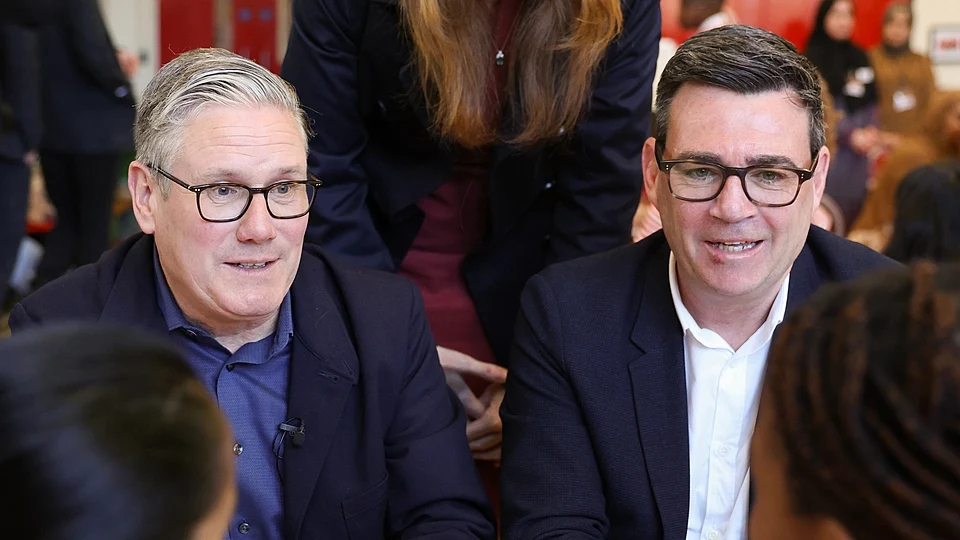
Then-Prime Minister Sir Keir Starmer visiting Holy Trinity Church of England Primary School in Manchester on 13 April 2026 with Andy Burnham, Mayor of Greater Manchester.
Picture by Lauren Hurley / No 10 Downing Street via Wikimedia Commons.
As Keir Starmer walked out of Number 10 for the last time, he was greeted by a huge cheering crowd. Wow, this guy is popular! He should consider running for office. “My work is done”, he told us, offering possibly the most misguided example of marking your own homework since George W Bush declared “Mission Accomplished” six weeks after invading Iraq. Although we shouldn’t be harsh: Liz Truss listed leading the nation in mourning the late Queen as her big achievement in office.
Starmer’s, as he pointed out yet again, was winning the election. The list of things done since then was slightly more vague. But again, Boris Johnson’s departing speech claimed credit for a high-speed train line to Manchester and a number of hospitals that still do not, as such, exist. At least Starmer could truthfully say that he was leaving “with a smile”. Was he also, as he claimed, going “with good grace”? Well, unlike Johnson, he managed to get through the speech without attacking the people who forced him out.
It wasn’t entirely cheery. His wife Victoria was wearing black, and Rachel Reeves was crying, once again. The departing prime minister warned us not to succumb to division and to “unite different people under our common flag”. Although he completely failed to help that happen while he was in office, and showed little interest in trying.
With that, he was off to Buckingham Palace, where the band was playing a medley of Bon Jovi songs. Shot through the heart, and only himself to blame, he gave Labour a bad name.
But if Starmer was going out in a blaze of inglory, the rest of us were only halfway there. While the King conducted his exit interview in the Palace’s Chinese Dining Room (imagine having a different space to eat every takeaway) we had to hold on, ready or not, through the hour in which we were without a prime minister and living, as it were, on a prayer.
Andy Burnham had put on a suit for the day, a concession to the soft southern ways of the monarch. We half-expected him to leap out of the car in Downing Street and rip off the whole ensemble, Full Monty-style, to reveal black jeans and a T-shirt underneath. Perhaps he felt that would be taking his personal branding too far.
A fresh crowd of Labour types had gathered, looking more convincingly happy than the ones who had stood behind the last guy. They included the incoming prime minister’s mum, and the youngest person present: Liverpool Mayor Steve Rotheram’s 10-week-old grandson, currently scheduled to become the King’s 49th prime minister, in about 2038.
Not everyone is as excited as Burnham’s Labour Party supporters:

In Spiked, Brendan O’Neill bids an unfond farewell to Two-Tier Keir:
Sir Keir Starmer: the PM who did nothing about the sense of doom pervading Britain, but he did ban “doomscrolling“. The man who did zilch to mend our fraying social fabric, but he did stop kids from perusing its consequences on TikTok. The man who failed – catastrophically – to alleviate that bleak feeling many of us have that Britain is broken, but he did cover the next generation’s eyes to just how broken we are.
Starmer should be remembered for his social-media ban for under-16s, that mad, illiberal law, due to come into force in spring next year, that promises to liberate youth from the angst-inducing “doomscrolling” inflicted on them by Big Tech’s wily algorithms. Not because it’s a “landmark” policy, as he claims. And not because it will be effective – kids will find a workaround. No, it’s because leaving intact the social conditions of doom while tweaking the machine so that fewer people can ‘scroll’ those conditions is Starmerism summed up: a regime of hollow theatricality, devoted more to managing the optics of crisis than mustering up the competence to avert it.
Starmer is a man without a legacy. He promised competence over charisma and delivered neither. His was a phantom premiership: government without governing. You could ask a hundred Brits to name a policy he enacted and I reckon five, at best, could do so. Even his vanishingly small number of apologists usually only squawk about what he didn’t do. He didn’t drag us into the Iran-US War. He didn’t follow through on his promise to cut the winter-fuel allowance for pensioners. He didn’t murder anyone. A man so staggeringly insubstantial that even his fans prefer his inertia to his initiative.
For me, the terrifying nothingness of Starmerism is best summed up in the fact that he recently said his “proudest achievement” was scrapping the two-child benefit cap, the Tory-introduced measure that meant families could only claim additional welfare payments for their first two kids. But Starmer opposed cutting that cap. For ages. In fact, in July 2024, he withdrew the whip from seven Labour MPs who voted to scrap it. It was only under pressure from his parliamentary colleagues that he relented. What can you even say about a man whose “proudest achievement” is a course of action foisted on him by others? That’s Sir Keir: the political weathervane who mistook a gust of wind for his own internal moral compass.