
Quotulatiousness

July 4, 2026

In the “early Victorian period … drinking whisky was the modern-day equivalent of licking hallucinogenic toads”

Filed under: Britain, History, Soccer, USA — Tags: , , , , , , , , — Nicholas @ 05:00

Scotland was terra incognita to the English for far longer than one might think, even though the two kingdoms shared a monarch as early as 1603. On his Substack, Ed West shows how modern day Scotland has long since emerged from the mysterious shadows of the past:
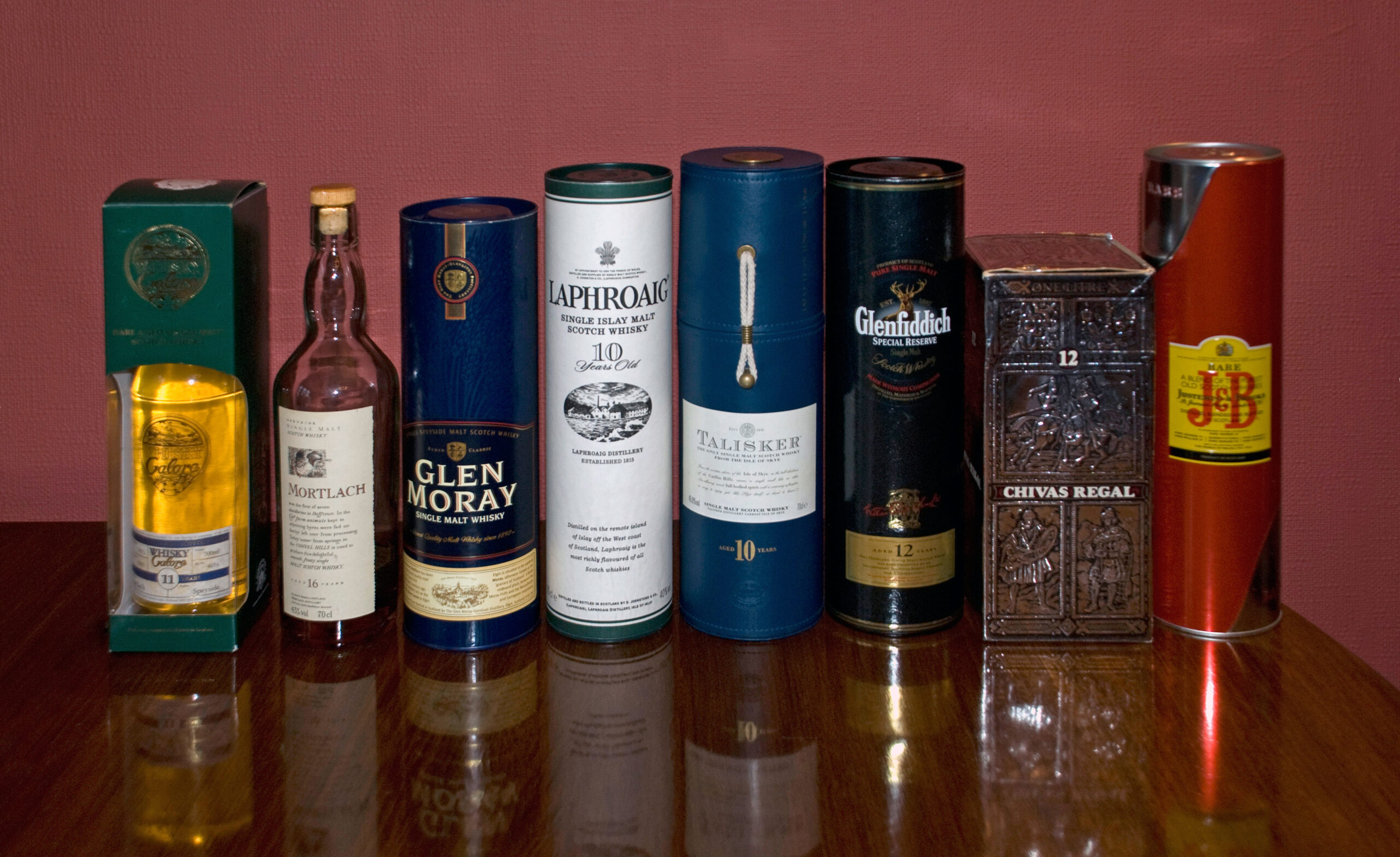
“Scotch whiskies” by Chris huh is licensed under CC BY-SA 4.0 .

In his highly entertaining history of alcohol and the British, Empire of Booze, Henry Jeffreys observed how one effect of the Napoleonic Wars was to make Scotland a popular destination for English holiday makers. What with the continent being isolated and everything, there weren’t many more exotic places for the richer, more adventurous traveller to visit.

The country was until then largely unknown to many people south of the border, something also true of its trademark drink. “Highland and lowland whisky in the early 19th century would have been a mystery to the majority of Englishmen”, Jeffreys writes: “In the literature of the Georgian and early Victorian period it’s apparent that drinking whisky while in Scotland was the modern-day equivalent of licking hallucinogenic toads while in the Amazon or eating rancid whale in Iceland”.

The conflict with revolutionary France proved to be a great boost to Brand Scotland, and not just because of the limits it placed on rival destinations, but also for the dash that the Scots cut on the field. This culminated with a momentous scene in which “the Highland regiments dazzled the French when the Allied armies marched into Paris”.

Here they wowed both friends and enemies alike, and Sergeant Thomas Campbell of the Grenadier Company recalled how the Tsar even personally “examined my hose, gaiters, legs, and pinched my skin, thinking I wore something under my kilt, and had the curiosity to lift my kilt up to my navel, so that he might not be deceived”. Thanks to the likes of the Black Watch and Gordon Highlanders, the Scots had arrived on the global stage, and no one would ever forget Die Damen aus der Hölle (Ladies from Hell) as German troops would later call Highlanders.

This period of upheaval and war – the birth pangs of true modernity — was marked by a growing craze for Highlandism, “a peculiar phenomenon where lowland Scotland, a predominantly settled mercantile society, took on the trappings of the Highlander as a way of differentiating themselves from Englishmen who they were now yoked to in the Union”.

Previously viewed as menacing, the Highlanders had been tamed by the defeat of the Jacobites and the Clearances that followed, making this once-feared Gaelic culture now safe for English speakers to adopt as their own. Much of this was driven by the romantic imagination of Edinburgh’s Walter Scott, who helped shape both Scottish national identity and the 19th century resurgence of medievalism. Perhaps more than literature, however, Highlandism was boosted by the region’s most famous export — whisky. As Jeffreys writes: “The growth of Scotch coincided with the birth of Highlandism”.

The development of Brand Scotland was also helped by a man widely regarded as Britain’s greatest buffoon and waste of space, the former Prince Regent. Historian John Plumb described a hugely influential visit by the now George IV in 1822, where: “He paraded Edinburgh in the kilt, resplendent in the Royal Stuart tartan and flesh-coloured tights, and yet managed to keep his dignity. The Scots loved it! Quaintly enough, George IV had struck the future note of the monarchy … Be kilted! Be sporans! Be tartans! Riding up Princess Street … To the roaring cheers of loyal Scots, he was showing the way that the monarchy would have to go if it were to survive an industrial and democratic society.”

It was the start of a beautifully symbiotic relationship, with the Royal Family immersing themselves in Highlandism ever since, spending much of their summer holidays there and helping to project an ideal of a region famed for its dramatic countryside, castles, distilleries and golf courses. They’re not alone: Donald Trump, whose mother hailed from the Isle of Lewis, has a noted fondness for the old country, even if this is not always reciprocated, and no doubt many more of his compatriots will be making the pilgrimage in the coming year thanks to the country’s newest brand ambassadors. These are, of course, another occupying force of Scots, the fans of the national football team who followed their country’s brief recent appearance at World Cup.

The Scots in Boston marched as proudly as their ancestors. Their bagpipers serenaded the opposition. Some even turned up at a wedding. They came to watch the Boston Red Sox, which one local described as “the best thing that’s happened in years”. They attracted many neutrals, including a duck. Folk songs were written about them. Everyone loved them, even if some struggled to understand them.

The Boston Globe published a full-page letter thanking them. One local reported how Scotland fans leaving Boston was “almost like a day of mourning for the Americans“. After they left, Massachusetts State Senator Paul Feeney made an emotional farewell, thanking them for visiting children’s hospitals and donating money to local charities: “You’ve been great, courteous guests, you’ve been polite and you’ve been fun and I don’t want that to end”. He invited them to return next year, by which time Glasgow will be twinned with Boston. Indeed, Scottish fans so impressed the Bostonians that the city changed its zoning laws, not an easy task in America. They may even have solved the fertility crisis. Indeed, the Tartan Army charm offensive in Boston has been so overwhelming that I half suspect it’s some sort of devious RICU operation.
The Dark Truth Behind America’s National Anthem

The Rest Is History
Published 8 Jun 2026

How did the War of 1812 result in America’s national anthem, The Star Spangled Banner? Who came up with it? And, why does this origin story make the anthem so controversial?

Join Dominic and Tom as they launch into the first episode of their Football World Cup special, with the story behind America’s national anthem, and its secret story.

0:00 – Lloyd’s
01:21 – The Star-Spangled Banner
02:43 – A World Cup Series on National Anthems
04:08 – America’s Most Controversial Anthem
05:00 – The Forgotten War of 1812
09:10 – Britain Strikes Back
11:39 – Francis Scott Key Boards the British Fleet
15:27 – The Bombardment of Fort McHenry
18:14 – The Giant Flag That Inspired the Anthem
20:41 – Francis Scott Key Writes the Poem
23:28 – Why the Anthem Used an Old English Tune
26:13 – The Anacreontic Song
29:07 – How the Song Became a Hit
30:37 – The Times
31:48 – Is The Star-Spangled Banner About Slavery?
36:08 – Escaped Slaves and the British Army
40:55 – The People Who Found Freedom Under the Union Jack
42:29 – Francis Scott Key’s Complicated Legacy
47:06 – The Song Spreads Across America
51:39 – Why America Took So Long to Get a National Anthem
56:42 – How It Finally Became the Anthem
57:06 – Controversial Performances
1:00:17 – Colin Kaepernick and Taking the Knee
1:02:39 – Can You Separate the Anthem from the Author?
1:03:03 – The Abolitionist Version of the Anthem
1:04:13 – Coming Next: God Save the King
1:06:33 – The Rest Is History Club

Video Editors: Jack Meek, Harry Swan + Adam Thornton
Social Producer: Harry Balden
Producers: Tabby Syrett & Aaliyah Akude
Senior Producer: Callum Hill
Executive Producer: Dom Johnson
Chief Digital Officer: Sam Oakley

“The fact that [Canadians] cannot define our values should concern every one of us”

Filed under: Cancon, Government, History, Media, Politics — Tags: , , , — Nicholas @ 03:00

While our American neighbours are busy celebrating their 250th anniversary, Canadians are still left wondering why we can’t seem to define what our own values are except in opposition to those of the United States. Eva Chipiuk discusses this briefly here:

In writing my book, Reconnect to Canada, the most difficult part was not recounting our history or explaining our political and legal systems. It was answering a simple question:

What does it mean to be Canadian?

Over the last few years, I have asked that question repeatedly.

It was clear that something fundamental had shifted, but I could never quite articulate what it was.

The responses to that question were revealing, and most telling was that there was no common answer at all.

Some said hockey. Some said healthcare. Others said diversity or simply that Canadians are “nice”.

The fact that we cannot define our values should concern every one of us.

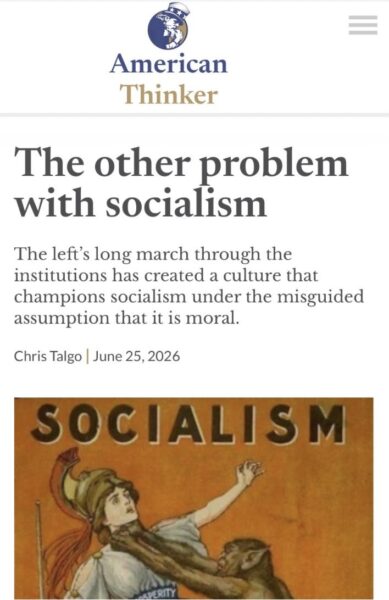
Then I came across this article, and it put things into perspective:

    Socialism, in its depraved but effective way, appeals to people’s worst instincts and impulses. It presents the world as a zero-sum game in which there are winners and losers. It pits groups of people against each other based on arbitrary measures. For the narrow-minded, it makes sense.

    It embodies most of the seven deadly sins.

    Pride: Socialists have zero humility because they reject the fallibility of humanity. They can micromanage an entire society. They can create a centralized, one-size-fits-all, command-and-control utopia. They know all and know best.

    Envy: Taking one’s property because they have too much to give to others who have less is not noble; it is theft. Stealing with state-sanctioned approval is unjust. The sheer resentment that some have more, better, or bigger material possessions is the driving force of socialist ideology.

    Wrath: Socialist doctrine fuels anger, rage, violence, and a desire for vengeance against the so-called oppressors. Instead of mimicking the successful, the people turn their ire toward them.

    Sloth: Because socialism is about passing the buck and the blame, it excuses idleness and promotes laziness. It allows one to shirk personal duties and retards personal growth.

The uncomfortable truth is that Canada increasingly reflects these traits, yet we refuse to acknowledge it.

We insist we are compassionate while shaming and disparaging those who hold different opinions.

We claim to value equality while encouraging envy.

We preach inclusion while dividing Canadians into competing groups.

We speak of unity while constantly finding new reasons to divide ourselves.

We demand accountability from everyone except the government.

We expect government to solve problems that citizens, families, communities, and free people once solved themselves.

Worst of all, we have become experts at pretending none of this is happening.

We congratulate ourselves on being tolerant, generous, and virtuous while our institutions fail, productivity declines, public debt explodes, trust evaporates, and Canadians become more divided than they have been in decades.

That is not something to celebrate.

It is something to confront.

If Canadians can no longer articulate what it means to be Canadian, perhaps it is because we have abandoned the principles that once defined us: freedom, personal responsibility, hard work, accountability, respect for the rule of law, and service to one another rather than dependence on the state.

You do not need to take my word for it.

Just open your eyes. Look around!

A country does not lose its identity overnight. It loses it one abandoned principle at a time.

A nation without shared values eventually becomes little more than a collection of people living within arbitrary borders.

So if we are going to celebrate Canada today, let us celebrate the principles that made this country worth celebrating in the first place and commit ourselves to restoring them where they have been lost.

Flag image candy for the 4th of July

Filed under: Food, History, USA — Tags: — Nicholas @ 02:00

Lofty Pursuits
Published 13 Jun 2018

At Lofty Pursuits we make hard candy using techniques and equipment from the 1800’s. Here we are making Blue Berry and Strawberry shortcake candy in a pattern inspired by the American flag for flag day and the 4th of July. This is one of our most complex designs as it does not have an outer wrap. The video covers some fun bits about the history of the American Flag.

Get our candy here: http://www.pd.net

QotD: “Yankee Doodle”

Filed under: Britain, History, Italy, Media, Quotations, USA — Tags: , , , — Nicholas @ 01:00

Everyone in America knows “Yankee Doodle”. That is a remarkable thing to be able to say about any piece of music, let alone one written in the middle of the eighteenth century by a British army surgeon who meant it as an insult. Most of us learned it before we learned to read. It arrives through some combination of school, parade, ice cream truck, and the ambient cultural air of the American summer, and by the time you can name it you already know it. You know the melody before you know the words, and you know the words before you know what any of them mean. A feather. A pony. Macaroni. A young man coming to town. It is the most familiar song in the American songbook and also, when you actually look at it, one of the strangest.

[…]

Which is how we ended up with a patriotic standard that is also a death threat, a sodomy joke, a farm boy’s account of watching grown men handle their enormous guns with mounting enthusiasm, and the song we teach five year olds at Fourth of July parades. All of this has been inside the song the whole time. I want to walk through what is actually in there, because once you can see it you cannot stop seeing it, and I think we owe the song more than we have been giving it.

Start with the title, because the title is already doing two things at once. “Yankee” is almost certainly from the Dutch Janke, a diminutive Dutch settlers in New York used to mock their English neighbors. The British army picked it up as convenient shorthand for a provincial American. A rube. A man of no consequence. “Doodle” meant fool, from the German dudel, and this is the part that makes it into the elementary school music program. The part that does not is that “doodle” was also eighteenth-century British slang for a penis. Both meanings were in active circulation. Neither was obscure. When the British handed this song to their regulars as a marching tune intended to demoralize the enemy, they were calling the colonists provincial idiots and, on a second pass, Yankee dicks. The American troops heard the title and, in the great tradition of men who have already stopped caring what anyone thinks of them, said yes, that one, put it on the flag.

The first thing the song was is a threat.

    Yankee Doodle’s come to town / For to buy a firelock / We will tar and feather him / And so will we John Hancock.

British soldiers were singing verses like this one in the run-up to Lexington. Tar and feathering was not a prank. It was a ritual. Men were stripped, had boiling pine tar poured directly onto bare skin, rolled in feathers while the tar was still cooling, and paraded through town as public spectacle. The skin came off with the tar. Some victims died in the days that followed from shock and from infections in the raw flesh. The British soldiers are singing about doing this to a specifically named man. John Hancock. The wealthiest man in Boston, already on London’s list for arrest. “So will we John Hancock” uses his name as a verb. We will do this to him. We will use his body to make a point.

The soldiers singing this were on their way to arrest him. They missed. Hancock got through Lexington, made it to Philadelphia, and in the summer of the following year signed the Declaration of Independence in letters so large that his name became, in English, the common noun for a signature. The verb became the noun. We will destroy you publicly became I was here, I did this, come and get me. The song that had been a mob-violence threat against a living dissident was now, a year later, being sung by the men who had saved him as they mustered for the same war. The target of the verse became the architect of the country that kept the verse. This is the first transformation the song undergoes and it is not subtle. It is also not the last.

The second thing the song is is a sodomy panic. He stuck a feather in his cap and called it macaroni. Every American schoolchild has been told this means the colonist was too stupid to know what fashion was. That is the sanitized reading. The full reading requires understanding what the Macaroni Club was. Young English aristocrats came back from the Grand Tour in Italy wearing wigs so tall they required structural adjustment to pass under a doorframe, corseted coats, embroidered slippers, and Continental affectations so pronounced the London press began printing caricatures of them within the year. “Macaroni” meant dandy, in the same dictionary-accurate way “doodle” meant fool. Technically correct. Missing the entire point.

The point is that the Macaroni Club had become, by the 1770s, a convenient public container for British anxieties about male effeminacy, foreign moral contamination, and sodomy. The caricatures drew them in pinched silhouettes and muffs, in poses the London audience was supposed to read as unmistakably queer. The courts were not caricaturing. They were prosecuting. Men were pilloried. Others were executed. The word “macaroni” was carrying the weight of active criminal cases at the exact moment “Yankee Doodle” was being composed. A British army surgeon named Richard Shuckburgh is the likely author of the most famous macaroni verse, and what he wrote was a joke with a second floor. On the ground floor: the colonial rube does not know what high fashion is and mistakes a single feather for an entire wardrobe. On the second floor: the colonial rube has just put on the signifier of a group of men the British state is currently prosecuting for sodomy, and he does not realize what he has announced himself as. He is a joke to the troops singing the song, and the joke is that he is queer and does not know it.

The colonists heard all of this and kept the song anyway. The British were banking on a shame that had already dissolved. You cannot humiliate a people that has stopped needing your approval. The song arrived as an instrument of British contempt, and the colonists adopted it anyway, and from that moment on it stopped being a British song and started being something else. A vessel. Whatever the singer needed it to carry, the song carried. That is the reclamation, and it is also the engine of everything that happens to the song from here.

Emma, “Yankee Doodle, Undressed”, Past Life, Present Cleavage, 2026-04-22.

Powered by WordPress



