Quotulatiousness

July 13, 2026

Canada’s performative “grand strategic pivot away from the United States”

Filed under: Cancon, Economics, Government, Middle East — Tags: , , , , — Nicholas @ 06:00

On the social media site formerly known as Twitter, L. Wayne Mathison provides the statistics to show that Prime Minister Carney’s big meeting with the Saudi Arabians is much more sizzle than steak:

Mark Carney wants Canadians to believe that courting Saudi Arabia represents some grand strategic pivot away from the United States.

The numbers expose the performance.

Saudi Arabia purchased roughly $1.3 billion in Canadian goods in 2025. Canada exported about $779 billion worldwide. That makes Saudi Arabia approximately 0.17 per cent of Canadian exports. It is a rounding error being marketed as an economic transformation.

Meanwhile, the real Canadian economy is voting with its money.

A new KPMG survey found that 57 percent of Canadian manufacturers have paused, reduced or cancelled capital investments. 42 percent have moved production to the United States or are considering doing so. Nearly one-third have already shifted at least some production south, and 61 percent say their businesses cannot survive without access to the American market.

That is the real Carney record: photo opportunities with Saudi royalty while Canadian factories, investment and future production quietly head for the border.

Ottawa keeps talking about “diversification”, but markets do not follow Liberal press releases. Capital goes where taxes are competitive, regulations are predictable, projects can be approved, energy is affordable and customers are close.

The latest trade figures make the point painfully clear. Canadian exports rose for the fourth consecutive month in May, driven by a 1.5 percent increase in exports to the United States. American-bound exports reached their highest level since February 2025 and still represented almost 70 percent of everything Canada shipped abroad. Exports to non-U.S. markets continued to shrink.

Canada should absolutely pursue new customers. But Saudi Arabia cannot replace an integrated continental market of more than 330 million people sitting directly beside us.

You do not reduce dependence on the United States by weakening Canadian competitiveness and watching manufacturers relocate there. You build Canadian strength first, then expand outward from a position of confidence.

Carney and the Liberals are doing the opposite.

They are allowing Canada’s productive base to erode while selling diplomatic tourism as economic strategy. They are chasing Saudi sovereign wealth while Canadian capital sits idle, scales back or leaves.

That is not diversification.

It is economic decline wearing a tailored suit and carrying a diplomatic passport. 🤡🌎
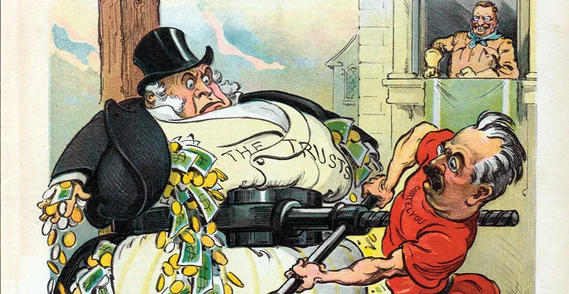
Teddy Roosevelt versus the “Robber Barons” of the Gilded Age

In the Coolidge Review, Burton W. Folsom, Jr. outlines the way President Teddy Roosevelt and his Progressives tried to rein in the wealthy industrialists who had helped create the Gilded Age:

Theodore Roosevelt looks on with glee as his commerce secretary puts the screws to trusts.
(Puck magazine, Alamy Stock Photo, via The Coolidge Review)

The early twentieth century marked the height of the progressive movement, which sought to check the power of free markets and business. To understand what progressives did in the early 1900s, we need to understand what happened in the late 1800s, the period often called the Gilded Age.

After the Civil War, the United States experienced spectacular economic growth. The industries leading the way included railroads, oil, and steel. This expansion made the United States a global economic power. The profits of those businesses enriched the wealthiest — and the average American. That’s in part because bigger, more efficient businesses can offer cheaper prices. Between 1870 and 1880, for example, railroad freight prices fell by half. By 1890, they had fallen by half again. And by 1900, they had been cut nearly in half once more.

Similar advances occurred in many other industries. In the Gilded Age the United States saw perhaps the greatest burst of invention and economic development any country has ever experienced.

[…]

Progressives relied on three tools to restrain business.

The first was the Sherman Antitrust Act. Passed in 1890, this law was used sparingly for a decade. Government enforcement proved difficult in part because the act’s language was vague: the Sherman Act outlawed any contract or “combination” in “restraint of trade or commerce”. In 1895 the U.S. Supreme Court interpreted the law narrowly. In a case involving a sugar-refining business, the Court held that the Sherman Act did not apply to manufacturing. Theodore Roosevelt later wrote in his autobiography that the ruling produced “governmental impotence”.

But soon after entering the White House in 1901, Roosevelt seized on the Sherman Act to engage in “trust busting”. He directed the Justice Department to dissolve the Northern Securities Company, a railroad holding company that Hill had created. This time, the Supreme Court upheld the government’s intervention. Referring to the 1895 ruling, Roosevelt crowed, “This decision I caused to be annulled by the court that had rendered it”, giving the federal government the power “to deal effectively with the trusts”. Roosevelt’s Justice Department soon targeted Standard Oil, which was eventually broken into thirty-four separate companies.

The second tool progressives used against business was the Interstate Commerce Commission. Although railroad rates had declined dramatically for decades, progressives objected to the way those rates were structured. Railroads tended to give the largest discounts to customers that transported the most goods. The railroads still profited from these volume discounts, and smaller customers still paid much lower rates than they had earlier. But progressives argued that it was unjust for smaller shippers to pay higher rates than larger businesses.

In his 1905 annual message to Congress, President Roosevelt demanded legislation to put “a complete stop to rebates in every shape and form”. The 1906 Hepburn Act accomplished that goal. The law was expanded to give the Interstate Commerce Commission the power to inspect railroads’ financial records, eliminate targeted rebates, and set “just and reasonable” rates. In other words, the federal government now had significant pricing power over railroads, America’s largest business sector.

The progressives’ third tool was the federal income tax. In 1909 Congress approved the resolution for a constitutional amendment to establish an income tax. The Sixteenth Amendment took effect in 1913, after three-quarters of the states had ratified it. That was the year Coolidge was elected president of the Massachusetts State Senate.

From the beginning, the tax system was progressive, imposing higher rates on larger incomes. In 1913 most Americans paid no federal income taxes, while the top marginal rate — for income exceeding the equivalent of $16 million in 2026 dollars — was only 7 percent. But within five years, tax rates had soared, with the top bracket paying 77 percent.

A Fair Reading of The Camp of the Saints

Filed under: Books, France, India, Media, Politics — Tags: , , , , , , , — Nicholas @ 04:00

Feral Historian
Published 10 Jul 2026

Jean Raspail’s 1973 novel The Camp of the Saints has gone from obscurity to infamy in recent years, drawing condemnation for its highly … unflattering depiction of third-worlders. Much of this condemnation comes from people who haven’t read it, or gave it only a shallow and cursory read. But if we let the book speak for itself it can be quite insightful at times, and the true target of its scorn becomes brutally evident.

Rather than use politically-charged b-roll, it’s all hiking shots this time. Mostly to cover some edits. This is a great one for those who listen to these on the commute. Or the commode as the case may be.

00:00 Intro
01:03 The Story
14:22 Escalation Curve
17:38 Hamadura and “Whiteness”
22:05 Culture and Ethnicity
26:33 Why so Serious?
30:09 The End of a World
34:14 Your Virtual Right-Wing Uncle
35:48 A “Martian” Perspective

🔹 Patreon | patreon.com/FeralHistorian
🔹 Ko-Fi | ko-fi.com/feralhistorian
🔹 and Merch! | feral-shop.fourthwall.com
🔹 Oh, and book 2 of Stellar Drift is out. https://www.amazon.com/dp/B0GTVXK4CN

Larry Correia’s trailer park elves

Filed under: Books, Humour — Tags: , , — Nicholas @ 03:00

On X, Larry Correia explains the genesis of a group of characters he created in his Monster Hunter International series:

I’ve been talking to this pathetic, race obsessed loser, bitter failure of a wannabe writer for a while, but it did remind me of the fun story of where MHI‘s trailer park elves came from.

This dork thinks it is because I’m racist against white people or some shit, but it is actually a lot simpler. I was in the bedroom, typing on my laptop. I was working on the beginning of MHI and still figuring out this whole writing thing.

My wife was in bed reading a fantasy novel. She sighs and puts the book down. I ask what’s wrong, and she says “Elves are always the same. It’s so boring. Authors just keep rehashing Tolkien elves over and over. They’re all wise and beautiful and eternal and blah blah blah. Just once I’d love for them to do something different! Why can’t there be, I don’t know … redneck elves or something?”

And the light bulb went on because she said this to a guy who’d lived in some poor areas in Alabama and Mississippi and had a blast. And that night I wrote the Enchanted Forest Trailer Park scene.

The part where the dog pees on the outside couch, and they just flip the cushion over and tell you to have a seat, true story. 😀

Contrary to what this woke loser thinks, I love rednecks. I think they’re hilarious and awesome and I appreciate the culture of being rowdy and not giving a shit while being ready to fight at the drop of a hat. Anybody who has read the series knows MHI is filled with bad ass southerners. Just like the woke left appointed themselves “speakers for the marginalized” this asshole is the same. I never bent the knee to the woke left, and my answer is the same to the woke right. Fuck off.

Meanwhile I go to the south and people love this stuff. Only humorless dolts get butt hurt over the Enchanted Forest, because the rest of us have been there! We know those guys. That’s what makes it fun.

The elves gave me the idea, what if every mythological race from the old world adopted an American subculture once they got to the US? Which gave us orcs, gnomes, minotaurs, dragons, cyclops, all adopting some culture. I’ve had a lot of fun with that over the series.

And the culture has got to be a twist on what’s expected. That is what makes it interesting. It goes back to what my wife said back in 2007. This prick is crying how come the elves are WHITE?! Tolkien, that’s why. And why is one FAT?! Why are they POOR?!? Did you make the other races fat and poor and use them for comedy relief or just the WHITE ONES?

Well A. stupid obviously never got to the gnomes, and B. it is because, elves are supposed to be beautiful and immortal and awesome. If I wrote a dwarf as fat and drunk that’s not interesting because that’s NORMAL, and doesn’t fit the established nature of the setting where traditional stuff goes sideways when it gets here. Duh.

This explanation is for my fans. Not this dork. I don’t think he’s smart enough to explain anything to.

The Tool That Changed Woodworking – the Stanley 42

Filed under: History, Tools, USA, Woodworking — Tags: , , , — Nicholas @ 02:00

Wood By Wright How To
Published 12 Mar 2026

The Stanley 42 came before the 45 or 55, and it is a fascinating tool!

QotD: They took away recess – and then wondered why boys struggled

Filed under: Education, Health, Quotations, USA — Tags: , , — Nicholas @ 01:00

For years, schools have acted as though more learning comes from more sitting, more compliance, more desk time, and more control.

But children do not learn best by being treated like machines.

And boys, especially, often do not thrive when movement, noise, spontaneity, and unstructured play are stripped from the school day.

One of the revealing things about modern education is how casually it has pushed recess aside. What was once understood as a normal and necessary part of childhood is now often treated as expendable — a frill, a reward, or a distraction from the “real work” of school. But the research points in the opposite direction. Recent reviews continue to find that recess is associated with academic and cognitive benefits, behavioral and emotional benefits, physical benefits, and social benefits. The strongest modern claim is not that recess is a magic cure for every school problem, but that it helps children function better and does so without harming academic achievement.

That matters for all children.

But it matters in a special way for boys.

Not because girls do not need recess. They do. But many boys are more movement-driven, more physically expressive, and more likely to regulate themselves through action. A school culture built around prolonged stillness can turn normal boyhood into a problem to be managed. Then, when boys struggle under those conditions, the system acts as though the flaw lies in the boy rather than in the environment. Recent research continues to find sex differences in recess physical activity, with boys on average being more physically active during recess than girls.

Tom Golden, “They Took Away Recess – And Then Wondered Why Boys Struggled”, Men Are Good, 2026-04-06.

Powered by WordPress