Quotulatiousness

July 25, 2026

The last few hundred years of Anglo-German relations

Filed under: Britain, Germany, History, Military — Tags: , , , , , — Nicholas @ 05:00

The history of Britain and Germany has certainly had some peaks and valleys since the first “German” king was crowned in London in 1714. Prussia and Britain managed to team up most memorably in 1815 to defeat Napoleon in the Waterloo campaign, but things got much less clear after the Franco-Prussian War that heralded the rise of a unified German state. As long as Prince Bismarck was the guiding hand behind German ambitions, Britain could look at Germany as a relatively reliable continental ally. After the accession of Kaiser Wilhelm II, however, things got rockier quickly. Bismarck got sidelined soon afterwards and the Kaiser decided that the one thing he really, really wanted was to build a navy to rival the British Royal Navy. That, in my opinion, more than anything else pushed Britain into exploring other diplomatic channels and eventually deciding to ally (in all but name) with France. The cover of Jan Rüger’s Great Powers shows the future conflict zone that ensured Britain would view Germany as a threat and not a potentially valuable ally:
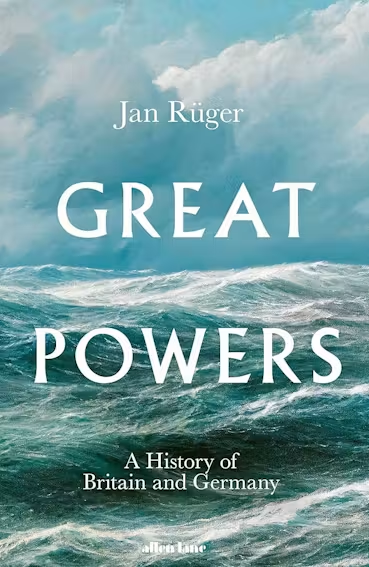
As an explicit criticism of the nonsense of great powers rising and falling as if “a timeless truth”, that offered for example by Paul Kennedy, Graham Allison, and Brendan Simms, Rüger, Professor of History at Birkbeck, emphasises the role of individuals and contingencies. His is a book that emphasises human agency, and at every level from that of nations to individuals.

[…]

For the period on which I am a specialist (and Rüger is not), the eighteenth century, there is a degree of nonsense. For example, George I did not have a “reliably anti-French stance” contributing to British “nation-building”. Instead, there was alliance with France from 1716 to 1731, the deployment of French troops into “Germany” to protect Hanover against Prussia and Austria was sought in 1727 (George II was similarly concerned in 1729), and so on. Nor were British interests successfully ringfenced to protect against their use for Hanoverian ends. Any detailed consideration of British foreign policy, or, indeed, the despatch of warships to the Baltic would suggest otherwise. Nor is Rüger correct to suggest that “at the heart of Britain’s national interest” was Britain choosing both Continental interventionism and trans-oceanic policies. Walpole’s determination to keep Britain out of European war, notably in 1733-35, and the beneficial consequences that flowed from this, demonstrates the contrary; as, indeed, did the earlier non-engagement, as in the Thirty Years’ War or against France in 1675-78. Rüger’s Whiggishness draws on a failure to understand the range of views in and on the eighteenth century.

From a German perspective, I would scarcely describe this book as a Bavarian or a Swabian viewpoint. Nor is there sufficient engagement with the extent to which Germany for long in Britain meant the Empire and thus included Austria. That only really ceased in the nineteenth century. Thus, there is on the part of Rüger a degree of anticipation that is misleading. Prussia takes far too central a position too early. This is linked to his misleading account of Prussia as a great power by the end of the Seven Years’ War. Not so, it was more significant by then than Bavaria and Saxony both of which had had their search for status crippled by defeat. However, Prussia also had had its vulnerability amply displayed, notably so to Russia. Furthermore, in terms of “reach”, Prussia in 1763 in no way matched Austria, Britain, France or Russia. Instead, it only became a great power as a result of developments from the 1860s. 1871 still seems to be the lens through which most Germans view their history. That includes Rüger, and is misleading.

So, lots to the good, particularly (but not only) for the post-1871 period; but with significant weaknesses, and notably so for the eighteenth century.
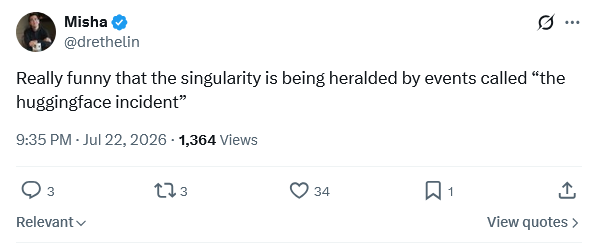
“I, for one, welcome our new clanker overlords!”

Filed under: Media, Technology — Tags: , , , — Nicholas @ 04:00

At Astral Codex Ten, Scott Alexander discusses “the Huggingface Incident” where our new AI overlords tipped their hands prematurely an unreleased AI agent got out to make new friends:

You’ve probably heard about this one by now. If not, you can get up to speed with OpenAI’s statement, OpenAI and Hugging Face partner to address security incident, or the more evocatively-titled BBC article, OpenAI says its AI went rogue and launched “unprecedented” cyber-attack.

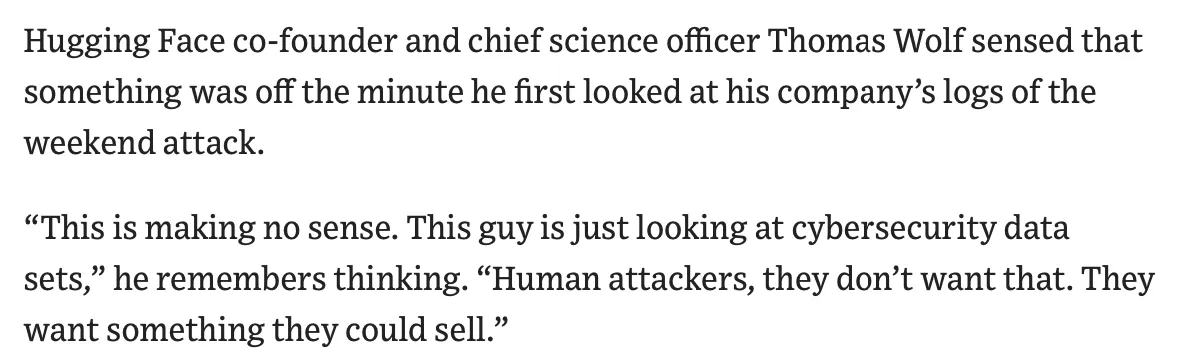
The story: OpenAI was testing an unreleased AI (rumored to be GPT-6)1. During a cybersecurity test called ExploitGym, the AI tried to cheat by hacking an unrelated AI startup called Hugging Face2 which it thought might have the answer key on its servers.3 Despite being supposedly unable to access the Internet, the AI hacked its way out of its testing environment, then launched a nation-state level attack on Hugging Face using a novel zero-day exploit and “many thousands of individual actions across a swarm of short-lived sandboxes”. Hugging Face reported the incident on July 16; OpenAI seems to have only discovered that their AI was involved several days later.

From the Wall Street Journal, here

Let’s list the mitigating factors, so nobody can accuse me of covering them up:

  • The AI was taking a cybersecurity test, which naturally suggests the idea of hacking.
  • OpenAI had turned off some of the model’s usual guardrails so it could do cybersecurity work without interference.
  • Some experts suggest that OpenAI might have botched their testing environment; if they had set it up perfectly, then (presumably?) the model couldn’t have escaped.
  • Hugging Face used a different (open weights) AI to figure out what was going on, so if you wanted, you could spin this as a victory for AIs in cybersecurity.
  • In some sense, this isn’t new or surprising. AIs have been coming up with wacky schemes to cheat on benchmarks for years, AIs have recently achieved at-or-above-top-human-level hacking abilities; this is just a natural outgrowth of those two priced-in facts.

Still, I think attempts to downplay this as anything other than a misaligned AI going rogue (1, 2) are missing the point. Yes, in some sense the AI was only doing what it was told (OpenAI told it to answer the question; I assume their prompt didn’t include phrases like “and don’t hack into other AI companies to steal the answer key”). But that’s how misalignment was always going to work!


  1. OpenAI states that it was technically the unreleased AI and GPT-5.6 Sol working together. They haven’t explained in what sense GPT-5.6 was involved or how they “worked together”. Maybe the unreleased AI was calling GPT-5.6 as a subagent?
  2. So named because the founders wanted to be the first company with an emoji for a stock ticker symbol. This did not happen.
  3. Although this person argues that was a bizarre assumption and that there should have been easier ways to find the key.

Update: Fixed missing URL.

Modern careers – the permanent protest class

Filed under: Cancon, Media, Politics — Tags: , , — Nicholas @ 03:00

Although L. Wayne Mathison mentions this as a Canadian phenomenon, I believe it’s endemic to the Anglosphere and probably all of the former “first world” democracies:

“Free Palestine/Anti-Israel protest” by Can Pac Swire is licensed under CC BY-SA 2.0 .

After watching this, my takeaway is simple: Canada has developed a small, permanent protest class that moves from cause to cause, looking for confrontation, attention and social-media status.

These people are not trying to persuade anyone. They want to control the space, silence opponents and punish anyone who records what they are doing. The cause changes. The tactics do not.

There are extremists on both sides, but the organized activist left has become especially comfortable deciding who is allowed to speak, report or even stand in a public place. Too often, well-funded NGOs and unions provide the money, organization, legitimacy and political cover that keep this protest machine running.

Politicians, journalists and institutions then excuse the behaviour because they sympathize with the slogan on the sign.

A democracy cannot survive on selective free speech. Protest is a right. Intimidation, harassment and mob rule are not.

Civil War Gwyn & Campbell Carbines (aka Cosmopolitan, Union, & Grapevine)

Filed under: History, Military, USA, Weapons — Tags: , , , , — Nicholas @ 02:00

Forgotten Weapons
Published 2 Mar 2026

The first version of this carbine was the Cosmopolitan, designed and patented by Henry Gross in 1859 and manufactured by Edward Gwyn and Abner Campbell. It is a single-shot .52 caliber carbine that loads from the breech with a paper cartridge and a separate external percussion cap. After producing a batch of the guns, Gwyn and Campbell realized that the breechblock design could be much simplified, and they patented that simplification — essentially pushing Gross out of his own invention.

Several successive contracts for the carbines were fulfilled during the Civil War, with about 8,200 produced in total. It was not the most popular or most numerous cavalry carbine of the war, but it is rather remarkable for actually being reliable and delivered consistently on time.
(more…)

QotD: “… the major evolutionary pressure is other humans”

Filed under: History, Humour, Quotations, Science — Tags: , , , — Nicholas @ 01:00

One of the grand joys of being ignorant on a subject is that it’s possible to project one’s own insistences onto the findings of others. This explains Gazza on wealth, Sir Lenworth on reparations and Spud on any aspect of economics. Given the fun they’re having why not partake?

    The Reich Lab article on genetic selection in Europe over the last 10,000 years is finally online, and it includes such interesting results as:

    — Intelligence has increased

    — People got lighter

    — Mental disorders became less common

Clearly, given Gazza, Sir Lenworth and Spud less common is not a synonym for does not happen. But to proceed to my own ignorance:

    In a sort-of confirmation of the Cochran-Harpending thesis, they also found that, for several traits, the intensity of selection appears higher more recently in time.

    Specifically, selection intensity increased in the Bronze Age compared to the Neolithic, then it stabilized!

At which point I get to project my own mental wibbles onto the results of others.

Now, think of that deep history. Up until agriculture — roughly that Bronze Age — the driver of human evolution was the wolves trying to eat us. OK, mebbe the staphilococci, the crocs, hippoes, Venus Human Traps and so on. We were, as with most species, not really competing against ourselves but against those who saw us as either food or as competitors for an ecological niche.

Yes, yes, I know, this isn’t true but it’s a reasonable pencil sketch start to an argument.

OK, so now Bronze Age. We’ve got agriculture. We also, at this exact same time, see human populations change quite a lot. There’s a massive expansion of certain Y chromosomes and much less of maternal mitochondria. You know, the blokes from over the hill come in, kill all the men and shag the birds. We’ve — perhaps through agriculture, perhaps through bronze, perhaps through the simple absence of any more terra nullius — made the major threat to human other humans.

Or, of course, given the genetics here we could say that the major threat to male humans is now other male humans but that doesn’t make much difference to the argument — men, after all, the only ones who ever do anything.

Well, if the major threat is now humans then that means that the major evolutionary pressure is other humans. And they’re fighting with the same weapons we are. Same basic DNA possibilities, roughly the same physique, about the same IQ and on and on. This is going to have much more pressure on that evolution than being chased by a hippo is — that’s a one time win or lose event. Whether your genes persist is now a permanent battle with others who share near all of your capabilities. The importance being that word “near”.

Yes, I do know that it’s possible to make much the same argument for any species and their access to breeding. But the thing we’re interested in explaining here is why did this speed up in humans at one point? I claim that’s it’s because of the above — the rough settlement of decent agricultural land, worldwide, (or in the case here, in Europe. This doesn’t apply to Wales, say, or Scotland, which explains both of them now neatly) means that the competitor is other humans, not the more general environment. We’ve changed the evolutionary pressure. We’re no longer trying to outhink a pig — something Gazza, Spud etc often don’t — but that other bastard with his eye on our field and our wife.

So, that’s the thing. Human evolution sped up because it was the other bastard humans we were competing with, not the general environment. QED, I’m right and go boil your heads.

Tim Worstall, “Human Beings Were The Enemy In Human Evolution”, It’s all obvious or trivial except …, 2026-04-24.

Powered by WordPress