
Quotulatiousness

July 16, 2026

“Only fans – Europe’s approach to air conditioning”

From the free-to-cheapskates portion of Ed West‘s most recent article on his Substack:
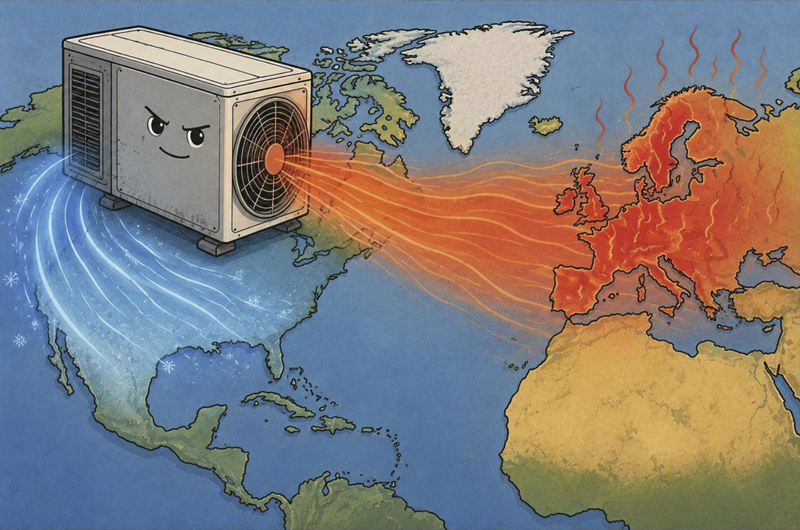
The EU may not actually believe this, but they thought you would …

Different climates have enjoyed advantages at different points in time. For most of history, industry and scholarship in southern Europe benefitted from significantly longer hours of sun and daylight much of the year compared to the north, allowing for more hours of work and study. James Belich noted in The World the Plague Made that this all changed with the expansion of the Basque whaling trade in the late medieval period, providing cheap wax for candles.

England and the Netherlands subsequently overtook the south in their levels of literacy, a transformation usually attributed to Protestantism, although this technical solution to a physical disadvantage certainly helped. As the northern countries grew richer, and were able to use more energy, so the climate came to be an advantage. Cooler areas of Europe in particular benefitted from a relative absence of vector-borne disease, dangerous insects and food poisoning, which made hotter regions of the world more lethal.

Yet the biggest curse of the lower latitudes is that heat makes us sluggish — since people struggle to work above 23° centigrade. As Maarten Boudry writes on his substack, “For every degree above 25°C (77°F), our cognitive performance declines by around two percent. And if synapses suffer, so does economic activity. At 30°C, office performance drops by almost 9 percent.”

I see that. I’ve been trying to write this in temperatures of up to 34°, which equates to a production level similar to a moderate hangover. If only there was some sort of technology that could make my home cooler.

Until relatively recently the world was dominated by a handful of relatively cold regions, and Paul Johnson observed in his history of the United States that human industry thrives in what Fahrenheit appreciators would call “the 60s”, a Goldilocks zone that turned New England and Greater Yankeedom into a powerhouse. The southern states, in contrast, were held back by higher mortality and the impossibility of productive work in the sweltering summer months, and until the mid-20th century were about 40 per cent poorer than the Union states.

The northerners were especially known for their work ethic and their inventiveness, a characteristic epitomised by the Boston-born Benjamin Franklin. Then in 1902, New York’s Willis Carrier changed everything with the one of the most world-changing inventions, the air conditioning unit; aircon has notably shifted population and power in the US southwards, but Dixieland is just part of a broader, global “sunshine belt”.

Among the most notable beneficiaries of this technology are the financial powerhouses of Dubai and Singapore. Lee Kuan Yew famously said of air conditioning that it was “perhaps one of the signal inventions of history. It changed the nature of civilization by making development possible in the tropics … The first thing I did upon becoming prime minister was to install air conditioners in buildings where the civil service worked.” Indeed, it has often been noted as characteristic of the city-state that the aircon is usually set to icy levels, reflecting their determination to be on work mode throughout the day.

While Singapore is the most famous beneficiary of Carrier’s invention, Japan has almost universal air conditioning, with 91 per cent of homes equipped, compared to 88 per cent in the US. China is home to more than 500 million aircon units, is the world’s largest manufacturer, and has also seen an economic shift towards the south. Vietnam, also likely to be a major economic power by mid-century, is as dependent on this technology as it is on its people’s ingenuity. The development of aircon, and medical breakthroughs in the treatment of tropical diseases, has shifted the centre of gravity away from the cold regions of the earth — just as the globe is warming up.

This year’s European heat wave, still ongoing, saw temperatures reach 37 last month in England, a June record. Many schools shut early, although one in Kent instead used air raid tunnels to teach children. London’s Central Line hit 39.4c, presenting a real risk of heat stroke.

Across Europe the hot weather has closed down not just schools but factories, offices and rail lines, and led to an estimated 10,000 deaths, with France top of the heat mortality charts. Indeed as Boudry writes, Europe has the worst heat-related excess deaths of any region — while fatalities in the US have declined by 75 per cent since the adoption of air conditioning.

Update, 17 July: Welcome, Instapundit readers! Have a look around at some of my other posts you may find of interest. I send out a daily summary of posts here through my Substackhttps://substack.com/@nicholasrusson that you can subscribe to if you’d like to be informed of new posts in the future.
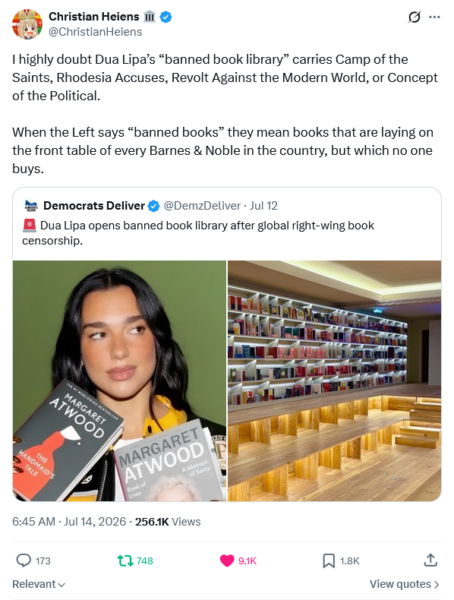
“Banned” book library in a Portuguese bookshop

Filed under: Books, Europe, Media, Politics — Tags: , , , , , — Nicholas @ 04:00

Most people are at least a bit uncomfortable with censorship, at least when the censors get into the swing of things and start banning ordinary books and authors. I had to check Wikipedia to find out who Dua Lipa might be as I hadn’t heard of her before, so the name popping up in headlines about her bold anti-censorship actions didn’t tell me much. I think I’m safe in assuming that Ms. Lipa is fully read-in on all the fashionable concerns of the celebrity set, so it’ll be easy to predict the works her library will feature:

The moment I heard Dua Lipa was curating a list of “banned” books, the first thing I knew for certain was that these books would definitely not be, in fact, banned.

For a start it’s a tautology to point out that if they were banned she couldn’t easily get hold of them and display them in a famous bookshop (Livraria Lello in Porto).

Secondly, there’s zero chance a famous mainstream pop star would decide to obliterate her career with anything genuinely controversial. “The Dua Lipa David Irving Collection” would make a funny meme — as when dense and edgy political viewpoints are jokingly attributed online to Sydney Sweeney or Lana Del Rey — but it would likely not be much of a career boost.

And thirdly, I am dimly aware of similarly-named sections in high street bookshops, which invariably contain the least banned books on the planet.

Hence I was able to guess much of Lipa’s list without even seeing it (A Clockwork Orange, 1984 etc.), yet it turned out to be even more mainstream than I imagined. These are books I studied at school (The Handmaid’s Tale) and university (Invisible Man, Things Fall Apart).

Which doesn’t mean they’re all bad, nor do I really mind that they weren’t all literally banned. As Vogue Adria explains: “The collection also includes books that may never have been formally banned but have nevertheless questioned existing structures of power or the suppression of individual and collective voices.”

What I do mind is that the list borrows the cachet of works that are bold artistic achievements, some published in genuinely hostile circumstances, and segues into books that uphold the current ideological orthodoxy.

This is most notable in the “Voice” section, which, we’re told, “amplifies voices that have historically or systematically been marginalised, excluded or underrepresented”.

Here we have Salinger’s The Catcher in the Rye, but also works like Gender Queer by Maia Kobabe and Stamped: Racism, Antiracism, and You by Jason Reynolds and Ibram X. Kendi. Thus Lipa, or whoever has helped her come up with this list, attempts a sleight of hand. The implication is that the liberal era of individual genius and freedom of expression leads naturally to the woke era of radical Leftism, aggressive conformity and cancel culture.

Of course there are postliberal thinkers who would agree with this, but they would mean it in the negative sense that liberalism’s inherent logic guaranteed its own demise in the form of Woke. Others, like Andrew Doyle, believe Woke is a hard break with liberalism — a hostile force attacking it from the outside.

And as the “banned” book library is in Portugal, I’m including Larry Correia’s comments on the issue (he still counts as “Portuguese”, right?)

Since I’m still getting barked at by pearl clutching weirdos about my comment yesterday about “banned books” everybody with a functioning brain knows that just because parents don’t want to spend their tax dollars subsidizing liberal authors to stock public school libraries with torture porn, and the book is still legally available literally everywhere else books are sold, means that book is not “banned”.

And most “banned” book displays are just left wing virtue signaling for marketing purposes. Like most liberal causes its a fake ass moralizing narrative disconnected from reality where they get to play the victim and the rest of us are bullies.

Manhattan publishing LOVES when the school board in Somnambulant Iowa says they don’t want to spend their limited budget buying copies of The Illustrated Guide To Fisting for Trans Middle Schoolers, because that’s great marketing and all the blue haired weirdos are now religiously mandated to go buy a copy to stick it to the chuds.

Libs tried their best to get writers like me booted out of everything, but it’ll be a cold day in hell before you see any of us showing up on any of these banned books displays, and we all know it.

Stephen King was lying his ass off about how that particular novella collection was all about “friendship” or WTF ever he claimed. The friendship story has prison rape as a subplot, but the real issue was the story about an escaped Nazi war criminal teaching an American teenager about the joys of rape, torture, and murder.

As you can imagine some parents get hesitant about giving stuff like that to their kids … just like Stephen King himself did when he banned his own school shooting book, Rage. But it was okay when he did it.

If a school board said they didn’t want to buy one of my books because they thought it was too violent for kids, I’d say, okay, cool. Not being a dishonest histrionic dork, I recognize that’s their choice, and not being in that one collection does not in any way make my book “banned”.

The book in question is still available in every store, can be ordered online, and is in most public library systems. No law is broken if you possess it or share it. But to a liberal NOT buying their shit with tax dollars to give to children (even if their parents think it is inappropriate) is the gravest sin imaginable and you are all basically nazis.

Well, except for Graham Platner obviously. Stephen King says he’s alright.

This is why so many of the kids are not “alright”

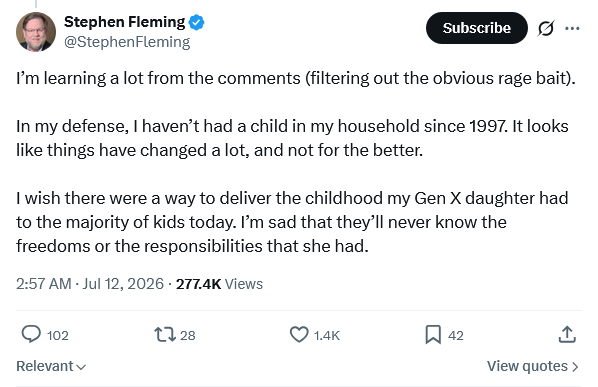
An interesting discussion at the social media site formerly known as Twitter, as Devon Eriksen responds to a comment from Stephen Fleming:

But don’t you understand?

There was a way. There was always a way.

We had it within our grasp, because we had already grasped it. The childhoods that you and your daughter had were available because you and your daughter had them.

All that the Boomers, and their parents, the eldest of the post WW2 generations, had to do was …

Nothing.

Just live in the paradise that their ancestors won for them, and make the minimum, the bare minimum, of effort that would have been required to actually sustain it.

That’s all.

Just keep things the way they were.

But they couldn’t handle that. Their fathers and grandfathers, the heroes that won WW2, made them jealous.

They wanted to be heroes, too.

So, for the sake of their own egos, they had to become Social Justice Warriors. They had to be Champions of Progress and Change.

They had to see the world they inherited as a pile of problems to be solved, rather than a pile of solutions to be cherished and preserved.

So they could feel like they were doing something important.

Almost all of the elder generations, even the ones who call themselves conservative and vote republican, are, in truth, socialist liberal progressives. Because they looked at paradise, and wanted to fix it instead of protect it.

That’s why the “republican” option was Reagan, the gun-ban guy, the social-welfare guy, the kiss-up-to-the-commies guy, the amnesty-for-foreign-invaders guy.

Reagan, the Hollywood liberal, the Obama of the 80s, instead of Joe McCarthy, Barry Goldwater, and Pat Buchanan.

Teens can’t have a summer job because elders had to be Third-World Compassion Heroes, and give us Hart-Cellar and eleventy-billion barbarians who don’t care about civilization, but will work cheap.

Teens can’t have a car because elders had to be Climate Emergency Heroes and give us emissions control laws and Cash for Clunkers.

Teens can’t have safe schools to learn at, because elders had to Anti-Racist Heroes and made it illegal to exclude violent thugs from our school districts. Just because those thugs generally come color-coded for your convenience.

Teens can’t have safe public spaces to hang out in, because elders had to be Compassion for the Underclass Heroes, and release violent savages into society, again and again, with a lecture and a slap on the wrist.

Teens can’t have a healthy economy to inherit, because elders had to be Equality Heroes and make sure every corporation that actually did anything useful was punished for not being Diverse, Equitable, and Inclusive enough to suit the ideal universe that exists only in their heads.

Teens can’t have dates, because elders had to be Anti-Sexist Heroes, and let feminists spend forty years diminishing the social value of men, until you had to a be a billionaire rockstar adventurer to avoid being an unsexy loser by default.

Teens can’t even be fit, healthy, and pretty, because elders had to be Sex Equality Heroes, and move women into the corporate workforce in droves, leaving children to be fed by corporate industrial slop factories.

Teens can’t have sane, well-adjusted, unspoiled girlfriends and wives, because elders had to be Champions of Sexual Freedom, and normalize unlimited female promiscuity, all in exchange for the largely unfulfilled promise of a little unshaven free-love yeti snatch.

And worst, of all, the crowning irony, the final dead hamster in the water pipe, is that all of this would be fixable, perhaps in three to five election cycles …

Except.

Except the elders don’t understand that any of this of this is happening.

They haven’t had a child in the household since 1997. They haven’t looked for an entry-level job since 1973. They haven’t gone on a date since 1981. They haven’t been laid off … ever.

They are safe with their paid-off houses and their investments and their pensions from 45 years at the same company and their social security and their medical plans.

It’s affecting the youngest generations first and worst. While the elders sit on their cruise ship, surveying the short with binoculars, wondering who all these ragged distressed looking people standing on the shore are.

And why they are holding signs that say “HELP”, “THIS IS ALL YOUR FAULT”, and “YOU STOLE THE LIFE I WAS SUPPOSED TO HAVE”.

Then they shrug, conclude that these must be the whiny losers, and everyone further inland is probably just fine, and everything is fine, because they fixed everything and they are all heroes, and the Summer of Love was the end of the Problematic Era of History and the beginning of the Great Enlightenment.

And when I am 74 years old, and the elders are all safely tucked into their cemetery plots, I will be torn apart by an angry mob for having white hair, and therefore being “one of them”.

And the mob will not care that I didn’t get to cast a vote until 1992, for the Man Who Predicted All Of This.

He called it the “giant sucking sound”.

Which is apt because it’s why everything sucks now.

How Few Remain: The Second War Between the States

Filed under: Books, History, Military, USA — Tags: , , , , , — Nicholas @ 02:00

Feral Historian
Published 13 Mar 2026

Let’s take a look at Harry Turtledove’s How Few Remain and its many themes and historical extrapolations. And probably argue about the Civil War a little along the way.

If there’s enough interest, this may be the start of a dive into the entire sprawling series that follows.

00:00 Intro
01:37 A War Unfinished
07:09 Adapting and Evolving
10:12 Abraham Lincoln and Frederick Douglass
13:15 The Horace Greeley Letter
15:40 Freddie’s Louisville Adventure
18:07 Turtledove, Lost Cause, and Spoilers
(more…)

QotD: The nostalgic British elements of Canadian nationalism

Filed under: Books, Britain, Cancon, History, Politics, Quotations, USA — Tags: , , , — Nicholas @ 01:00

[In The Strange Demise of British Canada, Chris] Champion’s argument is that the new liberal nationalism manufactured by Pearson and others was itself a product of and ended up perpetuating Britishness, and didn’t just kill it. The book develops a complex and lucid account of what Britishness actually meant, and Champion shows how Canadian Britishness “has always been more fluid, a home-grown ‘cluster of identities’ shaped by the intersection of factors like ethnicity, education, religion, and class”. There was undoubtedly an ethnic component to this Britishness in the early days of Confederation. But in the postwar era both defenders of the older form of nationalism and the newer Liberal version tried not to marginalize and to foster attachments of Canadians from other ethnic backgrounds.

Britishness survives as civic nationalism. Old British Canada may be gone, but aspects of that Britishness live on. We should celebrate our history and our historic symbols, but this alternative shouldn’t set about restoring it all. A future oriented embrace of our history needs to be built around the active parts of this Britishness that have now become truly Canadian. For example, the Crown in Canada is not now just a British institution, it’s a Canadian institution. Same with our democratic institutions and parliamentary traditions, which we must work to strengthen and renew.

Embracing this enables us to thread the needle on our relationship with America. Part of what makes us different historically, culturally, ideationally, and in disposition from America, is this history. Just as Canadian Britishness has survived to the present day in unique ways, our desire not to become Americans is alive and well. A homegrown Canadian Britishness enables us to continue this without falling into crass anti-Americanism, and without requiring us to embrace the new Liberal nationalism to reject America. We should see America as an amicable cousin, but one that we are distinct and different from.

But most importantly, what this new kind of national identity needs to build around needs to be an evolution of the liberal nationalism that emphasizes and consciously builds around our regional pluralism. […] but the kind of rationalistic liberalism that our modern national identity is built around, while sold as a way of dealing with diversity, suffers from some serious internal tensions. Liberalism, especially the Canadian variant of it, implicitly depends upon and encourages a degree of homogenization that flattens hard cultural differences. We need to become more pluralistic, and less liberal.

Ben Woodfinden, “True North Patriotism and a Distinctly Canadian Conservatism”, The Dominion, 2020-10-20.

Powered by WordPress



