Quotulatiousness

July 9, 2026

A new proposal for limiting “unreasonable searches and seizures”

Filed under: Government, Law, Liberty, USA — Tags: , , , , , , — Nicholas @ 05:00

In Reason, Jacob Sullum outlines Justice Gorsuch’s proposed new test for limiting government abilities to surveil and monitor private actions:

Supreme Court Justice Anthony M. Kennedy swears in Justice Neil M. Gorsuch on Monday, April 10, 2017, in the Rose Garden of the White House in Washington, D.C.
White House photo via Wikimedia Commons.

The Court’s 1967 decision in Katz v. United States, which held that the Constitution’s prohibition of “unreasonable searches and seizures” applies when people have a “reasonable expectation of privacy”, continues to shape Fourth Amendment rulings six decades later. That was clear on June 29, when the Court decided Chatrie v. United States, holding that a government-ordered analysis of cellphone location data qualifies as a “search” under the Fourth Amendment.

“An individual has a reasonable expectation of privacy in records about his cell phone’s location, and police intrude on that constitutionally protected interest when they demand the information”, Justice Elena Kagan wrote in an opinion joined by four of her colleagues. Justice Neil Gorsuch agreed with the result but not the rationale. The Katz test, he complained, “has no basis in the Constitution’s text or history”. He added that it has proven unworkable in practice because it has never been clear how courts should determine whether an expectation of privacy is “reasonable”.

Gorsuch is surely right that the Katz test has produced inconsistent and puzzling results. In cases addressing intrusions such as trash searches, demands for bank and telephone records, surveillance by low-flying aircraft, and police trespassing on private property, the Supreme Court has perceived no expectations of privacy it was prepared to recognize as reasonable. Applying the same test, it has repeatedly ruled that the Fourth Amendment does not apply to information that people voluntarily share with third parties. Yet the Court has repeatedly rebelled at the disturbing implications of that principle without explicitly renouncing it.

That is what happened in Chatrie, which involved a Virginia bank robbery investigation. Police used a “geofence” warrant to identify the perpetrator by requiring Google to search customer data collected by its Location History feature, which tracks the whereabouts of cellphone users. For reasons that are not entirely clear, the Court declined to apply the third-party doctrine, instead reverting to the original, unmodified Katz test.

A better approach, Gorsuch argued, would be to treat Location History records as “effects” covered by the Fourth Amendment — as a form of personal property, in other words. While it is not clear exactly how that property-rights approach would work in other contexts, it does seem less malleable than the Katz test, which gives courts wide discretion in discerning expectations and deciding whether they are reasonable. Gorsuch aptly likened the Court’s understanding of that test to its definition of obscenity in the 1960s: “We know a ‘reasonable expectation of privacy’ (and an exception to the third party doctrine) when we see it”.


They call it “Chat Control”

Filed under: Europe, Government, Law, Liberty, Media — Tags: , , , , , , — Nicholas @ 04:00

On the social media site formerly known as Twitter, Brivael Le Pogam talks about what the EU is calling “Chat Control”:

We need to talk about Chat Control, because it’s all happening this week and almost no one understands what it’s about.

In plain terms: the EU wants to authorize the scanning of your private messages. Your WhatsApp conversations, your emails, your DMs. Not those of a suspect. Those of everyone, all the time, by default.

The pretext is airtight, and that’s the trap: “protecting children”. No one can be against that. That’s exactly why it’s the perfect tool. They’ll never get you to swallow mass surveillance in the name of mass surveillance. They’ll get you to swallow it in the name of children, terrorism, disinformation. Always some cause you won’t dare challenge.

Understand the two-step mechanism well.

Today it’s the “soft” version: platforms have the right to scan, on a voluntary basis, unencrypted messages. Harmless on the surface. It’s the foot in the door.

Then comes the real version, the one under negotiation: mandatory scanning, including of your encrypted messages, analyzed directly on your phone before they’re even sent. Over 500 cryptographers have signed a letter saying it’s technically unfeasible without creating security vulnerabilities that any hacker or hostile state could exploit. You’re breaking encryption for everyone, including the criminals you claim to be targeting.

And the worst part isn’t even that.

The real danger isn’t that Brussels technocrats will be watching you tomorrow. They’re probably too spineless for that. The danger is that they’re building the infrastructure. Once scanning everyone’s messages becomes normal, legal, operational — the track is laid. And on that track will roll everything that comes next. The day a crisis brings ruthless people to power, they won’t have to invent anything. The machine will already be there, ready to go.

No surveillance infrastructure has ever stayed limited to its original purpose. None. It’s a law of administrative nature: a tool built for X always ends up serving Y.

What makes this text dangerous isn’t what it does today. It’s what it makes possible forever.

The decisive vote is Thursday. The last lock.

Auto-translated from the original French by X.

The good folks at Windscribe weigh in:

The EU is not a democracy.

They’re closer to a guy who keeps pressuring a girl to sleep with him despite her saying no.

5 times now.

But he won’t stop.

We’re at the stage where he’s giving her alcohol and making her drunk so she struggles to say no.

Over the last 3 years, Chat Control and similar scanning measures have been defeated or blocked 5 times.

The citizens of the EU and members of EU Parliament have made it abundantly clear — they don’t want Chat Control.

This latest attempt by the EU is the slimiest one yet. Revive dead legislation that was already defeated, flip the passing criteria so that majority don’t need to SUPPORT it, majority need to DEFEAT it, and as the cherry on top, hold that vote on the very last day before Parliament members go on summer break so that many don’t show up. Oh and if they don’t show up, it counts as a vote to pass Chat Control.

You can dress it up in as many legal technicalities and loopholes as you want, what the EU is doing here is fundamentally undemocratic.

No means no.

And if you ever saw a guy pressuring a girl into sleeping with him with disgusting tactics after she said no THIS many times, you would consider him to be a rapist.

So congrats to the EU on adopting rapist strategies to your governance.

Here’s why “free range children” went away

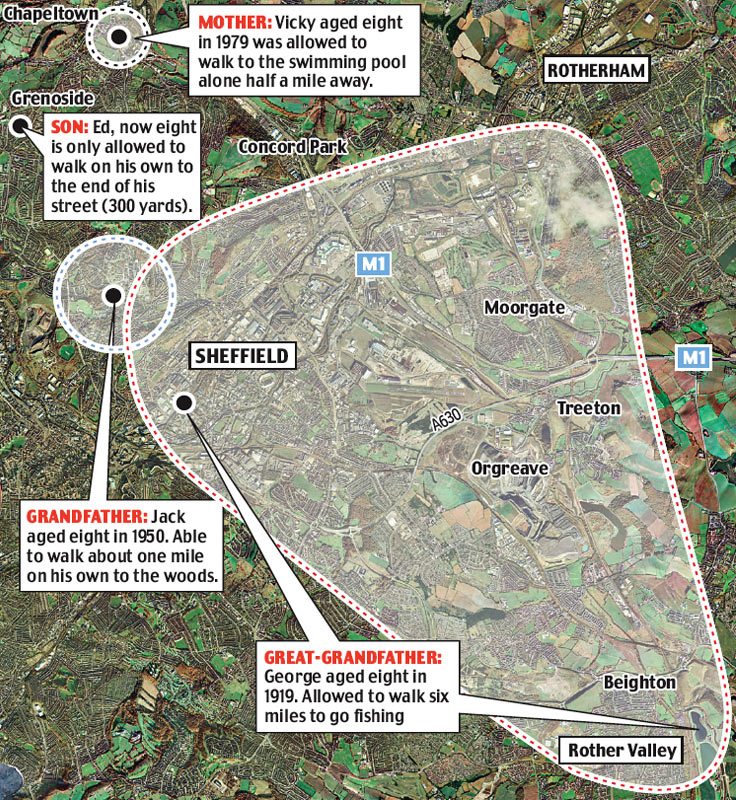
As a child in England and then in Canada, I had a pretty wide range for unsupervised activities and I generally took advantage of that. On foot or riding my bicycle, it was completely normal for me to be several miles from home on any given day. I’ve posted this image a few times, showing the “free range” diminishing generation by generation for an English family, and it’s mostly true here in Canada and in the United States as well:

Graphic showing the diminishing “free ranges” of each generation of an English family.

At Classical Ideals, Megha Lillywhite discusses the “political extremism” involved today in trying to raise your children:

One of the most fundamental things that children require in order to grow up healthy, strong, wise and good, is a lot of time outdoors and in public spaces. Yet what we see from more traditional families in the west, as well as from extremely wealthy families, is that they are holding their children closer than ever, and enclosing them in increasingly smaller and more carefully selected bubbles of protection.

This is because “the outdoors” and “public life” is territory that has increasingly been ceded by western society to violent criminals, the mentally ill, and drug addicts. Parenting, for those who are vigilant to the threats, can no longer be “laissez-faire” and it has become less about choosing the ideal, and more about choosing the least damaging option.

But what has been lost? And what must be reclaimed for those of us with power and spirit to have any kind of meaningful victory in this world?

Most leftists see politics through the framework of wanting to be “a good person” as it is defined by their peer group and ideology. The ordinary person, on the other hand, views politics through the set of decisions that would best protect their children and give them the best chance at a good life.

Why is this? Leftists either don’t have children, or they have children but live in gilded cages and are therefore untouched (yet) by the consequences of their ideological beliefs.

Children must exist as part of a broader community in order to develop healthily. They must be able to go to a public library, the local shop, ride their bikes to the park, take the city bus or walk to their grandmother’s house on their own. They must be able to play outside unsupervised for hours on end in their neighbourhoods.

[…]

But some measure of freedom is also necessary for children to develop a healthy psyche. A child who can go to the shop and pay for milk on his own and bring it home will develop not only a sense of responsibility, but will feel confident in his ability to do useful things. A child who can visit his friends and relatives on his own will develop social skills and a sense of belonging. A child who can go to the library on his own can begin the lifelong journey of guiding his own learning.

[…]

In a 2007 study done in Sheffield, UK by Dr. William Bird, he found that children in 1926 were allowed to roam up to six miles away from home unsupervised and by 2000, that number dropped to 300 metres. The major drop off happened around 1979 which is coincidentally the time when mass migration began in the United Kingdom and demographics of towns like Sheffield began to seriously shift. In the recent “Rape Gang Inquiry” released by the Restore Party of Britain, the report which details three decades of kidnap, rape and murder of a quarter of a million British girls which would have began around this time. So English parents restricting their children’s freedoms around this time period was not something hysterical or unfounded.

We must be politically courageous in order to admit what is required to maintain that kind of a world. Stated simply, a safe, healthy and good childhood requires a fundamental rejection of leftist “empathy” politics. There is one incident in particular that can help to describe how this system functions today.

Link from John Carter on Substack Notes, who commented:

The same shift towards a confined, highly monitored childhood took place in the US, corresponding to the great suburbanization. The suburbs grew due to white flight from the cities, following their colonization by blacks and the de facto ban on community defence enforced by the civil rights act.

Suburban municipal architecture is largely comprised of informal defensive barriers that prevent undesirable elements from penetrating the neighborhoods undetected.

This enables middle class parents to deniably insulate their children from the worst consequences of diversity, but at the cost of raising their children in open air prisons, in a stifling social atmosphere characterized primarily by a brittle insistence upon euphemistic avoidance of direct acknowledgement of the real issues. “Racism is simply terrible! We just wanted to live somewhere with good schools.”

Children brought up amidst the tedious fakery of the suburbs naturally become attuned to the pervasive hypocrisy of suburban white culture. They have to: simply navigating this culture requires the ability to understand the unsaid, while pretending that one has not understood it. Combined with the open air prison environment inhibiting emotional development, this is a powerful recipe for induced neurosis.

There are only a few possible outcomes: 1) they become cowardly hypocrites themselves; 2) they reject the hypocrisy and become fanatical anti-white race communists; 3) they reject the hypocrisy and become fascists.

The Ancient Greeks 03 – Enter the Persians 2 – Cyrus, Destiny, and the Making of an Empire

Filed under: Europe, History, Middle East — Tags: , , , — Nicholas @ 02:00

seangabb
Published 16 Feb 2026

Greece: A Brief History, c.700 BC – 500 AD

Who was Cyrus the Great? How did a minor Persian ruler come to dominate the Near East? In this lecture we examine Herodotus’ account of Cyrus’ miraculous survival, his overthrow of the Medes, and the conquest of Lydia and Babylon. We analyse Persian imperial strategy: flexible governance, religious tolerance, and pragmatic rule. We also explore how the Ionian Greek cities of Asia Minor first came under Persian control — setting the stage for future rebellion.

Empire did not emerge through chaos alone. It was built through method.

QotD: The labels “capitalism” and “socialism”

Before identifying why they were wrong, we need to acknowledge what Marx and his disciples were right about. Inequality did increase as a result of the Industrial Revolution. Between 1780 and 1830 output per laborer in the United Kingdom grew over 25 percent but wages rose barely 5 percent. The proportion of national income going to the top percentile of the population rose from 25 percent in 1801 to 35 percent in 1848. In Paris in 1820, around 9 percent of the population was classified as “proprietors and rentiers” (living from their investments) and owned 41 percent of recorded wealth. By 1911 their share had risen to 52 percent. In Prussia, the share of income going to the top 5 percent rose from 21 percent in 1854 to 27 percent in 1896 and to 43 percent in 1913. Industrial societies, it seems clear, grew more unequal over the course of the nineteenth century. This had predictable consequences. In the Hamburg cholera epidemic of 1892, for example, the mortality rate for individuals with an income of less than 800 marks a year was thirteen times higher than that for individuals earning over 50,000 marks.

It was not necessary to be an intellectual to be dismayed by the inequality of industrial society. The Welsh-born factory owner Robert Owen envisaged an alternative economic model based on cooperative production and utopian villages like the ones he founded at Orbiston in Scotland and New Harmony, Indiana. It was in a letter to Owen, written by Edward Cowper in 1822, that the word “socialism” in its modern sense first appears. An unidentified woman was, Cowper thought, “well adapted to become what my friend Jo. Applegath calls a Socialist”. Five years later, Owen himself argued that “the chief question … between the modern … Political Economists, and the Communionists or Socialists, is whether it is more beneficial that this capital should be individual or in common”. The term “capitalism” made its debut in an English periodical in April 1833 — in the London newspaper the Standard — in the phrase “tyranny of capitalism”, part of an article on “the ill consequences of that greatest curse that can exist amongst men, too much money-power in too few hands”. Fifteen years later, the Caledonian Mercury referred with similar aversion to “that sweeping tide of capitalism and money-loving which threatens our country with the horrors of a plutocracy”.

Niall Ferguson, “Capitalism, Socialism and Nationalism: Lessons from History”, 2020-02.

Powered by WordPress