At The Freeman, Nicole James discusses being so far ahead of a trend that it’s only just catching up with her now:
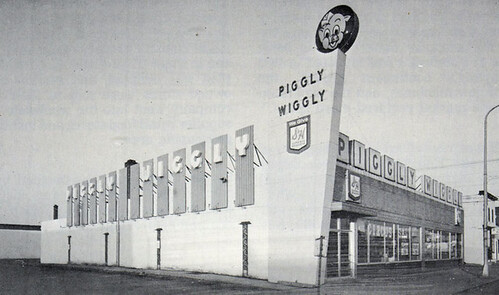
“Piggly Wiggly” by afiler is licensed under CC BY-SA 2.0


Grocery tourism is the hot trend of 2026 according to Condé Nast Traveler. This is all well and good, but also a bit late to the trolley because I have been practicing this trend since my twenties, although without the benefit of a name or a hashtag.
My two worlds met in the supermarket aisle. Before I was a travel writer and sent to places with hotel beds that appeared to have been prepared for minor royalty or a very clean corpse, I was a checkout chick at supermarket chain Coles. This was when prices were typed in by hand, making me feel like I was conducting a low-level NASA launch procedure.
A tin of pineapple rings would trundle towards me, and I would punch in its code. Behind it would come shampoo, fish fingers, instant pudding, 24 cans of Diet Coke, and a packet of aspirin. From these items, I could deduce entire family systems. Marriage trouble. School excursions. Flu. A birthday party. A woman about to murder everyone in her house unless she got a Mint Slice into herself immediately.
I loved the products. Not necessarily the customers who could turn feral over a five-cent discrepancy in canned tomatoes. The conveyor belt was a pageant of human need. It was anthropology in a polyester apron.
When people now declare that they have discovered grocery store tourism, I feel like saying, “We know. We’ve had those for years.”
My first trip to America should have been my grand supermarket awakening. I was a PR manager for Malaysia Airlines in the late ’90s, and we were launching a very long flight to New York from Sydney via KL and Dubai. I arrived bristling with ambition. I wanted to see the cereal aisle. Long had we heard rumors of American supermarkets. They were great glittering cathedrals of corn syrup with aisles devoted just to cereal and marshmallows in the shapes of everything from the moon and stars to presidents. I wanted to stand before them all in awe, like Moses, if Moses had come down from the mountain carrying Pop-Tarts.
[…]
I once stood in a Japanese aisle looking at 15 varieties of bottled tea and felt the kind of reverence other people reserve for stained glass. This is the point of grocery tourism. It’s anthropology with a basket.
Every country gives itself away eventually. This is usually somewhere between the biscuits and the cleaning products. Finland offers Moomins in places no Australian supermarket would dare put a cartoon hippo. Singapore understands the spiritual importance of salted fish skin. Sweden puts things in tubes that should never be in tubes and then offers fermented herring.
And then the Netherlands has licorice. The Dutch have built an entire moral philosophy out of licorice. Sweet, salty, double-salty, hard, soft, shaped like coins, cars, and warnings from your dentist. I’ve always admired the Dutch, but this commitment to black chewy punishment is heroic. Sweden is not to be outdone and has thus flirted with licorice-flavored chips.
Then there are the products that cause the traveler to stop dead and reconsider the whole Enlightenment. In Vietnam, I couldn’t walk past snake wine without dancing an involuntary flamenco of horror. There was a snake in a bottle suspended in alcohol. Sometimes there were scorpions.
South Korea has canned silkworm pupae. Peru has coca tea. Colombia has arequipe. America has cheese in a spray can, which I respect as both a product and a cry for help.
And now, social media has turned all of this into content. Travelers narrate the experience into their phones. A German soccer fan can wander into an American Waffle House at one in the morning and emerge as a folk hero. Erewhon in Los Angeles has become a celebrity shrine where a smoothie can cost more than a small household appliance and one strawberry comes packaged like an engagement ring and with a similar price.
Grocery stores offer the rarest thing in modern travel, the uncurated ordinary. The supermarket is the one place travel cannot fully manicure itself. Hotels can lie. Brochures can lie. Restaurants, especially the ones with menus printed on thick paper, can lie beautifully. But supermarkets are hopeless at lying. They’re too busy. They’re too full of nappies and mince.