
Quotulatiousness

July 30, 2026

Support for capital punishment is the opposite of a luxury belief

Filed under: Law, Media, Politics, USA — Tags: , , , , — Nicholas @ 05:00

As noted in City Journal, support for capital punishment is overwhelmingly high … which is why politicians and wealthy progressives whole-heartedly oppose it. As you probably know, a “luxury belief” is one that is usually held by people who will not be in any way impacted by the downstream effects of that belief. It’s not the wealthy and privileged who suffer when murderers get out of prison, so they are generally all in favour of ever greater leniency in sentencing and easing parole conditions. Poor and middle class people are more likely to suffer when violent criminals return to their communities, which is why they generally want longer incarceration for violent crimes and favour capital punishment for certain abhorrent acts of murder. Charles Fain Lehman has more:

Those findings undermine the narrative, routinely advanced by death-penalty abolitionists, that capital punishment is on the decline because the public has turned against it. In reality, both public opinion and the current composition of the Supreme Court militate in favor of expanding the death penalty’s use — and, specifically, relaxing many of the arbitrary and undemocratic restrictions imposed on it by courts over the past several decades.

Abolitionists have based their case for declining public support on polls such as Gallup’s, which for nearly a century has asked respondents if they are “in favor of the death penalty for a person convicted of murder”. The share in favor has indeed dropped steadily since the 1990s, from a 64-point difference between support and opposition to just a 6-point split today.

That question, though, artificially reduces support by asking about all murders. Under current precedent, only certain heinous murders — those in which jury-determined aggravating factors outweigh mitigating factors — are eligible for the death penalty. There is likely far more support, for example, for executing Dylann Roof specifically than there is for executing all murderers generally.

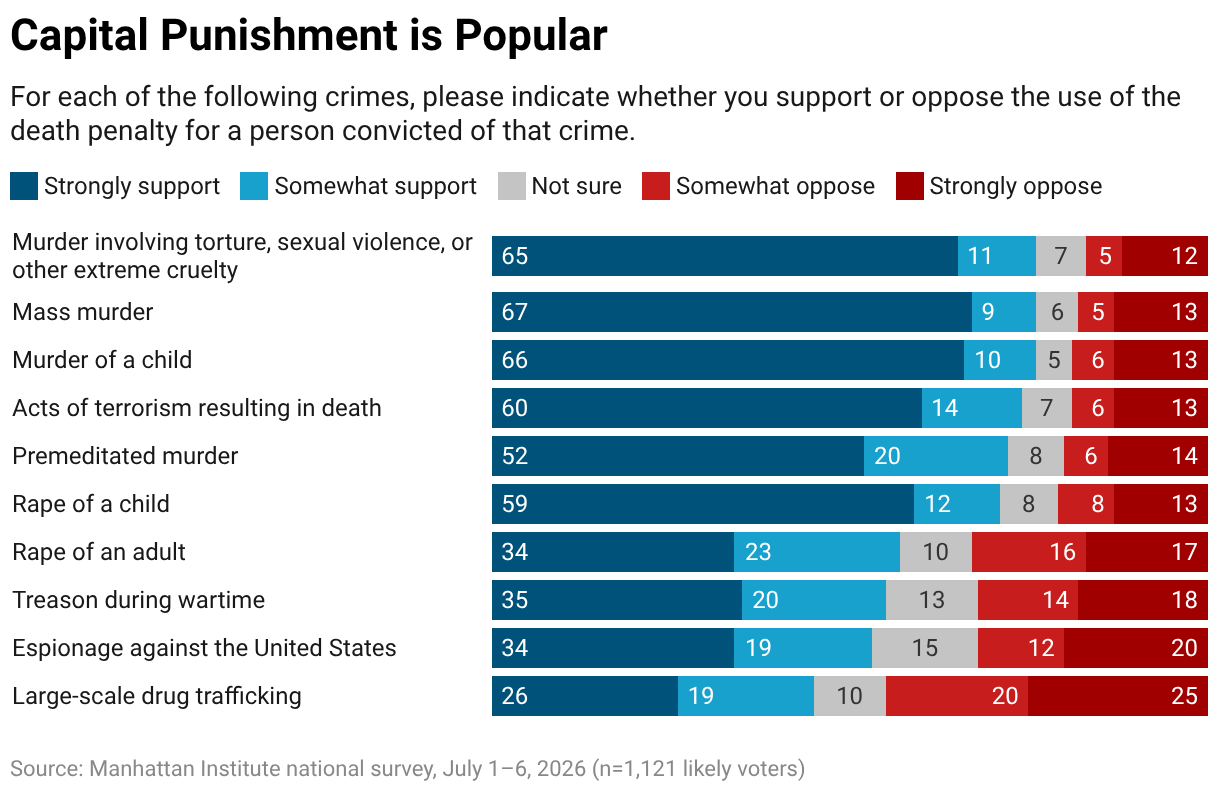
The new MI poll illuminates this point. It asks about support for capital punishment under a variety of circumstances. The result is lopsided endorsement in the event of, for example, murder involving “extreme cruelty”, mass murder, or the murder of a child — all supported by 3-to-1 margins. Death for premeditated murder generically has 72 percent support, suggesting that even clarifying intent significantly increases support for capital punishment.

Notably, the poll also finds majority support for executing those who rape a child (71 percent) or an adult (57 percent). Yet neither offense would, absent a concurrent murder, be death-eligible. The Supreme Court ruled that applying the death penalty to non-murdering rapists violated the Eighth Amendment’s prohibition on “cruel and unusual punishment” in 1977’s Coker v. Georgia, a prohibition it extended even to child rapists in a 2008’s Kennedy v. Louisiana. With certain exceptions for crimes against the state, the Kennedy majority asserted, a crime that did not result in the taking of someone’s life was categorically ineligible for the death penalty.

Both decisions were justified by reference to the court’s “evolving standards of decency” test. First introduced in 1958’s Trop v. Dulles, the test has led the court to understand “cruel and unusual punishment” through its interpretation of “the evolving standards of decency that mark the progress of a maturing society”. That lens allowed it to reach the conclusions it did in Coker, Kennedy, and numerous other narrowings of the use of the death penalty. In combination with the aggressiveness and gamesmanship of the capital defense bar — which spends decades filing often-frivolous procedural motions to keep clearly guilty clients alive — the result has been a steady choking off of capital punishment.
Update, 31 July: Welcome, Instapundit readers! Have a look around at some of my other posts you may find of interest. I send out a daily summary of posts here through my Substackhttps://substack.com/@nicholasrusson that you can subscribe to if you’d like to be informed of new posts in the future.

Canadian conservatives need different leaders, say Liberal media

Filed under: Cancon, Media, Politics — Tags: , , , , — Nicholas @ 04:00

Unlike the Liberals and NDP, whose leaders get a media honeymoon that sometimes lasts for years, Conservative leaders are never given the slightest break by presstitutes paid by the Liberals. (Anyone further to the right than the centrist Conservatives get almost no media attention at all, as Maxime Bernier can attest.) L. Wayne Mathison responds to “helpful” suggestions for how the Conservatives can get rid of their current unpopular-with-the-state-media leader and replace him with someone more “acceptable”:

The pattern is obvious.

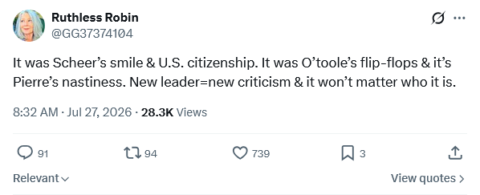
Scheer was supposedly too awkward. O’Toole was too inconsistent. Pierre is now too aggressive, too divisive, too nasty. Change the leader and the criticism changes with him. The objective stays the same: keep Conservatives apologizing, retreating and replacing leaders while the Liberals remain the default governing party.

The elite Red Tories never wanted Pierre Poilievre as leader because he threatens the arrangement they are comfortable with. They prefer a Conservative Party that manages Liberal policies a little more efficiently, attends the right receptions and never seriously challenges Ottawa’s permanent political class.

Put on the economics hat and the incentives become clear. The people closest to government often do very well under bigger government. Consultants get contracts. Lobbyists gain influence. Bureaucracies expand. Well-connected corporations receive subsidies and protection. Housing owners watch scarcity drive up their assets. Ordinary workers get higher taxes, weaker wages, expensive housing and declining public services.

Pierre’s real offence is that he speaks directly to the people paying the bill.

Canada has nearly every advantage a country could ask for: energy, minerals, farmland, fresh water, educated people, stable institutions and access to the largest market on Earth. We should be one of the wealthiest and strongest countries in the world. Instead, our political class keeps managing scarcity, blocking investment and teaching Canadians to expect less.

Conservatives should stop chasing approval from commentators and insiders who will never support them. Back Pierre. Defend the principles. Make the economic case clearly.

Prosperity should not be reserved for the people who already know how to work the system.

The best investment the Liberals ever made was buying the loyalty of the relic media with a dollop of cash from the government’s coffers. They already were mostly onboard with the Liberals — those that didn’t think the NDP was too far right — but the financial leash made even the mavericks think twice about substantive criticism of the man who co-signed their pay cheques.

Update: Fixed missing URL.

Intramural conflict in the progressive “big tent”

Filed under: Media, Politics, Religion — Tags: , , , , , — Nicholas @ 03:00

On the social media site formerly known as Twitter, L. Wayne Mathison identifies some of the major fault lines among the temporary coalition-of-convenience on “the left”:

“Free Palestine/Anti-Israel protest” by Can Pac Swire is licensed under CC BY-SA 2.0 .

The modern woke worldview keeps colliding with reality because it sorts people into fixed moral categories: oppressed people are presumed good, while designated oppressors are presumed guilty. Once that framework takes hold, facts become secondary.

That is why some progressives can condemn “Christian nationalism” before breakfast, then struggle to name radical Islam when an Islamist attacks the very people they claim to defend.

The contradiction is obvious. Radical Islam is deeply hostile to homosexuality, women’s equality, free expression and secular liberalism. Pretending otherwise does not make anyone tolerant. It makes society dishonest and vulnerable.

This does not mean every Muslim is dangerous, nor does it justify collective blame. It means an ideology should be judged by what it teaches, what its extremists do, and whether its institutions openly confront the problem. The same standard should apply to every religion and political movement.

The woke response is usually predictable: redirect attention toward the far right, blame Western society, or accuse anyone raising the issue of hatred.

That protects the ideology, but it does nothing to protect ordinary people. Compassion without boundaries becomes negligence.

A healthy society needs openness, but openness is not the absence of judgment. Immigration, asylum and multiculturalism require enforceable limits, cultural confidence and a clear expectation that newcomers accept the laws and basic freedoms of the country receiving them.

You cannot build social trust by demanding that citizens ignore obvious conflicts. You cannot defend gay people while excusing movements that despise them. You cannot defend women while tolerating misogyny from politically protected groups.

Reality does not care which side has the approved slogans. Eventually, contradictions collect a human cost.

Equilibrium: 198451 with Gun-Fu Fighting

Filed under: Media — Tags: , , , — Nicholas @ 02:00

Feral Historian
Published 27 Mar 2026

Equilibrium (2002) is a curious mix of early-aughts action movie and mid-20th Century dystopia. While it does feel a bit overwrought and derivative at times, it ends up being more than the sum of its parts.

00:00 Intro
03:17 Gun Kata
04:44 198451
06:45 Endings
07:07 Anti-Human Systems
(more…)

QotD: The three most important books on management

Filed under: Books, Bureaucracy, Business, Government, Quotations — Tags: , , — Nicholas @ 01:00

There are three management books — and only three — that need to be read. They also need to be read by everyone. The Peter Principle, Up the Organisation and Parkinson’s Law. Which state, in reverse order, that bureaucracies will always grow until they eat the organisation, that management’s proper job is preventing them from ever starting and that if they’re there then you promote them out of the way. In our case, in this grassroots political movement which is the Hang the Lanyards Party, promote them to transcendence and their eternal rewards.

[…]

This is also what needs to be done with every bureaucracy from time to time. Those management books insist — nay prove — that every organisation always ends up like this. For the driving force of any organisation is the survival of the organisation. To be, not to do, is the aim.

Yes, this does apply to private sector ones but we’ve a natural corrective for those. Other organisations which arrive and not yet having created an all encompassing bureaucracy they outcompete them. So the old bureaucracies die, the new ones grow until they too start hiring power skirts and the decay sets in.

A government bureaucracy does not have that outside force culling it when its time has come. Therefore we must be the merciful farmer taking them out given that we’ve killed off the wolves that thin the herd of the old and lame.

As we can see 65 years is long enough for such a bureaucracy to reach this stage. Rather Brave New World in fact as that was the age at which all reported to be turned off.

So, every bureaucracy, every department, gets closed after 60 to 65 years. Some sooner, just to keep people on their toes. Yes, every. Say, the Department of Education. Or of Defence. Once we’ve killed it and fired everyone just leave be for a few years. If we still have some problems that really do need to be dealt with we can always hire a few, give ’em a corner of a desk somewhere, and we get the vigour and growth of a new organisation actually trying to solve things.

Until, obviously, the arrival of power skirts and the renewal process starts again.

Tim Worstall, “Closing US AID is What We Should Do To All Government”, It’s all obvious or trivial except …, 2026-04-29.

Powered by WordPress



