Quotulatiousness

July 20, 2026

“Blame Canada”: evergreen. “Invade Canada”? It’s been done before

Filed under: Cancon, History, Military, USA — Tags: , , , — Nicholas @ 06:00

Upper Canadian Cavalier points out the obvious … that the United States absolutely could invade Canada and there’s not a lot the Canadian Armed Forces could do to stop them. But that would be the easy part:

“A mere matter of marching …”

The question of “could America ever invade Canada?” is wrong before it is even asked. Picture the MAGA politicos huddled in D.C. and the anon poasters spamming maps of how America could take Canada, as if it were even a question, as if the border were a wall and the wall the point. The whole conversation is midwits who never grasped what America already occupies.

Occupation is the crude instrument of the conqueror who arrives too late, who finds the ground already held by another and must break it by force, and that has never once been the American position in the north. The American position is that of the covert shareholder rather than the invader, and a shareholder does not knock down the door of a house whose deed already sits in his desk.

Empire in its highest form neither occupies nor marches, because it has learned to administer instead, and it does not plant a flag on the palace, since the flag is a confession that the palace was not yet yours. The genius of the modern Global American imperium has been to take without ever confessing, to hold Canada so completely that Canadians experience the holding as their own free choice. To reach for the army now would throw all of that away, trading a profitable and invisible dominion for a visible and bloody one, and teaching the empire at ruinous cost the difference between owning a country and holding it.

The republic was born reaching north with a bayonet, and it should remember how that went. In the winter of 1775 it sent Brigadier General Richard Montgomery and Colonel Benedict Arnold (yes, that Benedict Arnold) up through the snow to seize Quebec. The spirit of the country rose up in the snow to meet them, and Quebec killed Montgomery in a blizzard at the walls, the land itself passing sentence on the invasion before a single treaty could be signed.

That was first offensive act of the American project, it was a failed invasion of Canada that froze to death in the cold for its own arrogance. There is a symmetry waiting at the end of this essay that the reader should carry from the beginning, because a republic that opened its history reaching north may yet close its history the same way. America could invade Canada, but then it would not be able to conquer it, and in that attempt it would destroy the very thing that made its northern dominion worth having, because the soft empire cannot survive being seen and that invasion is nothing other than the act of trading quiet profits for overt pain and suffering.

Carneynomics in action

Even though the relic media are all singing from the government’s hymn book — because they might lose their generous subsidies if they don’t — a few dispiriting details about the real state of Canada’s economy still slip through:
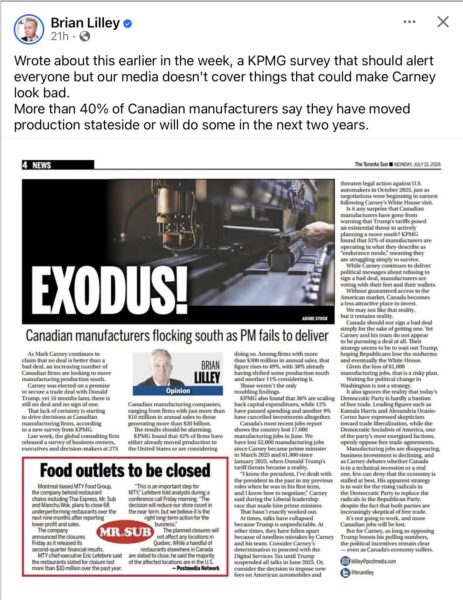
This is the Carney economy in one picture.

He sold himself as the adult in the room. The banker. The international dealmaker. The man who could handle Trump and restore confidence.

Instead, Canadian manufacturers are preparing their exit.

According to the KPMG survey, 42% of manufacturers have already moved some production to the United States or are considering doing so. Another 36% are cutting investment, 12% have paused spending and 9% have cancelled projects altogether.

Manufacturing jobs are disappearing. Investment is drying up. Factories are moving south.

Businesses respond to incentives, costs and uncertainty. They do not remain in Canada because Mark Carney gives polished speeches about nation-building. They go where taxes, energy prices, regulation, labour costs and access to markets make production worthwhile.

Carney promised competence. What Canadians are getting is stalled trade talks, falling investment, disappearing jobs and another Liberal government that seems incapable of understanding how private-sector wealth is actually created.

A great many Canadians now see Carney as an incompetent ideologue in a good suit, surrounded by the same Liberal machine that helped create this mess.

And what consequences does he face?

Very few.

Carney is rich. His family is secure. His pension, investments and connections are intact. He will never worry about a mortgage payment, a grocery bill, a lost factory job or whether his children can afford a home.

The people who pay for his failures are workers, families, small-business owners and young Canadians whose futures are being shipped across the border.

That is the ugliest part of modern government. The people making the decisions are often insulated from the consequences. They can damage an economy, lose jobs, drive away investment and still retire wealthy, respected and welcomed back into corporate boardrooms.

A résumé is not an economic policy. A banker’s vocabulary cannot hide factories closing and investment leaving.

Canada is not being built. It is being hollowed out, while the people responsible remain comfortable.

This is why I thought the announcement on Friday that a Republican senator is calling for Carney’s assets in the US to be seized and to refuse him a visa … it’s beyond weird that a Canadian Prime Minister would have over 90% of his personal assets invested in the United States rather than in Canada. This gives Trump another handle on Carney, if he chooses to use it.
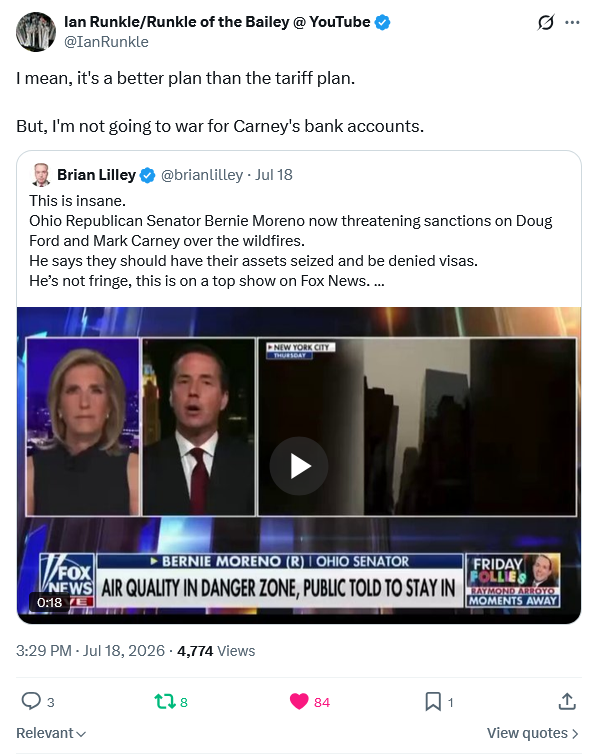
On her Substack, Melanie in Saskatchewan envisions how this may play out:
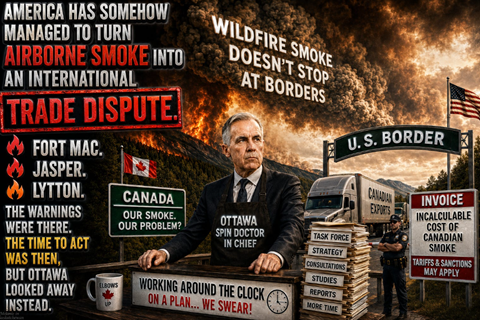
AI image from Melanie in Saskatchewan

So let me make a prediction: Any day now, your government will solemnly discover the importance of proper forest management.

There could be a task force, or a federal strategy, a minister standing solemnly in front of some trees. Perhaps an announcement that Ottawa has been “working around the clock” on a comprehensive plan that, by a miraculous coincidence, became urgent only after the American president threatened tariffs and a U.S. senator started talking about sanctions.

Should that happen, Canadians will be entitled to ask a very simple question: What finally changed Ottawa’s mind?

Was it concern for Canadians living through evacuations, destroyed communities and weeks of choking smoke? Was it the economic damage caused by recurring fire seasons? Was it pleas from provinces, northern communities and forestry workers for better prevention, mitigation and emergency capacity?

Or did the urgency arrive only when Washington threatened to slap another charge on Canadian exports and Senators possibly sanctioning Canadian officials like yourself? You personally have A LOT at stake if you are sanctioned since the majority of your wealth investment portfolio is in America.

The timing on this matters a great deal. It matters whenever a government suddenly treats a long-standing domestic problem like a national emergency only after somebody powerful outside the country attaches a financial consequence to it.

Trump has accused Canada of “wilful negligence” in maintaining its forests and says he intends to ask you what Canada plans to do. Your emergency management minister responded that governments have invested billions in fire prevention and forest sustainability since 2020. That defence deserves to be examined very closely and very carefully, because Canadians can reasonably ask what those billions purchased, where they went and why so many communities remain frighteningly vulnerable. To say it plainly … Canadians simply do not see any value for the dollars spent.

You announced spending of $317 million to lease 10 water bombers and heavy helicopters for rapid deployment to provinces because the wait time for them to be built is too long. So, here’s a fun little arithmetic exercise for Ottawa: water bombers are built right here in Canada — jobs, sovereignty, the whole patriotic package you’ve been selling — yet the federal shopping list remains stubbornly empty.

With $317 million, you could buy three heavy scoopers and have pocket change left for spotter planes or a helicopter, or — and this is where it gets embarrassing — you could roll out 45 to 55 single-engine Fire Boss aircraft, scattering an actual national fleet across every province that needs one. But apparently the government prefers its firefighting budgets theoretical. It is here that I will remind you, Fort Mac, Jasper and Lytton should have already provoked this response to act years ago.

The United States is hardly in a position to lecture anyone without hypocrisy. It is enduring its own brutal wildfire season, and fires do not stop at customs booths to declare their country of origin. Climate, drought, lightning, forestry practices and emergency capacity all play a role. There is plenty of responsibility, contradiction and political theatre to go around here. America has somehow managed to turn airborne smoke into an international trade dispute, because apparently even oxygen now requires a customs declaration. But that doesn’t absolve Ottawa. Again … Fort Mac. Jasper. Lytton. The warnings were already there. The time to act was then, but Ottawa chose navel gazing instead. In my books, that means today’s consequences lie with the governing Liberals.

Eating the Food of Homer’s Odyssey

Filed under: Food, Greece, History — Tags: , , , , , , — Nicholas @ 04:00

Tasting History with Max Miller
Published 14 Jul 2026

Skewer of roast pork covered in seasoned barley meal, accompanied by the Ancient Greek potion, Kykeon

City/Region: Greece
Time Period: c. 1650-1100 B.C.E., Mycenaean Period

When Odysseus finally makes it back to his home of Ithaca, he goes to the home of the swineherd Eumaeus. Disguised as a beggar, Odysseus is welcomed into Eumaeus’s home, and Eumaeus prepares skewers of roasted pork sprinkled with barley meal.

While I could just make plain roast pork sprinkled with plain barley flour, let’s assume that Eumaeus does the disguised Odysseus the courtesy of seasoning the meal. Archaeologists have found evidence that the people living in Greece during the Mycenaean Period, when The Odyssey is supposed to have taken place, commonly used coriander, cumin, celery, and fennel, so that’s what I used to season the barley flour coating.

This dish is very simple, and surprisingly flavorful. I made mine in the oven, but if you can cook it over an open fire, it would be even better. The cumin and fennel seeds are both very strong flavors, so choose one or the other so as not to completely overpower everything else.

    Eumaeus went off to the sties where the pigs were penned. Choosing two sucklings, he carried them in, slaughtered and singed them both, then cut them in pieces and spitted them on skewers. Then, when all was well roasted, he served it to Odysseus piping hot on the skewers, sprinkling the meat with white barley meal.
    The Odyssey, Book XIV

(more…)

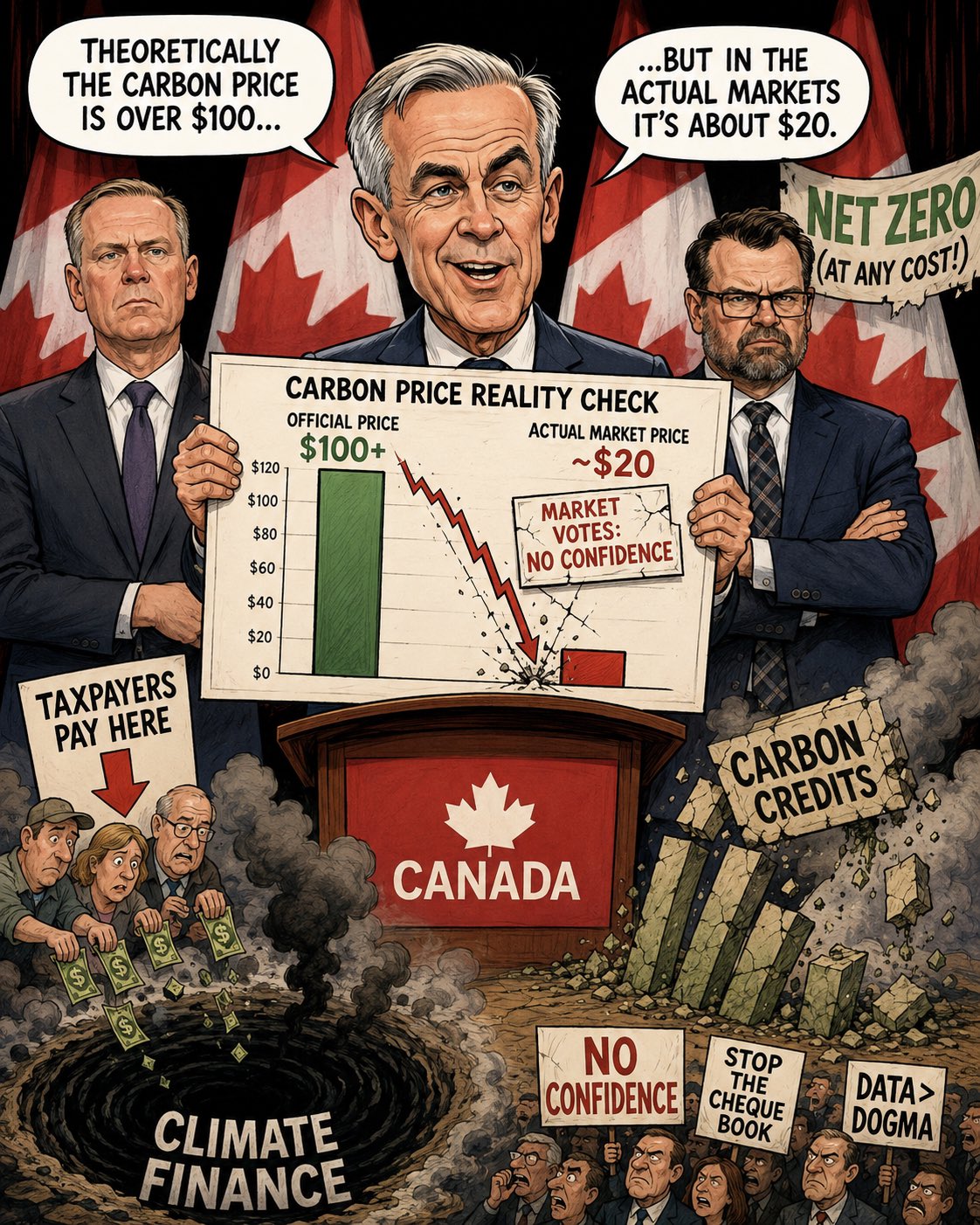
Markets reject Carney’s official carbon price, so Canadians have to pay more

Canada is one of the last remaining bastions of Net Zero zealotry … in fact, Prime Minister Mark Carney may be the only national leader trying to turn back the tide of economic reality over this:

AI image posted by L. Wayne Mathison on X.

Mark Carney wrote a book called Value(s) lecturing the world about fairness, responsibility, sustainability and humility. His real governing value appears to be this: when markets reject his climate scheme, force Canadians to rescue it.

Carney now admits the official carbon price is supposedly above $100 while actual credits have traded near $20. Any honest banker would recognize the message. The market does not believe these credits are worth the imaginary price politicians assigned to them.

Carney’s response is classic central-planner arrogance. He will not reconsider the product. He will rig the price, tighten the rules, compel companies to buy it and call the resulting coercion “investment certainty”.

He praised carbon pricing in Value(s) as one of the most important and effective ways to reduce emissions. Then the consumer carbon tax became politically poisonous, so he scrapped it. The industrial version survives because its costs are easier to bury inside electricity, transportation, groceries, construction materials, wages and lost investment.

Carney also boasts that Canada continues sending climate-finance money abroad while other G7 governments pull back. Canadian families are struggling with food, housing and energy, yet our philosopher-banker remains determined to finance his international reputation with their money.

His book preached humility. His government practises price fixing.

His book preached responsibility. His government transfers the risk to taxpayers.

His book preached fairness. His policies protect the climate-finance class while ordinary Canadians absorb the costs.

Carney spent years wrapping political ideology in the language of banking. Now the numbers are exposing the sales pitch. When a theoretical $100 asset trades for $20, the market has delivered its verdict. Ottawa can falsify the price, but it cannot manufacture genuine value.

Value(s) may be hundreds of pages long. Carney’s philosophy fits into one sentence:

When reality refuses to validate the climate fantasy, force Canadians to pay until it does.

Eight Great Powers Invade China: the Boxer Uprising 1900-1901

Real Time History
Published 20 Feb 2026

After the defeat in the 1st Sino-Japanese War, the Qing Dynasty is under pressure: Some are calling for domestic reforms and ousting Western influence, while the Great Powers want to further open up China for their businesses. Violence erupts when the so called Boxer movement kills several Westerners.
(more…)

QotD: The real, but unacknowledged, Global American Empire

Filed under: History, Quotations, USA — Tags: , , — Nicholas @ 01:00

[…] Of course some of that is just wishcasting by folks like me, who long for the end of the GAE — that’s “Global American Empire” (someone asked this the other day), and is of course pronounced “Gay”.

Not for sentimental reasons, I hasten to add. What am I, a Liberal, and / or a girl? I’m an Historian; I have no problem with Empires.

What I do have a problem with — an enormous problem, yuuuuuge, the biggest — is empires that don’t acknowledge themselves as such. A LOT of the 20th century would’ve gone very, very differently had the USA either acknowledged herself to be an Empire starting in 1898, or stuck to her anti-Imperial rhetoric and bowed out of the international power game. But — as we always do — we tried to have it both ways, acting like the most bellicose Empire on the planet while deliberately undermining the Imperial policies of everyone else. Woodrow Wilson, for example, tried to run the entire Western Hemisphere as an American satrapy while promising any micro-group with their own goulash recipe in the Balkans a State of their very own.

Consider what all our Middle Eastern adventures, 1948-present, would look like if the American Empire declared itself to be such. We might still be bombing Iran, but the “exit strategy” is simple: They’ve made sufficient obeisance to the Imperial standard; we’ll be sailing away now. “Air policing” is still retarded — it’s the kind of idea only your best Old School Tie toff could come up with, over tea and crumpets at Eton — but it works ok as a publicity stunt. Things get fuzzy out there on The Fringes of Empire, and while you occasionally have to slap the wogs around, just to remind them that you can, it doesn’t have to be anything more than that.

But alas.

Severian, “Friday Mailbag”, Founding Questions, 2026-04-03.

Powered by WordPress