
Quotulatiousness

July 26, 2026

Woodworking workbenches – the earliest artistic representation

Filed under: History, Italy, Woodworking — Tags: , , , , , — Nicholas @ 05:00

On his Substack, Christopher Schwarz recounts a visit to the historical remains of the town of Herculaneum under the volcano that erupted in 79 AD, killing many thousands, but preserving a lot of the Roman town under many metres of volcanic ash:
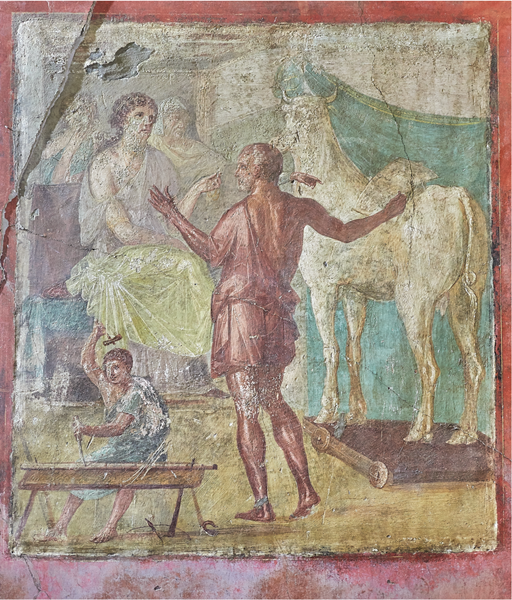
The beginning. In the House of the Vetti, this dining room fresco is perhaps the earliest depiction of a workbench in the West. (Photo by Narayan Nayar)

The journey to the summit of Mount Vesuvius has all the romance of visiting an unlicensed reptile farm. It begins in Ercolano, Italy, a touristy village in the shadow of the volcano and home to Herculaneum, one of the towns buried by Vesuvius’s eruption in 79 C.E.

As Narayan Nayar (the photographer for the journey) and I stepped off the train from Naples we were assaulted by young, attractive Italians. Their job: Bait tourists to nearby restaurants. We glanced around and saw only one escape route from the train station’s cul-de-sac. So, we plowed through the crowd of eager human fishing lures.

We emerged from the other side a bit relieved. Then we realized we’d scurried past the bus company that was supposed to drive us up the volcano. We turned around and dove back into the swarm of too-perky people in order to catch our bus.

The twisty-turny bus ride ended 660 feet below the volcano’s summit, and we then climbed a steep trail to the volcano’s rim. The top resembles a gravel pit where one of Frank Herbert’s worms might emerge. There’s no deep hole for tossing human sacrifices – throw a virgin into Vesuvius and she’s only going to get skinned knees and a sunburn. I looked around the volcano and promptly excused the early settlers of the area for building their homes at the base of Vesuvius. The only evidence you’re on a volcano (besides the little gift shops) is the occasional tiny plume of gas and the odd rocks below your feet.

I picked up a few rocks. For rocks, they were young – likely the result of the 1944 eruption, which destroyed several villages. I looked out from our 4,200-foot perch at the buildings in every direction below, which are built on top of villages that were covered in ash from earlier eruptions. It’s a grim scene if you think about it too much – 600,000 people now live in the so-called “red zone” for a future eruption.

And yet, as I fondled the rocks in my hand I felt only gratitude for this deadly, fire-breathing mountain.

The Earliest Workbenches

The recorded history of woodworking begins with the Egyptians. But the recorded history of workbenches begins (for now) with Vesuvius. Its massive eruption in 79 C.E. buried Pompeii, Herculaneum and other sites, preserving frescoes, buildings, pottery, human remains and even wooden furniture.

At Pompeii, the ash blanketed a fresco showing a low, four-legged workbench being used for mortising by a man in Greek attire. At nearby Herculaneum, the eruption preserved a fresco showing “erotes” – what we might call “buck nekkid cupids” – sawing a board at an eight-legged low workbench. It features a holdfast and other holdfast holes. This fresco has since been destroyed, but we have engravings that were made soon after its discovery (more on both the frescoes’ stories is ahead).

These two images are the earliest representations of workbenches of which I’m aware. And they launched my interest in exploring knee-high workbenches and how to use them to build furniture, boats, storage containers and wagon wheels.

The conventional wisdom is that these low benches were used in former times for simple work and were replaced by superior modern benches, which are thigh-high or taller. But the more I studied low benches, the more I found that they never disappeared. They are still in use. Additionally, these low benches can be used for complex work, including steam bending compound shapes and lutherie.

The low bench is more than a thick plank of wood with legs. It’s also a collection of simple jigs and appliances that allow you to do remarkable work while sitting comfortably on an easy-to-build platform. For centuries, these simple jigs remained hidden in plain sight in paintings and drawings in museums. And their appliances have been proven to work, both at my low benches and by the modern craftsmen who still use them.


How to Provoke a War – Death of Democracy 25 – Q1 1939

Filed under: Europe, Germany, History, Military — Tags: , , , , , , — Nicholas @ 04:00

World War Two
Published 25 Jul 2026

By March 1939, appeasement has failed.

Hitler’s Germany has moved from threats and persecution inside the Reich to the destruction of Czechoslovakia, the seizure of Memel, and renewed pressure on Poland. No shots have yet been fired between the great powers — but Europe is now locked on a course toward war.

In this episode of Death of Democracy, Spartacus Olsson reports from Berlin at the end of Q1 1939: the “Israel” and “Sara” decree, Schacht’s dismissal, Göring’s Central Office for Jewish Emigration, Hitler’s genocidal Reichstag threat, the launch of Bismarck, the coerced occupation of Prague, the Memel ultimatum, and Britain’s guarantee to Poland.

This is the moment when the Munich illusion collapses. Hitler is no longer pretending to unite Germans. He is dismantling states.

The Alchemy of Finance by George Soros

Filed under: Books, Britain, History, Media, Politics — Tags: , , , — Nicholas @ 03:00

Handre discusses the book George Soros wrote (or had written) after he gained a huge sum of money by speculating against the Bank of England in the 1990s:

George Soros made a billion dollars betting against the Bank of England in September 1992, and then he wrote a book explaining that markets are fundamentally irrational. Notice the tension there.

The Alchemy of Finance, published in 1987, gives you Soros’s theory of reflexivity. The idea runs like this: participants in a market do not observe prices from the outside. They shape the reality they are trying to measure. Their biased expectations feed into prices, prices feed back into expectations, and the whole thing spirals away from any “equilibrium”. Soros presents this as a devastating blow to the neoclassical economists who model markets as tidy machines grinding toward a single clearing price.

He is right, but misses one fundamental point. The equilibrium fetish deserves a beating. Ludwig von Mises and Friedrich Hayek spent decades explaining that the market is a process, not a photograph, and that no equation captures the discovery going on inside it. Prices carry dispersed knowledge. Entrepreneurs guess, act, and get corrected by profit and loss. Soros rediscovered a slice of this in his trading room, and called it “alchemy”.

But, Soros treats his “far from equilibrium” boom-bust sequences as proof that free markets are inherently unstable and require an adult (usually a central bank, sometimes Soros himself) to supervise them. He points at the credit bubbles of the 1980s and sees capitalism failing. He never asks who prints the credit.

The Federal Reserve does. Cheap money floods in, entrepreneurs misread the artificially low interest rates as real savings, and they pile into projects that cannot pay off. That is the boom. The bust arrives when reality collects its debt. Soros describes the symptom with real skill and misses the pathogen entirely.

So the man who broke sterling by exploiting a currency that politicians pegged at a lie somehow concludes that governments need more discretion, not less. The 1992 pound was a government price-fix collapsing, exactly as Mises predicted such fixes always do.

The reflexivity part is spot on, but send the bill for the bubbles to the people with the printing press.

The Ancient Greeks 03 – Enter the Persians 5 – Earth and Water: The Logic of Empire

Filed under: Greece, History, Middle East — Tags: , , , , , — Nicholas @ 02:00

seangabb
Published 16 Feb 2026

Why does Persia turn west? In this lecture we examine Persian strategic thinking after the suppression of the Ionian Revolt. We analyse the demand for “earth and water”, the meaning of submission in Persian political culture, and the diplomatic crisis that follows.

Most Greek states comply. Athens and Sparta do not. We also explore the Persian expedition of 492 BC under Mardonius and the calculated preparation for renewed intervention.

QotD: Progressives know they’re on the “right side of history”

Filed under: History, Politics, Quotations, USA — Tags: , , , — Nicholas @ 01:00

You want to know why the Left is so awful? They have no sense of history. Total ignorance would be sufficient, but the Left, as always, really goes the extra mile (so long as “going the extra mile” entails “patting yourself on the back”) — they think they have an exquisite knowledge of history. This is partly a holdover from Karl Marx, who thought his sub-Hegelian junk philosophy was not just a science, but THE Science — The Science of History. More than that, they’re certain that History is moral, that it has “sides”, and they’re on The Right Side of History.

Whatever happens, then, happens either exactly as they foretold — even if they never bothered to actually prophesy, or to even think about it at all until just this second — or is a temporary victory by the forces of evil, a temporarily successful holding action against the inevitable Triumph of Progress.

It’s a fascinating chicken-and-egg conundrum: Did the Left take to Marxism because they’re so invincibly self-righteous, or does their sanctimoniousness come from their dedication to Marxism? It doesn’t really matter, because the practical effect is the same either way: Their consciences are completely short-circuited. They can do the most awful stuff with a smile on their faces, because “awful” is relative, comrade – as you’d know if you had the proper proletarian consciousness; if you understood things from History’s perspective, as they do.

Severian, “Escriva Ch.8: Examination of Conscience”, Founding Questions, 2022-06-26.

Powered by WordPress


