
seangabb
Published 1 Apr 2026Greece: A Brief History, c.700 BC – 500 AD
What happens when victory creates power?
In this final lecture on the Persian invasion, we examine the consequences of Greek victory — and the transformation of liberation into empire. With the Persians driven out, unity collapses. Athens and Sparta begin to diverge, and a new political order emerges in the Greek world.
We explore:
– The rebuilding and fortification of Athens
– Themistocles and the rise of Athenian naval power
– Spartan suspicion and the fall of Pausanias
– The ostracism and exile of Themistocles
– The creation of the Delian League
– The transformation of alliance into Athenian empireThis lecture shows how victory over Persia leads directly to the rise of Athens — and to the tensions that will eventually produce the Peloponnesian War.
September 11, 2026
The Ancient Greeks 05 – The Greeks Fight Back 4 – Liberation to Empire
September 7, 2026
The Ancient Greeks 05 – The Greeks Fight Back 3 – Plataea
seangabb
Published 31 Mar 2026Greece: A Brief History, c.700 BC – 500 AD
How was the Persian invasion finally defeated on land?
In this lecture, we examine the final phase of the Persian invasion, culminating in the decisive Greek victory at the Battle of Plataea in 479 BC. After the withdrawal of Xerxes, a large Persian army remains in Greece under the command of Mardonius. Through diplomacy and force, he attempts to break Greek resistance — but fails.
We explore:
– Persian diplomatic strategy and the offer to Athens
– The reoccupation and second destruction of Athens
– The mobilisation of the Spartan army under Pausanias
– The Battle of Plataea and the destruction of the Persian land forces
– The simultaneous Greek victory at MycaleThis lecture shows that Salamis was not the end of the war, but the beginning of a final, decisive Greek victory on land and sea.
September 2, 2026
The Ancient Greeks 05 – The Greeks Fight Back 2 – Salamis
seangabb
Published 30 Mar 2026Greece: A Brief History, c.700 BC – 500 AD
How did a smaller Greek fleet destroy the naval power of Persia? This lecture examines the Battle of Salamis, one of the most decisive naval engagements in world history. Against overwhelming numbers, the Greeks achieved a catastrophic defeat of the Persian fleet — changing the course of the war.
We explore:
– Themistocles’ deception of Xerxes
– The strategic choice of the narrow waters at Salamis
– The nature of ancient naval warfare and trireme tactics
– Eyewitness accounts from Aeschylus and Herodotus
– The collapse of Persian naval supremacyWe also consider the wider implications of the battle: the loss of Persian control of the sea, the danger to Xerxes’ supply lines, and the beginning of the Persian retreat.
Salamis is not merely a battle — it is the moment at which the invasion begins to fail.
August 30, 2026
The Ancient Greeks 05 – The Greeks Fight Back 1 – The Way to Salamis
seangabb
Published 29 Mar 2026Greece: A Brief History, c.700 BC – 500 AD
How did the Greeks recover from what looked like total defeat? In this lecture, we pick up the story at the darkest moment of the Persian invasion. Athens has fallen. The Acropolis has been burned. Xerxes appears on the verge of total victory. And yet, the Greek resistance does not collapse.
We examine the extraordinary political and strategic crisis of 480 BC, including:
– The evacuation of Athens and the transformation of the city into a “nation at sea”
– The internal divisions within the Greek alliance
– Spartan reluctance to defend central Greece
– The decisive leadership of Themistocles
– The strategic importance of naval powerAt the centre of this lecture is the question of strategy: should the Greeks abandon the north and defend the Peloponnese, or risk everything in a naval battle at Salamis?
This is the turning point of the war — not yet a victory, but the moment at which survival becomes possible.
August 24, 2026
The Ancient Greeks 04 – The Persian Invasion 4 – The Fall of Athens
seangabb
Published 26 Mar 2026Greece: A Brief History, c.700 BC – 500 AD
What happens when resistance fails?
In this lecture, we examine the dramatic collapse of Greek resistance after Thermopylae and the advance of the Persian army into central Greece. With the Spartan force destroyed, the road to Athens lay open.
We explore:
– The consequences of Thermopylae
– The evacuation of Athens under Themistocles
– The Persian capture and destruction of the city
– The psychological and strategic impact on the Greek world
– Why, at this moment, Persian victory seemed inevitableThis is the darkest point of the war for the Greeks — a moment when everything appears lost, and yet the story is far from over.
August 20, 2026
The Ancient Greeks 04 – The Persian Invasion 3 – The Road to Thermopylae
seangabb
Published 25 Mar 2026Greece: A Brief History, c.700 BC – 500 AD
Why did the Greeks resist — and how did they organise their defence?
In this lecture, we follow the formation of the Greek coalition against Persia and the strategic decisions that led to the famous stand at Thermopylae. Against overwhelming odds, a divided collection of city-states came together to resist the greatest power in the known world.
We examine:
– The creation of the Hellenic League
– Spartan leadership and Greek strategy
– The selection of Thermopylae as a defensive position
– The parallel naval strategy at Artemisium
– The events leading up to the battleThis lecture sets the stage for one of the most famous last stands in history, showing that Thermopylae was not an isolated act of heroism, but part of a carefully considered defensive strategy.
August 16, 2026
The Ancient Greeks 04 – The Persian Invasion 2 – Logistics and Diplomacy
seangabb
Published 24 Mar 2026Greece: A Brief History, c.700 BC – 500 AD
How do you move an empire to war? This lecture examines the extraordinary logistical and diplomatic preparations behind Xerxes’ invasion of Greece. We explore how the Persian Empire assembled one of the largest armies in ancient history and the immense challenges of supplying and coordinating such a force.
At the same time, we examine the diplomatic pressure placed on the Greek states, including demands for submission and the divisions this created within the Greek world.
– The scale and organisation of the Persian army and navy
– Supply lines, engineering, and preparation
– The bridging (and scourging) of the Hellespont
– Persian diplomacy and the demand for “earth and water”
– Greek responses: submission, neutrality, and resistanceThis lecture shows that the invasion was not simply a military campaign, but a vast imperial operation combining force, intimidation, and political calculation.
August 13, 2026
The Ancient Greeks 04 – The Persian Invasion 1 – Xerxes Decides
seangabb
Published 23 Mar 2026Greece: A Brief History, c.700 BC – 500 AD
What drove the greatest invasion force of the ancient world to march against Greece?
In this lecture, we move from the aftermath of the Battle of Marathon to the momentous decision of King Xerxes of Persia to launch a full-scale invasion of mainland Greece in 480 BC. We examine the political, strategic, and psychological factors behind the Persian decision, including the legacy of Darius, the revolt in Egypt, and the internal debates within the Persian court.
Drawing on Herodotus and other ancient sources, this video explores:
– The consequences of Marathon for both Persia and Greece
– Xerxes’ consolidation of power
– The famous debate at the Persian court
– The role of honour, revenge, and imperial ideologyThis is the essential starting point for understanding how a regional conflict escalated into one of the defining wars of the ancient world.
Part of a full lecture series on the Persian Wars.
August 8, 2026
The Ancient Greeks 03 – Enter the Persians 7 – Marathon, The First Shock
seangabb
Published 16 Feb 2026Greece: A Brief History, c.700 BC – 500 AD
The Persian army lands at Marathon. Athens must decide whether to wait or fight. We examine Miltiades’ strategy, the Athenian command structure, hoplite tactics, and Herodotus’ restrained account of the battle.
We also analyse the later legend of the Marathon runner and the political consequences of the victory. Marathon did not end the Persian threat — but it changed Greek confidence forever.
This is not the end of the war. It is the end of its beginning.
August 3, 2026
QotD: The Hellenistic Age
In the 4th century BC, the Greeks conquered the world. And that is where their problems began.
When I was a child first getting interested in ancient history, the books I read followed a smooth narrative process. The story of the Greeks began with Athenian democracy and the victories at Marathon, Salamis, and Plataea that saved Western civilization from Persian conquest. Then there was the Athenian maritime empire, and its tremendous cultural achievements: the Parthenon, Socratic philosophy, the plays of Sophocles, Euripides, and Aristophanes. There was the Peloponnesian War and Thucydides’s chronicling of it. And then, in a tremendous climax, there were the awesome conquests of Alexander the Great, who destroyed the most powerful empire on Earth and conquered the known world by the age of 33, only to die young and have his empire swiftly broken up after his death.
… And then the story would promptly lurch 700 miles to the northwest and start over. Greeks? What Greeks? Now I was reading about the rise of a different city, Rome, and the achievements of its great republic. Instead of the Assembly and the ostracism, there was the Senate and the consuls. I would read about the Samnite Wars, the Punic Wars, the Gallic Wars, and finally the great civil wars that transformed Rome from a republic into the empire that men still think about a few times a week. In this story, the Greeks appear again, but only as enemies for Rome first to easily defeat, then be culturally influenced by. This fusion of Greek and Roman culture leads to European Christianity, the Renaissance, the cultural canon — in a word, the West itself.
Kid me didn’t think too much about it at the time. But as I grew, I and many others finally had a thought intrude: Wait a minute, what the heck was going on in Alexander’s old empire before the Romans got there?
And if you’re like me, asking that question is how you wind up reading Alexander to Actium.
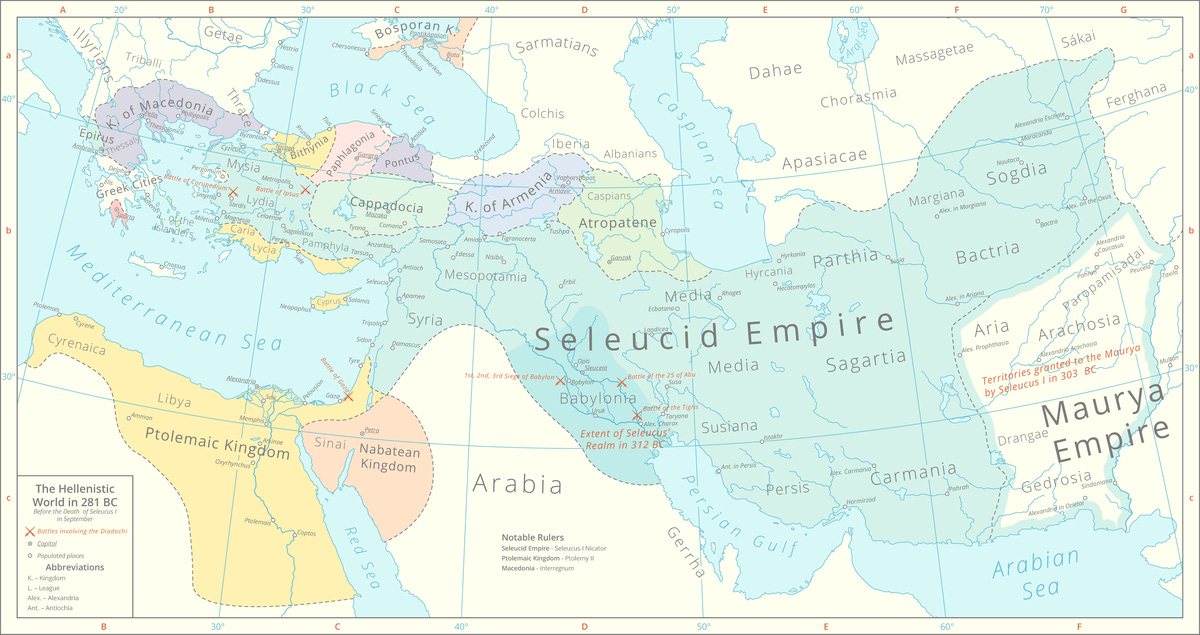
Alexander to Actium is classicist Peter Green’s gargantuan tome covering the period historians now call the Hellenistic era, the 293-year span following the death of Alexander the Great during which his vast but short-lived empire was divided up and ruled by ethnically Macedonian and Greek elites who left the stamp of Hellenic culture all across the eastern Mediterranean. The era begins with Alexander’s generals (the Diadochi, “Successors”) waging an epic forty years of war as funeral games for their dead master before finally settling into a more stable system with three great kingdoms centered on Macedon, Egypt, and Syria (plus lesser monarchies like Pergamon and Bactria). These kingdoms battled one another and Rome for another quarter-millennium, gradually losing land and power before they were extinguished, one by one. The last Hellenistic kingdom, Ptolemaic Egypt, made it until 30 B.C., when the legendary Cleopatra1 committed suicide and her realm became the personal possession of Octavian, the future Caesar Augustus. Long after their destruction, the Hellenistic legacy lingers most in religion: the Christian New Testament was written not in the Hebrew or Aramaic of Judea or the Latin of the Roman Empire, but in the koine Greek that had become the lingua franca of the educated eastern Mediterranean.
The ebb and flow of this 300-year historical epic is one that really deserves a trashy big-budget TV adaptation or three. The sordid acts of the Successors and their successors are so spectacular they could easily be made into a hybrid of HBO’s Rome and a popular show about dragons that shall remain nameless. I’m a little shocked one hasn’t been made already. To give just a small set of anecdotes from Green’s work:
- After an attempted army revolt following Alexander’s death, the general Perdiccas holds a “purification” ceremony for the army, which consists of rebel leaders being publicly trampled to death by elephants.
- Antigonus One-Eye, the man who came closest to reuniting Alexander’s empire, was very tall, very wide, very old, and had a very good nickname. Huge in size and huge in ambition, he dies fighting in battle at over 80 years old at Ipsus, a battle featuring 25,000 cavalry, 120 scythed chariots, and almost 600 elephants.
- Olympias, Alexander the Great’s mother, is so vindictive that when Philip II dies, she has a rival wife and her infant daughter roasted to death on a charcoal brazier even though they pose zero dynastic threat. When her own end comes during Macedon’s multiple civil wars, the soldiers of Cassander refuse to kill Alexander’s mother – so she is instead stoned to death by the families of those she had killed during past purges.
- Seleucus I, founder of the Syria-based Seleucid Empire, is happily married to his second wife Stratonice when he notices his son, Antiochus, is deeply enamored with her. No worry: Seleucus simply divorces Stratonice and has her marry Antiochus. This is actually a happy ending and works out for everyone, surprisingly.
- Lysimachus, king of Thrace, is happily married to his third wife, Arsinoe, when she tricks him into having his son by a first marriage executed so her own son can succeed. This sparks a war that kills Lysimachus and destroys his kingdom, somewhat botching the whole succession thing. But no worries: Arsinoe escapes to Egypt and makes out just fine by marrying its pharaoh – her brother.
- Cassander, king of Macedon, gets so irate at clever jabs from the wily Athenian politician Demades that he finally snaps and personally chops both Demades and his son to pieces while screaming insults at them.
- For about a decade during the various successor wars, Athens is ruled by a literal philosopher-king, the thirty-something Macedonian puppet Demetrius of Phaleron. One of his agenda items is building a gigantic mechanical snail to crawl through the streets of Athens leaving a realistic trail of slime behind; this is apparently some artful way of shaming the Athenians for being sluggish in standing up for Greek freedom.
- After Demetrius the Philosopher King is overthrown (by a different Demetrius, long story) the new tyrant takes advantage of divine honors granted to him to house his hoes in apartments at the back of the Parthenon. He tries to seduce a teenaged boy who instead commits suicide by jumping into a tub of boiling-hot water, and another time waives a fine against a prominent Athenian citizen in return for taking his son as a catamite. When you are legally a god, they let you do it.
- Aratus is a quite successful Greek general with the unfortunate problem of getting uncontrollable diarrhea before every battle.
- Escaped slave and rebel Drimakos defies authorities on Chios so successfully they simply reach a treaty with him: As long as he doesn’t steal too much and only accepts new slaves into his army who were severely abused by their masters (while sending the rest back), they’ll leave him alone. Drimakos lives to a ripe old age, then has his boy lover kill him and take his head in to claim a reward. Later, Drimakos’s spirit would supposedly appear to Chians in their dreams to warn of plots by their slaves.
- To show off their power, the Ptolemies commission a grand procession through Alexandria whose centerpiece is “a gaudily painted gold phallus, almost two hundred feet long … and tied up, like some exotic Christmas present, with gold ribbons and bows”. Green reasonably wonders how this mighty phallus was able to negotiate corners.
- The later Ptolemies could win some kind of ghastly award for their spectacular decadence. Ptolemy VIII Physcon (“the Obese”), who resembles a 2nd century BC Baron Harkonnen, seizes power after the death of his brother (also named Ptolemy) by marrying Cleopatra, who is also their sister. He then has her son, his nephew (also named Ptolemy), murdered during the wedding feast, then proceeds to seduce and marry his pubescent niece (also named Cleopatra). A decade later, riots forced Physcon and his niece-wife into exile, and his sister-wife proclaims her son by Physcon (another Ptolemy) as pharaoh, but the heir is apparently in Cyrene at the time, allowing Physcon to capture his unsuspecting son and send his dismembered corpse to the sister-wife as a birthday present. Meanwhile, the sister-wife’s daughter by her first brother (named Cleopatra, of course) gets married off to a Seleucid king and uses her sons as a series of puppets. The first puppet, Seleucus V, proves troublesome, so his mother murders him by using him for archery practice. The second puppet, Antiochus VIII, is more canny, and when his mother tries to murder him with a cup of poisoned wine, he notices something is up and forces her to drink the fatal cup herself. Antiochus VIII then fights a long civil war against his half-brother and cousin Antiochus IX, who is not a puppet but instead has the private hobby of playing with literal giant puppets. Got all that?
If learning the above is your idea of fun, then Alexander to Actium is a rich feast, enlivened throughout with Green’s flare for delicious details and legends that are possibly fanciful but too remarkable to leave out.
Blake Neff, “GUEST REVIEW: Alexander to Actium, by Peter Green”, Mr. and Mrs. Psmith’s Bookshelf, 2025-10-20.
- The Seventh, it turns out.
August 2, 2026
The Ancient Greeks 03 – Enter the Persians 6 – Eretria Falls, Athens Stands Alone
seangabb
Published 16 Feb 2026Greece: A Brief History, c.700 BC – 500 AD
In 490 BC the Persian fleet advances island by island across the Aegean. Eretria is besieged, betrayed, and deported. We examine Persian punitive strategy, internal Greek division, and the calculated destruction of Eretria as an example to others.
Athens now faces invasion. Pheidippides runs to Sparta. The Spartans refuse immediate aid due to religious obligation. Only Plataea stands with Athens.
This is the moment before Marathon.
July 26, 2026
The Ancient Greeks 03 – Enter the Persians 5 – Earth and Water: The Logic of Empire
seangabb
Published 16 Feb 2026Why does Persia turn west? In this lecture we examine Persian strategic thinking after the suppression of the Ionian Revolt. We analyse the demand for “earth and water”, the meaning of submission in Persian political culture, and the diplomatic crisis that follows.
Most Greek states comply. Athens and Sparta do not. We also explore the Persian expedition of 492 BC under Mardonius and the calculated preparation for renewed intervention.
July 22, 2026
The Ancient Greeks 03 – Enter the Persians 4 – The Ionian Revolt and the Fatal Intervention
seangabb
Published 16 Feb 2026The Persian Wars begin not in Athens, but in Miletus. In this lecture we explore the failed Naxos expedition, Aristagoras’ desperate gamble, and the outbreak of the Ionian Revolt in 499 BC. We examine Aristagoras’ appeals to Sparta and Athens, Herodotus’ famous scene before Cleomenes, and the fateful decision of Athens to send twenty ships.
We also analyse the burning of Sardis, Darius’ calculated response, and the suppression of Ionia. This is not yet a world war — but it is the moment when Athens introduces itself to empire.
July 15, 2026
The Ancient Greeks 03 – Enter the Persians 3 – Darius, Ionia, and the Fragile Peace
seangabb
Published 16 Feb 2026Greece: A Brief History, c.700 BC – 500 AD
With Darius I, the Persian Empire reaches its greatest extent. This lecture explores how Darius reorganised the empire into satrapies, imposed taxation systems, and stabilised rule across vast territories. We examine Persian cultural policy, military discipline, and the integration of Greek communities within the imperial system.
But beneath the surface of order, tension grows. The Ionian Greek cities resent indirect rule through tyrants. Persian administrative logic collides with Greek political volatility. The peace is real — but unstable.
July 9, 2026
The Ancient Greeks 03 – Enter the Persians 2 – Cyrus, Destiny, and the Making of an Empire
seangabb
Published 16 Feb 2026Greece: A Brief History, c.700 BC – 500 AD
Who was Cyrus the Great? How did a minor Persian ruler come to dominate the Near East? In this lecture we examine Herodotus’ account of Cyrus’ miraculous survival, his overthrow of the Medes, and the conquest of Lydia and Babylon. We analyse Persian imperial strategy: flexible governance, religious tolerance, and pragmatic rule. We also explore how the Ionian Greek cities of Asia Minor first came under Persian control — setting the stage for future rebellion.
Empire did not emerge through chaos alone. It was built through method.


