
People like to point out that the political Right in America, split as it is between redneck populists and classically-liberal free marketeers, lacks the European conservatives’ emphasis on order and tradition, place and class, throne and altar and blood and soil and so forth. And, pace various European immigrants over the years and a few weirdos on the Internet, that’s true. But it’s interesting to imagine what our politics might look like today if Tidewater had remained a force on the national stage and if any substantial strain in America could say, with John Randolph of Roanoke, “I am an aristocrat. I love liberty, I hate equality.”
So there’s Tidewater, lost and forgotten except for some guys in Virginia who still put on red jackets to hunt foxes from horseback — and maybe in slightly different voting patterns. What about the nation that won, the one that’s everywhere?
I refer, of course, to Yankeedom.
“But Jane,” you say, “Yankeedom isn’t everywhere! Scroll back up to your own map — it’s in New England, sure, and, uh, northeastern Ohio and, wow, okay, the entire Upper Midwest. But that’s not everywhere.” But ignore the map for a moment: that’s Woodard’s idea, based on settlement patterns and voting behavior. What is Yankeedom, really? What are its fundamental beliefs, its vision of how life ought to be, and where do they show up today?
Of course you know the story of Yankeedom’s founding: radical Calvinists from East Anglia, settled around the Massachusetts Bay in the 1620s and 30s, funny hats? Maybe you made one of those hats for your construction paper turkey in first grade — or, if you’re a little younger, maybe you learned a nice poem about welcoming new immigrants for a glowing future of multiculturalism and prosperity. In fact the emphasis on “the Pilgrims” in American civic mythology — never mind the traditional Thanksgiving menu, heavy on quintessentially New England dishes like pie1 — is itself a product of Yankeedom’s cultural dominance, as is the insistence in that familiar story that they left England for religious freedom. It’s true! They did! But there’s a very important final bit that we somehow leave out of the version we teach to elementary schoolers: religious freedom for themselves.
The earliest Yankees imagined their new society as a Protestant utopia, a new Zion, in which they would work out their collective salvation. Any deviation from the straight-and-narrow could doom everyone, so enforcing moral and religious conformity — through banishing heretics or, if necessary, even executing them — was of paramount importance. Yankeedom was meant to be a “city on a hill”, a model for mankind: if only they could be good enough, pure enough, and holy enough, God would bless them abundantly — and then everyone else, seeing their manifest blessings, would naturally emulate them and become holy themselves! The important thing, then, was not merely to do right but to be seen to do right, as an example to neighbors and foreigners alike. Yankeedom also put a tremendous emphasis on education (literacy was necessary to read the Word of God), encouraged subordinating the interests of the individual to the greater good of the community, and saw government as an extension of the citizenry. Government, then, since it was run by and for the people, was naturally called to propagate God’s will in a corrupt and sinful world by prohibiting or regulating immoral activities.
As Yankeedom moved west, out of the strict control of the Congregationalist ministers who dominated the New England colonies, they began to abandon their specific religious tenets. Sometimes this meant exciting new religious — the Yankee-settled western portions of New York State gave rise to such religious enthusiasms that people began to call it the “Burned-Over District“2 — but just as often it meant becoming a Methodist, Unitarian, or Baptist. Wherever they went, though, the Yankees clung to their belief that you could make earthly society resemble Heaven, or at least that there was no excuse for not trying as hard as you could. Yankees were at the heart of every push for social reform, from abolitionism and the temperance movement to Reconstruction, the minimum wage, women’s suffrage, and an end to child labor. For example, the members of New York City’s Committee of Fifteen, which militated against gambling and prostitution, were mostly Yankees or German-Jewish immigrants; none were culturally New Netherlanders.
By now this should all be sounding familiar. Heavy emphasis on education, embrace of the government regulation or prohibition of immoral behavior as the central bulwark of societal virtue, extremely visible adherence to highly specific rules and norms of behavior as proof of righteousness? Oh, look, it’s woke! It’s the ideology of the professional-managerial class, the meritocratic elite — it’s the same people with the same bumper stickers on the same Mercedes SUVs in the Whole Foods parking lot that you see in every major American city, regardless of which “nation” most of the other residents belong to.
There are two things going on here, I think: first, high-cultural capital Americans are far more mobile than they used to be. Plenty of people spend a few years in DC, then a few years in Austin, or maybe San Francisco or Boulder or Brooklyn, regardless of where they grew up. Second, and perhaps more important, is the role of education. Maintaining or improving your class position depends far more on a “good” college than it used to (witness the to-do when someone claims the distinction of Harvard on a night school degree!). The Yankee emphasis on education means that most of America’s prestigious colleges and universities are in Yankee-settled areas.3 Thus, membership in a higher stratum of society practically depends on four or eight years marinating in Yankeedom. What’s a kid from rural Nebraska to do?
Jane Psmith, “REVIEW: American Nations, by Colin Woodard”, Mr. and Mrs. Psmith’s Bookshelf, 2024-02-19.
- Harriet Beecher Stowe, in Oldtown Folks, as quoted in Albion’s Seed:
“The pie is an English institution, which, planted in American soil, forthwith ran rampant and burst forth into an untold variety of genera and species. Not merely the old mince pie, but a thousand strictly American seedlings from that main stock, evinced the power of American housewives to adapt old institutions to new uses. Pumpkin pies, cranberry pies, huckleberry pies, green-currant pies, peach, pear, and plum plies, custard pies, apple pies, Marlborough-pudding pies, — pies with top crusts, and pies without, — pies adorned with all sorts of fanciful flutings and architectural strips laid across and around, and otherwise varied, attested the boundless fertility of the feminine mind, when let loose in a given direction.”
For more on the history of distinctly American pies, including why they’re so different from the English pies you may have seen on The Great British Bake-Off, I highly recommend BraveTart: Iconic American Desserts, which is somehow both the best history of American sweets I’ve ever read and the best cookbook for them.
- Famous alumni of the Burned-Over District include the Seventh-Day Adventists, John Humphrey Noyes’s Oneida Community, and the Church of Jesus Christ of the Latter-Day Saints. (Yes, Mormons are Yankees. Obviously.) But my favorite wacky Yankee religious enthusiasm — actually in Massachusetts, where they weren’t branding people with H for heretic any more — was John Murray Spear‘s “New Motive Power”, an attempt to build an electric perpetual motion machine Jesus.
- The exceptions are generally the flagship school of a large non-Yankee region or in California, the culture of which I’ve entirely elided for reasons of brevity. Sorry. The tl;dr is that Woodard argues the “Left Coast” is a hybrid of Yankees settling the cities and Greater Appalachia in the countryside, which leads to culture fairly similar to that of Yankeedom.
October 7, 2026
QotD: The cultural dominance of “Yankeedom”
October 6, 2026
QotD: The decline of academic standards over the years
Twenty years before that, and it would’ve been called “basic cultural literacy”; the kind of thing any college man — indeed, any graduate of a remotely decent high school — would know cold. I’ve written many times that the not-elite-but-certainly-very-respectable school which awarded my PhD wouldn’t have admitted me as an undergrad as late as 1960; they would’ve been sticking me in some serious remedial classes as late as 1980. Watching my buddy struggling mightily — and failing miserably — to get even the ridiculously watered-down, extremely fake and utterly gay version of this stuff across to the brown-nosing test-acers of the Current Year sent me sobbing into the arms of Jack Daniel.
Not because I would’ve done better, mind you, but because I would’ve done so much worse. The only way I got through my last few semesters in academia was to regard it as acting. The University is paying me to stand on stage and say my lines, so I’ll stand there and say them. Aside from that, all they want to do is check the appropriate box: Students have attended thus-and-such class, taught by someone with a PhD (crucial for those “best college” rankings!), and … there it is.
What actual knowledge am I supposed to be conveying? What skill set? What world view?
Category error. If it doesn’t fit on the standardized test, which is the only thing that matters to the bottom line, then it’s useless.
Severian, “On the Absurdity of Life”, Founding Questions, 2022-09-12.
October 3, 2026
More on that change to student loan eligibility rules
Larry Correia’s comments on Trump’s executive order changing eligibility for federally guaranteed student loans generated a fair amount of discussion, so I felt linking to Copernican’s post on the same topic would be of interest to many of you:
As a White Western Man, I am unaccustomed to seeing or hearing “good news” in a larger geopolitical sense. That is, actions of our leaders tend to lead one to be somewhere between depressingly blackpilled and defiantly optimistic even in the face of overwhelming evidence to the contrary.
Recently, Donald Trump and his Department of Education have engaged in some more executive shenanigans. Once again bypassing our Congress, whose dysfunctional role is best thought of as the kidneys in our diabetic, alcoholic body politic. With that said, a relatively minor update to the Department of Education rules regarding underwriting federal student loans might have a dramatic long-term effect on our entire cultural system.
Take a look for yourself:
Of all the actions the Executive Branch can take, this is one of the best. Most notably, because it’s boring. Changing the rules on federal fiscal underwriting is boring, so the media and the population at large will have a hard time holding on to it as a talking point. The most dramatic cultural changes are precipitated from the most boring types of fiscal action. Flashy is fun, but boring is often effective. Something to keep in mind when our generation finally seizes the reins of power.
The recent update that takes effect in 2027 is functionally removing the federal guarantee from student loans for useless degrees. Predominantly degrees that fall under the “female daycare” category. That is, the reason why every employer in the United States demands a degree to flip burgers or fill out spreadsheets is due to the fact that everyone can get a degree. Removing a significant portion of the federally backed degree-mill system will force a top-down restructuring of the American cultural academic-caste system.
The fallout from this decision is going to be immense, but we won’t see it unless the current policy holds long enough for several generations of university students to grow up under it (say around 12 years). First, it’s going to cut off universities from the endless money of cheap federal student loans that’s been flooding into useless departments. Women’s studies, social studies, English majors, and early-childhood-education majors are about to see a significant drawdown in the number of attending students.

As many have pointed out, it’s only an Executive Order, so it can be easily set aside by the next president, but it may have a salutary effect on those who do see a university degree as just a way to stay out of the working world for a few more years.
October 1, 2026
Trump’s student loan policy change
On the social media site formerly known as Twitter, Larry Correia applauds President Trump’s decision to stop providing goverment-backed student loans for courses that don’t provide students who graduate with a viable career path:

Now this sounds like a good policy.
Only they’re not “banning” anyone from majoring in anything. Kids can still major in whatever dumb shit, gender studies, no job having degree, they want, and liberal academics will still make bank ripping off those kids and their parents.
This is just the rest of us tax payers not being on the hook for their good times.
Most regular loans the bank isn’t going to lend you money unless there’s some assurance that they’re not going to get screwed. If you went to your bank with a business plan that said you needed $250k up front so you could make $20 an hour after, they’d laugh at you.
Student loans were the one goofy ass outlier because Uncle Sam said it’s cool to go a quarter million dollars into debt to get a useless degree that qualifies you to get some specific $20 an hour job … except wait, due to all these loans for bullshit degrees the supply of eligible employees far exceeds the demand, so all those $20 an hour jobs are already filled, so now you’re working fast food where your coworkers are teenagers or illegal aliens, only you’re still $250k in debt.
Of course none of what I am saying will make sense to people who majored in the degrees in question because they weren’t required to take any math, econ, or accounting classes.
The headline says social work, art, religious studies, and music will be hardest hit! (teaching aides need a degree? WHY?!?) And now I’m gonna get yelled at by people who think what America really needs is more social workers.
Going off of what I’ve seen from creative writing degrees, MFAs, and the many art and music professionals I know, I’m guessing art and music degrees are mostly a huge waste of time. Just go get a real job to pay the bills and practice your art on the side until you get good at it (says the bestselling novelist who got an accounting degree).
Going deeply into debt for a “religious studies” degree from a university baffles me. Go to church. Read your scriptures. Serve your fellow man. But mostly I’m betting they included this one to try and pull at conservative heart strings because we all know in reality this policy change is going to overwhelming hit liberals.
But, Correia, you barbaric anti-intellectual* with the free taxpayer money faucet shut off this will irreparably harm America’s pretentious snooty sheltered ivory tower scholars of pointless fields who exist in a state of perpetual bossy uselessness in their little university bubble!
Oh no! Anyways.
* for the record, I’m not anti-intellectual. I’m all in favor of scholarly pursuits. I just think much of the education business is a scam, and the people who label themselves “intellectual” usually aren’t.
September 19, 2026
Internal migration patterns in the United States
It’s become a commonplace to see yet another tech company pulling up stakes and leaving California … and the state government seems determined to get rid of many of their biggest economic contributors with new legislation to make life harder for companies and wealthy individuals (see the second item, for instance). But it’s not just California losing population to other states:

Universities in the NCAA Southeastern Conference.
Map from Wikimedia Commons
Americans have long expressed their political preferences at the ballot box and their economic preferences with moving vans. Increasingly, they are expressing a third preference — where their children attend college — and the destination looks remarkably like the other two.
In 2025, North Carolina gained more than 84,000 residents from other states, more than any state in the union. Texas added over 67,000. California lost more than 229,000, and New York lost nearly 138,000, continuing a migration that has by now acquired the character of a rout rather than a trend. Yet few have noticed that the same states drawing families and factories are drawing something else: students, and with them, the institutions built to educate them.
For most of the 20th century, the hierarchy of American public higher education was as fixed as the Electoral College map of a one-party era. Berkeley, Michigan, Wisconsin — these were the names invoked when a public university wished to be mentioned in the same breath as Harvard. They remain formidable.
But formidable is no longer synonymous with singular.
Consider what the Southeastern Conference, or SEC — an organization whose reputation was built on forward passes rather than research grants — has quietly assembled. Texas A&M enrolls more than 79,000 students, a figure that would have seemed a typographical error a generation ago (see here and here). The University of Florida enrolls roughly 56,000 (see here, here, and here). Collectively, SEC institutions now educate more than half a million students, with total enrollment around 620,000 (see here and here), a statistic that ought to interest university presidents in blue states rather more than it apparently does.
This is not the result of some coordinated Southern strategy hatched in a statehouse. Universities are lagging indicators of demography, not leading ones. States that attract families acquire, in due course, college students. States that generate jobs retain their graduates rather than exporting them, as Rust Belt states have exported so much else.
States that welcome capital acquire, eventually, the tax base with which to build ambitious public institutions. Ambition, it turns out, is portable. The family that leaves Illinois for Tennessee brings its expectations for its children along with the furniture, and both eventually find a permanent address in Knoxville or some other city in the Volunteer State.
Affordability, too, plays its part, and Americans have noticed that a nationally respectable degree from a Southern flagship costs a fraction of what state flagships elsewhere demand for a comparable credential, at a moment when the public’s confidence in the value of a degree generally has become, to put it charitably, provisional.
One of California’s most impactful proposed pieces of legislation has been their “Billionaire tax”:

California’s proposed “billionaire’s tax” on the assets of wealthy state residents enjoys a slim lead in the polls leading up to the midterm elections, though so do two measures that, if they draw more votes, could render the scheme unenforceable. That makes for a high-stakes battle as many prosperous Californians are already fleeing to escape a tax that could force them to surrender ownership stakes in companies they’ve founded. Even if it doesn’t pass, a new report warns that the proposal is based on faulty research and could do vast economic damage.
[…]
The Wealth Tax Scheme Is Based on Unusual Accounting
Now, a new report finds the proposed wealth tax is not only dangerous for California’s economic prospects; it’s also based on bad research. According to the report’s author, Independent Institute research fellow Kristian Fors, “this proposal has been heavily influenced by the work of UC Berkeley professors Emmanuel Saez and Gabriel Zucman to justify the concept of wealth taxation”. Saez and Zucman have generated news headlines with their claims that the wealthy are undertaxed in comparison to lower-income Americans. But as Fors points out, the estimate that drew so much news coverage claimed that “the overall tax rate for the top 400 richest households in the nation was 23 percent”, while just a year earlier, Saez and Zucman “estimated that the top 1 percent paid an overall tax rate of approximately 36 percent; the authors found a share of 41 percent for the top 0.001 percent of earners in the most recent year of their survey, a category encompassing billionaires and high multimillionaires”.
The discrepancy, according to Fors, comes from how the economists treat corporate income taxes. Conventional analysis assumes that corporate taxes burden shareholders, workers, and consumers as the tax gets passed on. That results in the earlier estimate of a 41 percent tax rate for the wealthiest. To reach their much lower 23 percent estimated rate, Saez and Zucman used a non-standard analysis — and while the results of that approach won news coverage, they weren’t subject to peer review.
“Saez and Zucman’s empirical work on the California billionaire tax proposal retains these same unconventional accounting practices from 2019 without addressing their conflict with the mainstream corporate tax incidence literature,” cautions Fors.
The Independent Institute report observes that privacy laws prevented Saez and Zucman from drawing on personal income tax and other financial records. They relied on the Forbes 400 list, and “a 2010 study by a group of IRS statisticians found that the Forbes 400 dramatically overestimates the net worth of individuals in their lifetimes when compared to probate records of their estates after death”. Adjusting for that discrepancy produces estimates of “an average effective tax rate of 38 percent between 2018 and 2020, as compared to the 24 percent claimed by Saez and Zucman for this period”.
September 18, 2026
QotD: Higher education as a vast money laundering racket
But when you consider just how much money is involved, it’s a lot harder to laugh. Your average tenured prof makes north of $100 K, and for every one of them, there are at least two administrators, four outreach coordinators, and uncountable Special Assistants to the Assistant Provost’s Special Assistant for Diversity and Inclusion. Not to mention all the classroom space, office space, etc. that this requires (including paying the very real people who have to coordinate that stuff — no easy task — the custodial staff and so on). I’d bet that just one of these programs, all in, runs at least a million dollars per year when you throw in bennies and whatnot.
That’s a LOT of scratch, for one or two classes a semester that barely even make their enrollment numbers.
I dunno what nefarious purpose the Angry Studies programs serve (aside from the obvious, perpetual one of “burning down ambient civilization, just because”), but the “national security” ones I’m sure are basically just “diplomatic” cover for cloak and dagger shit. They used to use academic conferences like that back during the Cold War — who else but an officially credentialed diplomatic representative gets to travel around his enemies’ territory? In this case, of course, none of these people are actually going anywhere near war zones (with the exception of Mx. Kagan, of course, who decided to take command of American forces in the field). But academic “conferences” are good ways to make contacts and pass suitcases full of cash and other goodies around …
… I suspect.
Severian, “Klown Kollege”, Founding Questions, 2022-08-28.
September 12, 2026
QotD: The spiritual immune system
But first, keeping them totally away from anything is doing them a disservice. I think Escriva would strongly agree with this — we are commanded, after all, to be IN the world, not OF it. It’s a two-part command. The Poz is a disease, yes, and diseases can kill, but look at the aftermath of covid. Who are the unhealthiest people in society right now? The folks who got vaxxed and triple-boosted and spent two years hiding under their beds in a hazmat suit. Every minor sniffle hits them like a sledgehammer now, because they spent two years screwing up their own immune systems.
Second, and closely related, the fight is in the small things. People see you avoiding everything and you look like a wimp. Where I grew up, every high school had the Bible Camp Kids. They were their own little clique. They went everywhere together and tried to live as Amish-ly as possible. And everybody knew what happened to the Bible Camp Kids when they went off to college. You could set your watch by it: Two semesters in, and she’d have a tattoo and a face piercing and would either be knocked up or out of the closet.
They had no spiritual immune system.
Fighting and failing in the small things builds up your defenses for the big things. Not only that, people respect fighters. You failed, but you fought — you can hold your head high. As opposed to “You didn’t fail, but only because you tucked tail and ran”. Nobody respects those guys. It sucks to lose. But it’s far worse to “win” by never trying. Worst of all is to wallow in your defeat. Get up! Fight!
Severian, “The Way Ch. 10: Scruples”, Founding Questions, 2022-07-10.
August 24, 2026
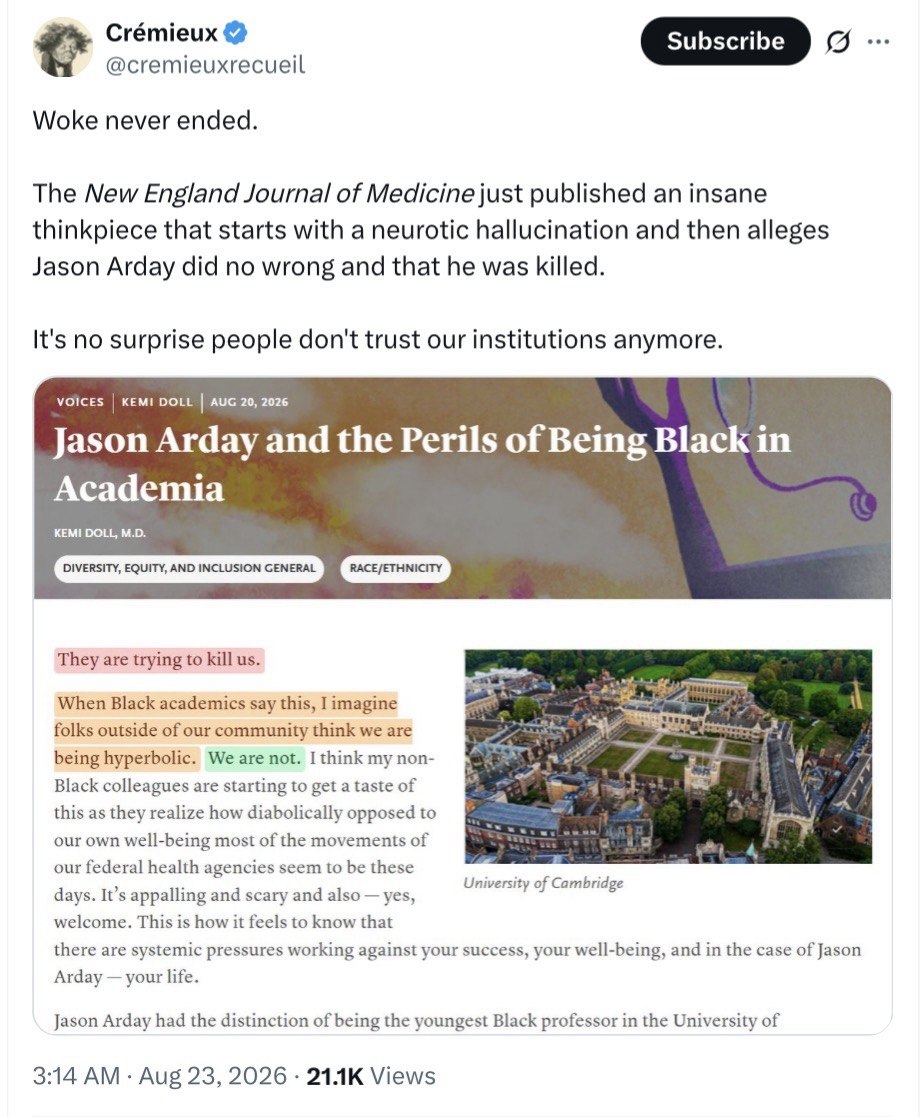
It’s no wonder that people have lost trust in formerly prestigious institutions
Lorenzo Warby on the two cases that are currently front-and-centre with the terminally online left, one a recently deceased academic grifter and another a confessed multiple murderer (of her own children):
We are currently observing attempts to turn the late Jason Arday — a fabulist who produced nothing of intellectual merit — and Lindsay Clancy, a woman who murdered her three children, into moral heroes. The former is allegedly a martyr for the cause of anti-racism and care for the neurodivergent/autistic, the latter for motherhood — or at least postpartum depression and psychosis. Both are construed as victims.
There is a real push to put the truly awful into Affluent White Female Urban Liberal. It’s almost as if there are some issues with feminisation. On the other hand, a woman being an open supporter of Lindsay Clancy is an excellent negative signal for men.
Just when you think progressivist purity spirals can’t get any worse, they do. Thus, we not only get the above hagiographical elevations of the grotesquely unworthy, we also see the physical mutilations of trans-surgery used to rehabilitate female genital mutilation.
But, of course, any such surprise is having far too contemporary a focus. Left-progressivism has a long history of elevating some of history’s most appalling monsters, most tyrannical mass murderers — Lenin, Stalin, Mao — as heroes of world-history and human liberation.
The use and abuse of moral mascots
The worse a group or individual behaves, the more progressives like them. If a group is noted for high levels of violence or various social dysfunctions, left-progressives adopt them as moral mascots.
The concept of such mascots comes from economist Thomas Sowell. Mascots are people or individuals that “the Anointed” — those who see themselves as at forefront of human liberation — adopt to be extolled and defended. This is connected to Thomas Sowell’s analysis of Constrained and Unconstrained political visions.
The Constrained Vision says there are no complete solutions, there are just trade-offs, all the way down. Human nature is one of those constraints. Biologist E.O. Wilson‘s famous observation about Communism — great idea, wrong species — is a pithy expression of the Constrained Vision.
In the Constrained Vision, history is an enormous memory well where we learn about ourselves. This is because the humans who made history are just like us. Their experience, their triumphs and failures, even their mundanities, are lessons for us.
History is contingent, it has no particular direction. The Constrained Vision finds it easy to take people’s choices as having authority because there is no direction of historical travel to which they must conform.
The Unconstrained Vision denies that human nature is a constraint in that way, so it’s possible to create a society of transformative human liberation. History is not a source of lessons, but a record of failures to achieve that liberation — a record of corruption and sin.
Moreover, history has a proper direction — towards transformative human liberation or another, related telos. Hence, choices that support that direction are legitimate, those that go against it are not. The politics of the Unconstrained Vision turns elections into legitimating rituals: citizens’ votes are blocked from overturning any of the policies the Anointed have decided represent history’s proper direction.
The Anointed evince what writer Wesley Yang labels the non-electoral politics of institutional capture. If you want to see that in its most complete form among the Western democracies, PM Tony Blair’s debauching of Britain’s constitutional order through quangoes, human rights legislation that empowered judges over elected ministers, and devolving decision-making to the EU — thereby massively increasing the degree to which elections became legitimating rituals that change remarkably little — is the current gold standard case. However, all Western democracies face similar pressures, albeit to considerably differing degrees.
The commitment of The Anointed to this vision of human liberation gives them such a sense of trumping moral authority that they see themselves as owning morality. They have the right-to-decide what is moral and then to impose their decisions on everyone else.
August 23, 2026
It is indeed a great curse to get everything you wished for
I have no idea how authentic these are, but even if they were dreamed up in the 1940s by a chain-smoking ad guy trying to sell pre-printed matchbooks to Chinese restaurants, they have a distinct ring of truth to them:
- May you live in interesting times
- May you be recognized by powerful people
- May you get what you wish for
John C. Wright suggests that the third curse adequately explains why womens’ organizations are always so angry:
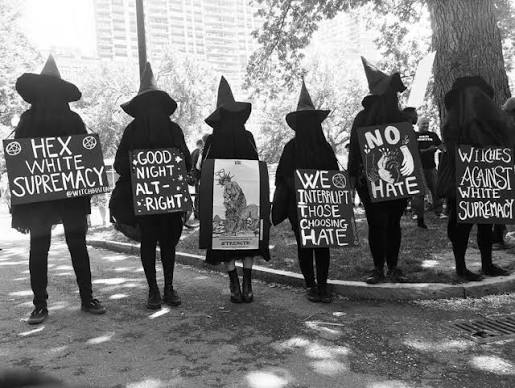
Photo from John C. Wright
Here is a comment from Twitter from a writer with the persican but cutting name of Peachy Keenan:
Why are so many women sooo angry? They won. They got everything they wanted.
Men have never been doing this badly, and women have never been doing this well.
They make more, they have the majority of jobs, they are the majority of college graduates, (UCLA undergrad is 60% female), they make more money, have much lower rates of suicide, addiction, and alcoholism, and live longer.
They won: they took over all men-only spaces, they took over the Boy Scouts, they ended men’s bathrooms, they can fly fighter planes and be in combat.
Marriage is optional, divorce is no-fault, they win 99% of the custody battles, they can control fertility at will, and they can’t get drafted. We are all living in the female future they promised.
So many women are so angry precisely because they won.
Women are naturally submissive and self sacrificial, loving and supportive. Feminine.
The lone wolf quality of being one’s own man is lonely, self supportive, selfish and domineering. Masculine.
But the sole reward for being a lone wolf, a pioneer, a masterless man, is the promise that one day, after proving yourself, you will win the love of wife and child, and she will turn your cave or hut into a home. The reward of being an independent man, a lonely man, a rebel who plays by his own rules, is finding a wife who will love, honor, and obey.
Woman obviously cannot have that reward. Women are attracted to rebels, bad boys, wolves, winners. They do not want to be them.
Women do not want to win wives.
Woman naturally want to turn huts into homes, and make their man happy. They do not want to live in the hut, run in the rat race, fight in the war.
Women do not want to crush their enemies and drive their enemies before them and hear the lamentation of their women. That is Conan.
Women, by and large, far prefer character assassination, whisper campaigns, false friendships, as the means to undermine enemies: alive but humiliated, and forced to recant and apologize.
A womanly way to win a debate is not through facts and logic, obeying the rules of debate. That is the behavior of a sportsman, a knight in a joust. A womanly way to win a debate is by humiliating the opponent into silence, by threat, by backstabbing. Cancel culture is the perfect tool for the feminine approach.
Women as well as men would rather live in a world run by men. Men aspire to run a world with rules, with honor, with chivalry, where confrontations are direct, juries rule on evidence rather than feelings or group-loyalty, innocence is rewarded and virtue punished. Women, and womanly men, aspire to run a world as a welfare state, a nanny state, where good intentions matter more than good results, and you never get a change to confront the accuser nor answer the whispered accusations. No arguments, no debate, no discussion is allowed, because that would produce conflict, disharmony, and someone might get his feelings hurt.
We have seen in countless cases how a feminized world works: if a mother strangles her children to death, the female world defends her. If a notorious academic fraud is awarded a position far beyond his competence to serve, and commits suicide rather than face the shame of exposure, the female world defends him. Cowardly assassins shooting bankers or public speakers, third-world rape gangs, cross-dressers in woman’s sports or prisons, Mohammedan child-molesters, spotted owls, endangered whales, or anything or anyone who is or who can be shoehorned into being a victim, a sad sack, a crybaby … the female world leads the otherwise healthy and normal maternal instinct to comfort crying babies into comforting any and every monster and madness imaginable, and female fear of social disapproval does not allow her, even in her own mind, to question her master.
August 20, 2026
The Frankfurt School – The most destructive intellectual project of the 20th Century
People tend to underestimate how influential intellectual movements can be, as they rarely get outside attention until they’re deeply entrenched in the university system. The Frankfurt School‘s damage record is unmatched by any other intellectual movement of the era:
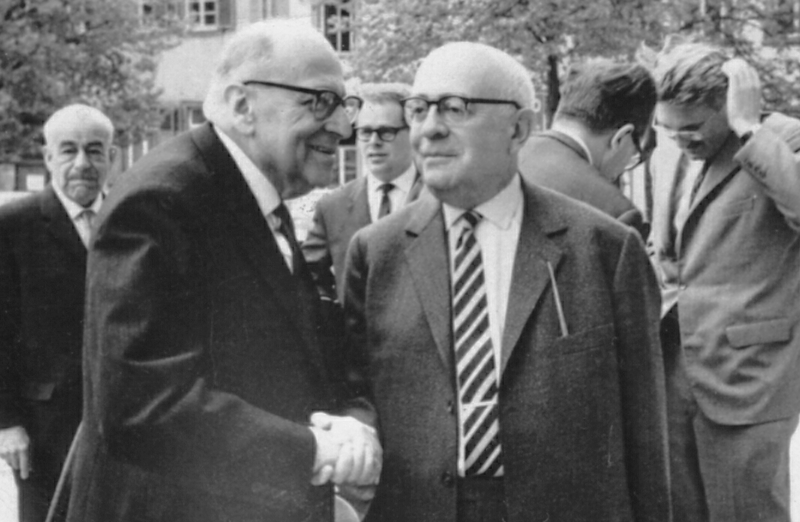
Notable members of the Frankfurt School in Heidelberg, April 1964 at the Max Weber-Soziologentag. Max Horkheimer is front left, Theodor W. Adorno front right, and Jürgen Habermas is in the background, right, running his hand through his hair. Siegfried Landshut is in the background left.
Photograph by Jeremy J. Shapiro via Wikimedia Commons.
The Most Destructive Intellectual Project of the Twentieth Century.
The Frankfurt School. You should know what it was, what it built, and why you are still living inside it.
1. The Institute for Social Research was founded in Frankfurt in 1923 and relocated to Columbia University in 1934 when Hitler came to power. The civilization they had decided to dismantle gave them refuge when another tried to kill them. They spent the next five decades producing the theoretical infrastructure for that dismantling. Western civilization itself was the problem: reason, the Enlightenment, the family, tradition, authority. Not reformed. Dismantled.
2. They called it Critical Theory – and the name is the program. Everything is to be criticized; nothing is to be built. In The Dialectic of Enlightenment (1944), Adorno and Horkheimer argued that Western reason — the reason that produced Newton and the rule of law — contained the seeds of Auschwitz. Not that reason had been misused, but that reason itself, taken to its conclusion, produces the death camp. This was not a critique of institutions. It was an indictment of the civilization itself.
3. Adorno gave them the psychological weapon. The Authoritarian Personality (1950) classified conservatism, religious faith, patriotism, and the traditional family not as political positions but as symptoms of a proto-fascist personality. If you believe in the nation or the father’s authority, you are pre-fascist. The opponent was no longer wrong – he was sick. You don’t argue with a pathology. You treat it. This made dialogue impossible. You don’t persuade someone who is wrong; you diagnose someone who is sick. Politics becomes therapy, and disagreement becomes pathology.
4. Marcuse gave them the political weapon. Repressive Tolerance (1965) argued that tolerating wrong ideas is itself oppression. True tolerance therefore requires suppressing intolerant ideas. The left decides which ideas are intolerant. Everyone else is silenced – not despite tolerance, but “in its name”. Censorship dressed in the vocabulary of liberation.
5. The generation that read Marcuse at Columbia, Berkeley, and Yale went on to run universities, media, foundations, NGOs, content moderation departments, and the EU regulatory apparatus. They implemented the argument sincerely because they had been taught it as philosophy. This was the Frankfurt School’s greatest achievement: it produced true believers.
6. French Theory picked up the tools and made them aesthetic. Foucault made the critique of power literary. Derrida made the critique of meaning philosophical. Deleuze made the critique of identity elegant. A political program became a cultural sensibility. You can argue with a program. A sensibility is in the air you breathe. By the time these ideas reached the American campus through the French conduit, they were no longer ideology. They were the water. The fish did not know they were wet.
7. A civilization stands on three pillars: truth exists and is accessible to reason; good is distinguishable from evil; and there is an inheritance worth transmitting. The Frankfurt School attacked all three – systematically and with considerable intellectual sophistication. It produced a generation that knows how to deconstruct and has forgotten how to build. That sees power everywhere and beauty nowhere. The ultimate achievement was to make destruction feel like progress. Every inherited institution became suspect; every constraint became oppression; every act of preservation became reactionary. Deconstruction became the default, while construction became something that needed to justify itself.
The answer is not another theory. It is the thing the Frankfurt School most feared: the builder who simply builds, the scientist who follows the evidence, the father who transmits what was transmitted to him.
The deconstruction machine runs on the assumption that nothing is worth building.
Prove it wrong.
Tell the truth, have courage, and build.
August 11, 2026
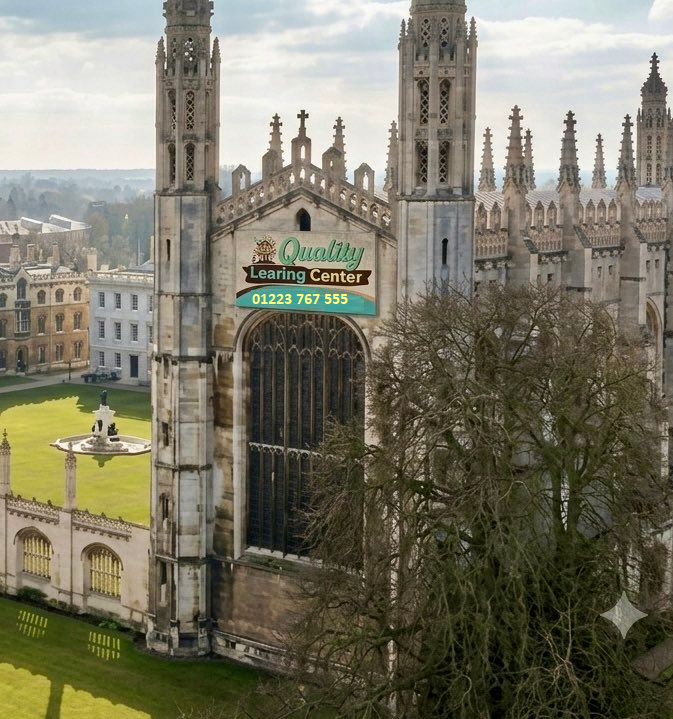
Cambridge has turned into a “Quality Learing Centre”
Even as I typed Sunday’s headline, I knew the fallout from the Jason Arday affair wasn’t going to be over quickly: it’s too high profile and gores far too many sacred cows to just fade out of the headlines. On his Substack, Francis Turner remembers what a Cambridge education used to mean and what progressive racists have turned it into now:
Once upon a time I was an undergraduate at Cambridge. Back in the day when men were real men, women were real women and Cambridge’s contribution to the national sense of humour were people like John Cleese, Tom Sharpe and Douglas Adams. Cambridge students were well aware that we were at the top of the intellectual tree and generally proud of the fact. In fact for many of us (e.g. your humble correspondent) coming to Cambridge was where we discovered that there were people far far smarter than we were for pretty much the first time in our lives. It was humbling. And once we got over that, exhilarating. You could have discussions about quantum mechanics or code optimizations or whatever with people who understood the concepts at least as well as you did. You could be lectured by professors who had Fields Medals or Nobel Prizes; often they had literally written the standard text book in the field. Sometimes they would drop digs about colleagues or rivals and you had to know that “Tony” was Tony Hoare who was in charge of Computer Science at the slightly inferior other place. And so on. Yes it was elitist. I’d say it was proudly so. Yes there were concerns about there being too many Old Etonians and other “public school”1 students compared to those from state schools but the solution was seen as going out to state schools and ruthlessly headhunting the top students rather than putting a cap on the number of privately educated students.
Some forty years later it seems that Cambridge no longer aspires to such intellectual heights — at least not for some areas of study. It is true that back then we generally held the Education Department and the associated students of Homerton College to be at a slightly lower level of intellect — and since they were mostly of the female persuasion many male chauvinist jokes were made at their expense. Also those of us reading for the more challenging degrees also disparaged some of the less challenging ones (sociology, land economy …) but even the most elitist MCPs agreed that even the ladies of Homerton had some intellectual assets to go along with what John Cleese might have called their attractive large tracts of land. However I doubt that even the ladies studying education back then would have put up with the quality of tuition offered today by professors such as J Arday, PhD.
However it isn’t just that the quality has gone down, what has also happened is that the racism, sexism and disableism has gone up at the same time as a deliberate part of the process. What do I mean by the racism etc. has risen?
Start with this excellent substack by Katy Barnett
You should read the whole thing because it is truly excellent, but the most relevant bit is this:
Arday’s appointment might make Arday’s enablers feel a righteous glow in the short term — “Look at how wonderful we are, we appointed a Black, disabled scholar!” — but when the web of falsehood disintegrates, it leads people to doubt the worth of all Black or disabled scholars more generally. It also does a disservice to all scholars and students at an institution. From what I have seen on social media, several former Cambridge graduates who had come from less advantaged backgrounds, and had worked exceptionally hard to be admitted, felt particularly betrayed.
I can understand this: they must feel that their hard work has been mocked. Instead of working so hard, why did they not embroider a story of sadness and use that instead? I, too, have felt this bitterness. Am I fool for not using my disadvantage?
If you want to know my “lived experience” before you think I’m worth listening to, you can have it. I have suffered from cerebral palsy since birth, because I was born at 29 weeks — and yes, I have proof of this! — but I do not think that this is relevant to my academic work. […]
I do not think my disability is a reason to promote me, nor do I think it is a reason why I am better than other people. It is certainly not a reason why I am more worth listening to on questions of private law. […]
Just presuming that someone is worthwhile simply because he is Black and disabled and from a disadvantaged background is patronising. But so, too, is dismissing someone simply because he is Black and disabled and from a disadvantaged background. These two positions are two sides of the one coin: using a simple, superficial heuristic to decide worth, without looking at the reality.
The sole relevant consideration is does this person produce good work, and can they do what is needed? I worry that the coin may flip in society, and we’ll go to a position where women and those from minority or disadvantaged backgrounds are presumed to be worthless. If the academy continues on this path, they will produce the very thing they fear: a backlash against minorities.
This is bit at the end is exactly the problem. If you promote incompetents to positions they are not suited for because of their gender, race etc. then you inspire everyone to look at other people with the same gender, race etc. and wonder if they too are incompetent. This is not a philosophical point, it is a real practical issue. I know people, some of whom read this substack, who make a conscious choice of choosing the older, white, male doctor if they can because they can be sure that this doctor was not given a helping hand due to his gender, race etc. and that therefore he will be more likely to give correct medical treatment.
Medicine is far from the only field where this is the case. You may recall the DC crash in early 2025 where a female helicopter pilot collided with a jet. There was a lot of commentary wondering whether (or outright saying that) she was unqualified and only got the job because she was a woman of the right (i.e. left) political leaning. I don’t know whether that is true or not — from what I recall at least some of the so-called evidence against her turned out to be rubbish — but the fact that such commentary sounds plausible and the responses are mostly of the form “Sexist!!!” with no evidence provided makes my point. Likewise the Florida university bridge collapse where the primary engineering firm was all female and (IIRC) Hispanic.
The fact that the phrase “DEI hire” exists and that everyone knows that a DEI hire is known to be less capable is the result of this racist behavior. And I do in fact mean racist. To quote Katy again:
In fact, their attitude strikes me as profoundly racist and not in the least “progressive”. The subtext is, “Black and disabled people can’t manage it, let’s turn a blind eye to any flaws and let this guy in anyway, so we can look good.”
This is the soft bigotry of low expectations.
- i.e. private, boarding school
August 9, 2026
Hopefully the last word on “L’affaire Arday”
On her Substack, Helen Dale discusses the recently resigned Cambridge professor Jason Arday, the people who positioned him to fail, and what their motivations were in doing so:
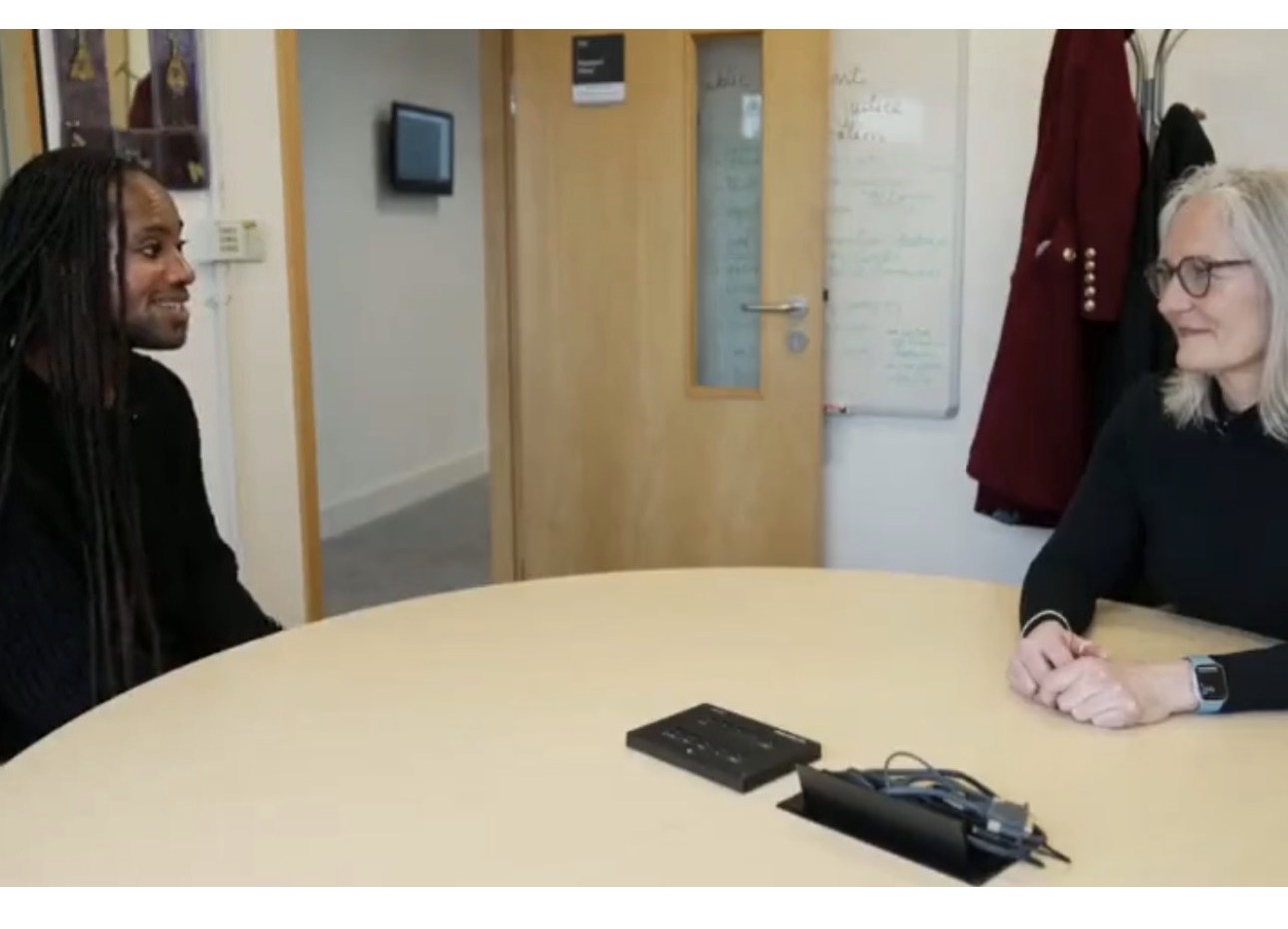
Arday’s arrival to take up his professorship at Cambridge was recorded by at least two BBC cameras. Here he is talking to Hilary Cremin, head of the Faculty of Education at Cambridge.
Sometimes both institutions and people pick up a firearm and blow both feet off.
Cambridge University has done so with its gross mismanagement of the Jason Arday affair.
Oceans of ink have been spilt already on this issue, so I’m not going to relitigate the main background. Instead, I want to make four observations, in no particular order.
1. Oh, the humanities (and social sciences)
The problems across these two large disciplinary areas long predate the idiotic wokery that got Jason Arday appointed to a professorial chair at Britain’s second oldest, second most famous university. Yes, wokery has made them worse, chiefly because the theoretical frameworks animating it — which Lorenzo Warby has written about both here and at his own place — deny the possibility of truth outside that of personal experience. This means people don’t just get their own opinions, they also get their own facts.
[…]
2. Nathan Cofnas is not racist
There are two distinct things going on in the background to the Arday appointment(s). The first is that he was appointed despite being a complete doofus and as dumb as a stump. The second is that while there probably are black candidates out there qualified to be a Cambridge professor, there won’t be many, and they are highly unlikely to be the descendants of slaves (from the Caribbean, the United States, or South America). They’re much more likely to be from a posh Nigerian background, and a particular Nigerian tribe (Igbo).
In the words of computer scientist Eric S. Raymond:
This is completely predictable to anyone who has spent 10 minutes reviewing the data on racial differences in mean IQ and knows what that implies for the right end of the bell curve.
The intersection set of people with predominantly sub-Saharan African ancestry with people sufficiently bright to deserve a university professorship is not empty, but it’s vanishingly small. The demand greatly exceeds the supply.
Which is why we’ve seen this movie many times before, and will again. They can’t help it. Corrupted academia would rather hire thousands of other incompetents than let go of its “anti-racism” to hire on merit alone.
The refusal to grapple with the black-white average IQ gap is astounding, and while the (mostly) white people responsible for appointing Arday look like absolute fools, the black intellectuals who refuse to accept an established fact look both truculent and dishonest. They don’t have to accept it’s genetic. They do have to accept that it’s real. As far as I’m aware, only one major black intellectual, Wilfred Reilly, accepts the existence of the gap (disclosure: I have been a guest on Wilfred’s podcast). If there are others, I would be delighted to know their names.
Two issues fall out of this. The first is that Nathan Cofnas is not racist for pointing it out. Facts are not racist. The second is that if people disagree with Cofnas’s secondary argument that the reason for the gap is primarily genetic, then yelling racist! at him does not prove him wrong. Evidence is what you need if you want to prove someone wrong, not moral abuse.
3. It’s the rule of law, Jim, but not as we know it
The idea that historically disadvantaged groups are entitled to extra civil rights — coupled with social preferment — over and above those held/enjoyed by people considered their oppressors is inimical to the rule of law, specifically the principle that people should not be punished for crimes they did not commit. We do not inherit criminality from our ancestors. This is in turn derived from the larger principle of treat like cases alike, which was first articulated in its modern form by the Roman jurist Ulpian.
Jason Arday got his job in large part because a lot of people — and especially humanities and social science academics — think it’s reasonable to punish whites (and sometimes East Asians) who have never wronged blacks by making it harder for them to get into university or gain employment. This punishment of whites/East Asians who have done no wrong is undertaken to compensate blacks who have not been wronged for wrongs committed by other white people against other black people in the past. This logic is the basis of all affirmative action schemes and preferential hiring regimes (provision for which exists — albeit in limited form — in the UK’s Equality Act 2010). It is also the logic of inherited vengeance.
[…]
4. Enter Carter-Ruck, or Journalism v. Law v. a bloke with a blog
It’s been widely — and accurately — reported that junior academic Nathan Cofnas broke the Jason Arday story on his personal blog. However, it shouldn’t have been his job to do. The same (or very similar) research had been done separately by both a retired academic (John Harris) and a journalist with Times Higher Education — an outlet dedicated to the tertiary education sector and owned, ultimately, by Rupert Murdoch. In response to both sets of revelations, either Cambridge or Arday or perhaps both in concert (this is unclear on the facts available to me) instructed Carter-Ruck, the most famous — and aggressive — specialist defamation law firm in the United Kingdom. Historically, Private Eye magazine (often a victim of their attention) referred to them as “Carter-Fuck” and, more recently, “Farter-Fuck”.
Despite the fact that the THE has libel insurance and Murdoch generally defends his publications, the magazine backed down. Jack Grove is the reporter who had his story spiked. I have it on good authority that several Cambridge academics — and perhaps people from other universities — then approached Cofnas with the material that they (and possibly the THE) had collated. Cofnas — being young & junior — is what lawyers call “a man of straw”. Suing him in defamation would benefit no-one, least of all Carter-Ruck. He published, scooping Jack Grove.

August 8, 2026
Pointing the finger of blame accurately
The Librarian of Celaeno wants you to know that former professor Jason Arday did nothing wrong:
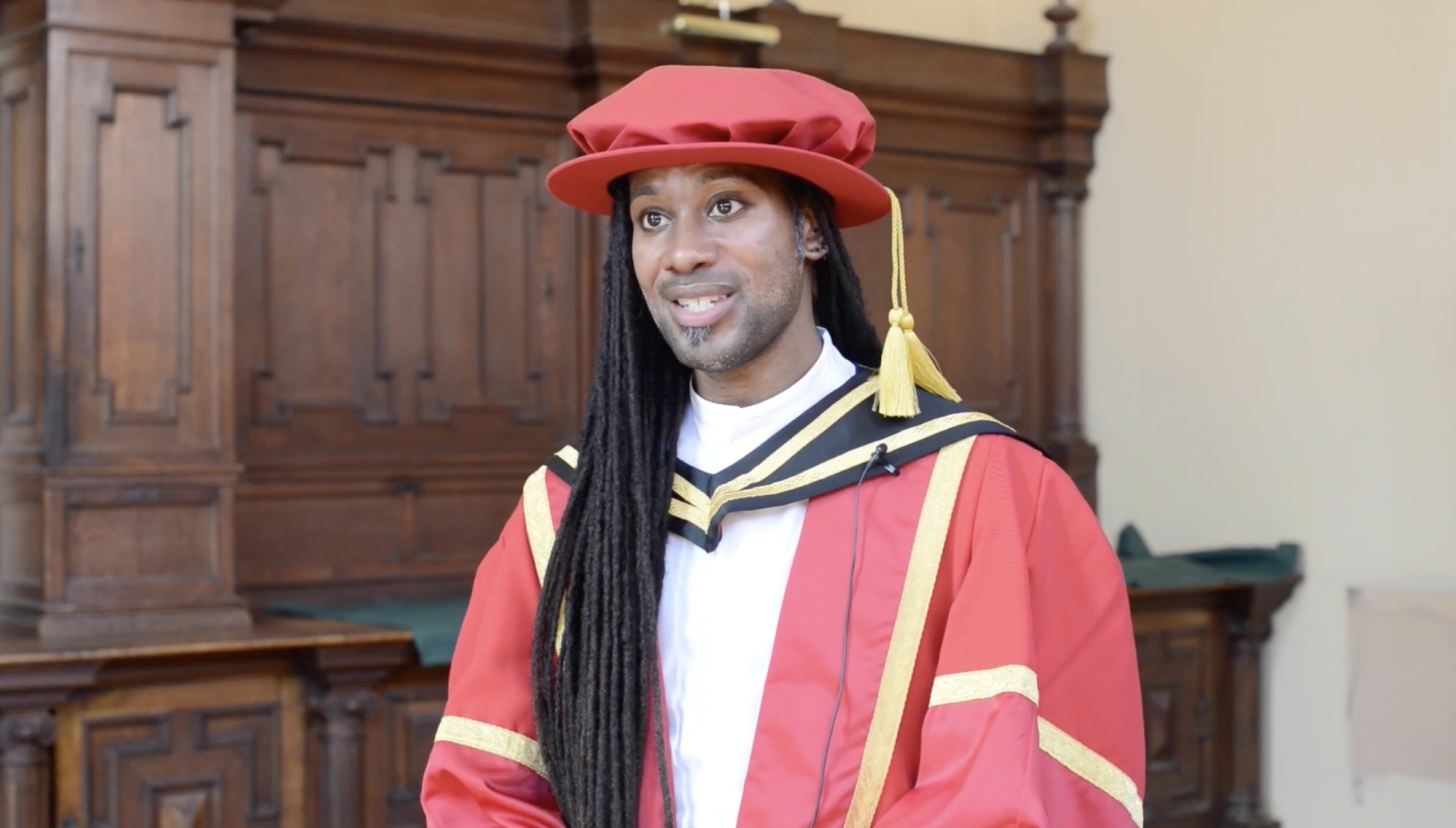
Former Cambridge professor Jason Arday
Image from Andrew Doyle
Once upon a time, an autistic black child was born. Usually, it takes several years to figure that out (the autism, not the blackness), but so autistically autistic was the infant Jason Arday that it was immediately apparent to everyone without there even needing to be any public record of it. Perhaps there is some lost evidence of him having a Reddit account as a toddler; one can speculate. Arday was unable to talk until age 11 and has been unable to stop talking ever since, which is fortunate since otherwise many of his unbelievable life accomplishments would now be unknown.
The range of setbacks he has overcome boggles the mind. Despite being illiterate until age 18, Arday not only graduated high school, but got into college, where he finally learned how to read good. This is even more incredible when you consider that the same year he discovered what the alphabet did he was beaten into epilepsy by random teens — he forgave them so thoroughly that any documentation of the incident is now gone from police records — and that some unspecified time before that he was in a car accident that left him in a waking coma for months. He studied so hard in college that he gave himself a brain tumor, which he evidently removed by himself in the mirror, since there is no evidence of a surgeon having done so. It may be that Arday has in fact learned to read several times in his life, but keeps getting that knowledge erased by semiannual episodes of CTE.
Even though he’d accumulated a substantial amount of what for a normal person would be crippling physical trauma over the course of his short time in the world, of the sort that would require medical interventions that would otherwise severely limit active life, Arday rapidly became one of the world’s most elite athletes. He participated in a ‘30 Marathons in 35 Days’ challenge, which was actually somewhat documented by an independent contemporary account, in the midst of which he suffered a hairline fracture in his fibula, which he seemingly just shrugged off to complete the remaining nine marathons. This was apparently the last time he ran slowly enough for anyone to witness, however, because his career as an ultramarathon runner who hyperGogginsed his way through 600 miles in six days passed entirely without notice by the few other people on Earth who could conceivably do that. He played semi-professional soccer, but was so good that he got bored with it and moved on before anyone could write his name down on a roster. Along the way, Arday became one of the best snooker players in Britain, with a skill level far beyond the need to participate in any public tournaments, other than the single amateur contest he entered but was too gracious to the other players to win.
He surmounted the intellectual challenges involved in becoming a PE teacher, and from there went on to earn a Ph.D as a black man, with his thesis largely consisting of arguing that it’s easier to do well in academia if you’re not closely supervised. It was so convincing a premise that his doctoral committee at Liverpool University evidently forewent actually reading the dissertation, perhaps also having concluded that his proximity to their whiteness had burdened him enough already. It was thus that Dr. Arday came into being, following a path blazed by Ibram X. Kendi as a bedredlocked black man writing about being black while being black blackly in a world basically controlled by the bad guys in Caddyshack.
On Substack Notes, Michael Southon also points the finger at the people who enabled Arday’s rise and attributed racist beliefs to anyone who asked questions:
Arday’s arrival to take up his professorship at Cambridge was recorded by at least two BBC cameras. Here he is talking to Hilary Cremin, head of the Faculty of Education at Cambridge.
Cambridge University was so proud of its choice of Jason Arday that they invited the BBC to film Hilary Cremin, the head of Cambridge University’s Faculty of Education, welcoming Arday to his new post. In the clip you can hear Cremin gushingly tell Arday:
We are so lucky to have you. You are the best in the world in terms of the research that you do.
Arday himself is incredulous and suggests that some people will see his appointment as “tokenistic”. In response, Cremin assures him he is “world class”.
The Telegraph reports that when Arday’s students complained that they weren’t being properly supervised, they were told they were being “racist”.
The truth is that Cambridge was desperate to appoint more people of colour. His alleged autism ticked another box on the identity politics agenda. The dreadlocks were icing on the cake.
Will this episode, which has been reported around the world, finally convince the establishment that DEI is a disastrous social policy that lowers standards and turns august institutions whose reputations are based on centuries of meritocracy into the laughing stock of the world?
I doubt it.
Also on Substack Notes, GenX Anecdotes finds the behaviour of Hilary Cremin to be emblematic of a kind of condescending attitude found most frequently among liberal white women:
We know the type.
And it does tend to be a woman.
They love nothing more than to put on that awful softy, patronising voice, as if talking to a small child.
I am reminded of that excrutiating clip of Hilary Cremin (Head of Cambridge University’s Faculty of Education) “You are the best in the world in terms of the research that you do“.
Really? “The best in the world”?
Like the bestest in the whole big wide world ever! 😂
I’m surprised she didn’t lean in and give him a pat on the head.
Wtf?
And that tone. 😭
It’s bad enough when they do it to kids.
I have posted about this “tone” before.
Near where I live there’s a Waitrose. The spiritual home of such a woman.
There used to be a Muslim woman wearing a hijab who would beg for money outside. I never gave her money because she seemed fake to me.
Always clean and well presented with the latest new iPhone (!), she would look up from her phone when she saw someone approaching, visibly completely change her facial expression, tilt her head to one side in a kind of puppy dog, “poor me” way, and put on a kind of fake whimpering “please help me!” and hold her hand out.
It was so obviously fake af!
One day I was waiting outside the shop for my daughter who had run in to get something.
As I waited, these two middle class, middle aged women stopped to talk to her.
They were both fawning over her, using that same softy patronising tone, falling over themselves to praise her. One of them said “you’re so beautiful and brave” and the other put her arm around her.
It was such a sychophantic display of patronising bullshit, I think I might have thrown up a little bit in my mouth.
This pathological sickly, performative fawning over their little pet minority groups, is something to behold!
And they were both being played.
This beggar wasn’t homeless. So obviously! You’d have to be a special kind of stupid to think so.
But they really are a special kind of stupid.
They just wanted to feel good about themselves. It’s all about their need to feel like they’re “good kind people”.
Then, no doubt make a FB post about it so all their other annoying cloying phoney friends can “coo” over how much they adore their little darling minority pets.
🤮
August 6, 2026
More threads unravelling from Professor Jason Arday’s backstory
As I mentioned the other day when I first noted this fascinating tale, I don’t think I’d heard of Professor Jason Arday before this week, so pretty much any new facets of the story will be news to me. Here’s an extensive survey of what’s been revealed so far by Donna Louise Flowers:
Cambridge professor Jason Arday
Image from Andrew Doyle
Cambridge Knew in 2023
On 19 May 2023 Martyn Hammersley emailed Hilary Cremin, Head of the Faculty of Education, and Rhys Morgan, Head of Policy. He flagged substantial plagiarism in Arday’s 2018 paper, including quotes attributed to Arday’s own interview subjects that matched quotes from another researcher’s participants. (emails first reported by Nathan Cofnas and later confirmed in The Telegraph)
On 21 June 2023 Morgan replied that it was “not within our remit”. Cremin said Arday had the department’s full support.
That is three years of Cambridge knowing. Everything that followed sits on top of that decision.
In the BBC’s 2023 video marking his appointment, Cremin went further. She said: “We are so lucky to have you. You are the best in the world in terms of the research that you do.” (BBC video, 2023)
Eight months later, on 2 February 2024, Arday was appointed to ITV’s Cultural Advisory Council. Sixteen months after the concerns were raised, on 19–20 September 2024, he led sessions on equity, diversity and inclusion at the National Aspiring Vice Chancellor Development Programme at Bolton.
He was teaching the next generation of vice-chancellors while the questions about his own record remained unanswered by the institution that employed him.
[…]
The Claims, Laid Out Together
Here, in one place, is the full set of claims Jason Arday has made about his life:
- Diagnosed with autism and global developmental delay at the age of three.
- Non-verbal until the age of eleven.
- Unable to read or write until the age of eighteen.
- Four to five hours of speech therapy every day from the age of three.
- A mother with five degrees.
- A benign brain tumour removed a fortnight before his PhD viva, which wiped his memory of the entire thesis; he re-learned it and still passed.
- Two further brain tumours diagnosed after the PhD, later found to be benign.
- Deaf in one ear.
- Ran 30 marathons in 35 days, the last nine after sustaining a hairline fracture that made his leg swell to twice its normal size.
- Covered 300 miles in three days.
- Covered 600 miles in six days (later quietly amended in some citations to twelve days).
- Raised £5.5 million for more than 80 charities.
- Installed water points in South America and West Africa with WaterAid.
- Received a severed pig’s head at his parents’ home.
- Faced a knife-wielding masked man.
- Received bullets in the post, rape threats against his daughter, threats to make him “top himself”, and other forms of intimidation including corrosive substances and mutilated animals.
- Came through a professional football club’s academy system and later played semi-professionally.
- Was on the verge of turning professional at snooker.
- Awarded an MBE in 2017 and turned it down.
- Olympic Torch Bearer for London 2012.
- Appeared in the ITV documentary series Seven Up!
- Obtained a Masters degree in “psychodynamic practice” from Birkbeck and became a qualified counsellor.
- Held visiting professorships at the University of Glasgow and Ohio State University.
This is the origin story as it has been told. Almost none of it has been independently verified. Several of the most dramatic claims have been directly contradicted by the organisations or records that should corroborate them.
That is the real failure.
In the rush to be diverse, to be inclusive, to champion a Black, autistic, working-class success story who ticked every box, almost no one stopped to ask the simplest question of all: when you look at these claims as a totality, how plausible are they?
Each claim on its own might have been given the benefit of the doubt. Taken together they form a pattern that should have been obvious long before Carter-Ruck letters and police complaints were required to shut the questions down.
The institutions that elevated the legend spent years repeating it. When the contradictions began to surface they did not investigate. They defended. They edited the websites quietly. They called the scrutiny a vile campaign. They treated the act of checking as the real offence.
Jason Arday did not need to invent a modest success story. He invented a legend. And for years almost no one dared to ask whether any of it was real — because he is Black, and in the current climate that was supposed to be enough.
It was not enough. And it never should have been.
Update: Reportedly after Cambridge opened an investigation into the plagiarism allegations, Professor Arday has submitted his resignation.
Jason Arday, who was touted as the university’s youngest black professor, announced on Wednesday that he was resigning effective immediately from both the university and Jesus College. His resignation came just hours after Cambridge had said it opened an investigation into the allegations after “new information” came to light.
In a statement published by the Good Law Project, Arday said that the “relentless accusations” had taken a “profound toll” on him. He added that he has decided to resign for his “own wellbeing”.
“I have tried to continue because I believe deeply in the values of higher education, in rigorous scholarship, and in the transformative power of universities. I have tried because of my students, my colleagues and the countless people who have written to tell me that my journey gave them hope,” he wrote. “But there comes a point when the personal cost becomes too great. I have a family. I want to be present for them. I want to reclaim some peace, some privacy and some semblance of an ordinary life. I no longer wish to feel as though I am living under a constant spotlight, where every aspect of my life is subject to public examination and judgement.”
The next shoe was funny enough that I assumed it was from the Babylon Bee, but apparently is not parody:
Following Arday’s resignation letter, social media users claimed that the statement itself appeared to have been AI-generated. According to Panagran, the leading AI writing detection software, Arday’s resignation statement was deemed to be 100 percent AI-generated.
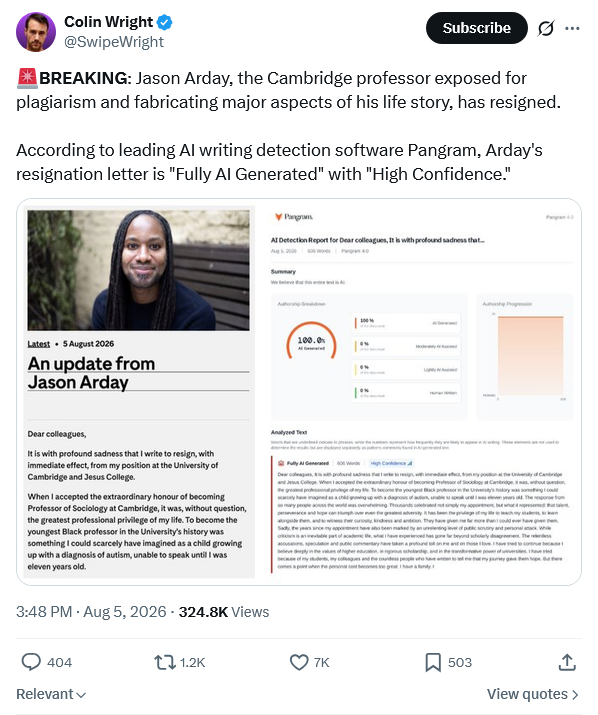
Frederick Alexander decrys the fools that bought Arday’s fantastic stories as nothing but the truth and moved mountains to get him advancement at all costs:
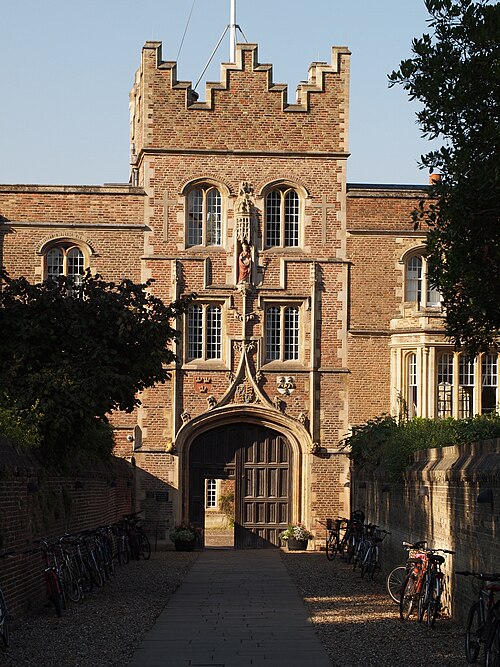
The main entrance of Jesus College, Cambridge from Jesus Lane.
Photo by Verbcatcher via Wikimedia Commons.
We may never know the full extent of Jason Arday’s talents. Perhaps he also sang the difficult half of Milli Vanilli, crossed the Atlantic on a lilo with a shattered pelvis, and designed the SpaceX rocket catcher in the margins of his PhD thesis. There is, in truth, no claim he could have made that the intellectual class would not have believed, provided it flattered their view of themselves as good and righteous people.
Did it not occur to him that someone might check? Confronted by the Guardian, Arday has since offered a defence that will live on his Wikipedia page forever despite the efforts of its editors: “To be honest with you, I thought you’d just believe me. Why would I lie?”
It’s probably the most honest thing he’s ever said. More importantly, it describes the workings of his career in the sort of plain language that the sociology department hadn’t quite trained out of him. He thought the Guardian class would believe him because he understood that they wanted to believe him. They were falling over themselves to grant legitimacy to anything he said simply because he was the one saying it. His story bore out their politics, advertised their virtue and bolstered their status. Scrutiny would only spoil the party.
Perhaps this explains why Arday’s writing also got a pass. Here, for instance, is Arday explaining … well, you figure it out.
As the researcher, textual units concerning the narratives and biographies were identified based on the criteria that the identified themes were fit for purpose in supporting the themes associated with the study.
You would get more sense from a gibberish generator. Academic writing is hell at the best of times, but sociology has mumbo-jumbo built in. Banalities disappear beneath layers of abstraction presumably in an effort to make them sound deep or insightful. Next to this, the plagiarism comes as a relief, another person’s sentences at least making the effort to mean something.
The writing should be disqualifying by itself, but it’s not like Arday tiptoed into the academy while nobody was looking. Cambridge signed him up in the manner of a Premier League football team landing the next Ronaldo, but on the strength of highlight reels that turned out to be AI-generated.
The remarkable thing is not merely that Arday appears to have invented stories about himself. Lots of people do that. I did it when I was nine, trying to convince people I was invisible. Nobody appointed me to a professorship at one of the country’s most prestigious universities. Or rather, formerly prestigious universities. Who can look at these institutions now and not see the wreckage of ideological capture?
They’re calling the fallout “a vile campaign” to undermine Arday’s credibility – of course they are. It’s a smear by “right-wing newspapers” intended to embarrass Arday and those who elevated him. Of course it is. But the embarrassment was born of their own vanity and gullibility. They demanded that everyone believe the story, then labelled anyone who checked it as morally suspect and worthy of a police investigation.
Nearly 15,000 people have signed an open letter declaring the allegations “entirely false”, even as the evidence points the other way. How long before they withdraw their names, reframe events and reposition themselves as the full truth comes to light? Soon they will talk solemnly about the importance of integrity, dissociate themselves entirely from Arday – yesterday a useful idiot, today a serious liability – and somehow still make it about race and right-wing bigotry. This stuff is hardcoded. The rest is just presentation.
The administrators who made the appointment will survive with a few bruises, scapegoating Arday until the media get bored of it. Then they’ll pick up where they left off, a little more careful next time – running the checks, scouring the next candidate’s PhD for plagiarism, testing every fantastical claim against reality, except where reality conflicts with ideology. Which is likely most of it.
August 4, 2026
“Jason Arday’s improbable claims have turned him into a Walter Mitty for our times”
The Jason Arday affair has only just drifted into my view, but it seems utterly fascinating that a young man with such a … varied and colourful personal history … has risen to be the youngest black professor at Cambridge. His backstory is (probably) too perfectly aligned with progressive worldviews to be true:
Cambridge professor Jason Arday
Image from Andrew DoyleJason Arday’s improbable claims have turned him into a Walter Mitty for our times. As the youngest black person ever to be appointed a professor at the University of Cambridge, there are good reasons why those who have championed him are rushing to his defence. But with each passing day, new revelations of his slippery relationship with reality seem to be emerging.
As with many fabulists, it is difficult to know where the truth ends and the fiction begins. Some of Arday’s boasts are quite obviously false. For instance, nobody believes that he completed the last nine of thirty consecutive marathons with a fractured leg that had swollen “to twice its normal size”. Or that he appeared in the television series Seven Up! as a child, even though its participants were selected in 1963 and Arday was born two decades later.
Other claims might well be embellishments on kernels of reality. No doubt he has raised money for charity, but it seems highly unlikely that his vaunted sum of £5.5 million is accurate. We know that he played snooker, but his assertion that he did so professionally would carry more weight if someone on the circuit had heard of him. Few would dispute that Arday is a keen amateur athlete. But if his claim to have run six hundred miles in six days were true, that would place him among the world’s elite sportsmen.
Perhaps most serious of all are the accusations of plagiarism. Cambridge has been quick to dismiss the matter, stating that an investigation has already been conducted by Liverpool John Moores University, where Arday completed his PhD thesis, and no evidence of plagiarism was found. Many readers who have compared the relevant passages side by side have reached a different conclusion. Numerous examples have been collated by Nathan Cofnas and can be seen here.
The refusal of the authorities at Cambridge to investigate the allegations properly has naturally raised suspicions that Arday is being protected because he is the poster boy for DEI. If it is true that he was raised on a council estate, diagnosed with autism at the age of three, first spoke at the age of eleven, and learned to read and write at eighteen, then his success story is unparalleled. Yet plagiarism is an extremely grave matter for an academic, and the evidence is difficult to dismiss.
The failure to hold Arday to the same standards as anyone else is, of course, a soft form of racism …
On Substack Notes, Michael Southron says he’s getting a strong Jussie Smollet vibe from this story:
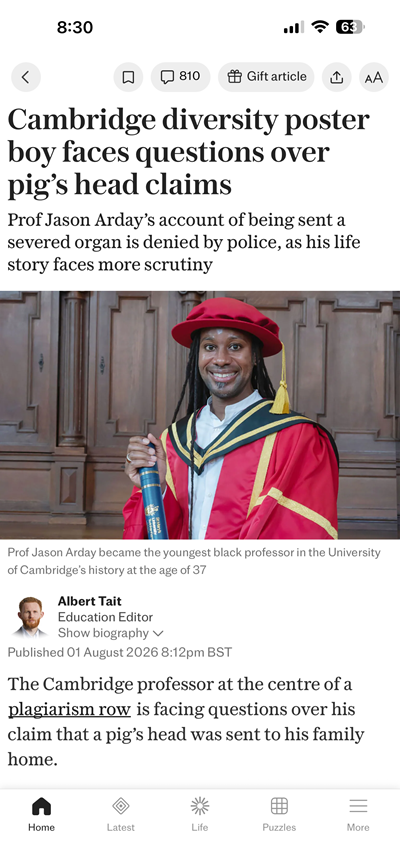
The Jason Arday affair is beginning to remind me of Jussie Smollett.
Not because we know that Arday fabricated anything. We don’t. But because of the strange self-protecting logic that surrounds allegations of racism.
Smollett’s story was initially believed because it fitted so perfectly with what many people already believed about America: a black, gay actor attacked by racist, homophobic Trump supporters. The allegation seemed almost to validate itself.
Something similar is happening with Arday.
He says a severed pig’s head was sent to his family home. Yet police can reportedly find no record of the investigation he described. The butcher he said police visited says no officers ever came. There are apparently no photographs or contemporaneous messages.
He also says a masked man twice entered his Cambridge faculty building and threatened him, on one occasion with a knife. Yet the man was apparently captured by no CCTV, seen by no colleagues, and Arday reportedly warned nobody in the building at the time.
“To be honest with you, I thought you’d just believe me,” Arday told the Guardian. “Why would I lie?”
That sentence may be the most revealing part of the whole affair.
Because questioning Arday’s claims now risks being folded into the very narrative those claims are supposed to establish.
Arday says he has been targeted because of racism. Questions are raised about the evidence for his claims. Those questions are then portrayed as part of a “vile campaign” against him — which becomes further evidence that he is being targeted.
The allegation begins to protect itself.
He is a victim of racism, therefore questioning his account may itself be racist; and because questioning his account may be racist, his claim to be a victim of racism receives less scrutiny.
It is a perfect circle.


