Tasting History with Max Miller
Published 17 Mar 2026Hash made from pulverized hardtack, salt pork, and vegetables, served with mashed potatoes
City/Region: England
Time Period: 1894Third class, or steerage, on the Titanic was served breakfast, dinner, tea, and supper, which was a major upgrade from other ships in decades past. Before this, third class passengers were given their rations, which they had to prepare and cook on their own. Sometimes they had to wait in line to use a stove, and not everyone would get a turn.
This meal hearkens back to that time. The recipe uses ingredients that were included in third class rations, and comes from a cookbook for sailors in 1894. I really can’t recommend making this. It’s … not great. There’s essentially no flavor, and the hash turns into a kind of paste in your mouth with the only texture coming from the onions. If I was really hungry and had no other options, I suppose it would be fine, but you shouldn’t feel the need to make this.
Biscuit Hash. (Cold Meat Cookery)
Ingredients
6lbs. Broken biscuits, steeped
2lbs. Cold salt beef or pork.
1/2lb. dripping.
2 onions.
1 cooked carrot.
1 cooked turnip.
1 teaspoonful pepper.
1 teaspoonful mixed spice.
Method — Chop the meat, onions, and vegetables finely; squeeze the water well out of the biscuits, and rub them through a coarse wire sieve; add all the other ingredients, and mix thoroughly. Put it into a baking tin, and brown in a moderate oven until firm. Cut into squares and serve.
— Cookery for Seamen by Alexander Quinlan and N.E. Mann, 1894
September 10, 2026
Hardtack Hash from Steerage on a Victorian Ocean Liner
QotD: The Victorian Workhouse diet and the modern “wellness” diet
The Victorian workhouse did not feed its inmates badly by accident. It fed them badly on purpose, and the purpose was written into the law.
The principle behind the New Poor Law of 1834 was “less eligibility”. Life inside the workhouse had to be made worse than the life of the poorest labourer surviving outside, or people might actually choose it. Misery was the policy, and the food was central to it.
The diet was built around gruel, bread, and watery broth. Thin oatmeal porridge. Pease soup. A little cheese. Meat, where it appeared at all, appeared in quantities a working man would have laughed at, carefully weighed out on a handful of days a year. Strip a population of meat and feed it on cheap starch, and you get people who are weak, compliant, and grateful for very little. The men with the ledgers understood that completely. They wrote the smallness down, in ounces, and signed it.
Now read that menu back slowly.
Porridge to start the day. Wholegrain bread as the base of every plate. Beans and pulses for protein. Broth-based soups. Dairy in moderation. Red meat cut right back, if you have it at all.
That is the workhouse diet, almost line for line. The gruel that was once the punishment for being poor is now the breakfast of the health-conscious. The near-absence of meat, once an economy forced on people who had no say in it, is now sold to you as the enlightened, heart-healthy choice you are making of your own free will.
They worked out the cheapest way to keep a body upright and dependent, and wrote it down in ounces.
A century and a half later the same menu comes back with a wellness label on it, and this time people pay extra for the privilege.
Sama Hoole, The social media site formerly known as Twitter, 2026-06-04.
September 9, 2026
QotD: Subordinate officers in pre-modern armies
One of the key divides that shows up repeatedly is the division between commoners elevated to positions of minor authority and aristocrats in positions of command. Indeed, we have this in our modern armies: this is the distinction between non-commissioned officers (NCOs) which are generally soldiers promoted from the lower ranks and commissioned officers who enter the military typically at the rank of lieutenant (or its equivalent). That system is a hold-over from the origins of modern military structure in Europe’s early-modern gunpowder armies: the commissioned officers (whose commission, to be clear, came from the king) were drawn from the aristocracy and often the nobility, while their non-comissioned subordinates were drawn from the common soldiery who were in turn recruited from the peasantry. Because no peasant could become a knight or noble (under normal circumstances) so too no sergeant could (under normal circumstances) become a lieutenant; the social orders were thus kept separate, civilian mirroring military.
But exactly where that divide occurs and its significance varies wildly. In the modern military structure, a second lieutenant, the lowest commissioned officer, typically commands a platoon of c. 40 soldiers while a sergeant typically leads a squad or section (around 10 soldiers). By contrast in the Roman army, the centurion – a senior NCO like the sergeant promoted from the common soldiers – led a century of 60-80 soldiers; more senior centurions (the primi ordines) commanded an entire cohort (480 soldiers). So the line between NCO and commissioned officer can be drawn in very different places in different societies.
Likewise an important distinction is often made around the emergence of a professional officer class (following on the emphasis made on this point by Samuel P. Huntington in The Soldier and the State (1957)) and the officers who came before which Huntington describes as “amateurs”. This is, I’d argue, a mistaken understanding of the role of military aristocrats in their societies; they were no more amateurs at war than a person born into serfdom is am amateur farmer. Neither the serf nor his military aristocrat overlord is a professional, but neither of them is an amateur either; the categories are not exclusive. Nevertheless there is a difference between truly “amateur” officers (which certainly existed), military aristocrats for whom war is a born-calling, and professional officers.
For this discussion, however, much of this complexity is beside the point. That isn’t to say it is unimportant generally (it is very important generally) but that for this topic here, we can define “officer” very broadly and so avoid having to untangle the particular social context of each military in question. Consequently we’re going to just define officer here as anyone who has command over other combatants, effectively lumping NCOs and commissioned officers (and their ancient equivalents) together. That isn’t because those distinctions are unimportant (they are important!) but because they aren’t quite relevant here, since we are really focused on how command structures enable armies to respond with ability and execute complex plans. It is command, not social status per se that we’re focused on.
Bret Devereaux, “Collections: Total Generalship: Commanding Pre-Modern Armies, Part IIIb: Officers”, A Collection of Unmitigated Pedantry, 2022-06-24.
September 8, 2026
QotD: Why the revolution envisioned by Marx didn’t happen
The prescriptions of The Communist Manifesto were in any case singularly unappealing to the industrial workers they were aimed at. Marx and Engels called for the abolition of private property; the abolition of inheritance; the centralization of credit and communications; the state ownership of all factories and instruments of production; the creation of “industrial armies for agriculture”; the abolition of the distinction between town and country; the abolition of the family; “community of women” (wife-swapping); and the abolition of all nationalities. By contrast, mid-nineteenth-century liberals wanted constitutional government, the freedoms of speech, press, and assembly, wider political representation through electoral reform, free trade, and, where it was lacking, national self-determination (“home rule”). In the half-century after the upheaval of 1848 they got a great many of these things — enough, at any rate, to make the desperate remedies of Marx and Engels seem de trop. In 1850 only France, Greece, and Switzerland had franchises in which more than a fifth of the population got to vote. By 1900 ten European countries did and Britain and Sweden were not far below that threshold. Broader representation led to legislation that benefited lower-income groups. Free trade in Britain meant cheap bread, and cheap bread plus rising nominal wages thanks to union pressure meant a significant gain in real terms for workers. Building laborers’ day wages in London doubled in real terms between 1848 and 1913. Broader representation also led to more progressive taxation. Britain led the way in 1842 when Sir Robert Peel introduced a peacetime income tax; by 1913 the standard rate was 14 pence in the pound. Prior to 1842 nearly all British tax revenue had come from the indirect taxation of consumption via customs and excise duties, regressive taxes that take a proportionately smaller amount of your income the richer you are. By 1913 a third of revenue was coming from direct taxes on the relatively rich. In 1842 the central government had spent virtually nothing on education and the arts and sciences. In 1913 those items accounted for 10 percent of expenditures. By that time, Britain had followed Germany in introducing a state pension for the elderly.
Marx and Engels were wrong on two scores, then. First, their iron law of wages did not exist. Wealth did indeed become highly concentrated under capitalism, and it stayed that way into the second quarter of the twentieth century, but income differentials began to narrow as real wages rose and taxation became less regressive. Capitalists understood what Marx missed: that workers were also consumers. It therefore made no sense to try to grind their wages down to subsistence levels. On the contrary, as the case of the United States was making increasingly clear, there was no bigger potential market for capitalist enterprises than their own employees. Far from condemning the masses to immiseration, the mechanization of textile production created growing employment opportunities for Western workers — albeit at the expense of Indian spinners and weavers — and the decline in the prices of cotton and other goods meant that Western workers could buy more with their weekly wages. The impact is best captured by the exploding differential between Western and non-Western wages and living standards in this period. Even within the West the gap between the industrialized vanguard and the rural laggards widened dramatically. In early seventeenth-century London, an unskilled worker’s real wages were not so different from what his counterpart earned in Milan. From the 1750s until the 1850s, however, Londoners pulled far ahead. At the peak of the great divergence within Europe, London real wages were six times those in Milan. With the industrialization of northern Italy in the second half of the nineteenth century, the gap began to close, so that by the eve of the First World War it was closer to a ratio of 3:1. German and Dutch workers also benefited from industrialization, though even in 1913 they still lagged behind their English counterparts.
Niall Ferguson, “Capitalism, Socialism and Nationalism: Lessons from History”, 2020-02.
August 13, 2026
QotD: Marx was right about “class consciousness”
Marx called religion “the opiate of the masses” for a reason — by dulling their pain, it prevented them from realizing their true class position, thus achieving class consciousness, thus sparking The Revolution. What religion really does, of course, is satisfy a deep yearning in the human soul. There is more to life than shit, shoes, and bread. Karl Marx didn’t want to hear that, because his religious yearning was satisfied by his substitute god, Dialectical Materialism, and the half-assed (but very real) ceremonial it produced. Again, there’s a reason every Leftwinger practically from the French Revolution looked like [this]
I don’t know how you say “fake and gay” in Russian, but every single thing in that photograph is fake and gay. A pose. An affectation. And as with their look, so with their behavior. Leftwingers are, and always have been, famously boorish. They have no idea how longshoremen actually act, but they sure think they know, and so that’s how they act — like the worst caricature of a crude, illiterate, drunken longshoreman.
(I don’t know any longshoremen either, but I do know some folks who make a living from the sweat of their brows, and they’d turn Lenin’s head around for him if he came to their neighborhood and started acting like that. The Laboring Masses might indeed be “rude mechanicals” in Shakespeare’s sense — meaning, without too much formal education — but they’re surely not rude in the behavioral sense, because in their world, running your mouth gets you punched in it).
Dressing and acting like that is, quite literally, a religious ceremony for them … and ceremonial can only take place in a designated space, a liminal space that the community respects. A priest can indeed hold a mass on a street corner, but only if the passersby have enough residual respect for the institution of religion not to beat and rob the worshipers while their backs are turned.
The intelligentsia never understood that consciously. They sure as hell understood it unconsciously, though, which is why they immediately self-segregated — getting “sent down to the countryside, to reconnect with the laboring masses” was one of the worst punishments Mao’s boys could dish out to one of their mandarins, and again, there’s a reason for that. The upshot is, the intelligentsia, the Apparat, the Cloud People, whatever you want to call them, are the only ones who developed “class consciousness” in the Marxist-Leninist revolutionary sense …
… and their class consciousness is entirely oppositional. They are not us. That’s their sole criterion for virtue. Whatever we like, they dislike. Whatever we do, they must not do; and whatever we eschew, they must embrace.
Severian, “On Losing the Cold War”, Founding Questions, 2022-07-02.
August 8, 2026
Pointing the finger of blame accurately
The Librarian of Celaeno wants you to know that former professor Jason Arday did nothing wrong:
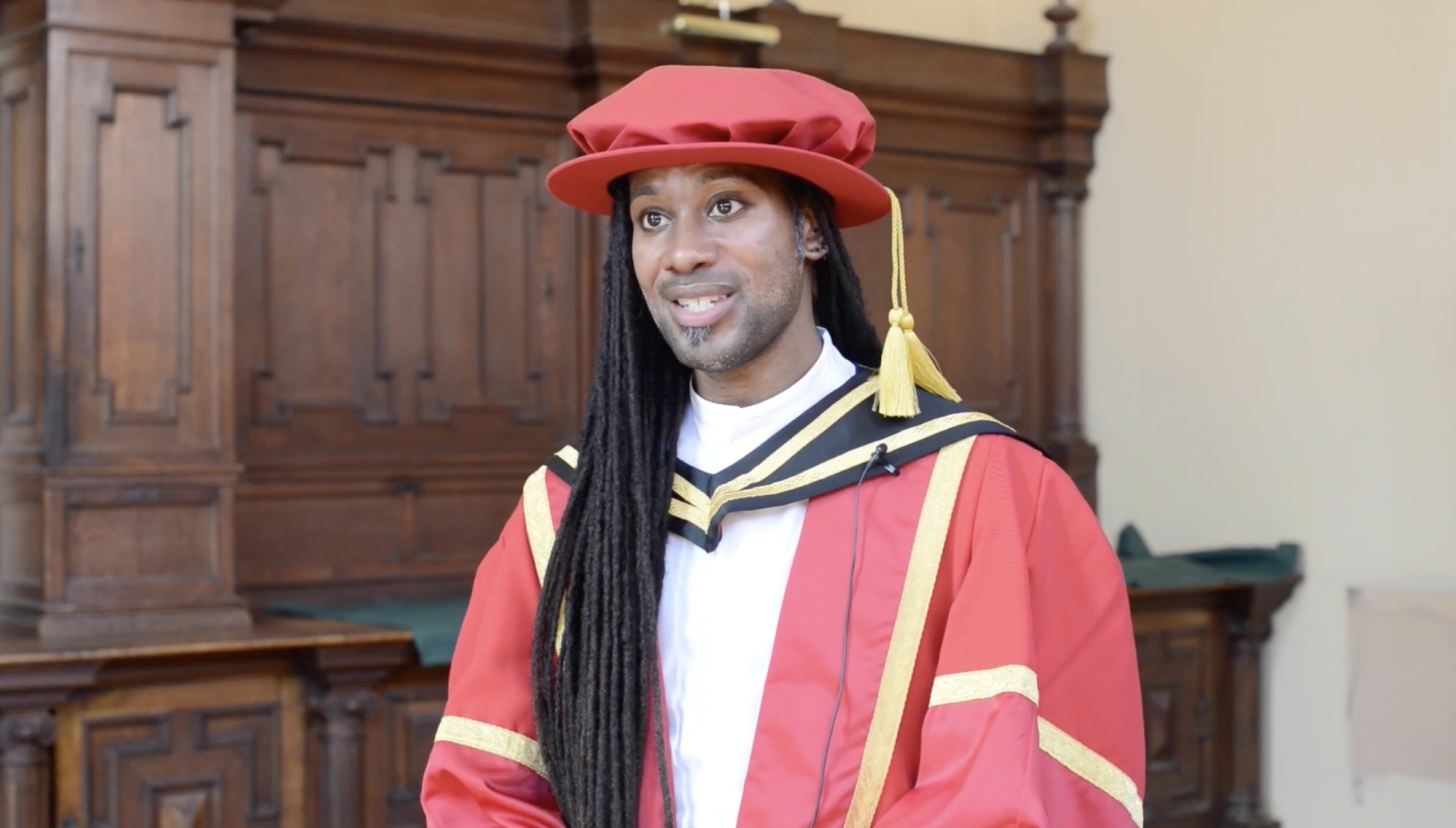
Former Cambridge professor Jason Arday
Image from Andrew Doyle
Once upon a time, an autistic black child was born. Usually, it takes several years to figure that out (the autism, not the blackness), but so autistically autistic was the infant Jason Arday that it was immediately apparent to everyone without there even needing to be any public record of it. Perhaps there is some lost evidence of him having a Reddit account as a toddler; one can speculate. Arday was unable to talk until age 11 and has been unable to stop talking ever since, which is fortunate since otherwise many of his unbelievable life accomplishments would now be unknown.
The range of setbacks he has overcome boggles the mind. Despite being illiterate until age 18, Arday not only graduated high school, but got into college, where he finally learned how to read good. This is even more incredible when you consider that the same year he discovered what the alphabet did he was beaten into epilepsy by random teens — he forgave them so thoroughly that any documentation of the incident is now gone from police records — and that some unspecified time before that he was in a car accident that left him in a waking coma for months. He studied so hard in college that he gave himself a brain tumor, which he evidently removed by himself in the mirror, since there is no evidence of a surgeon having done so. It may be that Arday has in fact learned to read several times in his life, but keeps getting that knowledge erased by semiannual episodes of CTE.
Even though he’d accumulated a substantial amount of what for a normal person would be crippling physical trauma over the course of his short time in the world, of the sort that would require medical interventions that would otherwise severely limit active life, Arday rapidly became one of the world’s most elite athletes. He participated in a ‘30 Marathons in 35 Days’ challenge, which was actually somewhat documented by an independent contemporary account, in the midst of which he suffered a hairline fracture in his fibula, which he seemingly just shrugged off to complete the remaining nine marathons. This was apparently the last time he ran slowly enough for anyone to witness, however, because his career as an ultramarathon runner who hyperGogginsed his way through 600 miles in six days passed entirely without notice by the few other people on Earth who could conceivably do that. He played semi-professional soccer, but was so good that he got bored with it and moved on before anyone could write his name down on a roster. Along the way, Arday became one of the best snooker players in Britain, with a skill level far beyond the need to participate in any public tournaments, other than the single amateur contest he entered but was too gracious to the other players to win.
He surmounted the intellectual challenges involved in becoming a PE teacher, and from there went on to earn a Ph.D as a black man, with his thesis largely consisting of arguing that it’s easier to do well in academia if you’re not closely supervised. It was so convincing a premise that his doctoral committee at Liverpool University evidently forewent actually reading the dissertation, perhaps also having concluded that his proximity to their whiteness had burdened him enough already. It was thus that Dr. Arday came into being, following a path blazed by Ibram X. Kendi as a bedredlocked black man writing about being black while being black blackly in a world basically controlled by the bad guys in Caddyshack.
On Substack Notes, Michael Southon also points the finger at the people who enabled Arday’s rise and attributed racist beliefs to anyone who asked questions:

Arday’s arrival to take up his professorship at Cambridge was recorded by at least two BBC cameras. Here he is talking to Hilary Cremin, head of the Faculty of Education at Cambridge.
Cambridge University was so proud of its choice of Jason Arday that they invited the BBC to film Hilary Cremin, the head of Cambridge University’s Faculty of Education, welcoming Arday to his new post. In the clip you can hear Cremin gushingly tell Arday:
We are so lucky to have you. You are the best in the world in terms of the research that you do.
Arday himself is incredulous and suggests that some people will see his appointment as “tokenistic”. In response, Cremin assures him he is “world class”.
The Telegraph reports that when Arday’s students complained that they weren’t being properly supervised, they were told they were being “racist”.
The truth is that Cambridge was desperate to appoint more people of colour. His alleged autism ticked another box on the identity politics agenda. The dreadlocks were icing on the cake.
Will this episode, which has been reported around the world, finally convince the establishment that DEI is a disastrous social policy that lowers standards and turns august institutions whose reputations are based on centuries of meritocracy into the laughing stock of the world?
I doubt it.
Also on Substack Notes, GenX Anecdotes finds the behaviour of Hilary Cremin to be emblematic of a kind of condescending attitude found most frequently among liberal white women:
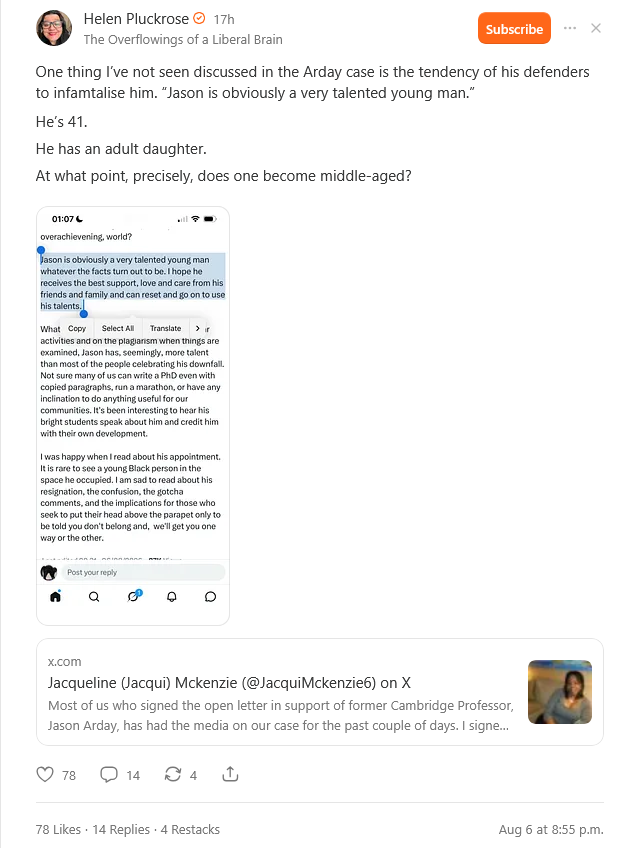
We know the type.
And it does tend to be a woman.
They love nothing more than to put on that awful softy, patronising voice, as if talking to a small child.
I am reminded of that excrutiating clip of Hilary Cremin (Head of Cambridge University’s Faculty of Education) “You are the best in the world in terms of the research that you do“.
Really? “The best in the world”?
Like the bestest in the whole big wide world ever! 😂
I’m surprised she didn’t lean in and give him a pat on the head.
Wtf?
And that tone. 😭
It’s bad enough when they do it to kids.
I have posted about this “tone” before.
Near where I live there’s a Waitrose. The spiritual home of such a woman.
There used to be a Muslim woman wearing a hijab who would beg for money outside. I never gave her money because she seemed fake to me.
Always clean and well presented with the latest new iPhone (!), she would look up from her phone when she saw someone approaching, visibly completely change her facial expression, tilt her head to one side in a kind of puppy dog, “poor me” way, and put on a kind of fake whimpering “please help me!” and hold her hand out.
It was so obviously fake af!
One day I was waiting outside the shop for my daughter who had run in to get something.
As I waited, these two middle class, middle aged women stopped to talk to her.
They were both fawning over her, using that same softy patronising tone, falling over themselves to praise her. One of them said “you’re so beautiful and brave” and the other put her arm around her.
It was such a sychophantic display of patronising bullshit, I think I might have thrown up a little bit in my mouth.
This pathological sickly, performative fawning over their little pet minority groups, is something to behold!
And they were both being played.
This beggar wasn’t homeless. So obviously! You’d have to be a special kind of stupid to think so.
But they really are a special kind of stupid.
They just wanted to feel good about themselves. It’s all about their need to feel like they’re “good kind people”.
Then, no doubt make a FB post about it so all their other annoying cloying phoney friends can “coo” over how much they adore their little darling minority pets.
🤮
July 24, 2026
To Zohran Mamdani, “working class” means earning less than a million a year
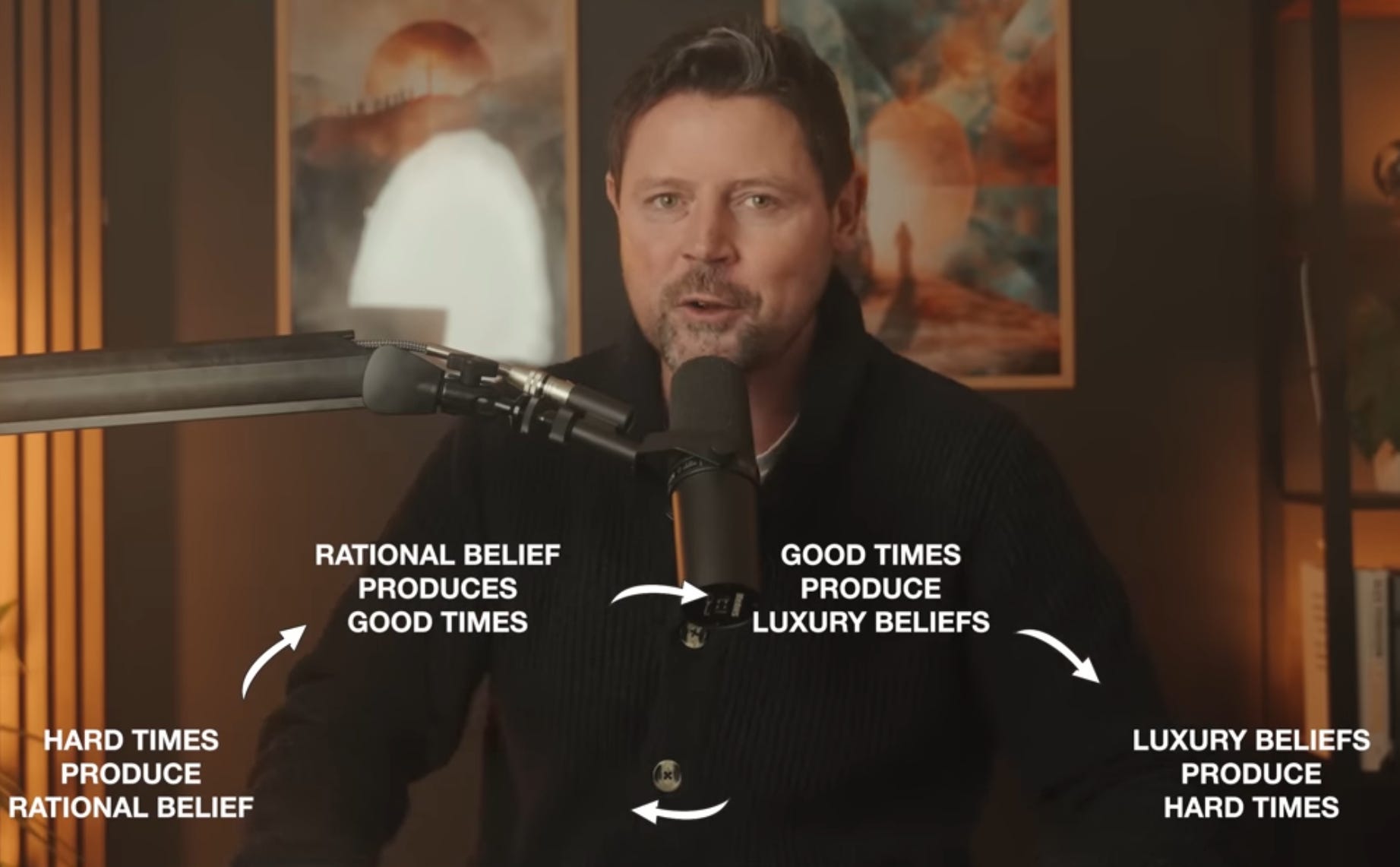
Rob Henderson coined the fantastically useful phrase “luxury beliefs”, and regularly points out examples of people expressing beliefs that allow them to virtue signal at little or no cost, yet if the ideas were implemented would harm those not as privileged as the speaker:

New York City mayor Zohran Mamdani, 10 February 2024.
Photo by Kara McCurdy via Wikimedia Commons.
In a recent New York Times interview, Zohran Mamdani, New York City’s socialist mayor, struggled to define “working class”.
At one point he was asked point-blank, “How do you define the working class?”
Mamdani replied, “I think if you have to work to pay your bills, I think that that is one definition of being a part of the working class”.
After some pushback from the interviewer, Mamdani said he would draw the line at “about a million dollars a year”. I have no idea how he can say that without any embarrassment, but that’s why he’s a politician and I’m not. Say what you will about him, but the man knows his base. These are the people who claim to be the champions of women yet — and please forgive what has now become a hackneyed line — can’t define what a woman is, and they claim to be the champions of the working class, yet can’t define what the working class is. Or they redefine both terms to be so expansive that they could potentially encompass just about everyone.
This is where the luxury belief class has steered us.
Anyone who isn’t a millionaire gets to be working class now. It sounds absurd but that’s where we’re at now. Remember during the primaries in 2015, Bernie Sanders said that “the millionaires and the billionaires” need to pay their fair share? At some point over the past decade, he dropped “millionaires” because he became one. Now you see the millionaires condemning only the billionaires. Mark my words, at some point in the not-too-distant future, you will see the billionaires disparaging the trillionaires. Maybe inflation will hasten that phenomenon.
Anyway, in that Mamdani interview, the focus on defining class by money is revealing.
People often conflate social class with economic class. This allows us to talk about the former while pretending we are talking about the latter.
It is easier to discuss income than educational pedigree, accent, hairstyle, clothing, taste, or zip code.
But education usually signals social class more clearly than income does.
Research has found that parental educational attainment is the most important objective indicator of social class. This is because, compared with parental income, parental education is a more powerful predictor of a child’s future lifestyle, tastes, and opinions. If your parents went to college but you didn’t, you’re still middle-class or higher. Not working class.
Education shapes habits, networks, and outlook long after the degree is earned. Higher education bestows cultural capital: patterns of speech, tastes, opinions, and expectations about life. Income may rise and fall over a lifetime. The worldview formed in selective institutions usually endures. By that standard, college graduates, regardless of earnings, are not working class.
Education also shapes political views more strongly than income does.
In 2021, Ezra Klein pointed out that “We tend to think of class as driven by income” but that “A high school dropout who owns a successful pest extermination company in the Houston exurbs might have an income that looks a lot like a software engineer’s at Google, while an adjunct professor’s will look more like an apprentice plumber’s. But in terms of class experience — who they know, what they believe, where they’ve lived, what they watch, who they marry and how they vote, act and protest — the software engineer is more like the adjunct professor.”
Plainly, a PhD who takes a job driving a taxi will tend to vote like other PhDs, not like other taxi drivers, especially if he or she also has a parent with a college degree.
It was so much easier to recognize the British classes, at least back in the 1960s that is:

John Cleese, Ronnie Barker, and Ronnie Corbet as the avatars of the British upper, middle, and lower classes
Original version from The Frost Report, 7 April 1966.
June 24, 2026
QotD: Beethoven’s Fifth Symphony is a “symbol of exclusion, elitism, and gatekeeping”
One is just that Beethoven is a dead white male who is universally deemed an incomparable composer. The other is that concerts of classical music are kind of classist and snooty, and if you showed up with a piercing or anime hair or dark skin, you might get beaten up, or sneered at, or something.
The first accusation attracts an immediate guilty plea, and identifies a real problem: no one (of any colour or creed or sexual orientation) who takes up music composition in 2020 has any real hope of becoming the equal of Beethoven. Vox found musicians to complain about the suffocating centrality of Beethoven within their tradition of creating and performing, but this sentiment isn’t the exclusive property of minorities, or of musicians. It persecutes all indiscriminately. No young mathematician setting out on a career imagines that he is going to give Euclid or even Poincaré a serious run for their money.
[…]
The second charge in Vox‘s indictment — that concerts of classical music discourage outsiders — is something that (surviving) symphony orchestras have been working their fingers to the bone to address, and not without obvious success. At this point there can’t be an ensemble of any size on this continent that hasn’t spent several summers going to battle in public parks, armed with trendy film scores and orchestral pop, to play for people in jogging outfits and tank tops.
Colby Cosh, “Roll over Beethoven, you exclusionary elitist”, National Post, 2020-09-16.
May 20, 2026
QotD: “Gilded Age” Robber Barons didn’t have access to what even working-class Americans have now
… but the robber baron knew he needed the serfs. Their relationship was purely dialectical. Without his factory hands, no robber baron. And in a strange but very real way, the higher up the food chain your Gilded Age robber baron went, the more he was dependent on his serfs for his lifestyle. J.P. Morgan is usually credited as being the first guy to become a Robber Baron purely through finance. Carnegie, Rockefeller, all those guys had most of their wealth in financial instruments, of course, but those financial instruments rested on control of a physical product — Carnegie Steel, Standard Oil.
I’m probably being unfair to Jay Cooke, the Michael Milken of his day, but since more people have heard of J.P. Morgan let’s roll with it. Even though Morgan’s wealth was entirely on paper — he was nothing but a securities trader — his lifestyle utterly depended on a battalion of servants. In a very real way, you yourself, right now, live much better than J.P. Morgan did in his heyday. And not just because you have aspirin, antibiotics, and air conditioning, three taken-for-granted things ol’ J.P. would’ve given half his kingdom for. But because you have more time. If you’re hungry, you can open the fridge or the microwave and have all the food you need in a matter of minutes.
J.P. couldn’t. J.P. had to deploy an army of servants every time he wanted a snack, and those servants were constrained by things like “availability of ice” and “when is the fishmonger at his stall”. You’re hungry at 2am, you jump in your car and get some Taco Bell. It takes ten minutes. J.P.’s hungry at 2am and it’s tough titty, J.P., your ass is going hungry. Because even though you’re the richest man in the world and have legions of manservants at your beck and call, Taco Bell just isn’t there. Even if someone had had the brilliant idea to create a Gilded Age Taco Bell, it still would’ve taken hours:
Wake up the manservant. Wake up the groom and stableboy. Hell, wake up the horse, then saddle the horse, ride to the drive thru window … which in this case means “the house of the guy who runs Gilded Age Taco Bell”. At which point he has to fire up the oven, start pounding the tortillas, send his own legion of valets and stableboys and whatnot out to get the refried beans …
And that’s the other thing, J.P. — you’d best not pull that shit too often, because those people know where you live. Not only do they know where you live, they live with you. Literally under the same roof. You want to sleep easy? You’d best not beat the servants too often, buddy.
There’s only so much “class consciousness” one can develop in that world. Oh yeah, J.P. thought of himself as one of the Masters of the Universe, there’s no denying that. But J.P. lived in what was still a brutally physical world, in a way we PoMo people really can’t grasp. If you can’t imagine what it would take to get some Gilded Age Taco Bell, maybe geography will do the trick. Ever seen Gangs of New York? Even if you haven’t, you’ve probably heard the name “Five Points”. The worst slum in America in the 19th century, and 19th century American slums were world class …
That was right down the street from Wall Street. Literally. I am not in any way joking, and if I’m exaggerating a little for effect when I say “J.P. could’ve hit Five Points with a five iron from his swanky digs on Central Park West”, I promise you I’m not exaggerating much. You can look it up for yourself. The main reason the Union rushed troops straight from the Gettysburg battlefield, and no-shit shelled parts of the city with gunboats, during the Draft Riots was because Five Points (et al) was right fucking there, and they might’ve gotten it into their heads to lynch a few Masters of the Universe. Rich man’s war, poor man’s fight, right? Let’s see how you like it, you bankster bastards …
The PoMo “information economy” removes all that. The other day I joked about colleges like Bennington and Goucher. I cracked some jokes, yeah, but I wasn’t really joking. Those places aren’t for us. Wall Street is still a physical location, but it might as well be on the dark side of the moon for all any of us have access to it. J.P. couldn’t beat the servants too hard, or too often. The modern equivalent of J.P. isn’t even aware that he has servants. He just clicks on a website, and stuff appears at his door. Like magic. Hell, it IS magic for all he knows, and he surely doesn’t care, because all that shit is his by right. He went to Bennington, after all. He has achieved full class consciousness.
All of which suggests, of course, that while Marx was wrong about the end state — the State will not, in fact, wither away — he might well have been right about the solution to the “contradictions of capitalism”, if you follow me. And if that makes me some kind of godless pinko Commie subversive, well … I’ve been called worse by better.
Anybody got the lyrics to La Marseillaise in English?
Severian, “On Losing the Cold War”, Founding Questions, 2022-07-02.
Update, 21 May: Welcome, Instapundit readers! Have a look around at some of my other posts you may find of interest. I send out a daily summary of posts here through my Substack – https://substack.com/@nicholasrusson that you can subscribe to if you’d like to be informed of new posts in the future.
April 30, 2026
Latest luxury belief just dropped: “microlooting”
Rob Henderson identifies the latest addition to the broad suite of luxury beliefs held by the over-educated, over-privileged people who will never bear the costs of their anti-civilizational thoughts:

In a 1955 essay titled “The English Aristocracy”, novelist Nancy Mitford suggested that as goods became more affordable, England’s upper classes could no longer rely on material possessions to distinguish themselves from the masses. Instead, Mitford wrote, “it is solely by their language that the upper classes nowadays are distinguished”.
Jia Tolentino and Hasan Piker proved this point last week in a conversation hosted by Nadja Spiegelman at the New York Times. It unfolded in a carefully staged loft that signaled taste and status. Ms. Spiegelman proposed a new word for shoplifting: “microlooting”. Mr. Piker later remarked that “many Americans, I think, are totally oblivious to this political language”.
“Stealing” sounds so tawdry. Microlooting is cleaner — a minor offense laundered into a boutique act of political protest. Indeed, much of upper middle class life is about rebranding disreputable behaviors to retain one’s position in the social hierarchy. The pattern is familiar. Mitford sorted vocabulary into “U” (upper class) and “non-U”. U-speakers said “vegetables” and “spectacles” and “lavatory”. Non-U speakers said “greens” and “glasses” and “toilet”.
Today, the favored words of the upper class come from a mishmash of therapy culture and human resources. Lazing off at work has become “acting your wage”. Saying no means “setting boundaries”. Infidelity is “ethical nonmonogamy”. Prostitution is “sex work”. Divorce can be called “conscious uncoupling”. Neglecting close relationships is “protecting your peace”. Listening to someone vent is “emotional labor”. Recall that in 2021 the AP Stylebook announced that a “mistress” must now be called a “companion, friend or lover”.
And shoplifting is “microlooting”.
Five years ago, I texted a high-school friend who had been released from prison. “Good news”, I told him. “You’re not an ex-felon anymore, you’re a justice-involved person.” He replied, “Okay Rob, you’re not a college graduate anymore, you’re a classroom-involved person.”
At UnHerd, Poppy Sowerby pours scorn on the well-to-do New Yorkers’ sudden discovery that “five finger discounts” are fun and socially conscious ways to strike back at “the man”:
The New Yorker columnist Jia Tolentino, the NYT‘s Nadja Spiegelman, and Hasan Piker — the midwit Marxist streamer accused of electrocuting his dog and who admitted having solicited a prostitute (not so against the free market now, ey?) — gabbed about “microlooting” — small thefts justified by the fact that, as Spiegelman puts it, “It’s so hard to live ethically in an unethical society”. Quick-fire scenarios are floated; stealing from the Louvre, Piker says, is “cool”. Stealing from supermarket chains is “not a big deal” in a “utilitarian sense”, says Tolentino. And Spiegelman wonders why she should “have to pay for organic avocados” when Jeff Bezos “has too much money” (Amazon, which he founded, acquired Whole Foods in 2017). Antisocial behaviour is justified here — explicitly or tacitly — under the lazy logic of “protest”.
Unlike microlooting, however, Tolentino finds “getting iced coffee in a plastic cup … profoundly selfish, immoral [and] collectively destructive” — presumably the bimbo-coding of that drink is unrelated. The lines of moral permissibility seem to be drawn, in other words, along the exact same lines of what these rich, educated progressives consider “cool”.
And that’s the real problem. Progressives have always found extravagant ways to reframe the ills which they personally enjoy — prostitution, pornography, choking women. Now shoplifting gets the same treatment. Tolentino is not really stealing lemons because it’s a way of flipping the bird at Bezos; she’s stealing them because she wants them. Nor are the barrier-bumpers actually trying to signal their dissatisfaction with the frequency or cleanliness of public transport — reasoning I have actually heard with my own ears, despite the fact these things can only be improved by the very funding the free riders are withholding; they are bumping barriers because they just don’t want to pay. Nicking groceries and dodging fares are age-old problems. What’s new is the towering cowardice of those who can’t admit that they, like most people, act mainly out of self-interested desire.
The appealing but deceptive idea that low-level criminality is a laudable demonstration against “the system” in fact conceals envy towards those in that “system” who, like Bezos, have known success. This resentment is particularly native to the media class, whose peers tend to out-earn them in higher-salaried fields like law and finance — conferring on writers like Spiegelman and Tolentino the faintly plausible whiff of bookish martyrdom. Nevertheless, and particularly in New York, mag luminaries can still live in $2.2 million brownstones in Clinton Hill; sticking it to the man by pilfering in the produce aisle might pass in grim artists’ squats, but five-finger discounts are harder to justify on six-figure salaries.
Update, 1 May: Welcome, Instapundit readers! Have a look around at some of my other posts you may find of interest. I send out a daily summary of posts here through my Substack – https://substack.com/@nicholasrusson that you can subscribe to if you’d like to be informed of new posts in the future.
April 26, 2026
QotD: College Town, USA
It’s not “change” in the sense we understand, and instinctively accept — it’s not “change” in the way the seasons change. It’s directed change — somebody decided to do it. And if it’s not immediately apparent who, or why, we are naturally suspicious. We are “based”, if you will, in the Permanent, so we are acutely aware of the deliberate aspects of the Impermanent.
City life gives you the opposite, indeed overwhelming, sense of Permanent Impermanence. Nothing stays the same; the only constant is change. I remember seeing it in College Town, which was not particularly large, population-wise, but had almost all the “amenities” you’d expect from a major metro. Bearing in mind, as always, that “College Town” is a composite of several different places … but they’re all basically the same, and that’s the point.
The first thing that struck me about College Town — that you see in every College Town, coast to coast — was how shabby it was. Even the brand-new apartment complexes (of which there were many, Higher Ed being a growth industry at that time) all looked dilapidated. The next thing I Noticed was the lack of institutions. College Town had every imaginable “amenity” — exotic cuisine, 24 hour everything — but no playgrounds, no ball fields, no churches. Hardly any schools, despite being pretty good size relative to the surrounding area, because why would there be? All that stuff is for people who actually live there, as opposed to the transients, or even the “permanent residents”, if you will, on the faculty (what an unconsciously telling phrase that is!).
Nobody’s from there, and nobody stays there. Not even the faculty — they always have one foot out the door, no matter if they’re Department Chairs with 30+ years’ seniority. It is crucial to their amour-propre to believe that they’re always about to get the call from Harvard, which in part explains the weird phenomenon of the “faculty ghetto”. They’ll spend a zillion dollars “restoring” a frankly tiny house in the “historic” district, by which is meant “gutting it, and making it as close to a Current Year McMansion as the physical infrastructure can bear”. Then they’ll spend a zillion more on yearly maintenance, when they could’ve gotten twice the house, with the latest and greatest everything, built to spec on the outskirts of town …
… which is five minutes away; it’s not like they’re facing some huge commute (and it’s not like they walk or even bike to campus, and God forbid they take the bus. No, they’d much rather gut or knock down another old building, just to have a garage in which to park the huge gas-guzzling SUV they drive the 45 linear feet to “work”, because how else would they show off how important they are, without parking in their designated space in the one fucking lot in the entire town?).
In other words, they don’t want to admit that they live there — they are, at most, “permanent residents”. There are no public playgrounds, because their one designer baby isn’t going to rub elbows with the children of the few greasy proles they grudgingly tolerate in the absolutely necessary service industries — you know, the mechanics and plumbers and snow plow drivers and such. There are no churches, just one or two Temples of the Current Thing, and only to the extent that a few of them have paraphilias involving clerical vestments. No ball fields, no Cub Scout packs or Elks Lodges or American Legion posts, because c’mon man. A town that size anywhere else would have a Walmart and a Minor League team and a big rivalry game between the local high schools; College Town has head shops and Egyptian-Thai fusion cuisine and DoorDash.
Permanent Impermanence, in other words. Deliberate impermanence. Nothing lasts, nothing can last, nothing should last. There are some people who find that attitude — which I would call straight-out, shit-flinging nihilism — deeply appealing, and … well … there it is.
Severian, “Transience”, Founding Questions, 2026-01-19.
April 20, 2026
Airline deregulation in the 1970s
The end result — democratizing air travel and enabling far more people to economically travel long distances — also meant that air travel became far more casual (people no longer dressed “properly” for flights) and economy flights began to more closely resemble long-distance buses, but overall it was a win:

The Airline Deregulation Act of 1978 stands as one of the most spectacular vindications of free market principles in modern American history. Before deregulation, the Civil Aeronautics Board controlled every aspect of commercial aviation: routes, schedules, and most critically, prices. Flying remained a luxury reserved for the wealthy elite, with fares artificially inflated by regulatory capture and government-sanctioned cartels.
Within a decade of deregulation, average airfares plummeted by 50% in real terms. The number of passengers more than doubled from 250 million in 1978 to over 500 million by 1990. New airlines like Southwest and JetBlue emerged with innovative business models that prioritized efficiency over bureaucratic compliance. Routes previously deemed “unprofitable” by government planners suddenly thrived under competitive pressure.
The regulatory regime had created exactly what free-market theory predicts: artificial scarcity, price distortions, and a complete disconnection from consumer preferences. Airlines competed on amenities instead of price because the CAB fixed fares at monopoly levels. They served cocktails and full meals while ordinary Americans couldn’t afford tickets. The moment government stepped aside, entrepreneurs discovered countless ways to serve previously ignored market segments.
Critics warned that deregulation would compromise safety and create chaos. Instead, aviation safety improved dramatically as airlines faced real liability for accidents and insurance companies imposed rigorous standards. Competition forced operational excellence in ways bureaucratic oversight never could. Hub-and-spoke networks emerged organically, maximizing efficiency without central planning.
The contrast couldn’t be starker: decades of stagnation under regulatory control versus explosive innovation and democratization under market freedom.
Yet the same politicians who celebrate affordable air travel continue strangling other industries with identical regulatory schemes.
January 20, 2026
Those awful AWFLs
On Substack, Rohan Ghostwind responds to a recent New York Times opinion from Michelle Goldberg pretending not to understand why “the right” is against Affluent White Female Liberals (AWFLs):
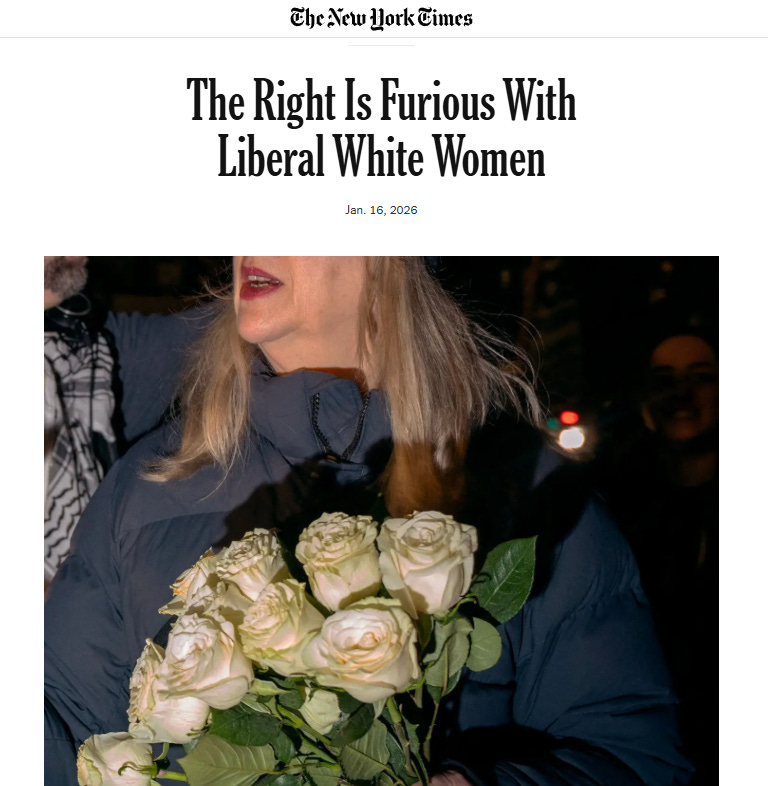
Michelle Goldberg recently wrote an opinion piece in the New York Times called “The Right Is Furious With Liberal White Women”
Specifically, she talks about the rising contempt for the AWFL: Affluent white female liberal.
The first part of the opinion piece is a play-by-play of the Renee Good situation, pointing out that the right is freaking out about roving bands of Karens.
The part I find interesting is in the final paragraph:
It wasn’t long ago that casual contempt for white women was the domain of the left, at least that part of the left that took books like “White Fragility” seriously. So it’s striking how easily conservatives, who’ve been stewing over insults to white people for at least five years, have singled out a group of white women as the enemy.
Here’s the interesting part: throughout the course of her opinion piece, she touches on White Female Liberal part. Conspicuously missing is the first part of the acronym: affluent.
This is par for the course for an NYT Opinion piece: play into the identity politics aspect while simultaneously downplaying class. This is, of course, a big reason why the Democrats lost ground with working class people during the 2024 election.
[…]
Rob Henderson popularized the term luxury beliefs …
And if it was ever one group of people who embody the most luxury beliefs per capita it would be the AWFL’s.
What makes them uniquely annoying is their persistent refusal to acknowledge how sanctimonious they come across to the rest of the world. As far as they’re concerned, they are the only intelligent and moral group of people, and they will eventually get what they want by scolding everybody else into submission.
People hate this, because people would actually prefer bigotry to infantilization — but the affluent white woman, by virtue of being affluent, never has to reality test her beliefs against the real world.
January 16, 2026
QotD: Another unintended consequence of conscription
The big social revolution started in the mid-1960s and had really taken root by 1980. I don’t mean drugs and shagging around I mean a proper social revolution. The British working classes no longer took what they were being told by the poshoes as being true. Questions, as we might put it, were being asked.
My theory, backed up by reality and all the obvious facts of the case, is that as all young men had spent two years being run by the poshoes up front and directly therefore no one believed the poshoes any more. Actual experience, see?
National Service led to the downfall of the posh classes. Simply because direct exposure to said posh was always going to do that.
This is not just a jeu d’esprit. I really do insist that Britain’s social revolution was driven by conscription. Being told to jump by some chinless 6 months out of Eton is going to do that.
Tim Worstall, “National Service Led To The Uppity Proles Of the 1960s”, It’s all obvious or trivial except …, 2025-10-14.
Update, 17 January: Welcome, Instapundit readers! Have a look around at some of my other posts you may find of interest. I send out a daily summary of posts here through my Substack – https://substack.com/@nicholasrusson that you can subscribe to if you’d like to be informed of new posts in the future.
January 10, 2026
Luxury beliefs thrive when there is no personal cost for embracing them
Lorenzo Warby on the inevitable result of well-to-do people espousing luxury beliefs when there is no feedback mechanism to inform them of the negative impact of those beliefs:
Look at anyone making consequential decisions. Ask the question: what penalty do they suffer if they are wrong? That is, what are the consequences for them if they adopt a belief that is not true; if they make a decision hostile to human flourishing; if they retard the operation of the organisation or society around them.
For a horrifying number of people in our modern, highly bureaucratised, highly regulated, highly taxed, highly subsidised societies, the answer is: nothing. Nothing happens to them if they are wrong.
Note, this is different from the question of: did you follow the correct process? It is relatively easy for failure to follow the correct processes to have consequences. The what-if-you-are-wrong question also applies to: what if you follow the correct process and are wrong?
Source. A luxury belief is a belief insulated from reality-tests that there are social motives to adopt — e.g. as shared status play; as a resource or power grab — that imposes costs on others (typically, lower down the social scale).
The question of being wrong has lots of layers. Something can simply block good things from happening, but those good things’ lack of happening is typically invisible.
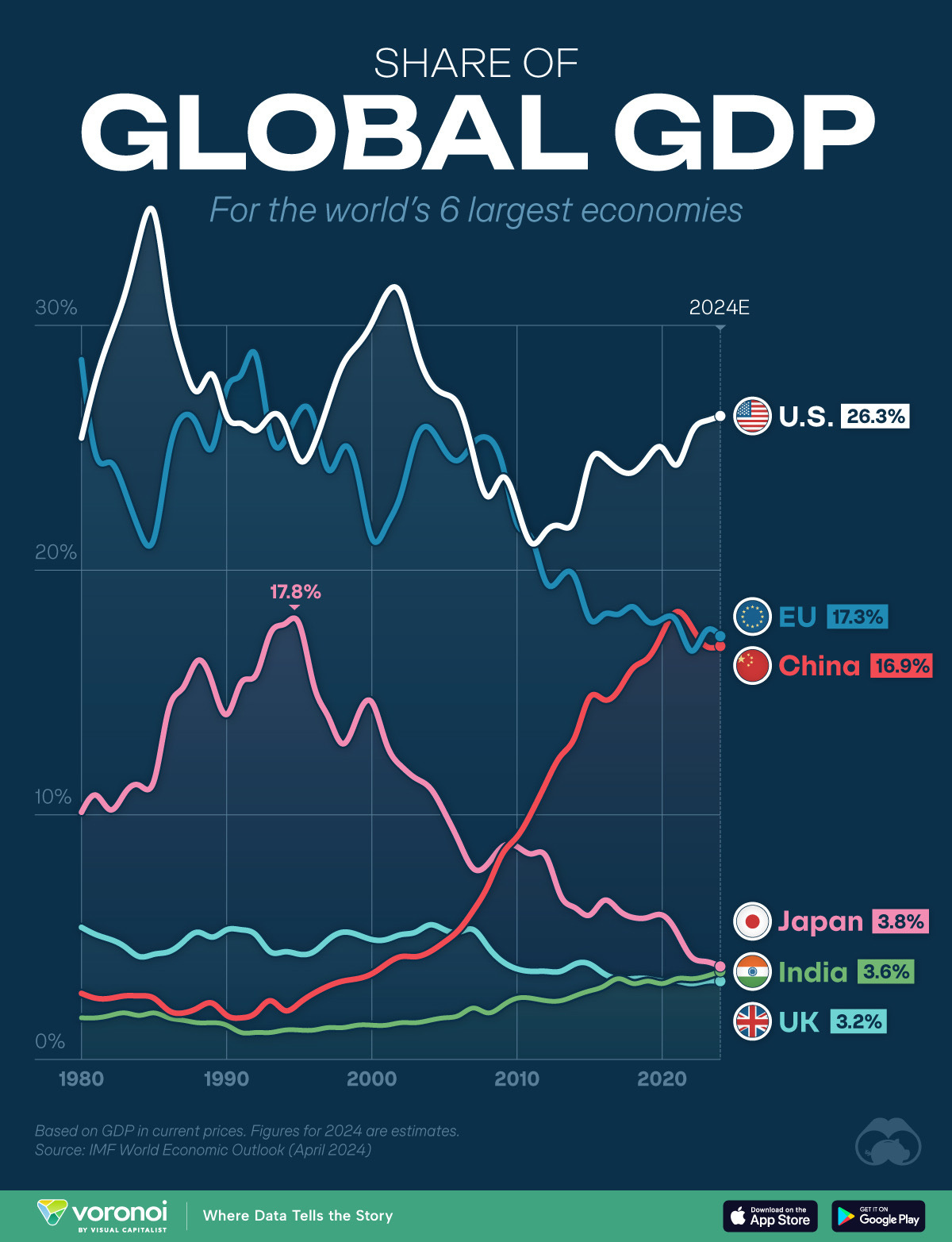
Economic stagnation is a normal condition of human societies, in large part because what is blocked from happening is invisible. Such has become more visible in the world since the 1820s, as mass prosperity has been demonstrated to be an achievable thing. Compare, for example, the post-2008 economic performance of the UK and much of the EU with, say, the US. But such is more visible only by comparison with other societies—we cannot directly observe good things that are blocked from happening.
Source. Japan shows the compounding effects of economic stagnation. Those of us who can remember the 1980s commentary on how the US needed to copy Japan can enjoy the irony and suggest caution about similar commentary re: China.
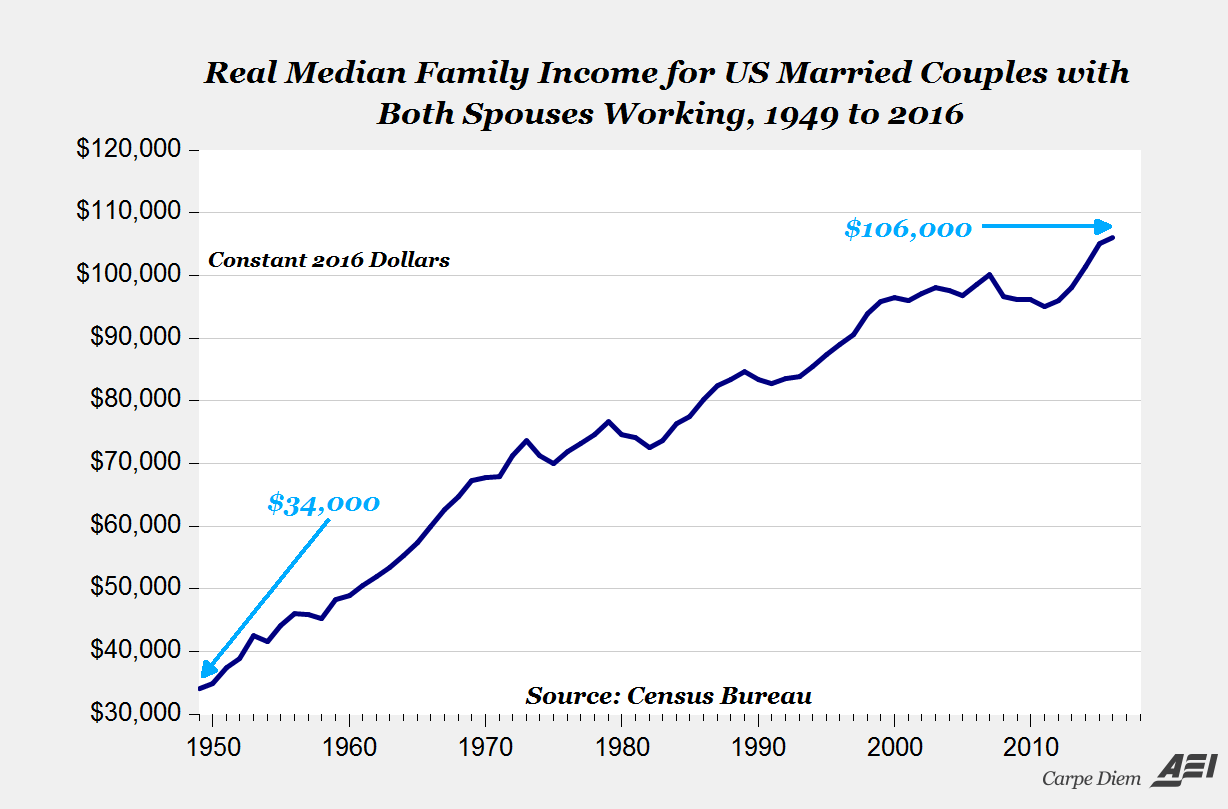
Even in the US, comparing the path of median incomes in different postwar periods shows that there has been a fair bit of blocking of good things from happening.
Moreover, comparison does not always resonate. People can not bother to compare or think that the comparisons do not apply. This time will be different has a great deal of wish-fulfilment appeal.
Across so much of modern societies, the what-are-the-consequences-of-being-wrong? question has the horrifying answer of no consequences to the person being wrong. (Real consequences, but very delayed, is not much better.)
I have already discussed this no consequences for being wrong with regard to the universities. But the same point applies across much of the non-profit world, the apparatus of the welfare state, etc. It applies intensely to UN bodies.