
… Alexander to Actium is a rich feast, enlivened throughout with Green’s flare for delicious details and legends that are possibly fanciful but too remarkable to leave out.
But telling the actual narrative of the Hellenistic world, however bizarre and entertaining it gets, is really only the superficial purpose of Alexander to Actium. No, the real point of the book, and the real reason to stick around for all 700 pages, is to witness Peter Green’s incredible, almost maniacal act of vengeance against an era he despises.
Whether it’s playwrights …
The poet-playwright Menander … has always struck me as a classic example of a growth industry created by papyrological accident.
… poets …
Callimachus, like Ben Jonson, has always had a rather better press than he deserves, and for much the same reason: his academic ideals and credentials can hardly fail to appeal to those other academics … I cannot help finding him at once pretentious and faintly distasteful, a literary exhibitionist with an unpleasant groveling streak about him, a sycophant implacable in his attacks on rival sycophants[.]
… philosophy …
Popular philosophies — and Stoicism must be accounted one of the most popular ever — almost always tend to have an intellectually suspect quality about them.
… coin portraits …
Prusias I of Bithynia is porcine, crass, and self-satisfied. The early kings of Pontus resemble nothing so much as a family of escaped convicts: Pharnaces I has the profile of a Neanderthaler, and Mithridates IV that of a skid-row alcoholic.
… or academia itself …
Museum faculty developed a reputation for symposia, frivolous research topics, and alcoholism: to anyone in the same profession there cannot fail to be a certain sense of deja vu.
… Green knows how to write a burn. It’s not simply that he’s a hater: his book about the Battle of Salamis overflows with love and admiration for the golden age Greeks who defeated the Persians. No, Green specifically has a bone to pick with the Hellenistic era and its rulers, its people, its art, and its ideas. For those who read for entertainment, the best part of Alexander to Actium isn’t the battles, the George R.R. Martin-esque politics, or the even more Martin-esque incest — it’s tagging along as Peter Green gets revenge on the Hellenistic Age by writing a definitive textbook about it, so that all students of history who come after him will read of his scorn and contempt.
Green’s harsh attitude is clear right from the preface, when he sets the book’s scope.
[I will not] devote specific sections either to law or to school education, on the grounds that during our period the first … was little more than an elaborate sham masking the realities of power, while the second offered nothing, in essence, but literary rote learning, elementary mathematics, music, athletics, and — most important — a rhetorical grab bag that would enable men at the top to talk their way into, or out of, anything.
Hellenistic historiography fares just as badly:
Polybius remains the only worthwhile historian of the Hellenistic period whose work substantially survives. Diodorus, as we are too often reminded, is a third-rate compiler … I have no wish to burden an already overlong book with yet another imaginative analysis of his chronological inconsistencies and synthetic rhetoric. Like Plutarch, he believed that one virtue of history lay in “recording the nobility of distinguished men, publicizing the vileness of the wicked, and in general promoting the good of mankind”. Successful statesmen, he thought, were righteous, while evil ones met with frustration: nothing, in short, succeeds like success. None of this inspires confidence.
From there the savagery continues almost non-stop, right down to the last page when Green ridicules imperial Roman literature for “guttering out” by the mid-2nd century. Virtually nothing escapes.1
Take philosophy, that most noble of ancient endeavors. The Hellenistic world’s biggest philosophical contribution was Stoicism. Today, Stoicism enjoys a good reputation for encouraging adherents to be stolid and uncomplaining in the face of difficulties. Green, though, puts the spotlight on Stoicism’s lesser-known traits like its determinism and pantheism, then singles it out as a shallow ideology perfect for helping elites rationalize their own hypocrisies.
Sandbach correctly notes that “the belief that the world was entirely ruled by Providence would have an appeal to the ruling class of a ruling people”. What Stoicism offered, in fact, was a built-in justification — moral, theological, semantic — for the social and political fixed order: it was the most powerful and subtle instrument of self-perpetuation that the Hellenistic ruling class ever conceived. The mere fact of anything happening meant that it had been fated to happen; and since nature was providentially disposed toward mankind, what was fated could not fail to be all for the best. This interesting version of determinism is most often presented as a source of comfort when things seemingly went wrong; but of course, as I have suggested, it would be of even greater benefit to those who were anxious to have some moral principles to offer the world in justification of ruthless self-interest. If it was bound to happen, it had to be right.
People have always wanted to learn the future, but Stoicism’s belief in a deterministic yet providential cosmos drove a tremendous increase in the popularity of astrology, divination, and other woowoo, often egged on by the philosophers themselves.2 Green even hypothesizes that Stoicism’s popularity directly sabotaged whatever nascent scientific progress there was in the late Hellenistic age.
Blake Neff, “GUEST REVIEW: Alexander to Actium, by Peter Green”, Mr. and Mrs. Psmith’s Bookshelf, 2025-10-20.
- Don’t assume that you, the reader, will be free from Green’s scorn. Green studied the classics at Cambridge back when standards were standards. The preface alone includes untranslated phrases in Greek, Latin, French, and even German, a norm that continues throughout the book for the first three languages (and for the fourth in the highly-entertaining footnotes). Green has no patience for the puny monolinguists of today.
- Posidonius of Apamea, one of the most famed Stoic writers of the ancient world, was also one of its most famed astrologers.
August 29, 2026
QotD: Peter Green’s vengeance against the Hellenistic Age
August 23, 2026
QotD: “I found a million dollar baby in a five and ten cent store”
I once asked a friend in the French music biz how the song went over there. I hummed him the tune and he sang me the French lyrics and, although I can’t recall any of them, I remember they were entirely different from the English words. It’s not just the five-and-ten that’s hard to translate or the million dollar baby. But the concept of finding the latter inside the former is also very American. There are a ton of Mitteleuropean operettas in which the prince or duke or count wanders into the streets in disguise and falls in love with a serving wench, but the serving wench usually turns out to be a Countess or Margravine or some such also wandering around in disguise. Even the British are prone to this syndrome (Spring In Park Lane, etc). But in an American song the shop girl is a genuine shop girl, and she’s still a million dollar baby. That’s what makes it American.
In the Sixties, by the way, you could have found a future billion dollar baby in a five and ten cent store: Sam Walton, founder of Wal-Mart, got his start in retail as a franchisee at a Ben Franklin’s, founded in 1920 by the Butler brothers, who’d been in the five-and-dime business since the 1870s. I’m not saying “I Found a Million Dollar Greeter in the Big Box Store at the Strip Mall on the Edge of Town” would be as big a hit, but there is an historical continuity from the Butlers to Wal-Mart.
Mark Steyn, “I Found a Million Dollar Baby (in a Five and Ten Cent Store)”, Steyn Online, 2020-10-25.
June 30, 2026
Sparta vs Athens 2(d): Athenian Freedom – Drama, Free Speech, Trade, and the Economy
seangabb
Published 8 Feb 2026Greece: A Brief History, c.700 BC – 500 AD
This final segment links culture to economics and asks what Athenian “freedom” actually looked like in practice. Drama was not a private pastime. It was a civic institution performed before the citizen body. Comedy could be brutally obscene and politically personal, naming living leaders on stage — evidence of a public culture far less timid about speech than most modern states.
From there I move to Athens as a maritime power: trade, grain dependence, Piraeus, coinage, state pay, and the economic dynamism that supported participation in Assembly and law courts. The images on the slides matter here: artefacts and “industrial art” show what Athens valued in daily life.
I end by returning to Sparta’s deliberately restrictive economy — iron currency, limited trade, enforced uniformity — and why that system could produce discipline but not lasting intellectual fertility.
This is also where I state plainly what we owe to Athens.
June 12, 2026
QotD: George Bernard Shaw
On the other hand, he was one of the few playwrights in English whose plays can still be performed for the pleasure of an audience a century later. One or two of them might even, without absurdity, be called great. He was undoubtedly very witty, and if he was unbearably opinionated, his prose was always vigorous and quite often elegant. I learned to write from him. Many of his bons mots are still nearly as funny as those of Oscar Wilde.
It was as a playwright — one whose fame stretched around the world — not as a thinker or guide to policy that he is commemorated in the name of the theatre [at Britain’s Royal Academy of Dramatic Art]. His plays have been in print ever since they were written. His achievements in the theatre can hardly be denied. He is virtually the founder of the modern drama in English. I can extract at least 20 of his plays from the vaults of my mind.
Theodore Dalrymple, “Man and Underman at RADA”, City Journal, 2020-09-17.
April 25, 2026
QotD: Goethe, the lost German master
Today, the texts are almost all recent and appear to be chosen partly with the film of the book in mind. In particular, Goethe has disappeared from the syllabus, presumably because the language is considered too archaic. Yet I recall the immense pleasure and satisfaction of mastering a Goethe play — Egmont. The story of the dashing Dutchman and his martial defiance of the sinister Duke of Alba, the courage of his beloved, Klärchen, who fantasises in song about how wonderful it would be to be a man and fight the Spaniards — “ein Glück sondergleichen ein Mannsbild zu sein“. Somehow I even obtained an LP of Beethoven’s incidental music for Egmont: seldom heard apart from the overture, but brilliantly evoking the grandeur of the drama.
Like Homer, Dante and Shakespeare, Goethe belongs not just to German literature, but to world literature, Weltliteratur — a term he coined. I am told that even in German Gymnasien, Goethe is little studied now. He is certainly a rare bird in English schools — or even universities. It is tragic that educated people, including students of literature, so seldom encounter the greatest of Germans even in translation. We might get on better with Germany if we did.
Daniel Johnson, “How I discovered Germany”, The Critic, 2020-08-02.
April 1, 2026
QotD: “Colour-blind” casting
As a regular reader of this column, I have no doubt that you want to remain on the right side of history, and I imagine your instincts are to applaud anything that is annoying for conservatives, like diverse casting in historical dramas. Sometimes being an anti-racist can be hard work, but we don’t tell people to “do the work” for nothing.
First, we need to dispense with the “historical accuracy” argument. There are two ways to do this and the first is to say accuracy should play second fiddle to representation. This is apparently the Hilary Mantel argument. The Times says the Wolf Hall author blessed colour-blind casting before she died, saying that although it was difficult: “you’re in the realm of representation. I think we have to take on board the new thinking.” Everything in 21st Century Britain should reflect 21st Century Britain. We’re in year zero, and hence not employing non-white actors in a production made today, even though there were very few non-white people in sixteenth century England, is simply racist.
The second option is to straightforwardly argue that there were lots of Black and Brown people pottering around the court of Henry VIII, so the production is historically accurate. This is the BBC Horrible History approach. Were you there? Can you prove that it wasn’t full of People of Colour? And is it worth losing your job to do so?
I prefer to hold both of these arguments in my head at the same time. Too much consistency seems a bit right-wing.
Next we need to look at specifically who is being played. Thankfully, the “colour-blind casting” didn’t select any PoGMSTs (People of Global Majority Skin Tones) to play bad guys. This was both on purpose, because oppressed people cannot be bad, and it was also not on purpose, because otherwise it wouldn’t be colour-blind casting. Whichever one it was — and it was both — without PoGMSTs actors playing historic fictionalised evil people, we can avoid the completely random casting process being labelled as racist.
David Scullion, “People of Colour television”, The Critic, 2024-11-12.
March 31, 2026
This Recipe Took 3 Years … Ninja Kikatsugan
Tasting History with Max Miller
Published 23 Sept 2025Very bitter, very sake-flavored balls that include ginseng, coix seeds, and licorice
City/Region: Japan
Time Period: 1676Much like cowboys, pirates, and knights, ninja have been fictionalized to be a far cry from the intelligence gathering and sabotage experts of history. The term “ninja” didn’t even become popular until the mid-20th century.
Even the historical text I’m using here, the Bansenshukai, has been called into question. Because it was written over the period of several centuries, often by people who weren’t even alive during the period when ninja, or shinobi, were active, who knows if it’s an accurate portrayal of their tools and methods.
If this recipe is accurate, I feel bad for the people who had to eat them. They’re really bitter with an overwhelming sake flavor that isn’t pleasant. Really, I wouldn’t recommend making these; they’re not worth the 3 year time investment, and hyōrōgan are a much tastier ninja survival food.
Kikatsugan
10 ryō Asiatic ginseng
20 ryō Buckweat flour
20 ryō Millet Flour
20 ryō Yam
1 ryō Liquorice
10 ryō Coix seed
20 ryō Rice flour
Grind this into a powder, soak it in three shō of sake for three years until it has dried. Afterward, roll it into balls the size of peach pits.
Eating three of these daily will keep you healthy even when you have nothing else to eat.
Eating three will prevent both mental and physical fatigue.— Bansenshukai, 1676
February 15, 2026
Everything you see in the media is kayfabe
Wikipedia defines kayfabe as “the portrayal of staged elements within professional wrestling (such as characters, rivalries, and storylines) as legitimate or real. Although it remains primarily a wrestling term, it has evolved into a code word for maintaining the pretense of ‘reality’ in front of an audience.” It’s hard not to see modern political theatre in that light, as Damian Penny points out:
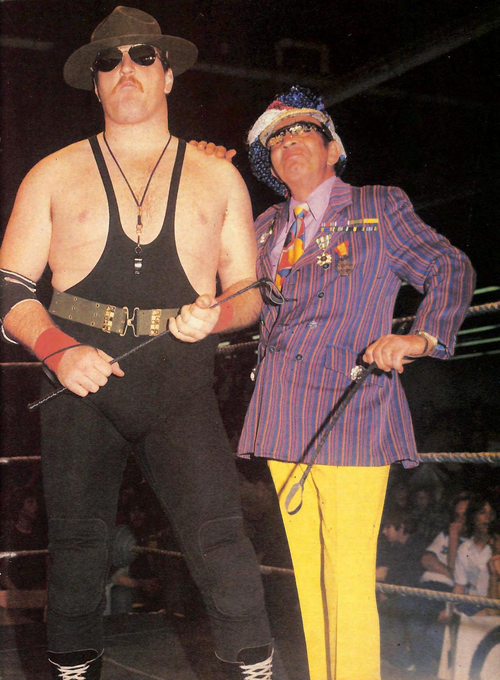
Sgt. Slaughter and The Grand Wizard, February 1984.
Photo from Wrestling’s MAIN EVENT magazine via Wikimedia Commons.
I know a guy who was obsessed with WWF wrestling (yes, I said WWF wrestling, because you kids better get off my lawn before Diagnosis Murder comes on) when he was younger and got to see it live when it came to his city. After the show, he was shocked to see several of the wrestlers — some of them good-guy “faces”, others bad-guy “heels” — being driven from the arena in the same minivan.
For someone who took the “sport” of professional wrestling seriously1 and was extremely emotionally invested in the performer rivalries, this was kind of like finding out that Santa Claus wasn’t real.2
That’s the first thing I thought about when I came across this piece by Christianity Today‘s Russell Moore, a rare evangelical leader who actually held on to his integrity in the age of Trump, about the Epstein Files:
Reading through the names of those connected with Epstein, one can hardly believe the range listed there. Some were unsurprising: for instance, creepy filmmaker Woody Allen or the man formerly known as Prince Andrew. But even then, the scope is unsettling. Even the Dalai Lama had to put out a statement noting that he was never involved with Epstein. Just as incredible, many of the people listed were partying with those they spend a lot of time telling the rest of us to hate.
Both Donald Trump and Bill Clinton were apparently friendly with Epstein. The New Age syncretist Deepak Chopra is in the documents many times — often with shady, enigmatic phrases — but so are those who accused the pope of New Age syncretism. With Middle Eastern tensions what they are, still the files include both sheikhs and Israelis. All over the files are connections with both left-wing populist provocateur Noam Chomsky and right-wing populist provocateur Steve Bannon. Epstein makes fun of evangelicals yet recommends a James Dobson article.
How can this be?
Maybe one reason is that Jeffrey Epstein figured out the deep, dark secret of this moment: The people who fight culture wars often believe what they say, but the people who lead culture wars often don’t.
[…] And if the Epstein revelations didn’t blackpill you hard enough, check this out:
To be fair, I’m not sure it’s an entirely bad thing that so many decision-makers and “thought leaders” who are sworn enemies in public get along just fine when the cameras are turned off. If they really hated each other, our political culture might be even more messed up.
- YouTuber Drew Allen says you should take wrestling seriously, and honestly he makes a darned good argument.
- I’ll never forget when I found out Santa Claus wasn’t real, and how I was so depressed and hopeless and wouldn’t leave my bed for days. Finally my mother came into my bedroom, sat down on the side my bed and said, “honey, I know you’re sad but you’re in your second year of law school and really we thought you’d have figured this out long ago“.

December 23, 2025
Vagabond by Tim Curry
Andrew Doyle reviews Tim Curry’s new autobiography Vagabond:
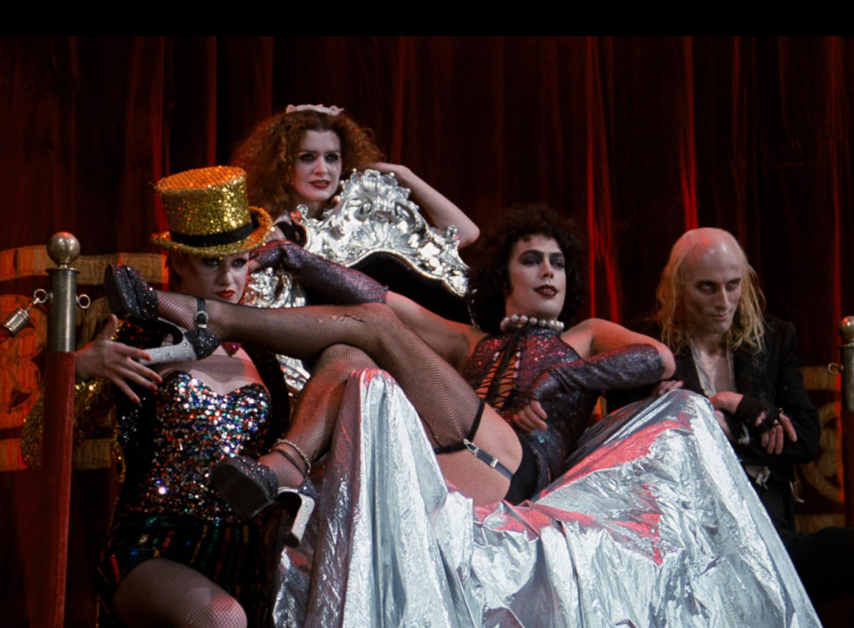
Tim Curry, Nell Campbell, Richard O’Brien and Patricia Quinn in The Rocky Horror Picture Show (1975)
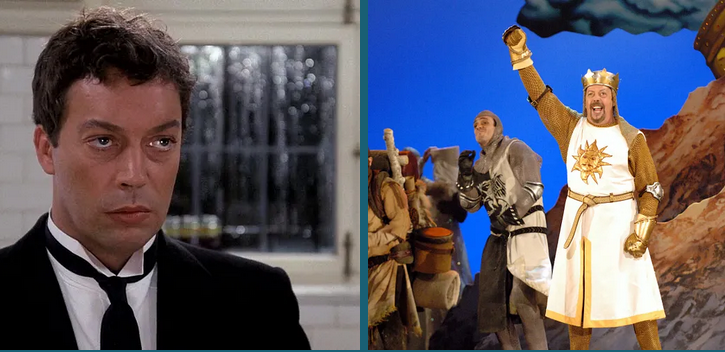
Tim Curry is a shapeshifter. I have a childhood memory of the moment I learned that the demon in Legend (1985), the villain in Annie (1982), the butler in Clue (1985) and the cross-dressing alien scientist in The Rocky Horror Picture Show (1975) were all played by the same man. It was quite the revelation.
Curry’s protean talents have meant that as a personality he has forever remained mysterious. He rarely gives interviews – only grudgingly whenever there is a movie to promote – and fans have therefore tended to project onto this reclusive figure the persona that best fits their expectations or desires. When more insistent fans have formed an emotional bond with the Tim Curry of their imaginations, he has on occasion been forced to put them right. “I’m just a person,” he says, “and I’m not your person”.
Fans will therefore be delighted at the publication of Curry’s memoir, Vagabond, which offers fascinating snapshots from his life. The approach is episodic, with chapters devoted to particular projects in his career. As such, Curry offers us morsels in lieu of a meal. Those who are hoping for salacious anecdotes about his love life will be disappointed, because – as he rightly points out – “specifics about my affairs of the heart or the bedroom are – respectfully – none of your fucking business”. Instead, we have a wonderfully compelling account of Curry’s origins and how his philosophy of life has informed his craft.
Tim Curry as Wadsworth in Clue and King Arthur in Spamalot
His vagabond status has been well earned. As the child of a military father, he was forever on the move, and it is easy to see how these early experiences shaped his capacity to embody such a wide breadth of humanity. His first accolade came early when he was awarded the prize for the “Most Beautiful Baby in Hong Kong”. His family relocated roughly every eighteen months for the first eleven years of his life, which is why he tells us that “mutability felt like a part of my DNA”. It was the ideal apprenticeship for his future vocation.
Writing in 1817, William Hazlitt called actors the “motley representatives of human nature” who “show us all that we are, all that we wish to be, and all that we dread to be”. For his part, Curry sees the actor as the vagabond of his book’s title. “How can you trust somebody, or truly know somebody, who appears as a king one day and a jester the next? What does it mean when neither role is the true identity of the person, and when that very person might be gone the next day?” In this, he could be paraphrasing Hazlitt’s description of actors as “today kings, tomorrow beggars”, and how “it is only when they are themselves, that they are nothing”.
October 7, 2025
An unexpected Gen Z “influencer” – Shakespeare
Ted Gioia describes the plight of a young man who had to move home after college and falls into a state of depression thanks to his hopeless situation and his dysfunctional home and social life. His name is Hamlet:
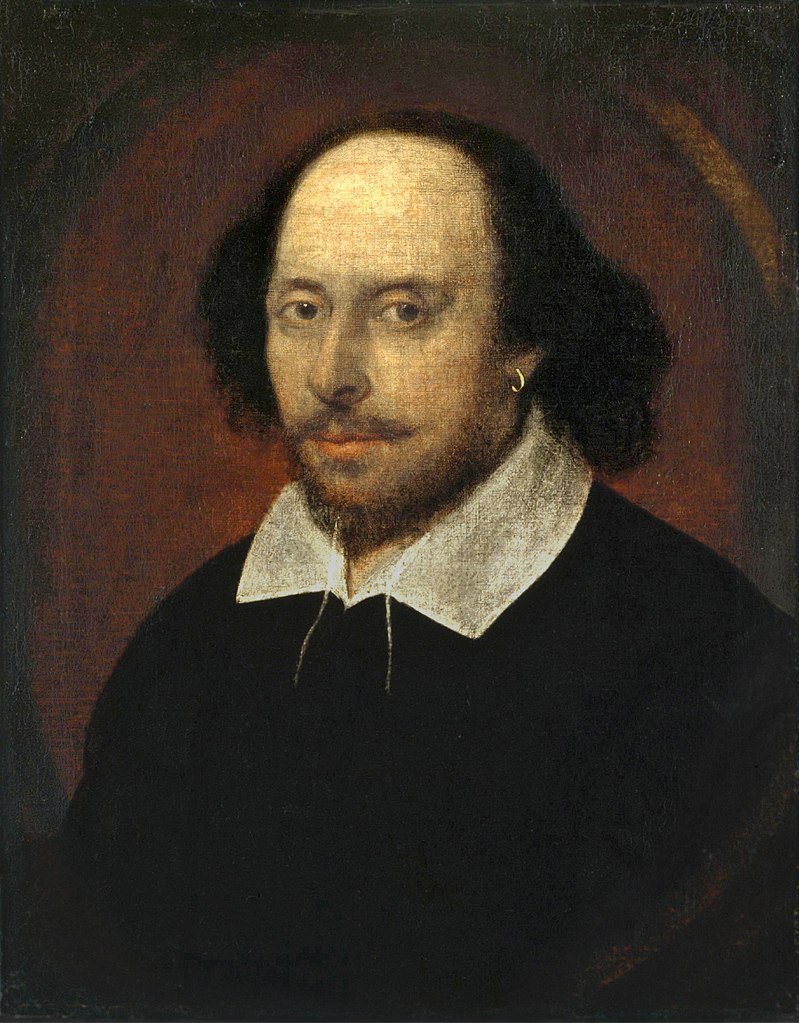
This was long thought to be the only portrait of William Shakespeare that had any claim to have been painted from life, until another possible life portrait, the Cobbe portrait, was revealed in 2009. The portrait is known as the “Chandos portrait” after a previous owner, James Brydges, 1st Duke of Chandos. It was the first portrait to be acquired by the National Portrait Gallery in 1856. The artist may be by a painter called John Taylor who was an important member of the Painter-Stainers’ Company.
National Portrait Gallery image via Wikimedia Commons.
It’s almost uncanny how relevant it feels right now.
So if I were directing Hamlet in the current moment, I’d give the title character an iPhone and game console. I’d have the characters onstage share photos on Instagram — and put up a big screen so the audience could see them posted in real time.
Hamlet could add pithy captions to his social media images. What a piece of work is a man! or maybe The lady doth protest too much!
Yes, Hamlet is many things, but one of them is, perhaps, a failed influencer.
Along the way, we may have answered the classic question about this play. For generations, critics have wondered why Hamlet wastes so much time, and can’t be bothered to take action.
Maybe he’s just too busy gaming and scrolling.
Okay, it sounds ridiculous. But is it really? Shakespeare possessed tremendous insight into the human condition — perhaps more than any author in history. So maybe he really did grasp the dominant personality types of our own time.
The Prince of Denmark still walks in our midst. And maybe — just maybe — careful attention to this play might help us, in some small degree, to heal the Hamlets all around us. Their number is legion.
Of course, the larger reality is that Shakespeare has proven himself relevant to every time and place. We can see that easily be examining how other generations viewed this same play.
Hamlet‘s original audience, four hundred years ago, clearly enjoyed the spectacle of violence and adultery. Nine key characters die during the course of the play — most of them murdered. Audiences loved these kinds of dramas back then, and Shakespeare always knew how to please the crowd.
But more sophisticated viewers, circa 1600, would have seen Hamlet as a political commentary — a reflection of all the tensions and rivalries of Elizabethan England. Nobody knew better than Shakespeare that monarchy is a dangerous game, and he always looked for opportunities to refer to current events in roundabout ways.
But two hundred years later, the Romanticists were in ascendancy, and they saw Hamlet as a very different kind of play. They ditched the politics, and embraced the Prince of Denmark for his pathos and personality. They tapped into the intense emotional currents of Shakespeare’s heroes — and the plays seemed perfectly suited for this kind of interpretation.
It’s no exaggeration to say that Hamlet continued to change for each new generation. He always feels timely and relevant.
A hundred years ago, critics began grappling with psychology and the unconscious — and Hamlet was a perfect character for these kinds of interests. In his 1900 book The Interpretation of Dreams, Freud focused on Hamlet as a case study in repression.
And who could disagree?
But fifty years later, Hamlet changed again. It now was the perfect play for those who had survived World War II. Jan Kott insists, in his book Shakespeare, Our Contemporary, that these old plays were more relevant than ever during the Cold War — just as timely as Beckett or Sartre or Brecht or Ionesco.
June 24, 2025
Fandom Has Always Been UNHINGED
Jill Bearup
Published 23 Jun 2025Listen, nobody asked for a history of fanfiction but here we are regardless. From Helen of Troy fix-it fic to Holmes fans unsubscribing en masse when the detective was killed in The Final Problem, fandom has always been this chaotic, and fanfiction has always been with us. In one form or another.
00:00 Did you ask for this? Nah.
01:20 Ancient authors ripping off other ancient authors
03:06 Virgil was a Homer fanboy
04:10 Dante was a Virgil fanboy
05:18 Don Quixote and the Case of the Unauthorised Sequel
08:01 The Statute of Anne
12:35 Gulliver’s Travels NSFW fanart
14:40 Geniuses and Originality
16:51 The Berne Convention
17:20 Character Vibes are not Copyrightable
20:46 The First Modern Fandoms (were Genuinely Unhinged)Link to Der Spiegel article on copyright and innovation: https://www.spiegel.de/international/…
May 19, 2025
Best of Cunk on Shakespeare – Part 1
Philomena Cunk
Published 20 Dec 2023Are you saying I’m a liar?
Sharing all things Cunk – a fictional character from Charlie Brooker’s Weekly Wipe, Cunk on Britain, Cunk on Shakespeare and Cunk on Earth – Portrayed by the incredible Diane Morgan.
October 28, 2024
QotD: Democracy as theatre
One thing we are learning about modern democracy is that it is a myth. The people are not in charge. They get to vote on things and select representatives, but those representative don’t actually represent the interests of the people, who voted them into their positions. The office holders in a modern democracy represent the interests of the money-men who sponsored them. Politicians in a democracy are like prize fighters, in that they are controlled by a management team.
Like a prize fighter, one of the demands placed upon a modern politician is that he must at all times seek the attention of the public. Much of what we see in our modern democracies is false drama, designed to gain attention. This is why women have proven to be so successful as politicians. Women are naturally gifted with the ability to get attention, especially through false drama. It turns out that democracy is a form of governance modelled on the beauty pageant.
This is the point of the impeachment fiasco. The Democrats are the party of girls and gay men, so they naturally seek drama. Trump’s great sin is that he is a great showman, so he gets all the attention. Impeachment allows the vagina party to one-up him and force him to pay attention to them. If you look at the people celebrating in the streets, it’s lesbians and middle-aged woman. They are not celebrating because they hate Trump. They are happy someone is noticing them.
The Z Man, “Impeaching Democracy”, The Z Blog, 2019-12-19.
June 21, 2024
From “invention” to “tradition”
At Astral Codex Ten, Scott Alexander considers some “traditions” which were clearly invented much more recently than participants might believe:

Two NYC synagogues, one in Moorish Revival style and the other is some form of modernism (you can tell it’s not Brutalism because it’s not all decaying concrete). Like Scott, I vastly prefer the one on the left even if it isn’t totally faithful to the Moroccan original design.
A: I like Indian food.
B: Oh, so you like a few bites of flavorless rice daily? Because India is a very poor country, and that’s a more realistic depiction of what the average Indian person eats. And India has poor food safety laws – do you like eating in unsanitary restaurants full of rats? And are you condoning Narendra Modi’s fascist policies?
A: I just like paneer tikka.
This is how most arguments about being “trad” sound to me. Someone points out that they like some feature of the past. Then other people object that this feature is idealized, the past wasn’t universally like that, and the past had many other bad things.
But “of the past” is just meant to be a pointer! “Indian food” is a good pointer to paneer tikka even if it’s an idealized view of how Indians actually eat, even if India has lots of other problems!
In the same way, when people say they like Moorish Revival architecture or the 1950s family structure or whatever, I think of these as pointers. It’s fine if the Moors also had some bad buildings, or not all 1950s families were really like that. Everyone knows what they mean!
But there’s another anti-tradition argument which goes deeper than this. It’s something like “ah, but you’re a hypocrite, because the people of the past weren’t trying to return to some idealized history. They just did what made sense in their present environment.”
There were hints of this in Sam Kriss’ otherwise-excellent article about a fertility festival in Hastings, England. A celebrant dressed up as a green agricultural deity figure, paraded through the street, and then got ritually murdered. Then everyone drank and partied and had a good time.
Most of the people involved assumed it derived from the Druids or something. It was popular not just as a good party, but because it felt like a connection to primeval days of magic and mystery. But actually, the Hastings festival dates from 1983. If you really stretch things, it’s loosely based on similar rituals from the 1790s. There’s no connection to anything older than that.
Kriss wrote:
I don’t think the Jack in the Green is worse because it’s not really an ancient fertility rite, but I do think it’s a little worse because it pretends to be … tradition pretends to be a respect for the past, but it refuses to let the past inhabit its own particular time: it turns the past into eternity. The opposite of tradition is invention.
Tradition is fake, and invention is real. Most of the human activity of the past consists of people just doing stuff … they didn’t need a reason. It didn’t need to be part of anything ancient. They were having fun.
I’ve been thinking a lot about [a seagull float in the Hastings parade] … in the procession, the shape of the seagull became totemic. It had the intensity of a symbol, without needing to symbolise anything in particular. Another word for a symbol that burns through any referent is a god. I wasn’t kidding when I said I felt the faint urge to worship it. I don’t think it would be any more meaningful if someone had dug up some thousand-year-old seagull fetishes from a nearby field. It’s powerful simply because of what it is. Invention, just doing stuff, is the nebula that nurses newborn gods.
I’m nervous to ever disagree with Sam Kriss about ancient history, but this strikes me as totally false.
Modern traditionalists look back fondly on Victorian times. But the Victorians didn’t get their culture by just doing stuff without ever thinking of the past. They were writing pseudo-Arthurian poetry, building neo-Gothic palaces, and painting pre-Raphaelite art hearkening back to the early Renaissance. And the Renaissance itself was based on the idea of a re-naissance of Greco-Roman culture. And the Roman Empire at its peak spent half of its cultural energy obsessing over restoring the virtue of the ancient days of the Roman Republic:
Then none was for a party;
Then all were for the state;
Then the great man helped the poor,
And the poor man loved the great:
Then lands were fairly portioned;
Then spoils were fairly sold:
The Romans were like brothers
In the brave days of old.Now Roman is to Roman
More hateful than a foe,
And the Tribunes beard the high,
And the Fathers grind the low.
As we wax hot in faction,
In battle we wax cold:
Wherefore men fight not as they fought
In the brave days of old.(of course, this isn’t from a real Imperial Roman poem — it’s by a Victorian Brit pretending to be a later Roman yearning for the grand old days of Republican Rome. And it’s still better than any poem of the last fifty years, fight me.)
As for the ancient Roman Republic, they spoke fondly of a Golden Age when they were ruled by the god Saturn. As far as anyone knows, Saturn is a wholly mythical figure. But if he did exist, there are good odds he inspired his people (supposedly the fauns and nymphs) through stories of some even Goldener Age that came before.
June 1, 2024
So who did write Shakespeare’s plays?
Mere mortals might be tempted to answer “Well, Shakespeare, duh!”, but to the dedicated conspiracist, the obvious is never the right answer:
This was long thought to be the only portrait of William Shakespeare that had any claim to have been painted from life, until another possible life portrait, the Cobbe portrait, was revealed in 2009. The portrait is known as the “Chandos portrait” after a previous owner, James Brydges, 1st Duke of Chandos. It was the first portrait to be acquired by the National Portrait Gallery in 1856. The artist may be by a painter called John Taylor who was an important member of the Painter-Stainers’ Company.
National Portrait Gallery image via Wikimedia Commons.
Was Shakespeare a fraud? The American writer Jodi Picoult seems to think so. Her latest novel By Any Other Name is based on the premise that William Shakespeare was not the real author of his plays. Specifically, in her story, the poet Emilia Lanier (née Bassano) pays Shakespeare for the use of his name so that she might see her work staged at a time when female playwrights were extremely rare.
The theory that Shakespeare was a woman isn’t original to Picoult. As with all conspiracy theories relating to the bard, the “true” Shakespeare is identified as one of the upper echelons of society (although not an aristocrat, Lanier was part of the minor gentry thanks to her father’s appointment as court musician to Queen Elizabeth I). Those known as “anti-Stratfordians” – i.e., those who believe that the man from Stratford-upon-Avon called William Shakespeare did not write the plays attributed to him – invariably favour candidates who had direct connections to the court. The general feeling seems to be that a middle-class lad from a remote country town could not possibly have created such compelling depictions of lords, ladies, kings and queens.
[…]
The notion that the actor Shakespeare could have hired out his identity to Lanier, or anyone else for that matter, makes no sense if one considers the collaborative nature of the theatrical medium. Shakespeare was the house playwright for the Lord Chamberlain’s Men (the company that became the King’s Men on the accession of James I). His job was to oversee productions, to write on the hoof, to adapt existing scripts in the process of rehearsal. (This is probably why his later plays such as Henry VIII contain so many stage directions; at this point he was almost certainly residing in Stratford-upon-Avon, and so was not available to provide the necessary detail in person.) It was never simply a matter of Shakespeare dropping off his latest script at The Globe and quickly scarpering. If he was being fed the lines, it is implausible that nobody in the company would have noticed.
[…]
The theory that Shakespeare’s contemporaries – fans and critics alike – would all collude in an elaborate deception requires a full explanation. The burden of proof is very much on the anti-Stratfordians, but proof doesn’t appear to be their priority. They seem to think they know more about Shakespeare than those who actually lived and worked with him. It’s oddly hubristic.
All of this nonsense began with the Baconian theory propounded by James Wilmot in 1785 and has never gone away. The candidates are usually university educated and aristocratic: Francis Bacon, Christopher Marlowe, the Earl of Rutland, the Earl of Oxford – even Queen Elizabeth I has been proposed. The anti-Stratfordian position seems to be based on a combination of class snobbery and presentism. They assume that the middle-class son of a glover who did not attend university could not have developed the range of knowledge needed to inform his plays. They forgot, or do not know, that the grammar school education of the time would have provided a firm grounding in the classics. Shakespeare would have been steeped in Ovid, Cicero, Plautus, Terence, and much more besides. Let’s not forget that Ben Jonson, the most scholarly of all his contemporaries, didn’t go to university either.
Moreover, the plays make clear that Shakespeare was a voracious reader. The idea that one must have direct experience in order to write about a subject is very much in keeping with the obsessions of our time, particularly the notion of “lived experience” and how writers ought to “stay in their lane”.
As I’ve joked in the past, I believe the theory that Homer didn’t actually write The Iliad and The Odyssey … it was another Greek chap of the same name.


