Andrew Doyle notes that the very first mention of Henry Nowak’s murder in Spain’s El País (approximately Spain’s equivalent of the Toronto Star, The Guardian, or the New York Times) frames the story as “evil extremely extreme extreme-right-wing Führers pounce”:
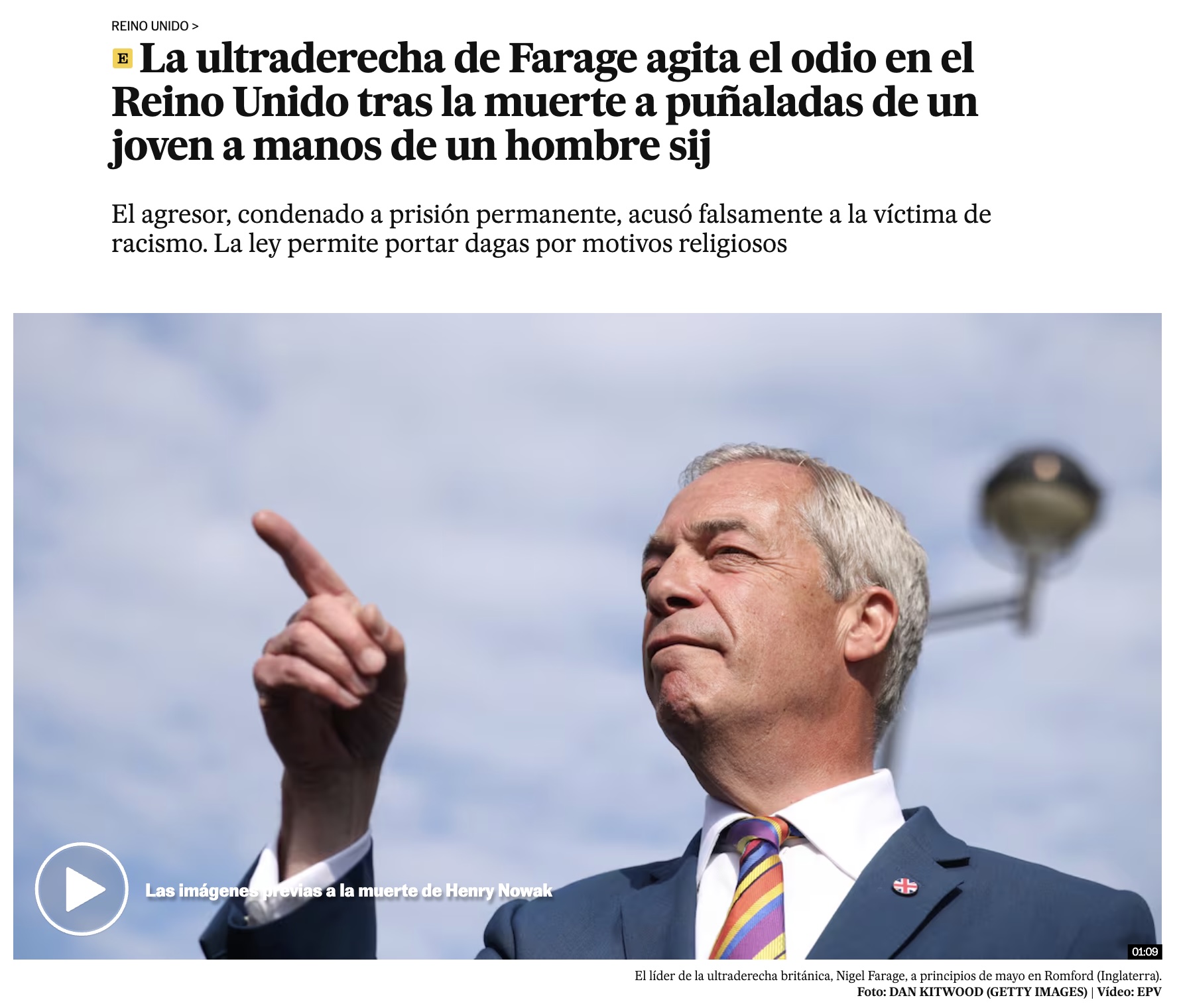
While the country is still reeling from the horrific murder of eighteen-year-old student Henry Nowak, an astonishing article has appeared in El País, Spain’s largest national newspaper. Rather than focus on the failures of the police officers, or the institutional bias within the force, the headline steers its readers away from the case and towards the outlet’s own obsessions. The headline translates as “Farage’s far right stirs up hatred in the UK after a young man is stabbed to death by a Sikh man”.
As Alejo Schapire (an Argentine journalist based in France) has pointed out, this is the first and only article produced by El País on the subject of the Nowak killing. Instead of an image of the victim, the newspaper has opted for a photograph of Nigel Farage. The Guardian was similarly histrionic and detached from reality in its coverage: “As ethnonationalist far right drives racist agenda, Reform UK leader felt need to weigh in on murder of Henry Nowak”.
It is one thing to take issue with those who seek to weaponise human tragedies for their own political gain, and quite another to dismiss legitimate criticism of a failed system. Reform UK is by no means a “far right” party, but of course the term has been so promiscuously misused in the press that at this point it might be best to dispense with it altogether. But of course, this is not really about Farage or his response to the murder at all. It is a cynical means of deflecting from the fate of Nowak and what it reveals about the state of policing in the UK.
So what exactly did Farage say to have the Guardian fulminate about his “racist agenda” and for El País to make him the focus of the story rather than the victim? During a live broadcast, Farage praised the Nowak family for their “extraordinarily dignified” response following the conviction of their son’s killer, and went on to say: “I suggest the rest of us respond to this with pure cold rage”.
And why not indeed? Let’s not forget the shocking details of what happened in this case. Nowak was stabbed multiple times by Vickrum Digwa using a Sikh ceremonial dagger. His mother hid the murder weapon, and his brother called 999 claiming that Nowak had been racially abusive. When police arrived, Digwa repeated this lie. And when Nowak repeatedly told the officers he had been stabbed, one replied “I don’t think you have, mate” and handcuffed him as he lay dying.
At Always the Horizon, Copernican shares his thoughts on the political response to the murder:
Riots have been growing over the last few years in the UK when incidents like this occur. Nigel Farage addressed the incident in a youtube video here. Referring it as a “moment to take a long hard look at ourselves and the country that we’ve become”. He proceeds to say, “All the values and standards of living in a free country, where everyone is judged equally before the law, have been trashed and thrown away”. Nigel Farage demands that “the police complaints operation, the IOPC, needs to get to the bottom of this and produce a report very very quickly.” He also states that the sentencing is unacceptable, as the sentencing of the Sikh was less severe than the minimum recommended for a sustained, aggressive, murderous assault.
Nigel knows how to fix this: file some more reports. Maybe even reprimand a judge for being too lenient. That will surely bring back the murdered man, make whole his family, and un-rape and un-murder the children that have been attacked over the years by numerous violent psychos imported from the third world by domestic traitors. What a British solution: file another report about it.
Keir Starmer took another position. He condemned Nigel Farage for “Whipping up” division against the wishes of Nowak’s family. He believes “Nigel Farage’s Reaction” is the “wrong reaction”. We wouldn’t want division at a time like this. What we really need to do is respect the wishes of the cucked cowards whose son was killed and who took no flesh or blood from the offending Sikh as recompense. Who were cowed by government processes and report filing. Those are the people whose feelings we should be worried about. We would hate for the Sikh community to feel threatened.
To be honest, I agree with Keir Starmer. Nigel Farage’s reaction is the wrong reaction
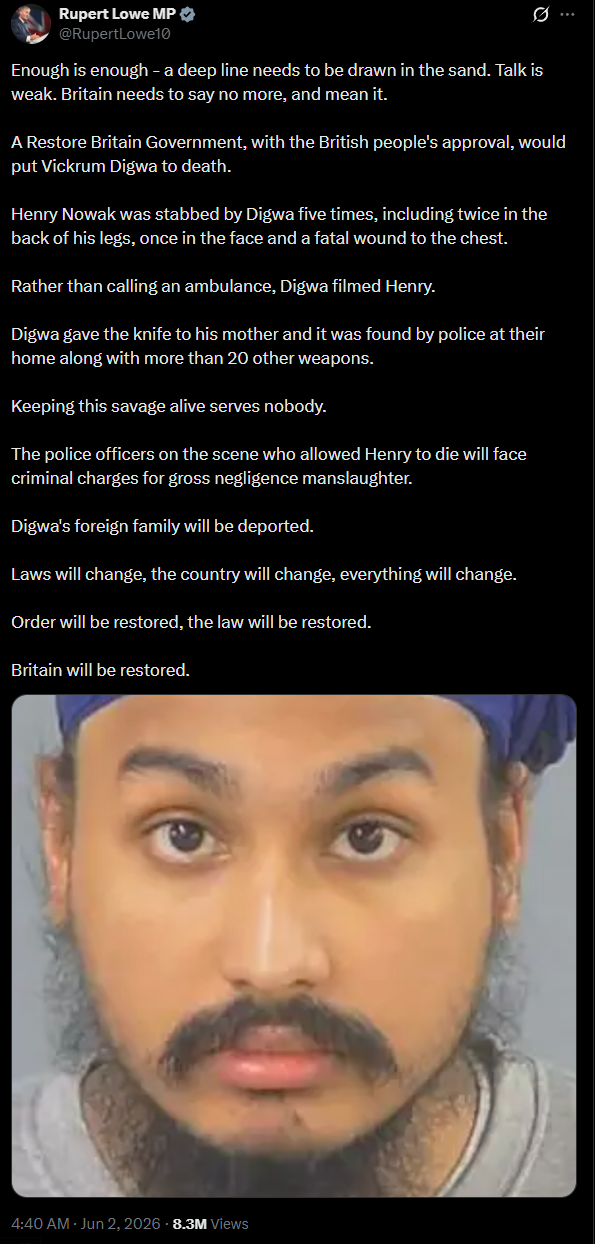
Rupert Lowe, an MP of the “far-right” British Reform party [correction: Lowe is the leader of the Restore Britain party], is getting closer to the correct reaction when it comes to this murderous Sikh, his community, and the managerial bureaucracy that brought them here and protected them.
That said, I think Rupert Lowe is also heavily couching his language for fear of public backlash, or getting arrested for “inflaming racial tensions”.
Update, 5 June: Welcome, Instapundit readers! Have a look around at some of my other posts you may find of interest. I send out a daily summary of posts here through my Substack – https://substack.com/@nicholasrusson that you can subscribe to if you’d like to be informed of new posts in the future.