For the vast majority of my readers, the address “24 Sussex Drive” might as well be “99 Sunset Strip” or “12 Grimmault Place”, but it’s a real place with some minor importance to Canadians: it’s the official residence of the Prime Minister of Canada. It’s also, famously, a dump (rather like the country has been allowed to become). It finally reached the point of structural decrepitude that the current and previous PMs never bothered to move in. Now, as related in the free-to-cheapskates portion of The Line‘s weekly dispatch, it’s supposed to be renovated.
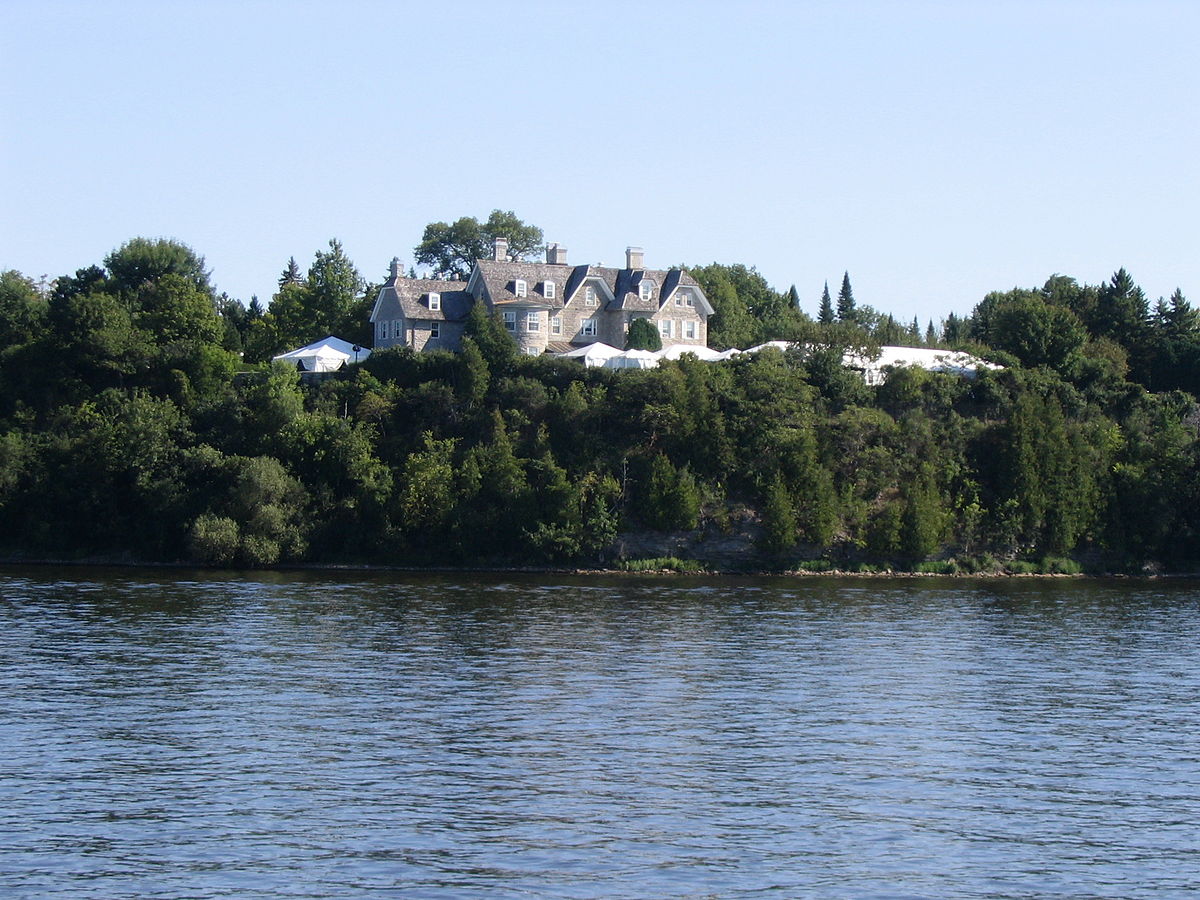
The official residence of the Prime Minister of Canada, 24 Sussex Drive, as seen from the Ottawa River. Ottawa, Ontario, Canada. (La résidence officielle du Premier ministre du Canada 24, promenade Sussex vu de la rivière des Outaouais).
Photo by sookie via Wikimedia Commons.
Hallelujah.
We’re responding to the announcement on Friday that the Canadian government will finally deal with the mess that is 24 Sussex Dr., the official residence of the Prime Minister of Canada (at least in theory). Successive Canadian prime ministers have refused to spend the money necessary to keep the building, which dates to the 1860s, in a state of good repair. PM after PM has been too terrified of the optics of spending taxpayer money on their own mansion.
Rather than solve this problem like a grown-up country by pushing control of a reasonable maintenance budget to a non-political body — something like the National Capital Commission, come to think of it — we instead simply sat around and allowed the building to decay to the point where it was no longer habitable. Stephen Harper and his family gritted their way through their time there. Justin Trudeau and his family never bothered moving in, settling instead at Rideau Cottage, on the grounds of the Governor General’s residence.
Mark Carney, God bless him, has decided that enough is enough and it’s time to bite the bullet and just fix the damn thing.
We repeat: hallelujah.
We are actually fairly agnostic on one of the central debates here, namely whether the mansion should have been rehabilitated or simply knocked down and replaced. You can make the argument fairly either way. In making his announcement on Friday, Carney indicated that he had chosen rehabilitation because Canadians need to do more to stand up for their heritage and their history, and that includes 24 Sussex.
That struck us as an astute reading of where public sentiment is, and a way to buy at least partial political cover for what will remain controversial.
We were less impressed by the rest of what he announced. Instead of simply hiring a reputable firm to come up with a new design for the renovated building, getting some quotes and then proceeding directly, the government will instead dramatically overcomplicate things, as Canadian governments tend to do, by commissioning some kind of design competition to be overseen by eminent Canadian designers and architects. We wouldn’t be shocked if David Johnston shows up somehow. Louise Arbour is, of course, recently spoken for, but we’ll see if any other retired Supreme Court justices end up giving their design skills a whirl.
Renovated building this way is dumb. But we think the next part of what was announced was weirder, and certainly riskier for the government. To offset the costs, this will become something the government fundraises for.
Okay. We guess?
Hey, The Line has no problem with fundraising. (Ahem. See below.) But we aren’t a national government? The devil will be in the details here. If this is structured in a way that limits donations to Canadian citizens and residents, caps donations at a set dollar value, and includes strong transparency requirements, we guess it’s fine. Canadians have been feeling patriotic of late, especially boomers and Liberals. If the prime minister has figured out a way to offload the financing of this project onto them, we’ll find a way to live with that.
Gosh, there’s risk here. Will foreign donations be permitted? Corporations? If corporations are allowed, must they be Canadian? Will Canadian subsidiaries of foreign corporations be able to contribute? What about foreign governments? Will the future dining room of the official residence of the prime minister of Canada be brought to you by the People’s Republic of China? Will the front foyer be a gift of the people of Qatar?
We’ll see. Those details are still pending. We suspect, or at least hope, that the government was smart enough to foresee the optics of having the prime minister’s official residence sponsored by Brookfield Asset Management, to pick one example out of thin air.
So we don’t love the process, but we love that we’re at least doing this. The state of 24 Sussex Dr. has not only been a long-standing national embarrassment, it’s been a painfully obvious symbol of broader Canadian dysfunction. Taking care of the damn house, or fixing it or replacing it, is a really easy thing by the standards of the problems the federal government is often faced with. But both Stephen Harper and Justin Trudeau curled up into tiny little balls and melted into jelly instead of just doing their jobs and taking care of a national infrastructure asset. That they did this simply to avoid the optics of spending a little money on themselves and future prime ministers is easily understood through the lens of politics, but no less pathetic for it.
For the record, I have no problem with the government spending the money to maintain or even upgrade the PM’s official residence, but it’s been a political liability for so long that fixing the place up will likely be far more expensive than any amount of deferred maintenance might have cost if we’d just committed to keeping the place in good condition. I’ve always been puzzled why it isn’t in the purview of the National Capital Commision anyway, so that it wouldn’t become a cheap political point-scoring opportunity every time it springs a leak or needs a window pane replaced.
The Line editors also declare they’re on Team Art Deco against the anti-human monsters of Brutalist architecture and point out that there actually is a uniquely Canadian architectural style:
Look, if the decline of 24 Sussex had become symbolic of Canadian vices like dysfunction and cheapness, there was an opportunity here to signal symbolic virtues like decisiveness and seriousness by just — announcing the government was going to fix a known problem using an architect that Carney had personally approved. There is absolutely no reason to use this building as an opportunity to create a travelling roadshow of the country’s architectural “greatness” by holding a design competition that will produce 15 different varieties of the AGO Crystal or the Edmonton Public Tank/Library. To be blunt, this country’s talent pool in architecture is as shallow as every other cultural industry we can name. It can be summed up thusly; we produce the odd star in the field who moves elsewhere. What gets left behind is derivative government-funded schlock that allows us to keep up appearances and maintain our national illusions. Our ability to create world class art of any kind at present is right up there with our ability to build a pipeline, scale a company, or manage an efficient regulatory process. Our decline is a universal problem.
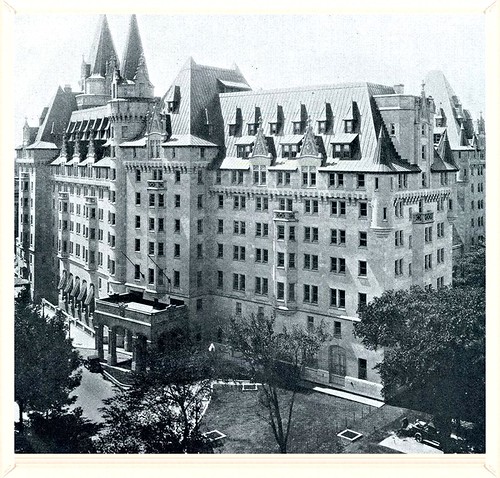
“Chateau Laurier, 1927 with the new extenstion” by Ross Dunn is licensed under CC BY-SA 2.0
.
Meanwhile, Canada already has a unique and rich architectural style that we should be using on all federal buildings intended to convey authority and heritage — it goes by many names, ranging from Railway Gothic, to neo-Chateau. It can be seen in beloved buildings ranging from the University of Toronto’s Hart House, to the aforementioned railway hotels that spread across the land. It’s turn of the century gothic revival meets French Chateaux and Scottish Kirk; romantic, a little ornate, and always grounded in the landscape and climate, and using the local materials. In other words, we already have a uniquely Canadian aesthetic language. We just stopped designing buildings this way when our cultural institutions decided that our history was a problem rather than the prima materia of our complicated national identity. We’ve been stuck with glass buildings and cheap concrete Soviet suicide boxes ever since.
And to be clear, we don’t think every Canadian building needs to look like it was built in 1919. Form ought to meet function. For buildings that are trying to convey modern values, or to align with environments sporting an updated aesthetic, there’s nothing wrong with a modern style. Museums and art galleries, for example, offer fine opportunities to push artistic envelopes. But when we’re considering buildings intended to convey government power, institutional authority, and the establishment of democratic legitimacy through continuation and heritage, that’s when we ought to be leaning back into our shared historic design languages. That’s the time to convey gravitas, solidity, and confidence; stone, ornate woodwork, traditional aspects and classical symmetry.
An updated version of Railway style, working in tandem with the existing structure of 24 Sussex, is the very obvious answer to the problem of the Prime Minister’s residence. If we can incorporate First Nations motifs or building materials, all the better.
But this country’s current architectural culture is profoundly derivative and fundamentally uncomfortable with the very institutional heritage this building needs to convey. Restrained and old fashioned is not the kind of thing that wins international acclaim. So instead, what we’re going to get is the generic, omnipresent, and pathologically insecure style better defined as “Modern Canadian Try Hard”. Think updated farmhouse, black window frames and white walls à la Studio McGee. Wavy glass Eurotrash that makes no sense for the climate of Canada and offers no gesture toward the symbolic value of the building.