Quotulatiousness

May 4, 2026

Public housing perpetuates the poverty it was supposed to cure

Filed under: Britain, Bureaucracy, Government, Politics — Tags: , , , — Nicholas @ 04:00

In The Critic, John Wills explains that public housing organizations, like any organization with perverse incentives, will never solve the problem of providing enough housing for those who cannot afford it:

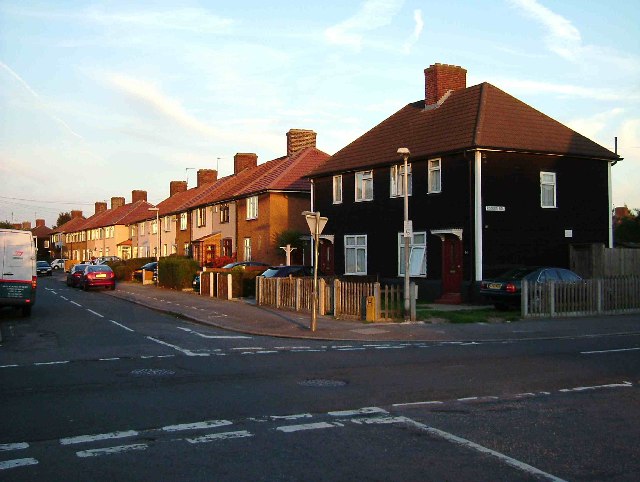
Homes Fit for Heroes – Dagenham
“These are typical examples of the housing on the Becontree Estate. Initially 25000 homes were built by the London County Council between 1921 and 1934. These homes fit for the heroes of WW1 had all mod cons gas, water and electricity with inside toilets and bathrooms. A further 2000 homes were built before WW2. The Becontree estate was the biggest council estate in the world.”
Image and description from geograph.uk. Photo by Glyn Baker – CC BY SA 2.0

There is a moment, familiar to anyone who has spent serious time inside a housing association, when the institutional logic becomes impossible to ignore.

Perhaps you are sitting in a meeting, reviewing the organisation’s performance: voids are down, rent arrears are within tolerance, development pipeline is healthy and the regulator is satisfied. By every measure the sector uses to evaluate itself, things are going well.

Outside the window, however, the waiting list has not reduced. The families in temporary accommodation are the same families (or families very much like them), who were there five years ago. In short, the problem the organisation was created to solve is precisely as large as it was when the meeting began.

Despite these demonstrable facts, nobody in the meeting thinks this is strange. Nobody considers the organisation a failure. The metrics are, after all, fine.

I spent a decade working at a senior level in housing associations. I left as I became disillusioned with a model that has evolved to measure everything except the thing that matters.

The founding logic was sound enough: postwar Britain faced a housing crisis that was specific, urgent and — crucially — finite. Tens of thousands of homes had been destroyed or damaged, men had died in enormous numbers, and a baby boom was placing acute pressure on stock that was already inadequate before the war started. Social Housing was therefore a rational response to a bounded problem: build homes, house people and alleviate a crisis that would, in time and as a result of the initial centralised effort, resolve itself. You might also apply the same logic to slum clearance a decade later: deplorable housing stock needed replacing, and the state needed a mechanism to do it. The model remained defensible so long as everyone understood that success meant crossing a defined finish line.

However, nobody thought to define that finish line. The problem here is that once you remove the time horizon from an organisation tasked with solving a problem, the organisation’s survival becomes contingent on the problem’s persistence, not its resolution. This is not a conspiracy and it requires no bad actors, nor even a conscious decision to perpetuate matters. It is simply what institutions do when the incentives are wrong. As a thought-experiment, imagine that the eradication of smallpox had been incentivised not by the goal of total global elimination, but instead by vaccines administered, clinics built or healthcare workers employed. What would the probability be of us continuing to battle smallpox into the 21st Century? I cannot be certain, but suspect it would be considerably higher than nil.

The regulatory framework for social housing has compounded the error rather than correcting it. Regulators, quite reasonably, dislike hoarded capital. A registered social landlord (RSL) sitting on large reserves and doing nothing with them is, from a regulator’s perspective, a problem to be solved. The solution the sector has converged on is growth — more stock acquired, more homes built, larger balance sheets, bigger organisations and more services and people employed to deliver them. The key metric of a healthy RSL is therefore its size: which is to say, the scale of the problem it exists to address. (To test this proposition, ask someone in housing to describe their organisation. The chances are the first words out of their mouth will be the number of homes they manage). An organisation genuinely succeeding in its mission — one that is housing fewer people because fewer people in its area of operations need housing — under the current framework would look like a failure. It would be encouraged to merge with a larger, more “successful” neighbour, which is to say one that has accumulated more evidence of unresolved housing need.

April 7, 2026

Alberta is the only province moving in the right direction

On the social media site formerly known as Twitter, Martyupnorth responds to Tristin Hopper’s post about Don’t Be Canada: How One Country Did Everything Wrong All At Once, which he published a year ago:

Here is a one-line summary of each of Tristin’s 8 points:

Housing crisis: Canada pioneered turning entire cities into over-leveraged real estate bubbles, driving home ownership out of reach for ordinary people because prices detached from wages.

Crime and justice: Soft-on-crime policies, catch-and-release bail, and activist courts created a revolving door for repeat offenders, leaving our streets unsafe.

Harm reduction & drugs: “Safe supply” and decriminalization experiments escalated addiction and public drug use, worsening overdoses, tent cities, and societal harm instead of reducing it.

Euthanasia (MAiD): Canada rapidly expanded medical assistance in dying into one of the world’s most aggressive programs, with soaring death numbers and cases pushing it as a tratement for poverty and disability.

Healthcare system: Despite high spending, Canada’s “free” system ranks near the bottom in performance among developed nations, with deadly wait times and dysfunction.

Transgender policies: Canada went further than most countries with permissive rules on youth transitions, pronouns, biological males in female spaces, and related ideology in schools and institutions.

Identity politics and “anti-racism”: Canada outdid even the U.S. in embracing divisive oppressed frameworks, including declaring itself guilty of an ongoing “genocide” against Indigenous people with little accountability.

Censorship and speech laws: Expansive hate speech rules, online content takedowns, and bills like the Online Harms Act pushed Canada toward Orwellian restrictions, chilling expression and drawing international warnings.

Canada took progressive ideas further and faster than peers, almost always with cascading negative consequences, turning a once-stable nation into a totally dysfunctional one.

He’s right in saying that Danielle Smith is the only one finally acknowledging that things aren’t working, and is trying to reverse some of these pad idea.

It’s still not enough to save Alberta, we need to divorce ourselves from the rest of Canada and their bad ideas.

February 17, 2026

QotD: Britain treats asylum seekers significantly better than their own citizens

Filed under: Britain, Bureaucracy, Government, Health, Media, Quotations — Tags: , , , — Nicholas @ 01:00

The Government’s own website explains, in the plainest words, how the asylum system works. It is a document of quiet enormity, a polite statement of how the British State treats foreigners as clients and its own people as expendable. On the page Asylum Support: What you’ll get, the Home Office writes: “You can ask for somewhere to live, a cash allowance or both”. The housing “could be in a flat, house, hostel or bed and breakfast”. There is no means test, no investigation of savings, no five-week delay before payment. The guarantee is absolute: “You’ll be given somewhere to live if you need it”. If meals are included, the allowance falls from £49.18 per person each week to £9.95, but the entitlement remains. The allowance is placed automatically on a prepaid debit card — the ASPEN card — and reloaded weekly.

The page continues: “You’ll get extra money to buy healthy food if you’re pregnant or a mother of a child aged three or under”. The payment is £5.25 per week for pregnancy, £9.50 for a baby under one, £5.25 for children aged one to three, plus a one-off £300 maternity grant for anyone expecting a child or with a baby under six months. Even when asylum is refused, support continues: “You’ll be given somewhere to live and £49.18 per person on a payment card for food, clothing and toiletries”. Only those who decline the accommodation lose the card.

Medical care is covered in full. “You may get free National Health Service healthcare,” the Government states, including “free prescriptions for medicine, free dental care, free eyesight tests and help paying for glasses”. Children are guaranteed a place in a state school and “may be able to get free school meals”. The terms are so generous that the NHS issues a dedicated HC2 certificate for people on asylum support, giving them automatic exemption from all prescription and dental charges, free eye tests and optical vouchers, and even help with wigs and fabric supports.

Compare this to the treatment of the people who pay for it. A British worker who loses his job must apply for Universal Credit, then wait at least five weeks before receiving a payment. Any advance must be repaid out of later instalments. He must show that he is seeking work, accept appointments and interviews, and risk sanctions if he misses them. He is scrutinised as a potential cheat. An asylum claimant is treated as a recipient of moral debt, requiring no proof of worthiness.

When the native taxpayer falls ill, he must pay £9.90 per prescription unless he qualifies for a limited exemption. He may buy a “pre-payment certificate” to spread the cost, but the charge remains. Dental treatment on the NHS costs £27.40 for a check-up, £75.30 for a filling, £326.70 for a crown or denture, and many cannot find an NHS dentist at all. Asylum seekers, by contrast, present their HC2 certificate and pay nothing. If the citizen asks the council for housing, he is told that the waiting list is full, that he is not a “priority case”, and that the private rental market is his problem. The asylum applicant, by the State’s own words, is “given somewhere to live if you need it”.

None of this is accidental. The cost of asylum support in 2023–24 was about £4.7 billion, according to the Home Office’s own figures, of which £3 billion went on hotel accommodation. In 2024–25, the bill fell slightly to £4 billion, but £2.1 billion of this was still for hotels — an average of £5.7 million every day. The National Audit Office has found that the ten-year accommodation contracts, first priced at £4.5 billion, are now projected to cost £15.3 billion. Between April and October 2024 alone, £1.7 billion was spent on housing and managing asylum seekers. The Financial Times has estimated the total annual cost of the asylum system at roughly £4.8 billion. The number of people receiving asylum support — housing, cash or both — now stands at over 100,000.

The figures expose a transfer of resources on a colossal scale. What is presented as “humanitarian duty” has become a domestic welfare state for foreigners, sustained by British workers who receive less support in return for greater taxation. The British State can house every migrant but not every nurse, find free dental care for the undocumented but not for the elderly, provide optical help for those who have just arrived but not for those who have paid into the system all their lives.

Marian Halcombe, “Britain’s Welfare Empire: A State that Feeds Strangers and Starves Its Own”, The Libertarian Alliance, 2025-11-05.

November 11, 2025

How not to solve your housing affordability crisis

Filed under: Economics, Government, USA — Tags: , , , , , , — Nicholas @ 04:00

On the social media site formerly known as Twitter, Devon Eriksen explains why allowing fifty-year mortgages are not the solution that financial journalists seem to think they are:

    Wendy O @CryptoWendyO

    I don’t think a 50 year mortgage is bad.
    It gives everyone more flexibility financially
    You can pay a mortgage off early
    Not sure how else to lower home costs in 2025

Buyers: “How much will this house cost me?”

Sellers: “What’s your budget?”

Buyers: “Well, it was 500K, but with these new fifty year mortgages, I think it could stretch to million.”

Sellers: “I have an astonishing coincidence to report.”

Look, I don’t know exactly who’s retarded enough to need to hear this, but if you throw money at something, you get more of it.

Which means that if you subsidize demand, you get more demand.

And if you have the same supply, and more demand, price goes up.

This is how the federal Stafford Loan program made college a gateway to permanent debt slavery. Subsidize demand, price goes up.

The reason people don’t understand this is that most people are only smart enough to think about individuals, not populations.

They think if you have more money, you can buy more things, as if things come from the item store in a Japanese console RPG, where the store always has infinity stuff to sell you, and infinity money to buy your loot.

People who are capable of thinking about large groups quickly realize that money is just a way of distributing things.

Like, there’s a limited supply of things, and you’re just choosing who gets them. Having more money doesn’t make more things.

Except … it should, shouldn’t it?

Eventually?

Like, if apples get super expensive, because somebody invented a new kind of apple that’s so delicious that everyone wants them, then the price of those apples goes up, so more people start growing them.

So why doesn’t that work with houses and colleges?

Why don’t the super-inflated prices of those things inspire profit-minded people to make more?

It’s almost as if there were some sort of gatekeeper, whose permission you needed to make a house or a university.

But that’s impossible, because this is a totally capitalist country, so you can just do things, right?

Ian Runkle/Runkle of the Bailey chimes in:

Okay, let’s talk about 50 year mortgages.

First, let’s talk about what sets the price in a market where there’s more demand than supply. It’s set by what people can afford to pay, which means the payment/month.

What that means in practical terms is that the total price isn’t the limiter. It’s the monthly payment.

So, if X house is going for a price that has a 2500/month payment, the market is going to land total prices on a 2500/month payment.

So, increasing the mortgage terms makes things more affordable for about six months before the market adjusts. After that, it stops making it more affordable.

But “affordable” here doesn’t mean inexpensive. In fact, quite the opposite. Extending from a 30 year to a 50 year mortgage is likely to double the cost of credit.

But that’s before the prices adjust upward to “eat” the supposed affordability gains.

This doesn’t make houses more affordable, it makes them more expensive by far.

September 22, 2025

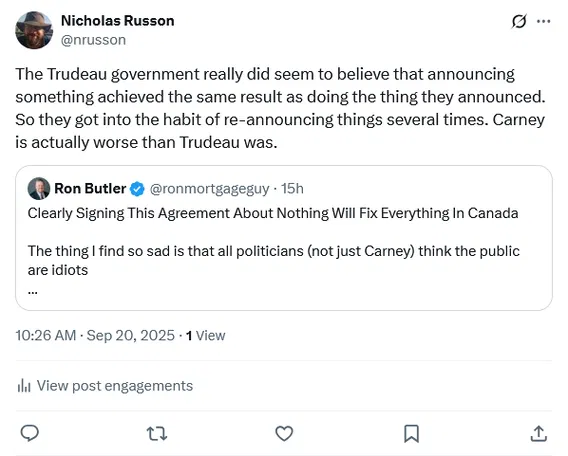
The Liberals fervently believe that saying something is the same as doing something

One of the most irritating aspects of Justin Trudeau’s long reign of error was his evident joy in making announcements about this or that topic. It got to the point that even the pro-Liberal media started to notice that the same policy would be announced several times over a few months but no actual progress was made (except where they could start setting up a new government program … they’d hire the staff very quickly, but little or nothing would get done beyond that). Mark Carney was supposed to be a clean break from the Trudeau years — even though most of his ministers were Trudeau retreads — but Carney may actually be worse than Trudeau in that he just loves photo ops with pretty props for the cameras. As Dr. Sylvain Charlebois notes, we need a lot fewer photogenic Potemkin Villages in how our federal government operates:

In recent weeks, we have witnessed politicians lean on powerful visuals to make their case on food and trade. But these staged moments rarely serve the public interest. Worse, they often deepen food illiteracy in a country where understanding how our system works is already fragile.

Take Ontario Premier Doug Ford’s stunt. Upset with Diageo’s decision to close its bottling plant in Ontario, he theatrically dumped a bottle of Crown Royal and urged Ontarians to boycott the brand. What he didn’t mention is that the bottle in question was made in Manitoba and bottled in Quebec by unionized Canadian workers — jobs unaffected by the Ontario closure. The Windsor facility mainly serviced the U.S. market, and Diageo’s decision was years in the making. Ironically, the boycott risks punishing Canadian workers who will continue producing Crown Royal for Canadians. And for future investors, the message is chilling: why put capital into Ontario if a government will trash your brand on television for a corporate restructuring decision?

The federal stage brought us another head-scratcher. During a trade visit to Mexico, Prime Minister Mark Carney posed with bags of Canadian wheat stamped with a maple leaf. The problem? Canada doesn’t export wheat in bags. We are among the most efficient bulk grain exporters in the world, shipping millions of tonnes through rail networks and ocean vessels designed for efficiency, safety, and traceability. Bagged wheat is a relic of less mechanized economies. For Canada to present itself this way trivializes our status as a modern agri-food powerhouse. Beyond being misleading, the image suggests to global partners that our system is less advanced than it truly is — a dangerous misrepresentation for a nation that depends on reputation as much as price.

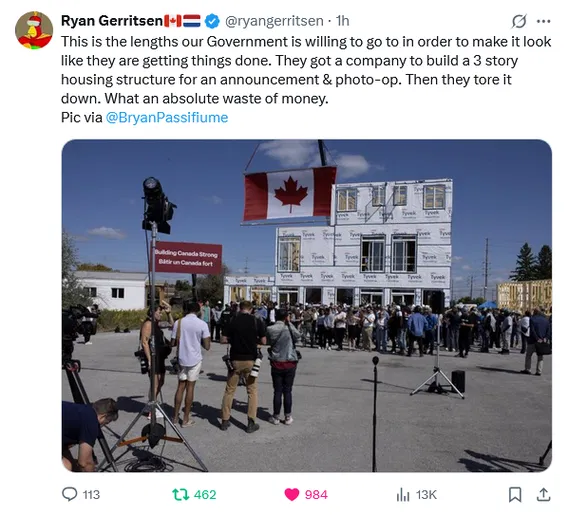
Even I didn’t realize how bad it got until the feds paid contractors to put up a fake building site for Mark Carney to pose in front of, then tore it all down:

September 15, 2025

When folks built their houses from Sears, Roebuck & Co. kits

Filed under: Business, History, Railways, USA — Tags: , , — Nicholas @ 03:00

I thought I’d discussed the Sears kit homes about a decade back, but perhaps it wasn’t for the blog. Anyway, there’s a nice summary by Katrina Gulliver of how Sears and other companies made home-building great a century ago:

A hundred years ago, kit homes were more common in the US. Sold by Sears, Montgomery Ward, and other local firms, buyers received the plans and the pieces for a house and put it together themselves. Economies of scale made these a viable option for someone looking to build a house in the expanding suburbs.

The 1914 Sears Modern Homes catalog shows three homes that could each be bought for $656 (in the small print, they admit your outlay would be more like $1,250 all-in, including brick, cement, plaster — which they don’t supply — and labor). Your kit house would be delivered by rail; it was generally assumed householders would be handy enough (or know whom to hire) to put it all together from the supplied plans.

According to a 1930 report by the National Bureau of Economic Research, National Income and Its Purchasing Power, in 1914, the average clerk could be making $1,000, and a factory manager earning $2,300. That means these houses were within reach of lots of people — especially bearing in mind that land costs in many cities were also relatively low. In Chicago, lots within 5 miles of downtown were available for less than 50¢/square foot in 1914.

Those kit homes included wood, metal, and glass, and reflected both the tastes of consumers and the economies of bulk production. The various styles in the catalog over the years included craftsman, Dutch colonial, Federal, and cottage — styles that have continued to be popular in residential architecture of the US.

The Sears catalog of 1936 states: “This is the age of modern efficiency. No longer can human hands compete with machine precision and production. ‘Speed with accuracy’ is the watchword in any department of our great factories.”

(For those curious about such houses, fans of Sears kit homes put together lists of examples still standing.)

July 23, 2025

Britain’s housing crisis has roots as far back as 1947

Tim Worstall on the deep reasons Britain can’t seem to build any new housing:

Homes Fit for Heroes – Dagenham
“These are typical examples of the housing on the Becontree Estate. Initially 25000 homes were built by the London County Council between 1921 and 1934. These homes fit for the heroes of WW1 had all mod cons gas, water and electricity with inside toilets and bathrooms. A further 2000 homes were built before WW2. The Becontree estate was the biggest council estate in the world.”
Image and description from geograph.uk. Photo by Glyn Baker – CC BY SA 2.0

The real problem Britain faces is that it’s no longer legal to build the housing we thought was the bare minimum acceptable a century ago.

    The more apposite point is that a couple of hundred yards up the road are those post-WWI homes for heroes. Here. Semi detached, not huge to be fair. But kitchen, living room, parlour, 3 beds and indoor bathroom. They’re still highly desirable houses in fact. Note, they’ve front gardens. They’ve also back ones too.

    Now, we’ve heard this, even heard it from someone on Bath City Council (who had heard it, we’re not quite old enough to know anyone who was on BCC in the 1920s), and never, quite tracked it down officially. But the statement was made that the Homes for Heroes needed to be on 1/4 acre gardens. The working man needed the space to grow vegetables for his family and to keep a pig. These houses, the 1920s ones, do have substantial gardens as the 1960s ones don’t.

As I pointed out:

    But Homes for Heroes? We’ve done this before. And those Homes for Heroes? Right now, today, it’s illegal to build them. No, really. What was considered the basic minimum that the local council should provide to the working man is illegal to build now. Those decent sized houses were on those decent gardens d’ye see? You can get perhaps 9 dwellings with 1/4 acre gardens on a hectare of land. Last we saw the current insistence is that we must have no less than 30 dwellings per hectare in order to gain planning permission. Even though Englishcombe – as with so much other land – is there and ripe for the taking.

    It’s actually illegal to build houses that were regarded as the proper minimum a century ago.

The reason we cannot is that Green Belt, itself stemming from the Town and Country Planning Act 1947. The point of which — no, really, the stated purpose — was to make sure that no one would ever be allowed to build housing for proles — sorry, stout Britons — anywhere anyone ever wanted to live.

Which is a bit of a problem. For, outside my own head, there’s no constituency for repealing the TCPA and abolishing the Green Belt.

However, there is a large constituency for plastering farmland with solar cells.

    Waller-Barrett’s farm has been targeted for a massive solar plant, which will be called Glebe Farm, and now his landlord plans to take his land away, replacing potato crops with thousands of giant glass panels.

    The decision, backed by edicts from Ed Miliband, the Energy Secretary, favouring solar farms over food production on UK farmland, means his flourishing food business will shrink – and staff will be out of work.

    Meanwhile the distant landlord will be quids in, potentially quadrupling their rent with virtually no effort.

Oh.

And now one of those little wrinkles of the law. Those solar farms will last 20 years maximum. No, really, that’s tops. The wrinkle being that the land underneath them will be, in that 20 years’ time, defined as brownfield land. Been previously developed, see? And brownfield land to housing is usually pretty easy as a development path. Certainly wholly unlike greenfield (or even Green Belt) to housing.

The land area Ed wants to cover with these things is 2 to 3% of the land area of the country. Which, as it happens, is about the land area currently covered by housing — including their gardens.

So, therefore we can see that Ed is, in fact, playing the long game. He’s going to solve the housing problem by not having to take on the Campaign for the Preservation of Rural England and every LibDem middle-ager with too few grandchildren to occupy her time. He’s going to do an end run around that problem by building solar first.

July 22, 2025

QotD: Social assistance as a Western cargo cult

Filed under: Education, Government, Quotations, USA — Tags: , — Nicholas @ 01:00

Part of the problem with social policy here in America is that it is conducted like a South Pacific Cargo Cult. We looked around and saw that the majority of successful people owned their own homes and had college degrees, so we figured that if we grabbed any old slacker and subsidized them a home and a college degree, then they, too, would become successful. It’s got cause and effect completely out of whack.

Tamara Keel, “From a conversation elsewhere…”, View From The Porch, 2020-06-10.

June 10, 2025

Mark Carney’s big defence spending announcement

Filed under: Cancon, Government, Military — Tags: , , , , , — Nicholas @ 05:00

On Monday Morning, Prime Minister Mark Carney was in Toronto to make a major announcement on Canada’s military spending. After being one of the worst freeloaders in the western alliance, Canada was spending far less on the Canadian Armed Forces than the 2% of GDP we’d promised our NATO partners several years ago. Of course, at the same time that Canada seems to be finally getting serious about defence priorities, the rest of our allies are talking seriously about raising the agreed-upon target to 5%:

Chris Lambie in the National Post says it’s a C$9 billion bump in direct military spending in this (unbudgeted) year:

Canada’s plan to add more than $9 billion to defence spending this year was praised by military watchers Monday, but they cautioned that the country is shooting at a moving target.

Prime Minister Mark Carney announced the country would meet its commitment in this fiscal year of hitting the two per cent of gross domestic product mark that was agreed upon by NATO countries more than a decade back.

“It’s very encouraging that the prime minister has come out this early in his mandate and made such a strong commitment to defence,” said Vincent Rigby, a former top intelligence adviser to former prime minister Justin Trudeau, who spent 14 years with Canada’s Department of National Defence.

“You’ve gone from the former prime minister talking about the two per cent as a crass mathematical calculation to the current prime minister saying, no, this is actually a serious commitment. We committed to it 10 years ago and even before that. And we have to do it because we owe it to our allies. But we also owe it to the Canadian people. He made it quite clear this is about protecting Canada, protecting our national interests and protecting our values.”

New spending could do a lot to improve crumbling military infrastructure, said Michel Maisonneuve, a retired Canadian Army lieutenant-general who has served as assistant deputy chief of defence staff, and chief of staff of NATO’s Allied Command.

“The housing on bases is horrible,” Maisonneuve said.

He’s keen on Carney’s plan to participate in the $234-billion ReArm Europe program.

“This will bolster our ability to produce stuff for ourselves” while also helping the Europeans to do the same, Maisonneuve said.

“All the tree huggers are going to hate that, but that’s where we are today in the world.”

Carney’s cash injection includes $2.6 billion to recruit and retain military personnel. The military is short about 13,000 people. It aims to boost the regular force to 71,500 and the reserves to 30,000 by the end of this decade.

“There is no way we can protect Canada and Canadians with the strength that we have now,” Maisonneuve said.

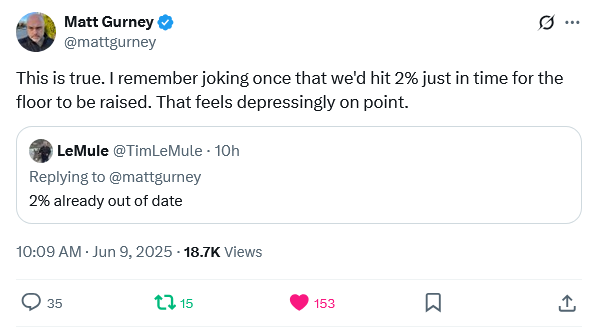
Later in the day, Matt Gurney made some preliminary comments on the social media site formerly known as Twitter (I imagine he’ll have more to say in an upcoming Line post):

I’ve had a chance to actually look at some of the details of what was announced today for Canada’s defence. Overall, I am very supportive of everything that’s been announced.

There are some caveats. Or at least notes.

1. The new spending is mostly aimed at flushing out existing capabilities, not adding new ones.

That’s fine! We need to do that, definitely. I just don’t know if the public understands how much money we could sink into the military without actually adding any new capabilities. All we would do is backfill capabilities that we currently claim to have that don’t really exist.

2. Billions of additional dollars are going toward very basic things. More money to retain existing personnel. Apparently more money to build out recruitment. Spending more money to bring equipment and facilities up to state of proper repair.

Same as above. All good! Needed. Smart.

3. Some of what’s being announced today is entirely a matter of how we’re budgeting stuff. Certain existing expenditures are being redesignated as defence expenditures.

That’s okay! Some of our allies count things toward their defence total that we don’t. Everybody cooks the books a little bit, and I have no objection to this.

4. Everything being announced today should have been done years ago.

The only note I really have to add here is how the longer [Mark Carney] is Prime Minister, the harder it gets to explain away some of the shocking inactivity of his immediate predecessor.

5. None of this is going to be enough.

Remember, all we’re doing here is building out existing capabilities so that they are actually real things, not just things that exist on paper. That’s good. But the actual work of recapitalizing, expanding and adapting the military for 21st-century conflict hasn’t really begun yet. Everything announced today is a necessary start to getting that done. But the hard work is still to come.

And so are the really eye-watering numbers.

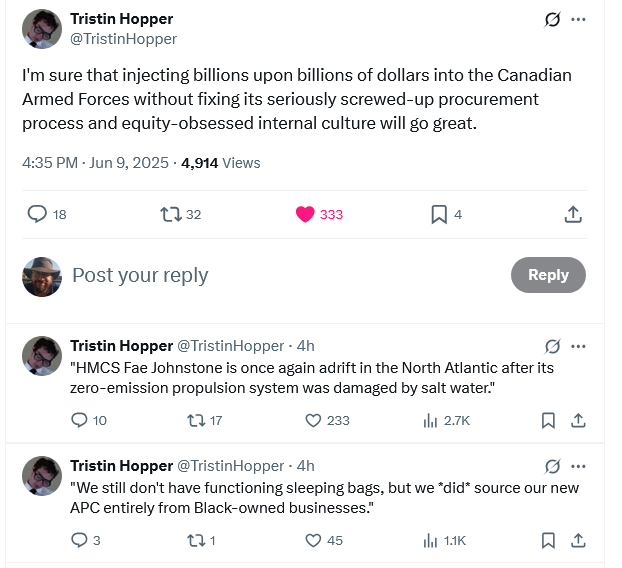
Of course, there are definite downsides to just opening up the spending taps the way things currently are set up:

He’s not wrong.

June 3, 2025

Canadian immigration numbers go even higher in 2025

Filed under: Cancon, Government — Tags: , , , , — Nicholas @ 03:00

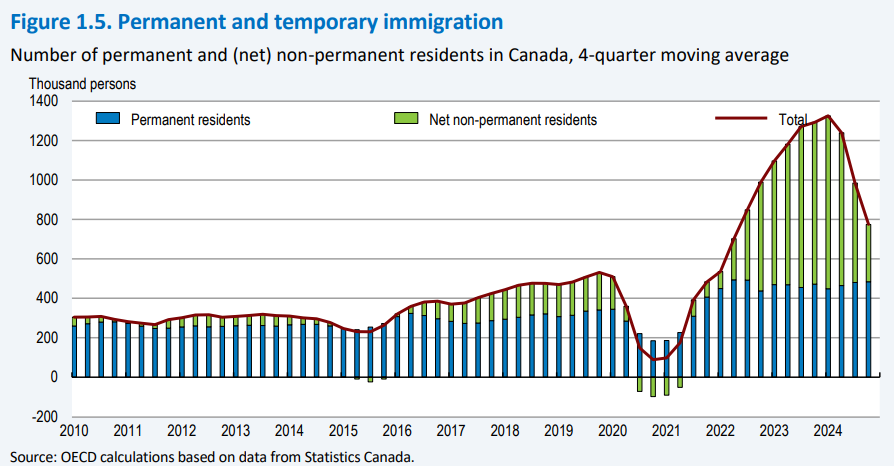
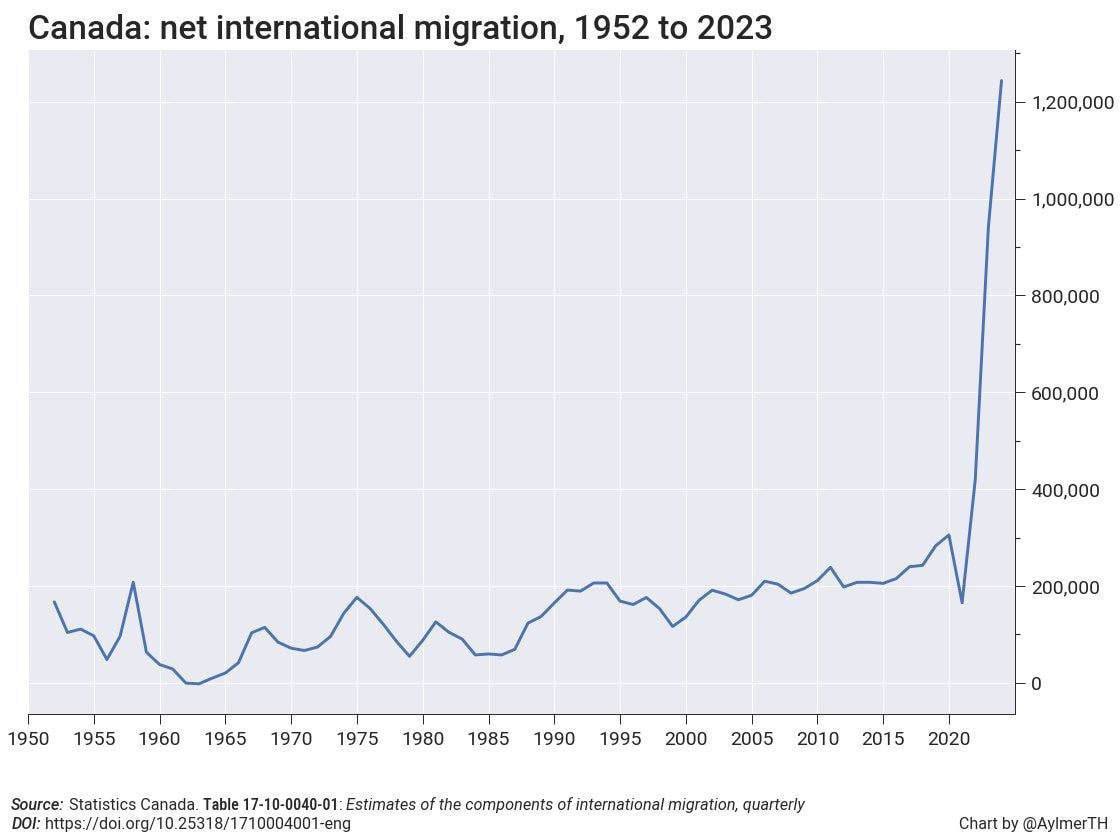
Although the new Liberal government in Ottawa made some slight noises about bringing immigration numbers back down to something closer to sustainable … there’s less than zero evidence that they actually meant it:

Despite all promises to the contrary, all the sudden and supposed interest in nation-building efforts that stretch from Victoria’s Inner Harbour to the Bay of Fundy, all the “Buy Canadian” horseshit lapped up by a portion of the electorate that votes like a long-tailed cat in a room full of rocking chairs, Canada’s once-in-a-generation betrayal of its labour market — and its very present and future — continued at pace to begin 2025.

The numbers are pants-shitting-ly grim.

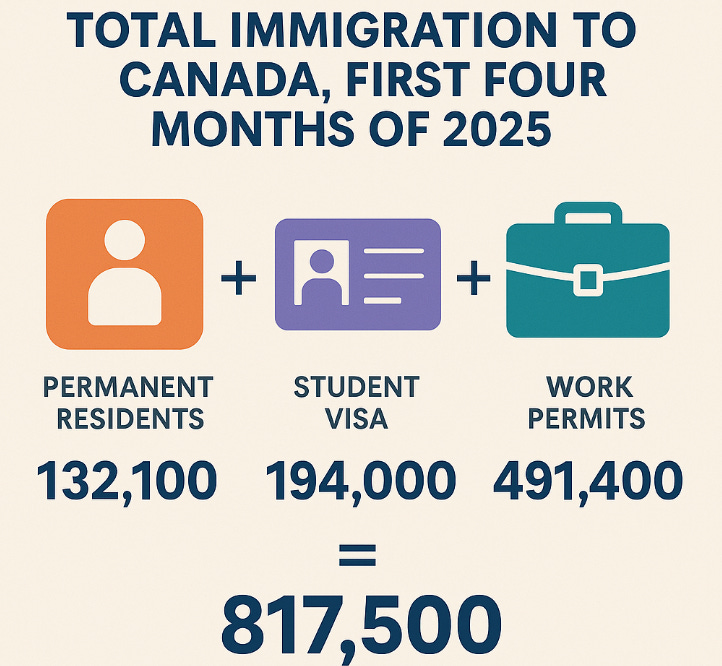
    The latest federal immigration data shows that Canada welcomed more than 817,000 newcomers in the first four months of 2025 when tallying up permanent and non-permanent streams.

    Between January and April 2025, 132,100 people were granted permanent residency, while 194,000 study permits and 491,400 work permits (including extensions) were finalized by Immigration, Refugees and Citizenship Canada. (Juno News)

At a time when 89% of Canadians under 34 have been beaten into believing that “owning a home is only for the rich” (Ipsos poll), along comes the worst summer job market in two decades to match the continued Liberal failure to course-correct on the mass-immigration, replacement-caste grift.

The two are of course inextricably linked.

With even the Bank of Canada speaking uncomfortable truths, that the foreign “student” surge and “temporary” foreign worker bacchanal lead to wage suppression and job displacement for Canadian workers, for 2025’s numbers to continue to blow through any semblance of well-meaning, sustainable targets, is as “bonkers” as it is seditious towards any citizen with an investment in Canada’s future.

The grift, the very lie, that “shortages” drive corporate Canada’s need for a basement-apartment economy has been disproved time and time again.

“All we hear about are labour shortages, [but] we have to begin to recognize that this really is a self-serving narrative mostly coming from corporate Canada,” said Mikal Skuterud, labour economics professor at the University of Waterloo.

May 20, 2025

Gen Z is blaming Capitalism for the sins of Cronyism

Filed under: Bureaucracy, Cancon, Economics, Media, Politics, USA — Tags: , , , , , — Nicholas @ 03:00

Lika Kobeshavidze at the Foundation for Economic Education explains why angry Gen Z’ers are blaming capitalism but should instead be blaming crony capitalism for the economic plight they find themselves in:

Image Credit: Custom image by FEE

Across college campuses, on TikTok feeds, and in everyday conversations, a familiar narrative is gaining steam: capitalism is broken.

Rising rents and stagnant wages fuel the claim among some young people that free markets have failed an entire generation. According to a 2024 poll by the Institute of Economic Affairs, more than 60% of young Britons now view socialism favorably. In the United States, the trend is similar, with Generation Z increasingly skeptical of capitalism’s promises.

But much of this idealism is rooted in distance — many of the young people romanticizing socialism have never lived through the economic dysfunction or political repression it often brings. For those who experienced Soviet shortages, Venezuelan collapse, or East Germany’s surveillance, the word socialism doesn’t suggest fairness or opportunity — it suggests fear, failure, and control. There’s a reason so many fled those systems to come to freer countries. What sounds utopian in theory has too often turned dystopian in practice.

But blaming capitalism misses the mark. The real culprit is cronyism, the unholy alliance between big government and big business that twists markets, blocks competition, and rewards political connections over genuine innovation.

[…]

Cronyism is not limited to one country or one political party. Across the United States and Europe, the symptoms are the same.

In the US, Canada, and the UK, the dream of homeownership slips further away for young people. Sky-high housing prices are blamed on “market failure”, but the real cause lies in layers of government-imposed barriers: restrictive zoning laws, burdensome permitting requirements, and endless bureaucratic delays. Big developers who can afford to navigate or influence the system survive. Everyone else gets locked out.

In Europe, the pattern repeats. France’s labor laws, designed to protect workers, instead stifle opportunity. Hiring becomes risky and expensive, especially for young people. Large corporations, with the resources to manage compliance costs, consolidate their dominance. Small firms and startups never get off the ground.

There’s also a persistent myth that big business fears government intervention. In reality, the largest corporations often embrace it, because it keeps them on top. Tech giants like Facebook and Google now lobby for more regulation, knowing that complex new rules will strangle smaller competitors who can’t afford fleets of compliance officers. Green energy subsidies, meant to combat climate change, often end up showering billions on well-connected firms while locking out emerging innovators.

Cronyism doesn’t reward the best ideas. It rewards the best lobbyists.

May 14, 2025

Carney’s new cabinet – remarkably similar to Trudeau’s cabinets

Prime Minister Mark Carney talked as if he was initiating a new era in Canadian politics, but when it came to nominating his first cabinet, it’s plus ça change, plus c’est la même chose with most of the same cast of incompetents, crooks, lickspittles, and fart-catchers. Justin Trudeau would feel right at home:

Prime Minister Mark Carney promised change, a new way of doing things at speeds never before seen. Yet to help him do this, he is relying on the same old, tired, incompetent ministers who got us into the mess we’re currently in.

The Liberals will trumpet the large number of new faces in Carney’s 28-member cabinet — there are 15 MPs who have never served before.

But the top tier of ministers — the ones sitting in the front row at the swearing-in ceremony on Tuesday — were all former Trudeau acolytes, cabinet ministers now committed to rescuing us from a crisis of their own making.

In the front row was Sean Fraser, our new justice minister and attorney general, and the man who, under former prime minister Justin Trudeau, was responsible for immigration and then housing, two files he spectacularly failed at. If we want to know how bad Fraser was in those jobs, we need only look to Carney’s election platform.

“The last time we faced a housing crisis at such a broad scale was after the Second World War”, read the platform. This crisis “has left younger generations facing rents, down payments and mortgage payments so high that it turned housing into a barrier to opportunity instead of a cornerstone of opportunity”.

What about Fraser’s record at immigration? According to the Liberal platform, the Trudeau government let immigration “grow at a rapid and unsustainable pace”.

In December, when Liberal fortunes were in the toilet, Fraser announced that, for family reasons, he was quitting politics. Strangely, after the party witnessed a reversal in the polls, he announced he was returning.

In Carney’s eyes, Fraser’s blundering on two key files qualifies him to become justice minister. The only thing worse than Fraser as a cabinet minister may be Carney’s judgment.

Also in the front row was Chrystia Freeland, who served as deputy prime minister and finance minister under Trudeau and is now returning to cabinet as minister of transportation and internal trade.

Freeland’s record is best summed up, again, by the Liberal platform: “Business investment in Canada has dropped from 14 per cent of GDP in 2014 to 11 per cent in 2024, undermining long-term economic growth”.

Meanwhile, long-time Trudeau lieutenant Mélanie Joly, whose reign at foreign affairs was about as successful as Fraser was at housing and immigration, moves to industry.

Well, if we’re stuck with Carney’s retreads, at least we can laugh about ’em. Through the tears:

Noah has some faint praise for the new minister of National Defence and the new Secretary of State for Defence Procurement:

Welp it’s official. Bill Blair is out.

I cant say that it’s overly shocking. I don’t think anyone truly expected Blair to be MND by the end of today. While I will give Blair some credit for holding the fort, most of you already know I wasn’t his biggest fan.

He was a great placeholder who was able to smoothly roll out the plans left to him. He also did have several good public showings, such as his efforts in Korea last year. I will give credit where it is due.

However, he was also uninspiring, too passive in his role, and while I have no doubt he took it seriously, was never going to be a great long-term option. He had long overstayed his welcome […] Now he’s out completely from cabinet and in his place we have not one but two new ministers on the defence profile!

David McGuinty, best known for his eight-year stint as Chair of the National Security and Intelligence Committee has taken the reigns as the new Minister of National Defence While Kelowna MP and veteran Stephen Fuhr will take on a new role as Secretary of State for Defence Procurement.

In this role Fuhr will work under McGuinty specifically to tackle the file of Defence Procurement ahead of the establishment of the DPA. He is one of eight new secretaries of state that will operate on a “junior” level in cabinet.

Now McGuinty wouldn’t have been my first pick. I will openly admit that, but it is hard [not] to argue that he is the most prepared for the role, and likely the best we have available.

McGuinty previously held the NSICOP chair from 2017 all the way until December when he was appointed Minister of Public Safety. He has a background in International Development before becoming a parliamentarian, including stints with UNICEF.

He isn’t coming into this without a background on the current security climate we’re facing. He certainly can’t be said to be ill-prepared to take the role at a time when CAF and the DND are at one of their most pivotal moments in restructuring.

May 1, 2025

When “looming dystopia” is the preferable scenario

Filed under: Bureaucracy, Economics, Government, USA — Tags: , , , — Nicholas @ 04:00

Elizabeth Nickson on just how badly the great and the powerful have managed to screw up so badly that instead of opening for Anthrax at the Hollywood Bowl, “Looming Dystopia” might actually be one of the better possible futures we face:

I asked Grok to show me Looming Dystopia opening for Anthrax. This is the “in Gothic style” version.

I am a person of faith, of Christ, not a very good one, but one who has been devoted for a long time. I’m not saying I didn’t spend twenty years in the great big glittering world, where I indulged every whim, lived among the powerful, beautiful, God- hostiles, adopted their habits of speech and dress, went to every small exquisite museum, the play of the moment, the art openings, the restaurants and parties, became a sophisticate able to live within that world as handmaiden or companion. I mean, for almost ten of those years, I had a husband who never, not once, came home without a present. But even that came of prayer, of a desire fulfilled a wish granted, of prayer, as in “You want this? Ok then, you will sicken, but here it is”.

That world – the enrichment of culture that came out of the 80’s and 90’s – determines today. That life is the model and goal for many and in fact, now the design, the plan laid out by those who plan the future of the world. Humans shunted deliberately into city life, then enhanced via surgery and chip. Indulgence, consumption, fighting for preference, ambition. Cultural creatives, unmarried, oddly-sexed, politically left would determine the future, their gifts the siren call of the arts, fashion, grand bohemia, Hollywood, eat, drink and travel merrily. The end goal of life: your individuality, your woundedness, your self care, the full expression of your specific gifts. If you are lucky you too can be Lady GaGa or BlackPink and have stadiums roar when you appear. Other humans? The state will take care of them, do not worry. Maybe they will die off. Like dinosaurs.

The central banks have gamed this going forward, making the insane assumption that this social movement was permanent. Did they depend on feminism and drugs to stop the next step, ie, young people leaving the city to build families? Even if they did, they thought they could stop it. Why? Because fascist greens like John Kerry, told them that rural regions must be left to “recover”.

Therefore they gutted the suburbs of financing, because “poor land use”, and “too much car required”, which is preposterous in the Americas with all this land. What else does a young family want but trees and parks, and lawns and a neighborhood of friends, not riven with whores, crackheads and murderous migrants?

The ‘08 crash was predicated on Thatcher’s fiscal success in selling people their council houses in the 80’s. Wonderful! thought Bill Clinton’s team, let’s lead marginal Americans into housing, and lo, we still haven’t paid the freight for that insane idea. I had a paralegal friend in Florida who was foreclosing on $500,000 loans to actual crackhead whores. Clinton’s people, lost in their greed and benevolence, forgot that the British council estate dweller was homogenous, placed, as in deep roots in the area, and stable. In the U.S and Canada, idiot banks lent to just about any joker who turned up with a plausible story. Then the speculators invaded, everyone cashed out merrily, then ka-boom. And pioneering walking away with $100 million from government “service” was Jimmy Johnson, Head of Fannie Mae.

I mean, it’s stupid. The western world’s current bankruptcy (and it’s severe) was caused by Central Bank clowns. Those ridiculous, repellent, hideously expensive COP #8,789 conferences had two outcomes: banks would be compelled to lend to green, require green, require climate mitigation, and jump through DEI, ESG hoops, and governments would chunk up green regs. And prosperity would bloom! Not only that, they surreptitiously, across the world, funded actual companies that poisoned the air, water and land. And when I say “they funded”, I mean the taxpayer did. A lot of our money went into insane outfits like this:

And just like Malcom Gladwell’s tipping point – it took ten years – boom, economic activity came to a screeching halt, except for the wreckage of green energy enterprises everywhere, government debt and re-financing. For instance, the Obama-created outfit, the Ivanpah Solar Power Facility, that consists of three solar concentrating thermal power plants in California burned through $1 billion before it collapsed in February. It is one of thousands across the west, all subsidized by the taxpayer. Unwittingly. The press is so embarrassed, they don’t report the trillions lost to green energy projects.

Again, the central bankers own this.

Central bankers have become a metastatic cancer on the economy. By definition, they are late adopters on the marketing curve. By the time they notice something and make their plans upon it, it’s over and something new is growing. Today, the mega-cities everywhere are emptying of everyone over 30 with an income, even or rather especially in China, where the young have just said … nope, a pox on your Commie plans. Chinese, European, British, American, everyone is trickling back to the towns of which their ancestral memories sing, where they can root, where they can live smaller, without environmental toxicity, the rank depravity of the super-culture, the ruinous stupidity of green. The great cities are now super-dangerous for women, and that is spreading as the autocrats in power force violent young men into towns. Last week a young woman in Vancouver fought off a migrant who tried to kill her three times in Stanley Park. My modest, Christian, pioneer family who built the early city along with their community of 10,000 and neglible government, made that park in the early 1900’s; my great grandmother was the first woman to ride a bike in bloomers through that park. It was so safe for 100 years you could let kids play in it after dark, calling them home with a whistle. It is one of the world’s great urban parks, more astonishing than Central Park. This is an outright tragedy. And it is unnoticed, unreported, except on TikTok.

January 2, 2025

How to solve Britain’s housing crisis

Tim Worstall outlines why just increasing the number of building permits allowed won’t — by itself — increase the total number of houses built. This is because the process of awarding the permits has been largely captured by the biggest players, and the supply is artificially restricted by local governments:

Kensington High Street at the intersection with Kensington Church Street. Kensington, London, England.
Photo by Ghouston via Wikimedia Commons.

The first bit is to diagnose the problem properly. If the big builders won’t build because they don’t want to then and therefore we want to find other builders who will and do want to. And the important part of this is that the big builders do indeed have market power. It costs a lot — a lorra lots — of money to be able to get a scheme through planning. Thus we not only have that problem of a shortage of places to build — because planning — but we’ve also handed market power to those able to build — because planning.

The answer is to shoot the planners, obviously. But then that always is the correct answer. Here, more specifically, we need to flood the zone with permissions. Really, grossly, oversupply. Like issue 15 million permits. Say. At which point the value of a permit is zero. So, anyone with a scrap of land can gain a permit and build.

This brings back the small housebuilder. Instead of being held back by the ideals of half a dozen national builders we’ve got 50,000 blokes all looking to build 2 or 3 houses a year. Or 10 or 20 even.

There’s no way that the big builders can then delay building on their plots. For they don’t have market power any more. And even if they do want to delay then it doesn’t matter a damn.

And this always is the way that you deal with those with market power. You flood that zone with supply so as to destroy their market power.

December 11, 2024

Canada’s current situation, as viewed by Fortissax

Fortissax recently spoke to an audience in Toronto. This is part of the transcript of his speech:

No doubt, many of you already have an idea.

The fact of the matter is this: 25% of the people in this country are, or soon will be, foreigners. Most of them are not the children of immigrants but fresh-off-the-boat migrants.

The economy? It’s in the dumps. Canada has the lowest upward mobility in the OECD for young people. One of the lowest fertility rates in the Western world. And the fastest-changing demographics in the Western world — as I’m sure you’ve all noticed here in the streets of Toronto, the old capital of Anglo-Canadians.

Think about this: approximately 4.9 million foreigners are classified as “temporary migrants.” Combine that with permanent residents, refugees, and immigrants, and that number swells to 6.2 million in just four years.


And it doesn’t stop there.

Crime is reportedly the highest it’s ever been. We have no military. The Canadian Armed Forces has faced retention issues for two decades. And what is command preoccupied with? Men’s bathrooms stocked with tampons and servicemen being “radicalized” by wearing extremist clothing like MAGA hats.


Let’s not forget foreign influence.

The Chinese Communist Party exploited the Hong Kong handover in the 1990s to infiltrate Canada, using British Columbia as their foothold. As Sam Cooper exposes in Claws of the Panda and Willful Blindness, they established a stronghold in Metro Vancouver, taking over the business community.

This “Vancouver Model”, as we Canadians ironically call it, normalizes our capitulation to foreign hostiles. Triads, working hand-in-glove with the Chinese communists, built a global drug empire. Fentanyl, mass-produced in football field-sized factories in China, is shipped to Vancouver and distributed across the entire Western Hemisphere.

Let this sink in: more Canadians have died from this economic warfare than all our soldiers lost in the Second World War.


And now, there’s India.

Intelligence agencies from the Republic of India have demonstrated their ability to conduct assassinations on Canadian soil. Recently, a Khalistani nationalist and separatist was killed — a figure I’ll leave to your sympathies or judgments. Regardless, this marks a disturbing shift.

India weaponizes its diaspora against the international community. In exchange for non-alignment with China, the West — particularly the Anglosphere — uses Indian migrants as wage-slave labor to suppress costs.

The result? A disaster.

In Canada, Australia, the U.K., and increasingly the United States, we see Indians climbing the ladders of power, pursuing their own interests — often brazenly. In Brampton, part of Greater Toronto, a 50-foot statue of the Hindu god Hanuman looms.

And let’s not forget the Punjabi Sikh population. They openly support an independent Khalistan — or remain at best indifferent to the cause. They have infiltrated Canada’s state apparatus, even reaching the Ministry of National Defense, where Harjit Sajjan prioritized rescuing Afghan Sikhs during Kabul operations over broader Canadian interests.

In Surrey, British Columbia, the trucking industry is effectively controlled by Sikhs. In online spaces, Sikh nationalists demand Brampton be recognized as a province, seemingly aware that their homeland exists more abroad than in Punjab itself. The leader of the NDP, Jagmeet Singh, serves as yet another example — barred from entering India due to his sympathies for separatism.


But foreign influence is only half the story. Among our own lies another problem: disintegration.

Decades of Western alienation and economic parasitism by the federal government are fueling separatist movements in places like Alberta and Saskatchewan. In Quebec, the Parti Québécois is polling higher than the ruling CAQ, openly advocating for secession from Confederation.

Meanwhile, the federal Conservatives court immigrant voters, alienating native Canadians and abandoning their base.


And then there’s the economic misery.

The average Canadian home costs $700,000. The median income? Just $48,000. Upward mobility is nonexistent. The managerial regime hoards wealth and power, gatekeeping opportunity through credentialism, exorbitant tuition, and crushing taxes.

55% of Canadians have post-secondary education, and yet most have nothing to show for it. The regime is not run by titans of intelligence or visionaries. It’s run by ideologues — loyal to their cause, not to competence or merit.


The final insult: demographics.

Over the next six years, British Columbia, Alberta, Saskatchewan, and Manitoba will become majority non-Canadian. The 50% threshold will be breached, with profound consequences for local politics.

Ontario will hover just above 50%, while Quebec and the Maritime provinces will remain over 70% and 80% Canadian, respectively. This is not a death sentence, but it is a profound transformation for Western Canada, which has historically been more propositional and less identitarian than the East.


This is where we are.

Our sovereignty is compromised. Our identity is eroded. But we are not yet defeated. What happens next depends entirely on us.

Older Posts »

Powered by WordPress