Quotulatiousness

April 30, 2026

Latest luxury belief just dropped: “microlooting”

Filed under: Business, Law, Media, Politics, USA — Tags: , , , , , — Nicholas @ 05:00

Rob Henderson identifies the latest addition to the broad suite of luxury beliefs held by the over-educated, over-privileged people who will never bear the costs of their anti-civilizational thoughts:

In a 1955 essay titled “The English Aristocracy”, novelist Nancy Mitford suggested that as goods became more affordable, England’s upper classes could no longer rely on material possessions to distinguish themselves from the masses. Instead, Mitford wrote, “it is solely by their language that the upper classes nowadays are distinguished”.

Jia Tolentino and Hasan Piker proved this point last week in a conversation hosted by Nadja Spiegelman at the New York Times. It unfolded in a carefully staged loft that signaled taste and status. Ms. Spiegelman proposed a new word for shoplifting: “microlooting”. Mr. Piker later remarked that “many Americans, I think, are totally oblivious to this political language”.

“Stealing” sounds so tawdry. Microlooting is cleaner — a minor offense laundered into a boutique act of political protest. Indeed, much of upper middle class life is about rebranding disreputable behaviors to retain one’s position in the social hierarchy. The pattern is familiar. Mitford sorted vocabulary into “U” (upper class) and “non-U”. U-speakers said “vegetables” and “spectacles” and “lavatory”. Non-U speakers said “greens” and “glasses” and “toilet”.

Today, the favored words of the upper class come from a mishmash of therapy culture and human resources. Lazing off at work has become “acting your wage”. Saying no means “setting boundaries”. Infidelity is “ethical nonmonogamy”. Prostitution is “sex work”. Divorce can be called “conscious uncoupling”. Neglecting close relationships is “protecting your peace”. Listening to someone vent is “emotional labor”. Recall that in 2021 the AP Stylebook announced that a “mistress” must now be called a “companion, friend or lover”.

And shoplifting is “microlooting”.

Five years ago, I texted a high-school friend who had been released from prison. “Good news”, I told him. “You’re not an ex-felon anymore, you’re a justice-involved person.” He replied, “Okay Rob, you’re not a college graduate anymore, you’re a classroom-involved person.”

At UnHerd, Poppy Sowerby pours scorn on the well-to-do New Yorkers’ sudden discovery that “five finger discounts” are fun and socially conscious ways to strike back at “the man”:

The New Yorker columnist Jia Tolentino, the NYT‘s Nadja Spiegelman, and Hasan Piker — the midwit Marxist streamer accused of electrocuting his dog and who admitted having solicited a prostitute (not so against the free market now, ey?) — gabbed about “microlooting” — small thefts justified by the fact that, as Spiegelman puts it, “It’s so hard to live ethically in an unethical society”. Quick-fire scenarios are floated; stealing from the Louvre, Piker says, is “cool”. Stealing from supermarket chains is “not a big deal” in a “utilitarian sense”, says Tolentino. And Spiegelman wonders why she should “have to pay for organic avocados” when Jeff Bezos “has too much money” (Amazon, which he founded, acquired Whole Foods in 2017). Antisocial behaviour is justified here — explicitly or tacitly — under the lazy logic of “protest”.

Unlike microlooting, however, Tolentino finds “getting iced coffee in a plastic cup … profoundly selfish, immoral [and] collectively destructive” — presumably the bimbo-coding of that drink is unrelated. The lines of moral permissibility seem to be drawn, in other words, along the exact same lines of what these rich, educated progressives consider “cool”.

And that’s the real problem. Progressives have always found extravagant ways to reframe the ills which they personally enjoy — prostitution, pornography, choking women. Now shoplifting gets the same treatment. Tolentino is not really stealing lemons because it’s a way of flipping the bird at Bezos; she’s stealing them because she wants them. Nor are the barrier-bumpers actually trying to signal their dissatisfaction with the frequency or cleanliness of public transport — reasoning I have actually heard with my own ears, despite the fact these things can only be improved by the very funding the free riders are withholding; they are bumping barriers because they just don’t want to pay. Nicking groceries and dodging fares are age-old problems. What’s new is the towering cowardice of those who can’t admit that they, like most people, act mainly out of self-interested desire.

The appealing but deceptive idea that low-level criminality is a laudable demonstration against “the system” in fact conceals envy towards those in that “system” who, like Bezos, have known success. This resentment is particularly native to the media class, whose peers tend to out-earn them in higher-salaried fields like law and finance — conferring on writers like Spiegelman and Tolentino the faintly plausible whiff of bookish martyrdom. Nevertheless, and particularly in New York, mag luminaries can still live in $2.2 million brownstones in Clinton Hill; sticking it to the man by pilfering in the produce aisle might pass in grim artists’ squats, but five-finger discounts are harder to justify on six-figure salaries.

Update, 1 May: Welcome, Instapundit readers! Have a look around at some of my other posts you may find of interest. I send out a daily summary of posts here through my Substackhttps://substack.com/@nicholasrusson that you can subscribe to if you’d like to be informed of new posts in the future.
Where did Dovetails come from?

Filed under: Britain, Europe, History, Tools, Woodworking — Tags: , , , , — Nicholas @ 04:00

Rex Krueger
Published 29 Apr 2026

All my plans!: https://www.rexkrueger.com/
Patrons saw this video early: / rexkrueger
Join the Mailing List: http://eepurl.com/g3rkmv
Take a course: https://www.rexkrueger.com/courses
Get my woodturning book: http://www.rexkrueger.com/book
Get My Book, Everyday Woodworking: https://amzn.to/3oyjC0E
Follow me on Instagram: @rexkrueger

Lost Art Press: https://lostartpress.com/

China’s weaker-than-it-seems strategic position

Filed under: China, Economics, Food, Middle East, Military — Tags: , , , — Nicholas @ 03:00

On the social media site formerly known as Twitter, ESR expands on a post by Tom Kratman about the strategic weakness of the current Chinese government:

Tom didn’t explain his second assertion, but it’s important so I’m going to do it.

China is in the worst strategic position of any great power in history because it is critically dependent on resources it has to import, and it doesn’t have control of the sea lanes over which it imports them.

China is neither food nor energy self-sufficient. It needs to import pork from the United States, grain from Africa, coal from Australia, and oil from the Middle East to keep its population fed and its factories running.

Naval blockades at about three critical chokepoints (Hormuz, Malacca, Sunda) would cripple the Chinese economy within months, possibly within weeks. China does not have the blue-water navy required to contrast control of those chokepoints. The moment any first-rate naval power or even a second-rate like India decides China needs to be stopped, it’s pretty much game over.

As a completely separate issue thanks to the one-child policy, Chinese population probably peaked in 2006 and has been declining ever since. Every year in the foreseeable future they will have fewer military-age males than they do now. Most of those males are only sons; their deaths would wipe out entire family lines, giving the Chinese people an extremely low tolerance for war casualties.

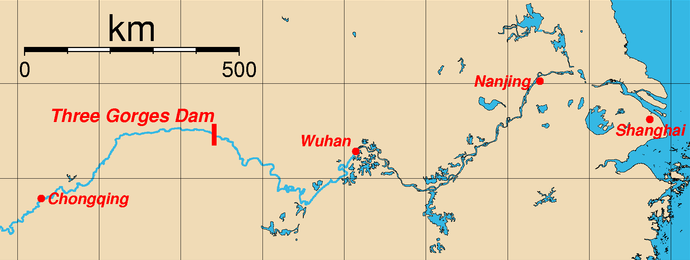
Then there’s the glass jaw. The Three Gorges Dam. Which is already in some peril even without a war — you can compare photographs over time and see that it’s sagging. If anyone gets annoyed enough to pop that dam thing with a bunker-buster or a pony nuke, the resulting floods will kill millions and wipe out the strip of central China that is by far the country’s most industrially and agriculturally productive region.

The Chinese haven’t fought a war since 1971. They lost. Against Vietnam. The institutional knowledge that could potentially fit their army for doing anything more ambitious than suppressing regional warlordism does not exist.

I could go on. But I think I’ve made Tom’s statements sufficiently understandable already.

The position of the Three Gorges Dam on the Yangtze River in Hubei Province, showing the major cities downstream of the dam.
Image by Rolfmueller via Wikimedia Commons.

And Tom Kratman responds:

Almost perfect; you missed four tricks.

1. People, when we talk about blockading China, imagine that we’re talking about a civilized stop and search. Uh, uh; we will designate a no go zone and sink without further warning anything that enters it.

2. Our blockade will be distant, well out of range of those Oh-they’re-just-too-terrible-for-words (but never tested) DF-21s. [Wiki] (You did sort of address this, but not in so many words.)

3. We can blow the levees on the Yellow River, too, to kill many millions more and destroy still more industry (it flows above ground).

4. China not only doesn’t have the navy to contest with us, it can never have that navy. Why not? Because there’s only so much wealth to go around; China is surrounded on all sides by enemies with anywhere from decent to quite good armies, any or all of which might take a stab (pun intended) at carving China up like a turkey. They must put a lot more money and effort and manpower into stymying those than they can ever put into meeting us and Japan.

The History of BROWN SAUCE: HP Sauce, A1 Sauce, OK Sauce and Chef Sauce

Filed under: Britain, Business, Food, History — Tags: , , — Nicholas @ 02:00

Tweedy Misc
Published 7 Nov 2025

Have you ever wondered how British “brown sauce” came about? What is it made from? Who invented it? When was it invented? Which brown sauce is the oldest? When did we start calling it “brown sauce”?

In this video we look into what exactly brown sauce is (and isn’t), we look into ingredients of a number of iconic brands (and some supermarket own brands) and explore the history of the five brown sauces which defined the category: A1 Sauce, OK Sauce, HP Sauce, Daddies Favourite Sauce and Chef Sauce.

Some links to Wikipedia etc in case it helps figure out what this is all about:
https://en.wikipedia.org/wiki/Brown_s…
https://en.wikipedia.org/wiki/HP_Sauce
https://en.wikipedia.org/wiki/A.1._Sauce
https://en.wikipedia.org/wiki/Daddies
https://en.wikipedia.org/wiki/OK_Sauce
https://en.wikipedia.org/wiki/Chef_Br…

If you’re finding the wobbling bottles are a problem for you, here’s a version of the video without any wobbling: • History of Brown Sauce (No Wobbling!)

This video was made using Davinci Resolve 20, with a lot of the still images made using Canva.

Chapters:

0:00 Introduction
0:16 What is brown sauce?
2:33 Supermarket own brand brown sauces
4:02 History of brown sauce
4:48 A1 Sauce
10:49 OK Sauce
15:31 HP Sauce
17:06 Daddies Favourite Sauce
19:06 Chef Sauce
23:50 Conclusion

QotD: The terrible economics of (most) recycling efforts

Filed under: Economics, Environment, Quotations, USA — Tags: , — Nicholas @ 01:00

New York City confidently predicted that it would save money by starting a mandatory recycling program in 1992, but it took so much extra labor to collect and process the recyclables that the city couldn’t recoup the costs from selling the materials. In fact, the recyclables often had so little value that the city had to pay still more money to get rid of them. The recycling program cost the city more than $500 million during its first seven years, and the losses have continued to mount. A new study by Howard Husock of the Manhattan Institute shows that eliminating the city’s recycling program and sending all its municipal trash to landfills could now save taxpayers hundreds of millions of dollars annually — enough money to increase the parks department’s budget by at least half.

Even those calculations underestimate the cost of recycling because they include only the direct outlays, chiefly the $686 per ton that the city spends to collect recyclables. But what about all the valuable time that New Yorkers spend sorting and rinsing their trash and delivering it to the recycling bin? For a New York Times Magazine article in 1996, I hired a Columbia University student to keep track of how much time he spent recycling cans and bottles and how much material he gathered in a week. Using those figures (eight minutes to gather four pounds), I calculated that if the city paid New Yorkers a typical janitor’s wage for their recycling labors, their labor would cost $792 per ton of recyclables — over $100 per ton more than what the city pays its sanitation workers to collect it.

As the economics of recycling worsened, cities in America and Europe found that the only viable markets for their recyclables were in poor countries, chiefly in China and other Asian nations, where processing recyclables was still profitable, thanks to lower wages and lower standards for worker safety and environmental quality. But as those countries have gotten wealthier, they’ve become reluctant to accept foreign trash. As bales of unwanted recyclables pile up in warehouses, towns have had to start sending them to landfills, and dozens of American municipalities have finally had the sense to cancel their recycling programs.

John Tierney, “Let’s Hold On to the Throwaway Society”, City Journal, 2020-09-13.

Update, 1 May: Welcome, Instapundit readers! Have a look around at some of my other posts you may find of interest. I send out a daily summary of posts here through my Substackhttps://substack.com/@nicholasrusson that you can subscribe to if you’d like to be informed of new posts in the future.

April 29, 2026

Three views on the Iran conflict

Filed under: Media, Middle East, Military, Politics, USA — Tags: , , , — Nicholas @ 05:00

In The Conservative Woman, Alex Story outlines the three distinct ways that western opinions differ on the ongoing struggle with Iran:

The BBC has a long history of … careful wording in describing events in Iran since 1979. I don’t think this cartoon is unfair in portraying that.

TRUTH is the first casualty of war.

Opinions on a conflict depend deeply on the prevailing culture, erasing nuance in the process. The less of it there is, the easier it is to convince yourself of your righteousness and your opponents’ wickedness.

For instance, the Iranian question divides the world in three main groups.

The first staunchly believes that the Israeli tail wags the American foreign policy dog, working around the clock to recreate Israel’s “from the river of Egypt to the great river, the River Euphrates” Old Testament borders as described in Genesis 15:18.

The second will accept the long-standing Islamic Republic of Iran’s evil nature and its core philosophy of perpetual warfare leading in due course to the unbeliever’s submission but are sceptical if it can be removed solely by this war. As David, an exiled Iranian, said: “I’m caught between wishing for the end of the regime and the very real prospect of its entrenchment through external violence”.

The third will argue that the Iranian leadership should be obliterated. Ending the regime’s five-decades long barbarism, exemplified by the slaughter of “40,000 Iranians” across the country in January 2026 in Prince Reza Pahlavi’s recent words, would make the world a better place. Having lived by the sword, the mullahs should die by the sword, they will say, adding that few will miss them.

Positions turn into intellectual fortresses at the speed of light, fed by a constant stream of “news” destined to further harden preconceived ideas. Little is provided that offers any hope of peaceful co-existence. Data is used, ignored and abused, thus ensuring escalation and lying becomes the accelerator for a world on its irrevocable path to war.

But while truth dies early in the antagonists’ deadly exchanges, war eventually reveals it, and its revelations tend towards the astounding.

In our case, for instance, it has become crystal clear that Britain is now effete, irrelevant and defanged. It is a flotsam on rough international seas, bullied by some, ridiculed by others and ignored by all who have not yet emasculated themselves.

The United Kingdom, the former global hegemon and only European country to come out of the Second World War justified, is not the same country it once was, dismantled stone by stone by an establishment haughtily bent on demise over decades and encouraging others, partially successfully, to follow them down to the Gates of Hades.

Our end, however, cannot all be pinned on Starmer, Hermer, Sands, the Fabians and purple-haired socialists.

He then goes on to make the case that only a counter-revolution will rescue Britain from its current path to misery and global irrelevance.

The Korean War Week 97: A Peace Proposal Package – April 28, 1952

Filed under: China, History, Military, USA — Tags: , , , , , — Nicholas @ 04:00

The Korean War by Indy Neidell
Published 28 Apr 2026

There is what should be major news this week as the UN gives the Communists a peace proposal package at long last that addresses the remaining three issues to solve. It does not seem that it will be accepted by the Communist side, though, with the only sticking point being the issue of POW repatriation. There’s also still more unrest and protest at Koje-Do POW camp. And it looks like we’ll be getting a new UN forces commander, since Matt Ridgway will soon head to Europe to take over NATO command there.

00:00 Intro
00:24 Recap
00:56 Truman and Ike
02:34 April 28th
07:14 POW Rations
10:37 Notes
11:05 Summary
11:20 Conclusion

Carney elbows out Canadian veterans to support an American company

Filed under: Business, Cancon, Government, Military, USA — Tags: , , — Nicholas @ 03:00

On his Substack, Brian Lilley points out another glaring inconsistency between Prime Minister Mark Carney’s rah-rah pro-Canadian rhetoric and his anti-Canadian actions:

This story should outrage everyone, regardless of political stripe.

But considering the positions taken by progressive Liberals in this country concerning Donald Trump, it should really outrage them. Sadly, like with Trudeau or whichever politician people seem to support these days, Carney’s backers won’t see the error of his ways.

When I was a young army cadet, the first person I would see checking into the James Street Armouries in Hamilton — now known as the John Weir Foote Armoury after a ceremony I was part of in 1990 — well, the first person I would see would be the Commissionaire. Back in the mid-80s these were mostly people who were veterans of the Korean War or our peacekeeping missions who were now charged with providing security at federal buildings.

Founded in 1925 to give meaningful employment to veterans of the First World War, the Corps of Commissionaires has been providing security services at federal buildings, and others, for just over 100 years. Since shortly after the Second World War, the Commissionaires have had a special relationship with the federal government when it comes to providing security.

Just recently, the Carney government — the Elbows Up and Canada Strong folks — ended the arrangement that gave the Commissionaires first right of refusal on security at federal department buildings. They ended the agreement with the not-for-profit organization that is still the biggest employer of veterans in the country at the behest of a global company scooping up security contracts from the Trump admin including ICE detention centres like Alligator Alcatraz.

You can love Trump or hate him but don’t tell me you are Elbows Up, that we are experiencing a rupture, that the old relationship is over, that being close to the Americans is dangerous and then do this.

I detailed it all in my latest column for the Toronto Sun including who was behind this, how it went down, and why it is outrageous.

From the Commissionaires website:

The Canadian Corps of Commissionaires was eventually founded in 1925, specifically to employ Canadian veterans of the First World War. We were initially established in Montreal, then Toronto and Vancouver, to look after these men and women and provide them with transitional and permanent jobs, primarily in the security field. The Right Honourable John Buchan, Governor General of Canada, became the Corps’ first patron in 1937. Viceregal patronage has been an 81-year tradition since then.

In the early years, we mostly provided guarding services for government institutions. From 1925 to 1948, Commissionaires expanded throughout Canada.

In 1950, with the opening of the St. John’s, Newfoundland division, Commissionaires was operating services from coast to coast.

By 1982, Commissionaires exceeded 10,000 employees.

T31: Garand’s Bizarre Bullpup

Filed under: History, Military, USA, Weapons — Tags: , , , , — Nicholas @ 02:00

Forgotten Weapons
Published 10 Dec 2025

The T31 was John Garand’s last project during his employment at Springfield Armory. It was proposed in 1948 as a bullpup configuration rifle to minimize muzzle blast and flash. It was a select-fire rifle with a 20-round detachable box magazine and basically every aspect of the design was unorthodox. The original gas system was more pneumatic than anything else, with the whole handguard tube filling with gas when it cycled. The recoil spring is a clockwork type in the buttstock, and the bolt uses a tilting wedge to lock.

At initial testing it ran into reliability problems after 2300 rounds. Upon disassembly, the found nearly an entire pound of powder fouling in the gas tube. This led to the gun being rebuilt with a tappet type gas system, and that’s the gun we have today to look at. Only two examples were made before Garand retired in 1953, and nobody took over the project when he left.
(more…)

QotD: The battlefield role of the general in pre-modern battles

Filed under: History, Military, Quotations — Tags: , , , — Nicholas @ 01:00

We have to start not with tactics or the physics of shouting orders, but with cultural expectations. First, we need to establish some foundations here. First, in a pre-modern battle (arguably in any battle) morale is the most critical element of the battle; battles are not won by killing all of the enemies, but by making the enemies run away. They are thus won and lost in the minds of the soldiers (whose minds are, of course, heavily influenced by the likelihood that they will be killed or the battle lost, which is why all of the tactics still matter). Second, and we’ve actually discussed this before, it is important to remember that the average soldier in the army likely has no idea if the plan of battle is good or not or even if the battle is going well or not; he cannot see those things because his vision is likely blocked by all of his fellow soldiers all around him and because (as discussed last time) the battlefield is so large that even with unobstructed vision it would be hard to get a sense of it.

So instead of assessing a battle plan – which they cannot observe – soldiers tend to assess battle commanders. And they are going to assess commanders not against abstract first principles (nor can they just check their character sheet to see how many “stars” they have next to “command”), but against their idea of what a “good general” looks like. And that idea is – as we’re about to demonstrate – going to be pretty dependent on their culture because different cultures import very different assumptions about war. As I noted back in the Helm’s Deep series, “an American general who slaughtered a goat in front of his army before battle would not reassure his men; a Greek general who failed to do so might well panic them.” An extreme example to be sure, but not an absurd one. In essence then, a general who does the things his culture expects from him is effectively performing leadership as we’ve defined it above.

But the inverse of this expectation held by the soldiers is that generals are not generally free to command however they’d like, even if they wanted to (though of course most generals are going to have the same culturally embedded sense of what good generalship is as their soldiers). Precisely because a general knows his soldiers are watching him for signs that he is their idea of a “good general”, the general is under pressure to perform generalship, whatever that may look like in this cultural context. That is going to be particularly true because almost all of the common models of generalship demand that the general be conspicuous, be available to be seen and observed by his soldiers. As a result, cultural ideals are going to heavily constrain what the general can do on the battlefield, especially if they demand that the general engage personally in combat.

Different sorts of generals

We can actually get a sense of a good part of the range simply by detailing the different expectations for generalship in ancient Greek, Macedonian and Roman societies and how they evolved (which has the added benefit of sticking within my area of expertise!).

On one end, we have what we might call the “warrior-hero general”. This is, for instance, the style of leadership that shows up in Homer (particularly in the Iliad), but this model is common more broadly. For Homer, the leaders were among the promachoi – “fore-fighters”, who fought in the front ranks or even beyond them, skirmishing with the enemy in the space between their formations (which makes more sense, spatially, if you imagine Homeric armies mostly engaging in longer range missile exchanges in pitched battle like many “first system” armies).

The idea here is not (as with the heroes of Homer) that the warrior-hero general simply defeats the army on his own, but rather that he is motivating his soldiers by his own conspicuous bravery, “leading by example”. This kind of leadership, of course, isn’t limited to just Homer; you may recall Bertran de Born praising it as well:

    And I am as well pleased by a lord
    when he is first in the attack,
    armed, upon his horse, unafraid,
    so he makes his men take heart
    by his own brave lordliness.

On the opposite end of the spectrum, there is the pure “general as commander” ideal, where the commanding general (who may have subordinates, of course, who may even in later armies have “general” in the name of their rank) is expected to stay well clear of the actual fighting and instead be a coordinating figure. This style […] is fairly rare in the pre-gunpowder era, but becomes common afterwards. Because in this model the general’s role is seen primarily in terms of coordinating various independently maneuvering elements of an army; a general that is “stuck in” personally cannot do this effectively. And it may seem strange, but violating these norms with excessive bravery can provoke a negative response in the army; confederate general Robert E. Lee attempted to advance with an attack by the Texas Brigade at the Battle of the Wilderness (May 6, 1864) only to have his own soldiers refuse to advance until he retired to a more protected position. Of course this sort of pure coordination model is common in tactical video games which only infrequently put the player-as-general on the battlefield (or even if the “general” of the army is represented on the battlefield, the survival of that figure is in no way connected to the player’s ability to coordinate the army).

In practice, pre-modern (which is to say, pre-gunpowder) generals almost never adopt this pure coordination model of generalship. The issue here is that effective control of a gunpowder army both demands and allows for a lot more coordination. Because units are not in melee contact, engagements are less decisive (units advance, receive fire, break, fall back and then often reform to advance again; by contrast a formation defeated in a shock engagement tends not to reform because it is chased by the troops that defeated it), giving more space for units to maneuver in substantially longer battles. Moreover, units under fire can maneuver, whereas units in shock generally cannot, which is to say that a formation receiving musket or artillery fire can still be controlled and moved about the field, but a unit receiving sword strikes is largely beyond effective command except for “retreat!”

In between these two extremes sits variations on what Wheeler terms a “battle manager”, which is a bit more complex and we’ll return to it in a moment.

What I want to note here is that these expectations are going to impact where the general is on the battlefield and thus what he can do to exert command. A general in a culture which expects its leaders to be at the front leading the army has the advantage of being seen by at least some of his soldiers (indeed that is the point – they need to see him performing heroic leadership), but once engaged, he cannot go anywhere or command anyone. This is also true, by the by, in cultures where the general is expected to be on foot to show that they share in the difficulties and dangers of the infantry; this is fairly rare but for much of the Archaic and Classical periods, this was expected of Greek generals. Even if a general on foot isn’t in combat directly, their ability to see or move about the battlefield is going to be extremely limited.

On the flipside, a general who is following the “commander” ideal is likely to be in the rear, perhaps in an elevated position for observation. The obvious limitation here is that such a commander is going to struggle to display leadership because no one can see them (everyone is facing towards the enemy, after all). But that also impacts their ability to command – no one is looking at them so if they want to change their plans on the fly they need to send word somehow to subordinate officers who are with or in front of the battle line who can then use their visibility to communicate those orders to the troops.

Bret Devereaux, “Collections: Total Generalship: Commanding Pre-Modern Armies, Part II: Commands”, A Collection of Unmitigated Pedantry, 2022-06-03.

April 28, 2026

Is the Secret Service fit for purpose?

Filed under: Government, Media, Politics, USA — Tags: , , , , — Nicholas @ 04:00

I haven’t been following the latest attempt to assassinate the President, but Mark Steyn apparently has been (even though he’s touring Ukraine at the moment):

By contrast Washington is ever more like Churchill’s riddle wrapped in a mystery inside an enigma. My conscience is clear. Almost two years ago, it was perfectly obvious to anyone who examined the facts on the ground in Butler, Pennsylvania that the United States Secret Service had an institutionalised level of incompetence and/or malevolence that was assisting those many persons anxious to kill Trump to do so. Even as mere incompetence, it is murderously so: Corey Comperatore is dead, and everyone in Butler and DC who enabled his death still has a job.

So immediately afterwards I stated the obvious:

Instead, the 47th President promoted the chap in charge in Butler that day to head of the entire Secret Service: one Sean Curran. And, on Saturday night, Mr Curran allowed the same thing that happened at Butler to happen all over again. On the incompetence front, look again at the would-be assassin breaching security with his brilliant cunning plan, requiring months of painstaking training and preparation and attention to detail, of simply running through the checkpoint:

The chaps at Kharkiv railway station are more alert than those guys. Yet setting aside the under-performance of the individual agents — close enough for government work, it seems — this ingenious manoeuvre became a critical issue mainly because, exactly as at Butler, the Secret Service had taken the decision to shrink the perimeter of the “secure zone”. In Islamabad the other day, the Pakistanis were hopeful that Vance and the Iranians would be jetting in for another round of face-to-face negotiations. So they took the precaution of ordering all the other guests out of the designated hotel: the Tehran delegation, in particular, is concerned that Netanyahu will off them while they’re in town by having Mr Moshe Wetwork check in to the junior suite on the fifth floor.

No such worries at the grisly Washington Hilton — even though half the country would be cheering on Mr Wetwork. On ABC TV, Jimmy Kimmel threw a Thursday-night “alternative” White House Correspondents Dinner at which he saluted the First Lady:

    You have the glow of an expectant widow.

I have never knowingly watched Jimmy Kimmel or Jimmy Fallon or Jimmy Colbert, whichever is which. But I’m old enough to remember when Johnny Carson in 1981 told Nancy Reagan and indeed when Steve Allen in 1901 told Ida McKinley that they had the glow of expectant widows.

Oh, wait, no. Neither Johnny nor Steve did that. Because, back in 1981 and 1901, America still had sufficient of what the late Roger Scruton called the “pre-political we” to recognise that assassination fantasies are not helpful to a functioning polity.

Alas, the role that in other western nations has to be outsourced to Muslim rape gangs and low-IQ child-stabbers and sundry novelty demographics is in America performed by showbiz bigshots, NPR ladies d’un certain âge, and pajama boys with a quarter mil in college debt.

That, however, is a given. What ought not to be a given is that the Secret Service is on their side. At Butler, Mr Curran and his colleagues shrunk the perimeter so that it excluded an easily accessible roof with a clear line to Trump’s head. At the Washington Hilton, Mr Curran and his colleagues shrunk the perimeter to the event room and its immediate approach. In the usual tedious “manifesto”, the would-be killer nevertheless noted that the security was so “insanely” bad they must be “pranking” him:

    What the hell is the Secret Service doing..?

    Like, I expected security cameras at every bend, bugged hotel rooms, armed agents every 10 feet, metal detectors out the wazoo.

    What I got (who knows, maybe they’re pranking me!) is nothing.

    No damn security.

    Not in transport.

    Not in the hotel.

    Not in the event.

    Like, the one thing that I immediately noticed walking into the hotel is the sense of arrogance. I walk in with multiple weapons and not a single person there considers the possibility that I could be a threat.

    The security at the event is all outside, focused on protestors and current arrivals, because apparently no one thought about what happens if someone checks in the day before.

    Like, this level of incompetence is insane, and I very sincerely hope it’s corrected by the time this country gets actually competent leadership again.

    Like, if I was an Iranian agent, instead of an American citizen, I could have brought a damn Ma Deuce in here and no one would have noticed shit.

    Actually insane.

So, once he’d run through the security line, he was able to get into the same men’s room that the entire cabinet had to use. Had RFK or Pete Hegseth felt the urge before settling in for a night of long speeches, the headlines this weekend would have been very different. Half the presidential line of succession was in there. That’s what the geopolitical types call, if you remember, a “decapitation strategy”. Except you don’t need a bunker buster, just some California doofus willing to take a run at the checkpoint — and bingo, whoever the Secretary of the Interior is winds up like some z-list ayatollah.

On a lighter note, Daniel Jupp imagines what Trump-haters might be thinking in the wake of another progressive would-be assassin’s attempt:

MAINSTREAM media and politicians throughout the Western world who insist on calling Trump a fascist, a dictator, a threat to democracy, and literally Hitler, declared a three-hour moratorium on insulting him before they raced to try to escape any responsibility.

“Our thoughts and prayers go out to President Trump and his family while we write an article claiming the assassin is a Republican and it’s actually Trump’s fault”, announced the BBC. “Our viewers should be reassured that we ARE doctoring footage.”

“Violence has no place in politics when it fails”, Ed Davey, leader of Britain’s Liberal Democrats intoned.

Religious leaders condemned the rise of populism and white supremacy that fuels such attacks.

“We must have unity, Christian compassion even for those who don’t deserve it, and come together in kindness. He who lives by the sword dies by the sword at some point”, Pope Leo wisely reflected.

“Where is this violence coming from?” wailed the Associated Press. The news agency issued a statement reminding people that assassinations should be attempted only in settings where misses, ricochets and other deaths could not possibly include any of their journalists. “A Correspondents’ Dinner is simply not the place for this sort of thing.”

Echoes of Spain in the 1930s

Filed under: Europe, History, Politics — Tags: , , , , — Nicholas @ 03:00

On the social media site formerly known as Twitter, Christian Heiens discusses how the Spanish Republic disintegrated in the lead up to the Spanish Civil War:

After the Spanish Right won the 1933 elections, Communists in Asturias launched a revolution, killing thousands before the army was deployed to finally put an end to the chaos.

They did the same thing in Catalonia, and when that too was quelled, they engaged in a low-level terrorist campaign all over the country, planting bombs, sabotaging infrastructure, assassinating newspaper editors and political figures, and staging general strikes all over Spain.

They kept doing this until they finally won the 1936 election, at which point the Left went full mask-off and began unleashing thousands of criminals into the streets, ransacking businesses, dragging conservatives out of their homes to beat them, and going into the countryside to expropriate private property. The entire country descended into a state of near-total anarchy in a matter of months.

The Left spent years agitating for a Marxist revolution in Spain and refused to obey the legal system because they saw the Spanish Republic as a mechanism to achieve Leftism, not as a neutral system intended to uphold democracy, the constitution, or the rule of law.

And thus, any deviation from the march towards Leftism was seen as an illegitimate act of treason and proof of an imminent fascist takeover of the state. As a result, ANY electoral victory by the Right was inherently treated as illegal by the Left, and ANY attempt to actually govern in accordance with Right-wing principles was seen as just cause to engage in violent insurrection.

You cannot have a country like this for long. If one side treats the process as illegitimate unless it produces their desired ideological outcome, they will inevitably win unless they’re physically stopped.

“Depression Era” Water Pie

Filed under: Food, History, USA — Tags: , , , , , — Nicholas @ 02:00

Tasting History with Max Miller
Published 4 Nov 2025

Custard-like pie with vanilla and nutmeg

City/Region: Fulton, Missouri
Time Period: 1908

While water pies have made the rounds on the internet as a Depression-era food, they were around long before the 1930s. In the decades leading up to the Great Depression, there was a series of smaller depressions, so there was plenty of opportunity for people to feel the need to make water pie.

This is surprisingly good with a texture like the filling of a pecan pie. Because the main ingredients are water and sugar, whatever flavorings you use are really important. The nutmeg and vanilla I use here are delicious, but the sky’s the limit. You could use citrus, flower waters, other spices, or basically anything that sounds good to you. Be sure to let the pie cool completely in order for it to set up to its soft custard-like texture.

    Water Pie.
    One cup sugar, two tablespoons of flour mixed well with the sugar, then add one-half cup of hot water, lump of butter and flavoring, cook until it becomes thick, then pour into your prepared paste and bake slowly.
    — Mrs. Hollis Crews, Fulton Weekly Gazette, March 6, 1908

    Plain Paste
    1 1/2 cups flour
    1/4 cup lard
    1/4 cup butter
    1/2 teaspoon salt
    Cold water
    Wash butter, pat, and form in circular piece. Add salt to flour, and work in lard with tips of fingers or case knife. Moisten to dough with cold water; ice water is not an essential, but is desirable in summer. Toss on board dredged sparingly with flour, pat, and roll out; fold in butter as for puff paste, pat, and roll out. Fold so as to make three layers, turn half-way round, pat, and roll out; repeat. The pastry may be used at once; if not, fold in cheese cloth, put in covered tin, and keep in cold place, but never in direct contact with ice. Plain paste requires a moderate oven. This is superior paste and quickly made.

    The Boston Cooking School Cook Book by Fannie Farmer, 1896

(more…)

QotD: The cultural history of the Tidewater and Deep South regions of the United States

Filed under: Books, Economics, History, Quotations, USA — Tags: , , , , , — Nicholas @ 01:00

The first nation [as described in American Nations, by Colin Woodard] that struck my interest was Tidewater, earliest of the English nations. (El Norte and New France, as Woodard names them, are the remnants of colonial empires that predate English settlement in North America.) Founded on the shores of the Chesapeake Bay by gentlemen from southern England, and with a sizeable population influx a generation later from Royalists who had found themselves on the losing side of the English Civil War, Tidewater began with an aristocratic ethos. Its gentlemen wanted to recreate the rural manor life of the English landowners: ruling benevolently over their estates and the tenants who inhabited the associated villages, presiding over the courts and local churches, hunting and visiting their neighbors and paying for the weddings and funerals of the poor. To play the role of the peasantry in this semi-feudal system, they imported indentured servants from among the English poor. But unlike English villagers, who were engaged in a variety of subsistence farming endeavors or local forms of production in much the same way that their ancestors had been, the indentured servants of Tidewater were mostly put to work farming tobacco for export.

This may not seem like a huge difference — does it really matter if you’re growing wheat or tobacco, if you’re farming someone else’s land? — but it had profound implications for what happened after the indenture. In theory, the formerly-indentured should have taken on the role of either the English tenant farmer (think Emma‘s Robert Martin) or yeoman/freeholder (a small-time landowner but not of the scale or social class to be a “gentleman”). In practice, though the colony was a plantation economy exporting a cash crop: there was very little local manufacturing, since it was so easy for a ship from London or Bristol to sail right up to some great landowner’s dock on the river and unload whatever he might have ordered. Independent small-scale farmers simply couldn’t compete for tobacco export with their larger neighbors, and especially not if they also had to pay rent. But luckily for them, they had something no Englishman had had for centuries: empty land nearby. Or, you know, sort of empty. (Several of the rebellions in early Virginia were fought over the colonial government’s refusal to drive the Indians off the land former servants wanted to settle.) They could just leave.

The obvious solution for the Tidewater elites — the clear way for gentlemen to maintain an aristocratic lifestyle without a peasantry tied to the land — was African slaves. And here’s the important difference between Tidewater and it neighboring nation, the Deep South: Tidewater turned to slavery in the hopes of perpetuating their social structures, while the Deep South was envisioned from the first as a slave society.

The Deep South had been founded in the 1670s by Barbados sugar planters who ran out of room on their tiny island and were now exporting their particularly brutal combination of slave gangs and sugarcane to the coastal lowlands around Charleston Harbor. (Like the Tidewater gentry, the Barbadians had originally experimented with indentured servants from Britain, but they were worked to death so rapidly that the authorities objected.) The planter class quickly became phenomenally wealthy — by the American Revolution, per capita wealth in the Deep South was four times that of Tidewater and six times either New York or Philadelphia, and the money was much more concentrated than anywhere else in the colonies — but unlike the manorial idyll of Tidewater, with its genteel pursuits and colonial capitals all but abandoned when the legislature was out of session, the Deep South planters spent as much time as possible in the city.

Charles Town (later Charleston), South Carolina, modeled on the capital of Barbados, was filled with theaters, taverns, brothels, cockfighting rings, private clubs, and shops stocked with goods imported from London. Life in the city was a constant churn of social engagements, signalling, and status competition: in 1773, a pseudonymous correspondent wrote in the South Carolina Gazette that “if we observe the Behavior of the polite Part of this Country, we shall see, that their whole Lives are one continued Race; in which everyone is endeavouring to distance all behind him, and to overtake or pass by, all before him; everyone is flying from his Inferiors in Pursuit of his Superiors, who fly from him with equal Alacrity …” The planters of the Deep South had no interest in being lords of their estates, which were managed by overseers, or indeed in their land or the people who worked it. Certainly there existed poor whites in the colonies of the Deep South, but they never entered into the conversation: where Tidewater imagined agricultural labor performed by the English “salt of the earth” but had to fall back on slaves, the Deep South always planned on slaves.

This may not seem like an important difference, especially if you’re a slave,1 but it matters a great deal for national character. Culture, after all, lives as much in a people’s values and ideals as in their daily routines: a culture that praises loyalty to clan and family will behave very differently from one that lauds fair dealing with strangers. And the Deep Southern ideal, the nation’s vision of how life ought to be, was more or less Periclean Athens: a tremendous efflorescence of wealth, art, and personal distinction for the great and the good, with no consideration whatsoever for the slaves and metics who made up the bulk of the population. A good life meant leisure and luxury, wealth and freedom, the full exploration of personal capacity for the few and who cares about the many. The Tidewater ideal, on the other hand, was basically the Shire: bucolic, rural, politically dominated by a cousinage of great families who shared a profound sense of noblesse oblige and populated by a virtuous, hardworking yeomanry who knew their place but were worthy of their betters’ respect.

Did that world actually exist? Of course not, neither here or in its English model,2 any more than the Puritans’ commonwealth in Massachusetts Bay was a new Zion inhabited by saints. But a culture’s picture of how life ought to be determines its reaction to changing circumstance, and Tidewater pictured an enlightened rural gentry ruling benevolently over lower orders who nevertheless mattered. In contrast to the aggressively middle class northern nations, the fiercely independent Appalachians, and the elite-centric Deep South, Tidewater imagined itself as an aristocracy. And it was the only one among the American nations.

Tidewater had a disproportionate influence on the early United States, contributing far more than its fair share of early statesmen and generals as well as a healthy dose of the philosophical underpinnings for many of our founding documents. Unfortunately for the lowland Virginia gentlemen, however, they were hemmed in to the west by the hill people of Greater Appalachia: when the other nations began to expand deeper into the continent after 1789, Tidewater was stuck in its starting position. Soon the nation that had been “the South” on the national stage was dwarfed by Greater Appalachia (more than doubled between 1789 and 1840) and especially by the Deep South (ten times larger). When the young United States began to polarize over the issues of slavery, Tidewater — by then a minority in Maryland, Delaware, North Carolina, and even Virginia3 — had to retreat to the political protection of the Deep South and began to lose its cultural distinctiveness. It never really emerged again as its own ideological force.

Jane Psmith, “REVIEW: American Nations, by Colin Woodard”, Mr. and Mrs. Psmith’s Bookshelf, 2024-02-19.


  1. Though it actually mattered a great deal to slaves, who were imported to the Deep South in great waves only to be worked to death; the enslaved population of Tidewater, by contrast, increased steadily over the entire antebellum period.
  2. Though I will point out that Akenfield suggests the total immiseration of the tenant farmers in the early 20th century has something to do with the land being owned by rich farmers and implies that the local gentry are more generous employers.
  3. West Virginia’s eventual secession back to the Union would put Tidewater back in the majority there.

April 27, 2026

Abstract Expressionism “… wasn’t even real art … just a psyop”

Filed under: Government, History, Media, USA — Tags: , , , , , , , — Nicholas @ 04:00

When I first got married, we had several friends in the Toronto arts community, and while I enjoyed their company, for the most part I heartily disliked their art. Everything seemed to be consciously designed to be unpleasant to look at: jagged, rusty metallic edges, weird proportions, bilious colour choices, and so on. I was assured more than once that this was what “art” was meant to be: if it didn’t evince a strong reaction, it wasn’t doing its job. On Substack, Celina discusses the claim that modern art was actually a psyop sponsored by, inter alia the CIA:

Abstract Expressionism is arguably the most famous American art movement of the 20th century.

There’s a 95% chance you’ve seen a painting by Jackson Pollock, Willem de Kooning, or Mark Rothko, even if you didn’t know their names.

And if you’ve spent any time online, you’ve probably heard the rumours:

They were funded by the CIA.
It was all propaganda.
It wasn’t even real art … just a psyop.

That sounds absurd.

Except … there is a large, large grain of truth behind it.

Jackson Pollock, Number 1A, 1948, The Museum of Modern Art, New York, NY, USA.

Manufacturing Consent

After the First World War, the journalist Walter Lippmann helped pioneer the view that the control of information and, more importantly, the control of public response, had become essential to the stability of modern democracy. This was especially true in moments when the state required certain reactions from the public, as it did during wartime. Lippmann, who famously popularised the phrase “the manufacture of consent“, argued that representative government could no longer function without the deliberate use of mass communication in the supposed service of the public good:

    That the manufacture of consent is capable of great refinements, no one, I think, denies. The creation of consent is a very old act, which was supposed to have died out with the appearance of democracy, but it has not died out. It has, in fact, improved enormously in technique, because it is now based on analysis rather than on rule of thumb. And so, as a result of psychological research, coupled with the modern means of communication, the practice of democracy has turned a corner. A revolution is taking place, infinitely more significant than any shifting of economic power.1

Lippmann’s ideas about the “manufacture of consent” would not remain theoretical for long. After the Second World War, they were tested on an unprecedented scale by the American establishment.

Poets, philosophers, critics, and intellectuals became participants in it. They were recruited, funded, and mobilised to form the cultural front line of a struggle against the Soviet Union. But this was not a conventional war. There were no trenches, no battlefields, no declarations.

Instead, it was a war of ideas, fought in publishing houses, universities, art galleries, and across the airwaves. At the centre of this effort stood the Congress for Cultural Freedom.

And its story reveals just how far a democracy was willing to go in shaping what its citizens and the world would come to believe.


  1. Lippmann, W. (1922). Public opinion. Harcourt, Brace and Company.
Older Posts »

Powered by WordPress