
Quotulatiousness

April 30, 2026

Latest luxury belief just dropped: “microlooting”

Filed under: Business, Law, Media, Politics, USA — Tags: , , , , , — Nicholas @ 05:00

Rob Henderson identifies the latest addition to the broad suite of luxury beliefs held by the over-educated, over-privileged people who will never bear the costs of their anti-civilizational thoughts:

In a 1955 essay titled “The English Aristocracy”, novelist Nancy Mitford suggested that as goods became more affordable, England’s upper classes could no longer rely on material possessions to distinguish themselves from the masses. Instead, Mitford wrote, “it is solely by their language that the upper classes nowadays are distinguished”.

Jia Tolentino and Hasan Piker proved this point last week in a conversation hosted by Nadja Spiegelman at the New York Times. It unfolded in a carefully staged loft that signaled taste and status. Ms. Spiegelman proposed a new word for shoplifting: “microlooting”. Mr. Piker later remarked that “many Americans, I think, are totally oblivious to this political language”.

“Stealing” sounds so tawdry. Microlooting is cleaner — a minor offense laundered into a boutique act of political protest. Indeed, much of upper middle class life is about rebranding disreputable behaviors to retain one’s position in the social hierarchy. The pattern is familiar. Mitford sorted vocabulary into “U” (upper class) and “non-U”. U-speakers said “vegetables” and “spectacles” and “lavatory”. Non-U speakers said “greens” and “glasses” and “toilet”.

Today, the favored words of the upper class come from a mishmash of therapy culture and human resources. Lazing off at work has become “acting your wage”. Saying no means “setting boundaries”. Infidelity is “ethical nonmonogamy”. Prostitution is “sex work”. Divorce can be called “conscious uncoupling”. Neglecting close relationships is “protecting your peace”. Listening to someone vent is “emotional labor”. Recall that in 2021 the AP Stylebook announced that a “mistress” must now be called a “companion, friend or lover”.

And shoplifting is “microlooting”.

Five years ago, I texted a high-school friend who had been released from prison. “Good news”, I told him. “You’re not an ex-felon anymore, you’re a justice-involved person.” He replied, “Okay Rob, you’re not a college graduate anymore, you’re a classroom-involved person.”

At UnHerd, Poppy Sowerby pours scorn on the well-to-do New Yorkers’ sudden discovery that “five finger discounts” are fun and socially conscious ways to strike back at “the man”:

The New Yorker columnist Jia Tolentino, the NYT‘s Nadja Spiegelman, and Hasan Piker — the midwit Marxist streamer accused of electrocuting his dog and who admitted having solicited a prostitute (not so against the free market now, ey?) — gabbed about “microlooting” — small thefts justified by the fact that, as Spiegelman puts it, “It’s so hard to live ethically in an unethical society”. Quick-fire scenarios are floated; stealing from the Louvre, Piker says, is “cool”. Stealing from supermarket chains is “not a big deal” in a “utilitarian sense”, says Tolentino. And Spiegelman wonders why she should “have to pay for organic avocados” when Jeff Bezos “has too much money” (Amazon, which he founded, acquired Whole Foods in 2017). Antisocial behaviour is justified here — explicitly or tacitly — under the lazy logic of “protest”.

Unlike microlooting, however, Tolentino finds “getting iced coffee in a plastic cup … profoundly selfish, immoral [and] collectively destructive” — presumably the bimbo-coding of that drink is unrelated. The lines of moral permissibility seem to be drawn, in other words, along the exact same lines of what these rich, educated progressives consider “cool”.

And that’s the real problem. Progressives have always found extravagant ways to reframe the ills which they personally enjoy — prostitution, pornography, choking women. Now shoplifting gets the same treatment. Tolentino is not really stealing lemons because it’s a way of flipping the bird at Bezos; she’s stealing them because she wants them. Nor are the barrier-bumpers actually trying to signal their dissatisfaction with the frequency or cleanliness of public transport — reasoning I have actually heard with my own ears, despite the fact these things can only be improved by the very funding the free riders are withholding; they are bumping barriers because they just don’t want to pay. Nicking groceries and dodging fares are age-old problems. What’s new is the towering cowardice of those who can’t admit that they, like most people, act mainly out of self-interested desire.

The appealing but deceptive idea that low-level criminality is a laudable demonstration against “the system” in fact conceals envy towards those in that “system” who, like Bezos, have known success. This resentment is particularly native to the media class, whose peers tend to out-earn them in higher-salaried fields like law and finance — conferring on writers like Spiegelman and Tolentino the faintly plausible whiff of bookish martyrdom. Nevertheless, and particularly in New York, mag luminaries can still live in $2.2 million brownstones in Clinton Hill; sticking it to the man by pilfering in the produce aisle might pass in grim artists’ squats, but five-finger discounts are harder to justify on six-figure salaries.

Update, 1 May: Welcome, Instapundit readers! Have a look around at some of my other posts you may find of interest. I send out a daily summary of posts here through my Substackhttps://substack.com/@nicholasrusson that you can subscribe to if you’d like to be informed of new posts in the future.
Where did Dovetails come from?

Filed under: Britain, Europe, History, Tools, Woodworking — Tags: , , , , — Nicholas @ 04:00

Rex Krueger
Published 29 Apr 2026

All my plans!: https://www.rexkrueger.com/
Patrons saw this video early: / rexkrueger
Join the Mailing List: http://eepurl.com/g3rkmv
Take a course: https://www.rexkrueger.com/courses
Get my woodturning book: http://www.rexkrueger.com/book
Get My Book, Everyday Woodworking: https://amzn.to/3oyjC0E
Follow me on Instagram: @rexkrueger

Lost Art Press: https://lostartpress.com/

China’s weaker-than-it-seems strategic position

Filed under: China, Economics, Food, Middle East, Military — Tags: , , , — Nicholas @ 03:00

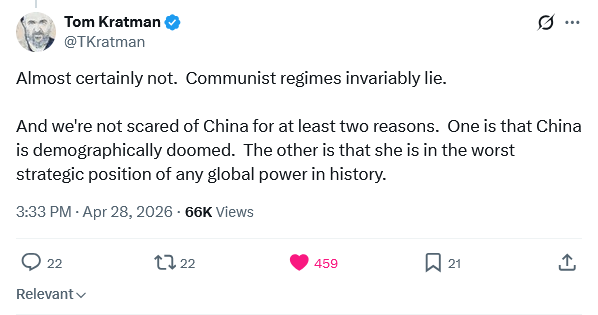
On the social media site formerly known as Twitter, ESR expands on a post by Tom Kratman about the strategic weakness of the current Chinese government:

Tom didn’t explain his second assertion, but it’s important so I’m going to do it.

China is in the worst strategic position of any great power in history because it is critically dependent on resources it has to import, and it doesn’t have control of the sea lanes over which it imports them.

China is neither food nor energy self-sufficient. It needs to import pork from the United States, grain from Africa, coal from Australia, and oil from the Middle East to keep its population fed and its factories running.

Naval blockades at about three critical chokepoints (Hormuz, Malacca, Sunda) would cripple the Chinese economy within months, possibly within weeks. China does not have the blue-water navy required to contrast control of those chokepoints. The moment any first-rate naval power or even a second-rate like India decides China needs to be stopped, it’s pretty much game over.

As a completely separate issue thanks to the one-child policy, Chinese population probably peaked in 2006 and has been declining ever since. Every year in the foreseeable future they will have fewer military-age males than they do now. Most of those males are only sons; their deaths would wipe out entire family lines, giving the Chinese people an extremely low tolerance for war casualties.

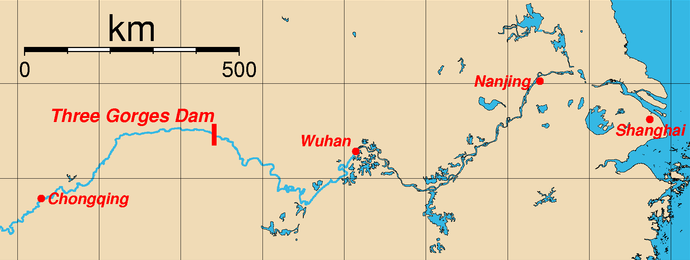
Then there’s the glass jaw. The Three Gorges Dam. Which is already in some peril even without a war — you can compare photographs over time and see that it’s sagging. If anyone gets annoyed enough to pop that dam thing with a bunker-buster or a pony nuke, the resulting floods will kill millions and wipe out the strip of central China that is by far the country’s most industrially and agriculturally productive region.

The Chinese haven’t fought a war since 1971. They lost. Against Vietnam. The institutional knowledge that could potentially fit their army for doing anything more ambitious than suppressing regional warlordism does not exist.

I could go on. But I think I’ve made Tom’s statements sufficiently understandable already.

The position of the Three Gorges Dam on the Yangtze River in Hubei Province, showing the major cities downstream of the dam.
Image by Rolfmueller via Wikimedia Commons.

And Tom Kratman responds:

Almost perfect; you missed four tricks.

1. People, when we talk about blockading China, imagine that we’re talking about a civilized stop and search. Uh, uh; we will designate a no go zone and sink without further warning anything that enters it.

2. Our blockade will be distant, well out of range of those Oh-they’re-just-too-terrible-for-words (but never tested) DF-21s. [Wiki] (You did sort of address this, but not in so many words.)

3. We can blow the levees on the Yellow River, too, to kill many millions more and destroy still more industry (it flows above ground).

4. China not only doesn’t have the navy to contest with us, it can never have that navy. Why not? Because there’s only so much wealth to go around; China is surrounded on all sides by enemies with anywhere from decent to quite good armies, any or all of which might take a stab (pun intended) at carving China up like a turkey. They must put a lot more money and effort and manpower into stymying those than they can ever put into meeting us and Japan.

The History of BROWN SAUCE: HP Sauce, A1 Sauce, OK Sauce and Chef Sauce

Filed under: Britain, Business, Food, History — Tags: , , — Nicholas @ 02:00

Tweedy Misc
Published 7 Nov 2025

Have you ever wondered how British “brown sauce” came about? What is it made from? Who invented it? When was it invented? Which brown sauce is the oldest? When did we start calling it “brown sauce”?

In this video we look into what exactly brown sauce is (and isn’t), we look into ingredients of a number of iconic brands (and some supermarket own brands) and explore the history of the five brown sauces which defined the category: A1 Sauce, OK Sauce, HP Sauce, Daddies Favourite Sauce and Chef Sauce.

Some links to Wikipedia etc in case it helps figure out what this is all about:
https://en.wikipedia.org/wiki/Brown_s…
https://en.wikipedia.org/wiki/HP_Sauce
https://en.wikipedia.org/wiki/A.1._Sauce
https://en.wikipedia.org/wiki/Daddies
https://en.wikipedia.org/wiki/OK_Sauce
https://en.wikipedia.org/wiki/Chef_Br…

If you’re finding the wobbling bottles are a problem for you, here’s a version of the video without any wobbling: • History of Brown Sauce (No Wobbling!)

This video was made using Davinci Resolve 20, with a lot of the still images made using Canva.

Chapters:

0:00 Introduction
0:16 What is brown sauce?
2:33 Supermarket own brand brown sauces
4:02 History of brown sauce
4:48 A1 Sauce
10:49 OK Sauce
15:31 HP Sauce
17:06 Daddies Favourite Sauce
19:06 Chef Sauce
23:50 Conclusion

QotD: The terrible economics of (most) recycling efforts

Filed under: Economics, Environment, Quotations, USA — Tags: , — Nicholas @ 01:00

New York City confidently predicted that it would save money by starting a mandatory recycling program in 1992, but it took so much extra labor to collect and process the recyclables that the city couldn’t recoup the costs from selling the materials. In fact, the recyclables often had so little value that the city had to pay still more money to get rid of them. The recycling program cost the city more than $500 million during its first seven years, and the losses have continued to mount. A new study by Howard Husock of the Manhattan Institute shows that eliminating the city’s recycling program and sending all its municipal trash to landfills could now save taxpayers hundreds of millions of dollars annually — enough money to increase the parks department’s budget by at least half.

Even those calculations underestimate the cost of recycling because they include only the direct outlays, chiefly the $686 per ton that the city spends to collect recyclables. But what about all the valuable time that New Yorkers spend sorting and rinsing their trash and delivering it to the recycling bin? For a New York Times Magazine article in 1996, I hired a Columbia University student to keep track of how much time he spent recycling cans and bottles and how much material he gathered in a week. Using those figures (eight minutes to gather four pounds), I calculated that if the city paid New Yorkers a typical janitor’s wage for their recycling labors, their labor would cost $792 per ton of recyclables — over $100 per ton more than what the city pays its sanitation workers to collect it.

As the economics of recycling worsened, cities in America and Europe found that the only viable markets for their recyclables were in poor countries, chiefly in China and other Asian nations, where processing recyclables was still profitable, thanks to lower wages and lower standards for worker safety and environmental quality. But as those countries have gotten wealthier, they’ve become reluctant to accept foreign trash. As bales of unwanted recyclables pile up in warehouses, towns have had to start sending them to landfills, and dozens of American municipalities have finally had the sense to cancel their recycling programs.

John Tierney, “Let’s Hold On to the Throwaway Society”, City Journal, 2020-09-13.

Update, 1 May: Welcome, Instapundit readers! Have a look around at some of my other posts you may find of interest. I send out a daily summary of posts here through my Substackhttps://substack.com/@nicholasrusson that you can subscribe to if you’d like to be informed of new posts in the future.

Powered by WordPress


