When I first got married, we had several friends in the Toronto arts community, and while I enjoyed their company, for the most part I heartily disliked their art. Everything seemed to be consciously designed to be unpleasant to look at: jagged, rusty metallic edges, weird proportions, bilious colour choices, and so on. I was assured more than once that this was what “art” was meant to be: if it didn’t evince a strong reaction, it wasn’t doing its job. On Substack, Celina discusses the claim that modern art was actually a psyop sponsored by, inter alia the CIA:
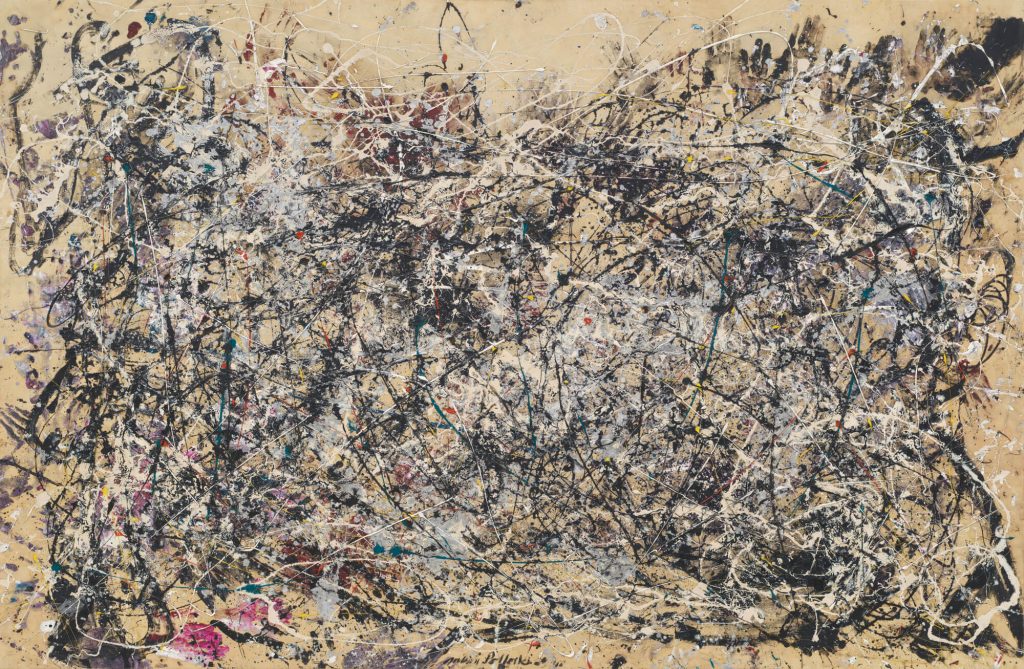
Abstract Expressionism is arguably the most famous American art movement of the 20th century.
There’s a 95% chance you’ve seen a painting by Jackson Pollock, Willem de Kooning, or Mark Rothko, even if you didn’t know their names.
And if you’ve spent any time online, you’ve probably heard the rumours:
They were funded by the CIA.
It was all propaganda.
It wasn’t even real art … just a psyop.That sounds absurd.
Except … there is a large, large grain of truth behind it.
Jackson Pollock, Number 1A, 1948, The Museum of Modern Art, New York, NY, USA.
Manufacturing Consent
After the First World War, the journalist Walter Lippmann helped pioneer the view that the control of information and, more importantly, the control of public response, had become essential to the stability of modern democracy. This was especially true in moments when the state required certain reactions from the public, as it did during wartime. Lippmann, who famously popularised the phrase “the manufacture of consent“, argued that representative government could no longer function without the deliberate use of mass communication in the supposed service of the public good:
That the manufacture of consent is capable of great refinements, no one, I think, denies. The creation of consent is a very old act, which was supposed to have died out with the appearance of democracy, but it has not died out. It has, in fact, improved enormously in technique, because it is now based on analysis rather than on rule of thumb. And so, as a result of psychological research, coupled with the modern means of communication, the practice of democracy has turned a corner. A revolution is taking place, infinitely more significant than any shifting of economic power.1
Lippmann’s ideas about the “manufacture of consent” would not remain theoretical for long. After the Second World War, they were tested on an unprecedented scale by the American establishment.
Poets, philosophers, critics, and intellectuals became participants in it. They were recruited, funded, and mobilised to form the cultural front line of a struggle against the Soviet Union. But this was not a conventional war. There were no trenches, no battlefields, no declarations.
Instead, it was a war of ideas, fought in publishing houses, universities, art galleries, and across the airwaves. At the centre of this effort stood the Congress for Cultural Freedom.
And its story reveals just how far a democracy was willing to go in shaping what its citizens and the world would come to believe.
- Lippmann, W. (1922). Public opinion. Harcourt, Brace and Company.