Quotulatiousness

April 18, 2026

“The whole thing was one giant attempt to gaslight both young men and the public at large”

Filed under: Britain, Media, Politics — Tags: , , , — Nicholas @ 05:00

On the social media site formerly known as Twitter, Christian Heiens responds to a cover story in The New Statesman:
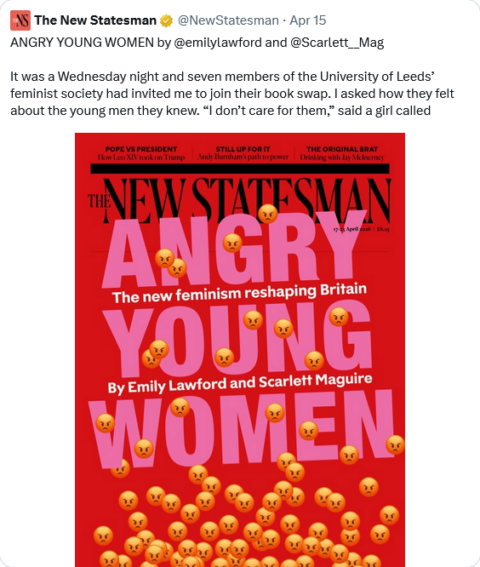
We were subjected to years of “young men are becoming radicalized, what’s driving this and how do we stop it?” discourse when in reality the typical young man saw practically zero change in his political outlook over the last 30 years.

The whole thing was one giant attempt to gaslight both young men and the public at large that they had suddenly moved well outside the Overton window and were either self-radicalizing or falling for extremist propaganda.

In reality, the problem was that young men were staying put rather than adopting increasingly radical progressive views. The real issue was that young women were flying off the rails, espousing views that would lead to the complete dissolution of civilization itself while acting like these were basic normal positions that completely sane people should hold.

That disconnect between what was being said and what was being done became so off kilter with reality that something finally began to break after 2020.

The problem isn’t with young men. The problem is that young women have gone certifiably insane. They’ve made radical progressivism their religion. They’re acting out on the perfectly healthy female tendency to act to uphold and preserve the existing social order.

Young women are trying to conserve an ideology they see as the stable bedrock of society, even if it’s actually an acidic collection of delusions that will inevitably destroy society itself. And they’re upset that young men aren’t doing what they see as their role to uphold that order as well.

In short, women are natural conservatives. They’re trying to conserve progressivism because it’s the reigning social order and theological governing system of Western civilization. And they’re upset and confused as to why young men aren’t stepping up to uphold it as well.

On Substack Notes, John Carter commented on the same New Republic The New Statesman cover story:

Women have never had it better than they do in modern Western countries. They are affluent, thanks to being given every advantage in education and employment; young women now hold more degrees, and make more money, than young men. They can marry whoever they want, from anywhere in the world, or they can marry no one at all. They can sleep with whoever they want, with however many people they want, with no risk of pregnancy, and if they get the ick later they can decide that it was rape and their abuser will be punished. Any opposition to their cultural or political preferences is automatically classified as hate, and every institution acts to denounce and punish this unacceptable hatred on their behalf … in no small part because they have taken over these institutions.

Women have never had it better, and they are absolutely incandescent with fury about that.

Australia’s age verification scheme – a great success!

Every time a politician gets up on hind legs to propose yet another brilliant scheme to ensure little Jaden and little Daenerys don’t access adult content on the internet, I remind myself that it’s going to be pitting the tech know-how of people who need help opening child-proof caps against the youngsters they get to open the child-proof caps for them. In other words, it’s not going to work out quite how the politicians expect:

“Kid-notebook-computer-learns-159533” by LuidmilaKot is marked with CC0 1.0 .

Among the great many bogeymen of the current moment is social media, which stands accused of making young people anxious and unhappy. Whatever the merits of those charges — and they’re debatable — politicians have predictably tried to address concerns by applying the blunt instrument of coercive law to kids’ online activities rather than simply let parents help their children make better choices. The experience in Australia now shows the subjects of the law have, once again, proven cleverer than law enforcers.

[…]

“There are significant questions about the effectiveness of Australia’s social media ban”, reports the U.K.’s Molly Rose Foundation, which supports internet restrictions, of the results of a poll of Australian young people. “Three fifths (61%) of 12–15 year-olds who previously held accounts on restricted platforms continue to have access to one or more active accounts.”

The group adds that “70% of children still using restricted sites say that it was ‘easy’ to circumvent the ban. In most cases, social media platforms have failed to detect or seek to remove under 16s accounts.”

Importantly, officials agree that young people subject to the law are actively evading its impact. In a compliance update published last month, Australia’s eSafety Commissioner, which enforces the ban, conceded that “a substantial proportion of Australian children under the age of 16 continue to retain accounts, create new accounts, or pass platforms’ age assurance systems”.

Like the Molly Rose Foundation, Australian regulators note that noncompliance is not just a concern for the small platforms with limited exposure in Australia which were expected to become refuges for Australian teens seeking online connections. They also point to large, established companies including Facebook, Instagram, Snapchat, TikTok, and YouTube.

In the majority of cases, according to both reports, young people ignoring the law have not yet been asked to verify their age. But, according to the Molly Rose Foundation, “around a quarter of children still using each restricted platform had been successfully able to get around an age check on a pre-existing account”. Some changed their claimed age, others had older friends and relatives set up accounts for them, and still others gamed technology intended to estimate their age by their appearance.

Another proof of the value of open source

Filed under: History, Media, Technology — Tags: , , , , , — Nicholas @ 03:00

On the social media site formerly known as Twitter, ESR discusses a pre-computer (pre-electronics) proof that open source is more secure than closed source:

“How university open debates and discussions introduced me to open source” by opensourceway is licensed under CC BY-SA 2.0

There’s an old, bad idea that’s been trying to resurrect itself on X in the last couple of days. Which makes it time for me to explain exactly why, in the age of LLMs, open-sourcing your code is an even more important security measure than it was before we had robot friends.

The underlying principle was discovered in the 1880s by an expert on military cryptography, a man named August Kerckhoffs, writing long before computers were a thing.

To start with, you need to focus in on the fact that cryptosystems have two parts. They have methods, and they have keys. You feed a key and a message to a method and get encrypted information that, you hope, only someone else with the same pair of method and key can read.

What Kerckhoffs noticed was this: military cryptosystems in normal operation leak information about their methods. Code books and code machines get captured, stolen, betrayed, or lost in simple accidents and found by people you don’t want to have them. This was the pre-computer equivalent of an unintended source-code disclosure.

Cryptosystems also leak information about their keys — think post-it notes with passwords stuck to a monitor. What Kerckhoffs noticed is that these two different kinds of compromising leakage happen at very different base rates. It is almost impossible to prevent leakage of information about methods, but just barely possible to prevent leakage of information about keys.

Why? Keys have fewer bits. This makes them easier to keep secret.

Remember: this was something an intelligent man could notice in the 1880s, well before even vacuum tubes. Which is your first clue that the power of this observation hasn’t changed just because we’re in the middle of a freaking Singularity.

Security through obscurity — closed source code — means you’re busted if either the source code or the keys get leaked. Open source is a preemptive strike — it’s a way to force the property that your security depends *only* on keeping the keys secret.

What you’re doing by designing under the assumption of open source is preventing source code leakage from being a danger. And that’s the kind of leakage with a high base rate.

As far back as 1947 Claude Shannon applied this to electronic security — he did critical work on the voice scramblers that were used for secure telephone communications between heads of state during World War II. Shannon said one should always design as though “the enemy knows the system”. The US’s National Security Agency still uses this as a guiding principle in computer-based cryptosystems.

If you’re doing software security, always design as though the enemy can see your source code. I’m still a little puzzled that I was apparently the first person to notice that this was a general argument for open source; as soon as I did, my first thought was more or less “Duh? Somebody should have noticed this sooner?”

Now let’s consider how LLMs change this picture. Or…don’t.

An LLM is like a cryptanalyst with a superhuman attention span that never sleeps. If your system leaks information that can compromise it, that compromise is going to happen a hell of a lot faster than if your adversary has to rely on Mark 1 meatbrains.

But it gets worse. With LLMs, decompilation is now fast and cheap. You have to assume that if an adversary can see your executable binary, they can recover the source code. If you were relying on that to be secret, you are *screwed*.

Leakage control — limiting the set of bits that can yield a compromise — is more important than ever. So security by code obscurity is an even more brittle and dangerous strategy than it used to be.

Anybody who tries to tell you differently is either deeply stupid or trying to sell you something that you should not by any means buy.

The First M60 Prototype: FG42 + MG42 = T44

Filed under: Germany, History, Military, USA, Weapons, WW2 — Tags: , , , , , — Nicholas @ 02:00

Forgotten Weapons
Published 1 Dec 2025

The FG-42 caught the attention of a lot of countries at the end of World War Two. The British and Swiss both used it as the starting point for some developments. The US went one step simpler, and simply cut up a captured FG-42 to make into the T44, the first prototype of what would become the M60 machine gun.

This project was done in 1946 by the Bridge Tool & Die Company, who spent about six months reinforcing an FG42 and adding an MG42 feed system to it to create an unholy hybrid kludge of a gun. It was, however, successful enough to justify continuing the project. Only this one example was made before moving on to much more practical models built from the ground up instead of hacking up captured German guns.
(more…)

QotD: Democratic versus Republican Senators

Filed under: Media, Politics, Quotations, USA — Tags: , , — Nicholas @ 01:00

A few years ago, Democratic Senator Kyrsten Sinema provoked the rage of progressive activists by occasionally having an independent thought, voting with her caucus on “party unity votes” only 96% of the time. Senator Joe Manchin caused comparable disgust by joining his party in those votes only 92% of the time. Sinema and Manchin were EVIL MONSTERS, and progressive activists showed up at their public events to scream at them.

Sinema eventually left the Democratic Party, declaring herself an independent, because a disgusting heretic couldn’t remain in a party that she only agreed with 96% of the time. Burn the witch, Democrats explained.

The descent of the Democratic Party into a state of increasingly obvious group psychosis is a product of the absence of internal debate, and of the degree to which Democratic legislators wholeheartedly believe that their job is to hold up their hands in unison whenever their party leaders tell them to. They can’t talk themselves out of their madness — they don’t know how. They don’t have the cultural habit of thought. Watch someone like Chris Murphy speak, and ask yourself if there’s a person inside there. I find myself unable to say yes to that question. He will read anything that is put on that teleprompter, and I mean an-y-th-ing.

By comparison, the Republican legislative habit of wandering around like the residents of a feline daycare center is a strength, and the presence of independent thought in the GOP’s legislative caucuses makes the party relatively sane. The presence of a Rand Paul, refusing to get on board, is more a good thing than a bad thing. The culture of debate is healthier than the behavior of the North Korean legislature or Tina Smith, soulless human robots.

Chris Bray, “The Greatest Republican Strength is the Greatest Republican Weakness, Again”, Tell Me How This Ends, 2026-01-15.

Powered by WordPress