Quotulatiousness

April 7, 2026

Alberta is the only province moving in the right direction

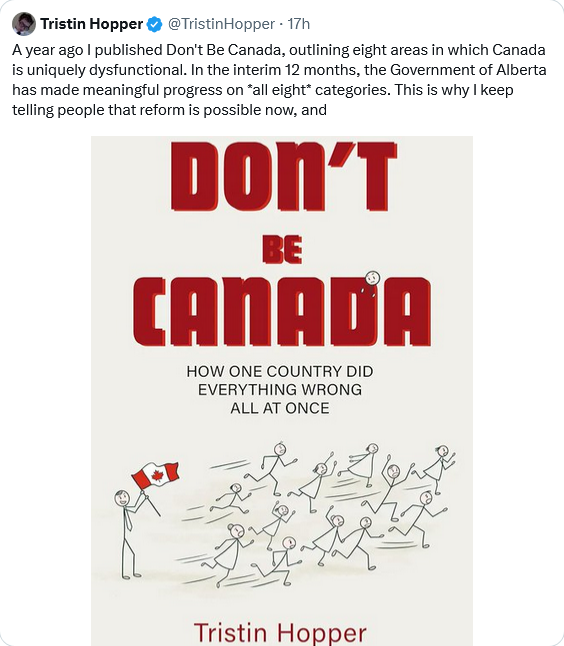
On the social media site formerly known as Twitter, Martyupnorth responds to Tristin Hopper’s post about Don’t Be Canada: How One Country Did Everything Wrong All At Once, which he published a year ago:

Here is a one-line summary of each of Tristin’s 8 points:

Housing crisis: Canada pioneered turning entire cities into over-leveraged real estate bubbles, driving home ownership out of reach for ordinary people because prices detached from wages.

Crime and justice: Soft-on-crime policies, catch-and-release bail, and activist courts created a revolving door for repeat offenders, leaving our streets unsafe.

Harm reduction & drugs: “Safe supply” and decriminalization experiments escalated addiction and public drug use, worsening overdoses, tent cities, and societal harm instead of reducing it.

Euthanasia (MAiD): Canada rapidly expanded medical assistance in dying into one of the world’s most aggressive programs, with soaring death numbers and cases pushing it as a tratement for poverty and disability.

Healthcare system: Despite high spending, Canada’s “free” system ranks near the bottom in performance among developed nations, with deadly wait times and dysfunction.

Transgender policies: Canada went further than most countries with permissive rules on youth transitions, pronouns, biological males in female spaces, and related ideology in schools and institutions.

Identity politics and “anti-racism”: Canada outdid even the U.S. in embracing divisive oppressed frameworks, including declaring itself guilty of an ongoing “genocide” against Indigenous people with little accountability.

Censorship and speech laws: Expansive hate speech rules, online content takedowns, and bills like the Online Harms Act pushed Canada toward Orwellian restrictions, chilling expression and drawing international warnings.

Canada took progressive ideas further and faster than peers, almost always with cascading negative consequences, turning a once-stable nation into a totally dysfunctional one.

He’s right in saying that Danielle Smith is the only one finally acknowledging that things aren’t working, and is trying to reverse some of these pad idea.

It’s still not enough to save Alberta, we need to divorce ourselves from the rest of Canada and their bad ideas.

“The Eight Hundred Years of Oppression”

Filed under: Britain, History, Politics, Religion — Tags: , , , , — Nicholas @ 04:00

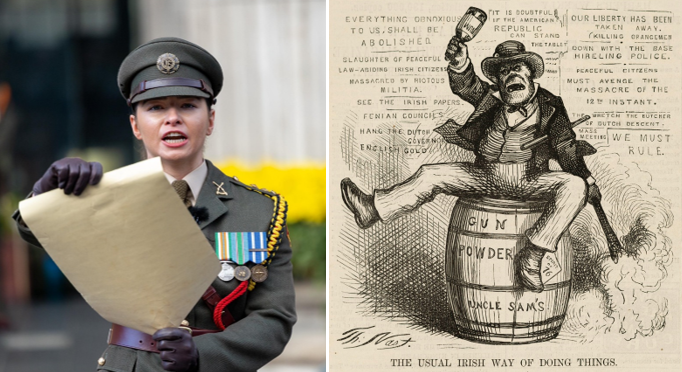
On Substack, Upper Canadian Cavalier examines “The Irish Question”:

Every confidence scheme requires three things. A mark who is sympathetic. A grievance real enough to be credible. And an operator whose entire livelihood depends on ensuring the grievance is never actually resolved. Resolution ends the game. The operator does not want justice. He wants the next fundraising dinner.

Irish nationalism, in its mature institutional form, is one of the longest-running confidence schemes in the history of democratic politics. This is not to say the underlying grievances were invented. English rule in Ireland produced genuine catastrophes, and anyone who tells you otherwise has not read much history. The point is not that the wounds were fake. The point is that a very specific class of people discovered, sometime in the nineteenth century, that a bleeding wound is worth considerably more than a healed one, and they have been salting it professionally ever since.

The operators of this scheme are not a conspiracy in any tidy sense. They do not meet in a room. They are, rather, an ecosystem: the Sinn Féin political class, the Irish-American fundraising establishment, the Gaelic cultural bureaucracy with its language boards and arts councils and grant committees, and undergirding all of it for most of its history, the Catholic Church, which managed the remarkable trick of positioning itself as the spiritual soul of Irish resistance while simultaneously running the country’s schools, hospitals, orphanages, and laundries with the administrative efficiency of a medium-sized colonial power. They share no common mailing list. They share something considerably more durable: a common interest in a people who define themselves entirely by what was done to them, because such a people will always need someone to explain what it means.

That someone, naturally, has a salary. Sometimes several.

Part One: The Invoice That Never Clears

The foundational text of Irish identity is not a poem or a legal document or a philosophical treatise. It is an invoice. The Eight Hundred Years of Oppression, presented at every available occasion, never stamped paid, accruing interest at a rate that defies actuarial calculation. It is invoked at pub tables and university seminars and Boston fundraisers and Sinn Féin press conferences with the solemn regularity of a liturgical response, which is appropriate, since it has become one.

Eight hundred years. Let us sit with that number for a moment, because it deserves scrutiny rather than reverence.

The Poles were partitioned entirely out of existence for a hundred and twenty-three years, absorbed simultaneously by three empires, had their language banned, their nobility liquidated, their clergy persecuted, and their country removed from the map of Europe with a finality that the Irish situation never approached. They rebuilt it. They were then invaded again from both sides at once within living memory, occupied by The Nazis and Soviets losing somewhere between five and six million citizens in six years. They do not, as a general rule, organize their entire national identity around the experience. They built things instead.

The Armenians experienced something so total it required the coinage of an entirely new word to describe it. The Acadians were physically deported. The Welsh had their language suppressed for centuries by a state apparatus that regarded Welsh-speaking children as candidates for corrective intervention, which is considerably more systematic than anything the Penal Laws produced. The Greeks spent nearly four centuries under actual Ottoman administration, not the notional suzerainty that characterized much of the Anglo-Irish relationship, and emerged and got on with being Greeks.

None of them made Eight Hundred Years into a brand.

What distinguishes the Irish accounting of oppression is not the severity of the oppression, which was real but not historically singular, but the extraordinary care with which it has been packaged, maintained, and exported. The Famine, which ended in the 1850s, is still discussed in certain Irish-American circles as a recent bereavement requiring ongoing condolences and, more usefully, ongoing donations. The emotional statute of limitations has never been permitted to run. Each generation receives the invoice freshly printed, as though the debt were personally owed to them and personally owed by someone who can still be made to feel bad about it.

NATO’s sudden-onset existential crisis

Filed under: Europe, Media, Military, Politics, USA — Tags: , , , , — Nicholas @ 03:00

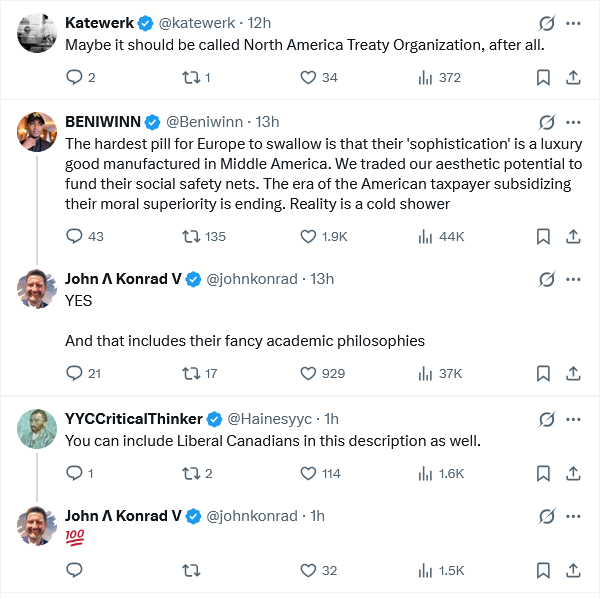
On the social media site formerly known as Twitter, John Konrad explains that the sudden crisis facing the European NATO allies has been building un-noticed for decades:

NATO is in far bigger danger than anyone realizes. And the reason has nothing to do with defense budgets.

The real danger is psychological. It’s cultural.

Europeans didn’t just free-ride on American security for 80 years. They built an entire identity around the idea that they evolved past the Americans protecting them.

That identity is now the single biggest obstacle to Western survival. And the darkest irony is: we helped build it. After World War II, Europe wasn’t just economically shattered. Its culture was in ruins. The cities, the universities, the concert halls, the museums. Rubble.

The Marshall Plan rebuilt the economy. But culture wasn’t a priority. Not at first. Then the Iron Curtain dropped. And suddenly culture became a weapon.

American diplomats, academics, artists & scholars flooded Western Europe. We funded their universities. Supported their orchestras. Rebuilt their museums. Promoted their intellectual life.
Not because European culture needed saving for its own sake.

Because Eastern Europeans were struggling for Maslow’s mist basic needs.

We needed the view from the other side of that Wall to be intoxicating.

So America built Western Europe into a showcase of self-actualization. Art. Philosophy. Cafe culture. Long vacations. Universities where people studied literature instead of surviving. We were manufacturing jealousy.

And it worked. The Wall came down.

But here’s what no one accounted for.

When you give a society self-actualization on someone else’s tab long enough, they forget it was a gift. They start believing it was organically theirs.

And when they look at the country that funded it all, a country busy building aircraft carriers and semiconductor fabs and shale fields instead of reaching the Maslow’s pinnacle.

An overweight American in a ball cap who can’t tell Monet from Pissarro. Who eats fast food. Who drives a truck. Who builds strip malls instead of piazzas.

And to a culture trained in aesthetics but stripped of strategic awareness, that American looks uncivilized.

So the arrogance takes root. And once a culture decides another is beneath them, they stop listening.

Americans say wars are sometimes necessary: crude.

Oil is the backbone of prosperity: unsophisticated.

Kids build companies in garages that reshape the planet: crass.

Wall Street finances the global economy: vulgar.

Europe has no world-class technology sector. No military capable of strong defense. No energy independence. No AI capacity.

What Europe has is culture. The culture we paid for at the expense of us reaching Maslow’s pinnacle.

For decades that was fine. We funded the museums, protected the sea lanes, and tolerated the sneering because the arrangement worked.

Then Europeans stopped keeping the contempt private. They started saying it to our faces. In their media. In their parliaments. At every international forum. “Americans are stupid. Americans are violent. Americans are a threat to democracy.”

We could have moved the Louvre to NY. We could have built a Venice here. We could have stolen your best artists, designers, philosophers and more … like your conquering armies did for centuries.

Instead we funded them. And all we asked for in return was to let us visit.

You don’t have the military to defend your borders. You don’t have the technology to compete. You don’t have the energy to heat your homes without begging dictators.

What you have is an 80-year superiority complex FUNDED BY AMERICANS, protected by American soldiers, and built on the false belief that self-actualization is civilization.

It isn’t. Civilization is the ability to sustain itself. By that measure, Europe isn’t a civilization at all. It’s a dependency with better wine.

That’s not a threat. It’s a weather report.

Build a Navy. Or don’t. But stop lecturing the people who made you “better than us”

Our “crudeness” our “stunted liberal education” our “ugly strip malls” are because we sacrificed our culture to support yours.

From the comments on that post:

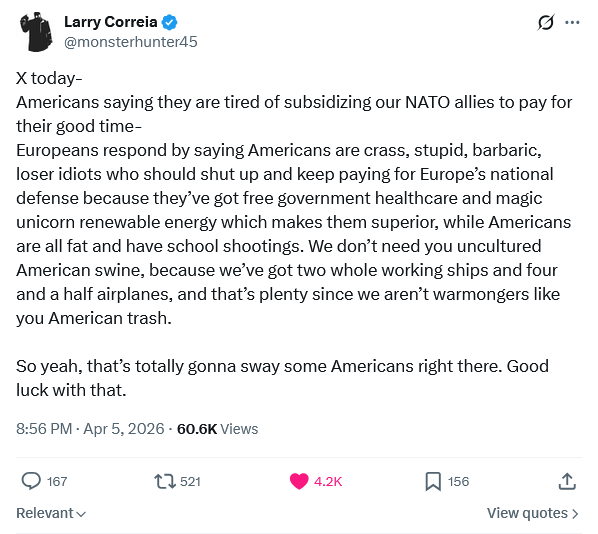
Larry Correia chimes in:

Update, 8 April: Welcome, Instapundit readers! Have a look around at some of my other posts you may find of interest. I send out a daily summary of posts here through my Substackhttps://substack.com/@nicholasrusson that you can subscribe to if you’d like to be informed of new posts in the future.

The Myth of Mooncakes: Did they topple a Chinese Dynasty?

Filed under: China, Food, History — Tags: , , , , — Nicholas @ 02:00

Tasting History with Max Miller
Published 30 Sept 2025

Mooncakes made with flaky pastry and a seed and nut filling, decorated with a red stamp

City/Region: China
Time Period: 1792

There are many different kinds of mooncakes made all over East Asia around this time of year for the Mid-Autumn Festival. Some are savory, some are sweet, and they can have chewy, crumbly, or flaky doughs.

The flaky dough that we’re making here can be made with either lard or melted butter. Lard would have been more traditional for 1792, and it makes a more flavorful pastry, but melted butter will make a smoother dough that’s easier to work with and comes out less crumbly and more flaky.

The filling is delicious and not too sweet, with a rich unctuousness from lard, nuts, and seeds.

    Imperial Scholar Liu’s Mooncake
    Use flying flour from Shandong to make a flaky pastry for the crust, with pine nuts, walnuts, and melon seeds ground into a fine powder for the filling. A little rock sugar and lard are added. When eaten, it does not taste overly sweet, but instead is fragrant, flaky yet tender, and rich; a truly unique experience.
    Suiyuan Shidan by Yuan Mei, 1792

(more…)

QotD: Advice for foreign leaders trying to deal with Donald Trump

Filed under: Government, Media, Politics, Quotations, USA — Tags: , , — Nicholas @ 01:00

If you want to understand Trump, you have to understand that he’s not a politician.

I do not say this as meaningless praise, just to say, oh, he’s not a corrupt scumbag. I say it with a very specific meaning.

To understand Trump, you must purge yourself of all expectations you have learned from watching politicians, include the assumptions you are not even aware you are making.

Trump is a completely different animal.

Trump is a businessman, and while there are many sorts of businessman, he is of a very specific type. He rose to wealth and prominence by doing two things very well:

1. Brand reputation building.
2. Negotiation.

#1 forms the basis of how he deals with voters.

#2 forms the basis of how he deals with other power blocs within the US, and with other nations.

You see, the true love of Donald Trump’s life is bargaining. He is a business deal sperg. And he’s very, very good at it, because the actual process is his idea of fun, and winning at it is definition of pure satisfaction and joy.

He’s never made uncomfortable by the play of offer and counteroffer, or by butting heads and seeing who blinks first. That is, instead, his happy place. This means that not only is he totally at peace in the moment, he’s also practiced a lot.

When he called his book The Art of the Deal, it wasn’t just because he wants to think he’s good at this, it’s because this is the meaning of his life. The man finds meaning in haggling the way Musk finds meaning in building technologies, or the way I find meaning in explaining things to an audience.

So when Trump is dealing with others, from political office, he’s negotiating as if it were his money. Because that’s just how he ticks.

Now, the ground rule of global politics for the past 100+ years is that no matter who you are, you are allowed to rob American taxpayers and voters, so long as you pay American politicians for the privilege of doing so.

All of us, even democrat voters who don’t want to think about it, know what 10 percent for the big guy meant, and who the particular big guy was.

For all that time, global politics amounted to treating America as a giant cash pinata, and the deals had only two guardrails on them.

1. You must pay American politicians a large enough sum, in a subtle enough manner.
2. You can’t buy anything that your paid-off politicians won’t be able to hide their personal connection to.

That’s it.

Everything else was on the table.

Trump isn’t like that. He can’t be bought.

Not because he’s some kind of saint, which he isn’t, nor because corrupt-politician money is loose change compared to Donald Trump money, which it is.

But because Trump can’t stand to deliberately lose a negotiation for a bribe, any more than Floyd Mayweather wants to throw a match to get paid off by bookies.

And this is how Trump became involved in politics in the first place. He was a standard New York City rich moderate democrat. Believed in the Postwar Dream, bought into the raceblind thing, was all in favor of exporting democracy, and taxed capitalism paying for a moderate amount of welfare state. But as he realized the political machines were selling out America, he got personally offended.

Not because he was principled and deeply cared about middle America. Perhaps a little because selling out America was hurting his real estate interests.

But mostly because bad business deals give Donald Trump the ick.

Trump seems like a loose cannon to a lot of people, because they don’t what he’ll do next. And they don’t know that because they don’t understand what motivates him.

Trump wants America to make better deals and stop being taken advantage of. And to make those better deals, he has to demonstrate to the people who are used to buying American politicians that the rules in play have changed.

So what’s the deal with Venezuela and Maduro?

Simple. If you ride the NYC subway enough, it’s pretty likely that eventually a bum will come up to you, whip out his dick, and piss on your shoes.

Why? Because he wants to feel powerful. Because his day isn’t going well, and so he wants to ruin yours. Because he’s crazy. Because who the fuck cares?

But most of all, because he can. Because NYC is run by out of touch commie liberals, and he knows that if he is arrested, he’ll be fed and let out in the morning, but if you punch him in the teeth, your life will be ruined.

So when things change, people need to be put on notice. The bums aren’t going to read a sign that says “this subway now functions under Tennessee rules”, and if they do read it, they aren’t going to believe it. They’ve heard it all before as a bluff.

You have to actually punch someone in mouth and knock some teeth out. And then have the Tennessee cops show up and say, so what, you shouldn’t have pissed on his shoes, dumbass.

It is beyond the shadow of a doubt that Maduro was offered plenty of gentle offramps which would have preserved his dignity, lifestyle, etc, if not his pride.

But he didn’t take them, because everything is a bluff … until it isn’t.

Maduro is a head on a spike. A signal that the ground truth of how to deal with America has changed.

A signal that both violence, and personal consequences, are no longer off the table.

Because the whole reason for the existence of governments is to wield organized violence instead of the disorganized kind.

Other nations will now be coming to the negotiating table with this example in mind.

America is tired of being your ATM.

Devon Eriksen, The social media site formerly known as Twitter, 2025-01-06.

Update, 8 April: Welcome, Instapundit readers! Have a look around at some of my other posts you may find of interest. I send out a daily summary of posts here through my Substackhttps://substack.com/@nicholasrusson that you can subscribe to if you’d like to be informed of new posts in the future.

Powered by WordPress