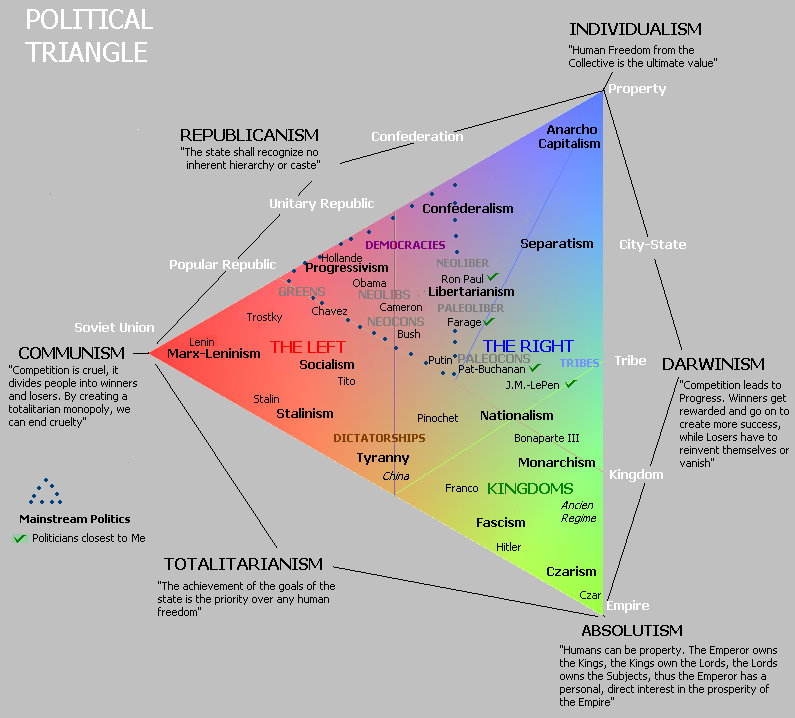
Lorenzo Warby discusses political categories and explains why they aren’t the same as moral categories:
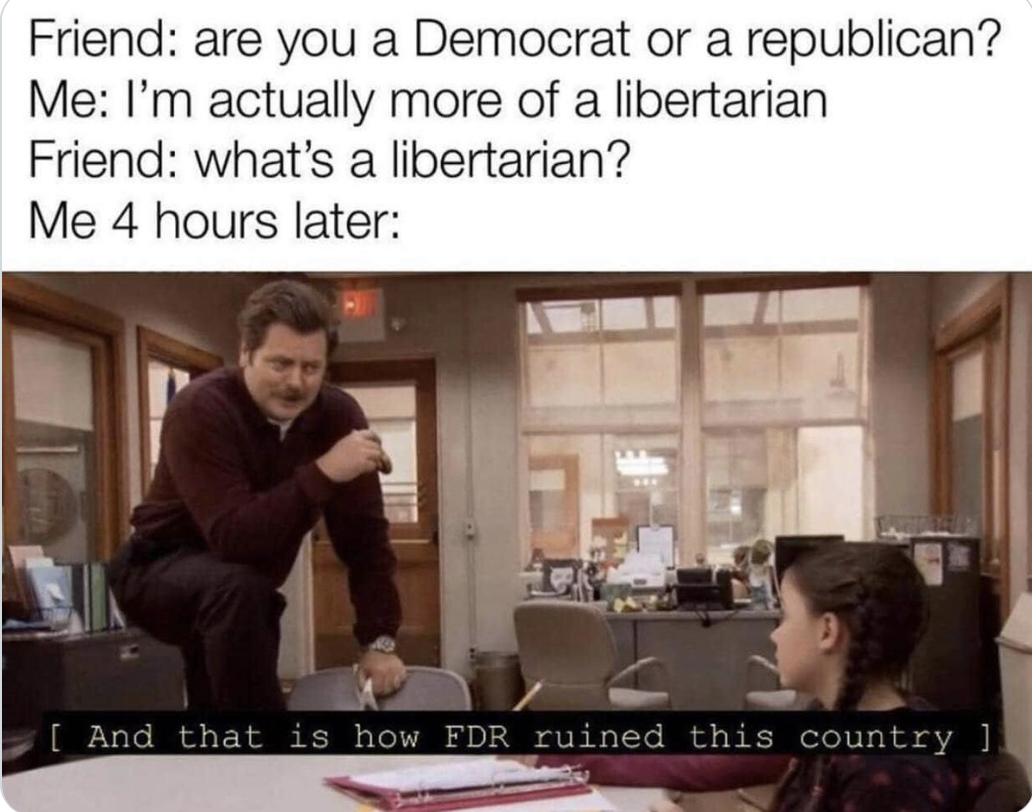
A lot of people who class themselves as being on the Left clearly feel that there is some automatic moral kudos from being on the Left. As a direct implication of this sense of moral kudos, they also clearly think that there is some moral deficiency from being on the Right.
Yes, there are difficulties in defining Left and Right. Nevertheless, even without that difficulty, any such claim of moral kudos is ridiculous. The Left includes Lenin, Stalin, Mao, Kim il-Sung, Pol Pot, Mengistu … Indeed, by far the most important historical impact of Left politics on world history is precisely the actions of this succession of mass-murdering tyrants and their regimes.
If you think that somehow the Left does not include said mass-murdering tyrants, you are simply wrong. It is very revealing that there are clearly many folk on the Left who somehow edit out this history. They are not looking at the Left as it is in history, but as some set of noble aspirations that morally ennoble themselves.
Folk not of the Left absolutely associate the Left with those mass-murdering tyrants. Moreover, if you edit out that history, you are editing out how the political tradition you identify with can go horribly wrong. That is not a reassuring pattern. On the contrary, it is a deeply worrying pattern.
Of course, if you are happy to be associated with some or all of those mass-murdering tyrants, that is even more of a worry.
Clearly, Left is not a moral category. It is a political category, not a moral one.
The same point applies, of course, about the Right. After all, the Right includes Hitler.
Thus, neither Left nor Right are moral categories. They are political categories, and political categories that people can get very tribal about. But they are not moral categories.
This point applies to other political categories: Socialist, for example. Hitler was a socialist. He called himself a socialist, he did socialist things, intended to do more socialist things after the war. In his writings, he argued in socialist ways.
The aforementioned mass-murdering tyrants were all socialists. They were implementing socialism on the way to communism, except for Hitler, who was using socialism as a tool to forge an Aryan super race worthy and able to dominate others. So, Socialist is not a moral category.
If you stop regarding broad political categories as also being moral categories, a lot of silly arguments go away. Such as, for example, whether Hitler was a socialist. Or, whether Hitler was of the Right. Yes, Hitler was a both a socialist and of the Right—which points to how diverse a range of political traditions Right applies to.
Even when there are grounds to attaching moral valence to political categories, that is something to be done carefully and sparingly, otherwise it can seriously get in the way of understanding.
Thus, using Fascist as a boo! word but Communist as a neutral, or even hurrah! word, is ridiculous. It is even more so when Fascist is used to obscure Nazis being National Socialists.