Quotulatiousness

April 20, 2026

Civilization-building is gendered, sorry ladies

Filed under: Health — Tags: , , , , , — Nicholas @ 05:00

On Substack, Janice Fiamengo explains why the very different strengths and weaknesses of men and women will always lead to what appear to be unequal results, and fighting against biology is always a bad idea:
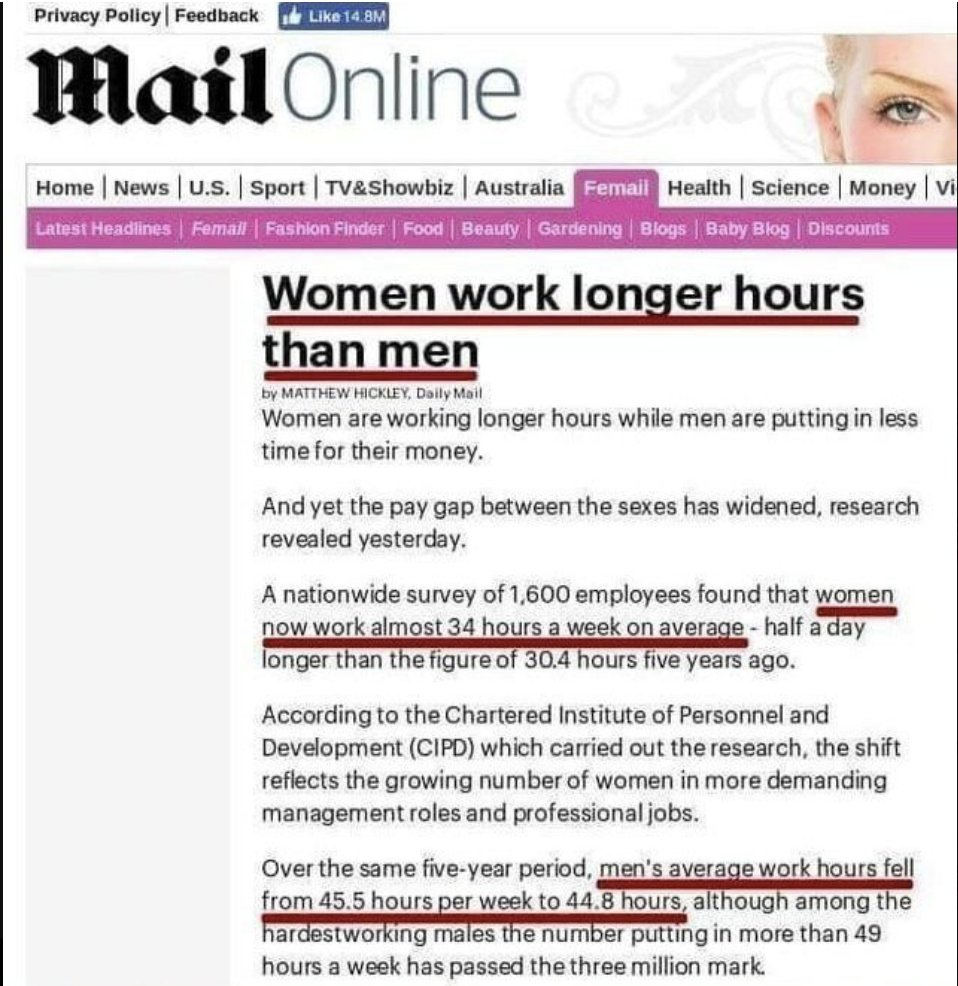
Even if the numbers don’t back it up, women feel that this is so true.

Social psychologist Roy Baumeister explored the relevant research in Is There Anything Good About Men (2010), a cautiously non-feminist book in which the author readily asserted that he, like most everyone else, prefers women to men. Women are more lovable, he claimed, and more pleasant to be around.

But he was not quite willing to accept the now-mainstream thesis that women can replace men in all areas of society.

His thesis is summed up in the book’s sub-title: How Cultures Flourish By Exploiting Men. Men are the foot soldiers of civilization as well as its leaders. They are the ones who make things work or make new things.

Men are the ones who must prove their utility to society. Their drive to be useful has powered centuries of back-breaking work, risk-taking, tool-building, self-sacrifice, and outstanding performance of a sort that has never been expected of women (and still isn’t).

Women in the main tend not to work as hard as men to succeed because they don’t have to. Women developed different strengths and tendencies.

Women’s strength, for good and ill, is in the inter-personal arena: not only in caring for those who are weaker but also in being cared for by those who are stronger. Women are good at reading people’s emotions and desires, and at expressing their own.

Men are not rewarded for expressing emotions and desires; men are oriented to acting, often under pressure to perform competently, in large groups and systems.

“The female brain,” according to Baumeister, “tends to be geared toward empathy, which includes emotional sensitivity to other people and deep interest in understanding them and their feelings. In contrast, the male brain is oriented toward understanding systems, which means figuring out general principles of how things operate and function together, and this applies to inanimate objects as much as social systems” (p. 85).

Baumeister supports his argument in a book-length exploration of men’s system-building. He shows how men are driven to work with, and in competition with, other men to make it possible for large numbers of human beings to live together in complex, efficient networks. The large social institutions that have characterized western cultures, from the army to churches, from corporations to unions, and from market places to police forces, give evidence of men’s system-building.

Women can work well within the systems that men devise, but they rarely devise new systems on their own. This is not because women are, on average, less intelligent than men (except at the very highest levels). It is because women’s motivations and sources of satisfaction are generally different from men’s.

Women’s contribution to culture in nurturing children, providing companionship, and looking after the family home has been a crucial one. But it does not drive innovation or invent new technologies.

Even the most intelligent women are rarely compelled, as highly intelligent men often are, to pursue scientific and other breakthroughs with the single-minded focus necessary for greatness. Often, as in the case involving Matt Taylor discussed above, many women do not seem to value or understand the nature and importance of such breakthroughs.

Women’s main contribution in the male civilizational sphere has been to lobby for admission and then to complain about, and work to undermine, the male culture of competitive excellence.
“Hail, Caesar!” oops we meant “Hail, Carney!”

Filed under: Cancon, Media, Politics — Tags: , , , , , , — Nicholas @ 04:00

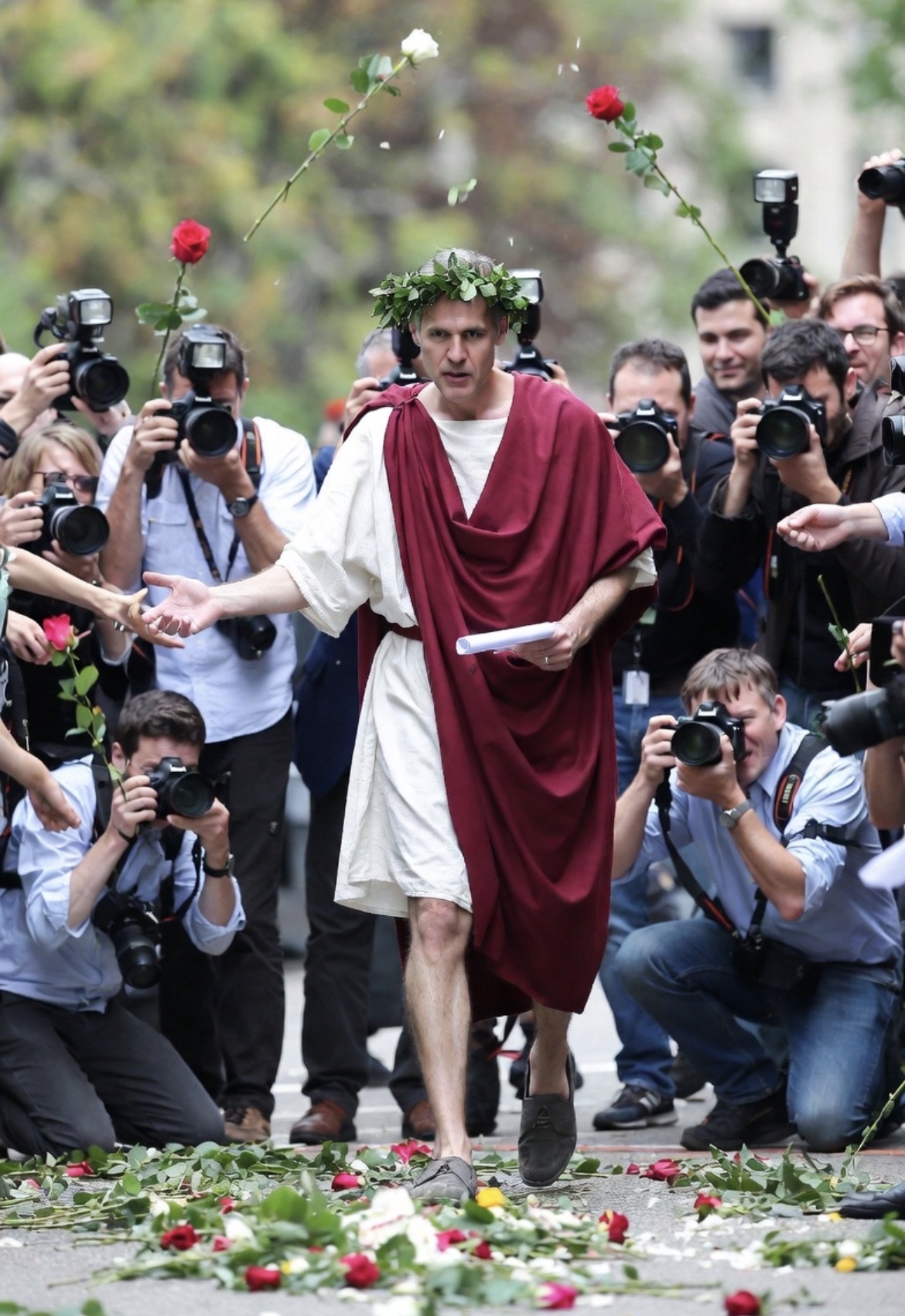
At The Rewrite, Peter Menzies discusses the unseemly media adulation1 for Caesar Prime Minister Mark Carney after more than a year in power:

Grok illustration of PM Carney as Caesar
Image from The Rewrite.

Thirteen months into his reign as prime minister, we still don’t know who Mark Carney is or how he engineered the removal of Justin Trudeau from office.

Nor do we know what really happened behind the scenes to convince five Members of Parliament to betray their constituents’ democratic decisions and, for the first time in the nation’s history, give Canadians a majority government they didn’t elect.

What we do know is that none of that seems of great interest to most of our media or, as they like to describe themselves when seeking federal subsidies, “defenders of democracy”.

As The Rewrite noted a year ago, the moves behind the scenes to effect the abrupt ouster of Trudeau remain a mystery. And, unlike with other PMs, there have been no Carney family magazine profiles. (Who can forget Justin and Sophie Trudeau‘s sexy Vogue cover?) Yes, there are the books, Values and The Hinge. We have learned he likes hockey, runs, won’t criticize China and is ruthless. But there is a tangible paucity of efforts within MSM to get beyond what is permitted to be known. We don’t even know if he watches Heated Rivalry or why the Brits called him “the unreliable boyfriend”. And yet, as Stephen Maher wrote for Time magazine last week, Canadians adore him.

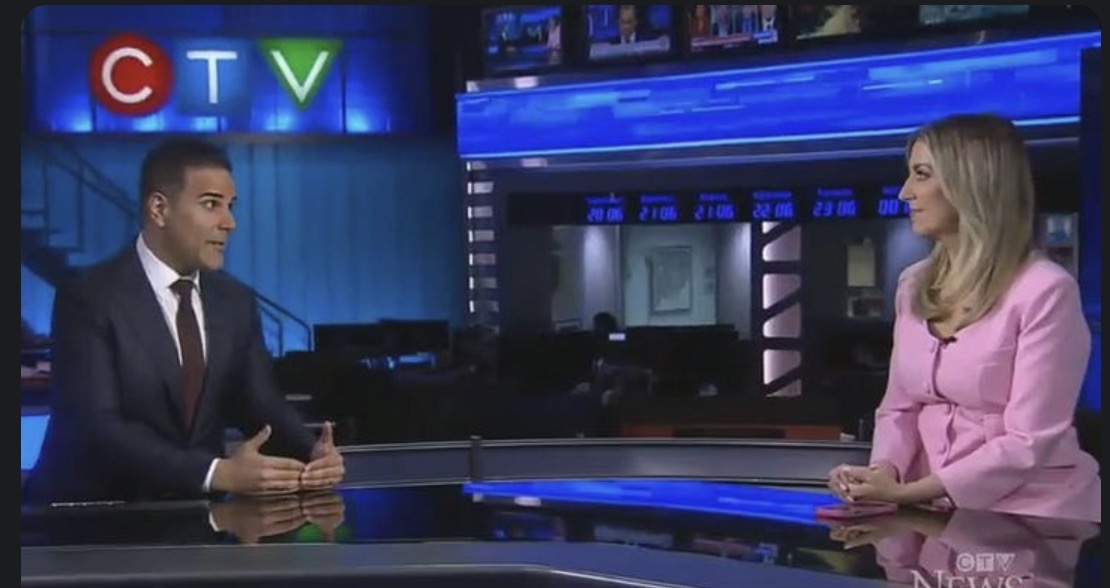
As for how he has seized power in excess of that granted by the electorate 11 months ago, there wasn’t a hint of concern on the part of CTV News anchor Omar Sachedina when Carney’s majority was confirmed in a couple of “gimme” by-election victories.

The leading voice on Canada’s most-watched newscast, Sachedina appeared awestruck by the “historic” moment and “what the Liberals have been able to achieve in the past year”. When his sidekick, Vassy Kapelos, noted Carney was now out of excuses for not fulfilling the promises that won him a minority government in 2025, Sachedina suggested soothingly that Canadians remember “sometimes ambition does take time, sometimes several election cycles”.

Screencap of CTV News from The Rewrite

The message to Canadians? The Liberals have accomplished great things in the past year, the greatest of which was to do what no one in the nation’s history had ever done before — manufacture a majority without the public’s consent. Oh, and be patient. PMMC’s agenda could take a few more elections. Sit tight and trust.

The next morning, questions were not, as one might expect from defenders of democracy, about whether the PM felt a tad greasy for the way in which he had won unfettered power. Like, in some countries — many actually — that might be considered kind of scary. Here? If you watch the news, it’s dreamy.

The preferred line of inquiry was to ask Carney whether, if he was the Opposition Leader, Pierre Poilievre, he would quit. And so it went for the rest of the week. PMMC wasn’t asked if he worried that his majority would undermine the public’s faith in its institutions. Nor did the press corps pursue their sources to discover what inducements may have been offered to create his Judas Gang of Five.


  1. Yes, I know … the presstitutes will “love him long time” as long as the government subsidies keep rolling in.

Airline deregulation in the 1970s

Filed under: Bureaucracy, Business, Government, History, USA — Tags: , , , — Nicholas @ 03:00

The end result — democratizing air travel and enabling far more people to economically travel long distances — also meant that air travel became far more casual (people no longer dressed “properly” for flights) and economy flights began to more closely resemble long-distance buses, but overall it was a win:

The Airline Deregulation Act of 1978 stands as one of the most spectacular vindications of free market principles in modern American history. Before deregulation, the Civil Aeronautics Board controlled every aspect of commercial aviation: routes, schedules, and most critically, prices. Flying remained a luxury reserved for the wealthy elite, with fares artificially inflated by regulatory capture and government-sanctioned cartels.

Within a decade of deregulation, average airfares plummeted by 50% in real terms. The number of passengers more than doubled from 250 million in 1978 to over 500 million by 1990. New airlines like Southwest and JetBlue emerged with innovative business models that prioritized efficiency over bureaucratic compliance. Routes previously deemed “unprofitable” by government planners suddenly thrived under competitive pressure.

The regulatory regime had created exactly what free-market theory predicts: artificial scarcity, price distortions, and a complete disconnection from consumer preferences. Airlines competed on amenities instead of price because the CAB fixed fares at monopoly levels. They served cocktails and full meals while ordinary Americans couldn’t afford tickets. The moment government stepped aside, entrepreneurs discovered countless ways to serve previously ignored market segments.

Critics warned that deregulation would compromise safety and create chaos. Instead, aviation safety improved dramatically as airlines faced real liability for accidents and insurance companies imposed rigorous standards. Competition forced operational excellence in ways bureaucratic oversight never could. Hub-and-spoke networks emerged organically, maximizing efficiency without central planning.

The contrast couldn’t be starker: decades of stagnation under regulatory control versus explosive innovation and democratization under market freedom.

Yet the same politicians who celebrate affordable air travel continue strangling other industries with identical regulatory schemes.

How to sharpen a Thin Scraper | Paul Sellers

Filed under: Tools, Woodworking — Tags: , , — Nicholas @ 02:00

Paul Sellers
Published 12 Dec 2025

We try to cover every woodworking hand tool we can to pass along the knowledge we have to future generations.

We’ve been asked for this video a few times, so here it is. How to sharpen a thin scraper. It has many uses, and the art should not be lost.

It takes only a couple of minutes to do, and you can approach even the wildest grain with this single tool.
——————–
(more…)

QotD: The quality of evidence problem for historians

Filed under: Britain, France, History, Military, Quotations, Weapons — Tags: , , , — Nicholas @ 01:00

The major problem isn’t with quantity of evidence, it’s quality of evidence. More fundamentally, it’s a question of the very nature of evidence. As far as I understand it — which is “not very” — contemporary accounts of the Battle of Crecy seem wildly implausible, even by medieval standards. And that’s the first indicator of the problem right there: By medieval standards. Medieval numbers, as we’ve noted probably ad nauseam, are Rachel Maddowesque — they’re there to augment The Narrative, nothing more. “We were opposed by fifty thousand Saracens” thus can mean anything from “bad guys as far as the eye could see” to “it just wasn’t our day, so we ran”.

And yet, you can’t entirely discount them, either. Crecy (along with of course Agincourt) is supposed to be the triumph of the English longbow, and that’s the thing: We’ve reconstructed English longbows, and put them through all kinds of trials. The results, as I understand it — which, again, ain’t much — were highly variable. A very strong, well-fed, highly trained longbowman, firing an ideally constructed and maintained bow under optimal conditions, really can put X number of arrows up a flea’s ass at Y range in Z time.

Or they could miss the broad side of a barn at twenty feet, depending.

So: What was the weather like in Northern France on 26 August 1346? That’s not an idle question. Rather, it’s the central question. Assume perfect shooting conditions, and you’ve got a far, far different picture of the battle than if you assume poor ones. And if that seems to be giving too much credit to the weather, watch a few baseball games — you’ll quickly discover that quite often, the difference between a home run and a long out is just a few percentage points of relative humidity.

Ultimately it comes down to judgment. More importantly, it’s a judgment on how any particular event fits into the larger argument you’re trying to make. In a way, then, the details really don’t matter very much on their own — the mechanics of how the English won are almost irrelevant, except insofar as they feed into an analysis of why they won. Why did the French king attack uphill, in the mud? Was he stupid? Overconfident? Did he feel he had to, because of political problems inside his host? Did he have faulty information? Did he have accurate information, but just made a bad call?

That’s the art of History, and why, despite what the Peter Turchin (and Karl Marx) crowd keeps insisting, it will always be an art, not a science. We can have a high degree of confidence, most times, in what happened — there really was a battle at Crecy, and the English really did win it. It’s the why that is susceptible to radical reinterpretation.

Severian, “Friday Mailbag”, Founding Questions, 2022-06-17.

Powered by WordPress