Quotulatiousness

April 6, 2026

NATO without the United States?

Filed under: Europe, Military, Politics, USA — Tags: , , , — Nicholas @ 05:00

At The Conservative Woman, Jonathan Riley considers the sudden existential crisis facing the NATO alliance with President Trump openly musing about pulling the United States out of their current commitment to joint European defence:

PRESIDENT Trump’s warning that the US could pull out of Nato should shock even the most complacent and anti-American elements on the political left. Mr Trump has raised the issue in private discussions with White House aides in recent days, and on Wednesday confirmed that he was “absolutely” reviewing membership.

I have underlined several times in these pages why this is so – the global reach and sheer size of US military power and the fact that the USA brings capabilities to Nato that no other country has, or is ever likely to have. With American backing, Nato has credibility in its deterrent posture – deterrence being built on capability and will to use those capabilities. Without the US, credibility remains only in the nuclear sphere because of the independent British and French arsenals, but not in the conventional sphere. An aggressor could well, therefore, be tempted to take actions that fell short of the use, or riposte, of weapons of mass destruction. A Russian incursion into a non-Nato state, for example, Bosnia and Herzegovina or Moldova; or even a limited incursion in the Baltic, either on land or at sea.

The President’s threat came as the latest in a sequence of angry responses to the failure of traditional allies to give their support, as he sees it, to the US/Israeli war on Iran. Not least was his disappointment with Starmer, first over his refusal to give the US use of Diego Garcia and RAF Fairford in Gloucestershire for strikes on Iran, second over Starmer’s reluctance to deploy the Royal Navy and then his refusal to take the lead on re-opening the Strait of Hormuz. France’s preference for diplomacy has irked him too. Austria, not a Nato member, has become the latest EU country to deny US military use of its airspace.

Whether or not this outburst was more than a mark of his frustration with unappreciative allies – more wake-up call than genuine warning – it still suggests an alarming failure on his part to understand what Nato is and is not; why a US pull-out would be a lose/lose situation for Europe and the US.

Nato is an alliance founded in the Treaty of 1949 and is about mutual defence. Article Five affirms that an attack on one member state is an attack on all and obliges all other states to come to the aid of whoever has been attacked. During the Cold War, there was no discussion about resources, or caveats, or vetoes – what mattered was survival. Once the Cold War was over, nations did have a choice about what they committed – and in the case of every European country, it was less.

The water was muddied by the Nato-led expeditions to Bosnia, Kosovo and Afghanistan. These were carried out using coalitions built on the Alliance and in some cases, simultaneously, coalitions built within the Alliance. For example, in Afghanistan, there were really two International Assistance Forces (ISAFs): one was a coalition of the willing confronting insurgency and terrorism; the other was a non-kinetic coalition based on the Bonn Agreement, concerned with nation-building. Some people and member states may therefore believe that Nato is a vehicle for Allies to climb aboard and support US (or French, or British) expeditionary operations. It is not.

Cross-country booze woes

Filed under: Business, Cancon, Politics, USA, Wine — Tags: , , , , — Nicholas @ 04:00

On his Substack, Brian Lilley discussed the frustrations of Canadian drinkers thanks to our odd and often illogical regulations around the sale of alcohol:

How Canadian Premiers think they’d have to operate if they let private enterprise into the alcohol trade.
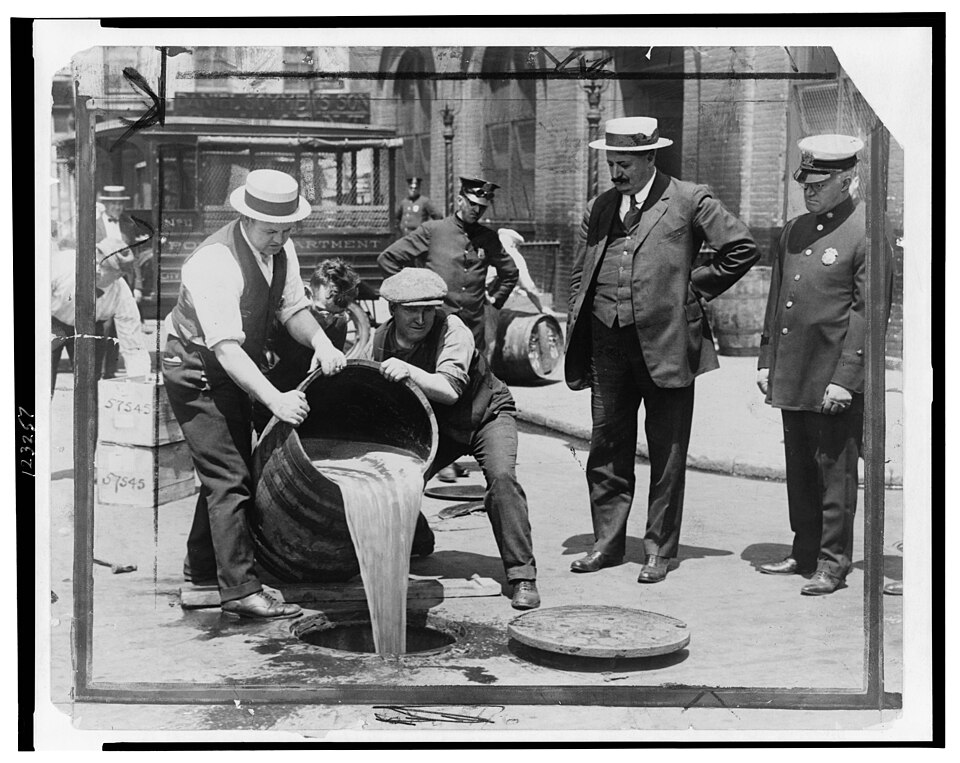
New York City Deputy Police Commissioner John A. Leach, right, watching agents pour liquor into sewer following a raid, 1921.
Wikimedia Commons.

I landed in Saskatoon after a late in the evening flight from Toronto on Thursday. As we headed to a family gathering south of the city, we stopped to pick up some refreshments to add to the festivities.

First off, I’ll say private liquor stores in Sask, like the ones run by Sobey’s or Co-Op are generally quite nice. It’s proof that you can have private liquor stores, the province won’t fall apart and consumers can get their products in a nice, clean, friendly environment.

This is in reference to the silly Canadian abhorrence of private liquor sales … most of our provincial governments are deeply involved in the booze trade, and regularly imply that letting any more of that business go into private hands will instantly create a maple-flavoured version of Al Capone’s empire during Prohibition.

You can also buy booze here that is forbidden in Ontario.

But holy crap is beer expensive here!

[…]

The combined federal and provincial tax rate for Quebec is about 31.5%, Ontario’s is 43% and Sakatchewan’s are the highest in the country at 49.4%.

While beer is more expensive in Sask, Ontario made liquor is cheaper here…
Why is it that in Saskatoon I can buy a bottle of Wiser’s whiskey, made in Windsor, Ontario, for about $10 cheaper than I can at the LCBO, Ontario’s government run liquor stores?

[…]

In Saskatchewan, consumers can choose what to buy…

Ontario has had a ban on the sale of American alcohol products via the LCBO since March 2025. In Saskatchewan, as in Alberta, you can choose whether to buy your Kentucky bourbon or California wine.

That’s a lot of sweet, sweet bourbon for sale at a Sobey’s store in Saskatoon.

If you want to buy some California wine in Saskatoon, you can.
So far, Alberta and Saskatchewan are alone in allowing the regular sale of American alcohol. Consumers who want to boycott here can and I’m sure many do. I hear plenty of anti-Trump/anti-American attittudes here so sales are likely lower than they were pre-tariff.

That said, you are an adult and can buy Yankee hooch if you want to.

That won’t be happening in Ontario anytime soon.

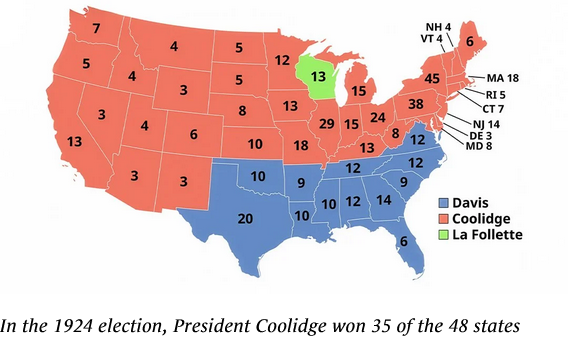
Coolidge “does not deserve credit for winning the 1924 election … it just happened to him”

Filed under: Economics, History, Politics, USA — Tags: , , , , , — Nicholas @ 03:00

While I wouldn’t agree with the statement in the title of this post, it has been a common enough reading of the US 1924 presidential election — that it wasn’t an endorsement of Coolidge and his policies but merely a reflection of voters’ overall satisfaction with the economy. The editors of the Coolidge Review would beg to differ:

From the distance of more than a century, a political scientist has taken a fresh look at the 1924 presidential election.

In an article published last year in Presidential Studies Quarterly, Christopher Devine questions the conventional wisdom about how and why the incumbent, Calvin Coolidge, won that election in a landslide. Coolidge had assumed the presidency little more than a year earlier, after the unexpected death of Warren Harding. In 1924’s three-way race, he received more votes than the other two candidates combined and carried thirty-five of the forty-eight states.

As Devine points out, most historians say that a robust economy was by far the biggest reason Coolidge won. Strong economic conditions did work in the president’s favor. But Devine notes that many historians adopt a form of economic “determinism”. In this very common view, Coolidge “does not deserve credit for winning the 1924 election”. Rather, “thanks mostly to the economy, it just happened to him”.

That argument is too simplistic, Devine suggests. He presents both qualitative and quantitative evidence to challenge the standard narrative of the 1924 campaign.

Old Assumptions, New Data

For his empirical analysis, Devine examines “county-level political, economic, and demographic data” alongside county-by-county voting results. Using these data, he tests three common explanations for the election’s outcome:

Did Coolidge win primarily because of the economy? Scraping the data, Devine concludes that the answer is largely yes. And he shows it’s misleading to claim that — as one history textbook put it — Coolidge merely rode “the crest of a wave of economic prosperity for which he was given undeserved credit”. Devine demonstrates that from behind the scenes, Coolidge “took an active role in coordinating campaign messaging” that showcased the administration’s and Republicans’ achievements. For example, Coolidge worked closely with his running mate, Charles Dawes, to keep the famously free-range vice-presidential candidate focused on the economic message. “In the matter of economy and tax reduction”, Dawes declared, “the Federal Government is headed in the right direction”. Moreover, as Devine reports, Dawes argued that the administration’s work to stabilize Europe via the Dawes Plan spared America from “the depths of an inevitable and great depression” while also ensuring that “the whole world enters upon a period of peace and prosperity”.

Did third-party candidate Robert M. La Follette hurt Democratic nominee John W. Davis more than Coolidge? Devine concludes that this effect appeared only in the Great Plains and the Mountain West. It probably wasn’t large enough to change the election’s outcome.

Did internal divisions cost the Democratic Party votes in 1924? The Democrats were so fractured that they needed 103 ballots to choose a nominee at their convention. Devine says it would be hard to imagine that such disarray did not hurt Democrats in the election. Yet he notes that quantitative evidence on the reasons for Democratic losses in 1924 is hard to find because “scientific polling did not exist in the 1920s”.

Seeking an alternative approach, Devine looks at patterns of defection from the Democratic Party by state. He finds that northern states that voted to defeat the anti-Ku-Klux-Klan plank at that year’s Democratic National Convention — in other words, states whose delegations supported the Klan — saw heavier defections in the general election. From that, Devine extrapolates to suggest that Coolidge “benefited from the resurgence of the Ku Klux Klan — or, perhaps one might say, Democrats lost ground because of it”.

T20 Family: Springfield Makes the Garand a Grenade Launching Sniper Machine Gun

Filed under: History, Military, USA, Weapons, WW2 — Tags: , , , , — Nicholas @ 02:00

Forgotten Weapons
Published 17 Nov 2025

Late in 1944 the Ordnance Committee recommended adoption of a magazine-fed, select-fire version of the M1 Garand as a new standard US infantry rifle. Both Springfield and Remington developed rifles to meet the requirement, with Springfield’s being the T20 and Remington’s the T22.

The Springfield design went through several iterations from the original T20 to the T20E1 and T20E2, with the capability to launch rifle grenades, mount optical sights, and fire in either semiautomatic or full auto. The first examples of the final T20E2 design were ready in June 1945, but the program lost momentum in August when Japan surrendered. It did continue slowly until 1949, providing some of the basis for the eventual M14 rifle.
(more…)

QotD: Taylorism

Filed under: Books, Business, Quotations — Tags: , , , , , — Nicholas @ 01:00

In the world of management, the ideology of generic, domain-agnostic expertise first made its appearance in the late 19th century under the name of “scientific management”, or “Taylorism” after its godfather Frederick Winslow Taylor. Taylor’s insight was that the same engineering principles used to design a more economical or efficient product could just as well be applied to the shop floor itself. In his view, the workers, overseers, and production processes of a factory all combined to form a great living machine, and that machine could be optimized and made more efficient by an application of scientific attitudes.

Taylor was unpopular in his own day and is even less popular today, because his particular brand of optimization of the great living machine was all about stripping autonomy (or as Marx would say, “control and conscious direction“) from workers. But the particular kind of optimization he advocated is less important than the conceptual breakthrough that while a nail factory and a car factory might look very different on the surface, they are both governed by the same set of abstract laws: laws of time and motion, concurrency, bottlenecks, worker motivation and so on. A master of those laws could optimize a nail factory, and then go on to optimize a car factory, and could do both without knowing very much at all about nails or cars.

Who could have a problem with that? Even I don’t think it’s entirely wrong — I may have misgivings about the sheer volume of people going into fields like management consulting, but I’ll admit that there remains alpha in asking a smart and incisive outsider to take a look at your operation and tell you what seems crazy. The trouble comes with confusing that sporadic, occasional sanity-check with the actual business of leading a team of people who are working together to achieve an objective. Because, get this, it’s impossible to lead such a team without a deep understanding of the details of every person’s tasks.

It’s surreal to me that this point has to be made, yet somehow it does. If the team you lead makes nails, you need to know everything there is to know about making nails. If the team you lead operates a restaurant, you need to be an expert, not in “management”, but in restaurants. If the team you lead sells mortgage-backed derivatives, you better know a heck of a lot about finance in general, mortgages in particular, the art of sales, and the specific world of selling financial instruments. There are a thousand reasons why this is true, but consider just one: a subordinate is failing at a task, and tells you that it isn’t because he’s lazy or unqualified but because the task is unexpectedly difficult. How on earth can a manager evaluate this claim without being able to do the job himself?

There’s another, very different reason managers need to be experts in whatever it is their team is doing, and it has to do with morale. A subordinate in any sort of hierarchical organization needs to see that his superior can do his own job as well or better than he can. Almost everybody gets this. In a high-pressure commercial kitchen, if a chef or sous-chef doesn’t like the performance of one of their line cooks, they will often leap in, take over that cook’s station, and begin “expediting.” This has a dual purpose: it both relieves a genuine production bottleneck, and also acts as a showy demonstration of prowess, reminding everybody that they got to be the boss through excellence. At the better tech companies, those managing software engineers are always former engineers themselves, and often the very best of the lot. Just like a chef would do, an engineering manager needs to be able to seize a computer and begin expediting under pressure, both to solve a real problem and as a dominance display. But it’s not just about keeping the troops in line, it’s about inspiring them. Nothing motivates a soldier like seeing his commander leading the charge, weapon in hand.1

John Psmith, “REVIEW: Scaling People by Claire Hughes Johnson”, Mr. and Mrs. Psmith’s Bookshelf, 2023-08-28.


  1. This shows up in places you wouldn’t expect to. I was once cast in a show, and quickly came to understand that our director could (and often did) leap onto the stage, snatch a script out of somebody’s hand, and play their part better than they could. For any part. Before he did this to me, I found him annoying and bossy. Afterwards, I would follow him into the Somme.

Update, 7 April: Welcome, Instapundit readers! Have a look around at some of my other posts you may find of interest. I send out a daily summary of posts here through my Substackhttps://substack.com/@nicholasrusson that you can subscribe to if you’d like to be informed of new posts in the future.

Powered by WordPress