
Quotulatiousness

April 22, 2026

“Finally authorities gave up and decided to let Timmy the Whaletard die in peace”

Filed under: Germany, Media — Tags: , , — Nicholas @ 05:00

The German media has been breathlessly covering the story of a wandering whale who seems to delight in getting stranded on sandbanks along the northern coast of Germany in the Baltic Sea:
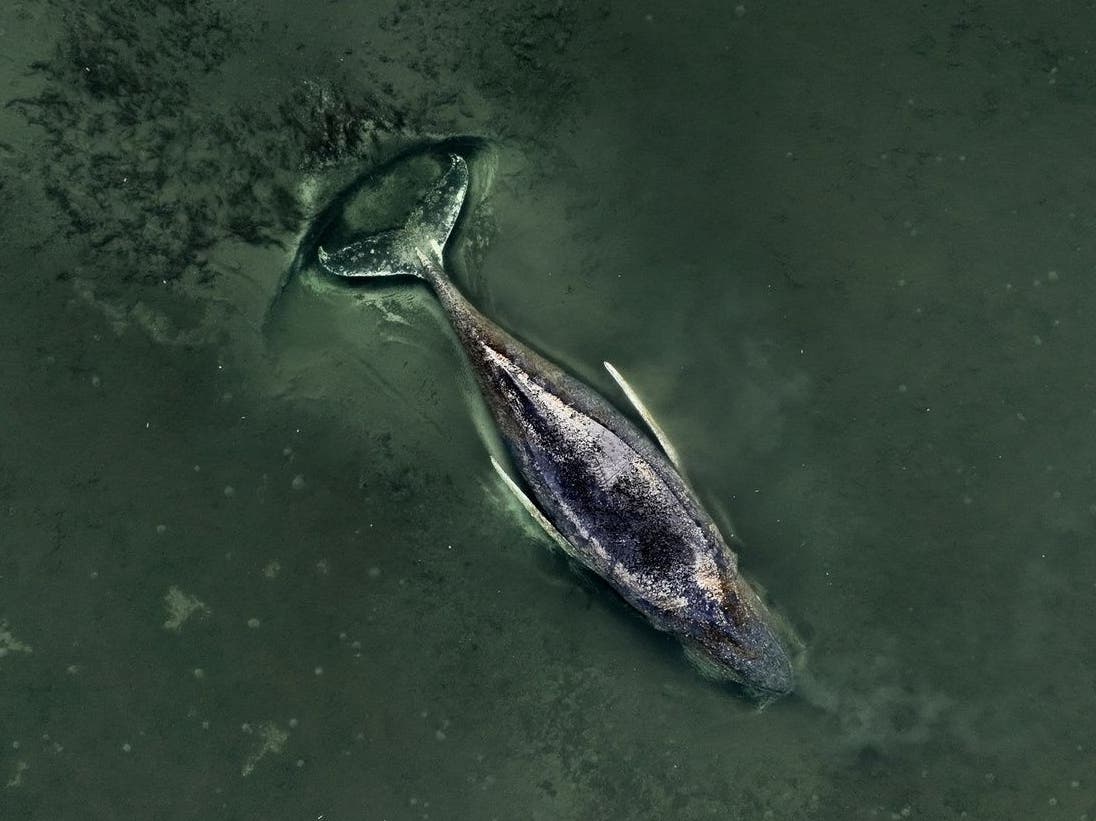
Timmy
Photo from eugyppius

Timmy is the name the German press have given to a confused humpback whale who got himself caught in a fishing net off the coast of Mecklenburg-Vorpommern in early March.

Authorities cut Timmy free in the hopes that he would swim back to the Atlantic like a good whale, but instead he continued to poop around off the German Baltic coast where he does not belong, finally stranding himself on a sandbar near Niendorf like a complete fucking retard.1 An intensive rescue ensued – breathlessly livestreamed by the German press and regrettably also live-tweeted by myself. Ultimately the effort succeeded and Timmy swam free, only to strand himself again, and again, and again, and still again.

Finally authorities gave up and decided to let Timmy the Whaletard die in peace, but soon a whole raft of philanthropists and “whale whisperers” (this is literally what the press called one of them) descended on the problem and the drama of Timmy continues to this moment. The latest subplot unfolded yesterday, as our whale saviours prepared a complex scheme to lift Timmy via air cushions onto a tarp, tie him to pontoons and tug him around Denmark back into the North Atlantic. Alas, a rising tide loosened the hapless Timmy from his sandbar and he swam free, escaping this indignity at least and leaving all the whale-whispering shitheads with nothing to do but give more pointless media interviews. For two hours children across the Federal Republic jubilated as Timmy lurked aimlessly in shallow coastal waters, until of course he beached himself again, provoking a whole new narrative epicycle.

The case of Timmy the Retard Whale is oddly captivating. Most obviously it illustrates the naiveté and neotenous emotional incontinence of Germans today, many of whom have countered the pervasive secularisation of society with an exaggerated and childish faith in the overarching sacrality of the natural world and its creatures. The media have constructed a perverse Disney plot out of the endless ups and downs of Timmy’s plight: Now the whale is free! Now he is dying! Now he must be rescued! Now he is free again! Now he is stranded! Now there is hope! Now he is dying! Not only children but plenty of adults have lost themselves in this transparently repetitive drama. At one point a gaggle of dumb women even protested to demand that authorities do more to save our unsaveable humpback – who is of course merely one of perhaps 100,000 humpbacks across the world, the vast majority of whom will die in complete obscurity with nary a news article.

In my more delirious moments I wonder if Timmy is not also an omen from on high, a metaphor from the heavens to illustrate for us the ridiculous, circular farce that Germany has become.


  1. He was named Timmy for Timmendorfer Strand, where he beached himself for the first time. My efforts to christen him Horst have not caught on. I know the good Timmy is probably disoriented due to illness or injury and not actually retarded but this is how I have chosen to maintain emotional distance from the fate of this particular incorrigible mammal, who is beyond all human capacity to rescue but unfortunately not beyond all of my sympathies.


The Korean War Week 96: Korean Marines Leapfrog the Han – April 21, 1952

Filed under: China, History, Military, USA — Tags: , , , , , , — Nicholas @ 04:00

The Korean War by Indy Neidell
Published 21 Apr 2026

UN Command completes its screening of the 170,000 military and civilian POWs they hold to see how many of them would violently resist repatriation, and it turns out it’s most of them. The Communists are furious. This cannot be good for the armistice negotiations. We also take a look at the defense possibilities the Marines have in their new positions and which Chinese forces oppose them.

00:00 Intro
00:55 Recap
01:32 POW Screening
07:26 The Marines
08:56 The Chinese
13:37 Summary
13:53 Conclusion

Reflections on the life extension of the A-10 – “we ought to be seriously looking at building an A11”

Filed under: Middle East, Military, USA, Weapons — Tags: , , , — Nicholas @ 03:00

On the social media site formerly known as Twitter, ESR admits that there clearly still is a role for the “Warthog” in modern combat … under the right conditions:

Gotta admit I’ve changed my mind about this. I was in the camp that loved the Hog but was grudgingly prepared to concede that its time had passed — not survivable in a modern threat environment stiff with drones and MANPADs.

But damned if the A-10 didn’t turn out to be an effective tool against small-boat swarms in the Straits of Hormuz. And not so expensive to fly or ammo up that you end up with a nasty shot-exchange problem either — not something you can say for putting the F-35 on that job.

The Hog has demonstrated that there is still a tier of missions in between the envelope of an attack helicopter and a fast fighter for which the Hog is excellently fitted. Still. In 2026.

Of course you need to have done SEAD to lower the odds that it will be popped by competent air defense, but the US Air Force is very good at that mission. As it keeps demonstrating.

I was wrong. The Hog deserves its extension. And we ought to be seriously looking at building an A11. Maybe not a manned A11, but a functionally similar instrument with a big fucking gun and the ability to fly low and slow and loiter on a patrol area.

In conclusion: “Let me sing you the song of my people: BRRRRRRRRRT.”

Walther’s Forgotten SMG: The MPK (and MPL)

Filed under: Germany, History, Military, Weapons — Tags: , , , , — Nicholas @ 02:00

Forgotten Weapons
Published 3 Dec 2025

Walther began developing a modern stamped sheet metal SMG in the late 1950s, and it entered production in 1963. It was an open-bolt, simple blowback gun available in a short (MPK; 6.75″ barrel) and long (MPL; 10.25″ barrel) version. It was cheap and simple, but well thought out with a number of quite good features.

The standard design was just safe/full, but a semiautomatic selector position was available if desired by the client. An excellent safety sear prevented the bolt from bouncing open and firing, and the charging handle was both non-reciprocating and capable of also serving as a forward assist if needed. The sights were a bit too clever for Walther’s own good, with a 75m notch and a 150m aperture, both of which were not really great.

Faced with competition from contemporaries like the Uzi and MP5, the Walther never really became massively popular. It did get enough small and medium sized contracts (German police, South African police, Mexican Navy, Portuguese Navy, US Delta Force, etc) to remain in production until 1985 though. Overall a solid and reliable gun even if it failed to really stand out from the other options on the market.
(more…)

QotD: Traditional Chinese approaches to science

Filed under: China, History, Quotations, Science — Tags: , , , , — Nicholas @ 01:00

Those of you who have studied physics know that the laws of motion are usually introduced through the mechanics and dynamics of point particles, or of simple objects acting under the influence of discrete and coherent forces. The reason for this is straightforward: even a tiny bit more complexity, and the system’s behaviour quickly dissolves into a morass that’s analytically intractable and computationally infeasible. The fact that the mutual gravitational influences of just three celestial objects results in chaotic dynamics has entered into popular culture as the “three-body problem”. But even a simple double-pendulum is impossible to predict, even with all kinds of simplifying assumptions (massless rods, no friction, no air resistance, etc., etc.).

It’s not just physics. The central technique of modern science is that of boiling something down to its absolute simplest form, understanding the simplest non-trivial case as thoroughly as possible, and only then building back up to more familiar situations. In physics we start with contrived gedankenexperimenten: “what if two particles collided in a vacuum”, and build experimental apparatuses designed to mimic these ultra-simple cases. In economics we imagine markets with a single buyer and a single seller, both perfectly rational. In political philosophy we imagine human beings in a state of nature, or societies established by a primitive contract. In biology we try to understand the functions of organisms, organs, or other systems by recursively taking them apart and trying to figure out each part in isolation. In every case, what we’re engaging in is “analysis”, ἀνά-λυσις, literally a “thorough unravelling”, understanding the whole by first understanding its parts.

This approach is totally alien to the traditional Chinese understanding of reality, which held instead that no part of the world could be understood except in its relation to the rest of the universe. You can see this in the domains of science where they did maintain a lead. Is it really a coincidence that the Medieval Chinese got frighteningly far with the mathematics of wave mechanics? Or quickly deduced the causes of the tides? Or made great strides with magnetism? In each of these cases, the physical phenomenon in question was compatible with an “organicist conception in which every phenomenon was connected with every other according to a hierarchical order”. Indeed, in all of these cases real understanding was aided by the assumption that a universal harmony underlay all things and connected all things. The tides really are in harmony with the moon, and the lodestone with the earth.

This science, founded on holism rather than on analysis, made great strides in some fields but fell behind in others. It readily imbibed action at a distance, but it could not and would not tolerate the theory of atoms. In this way it serves as a strange mirror of Medieval European science, which also loved the theory of correspondences, also loved alchemy and disdained analysis. The difference is that the glorious intellectual synthesis of Neo-Confucianism was never seriously challenged, it survived the Mongol conquest, it survived the desolation of the civil wars that preceded the Ming founding, it survived everything until communism. In contrast, the eerily-similar Thomistic metaphysics of the High Middle Ages was broken apart by the Reformation, and sufficiently discredited that analytical methods could take their first tentative steps.

This is, to be clear, my own crazy theory, because Needham never really gave a solution to his own puzzle. I came up with it only as a sort of thought-experiment, because I wanted to see if I could find a solution to Needham’s puzzle that disdained material explanations in favour of intellectual tendencies, because I find such theories curiously underrated in our culture. I only half-believe this theory,1 but I find it interesting because twentieth-century Western science has in some ways come back around to the holistic view of things: from Lagrangian methods in theoretical physics, to category theory in mathematics, to systems biology and ecology. It wouldn’t be the first time that a way of viewing the world useful to one age became an impediment to reaching the next one. The question is: what are we missing today?

John Psmith, “REVIEW: Science in Traditional China, by Joseph Needham”, Mr. and Mrs. Psmith’s Bookshelf, 2023-08-14.


  1. The thing about material conditions is they usually are dispositive!

Powered by WordPress


