
Quotulatiousness

April 10, 2026

Trump’s intemperate, irresponsible, unhinged rants … worked?

Filed under: Media, Middle East, Military, Politics, USA — Tags: , , , , , — Nicholas @ 04:00

For all that Trump’s habitual form of social media post seem to frequently dance on the edge of incoherence — if not insanity — his track record is far better than his critics give him credit for. I thought his most recent blustering threats against the Iranian leadership would be counter-productive, but something approximating a ceasefire began just before his deadline. As Brendan O’Neill put it, this gives Iranian civilization a bit of a reprieve, but what about the West?

Imagine calling for the destruction of a civilisation. Imagine dreaming about violently scrubbing an ancient nation from the face of the Earth. Imagine flirting with the idea of obliterating a land with thousands of years of rich history. I am referring, of course, to the activist class and its annihilationist hatred for the Jewish State. For nearly three years, these people have beat the streets and swarmed the digital networks to agitate for the erasure of Israel, all the way “from the river to the sea“. President Trump’s juvenile bluster on Iran has nothing on their existential loathing for the Jewish homeland.

The frenzy of the past 48 hours, following Trump’s potty-mouthed and threatening social-media posts about Iran, has felt unhinged. The nukes are coming, influencers wailed. Trump must be “removed as president” in order to “prevent a catastrophe that our species will never recover from”, said the Guardian‘s Owen Jones. Within hours of this giddy apocalypticism, this huddled descent of the chattering classes into the pit of End Times prophesying, Trump had done what many of us expected he would: struck a kind of deal. The great detonation was not of a nuclear bomb but of the common sense of the cultural establishment. That’s the only thing that got vaporised yesterday.

Then there was the sheer cant. It was Trump’s ominous yelp that “A whole civilisation will die tonight” that got leftists and liberals frothing. It’s genocidal lunacy, they said. Let’s leave to one side that the target of his digital ire appeared to be the Islamic Republic, not Persia. “Forty-seven years of extortion, corruption and death will finally end”, he said. The more striking thing is the industrial-level gall of a cultural elite that is devoted to the dismantling of Israel, puffing itself up in fury over Trump’s hyperbole on Iran.

I agree that “A whole civilisation will die tonight” is a chilling thing to say. That’s why I’m so horrified by the frenzied anti-Zionism of our times. Our intellectual classes furiously deny Israel’s “right to exist”. Our activist classes openly call for Israel’s excision from the family of nations, by intifada (violence) if necessary. Our celebrity classes cheer the armies of anti-Semites (Hamas, Hezbollah) that were founded with the express intention of vaporising the Jewish nation. One minute the keffiyeh set is accusing the likes of Pete Hegseth of being in the grip of an anti-Iranian “bloodthirst”, the next it’s chanting for the death of the Jewish nation’s soldiers.

Future historians will marvel at the brass neck of an influencer class that took 24 hours off from calling for the destruction of Israel to bash Trump for posting about the destruction of Iran. I raise this not to be facetious but to draw attention to the moral disarray here on the home front that has been so spectacularly exposed by events in Iran. For it is undeniable now – we are surrounded by people who salivate over the violent disappearance of Israel but who fret over the withering of the Islamic Republic. They have taken sides – the side of the barbarous regime that dreams of “Death to America” over the side of the democratic state rebuilt by Jews in the aftermath of the Holocaust. I’m delighted the Persian civilisation is safe – now what about the West’s?
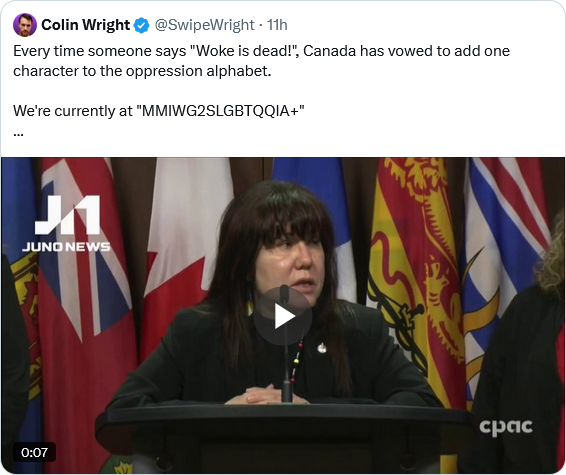

“MMIWG2SLGBTQQIA+”

Filed under: Cancon, Government, Media, Politics — Tags: , , , — Nicholas @ 03:00

Another Canadian interest group decided that their already oversized abbreviation needed to be super-sized. Jonathan Kay provides some useful context for those not familiar with Canadian domestic politics:

Canadian here, with four (count em) points of clarification on the “MMIWG2SLGBTQQIA+” thing, which has now escaped its absurdist Canadian genderwang containment chamber, and gone viral internationally:

1) the speaker here is @LeahGazan, a fringe minor-party politician. She’s not in the government. She regularly calls for dumb things, such as criminalizing anyone who dares talk candidly about the 2021-era unmarked-graves social panic. CBC types treat her as a serious person because she’s indigenous and because she always talks in the tear-drenched idiom of white-settler colonial evilness. But she’s not.

2) MMIWG2SLGBTQQIA+ is a mashup of two acronyms (each unique to Canada). Her decision to run them together is hilarious, which is why this has gone viral, but it’s not a common practice, even in rarefied leftist circles.

3) MMIWG refers to “Murdered and Missing Indigenous Women and Girls”. The problem of violence against indigenous women is a real and tragic issue. Unfortunately, a couple of years ago, a bunch of activists produced a ridiculous report on the subject that called it a “continuing” (!!!) “genocide”, and demanded that we all call it that. The whole movement collapsed when it was pointed out that something like 80% of the indigenous women who are killed are killed by indigenous men, which is very much off-message from the whole white colonial G-word thing. But the acronym still gets name-dropped when people are indicting Canada for all its infinitely genocidey genociding of everybody

4) “2SLGBTQetcetc…” Americans always ask me what “2S” stands for. It stands for “2 spirited,” a term that white academics popularized 50 years ago to give expression to their mystical reveries about sacred indigenous elf-people living in some precolonial eden-like genderwang Nirvana where everyone has three penises and five vaginas. No one is allowed to ask what the term even means, but our government made it official policy to use ridiculous words like this under Trudeau, so we’re stuck with it. Basically, if you’re an indigenous guy who likes to wear eyeliner, or an indigenous woman with blue hair and sensible shoes, you call yourself “2 spirited” on your govt grant applications. No one is even allowed to ask whether it’s a gender identity or a sexual orientation. It apparently exists in some exalted state that defies this kind of rigid colonial typology, or something like that.

Back in 2022, I read a whole report about how to teach two spirited concepts to Canadian students, and it turned out that even the authors of the report admitted they had no idea what the term meant. I wrote about it for @Quillette: https://quillette.com/blog/2022/10/0

A Brief History of GRAVY

Filed under: Britain, Food, History — Tags: , , — Nicholas @ 02:00

Tweedy Misc
Published 2 Dec 2025

For the next instalment of the series of classic British sauces we take a look at the history of gravy.

In this video I look into some of the earliest historical references to gravy, then some 18th Century recipes. I investigate whether gravy might be a derivative of a classic French sauce, and look in some detail into one important component of traditional gravy recipes: the roux, used for thickening.

I also investigate some products which have emerged since the 19th Century to help with the process of making gravy, from gravy salt and gravy browning, through Bisto’s original gravy powder of 1908, and their fully instant product in the form of “gravy granules”, launched in the 1970s.

Also, have you ever wondered why Bisto is called Bisto? We’ll get into that too.

0:00 Introduction
0:32 What is gravy?
1:27 Early history of gravy
2:01 18th Century gravy recipe
2:25 The importance of the roux
3:37 More 18th Century gravy recipes
4:07 Is gravy actually…. French?!?!
5:29 Gravy salt
6:47 Gravy browning
7:31 History of Bisto
9:19 Modern Bisto
10:25 Conclusion

QotD: William Cobbett

Filed under: Books, Britain, Economics, History, Quotations — Tags: , , , , , , — Nicholas @ 01:00

… The truest reason I love The King’s Head is that William Cobbett once gave a lecture there: an event commemorated by a nice print on the wall of the man — in red jacket, white britches and black boots, all properly Georgian — and a bit of accompanying biographical text.

Cobbett was a scrapper on the same majestic scale as our Henry V and our Horatio, except he dished it out to Vested Interest rather than Jean-Pierre Foreigner. He is the faded star of the British Awkward Squad (Capt. Jon. Swift; Vice Capt. Geo. Orwell) and he needs a boost. He needs a blue plaque on every place he ever visited. In his long life — he was born in 1763 and died in 1835 — Cobbett was a farmer, Tory, soldier, Radical, MP, agony uncle (his books include Advice to Young Men), and the founder of Hansard.

His obituary in The Times, after categorising him as a “self-taught peasant”, declared Cobbett “by far the most voluminous writer that has ever lived for centuries”. The funniest, too: when some town council somewhere banned his anti-Malthusian play Surplus Population, he riposted with a drama entitled Bastards in High Places.

Above all, though, Cobbett was the champion of the rural poor, the village labourer and the small farmer. He was their one true tribune. He spoke at The King’s Head in 1820 because country folk were suffering a triple wham from agricultural depression, enclosure and the rise of agri-business. Or, to precis, “Hodge” (his name for the generic farm worker) was low-waged or unwaged and deprived of the bits of land he had once enjoyed under commoner’s rights.

Cobbett railed against “The Thing” (the capitalist, manufactory system) and the centrifugal, corrupting force of smoky London (“The Wen”, in Cobbettian). But he was no bloviator: he was a farm boy, and hence entirely empirical and properly pragmatic. He spent a decade travelling around the English sticks to discover the true state of affairs. His descriptions of his horseback journeys were published in 1830 as Rural Rides, the first sociological study of the English countryside.

No dry-as-dust tome by the way, the Rides: it brims with pinned-to-the-specimen-board descriptions of people and places, nature, wit. Cobbett knew beauty and, the proper Englishman that he was, he loved horses:

    The finest sight in England is a stage coach ready to start. A great sheep or cattle fair is a beautiful sight; but in the stage coach you see more of what man is capable of performing. The vehicle itself, the harness, all so complete and so neatly arranged; so strong and clean and good. The beautiful horses, impatient to be off. The inside full and the outside covered, in every part with men, women, children, boxes, bags, bundles. The coachman taking his reins in hand and his whip in the other, gives a signal with his foot, and away go, at the rate of seven miles an hour.

    One of these coaches coming in, after a long journey is a sight not less interesting. The horses are now all sweat and foam, the reek from their bodies ascending like a cloud. The whole equipage is covered perhaps with dust and dirt. But still, on it comes as steady as the hands on a clock.

Speaking at The King’s Head coaching inn in Monmouth must have been the dream gig for Cobbett the horseman.

John Lewis-Stempel, “Why Britain needs a peasants’ revolt”, UnHerd, 2020-08-06.

Powered by WordPress


