Quotulatiousness

April 23, 2026

The SPLC in the news

Filed under: Government, Law, Media, Politics, USA — Tags: , , , , , — Nicholas @ 05:00

The Southern Poverty Law Centre (SPLC) is in the news this week for unusual reasons — not SPLC lawyers levelling accusations against individuals, elected officials, or corporate leaders, but the SPLC itself being hit with very serious charges from the US DoJ:

For nearly a decade, the 2017 “Unite the Right” rally in Charlottesville has been portrayed as a defining moral crisis of the Trump era. Across the media and in political speeches, Charlottesville became shorthand for “Trump-era” hate. In his 2019 campaign launch, Joe Biden called Charlottesville “a defining moment for this nation”, describing how “Klansmen and white supremacists and neo-Nazis” marched bearing “the fangs of racism”.1

He condemned President Trump’s “very fine people on both sides” comment. In Biden’s words, the president’s equivocation “assigned a moral equivalence between those spreading hate and those with the courage to stand against it”, and thus signalled a threat “unlike any I had ever seen in my lifetime”.2 Polling at the time showed the public broadly agreed, nearly 60% of voters said Trump had “encouraged” white supremacists by his response, and a majority disapproved of how he handled Charlottesville.3 In short, Democrats and sympathetic media used Charlottesville as a concrete proof-point that Trump had unleashed a racial crisis, and that the country was in “a battle for the soul of this nation”.4 This narrative was presented earnestly by them: far-right violence in Charlottesville would be a national wake-up call about racial hatred that, in their telling, demanded urgent political action.

The Indictment: SPLC Charged

Last week, a new development has upended that narrative. On April 21, 2026, the Department of Justice announced that an Alabama grand jury returned an 11-count indictment against the Southern Poverty Law Center (SPLC), the prominent civil-rights nonprofit best known for its “hate group” lists, charging it with wire fraud, bank fraud, and conspiracy to commit money laundering.5 The indictment alleges that from 2014 to 2023 the SPLC secretly funnelled more than $3 million in donated funds to individuals in violent extremist groups.6 For example, DOJ spokesmen say SPLC paid large sums to figures associated with the Ku Klux Klan, the neo-Nazi National Socialist Movement, the Aryan Nations and others. Crucially, prosecutors claim SPLC used covert methods: it opened bank accounts in the names of “fictitious entities” (with names like “Center Investigative Agency”, “Fox Photography”, and “Rare Books Warehouse”) to disguise payments to its paid informants. By routing donations through these shell accounts, SPLC allegedly hid the true destination of the funds. In effect, donors were told their money was helping to “dismantle” hate groups, but a portion of it was instead being diverted back to the leaders and organisers of those very groups, all while SPLC publicly denounced them.7
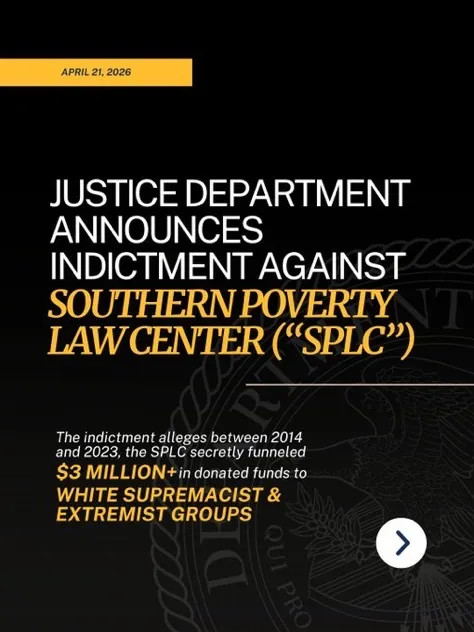
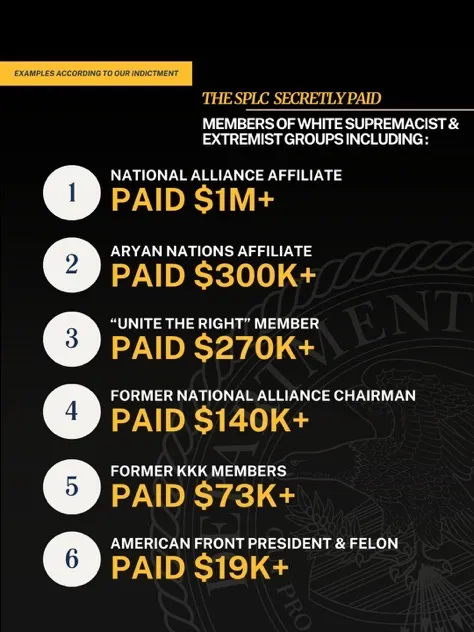
The indictment lays out telling examples. One SPLC “field source” reportedly received over $1 million between 2014 and 2023 while affiliated with the neo-Nazi National Alliance.8 Another informant was actually in the inner online circle that planned the Charlottesville rally itself: prosecutors say he “made racist postings” in that chat group and even “helped coordinate transportation” to the August 2017 march, all while being paid by SPLC.9 The DOJ press release quotes FBI Director Kash Patel, who bluntly said SPLC “lied to their donors, vowing to dismantle violent extremist groups” while “paying the leaders of these very extremist groups”.10 Acting Attorney General Todd Blanche similarly charged that “the SPLC is manufacturing extremism to justify its existence”, using donor money not to combat but to “stoke racial hatred”.11 DOJ officials argue that, if proven, SPLC’s actions amounted to an elaborate fraud: donors were intentionally misled, and false statements were made to banks to conceal the program. In sum, the indictment portrays SPLC as doing “the exact opposite” of its claimed mission, funding racial hate rather than fighting it. All of these details are, of course, allegations. The legal question at this stage is whether prosecutors can prove intent to defraud, but the charges alone lay bare a startling claim: that an organisation central to defining and fighting extremism may have been materially involved with it.


  1. https://www.washingtonpost.com/politics/2019/04/25/joe-biden-charlottesville-defines-trump-presidency/
  2. Ibid
  3. Ibid
  4. https://www.jta.org/2019/04/25/politics/biden-makes-trumps-charlottesville-reaction-the-center-of-his-campaign-launch/
  5. https://www.justice.gov/opa/pr/federal-grand-jury-charges-southern-poverty-law-center-wire-fraud-false-statements-and/
  6. https://www.northcountrypublicradio.org/news/npr/g-s1-118275/southern-poverty-law-center-indicted-on-federal-fraud-charges/
  7. https://abcnews.com/US/southern-poverty-law-center-facing-justice-department-probe/story/
  8. https://www.wunc.org/2026-04-21/southern-poverty-law-center-indicted-on-federal-fraud-charges/
  9. Ibid
  10. https://www.justice.gov/opa/pr/federal-grand-jury-charges-southern-poverty-law-center-wire-fraud-false-statements-and/
  11. https://abcnews.com/US/southern-poverty-law-center-facing-justice-department-probe/story/

On a lighter note, The Babylon Bee asks you to donate to the SPLC today to support a needy racist in your community.
They put out propaganda because it works

Filed under: Britain, Cancon, Government, History, WW1, WW2 — Tags: , , — Nicholas @ 04:00

I often find myself commenting on social media posts that the Canadian government’s direct subsidies to most of the mainstream media in Canada has created one of the most effective propaganda machines since 1930s Germany. “eLbOwS uP!” They keep doing it because it clearly is working fantastically well on a large enough share of Canadian voters that the polls (which may or may not be biased) keep touting that Dear Leader Carney and the Natural Governing Party are ever more popular. And most of the people consuming the propaganda message have their preferences re-inforced and the cycle starts again.

At Cracking Defence, Matthew Palmer discusses wartime propaganda during the 20th century, emphasizing that it’s the use to which it is put rather than the mechanism itself that has a moral value:

Propaganda is an absolute favourite subject of mine — probably not surprising considering that one of my roles in the military was psychological operations.1 Despite its very negative connotations thanks to the work of interwar writers like Frederick Ponsonby,2 propaganda really should be seen as a neutral term, perhaps best defined as “the deliberate attempt to persuade people to think and behave in a desired way”.3 Nor does it need to be state-driven; propaganda can come be generated from below as much as being driven top-down from the state or elites.

Some of the best propaganda comes out of wartime, and the First and Second World Wars were absolute goldmines. I also have a particular weakness for propaganda drawn up in early modernist and art deco styles, for which the first half of the 20th century was the high watermark. As such, here are a few of my all-time favourites for your delectation.4


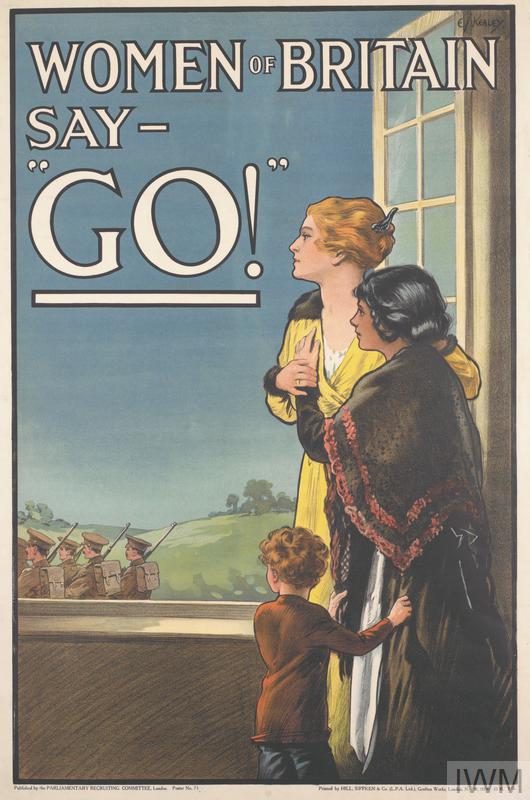
Women of Britain Say — Go!

Women of Britain Say ‘Go!’
Copyright: © IWM. Original Source: http://www.iwm.org.uk/collections/item/object/14592

A true classic that has reverbrated through the ages. Despite First World War propaganda having the reputation of being crudely jingoistic, much of it was in fact consciously aware of the pain and sacrifice being endured by the warring population, and did not try to hide it. This one acknowledges the sacrifice undertaken by the women and children left behind, while the background reminds the viewer of the green and pleasant land of ‘old England’ that they are fighting for.

[…]


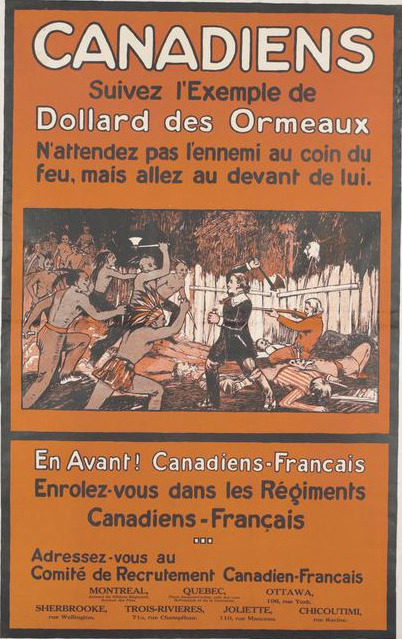
Canadiens, Suivez l’Exemple de Dollard des Ormeaux

Canadiens, Suivez l’Exemple de Dollard des Ormeaux [Canadians, Follow the Example of Dollard des Ormeaux] a depiction of Adam Dollard resisting an attack by Iroquois tribesmen. Dollard’s dead comrades lie at his feet.
Copyright: © IWM. Original Source: http://www.iwm.org.uk/collections/item/object/31027

I find this one intriguing, not because I think it is actually a brilliant poster but for what it tells you about historical context and how propaganda was often tailored explicitly for local sensibilities. While Canadian support for the Allies in the First World War was generally fierce, the major exception was Quebec, which saw relatively poor levels of recruitment for overseas service. As such, propaganda aimed at Quebecois often tapped deeply into local traditions, in this case the (extremely dodgy!) myth of Adam Dollard, venerated in the period as a Catholic martyr who died defending Quebec from native Iroquois.5

[…]


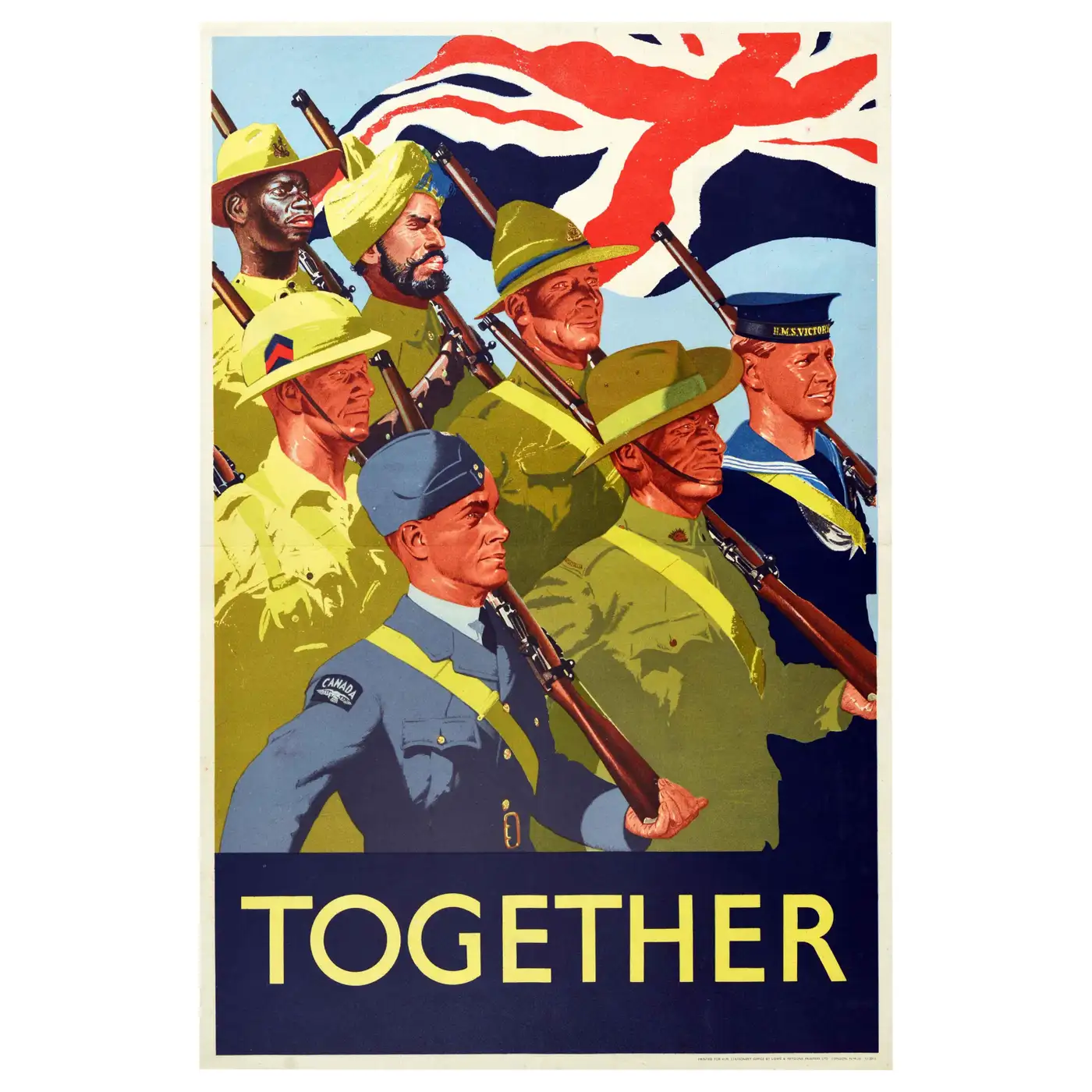
Together

Image courtesy of the IWM.

One can of course criticise the imperialism inherent in this poster, but I think it still works exceptionally well as a bold call for unity between the different nations of the British Empire. It shows how British propagandists took pains to highlight the Second World War as a global conflict against fascism.


  1. A job which, if I do say so myself, I was pretty bloody good at.
  2. Ponsonby wrote Falsehood in Wartime in which ironically he basically made up stories about British propagandists in a book supposedly about manufactured atrocity propaganda!
  3. Phillip Taylor, Munitions of the mind: A history of propaganda (Manchester University Press, 2013).
  4. I’m only going to present Allied propaganda. Because, frankly, fuck fascism.
  5. The story of Dollard is mostly myth, and he was more likely an idiot fur-trapper who got himself killed through stupidity.

Arctic defence – Canada can’t “go it alone”

Filed under: Cancon, Military, Technology, Weapons — Tags: , , — Nicholas @ 03:00

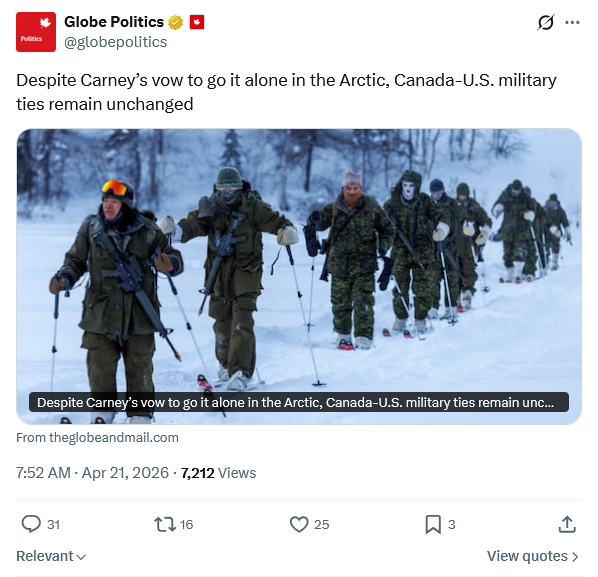
On the social media site formerly known as Twitter, Lee Humphrey explains a few of the reasons that we can ignore Prime Minister Mark Carney’s claims that Canada can defend the north without US assistance:

Canada is not capable of going it alone & is not going it alone. It’s a lie to say otherwise.

The majority of new radars being bought to replace existing radars will be from US companies, all our radars including the Australian built OTH radar will use US military satellites to communicate with monitoring stations in the US & Canada.

The armed drones we are buying are built in the US & will use US military satellites to communicate with their ground based controllers.

The subs we are spending $40 billion on are not capable of safely patrolling under sea ice for more than 11 continuous days before they have to turn around & get to clear water so we will continue to rely on US nuclear powered subs to track Russian & Chinese subs who are in sovereign CDN arctic waters.

Over the last year, US fighter aircraft have had to respond to 3 separate incidents that the RCAF were unable to respond to at all or in a timely way.

CDN’s who still believe Trump is going to invade need to realize just how many opportunities he keeps missing 😎

Reality sucks especially when national security or national sovereignty is at stake but the reality is that not only can we not operate independently at home, we can’t & haven’t been capable of operating independently for 60 years now!

Alexander the Great and Julius Caesar

Adrian Goldsworthy. Historian and Novelist
Published 1 Oct 2025

The first of this year’s video’s in answer to viewers’ questions — today we think about and compare Alexander and Caesar. This is not new, for in the ancient world the pair were often connected, even though they lived centuries apart. Appian compared and contrasted them, Plutarch paired his biographies of them, while Suetonius and others told stories about Caesar’s admiration for the famous Macedonian.

QotD: The problems of a “no first use” nuclear weapons policy

Now, you might ask at this point: why not defuse some of this tension with a “no first use” policy – openly declare that you won’t be the first to use nuclear weapons even in a non-nuclear conflict?

For the United States during the Cold War, the problem with declaring a “no first use” policy was the worry that it would essentially serve as a “green light” for conventional Soviet military action in Europe. Recall, after all, that the Soviet military was stronger in conventional forces in Europe during the Cold War and that episodes like the Berlin Blockade (and resultant Berlin Airlift) seemed to confirm Soviet interest in expanding their control over central Europe. At the same time, the Soviet use of military force to crush the Hungarian Revolution (1956) and the Prague Spring (1968) continued to reaffirm that the USSR had no intention of letting Central or Eastern Europe choose their own fates – this was an empire that ruled by domination and intended to expand if it could.

The solution to blocking that expansion was NATO, the North Atlantic Treaty Organization. Not because NATO collectively could defeat the USSR in a conventional war – the general assumption was that they probably couldn’t – but because NATO’s article 5 clause pledging mutual defense essentially meant that the nuclear powers of NATO (Britain, the United States, and France) pledged to defend the territory of all NATO members with nuclear weapons. But just like deterrence, mutual defense alliances are based on the perception that all members will defend each other. Declaring that the United States wouldn’t use nuclear weapons first would essentially be telling the Germans, “we’ll fight for you, but we won’t use our most powerful weapons for you” in the event of a conventional war; it would be creating a giant unacceptable asterisk next to that mutual defense clause.

So the United States had to be committed to at least the possibility that it would respond to a conventional military assault on West Germany with nuclear retaliation (often envisaged as a “tactical” use of nuclear weapons – that is, using smaller nuclear weapons against enemy military formations. That said, even in the 1950s, Bernard Brodie was already warning that restraining the escalation to general use of nuclear weapons once a tactical nuclear weapon was used would be practically impossible).

Bret Devereaux, “Collections: Nuclear Deterrence 101”, A Collection of Unmitigated Pedantry, 2022-03-11.

Powered by WordPress