
Quotulatiousness

April 17, 2026

Hungary in the news

Filed under: Europe, Media, Politics — Tags: , , , , — Nicholas @ 05:00

The way the mainstream media reacted to the recent Hungarian election results, you’d think it was the 2020s equivalent to the fall of the Iron Curtain. Outgoing leader Viktor Orbán has been portrayed as Hungary’s Trump when he hasn’t been discussed as Hungary’s Mussolini. His successor, Péter Magyar is largely unknown outside Hungary where he had been a member of Orbán’s Fidesz party before leaving to join his current party, Tisza. In The Critic, Ben Sixsmith provides some useful background on the state of politics in Hungary today:

Hungarian Prime Minister-elect Péter Magyar, on 15 March 2026 during a national day demonstration at Heroes’ Square in Budapest. Magyar is wearing a traditional bocskai jacket and a national cockade.
Photo by Norbert Banhalmi and released under CC BY-SA 4.0 via Wikimedia Commons.

Tisza — the name being a portmanteau of the Hungarian words tisztelet (respect) and szabadság (freedom), and a reference to the nation’s second largest river — was founded in 2020 and registered in 2022. It was a very marginal conservative party with policies like “raise the minimum pension” and “stop migration”.

In the 2022 parliamentary elections, the party fielded no candidates at all.

Tisza became a major force in Hungarian elections when Péter Magyar joined the party. Magyar, who has a legal background, had been a member of Viktor Orbán’s party Fidesz. More significantly, he had been married to the Hungarian Minister of Justice, Judit Varga, from 2006 to 2023.

In 2024, Varga resigned, along with Hungarian president Katalin Novák, after both were exposed as having signed a pardon for a convicted paedophile who had been a director of a state-run children’s home. Magyar resigned from Fidesz, accusing Orbán of “hiding behind women’s skirts”.

“For a long time I believed in an idea, a national, sovereign, civic Hungary,” wrote Magyar in a much-quoted statement, “But in recent years, I have slowly and finally realized that all of this is really just a political product.”

Magyar became a ferocious critic of alleged government corruption. His ex-wife responded to his anti-Orbán activities by accusing him of domestic abuse. Magyar denied this. Undaunted, he led various anti-government demonstrations, which attracted tens of thousands of Hungarians. He was also chosen to lead Tisza.

Magyar has profited from good timing. He is also a photogenic man who has performed well on social media. His politics are more mysterious. He has called himself a “critical pro-European and a conservative liberal”.

He is not the sort of liberal that anti-Orbán Westerners might want him to be. While he has said that he will “move away from the current, uncritically friendly approach towards Russia”, he has also said that it will take time to stop buying Russian fuel, and he has criticised the Ukrainian approach to Hungarian minorities. He has sometimes tried to outflank Orbán on sovereignty, saying that Fidesz have brought in too many guest workers, and even questionably saying that migrants have been stealing ducks from Hungarian ponds. Still, it remains to be seen if the pro-EU Magyar will maintain his more right-wing opinions or be swept along by European orthodoxy — not least when he has emphasised the importance of unlocking EU funds.

At The Sceptic, James Alexander says that the situation is more complicated than a split between Orbán and what he terms “the Roral Response”:
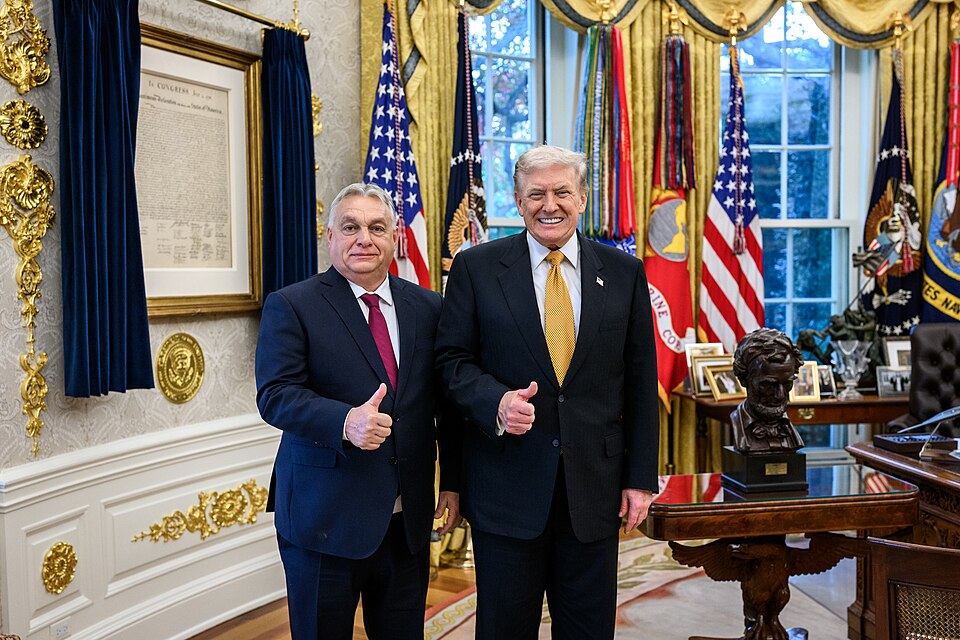
President Donald Trump and Hungarian Prime Minister Viktor Orban pose for a photo in the Oval Office, Friday, November 7, 2025.
Official White House photo by Daniel Torok via Wikimedia Commons.

What is the Orbán-Roral Divide? It is the Manichaean yin-yang binary of the simplistic political imagination, which supposes that, on one side, we have Orbán, Putin, Trump etc., and that, on the other side, we have von der Leyen, Merz, Starmer, Carney, Zelensky and of course the man after whom I name the category: Rory Stewart.

It has some truth in it, but it is bewildering when we see the binary exalted as if it is the only truth of politics. The downfall of Orbán illustrates this almost perfectly.

The subject today is Orbán Developments. And the Roral Response.

News.

As you all know, Orbán, after 16 years of power, fell in the recent election.

  • Viktor Orbán = Fidezs = 37.8% = 55 seats
  • Peter Magyar = Tisza = 53.6% = 138 seats

“Who loses and who wins, who’s in, who’s out,” quoth King Lear.

Orbán lost.

Now, I like Orbán, symbolically. I don’t know about actually: never studied him. I read one of his speeches once, and it read as more intelligent than any equivalent political speech. I have one thing in common with him, which is that he was present at the funeral of Norman Stone. Anyhow, like him or loathe him, we have to be philosophical. And we have to respect him, even if he is an Oxford man.

  • Oxford: Obsessed with power. Corrupt. Cecil Rhodes, Lord Milner, Tony Blair, David Cameron, Boris Johnson, Dominic Cummings, Viktor Orbán etc.
  • Cambridge: Lord Acton: “Power corrupts and absolute power corrupts absolutely.”

So let us look at what people say. The amusing thing is that people immediately editorialise. Twitter, X, Whatyouwill.com, turns everyone into William Rees-Mogg. Look at all these Editors.

Here is Ferenc Horcher, a very important Hungarian scholar:

    Time to face reality: the Hungarian electorate ousted the ruling power. The electoral system Fidesz introduced gave its opponent a two-thirds majority. Orbán established a one-man rule, tailored the campaign to himself, he is responsible for the defeat, he has to resign.

That’s grim talk from a conservative. So here on the jolly side is Sam Moyn, a very important Yale Law School professor:

    Yay for Hungary. What if the answer to illiberalism is democracy?

Ho hum. I sigh a bit over the innocence of making a contrast between illiberalism and democracy, as if liberalism = democracy.

(more…)

This is how drawers worked before screws

Filed under: Tools, Woodworking — Tags: , , , — Nicholas @ 04:00

Rex Krueger
Published 16 Apr 2026

The book I mentioned (affiliate): https://amzn.to/4mC2TWT
All my plans: https://www.rexkrueger.com/
Patrons saw this video early: / rexkrueger
Compass Rose Toolworks: https://www.compassrosetools.com/
Join the Mailing List: http://eepurl.com/g3rkmv
Take a course: https://www.rexkrueger.com/courses
Get my woodturning book: http://www.rexkrueger.com/book
Get My Book, Everyday Woodworking: https://amzn.to/3oyjC0E
Follow me on Instagram: @rexkrueger

Canada joining the EU is a terrible idea

Filed under: Bureaucracy, Cancon, Economics, Europe, Government, Media, Politics — Tags: , , , , — Nicholas @ 03:00

On the social media site formerly known as Twitter, Dean Allison explains a few of the reasons Canada should not be attempting to join the European Union, despite Prime Minister Carney’s obvious love for the idea:

One of the dumbest ideas floating around right now: Canada joining the European Union.

This isn’t a trade deal. This is a surrender.

You don’t “partner” with the EU. You hand power to unelected technocrats in Brussels who dictate policy across 27 countries.

Let’s be clear what that means for Canada:

  • You lose control of monetary policy. Goodbye independent Bank of Canada.
  • Your federal budget gets reviewed and constrained by foreign bureaucrats.
  • Regulations get imposed from overseas with zero accountability to Canadians.

And if you think Ottawa is slow now, wait until every decision requires EU-level consensus. Nothing gets done without layers of approvals, committees, and political trade-offs across continents.

Then there’s censorship.

The EU is aggressively regulating online speech, platforms, and content. Handing them influence over Canada means more control over what you see, say, and share.

This isn’t sovereignty. It’s outsourcing it.

As Brian Lilley points out, we’d be giving up more control than in any U.S. trade deal.

Rejecting becoming the 51st state of the U.S. only to become the 28th state of Europe isn’t strategy, it’s pure stupidity!

And Canadians will pay the price.

The Chronicles of Riddick: a Treatise on Political Machinery

Filed under: Media, Religion — Tags: , , — Nicholas @ 02:00

Feral Historian
Published 28 Nov 2025

The Chronicles of Riddick probably isn’t on anyone’s “top 10 science fiction” list, but it’s a remarkably astute study of how ideologies lead to systems, and how those systems co-opt people within them.

And of course it has a great cast that seems to have had fun with their roles.

00:00 Intro
01:04 Perception of Enemies
03:12 The Underverse
04:59 Plotting and Scheming
07:47 Superposition
08:20 Institutional Inertia
(more…)

QotD: The decline of cities in the late western Roman Empire

The ancient Mediterranean was a world of cities and in the eastern Mediterranean at least, it had been long before the Roman period. By the beginning of the Roman Republic (509 BC), the pattern of organization was broadly similar in Italy, Sicily, coastal North Africa, Egypt, the Levant, Mesopotamia, Anatolia and Greece: agricultural land was broken up into the territory of cities (so that each city consisted of both its urban core but also its agricultural hinterland). Those cities might then either be independent, as with the poleis of Greece and the various communities of pre-Roman Italy, or be the basic administrative units of larger empires, as in the Persian Empire (or later Roman Italy). And so, while most people still lived in the countryside, most of that countryside was in turn attached to an urban center which was the center of political, economic, religious and cultural life.

This was the world the Romans knew and the world they were most comfortable governing. Consequently, while the Romans were utterly uninterested in “civilizing” anyone, when they conquered areas which weren’t urbanized, they tended to found cities or encourage local urbanization in order to create the administrative structures through which the Romans could extract revenue most efficiently.

As mentioned above, the Romans generally wanted these cities to be mostly self-governing. While at conquest, the Romans found themselves managing a bewildering array of different styles of local urban government, over time a mix of Roman administrative preference and cultural diffusion tended to produce a fairly similar set of civic institutions. City governments, which also administered their rural countryside, were run by a town council which consisted of the wealthiest notables of the town – the curiales – in much the same way that the Roman upper-class had dominated the running of the city during the Republic. Roman authority generally protected the curiales and their wealth from the sorts of popular uprisings that tempered many Greek oligarchies in the classical period and in return the curiales managed the population and the collection of taxes for the Romans.

The curiales both managed the town affairs and were also expected to use their own wealth to fund public activity and works: maintain temples and baths, fund religious rituals and festivals, and so on. Through the first and second century, that process was mostly responsible for providing the cities of the Roman Empire with the impressive collection of often still-visible public works they boasted: baths, theaters, amphitheaters, aqueducts, temples, courthouses, public spaces and so on. While some of these structures were little more than the public posturing of the elites, many of them were open to the general public and will have represented, in as much as anything before the industrial revolution could, meaningful improvements in the lives of regular people.

While most of the wealth of any of these cities was derived from the rents and taxes extracted from their agricultural hinterlands, these cities also substantially lived off of trade and markets. Because the local city typically housed the local market, they were the obvious point for local products to enter the stream of provincial-wide or empire-wide trade or for distant imports to reach their final customers. We’ll come back to this next time when we discuss trade and the economy, but for now I want to note that this trade provided a fair bit of the economic vitality of these cities but also that it did in fact reach down beyond mere luxury goods into the basic staples that even the relatively poor might buy.

The decline and fall of these Roman cities is most extensively described in J.H.W.G. Liebeschuetz’ aptly titled, Decline and Fall of the Roman City (2001). Given his title, as you might imagine, Liebeschuetz is in the “decline and fall” camp, arguing that the classical city which defined the Roman world largely did not survive it. Regional patterns differ, with Liebescheutz identifying three “patterns”: I) Western and Central Anatolia, II) Syria, Palestine and Arabia, III) the west, including North Africa).

We’ll deal with the situation in the east in just a moment, so let’s focus here on the cities of the west, which were at the start generally smaller, less wealthy and generally far younger than those of the east (with some exceptions in Italy). Decline sets in fastest and is most severe in Britain, with the final collapse of the cities coming as early as the 360s, whereas in North Africa, the classical city doesn’t seem to tip into decline until after 400.

While each individual region and indeed each city will have been subject to its own unique conditions, a few basic causes seem to have been active everywhere to some degree. First, the crisis of the third century seems to have fundamentally disrupted empire-wide Roman trade, which then stabilized at a lower level for the fourth century, before declining precipitously in the fifth. That first decline seems to have been somewhat offset by the increased demands of imperial administration and in particular the centralized taxation in-kind and movement of goods which had to move through cities. Peter Brown describes the late Roman state as, “the crude but vigorous pump which had ensured the circulation of goods in an otherwise primitive economy” (The Rise of Western Christendom, 2nd ed., 13). We’ll return to this when we discuss the shape of the economy next time, but for now it works as a crude, but vigorous description of that facet of the late Roman economy.

At the same time, as Liebescheutz describes, the role of the curiales steadily atrophies in the fourth century. On the one hand, much of the authority and power of being on the council was steadily eroded as those functions were pulled upwards into the imperial bureaucracy. At the same time, members of the curial class who sought imperial office could get immunities from the progressively more severe taxation which otherwise often fell on the curiales and so the imperial elite often crowded out the curiales when it came to wealth and prestige in the community. As they lost both control and responsibility for their cities, the curiales‘ investment in public works and monumental architecture also ceased (though local elites do invest in church-building and monastic foundations), leading to the decay of the physical urban centers.

Finally, the warfare of the fifth century had its impact, though as Liebescheutz notes, it cannot be presented as a sole cause simply because many urban areas were already clearly in decline when conflict hit. In the case of Britain, the cities were gone by 420, decades before the arrival of any invaders. Nevertheless, political instability and violence in the fifth century seems to have delivered death-blows to ailing communities, especially in the Balkans and along the Rhine.

The end result was that in the West, urbanism declined severely between the fourth and sixth centuries. Rome, once a city of a million people, collapsed down to a population of just 80,000. Arles, which had been a thriving Roman city with an amphitheater, an aqueduct, a chariot-racing track, a theater and full city walls shrunk so severely that the remains of the city moved inside its amphitheater, repurposing it as a new set of city walls, with the town square in the middle and houses built in the stands. While many towns survived in their new, shrunken and impoverished form, urbanism in Europe outside of the Eastern Roman Empire would largely have to be reinvented during the High Middle Ages, (though with some key institutional survivals from the Roman era and often rising out of the diminished remains of Roman cities). Instead, the society of the early Middle Ages was overwhelmingly rural in both population and focus. If on politics we have a bit of a mix between decline and continuity, when it comes to the cities that made up the old political system, the “decline and fall” knight strikes a clear blow: the system of social organization that characterized the ancient world practically vanished and would have to be redeveloped centuries later. The institutions that had maintained it (like the curiales) largely vanished, replaced in some cases by local “notables” and in other cases by ruralization.

Bret Devereaux, “Collections: Rome: Decline and Fall? Part II: Institutions”, A Collection of Unmitigated Pedantry, 2022-01-28.

Powered by WordPress


