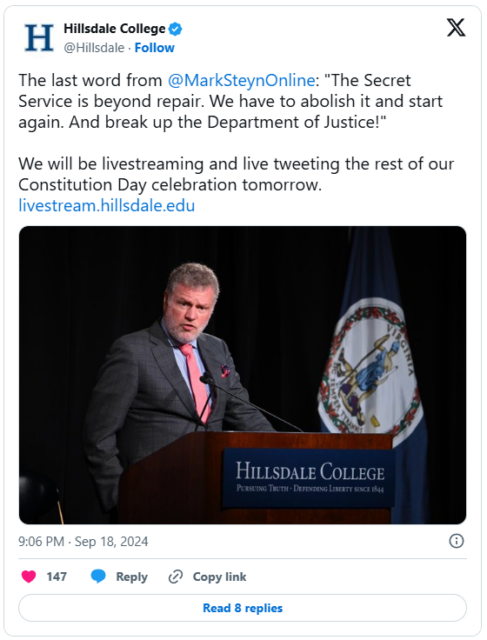
I haven’t been following the latest attempt to assassinate the President, but Mark Steyn apparently has been (even though he’s touring Ukraine at the moment):
By contrast Washington is ever more like Churchill’s riddle wrapped in a mystery inside an enigma. My conscience is clear. Almost two years ago, it was perfectly obvious to anyone who examined the facts on the ground in Butler, Pennsylvania that the United States Secret Service had an institutionalised level of incompetence and/or malevolence that was assisting those many persons anxious to kill Trump to do so. Even as mere incompetence, it is murderously so: Corey Comperatore is dead, and everyone in Butler and DC who enabled his death still has a job.
So immediately afterwards I stated the obvious:
Instead, the 47th President promoted the chap in charge in Butler that day to head of the entire Secret Service: one Sean Curran. And, on Saturday night, Mr Curran allowed the same thing that happened at Butler to happen all over again. On the incompetence front, look again at the would-be assassin breaching security with his brilliant cunning plan, requiring months of painstaking training and preparation and attention to detail, of simply running through the checkpoint:
The chaps at Kharkiv railway station are more alert than those guys. Yet setting aside the under-performance of the individual agents — close enough for government work, it seems — this ingenious manoeuvre became a critical issue mainly because, exactly as at Butler, the Secret Service had taken the decision to shrink the perimeter of the “secure zone”. In Islamabad the other day, the Pakistanis were hopeful that Vance and the Iranians would be jetting in for another round of face-to-face negotiations. So they took the precaution of ordering all the other guests out of the designated hotel: the Tehran delegation, in particular, is concerned that Netanyahu will off them while they’re in town by having Mr Moshe Wetwork check in to the junior suite on the fifth floor.
No such worries at the grisly Washington Hilton — even though half the country would be cheering on Mr Wetwork. On ABC TV, Jimmy Kimmel threw a Thursday-night “alternative” White House Correspondents Dinner at which he saluted the First Lady:
You have the glow of an expectant widow.
I have never knowingly watched Jimmy Kimmel or Jimmy Fallon or Jimmy Colbert, whichever is which. But I’m old enough to remember when Johnny Carson in 1981 told Nancy Reagan and indeed when Steve Allen in 1901 told Ida McKinley that they had the glow of expectant widows.
Oh, wait, no. Neither Johnny nor Steve did that. Because, back in 1981 and 1901, America still had sufficient of what the late Roger Scruton called the “pre-political we” to recognise that assassination fantasies are not helpful to a functioning polity.
Alas, the role that in other western nations has to be outsourced to Muslim rape gangs and low-IQ child-stabbers and sundry novelty demographics is in America performed by showbiz bigshots, NPR ladies d’un certain âge, and pajama boys with a quarter mil in college debt.
That, however, is a given. What ought not to be a given is that the Secret Service is on their side. At Butler, Mr Curran and his colleagues shrunk the perimeter so that it excluded an easily accessible roof with a clear line to Trump’s head. At the Washington Hilton, Mr Curran and his colleagues shrunk the perimeter to the event room and its immediate approach. In the usual tedious “manifesto”, the would-be killer nevertheless noted that the security was so “insanely” bad they must be “pranking” him:
What the hell is the Secret Service doing..?
Like, I expected security cameras at every bend, bugged hotel rooms, armed agents every 10 feet, metal detectors out the wazoo.
What I got (who knows, maybe they’re pranking me!) is nothing.
No damn security.
Not in transport.
Not in the hotel.
Not in the event.
Like, the one thing that I immediately noticed walking into the hotel is the sense of arrogance. I walk in with multiple weapons and not a single person there considers the possibility that I could be a threat.
The security at the event is all outside, focused on protestors and current arrivals, because apparently no one thought about what happens if someone checks in the day before.
Like, this level of incompetence is insane, and I very sincerely hope it’s corrected by the time this country gets actually competent leadership again.
Like, if I was an Iranian agent, instead of an American citizen, I could have brought a damn Ma Deuce in here and no one would have noticed shit.
Actually insane.
So, once he’d run through the security line, he was able to get into the same men’s room that the entire cabinet had to use. Had RFK or Pete Hegseth felt the urge before settling in for a night of long speeches, the headlines this weekend would have been very different. Half the presidential line of succession was in there. That’s what the geopolitical types call, if you remember, a “decapitation strategy”. Except you don’t need a bunker buster, just some California doofus willing to take a run at the checkpoint — and bingo, whoever the Secretary of the Interior is winds up like some z-list ayatollah.
On a lighter note, Daniel Jupp imagines what Trump-haters might be thinking in the wake of another progressive would-be assassin’s attempt:
MAINSTREAM media and politicians throughout the Western world who insist on calling Trump a fascist, a dictator, a threat to democracy, and literally Hitler, declared a three-hour moratorium on insulting him before they raced to try to escape any responsibility.
“Our thoughts and prayers go out to President Trump and his family while we write an article claiming the assassin is a Republican and it’s actually Trump’s fault”, announced the BBC. “Our viewers should be reassured that we ARE doctoring footage.”
“Violence has no place in politics when it fails”, Ed Davey, leader of Britain’s Liberal Democrats intoned.
Religious leaders condemned the rise of populism and white supremacy that fuels such attacks.
“We must have unity, Christian compassion even for those who don’t deserve it, and come together in kindness. He who lives by the sword dies by the sword at some point”, Pope Leo wisely reflected.
“Where is this violence coming from?” wailed the Associated Press. The news agency issued a statement reminding people that assassinations should be attempted only in settings where misses, ricochets and other deaths could not possibly include any of their journalists. “A Correspondents’ Dinner is simply not the place for this sort of thing.”