
Quotulatiousness

April 11, 2026

Declining educational standards are now “a civilizational catastrophe”

Filed under: Education, USA — Tags: , , — Nicholas @ 04:00

On the social media site formerly known as Twitter, Brandon Zicha points out that the declining educational standards across the west are now to the point of “a civilizational catastrophe”:

A student today at my elite university admitted to me today that she took a class so she could work on reading for more than 20 minutes at a time. She can’t read. She mainly skims and summarizes, she says and still gets A’s.

This student is, by professional standards, illiterate. Gonna have high GPA when she graduates.

This conversation was had after 6 of 22 students dropped my course because the maximum reading per week in one week was over 100 pages.

What people aren’t grasping is that this is literally *dangerous*. These people are going to be come doctors, engineers, etc. They are — by any metric — vastly less capable than prior generations. These effects are cumulative over a lifetime.

This grade inflation is part of the problem, but not even close to the entirety. And the problem obviously starts in K-12.

Students don’t know history because, you can’t actually become historically literate on the advice of “never assign more than 30 pages a week”. You can’t develop any of the skills that came with literacy. This is, quite honestly, a civilizational catastrophe.


Another student who seemed really interested in history … confirmed he was … but doesn’t read. He watches Youtube …

… which explained how the conversation went after when I pressed further.


I coteach a class with a colleague … but I am lead … for the past 15 years. I was discussing complaints from students and he pointed out that we have reduced the difficulty and load every 3 years or so since the beginning, and we probably have to stop.

I agreed. But, the students were absolutely irate, and complained about how it left them no time to “reflect” … a load about 30% less than when the course started.

That is an objective decline in ability.


Honestly, I hadn’t even noticed until he pointed it out. It was just incremental.

Changed how I approach teaching.


A good colleague is worth a thousand teaching development seminars.


(quick note … most of those 6 dropped for this reason … not each one … there was a double booking or two)


I feel like I need to point out that the student in the original tweet is a model of *what to do*.

This student is the hero of my tale, but is overcoming something they should not have to, and that is disasterous if it is as widespread as it seems it may be, and they aren’t all similarly driven.

This student? The hero.

Not a dunk.


Another clarification:

I’m a small account here … Didn’t expect the affection.

The student is literate. Not a professional university level (or what it’s ever been).

It was hurried poor phrasing.

The student seems aware that their reading retention and scope is not what it should be … And is addressing it!


Summarizing:

The concern isn’t my (actually heroic) student, but the trend that student is tackling under her own steam …

I routinely here professors complaining about students who:
1.) Can’t or won’t read at levels we have never seen.
2.) When they do, their ability to connect between texts and evaluate is poor. Indeed, grasping the text is not great. It’s increasingly the norm, and it used to be the opposite.
3.) They struggle to reason, honestly.
4.) Most weirdly, we struggle to talk about “reflecting on ones ideas”. They often struggle to understand *what that means*. This suddenly started where students didn’t understand what this meant.
5.) They have declining writing skills.
6.) They have lower interest in ideas
7.) They are less sophisticated in their ability to manipulate ideas
8.) They are much worse on many of the metrics associated with high level reading ability.

At the same time
1.) Study times have declined.
2.) Assigned workloads have declined a great deal
2.) Hiring employer complaints about graduate quality has declined increased continually.
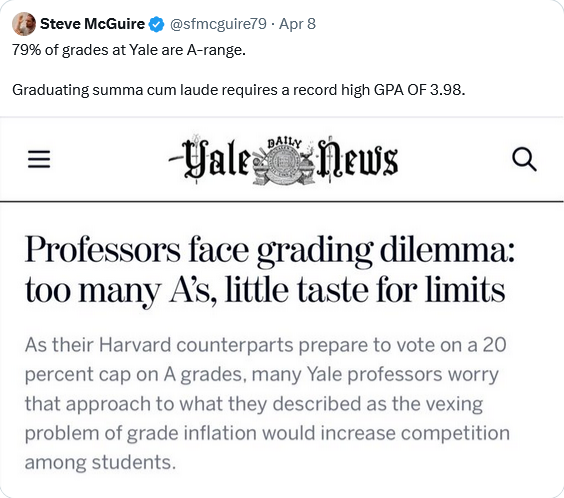
3.) Grades have remained the same or gone up.

… in the past decades, but particularly the last decade to an alarming degree. This is not about one student’s situation, or whether or not one should be “readmaxxing” in college, reading 500 pages plus.

… and just look at the examples cited in this thread.

We have a major issue to address here, folks. Civilizational level issues. And, I genuinely don’t feel we are having the conversation we need to be having yet.
Update, 12 April: Welcome, Instapundit readers! Have a look around at some of my other posts you may find of interest. I send out a daily summary of posts here through my Substackhttps://substack.com/@nicholasrusson that you can subscribe to if you’d like to be informed of new posts in the future.


The Liberal Party is about pure politics, not principle

Filed under: Cancon, Media, Politics — Tags: , , , — Nicholas @ 03:00

In some ways, you have to admire the Liberal Party of Canada — often described as Canada’s “Natural Governing Party” — for their long-term success at staying in power. They do this because, unlike the Conservatives or the NDP, their raison d’être is gaining and holding power. No Liberal holds firm values in any other area and therefore can switch sides on a given topic at a moment’s notice. As long as believing A keeps them in power, they’ll believe wholeheartedly in A, but if believing B becomes more important, like a shoal of fish, they’ll instantly switch to believing in B. It’s an amazing phenomenon. In the Toronto Sun, Jamil Jivani (my local MP) documents this Liberal talent:

Aussies & Tanks: The Story of Australian Armour

Filed under: Australia, Britain, History, Military, USA, WW1, WW2 — Tags: , , , , — Nicholas @ 02:00

The Tank Museum
Published 30 Jan 2026

Australia has always been an outlier when it comes to tanks. The first time Australians fought alongside tanks, it was such a disaster they almost gave up on the whole idea. And the first time they fought IN tanks, they were pinched from the enemy.

They’re the only Allied nation to reject the M4 Sherman. More than once, they’ve used their tanks very differently to how they were designed. Yet somehow, they’ve almost always been successful.

So, why do the Australians use tanks so differently to everybody else?

Join James and Fam as they explore the weird and wonderful ways that our Australian cousins have used their tanks. From captured tanks in the desert, to heavy metal in the jungle, the Aussie methods of armoured warfare have always seemed a little upside down from the outside.

While Australian interest in tanks has come and gone, when the need has arisen, the Australian tank force has been up to the challenge. Simply put, Australian soldiers usually use tanks differently because they usually fight differently. And despite long periods of neglect, tanks in the Australian Army always seem to find a way to bounce back.

00:00 | Introduction
00:36 | A Bad Start
03:44 | Tanks of their Own
06:19 | Welcome to the Jungle
11:07 | Lessons Relearned
13:53 | Defence of Australia
(more…)

QotD: Kingdoms were not “nations” in the Middle Ages

Filed under: Europe, History, Media, Quotations — Tags: , , , , — Nicholas @ 01:00

Medieval kingdoms and Early Modern states were both built around the personal holdings of individual rulers. For instance, to talk of “Austria” or “Burgundy” in the 1400s as states/countries/governments is to engage in a degree of anachronism. There was no Austrian state, merely the collection of lands either owned or controlled by whoever the reigning Habsburg was at the time. Likewise, Burgundy in, say, 1440 was not a coherent entity, it was simply the collection of lands that Philip the Good (Duke of Burgundy, but also Duke of Brabant, Limburg, Luxemburg and Lothier, Count of Artois, Flanders, Charolais, Haniaut, Holland and Zeeland, and the Margrave of Namur). The “kingdom” was thus not a permanent, durable entity so much as a collection of possessions the same way my personal “library” is not permanent building but just a term for “books I happen to own right now”.

It is thus a bit odd that the regions of Westeros are seen by its inhabitants as being clear and unchanging. For instance, the Reach has borders, those borders do not move and everyone in those borders is loyal to House Tyrell. This is not how medieval rule works. The borders of, say, France, shifted over time (some places we consider “obviously” part of France were added only quite late, like French Flanders or Provence) as the ability of the French king to control those regions changed. For long periods of the Middle Ages, large parts of France were effectively controlled by the Kings of England (because they were also Dukes of this or that French duchy).

The idea that France, or Germany or Italy was a distinct, permanent entity with its own existence apart from a given royal family – more than just a space on a map – which comprised a people, their language and the government of those people, this is a modern phenomenon. Indeed, one may argue, it – that is, the nation-state – is the modern phenomenon.

Bret Devereaux, “New Acquisitions: How It Wasn’t: Game of Thrones and the Middle Ages, Part III”, A Collection of Unmitigated Pedantry, 2019-06-12.

Powered by WordPress


