At True North Strategic Review, Noah tries to answer the obvious question “what the hell is an Arctic Mobile Base?”
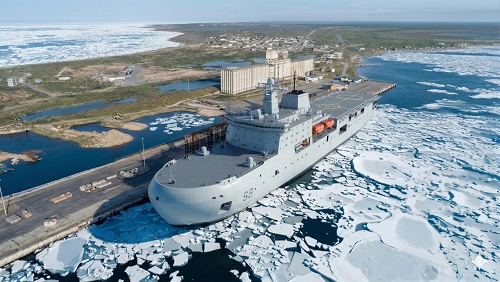
RCN Arctic Mobile Base concept image
RCN via True North Strategic ReviewFor those that don’t know, the Arctic Mobile Base, as it is currently called, is officially on the books. Despite a few years of conceptualization, the project is still in its early stages.
I always feel the need to reiterate that to folks; it is very much still a concept. It is not funded, not approved, but despite that, we already have a fairly decent vision of what the RCN is sorta looking for as a platform.
[…]
When you hear a name like Arctic Mobile Base, I’m sure a lot of ideas go through your head. Indeed. What exactly is a base in this context? Who or what is it meant to support? What sort of gaps is it designed to fulfill?
To understand the AMB (as I will call it from here on out), you need to understand exactly what the Navy is facing up in the Arctic; more specifically, the difficulty in building and maintaining infrastructure. With the failure of Nanisivik, the RCN is faced with a difficult position.
The first thing you need to know here is fundamental limitations. Canada, unlike our other allies, lacks an available ice-free port to utilize in the Arctic year-round. The closest available major ports that Canada has access to with year-round access are Saint John on the East Coast and Prince Rupert on the West Coast.
Iqaluit, Tuktoyaktuk, and Churchill, the major ports available in the Canadian Arctic, all freeze in the winter. Even Nome in Alaska freezes. The only port facility available year-round would be in Nuuk, where, while work is underway on the Danish side to expand current facilities, it is still not enough to provide ample support for Canadian vessels operating in the Archipelago.
[…]
That brings us to the vessels themselves, or at least the concept as I have been told. I guess one could say they are the true successors to the original Joint Support Ship concept; maybe even ALSC if you want to get deep into the philosophical.
They are an everything vessel. They will be Command and Control centres. They will have large, extensive medical facilities. They will be Replenishment Vessels, able to support the rest of the fleet at sea. They might have some submarine tender capabilities and forward repair capabilities built in. Those two are me speculating, though I’m sure someone is asking those questions.
They will be HADR platforms, able to operate independently of any existing infrastructure like ports. They will have an amphibious capability to support that, and if needed, support the Army in any endeavour they find themselves in. They will be able to reach any other vessel in the fleet, even the Polars if required.
That means that as of now, the Navy is looking at PC 2 for its potential rating, a monumental ask. It is likely to have similar range and endurance requirements to the existing Polar Icebreakers, so perhaps around a 25,000-30,000 Nautical Mile Range (as a general rough figure) and upwards of 270 days endurance.
That will allow for the AMB to maintain a persistent, on-station capability in the Archipelago for an extended period of time, similar to the future Arpatuuq and Imnaryuaq. Again, the AMBs are meant to be a semi-permanent capability in the Arctic, with the desire to have one up there or available to get up there at any given time and stay up there supporting both the fleet and local communities for an extended period of time.
As for what I know? Two are planned. Both will be based on the East Coast, where it is easiest to access the Arctic compared to going from Esquimalt, past the Bering Strait, and over Alaska. It is also the area of most activity for the Navy. So it makes sense, along with the typical desire to consolidate maintenance, crews, training, and additional infrastructure.
While I’m pleased to discover that the RCN seems to be taking the Arctic seriously and doing planning to that end, we should also keep in mind that the federal government is a big believer in the “ice free Arctic by 2050” predictions, they may not be willing to fund hulls built to PC 2 levels of ice-breaking capability. Which would be fine if the predictions come true, but very limiting to the planned ships if the Arctic fails to warm up as the climate models claim it will.