
Quotulatiousness

April 24, 2026

Britain’s Green Party … not your weird cousin’s old Green Party

The Green Party have been more of a punchline than a party for decades in British politics, but the Green Party of today shares only a name with its earlier incarnations (the old UK party is now split into three separate Green Parties for England and Wales, Scotland, and Northern Ireland). Now, it’s become a significant threat to the Labour Party thanks to its unlikely fusion of socialist and green policies with strong support from Britain’s growing Muslim community:
The Green Party is a growing force in British politics. In February, they gained the Parliamentary constituency of Gorton and Denton in a by-election — a supposedly “safe” seat for the Labour Party. Local elections in May see them set to make big gains — perhaps sweeping to power in several town halls in London, perhaps including Camden, where Sir Keir Starmer is one of the local MPs. Opinion polls often show them roughly level with Labour and the Conservatives.

This is quite a change from previous decades when they were indulged as eccentrics on the political fringe. The Green Party (or the Ecology Party, as it was earlier named) were the sandal-wearing, muesli-munching environmentalists who wanted to go back to nature. They opposed economic growth — but their supporters tended to be affluent enough that they could afford to do so. Its leader was the aristocrat Sir Jonathon Porritt.

They were the breed George Orwell was thinking of when he wrote: “One sometimes gets the impression that the mere words ‘Socialism’ and ‘Communism’ draw towards them with magnetic force every fruit-juice drinker, nudist, sandal-wearer, sex-maniac, Quaker, ‘Nature Cure’ quack, pacifist, and feminist in England”.

Great fun. But there was a darker side to the quackery then and now. A totalitarian mentality which, as Orwell also vividly described, proves horrific when it prevails.

Increasingly, the Green Party has shifted its focus away from the environment. In the few towns and cities where it has gained power locally, such as in Bristol and Brighton, it has proved ineffective at practical work in this respect. Typical behaviour would be to pass a motion declaring a “climate emergency” but then perform lamentably when it comes to recycling or tree planting or any of the relevant matters they have the power to deal with.

There was always a distortion in its supposed concern for sustainability in that it was really an excuse to denounce capitalism. The Property and Environment Research Center, a US think tank which champions free-market environmentalism, has shown a more enlightened approach. Their work has included a comparison of privately-owned and state-owned forests. Another applies property rights to marine assets. But the role of property rights as a means of good stewardship of our planet is dismissed by the Green Party out of hand.

In any case, much of the campaigning by the Green Party now is on non-green issues. Its leadership talks a lot about foreign policy and a broader economic pitch focusing on class war rhetoric and an extreme programme of state control. Taxing the rich is always seen as the panacea, despite the reality that many entrepreneurs are already fleeing the United Kingdom due to its hostile fiscal environment.

Its Manifesto for the last election two years ago proposed a Wealth Tax, a pensions tax, and a big increase in Capital Gains Tax. A £90 billion carbon tax would have closed down much of British industry, which was probably the idea.
The Mailbox Test

Filed under: Law, Liberty, Politics, USA — Tags: , , — Nicholas @ 03:00

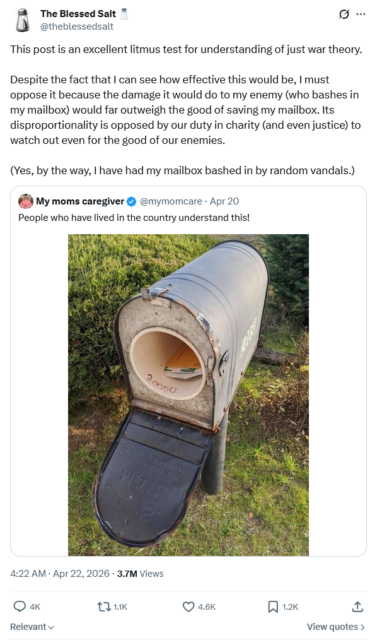
On the social media site formerly known as Twitter, Devon Eriksen responds to a thread about the ethics of setting up a trap that will only be effective if someone attempts to destroy it:

The Mailbox Test, like the breakfast test, is an excellent way to tell who you can allow to wield power in your society.

Goes like this:

    If someone is hurt trying to destroy someone else’s stuff in order to take pleasure from their pain, do you sympathize with …

    The aggressor because he got hurt?

    Or with the guy who owns the stuff, because he wasn’t the aggressor?

You can have people in your society who fail the Mailbox Test. That’s okay … they can work at hospices, or shelters for orphaned kittens, or something.

But you cannot allow them to vote, or otherwise wield political power. Because if you do, they will open the gates of the city to the enemy.

I am personally tired of everyone pretending that people who enjoy ruining things for random strangers are just kewt smol beans who are only aggressive because of all the complex socioeconomic factors and lack of resources.

They knew someone would be hurt by what they did. They knew that someone had done literally nothing harmful to them. And those two ideas, in combination made them feel pleasure. And they went and did it.

That is the sign of a rotten soul.

Defending ourselves and our property is not just a right, it’s a moral obligation. Otherwise, we just kick the can down the road for someone else to deal with, someone who may not be able to defend herself.

I don’t care if a vandal breaks his arms trying to destroy my stuff. Because I value my stuff more than a vandal’s arms. And the fact that he tried to destroy somebody else’s stuff shows that he, too, values his arms less than the opportunity to hurt somebody.

We cannot allow such people inside the city, and we cannot give the keys to those who would open the gates for them.

Another response to the original post from Kit Sun Cheah:

Sure, this adheres to a strict interpretation of Just War Theory.

However … we’re talking about a mailbox.

A mailbox is not a weapon. It does not serve any military purpose. Its existence is entirely inoffensive.

That is why it is an easy target.

A reinforced mailbox is purely defensive. Do not meddle with it and it will leave you alone. Strike it, and Newton’s Third Law kicks in.

Poke it and nothing will happen to you. Try to smash it and you risk smashing your own arm. It does not amplify an incoming force, it merely resists and returns it. Thus it is inherently proportionate.

No law or theory of war requires that you advertise your capabilities. Concealment may feel wrong to a certain type of personality, but openness is not always a social good.

Yes, you can fortify the mailbox in a blatantly obvious fashion. Some ne’er do well will notice it, then decide to pick another easier mark.

You have deterred an attack on your own property by redirecting attention to someone else’s.

Now suppose the mailbox were covertly fortified. A vandal strikes it and is injured. He passes along word to his friends, and their friends. Then they will start to wonder: are all the mailboxes reinforced?

They can’t tell, so they must assume every mailbox is fortified.

Thus, covert reinforcement does more to deter aggression than overt reinforcement. And ultimately, we want to see an end to mailbox destruction.

This post is not about just war theory or mailboxes.

Update, 25 April: Welcome, Instapundit readers! Have a look around at some of my other posts you may find of interest. I send out a daily summary of posts here through my Substackhttps://substack.com/@nicholasrusson that you can subscribe to if you’d like to be informed of new posts in the future.

Defending Heinlein and his most controversial novel – Farnham’s Freehold

Filed under: Books, USA — Tags: , , , , , , — Nicholas @ 02:00

Grammaticus Books
Published 21 Nov 2025

An indepth review of Robert A. Heinlein’s most controversial novel. A novel sometimes referred to as Science Fiction’s most controversial novel, Farnham’s Freehold.

00:00 Intro
02:30 Why I Read Farnham’s Freehold
04:33 The Plot (Spoilers)
12:48 The Critics’ Complaints
21:40 Is it A Fun Read?

My Video on Time Enough for Love:
Heinlein’s MOST CONTROVERSIAL Novel – Time…

Update, 25 April: Welcome, Instapundit readers! Have a look around at some of my other posts you may find of interest. I send out a daily summary of posts here through my Substackhttps://substack.com/@nicholasrusson that you can subscribe to if you’d like to be informed of new posts in the future.

QotD: Cant

Filed under: Politics, Quotations — Tags: , , — Nicholas @ 01:00

How does one distinguish cant from real concern or real emotion? The authors rightly say that there is no fool-proof test. Some people are more sensitive than others to the wrongs of the world: as Mrs. Gummidge puts it, “I feel it more”. But if I were to say with a pained expression, “I am so concerned about the situation in the Southern Sudan that I cannot sleep at night”, and you knew perfectly well that I slept like a log the night before after dining well, and furthermore that I had no connections whatever with the Southern Sudan, you would know that I was canting.

As the authors point out, canting has an inherent positive feedback mechanism. For example, in the game of more-compassionate-than-thou it is always possible to be outflanked by someone who claims an even wider circle of concern, a deeper fellow-feeling with the downtrodden, than any that you have expressed, so that you feel obliged, in order to come out top in this competition, to go another step beyond your original claim, which was bogus to start with. Once you start canting, it is difficult to stop, at least in the short term.

Theodore Dalrymple, “The Expanding Tyranny of Cant”, The Iconoclast, 2020-08-26.

Powered by WordPress



