Quotulatiousness

April 9, 2026

The NFL’s “Rooney Rule”

Filed under: Business, Football, Government, Law, Politics, USA — Tags: , , , , — Nicholas @ 05:00

As the NFL in its modern incarnation exists as an exception to the normal rules governing corporate structure under US law, you can readily imagine that the NFL’s legal teams are extremely sensitive to the changing winds at the federal level. At a time that the federal government was emphasizing providing employment equity, the NFL scrambled to implement a hiring solution that gave black coaches a better chance of being hired for head coaching opportunities. The winds have shifted recently and the NFL risks being caught on the wrong side of evolving legal decision-making:

In a recent interview with the New York Times, Tampa Bay Buccaneers head coach Todd Bowles said he “absolutely” believed that he was sometimes brought in by NFL teams just to check the “Rooney Rule” box.

The Rooney Rule is an NFL policy instituted more than two decades ago that requires teams to interview — though not to hire — at least one minority candidate when hiring new coaches.

The rule was designed to increase the number of minority head coaches in the NFL, a goal it has failed to achieve. For years, it has been a source of moral controversy, but new developments suggest it may now be a legal issue for the league.

Last week, Florida Attorney General James Uthmeier (R) sent a letter to the NFL calling the Rooney Rule “blatant race discrimination“, adding that hiring decisions should be based solely on merit.

Though the NFL says it believes its policy “is consistent with the law” and promotes fairness, others have indicated the Rooney Rule may be on the chopping block, given recent legal challenges to other forms of racial preferences.

“There’s no question that the environment has changed in recent years“, said Pittsburgh Steelers owner Art Rooney II, the son of Dan Rooney, for whom the rule is named. “We do have an obligation to make sure that our policies comply with the laws, whatever the law is, and whatever the changes in law might be.”

Art Rooney didn’t specify the laws the NFL may not be in compliance with, but he might have been referring to last year’s Supreme Court ruling in Ames v. Ohio Department of Youth Services. In that decision, the court unanimously ruled that separate standards for minority and majority plaintiffs seeking redress for racial discrimination were illegal.

The ruling undercut the ability of organizations to use race or sex in hiring decisions — even for ostensibly benign or diversity-promoting purposes — because majority-group plaintiffs are now allowed to sue under the same legal standard as minority groups.

As I wrote at the time, the Ames decision was likely to be a wrecking ball to diversity, equity, and inclusion initiatives, which employers had used for years to discriminate against majority ethnic groups (and non-focus minorities, such as Asians), in violation of Title VII of the Civil Rights Act.
Carney gets another MP to defect, drawing ever closer to a Parliamentary majority

Filed under: Cancon, Media, Politics — Tags: , , , , , — Nicholas @ 04:00

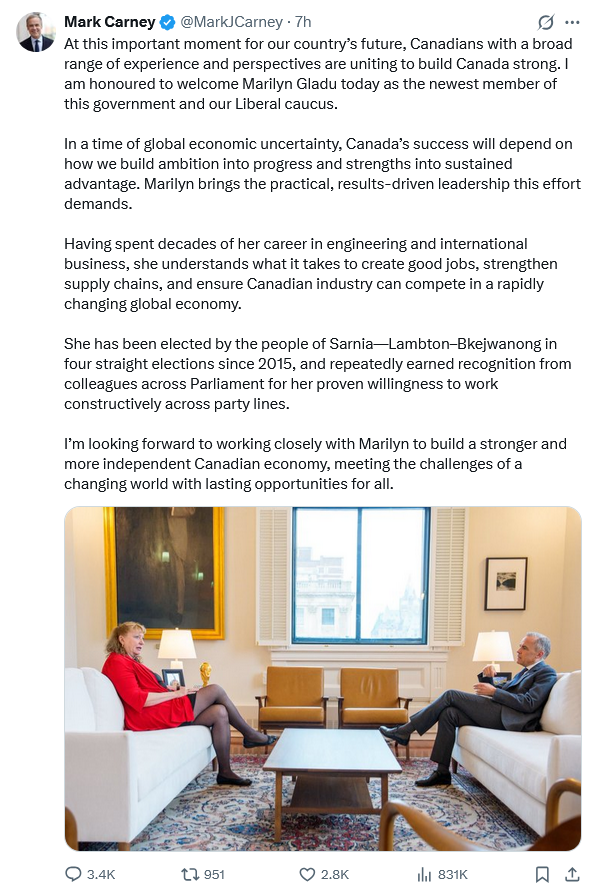
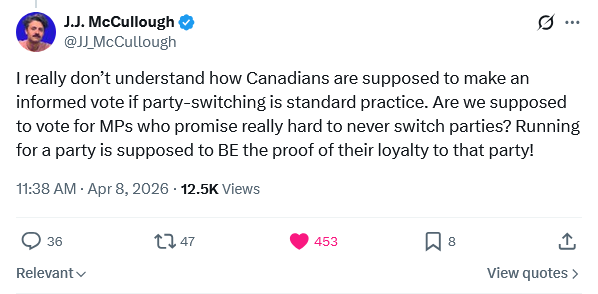
I’m not a Parliamentary history buff, but it strikes me that the number of Canadian Members of Parliament switching parties (always in the direction of the government) over the last year must be close to its historical high-water mark. On Wednesday, Prime Minister Mark Carney welcomed yet another “Conservative” MP to the Liberal caucus in Ottawa:

Call me a cynic if you like, but something is fishy about Carney’s talent for drawing turncoats over to his side. It would not surprise me to find that many more MPs have been offered all sorts of incentives to discover that they were really Liberals all along. Once upon a time I’d have been unbothered by this, but I’m coming to believe that an MP elected under a party banner may choose to leave that party but if they switch to a different party (that also ran a candidate in that MP’s riding), a byelection should be called. If the voters in North Bumbleford-Moosehip-Bongwater are happy with the MP’s decision, they’ll re-elect him/her/them. If not, well, shoulda thought longer before turning traitor.

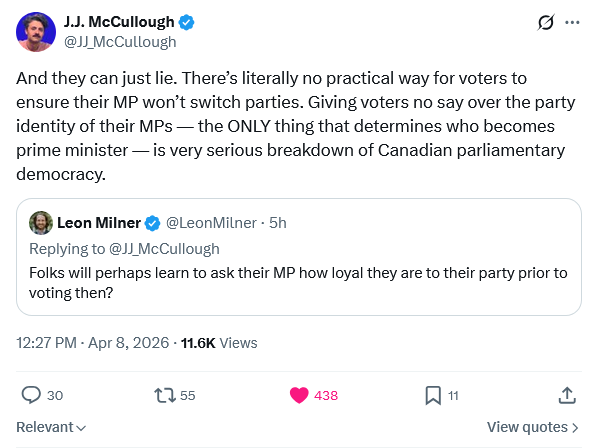
Along with many others on the social media site formerly known as Twitter, J.J. McCullough clearly feels the same way: “This floor crossing BS is out of control. If MPs in this country can just change parties whenever they want, then voters truly have no control over who becomes prime minister and runs our government. The whole Canadian system is based on the premise that parties MATTER.”

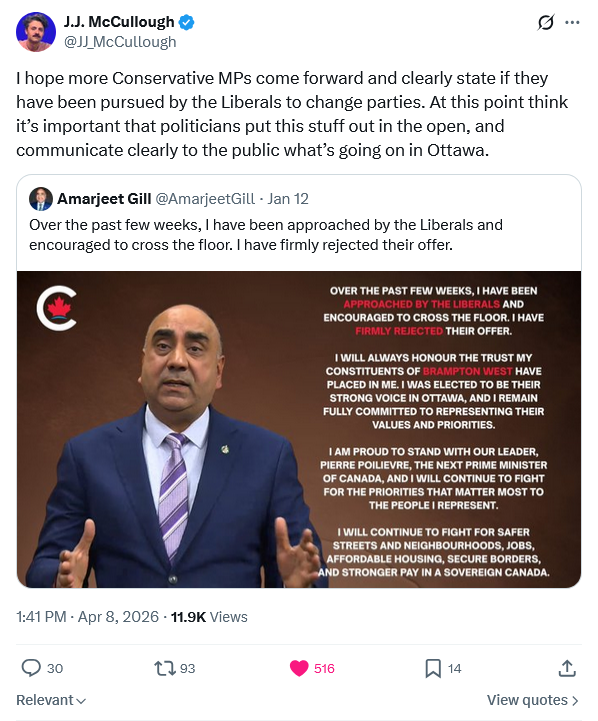
At least one opposition MP did go public about Liberal approaches to switch sides — it’s my belief that he’s one of perhaps dozens:

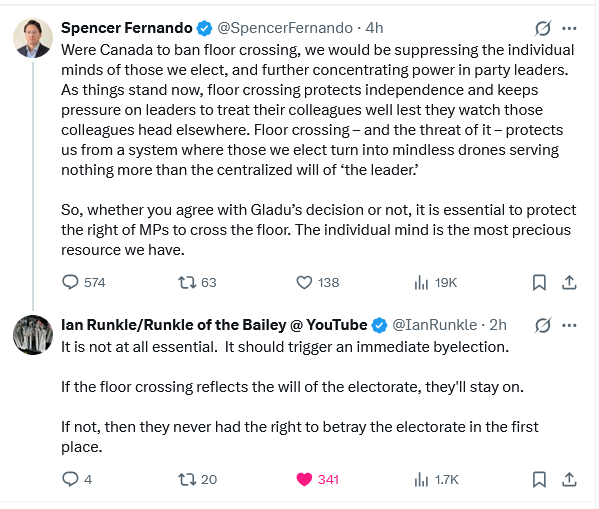
Ian Runkle (“Runkle of the Bailey”) responds to a typical middle-of-the-Canadian-road take by Spencer Fernando:

L. Wayne Mathison is viscerally against such backroom shenanigans when it comes to Parliament:

I am disgusted, and I am not going to dress it up with polite Ottawa language.

Marilyn Gladu crossed from the Conservatives to Mark Carney’s Liberals on April 8, 2026, saying constituents want “serious leadership” and “a real plan to build a stronger and more independent Canadian economy”. Her move gives the Liberals 171 seats, one short of the 172 needed for a majority.

That is exactly why people do not buy the noble script.

This is how Ottawa usually works. The speech is about conscience.

The reality is about power.

Suddenly the language gets soft, patriotic, and lofty right when the political math gets useful. We are asked to believe an MP was hit by a lightning bolt of principle at the exact moment her switch strengthens the governing party and brings it within one seat of majority control. Convenient does not begin to cover it.

Gladu says this is about leadership and collaboration. Fine. Then let voters decide whether they agree. That is the part these people always skip. They act as if a personal change of heart magically rewrites the contract with the public. It does not. People did not vote only for Marilyn Gladu the individual. They voted for a Conservative MP, a Conservative platform, and a Conservative opposition role. Crossing the floor without first seeking a new mandate may be legal, but it feels like a bait-and-switch because that is exactly what it is.

And spare me the line about “doing the best thing” for the riding. Every floor crosser says some version of that. It is the oldest detergent in the political cupboard. It is meant to wash ambition into service. What it really signals is this: I think my judgment now matters more than the basis on which you elected me.

That is where the anger comes from.

Voters are already drowning in managed language, staged sincerity, and plastic promises. Trust in politics is weak because people keep seeing the same pattern. Politicians campaign one way, govern another, then call the switch “leadership”. They wrap self-interest in national purpose and hope the flag covers the fingerprints.

What makes this worse is the timing. Carney publicly welcomed Gladu into Liberal caucus the same day, and the result is not symbolic. It materially strengthens the government’s position in the House. This is not some minor personal journey. It changes parliamentary leverage. It changes committee numbers, confidence calculations, and the balance of power.

So yes, I’m pissed.

I am pissed because voters are treated like props in a story written after the fact. I am pissed because party labels suddenly matter a great deal during elections and apparently not at all when power is on offer. I am pissed because people who were sent to oppose Liberal policy can simply walk across the aisle and help entrench it, then expect applause for being “constructive.”

And there is another detail that makes this smell even worse. Local reporting says that in January, Gladu had advocated for byelections when MPs switch parties. If that report is accurate, then this is not just opportunism. It is opportunism with a side order of hypocrisy.

That is the real issue here. Not whether floor crossing is technically allowed. Not whether Ottawa insiders can invent a respectable sentence for it. The real issue is whether voters still mean anything once the election is over.

My view is simple. If you want to switch parties, resign and run again. Go back to the people. Make your case honestly. Ask for a fresh mandate under the new banner. Anything less might be lawful, but it is not clean. It tells voters their consent is temporary, conditional, and easily bypassed once the machinery of power starts humming.

That is why this disgusts me.

Because democracy is not only about counting seats. It is about keeping faith with the people who gave you one.

“Trump … scared us into doing the right thing”

Filed under: Cancon, Government, Media, Politics, USA — Tags: , , — Nicholas @ 03:00

Canada got into the incredibly bad habit of freeloading on national defence under Pierre Trudeau, and from 1968 onward, we’ve been leaning ever more heavily on US military power to fill in the gaps we’ve chosen not to invest in ourselves. At the same time, we’ve almost dislocated our arm in patting ourselves on the back for our “soft power” on the international diplomatic scene. The Americans, for reasons known only to themselves, rarely pushed back or called us out for our perpetual slacking … until Donald Trump came along. Now, as Matt Gurney regretfully points out, Trump seems to be the only accountability mechanism on the Canadian government:

Coming soon to a Jewish daycare centre near you, sadly.
Image from The Line

Every well-functioning society needs effective accountability mechanisms. It needs something that can reliably deter bad guys from doing bad things, or at least catch them and stop them when they try. Hell, it also needs some sort of immune system that simply prevents the good ones from getting flaky and lazy, and to prune out the soft corruption that can easily settle in in comfortable and generally affluent societies.

“Accountability mechanism” is a broad term, but it has to be. It can be many things. It can be as basic as a strict moral or religious code, enforced by a priestly caste or even simple scolds. Or, ahem, a thriving press, with reporters and columnists poring over all the information they can find for examples of bad things that need fixing and then making a lot of noise about them. In democracies, effective opposition parties are a key part of this; so are government accountability officers, like auditors and ombudsmen. In a pinch, even just a healthy sense of personal honour and shame can work.

In a perfect world, you’ll have many or all of these, and they’ll be mutually reinforcing. Does Canada have any? Or, as I’m increasingly worried, have we basically outsourced this key democratic function entirely to the United States, and specifically, Donald Trump?

This bleak thought occurred to me after I watched, with equal parts horror and relief, a recent video put out by the Toronto Police Service. You can see it for yourself here, but, in short, it’s a promotional video for the new public order mission that is putting heavily armed and armoured officers onto the streets of Toronto to secure sites at risk of attack. The video has an intensely martial vibe; the deployment looks much more like a military operation than a police patrol. Though the video doesn’t say so directly, the intended purpose is clearly stopping the sustained attacks we’ve seen on Jewish religious, commercial and cultural sites in Toronto since Oct. 7, 2023.

[…]

There was also border security and fentanyl. I’m fully aware that the White House exaggerated both issues so they could use them against us. But I’m equally aware that Canada tends to ignore issues even slightly related to national security. A few tweets from Trump changed that. Some of our initial responses, like a czar and a pair of leased Blackhawks, were symbolic, clearly intended for Trump’s consumption. But Mark Carney has continued to ramp up our border security, and make a point of saying so. Again, we did this to avoid Trump’s wrath.

The biggest example, though, is clearly defence spending and rearming the Canadian military. Canada had long pledged to hit the NATO target, but never did; indeed, the former PM reportedly told our allies he had no plans to even try, as it wasn’t a domestic priority. But then Trump comes along and scares the crap out of us and, voilà, we’re hitting the target. Some of that is creative accounting, but not all of it.

Again, Trump did this. He scared us into doing the right thing.

Aly & Kaufman AKB-23: Better Than the SA80 / L85

Filed under: Britain, USA, Weapons — Tags: , , — Nicholas @ 02:00

Forgotten Weapons
Published 19 Nov 2025

The Aly & Kaufman AKB-23 is a set of parts that allows one to use a Brownells BRN-180 upper to create an SA80 / L85 lookalike. It’s a very clever adaptation, based on the fact that the original British L85A1 was essentially copied from the AR-180 design. By creating a new bullpup lower for Brownells’ modernized AR-180 (the BRN-180), the basic mechanics of the SA80 are used, but in a form that is well tested and reliable.

The parts include, of course, the new lower (which is legally a firearm, and requires FFL transfer). The lower is milled aluminum, and uses standard AR fire control parts. It also includes iron sights that mount onto the BRN-180 picatinny rail and a high quality 3D-printed cheek rest and front handguard.

This is a really fun rifle, and a very clever way to create an L85 analog that is affordable and accessible.
(more…)

QotD: Diffuse versus concentrated state power

Filed under: Government, History, Quotations — Tags: — Nicholas @ 01:00

We have seen in the twentieth century the dire consequences when all power is concentrated in the hands of the state. When power is widely diffused, it is difficult and normally impossible for any one man or a few to turn it all at once to evil use. But when all power is concentrated in the hands of the state, it is a simple matter for one man or a few men having control of the state mechanism to turn all that concentrated power in any direction they please; an unhappily their pleasure has usually been in the direction of evil.

Ivor Thomas, The Socialist Tragedy, 1951.

Powered by WordPress